


 |
市場調查報告書
商品編碼
2124634
美國緊急照明:市場佔有率分析、產業趨勢與統計及成長預測(2026-2031 年)United States Emergency Lighting - Market Share Analysis, Industry Trends & Statistics, Growth Forecasts (2026 - 2031) |
||||||

※ 本網頁內容可能與最新版本有所差異。詳細情況請與我們聯繫。
據 Mordor Intelligence 稱,2025 年美國緊急照明市場價值為 23.1 億美元,預計到 2031 年將從 2026 年的 26.1 億美元成長至 47.5 億美元,預測期(2026-2031 年)複合年成長率為 12.74%。
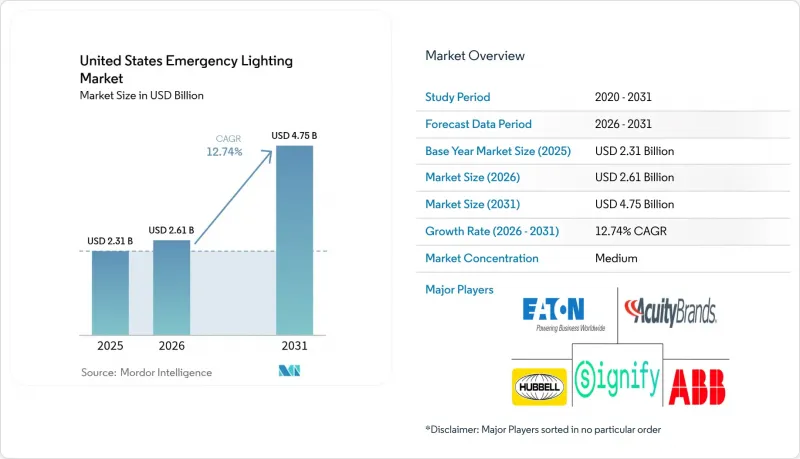
本報告按系統類型(自主型和集中供電式)、光源(LED、螢光及其他)、運作模式(常亮、緊急開啟、可切換/多模式)以及最終用戶(商業設施、工業設施、教育設施、醫療設施、公共基礎設施和交通運輸及其他)進行細分。市場預測以美元計價。
美國緊急照明市場趨勢與洞察
LED效率的提高和價格的降低正在推動市場轉型。
新一代LED緊急照明燈具的光效現已超過180流明/瓦,使設施業主在維修後能夠降低高達82%的能耗。麥克拉倫醫療保健公司在11家醫院更換了25,000套燈具,每年節省了160萬美元的公用事業費用。這表明,儘管需要根據監管要求升級電池,但投資回收期仍然很短。二極體成本的降低正在壓縮燈具價格,進一步加劇了美國緊急照明市場中與傳統螢光產品的價格競爭。更高的效率降低了所需的電池容量,從而進一步降低了初始投資。因此,預計到2027年,超過90%的新安裝項目將採用LED燈具。這項技術優勢增強了供應商的議價能力,同時也促進了對預算敏感的教育機構和市政計畫採用LED燈具。
嚴格的 NFPA 70/101 和 OSHA 合規要求正在促使安裝標準進行重組。
最新的NFPA 101標準規定,疏散路線的最低照明強度為1英尺燭光(fc),備用照明時間至少為90分鐘,這迫使設施管理人員在維修更換不符合標準的照明設備。 UL 924標準(2022年5月)要求照明設備能夠偵測正常電源,而像nLight AIR這樣的無線網狀產品無需額外的控制線路即可滿足此要求。像西米夫林學區這樣的學區,由於採用了績效合約模式,預計在15年內可透過超越監管標準節省990萬美元。智慧型驅動器產生的每月定期自診斷和年度放電報告,無需人工記錄,並簡化了OSHA審核流程。監管力度的加強正在縮短更換週期,而合規功能正成為美國緊急照明市場競標規範中的強制性要求。
符合標準的系統初始成本高昂,阻礙了它們的普及。
與傳統螢光相比,先進的自我診斷功能、磷酸鐵鋰電池組和無線通訊功能使LED組件成本增加了高達40%,導致融資有限的業主需要更長的投資回收期。小規模零售商和社區學院儘管有能源補貼,但往往推遲升級,從而減緩了這些佔建築存量三分之一以上的細分市場的潛在市場規模成長。然而,隨著LED組件成本的下降和公用事業公司擴大監管獎勵,成本障礙預計將會降低,這將推動潛在需求轉向蓬勃發展的美國緊急照明市場。
細分市場分析
預計到2025年,自主型照明單元將主導美國緊急照明市場,佔64.38%的市場佔有率,並將以13.92%的複合年成長率持續成長至2031年。這主要歸功於其易於安裝和對單點故障的容錯能力。每個燈具整合式分散式電池,簡化了辦公室、醫院和火車站等場所的分散式維修,無需專門的電池室。同時,集中式電源系統在大型醫療設施專案中仍佔有一席之地,統一的監控系統便於進行季度檢查,但高昂的佈線成本限制了其在新專案中的應用。
這種分散式智慧的發展趨勢與商業房地產的廣泛數位化相契合,自主型的照明設備正逐漸成為建築級感測器網路的核心。每個燈具內部的邊緣分析功能可實現局部診斷,從而縮短平均維修時間 (MTTR) 並加強合規性報告,這對於在美國緊急照明市場維持 NFPA 和 OSHA 認證至關重要。
預計到2025年,LED燈具的出貨量將佔總出貨量的78.02%,並以14.06%的複合年成長率繼續保持成長最快的照明光源地位。這主要得益於LED燈具卓越的發光效率、即時啟動能力以及長達5萬小時的使用壽命。隨著採購負責人尋求實現兩位數的節能效果並降低維護預算,預計在預測期內,美國LED緊急照明燈具市場規模將是螢光替代市場的四倍。工業客戶報告稱,從T8燈管電池組轉向客製化設計的LED緊急出口照明後,維修電話減少了60%。
組件價格的下降縮小了LED燈的價格差距,即使在對價格敏感的市政項目中,也能實現快速的投資回報。雖然螢光和鹵素燈目前仍主要用於特定應用,但預計到2028年,它們的市場佔有率總合將降至5%以下,這證實了LED燈將成為美國緊急照明市場的實際標準。
其他好處:
- Excel格式的市場預測(ME)表
- 3個月的分析師支持
目錄
第1章:引言
- 研究假設和市場定義
- 調查範圍
第2章:調查方法
第3章執行摘要
第4章 市場狀況
- 市場概覽
- 市場促進因素
- LED效率更高,價格更低
- 鼓勵嚴格遵守 NFPA 70/101 和 OSHA 標準。
- 智慧建築維修(物聯網整合)增加
- 聯邦政府基礎設施發展資金(IIJA)
- 確保應對氣候變遷和極端天氣事件的強制性措施。
- 企業基於ESG的脫碳目標
- 市場限制因素
- 符合標準的系統的初始成本很高。
- 分散式微型UPS和PoE照明帶來的競爭
- 鋰電池供應波動
- 低壓設備安裝技能缺口
- 宏觀經濟因素的影響
- 產業供應鏈分析
- 技術概述
- 監理情勢
- 波特五力模型
第5章 市場規模與成長預測
- 依系統類型
- 自主型
- 集中供應類型
- 透過光源
- LED
- 螢光
- 其他(鹵素燈、白熾燈等)
- 透過操作模式
- 維持
- 非維護型
- 開關/多模
- 最終用戶
- 商業
- 產業
- 教育設施
- 醫療機構
- 公共基礎設施和公共交通
- 其他(住宅、飯店等)
第6章 競爭情勢
- 市場集中度
- 策略趨勢
- 市佔率分析
- 公司簡介
- Acuity Brands Inc.
- Eaton Corporation plc
- ABB Ltd
- Hubbell Incorporated
- Signify NV
- Legrand SA
- Emerson Electric Co.
- Myers Emergency Power Systems LLC
- Cree LED Lighting Solutions Inc.
- Digital Lumens Inc.
- Encore Wire Corporation
- Larson Electronics LLC
- Beghelli SpA
- Cooper Lighting Solutions LLC
- Stanley Electric Co., Ltd.
- Lite-On Technology Corporation
- Schneider Electric SE
- Zumtobel Group AG
- Fagerhult AB
- Philips Emergency Lighting
第7章 市場機會與未來展望
According to Mordor Intelligence, the United States emergency lighting market size was valued at USD 2.31 billion in 2025 and estimated to grow from USD 2.61 billion in 2026 to reach USD 4.75 billion by 2031, at a CAGR of 12.74% during the forecast period (2026-2031).
This report is Segmented by System Type (Self-Sustained and Centrally Supplied), Light Source (LED, Fluorescent, and Others), Operating Mode (Maintained, Non-Maintained, and Switched/Multi-mode), and End User (Commercial, Industrial, Educational Facilities, Healthcare Facilities, Public Infrastructure and Transit, and Others). The Market Forecasts are Provided in Terms of Value (USD).
United States Emergency Lighting Market Trends and Insights
Growing LED Efficacy and Price Declines Drive Market Transformation
New-generation LED emergency luminaires now surpass 180 lm/W, allowing facility owners to cut energy use by up to 82% after retrofits. McLaren Health Care replaced 25,000 units across 11 hospitals and lowered annual utility costs by USD 1.6 million, confirming favorable payback periods despite code-driven battery upgrades. Falling diode costs compress fixture pricing, pushing the United States emergency lighting market deeper into price-parity territory with fluorescent incumbents. High efficacy shortens battery sizing requirements, further trimming upfront spend. As a result, LED penetration is expected to exceed 90% of new installations before 2027. The technology leadership strengthens supplier bargaining power while widening adoption in budget-sensitive education and municipal projects.
Stringent NFPA 70/101 and OSHA Compliance Push Reshapes Installation Standards
The latest NFPA 101 edition mandates 1 fc minimum egress illuminance and 90-minute backup duration, driving facility managers to replace non-conforming fixtures during remodels. UL 924 (May 2022) now requires luminaires to sense normal power presence; wireless mesh offerings like nLight AIR satisfy this rule without extra control wiring. School districts leveraging performance-contract models, such as West Mifflin, anticipate USD 9.9 million in savings across 15 years by exceeding code baselines. Consistent monthly self-tests and annual discharge reports generated by smart drivers remove manual log-keeping, easing OSHA audits. Enhanced enforcement boosts replacement cycles and cements compliance features as table-stakes in bid specifications throughout the United States emergency lighting market.
High Upfront Cost of Code-Compliant Systems Constrains Adoption
Advanced self-test drivers, LiFePO4 packs, and wireless radios elevate the bill-of-materials up to 40% versus legacy fluorescent units, stretching payback horizons for cash-constrained owners. Smaller retailers and community colleges often postpone upgrades despite energy rebates, slowing total addressable volume in segments that collectively account for more than one-third of building stock. Nonetheless, as LED component costs retreat and utilities expand prescriptive incentives, cost barriers are forecast to soften, permitting latent demand to migrate into the active United States emergency lighting market.
Other drivers and restraints analyzed in the detailed report include:
- Rise in Smart-Building Retrofits Accelerates IoT Integration
- Federal Infrastructure-Upgrade Funding Creates Unprecedented Market Opportunities
- Lithium-Battery Supply Volatility Threatens Cost Predictability
For complete list of drivers and restraints, kindly check the Table Of Contents.
Segment Analysis
Self-sustained units dominated with a 64.38% United States emergency lighting market share in 2025 and are projected to expand at a 13.92% CAGR to 2031, underscoring their ease of installation and resilience against single-point failures. Dispersed batteries embedded inside every luminaire simplify decentralized retrofits in offices, hospitals, and rail stations, eliminating the need for dedicated battery rooms. Centrally supplied systems retain a foothold in mega-campus healthcare projects where unified monitoring eases quarterly testing, but their cost-intensive wiring constrains new adoption.
The distributed-intelligence trend aligns with the broader digitization of commercial real estate, positioning self-contained fixtures as a backbone for building-wide sensor networks. Edge analytics within each light enable localized diagnostics, compressing mean-time-to-repair and enhancing compliance reporting that is critical for maintaining NFPA and OSHA certifications across the United States emergency lighting market.
LEDs accounted for 78.02% of 2025 shipments and will remain the fastest-growing light source at 14.06% CAGR, reflecting superior efficacy, instant-on capability, and 50,000-hour lifetimes. The United States emergency lighting market size associated with LED luminaires is set to outpace fluorescent replacements by a factor of four during the forecast horizon as procurement managers chase double-digit energy savings and lower maintenance budgets. Industrial clients cite maintenance callouts falling by 60% after switching from T8-based battery packs to purpose-built LED exits.
Declines in component pricing are shrinking the LED premium, enabling quick paybacks even in price-sensitive municipal projects. Fluorescent and halogen options persist mainly in niche applications, but their combined unit share will likely dip below 5% before 2028, confirming LEDs as the de-facto standard throughout the United States emergency lighting market.
Complete Report Scope:
- By System Type
- Self-sustained
- Centrally Supplied
- By Light Source
- LED
- Fluorescent
- Others (Halogen, Incandescent, etc.)
- By Operating Mode
- Maintained
- Non-maintained
- Switched/Multi-mode
- By End User
- Commercial
- Industrial
- Educational Facilities
- Healthcare Facilities
- Public Infrastructure and Transit
- Others (Residential, Hospitality, etc.)
List of Companies Covered in this Report:
- Acuity Brands Inc.
- Eaton Corporation plc
- ABB Ltd
- Hubbell Incorporated
- Signify N.V.
- Legrand S.A.
- Emerson Electric Co.
- Myers Emergency Power Systems LLC
- Cree LED Lighting Solutions Inc.
- Digital Lumens Inc.
- Encore Wire Corporation
- Larson Electronics LLC
- Beghelli S.p.A.
- Cooper Lighting Solutions LLC
- Stanley Electric Co., Ltd.
- Lite-On Technology Corporation
- Schneider Electric SE
- Zumtobel Group AG
- Fagerhult AB
- Philips Emergency Lighting
Additional Benefits:
- The market estimate (ME) sheet in Excel format
- 3 months of analyst support
TABLE OF CONTENTS
1 INTRODUCTION
- 1.1 Study Assumptions and Market Definition
- 1.2 Scope of the Study
2 RESEARCH METHODOLOGY
3 EXECUTIVE SUMMARY
4 MARKET LANDSCAPE
- 4.1 Market Overview
- 4.2 Market Drivers
- 4.2.1 Growing LED efficacy and price declines
- 4.2.2 Stringent NFPA 70/101 and OSHA compliance push
- 4.2.3 Rise in smart-building retrofits (IoT integration)
- 4.2.4 Federal infrastructure-upgrade funding (IIJA)
- 4.2.5 Climate-resilience mandates for severe-weather events
- 4.2.6 Corporate ESG-lighting decarbonisation targets
- 4.3 Market Restraints
- 4.3.1 High upfront cost of code-compliant systems
- 4.3.2 Competition from distributed micro-UPS and PoE lighting
- 4.3.3 Lithium-battery supply volatility
- 4.3.4 Skills gap in low-voltage ?installation
- 4.4 Impact of Macroeconomic Factors
- 4.5 Industry Supply-Chain Analysis
- 4.6 Technology Snapshot
- 4.7 Regulatory Landscape
- 4.8 Porter's Five Forces
- 4.8.1 Threat of New Entrants
- 4.8.2 Bargaining Power of Buyers
- 4.8.3 Bargaining Power of Suppliers
- 4.8.4 Threat of Substitutes
- 4.8.5 Intensity of Competitive Rivalry
5 MARKET SIZE AND GROWTH FORECASTS (VALUE)
- 5.1 By System Type
- 5.1.1 Self-sustained
- 5.1.2 Centrally Supplied
- 5.2 By Light Source
- 5.2.1 LED
- 5.2.2 Fluorescent
- 5.2.3 Others (Halogen, Incandescent, etc.)
- 5.3 By Operating Mode
- 5.3.1 Maintained
- 5.3.2 Non-maintained
- 5.3.3 Switched/Multi-mode
- 5.4 By End User
- 5.4.1 Commercial
- 5.4.2 Industrial
- 5.4.3 Educational Facilities
- 5.4.4 Healthcare Facilities
- 5.4.5 Public Infrastructure and Transit
- 5.4.6 Others (Residential, Hospitality, etc.)
6 COMPETITIVE LANDSCAPE
- 6.1 Market Concentration
- 6.2 Strategic Moves
- 6.3 Market Share Analysis
- 6.4 Company Profiles (includes Global-level Overview, Market-level Overview, Core Segments, Financials as available, Strategic Information, Market Rank/Share, Products and Services, Recent Developments)
- 6.4.1 Acuity Brands Inc.
- 6.4.2 Eaton Corporation plc
- 6.4.3 ABB Ltd
- 6.4.4 Hubbell Incorporated
- 6.4.5 Signify N.V.
- 6.4.6 Legrand S.A.
- 6.4.7 Emerson Electric Co.
- 6.4.8 Myers Emergency Power Systems LLC
- 6.4.9 Cree LED Lighting Solutions Inc.
- 6.4.10 Digital Lumens Inc.
- 6.4.11 Encore Wire Corporation
- 6.4.12 Larson Electronics LLC
- 6.4.13 Beghelli S.p.A.
- 6.4.14 Cooper Lighting Solutions LLC
- 6.4.15 Stanley Electric Co., Ltd.
- 6.4.16 Lite-On Technology Corporation
- 6.4.17 Schneider Electric SE
- 6.4.18 Zumtobel Group AG
- 6.4.19 Fagerhult AB
- 6.4.20 Philips Emergency Lighting
7 MARKET OPPORTUNITIES AND FUTURE OUTLOOK
- 7.1 White-space and Unmet-need Assessment

 緊急照明市場:按產品類型、電源系統、光源、應用、安裝類型和地區分類。
 緊急照明:市場佔有率分析、產業趨勢與統計、成長預測(2026-2031)
 緊急照明市場-2026-2032年全球市場預測
 緊急照明市場規模、佔有率和趨勢分析報告:按組件、照明類型、電源系統、最終用途、地區和細分市場預測(2026-2033 年)
 緊急螢光棒市場:按產品、應用和地區分類(2026-2034 年)緊急照明電池市場:按最終用途、電池化學成分、應用和分銷管道分類-2026-2032年全球市場預測
 全球國防緊急電池市場(2026-2036)緊急警告燈市場:按產品類型、技術和地區分類商用出口照明燈具市場:依光源、安裝類型、電源類型、終端用戶和通路分類-全球預測,2026-2032年
 緊急照明市場分析及預測(至2035年):按類型、產品、服務、技術、組件、應用、形狀、材料類型和最終用戶分類