


 |
市場調查報告書
商品編碼
2122819
緊急照明:市場佔有率分析、產業趨勢與統計、成長預測(2026-2031)Emergency Lighting - Market Share Analysis, Industry Trends & Statistics, Growth Forecasts (2026 - 2031) |
||||||

※ 本網頁內容可能與最新版本有所差異。詳細情況請與我們聯繫。
據 Mordor Intelligence 稱,2025 年緊急照明市場價值為 73.1 億美元,預計到 2031 年將達到 129.8 億美元,而 2026 年為 80.5 億美元,預測期(2026-2031 年)的複合年成長率為 10.05%。
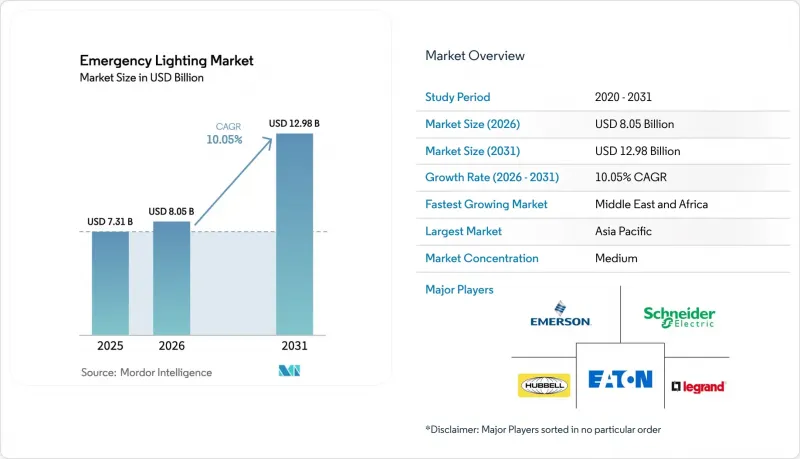
本報告按光源(LED、螢光等)、電源系統(自主型/電池備用、中央電池(UPS)等)、安裝類型(表面安裝、嵌入式等)、產品(緊急出口標誌等)、通訊方式(有線等)、最終用戶(住宅、工業等)和地區進行細分。市場預測以美元計價。
全球緊急照明市場趨勢及洞察
歐洲公共基礎設施升級改造為智慧LED照明
歐洲各市政當局正以連網LED照明燈具取代螢光具,這些燈具不僅能降低高達50%的能耗,還能簡化合規報告流程。歐盟綠色交易要求公共建築在2030年前實現碳中和,而連網照明燈具能夠自動將測試日誌發送到設施的控制面板,從而減少維護工作量。 Acuity Brands公司的「STAR Gateway」展示了自動化審核如何滿足EN 50172標準的要求,使智慧LED成為火車站、學校和政府辦公大樓的標準選擇。
美國IBC/NFPA 101對高層建築提出了更嚴格的要求
2024 年建築規範修訂版將疏散通道的最低照度提高至 1.07 勒克斯,持續 90 分鐘,並將開啟時間縮短至 10 秒。許多老式鎳鎘燈具現在無法通過更新的 UL 924 測試,該測試要求「正常供電」訊號,迫使業主在重新認證截止日期前更換設備。聯邦政府機構面臨更大的壓力,因為它們被要求採用具有整合控制功能的 LED 系統,以滿足美國總務署 (GSA) 的能源目標。
醫療機構中鋰離子電池的消防安全隱患
由於發生熱失控事故導致病房疏散,醫院推遲了鋰離子電池的引入。美國消防協會(NFPA)正在起草NFPA 800標準,該標準將規範現場存儲,但在最終決定訂定之前,許多醫療機構仍在繼續使用壽命較短的密閉式鉛酸電池和鎳氫電池組。一項旨在製定全國電池安全標準的美國法案也加劇了這種不確定性。
細分市場分析
至2025年,LED燈具將佔據緊急照明市場57.25%的佔有率,預計到2031年,該細分市場將以9.54%的複合年成長率成長。螢光管仍在一些舊建築中使用,但不斷上漲的能源成本和對螢光燈管使用的禁令正在加速其更換。高強度氣體放電燈(HID)照明仍應用於石化工廠和其他一些對10 kV突波耐受性要求高於發光效率的場合。
智慧型二極體如今整合了感測器、記憶體和色溫選擇功能,例如「Green Creative Universal CCT Select」燈管。這使得設計人員無需更換硬體即可調節眩光水平。這種照明與智慧的整合確保了LED系統在緊急照明市場中仍佔據基石地位,即便無線協定正在重塑產品線路藍圖。
至2025年,由於安裝簡單且可逐一單元進行維護,自主型電池組將佔據緊急照明市場65.05%的佔有率。然而,大規模設施更傾向於使用集中式電池,以減少逐個房間檢查電池的需要。資料中心便是這種轉變的典型例證,集中管理的機架可確保所有照明設備都能從單一中心獲得穩定的電源和韌體更新。
伊頓的逆變器平台即將整合Exertherm的熱分析技術,凸顯預測性維護在減少意外停機時間的潛力。儘管鋰離子電池組具有較長的循環壽命,但在監管政策進一步明確之前,閥控式鉛酸蓄電池(VRLA)仍主要用於醫院和機場等關鍵區域。自主管理和集中管理之間的兩極化可能會在預測期內影響採購政策。
區域分析
亞太地區佔緊急照明市場33.85%的佔有率,並受惠於孟買地鐵3號線和北京次級中心隧道等大型企劃。該地區各國政府正利用亞洲開發銀行(亞銀)等機構提供的優惠貸款,為周邊地區供電,並確保所有新建變電站和鐵路支線都配備標準化的照明設備。儘管半導體短缺給進度管理帶來困難,但深圳和檳城的本地印刷電路基板(PCB)製造商正在縮短國內供應商的前置作業時間。
預計到2031年,中東和非洲地區的複合年成長率將達到10.74%,這主要得益於卡達液化天然氣出口樞紐的擴張以及沙烏地阿拉伯「2030願景」下旅遊走廊建設的加速推進。波斯灣的海上鑽油平臺需要採用無銅鋁機殼,以承受鹽霧和高達攝氏60度的高溫。 「Chalmit」品牌的「Protecta X」照明燈具在北海油田的應用,其使用壽命長達12萬小時,促使各國國家石油公司(NOC)積極將高品質的照明解決方案累計。
在北美和歐洲,預計將出現穩定的更新周期。美國建築規範的修訂強制要求高層建築業主在重新認證期間內升級設備,導致維修工程量增加。在歐洲的「翻新浪潮」中,政府為公共部門轉向LED照明提供津貼;在德國,為了實現2030年的目標,政府正在支持引入智慧控制系統以減少碳排放。經驗豐富的買家往往更傾向於選擇將分析儀錶板與硬體捆綁銷售的供應商,因此軟體維護合約在緊急照明市場中至關重要。
其他好處:
- Excel格式的市場預測(ME)表
- 3個月的分析師支持
目錄
第1章:引言
- 研究假設和市場定義
- 調查範圍
第2章:調查方法
第3章執行摘要
第4章 市場狀況
- 市場概覽
- 市場促進因素
- 歐洲公共基礎設施對智慧互聯LED緊急照明維修的需求日益成長。
- 美國高層建築標準(IBC/NFPA 101)對居住者安全提出了更嚴格的要求
- 中國和印度的城市鐵路隧道建設迅速擴張
- 在北美,資料中心的快速成長正在推動集中式電池供電照明的普及。
- ESG(環境、社會和治理)主導的綠建築認證正在推動LED出口指示牌的升級。
- 對中東海上平台的投資正在激增。
- 市場限制因素
- 鋰離子電池的消防安全隱患限制了其在醫療機構中的使用。
- 從 2023 年開始,積體電路驅動器和光元件的供應鏈預計將變得緊張。
- 東協地區不同區域間標準的差異,使得產品在地化變得複雜。
- 實施和測試可尋址無線系統的成本相對較高。
- 產業生態系分析
- 監理展望
- 技術展望
- 波特五力分析
第5章 市場規模與成長預測
- 透過光源
- LED
- 螢光
- 高強度放電燈(HID)
- 歸納法和其他
- 電源系統
- 自主型/電池供電式
- 集中式電池(UPS)
- 混合/去中心化
- 按安裝類型
- 表面黏著技術型
- 嵌入式
- 吊掛式
- 可攜式的
- 依產品
- 緊急出口標誌
- 獨立緊急照明設備
- 組合單元
- 緊急安定器和驅動裝置
- 透過溝通方式
- 有線
- 相容無線/物聯網
- 最終用戶
- 商業設施 - 辦公大樓
- 商業領域-飯店和零售
- 工業——製造和倉儲
- 石油天然氣/採礦
- 住宅
- 公共基礎設施(機場、隧道、鐵路)
- 醫療機構
- 按地區
- 北美洲
- 美國
- 加拿大
- 墨西哥
- 歐洲
- 德國
- 英國
- 法國
- 北歐的
- 其他歐洲國家
- 南美洲
- 巴西
- 其他南美國家
- 亞太地區
- 中國
- 日本
- 印度
- 東南亞
- 其他亞太國家
- 中東和非洲
- 中東
- 波灣合作理事會(GCC)成員國
- 土耳其
- 其他中東國家
- 非洲
- 南非
- 其他非洲國家
- 中東
- 北美洲
第6章 競爭情勢
- 市場集中度
- 策略趨勢
- 市佔率分析
- 公司簡介
- Acuity Brands Inc.
- Arrow Emergency Lighting Ltd.
- Beghelli SpA
- Cooper Lighting Solutions(Signify)
- Daisalux SAU
- Digital Lumens
- Diehl Stiftung and Co. KG
- Eaton Corp. plc
- Emerson Electric Co.
- Fulham Co. Inc.
- Hubbell Lighting Inc.
- Legrand SA
- Lutron Electronics Co.
- Myers Emergency Power Systems
- OSRAM GmbH
- Schneider Electric SE
- Signify NV(Philips Lighting)
- Taurac BV
- Thorlux Lighting
- Toshiba Corporation
- Tridonic GmbH
- Zumtobel Group AG
第7章 市場機會與未來展望
According to Mordor Intelligence, the emergency lighting market size was valued at USD 7.31 billion in 2025 and estimated to grow from USD 8.05 billion in 2026 to reach USD 12.98 billion by 2031, at a CAGR of 10.05% during the forecast period (2026-2031).
This report is Segmented by Light Source (LED, Fluorescent, and More), Power System (Self-Contained/Battery-Backup, Central Battery (UPS), and More), Installation Type (Surface-Mounted, Recessed, and More), Product (Emergency Exit Signs, and More), Communication (Wired, and More), End-User (Residential, Industrial, and More), and Geography. The Market Forecasts are Provided in Terms of Value (USD).
Global Emergency Lighting Market Trends and Insights
Smart LED retrofits across European public infrastructure
European municipalities are replacing fluorescent fixtures with networked LED luminaires that cut energy consumption by up to 50% while simplifying compliance reporting. The EU Green Deal pushes public buildings to reach carbon neutrality by 2030, and connected fixtures automatically send test logs to facility dashboards, trimming maintenance labor. Acuity Brands' STAR Gateway illustrates how automated audits meet EN 50172 requirements, making smart LEDs the default choice for rail stations, schools, and government offices.
Stricter U.S. IBC/NFPA 101 mandates for high-rises
The 2024 code cycle raises minimum egress illuminance to 1.07 lux for 90 minutes and cuts activation time to 10 seconds. Many legacy nickel-cadmium units cannot pass updated UL 924 tests that now require a "normal-power present" signal, compelling owners to replace equipment ahead of recertification deadlines. Federal facilities add another layer of pressure by specifying LED systems with integrated controls to meet GSA energy targets.
Lithium-ion fire-safety concerns in healthcare facilities
Hospitals are delaying lithium-ion rollouts after thermal-runaway incidents that led to ward evacuations. NFPA is drafting NFPA 800 to govern on-site storage, but until finalized, many health networks stay with sealed lead-acid or nickel-metal hydride packs despite shorter life. Proposed U.S. legislation to codify national battery safety standards adds further uncertainty.
Other drivers and restraints analyzed in the detailed report include:
- Urban rail-tunnel build-outs in China and India
- Data-center boom adopting centralized battery systems
- Supply-chain crunch for IC drivers and optics
For complete list of drivers and restraints, kindly check the Table Of Contents.
Segment Analysis
LED devices controlled 57.25% of emergency lighting market share in 2025, and the segment is set to advance at a 9.54% CAGR through 2031. Fluorescent tubes linger in older buildings, yet rising energy tariffs and lamp bans speed replacement schedules. Niche high-intensity discharge units remain in petrochemical zones where 10 kV surge immunity takes precedence over efficacy.
Smart diodes now embed sensors, memory, and selectable color temperatures, exemplified by the Green Creative Universal CCT Select tube, which helps specifiers tailor glare levels without swapping hardware. This convergence of intelligence with illumination keeps LED systems as the anchor of the emergency lighting market, even as wireless protocols reshape product line roadmaps.
Self-contained packs represented 65.05% of emergency lighting market size in 2025, thanks to straightforward installation and unitized maintenance. Large venues, however, prefer central banks to cut room-by-room battery checks. Data centers exemplify the shift, with centralized racks ensuring all fixtures receive conditioned power and firmware updates from a single hub.
Eaton's inverter platforms, soon incorporating Exertherm thermal analytics, highlight how predictive monitoring reduces unscheduled downtime. Lithium-ion strings deliver long cycle life, yet hospitals and airports still specify VRLA in critical zones until regulatory clarity improves. The split between autonomy and central command will define procurement choices over the forecast horizon.
Complete Report Scope:
- By Light Source
- LED
- Fluorescent Lamps
- High-Intensity Discharge (HID)
- Induction and Others
- By Power System
- Self-Contained/Battery-Backup
- Central Battery (UPS)
- Hybrid/Distributed
- By Installation Type
- Surface-Mounted
- Recessed
- Suspended
- Portable
- By Product
- Emergency Exit Signs
- Stand-alone Emergency Luminaires
- Combo Units
- Emergency Ballasts and Drivers
- By Communication
- Wired
- Wireless/IoT-Enabled
- By End-user
- Commercial - Offices
- Commercial - Hospitality and Retail
- Industrial -Manufacturing and Warehouses
- Oil and Gas/Mining
- Residential
- Public Infrastructure (Airports, Tunnels, Rail)
- Healthcare Facilities
- By Geography
- North America
- United States
- Canada
- Mexico
- Europe
- Germany
- United Kingdom
- France
- Nordics
- Rest of Europe
- South America
- Brazil
- Rest of South America
- Asia-Pacific
- China
- Japan
- India
- South-East Asia
- Rest of Asia-Pacific
- Middle East and Africa
- Middle East
- Gulf Cooperation Council Countries
- Turkey
- Rest of Middle East
- Africa
- South Africa
- Rest of Africa
- Middle East
- North America
Geography Analysis
Asia-Pacific, with a 33.85% stake in the emergency lighting market, benefits from megaprojects such as Mumbai Metro Line 3 and Beijing Sub-Center Tunnel. Regional governments use concessional loans from institutions like ADB to electrify outlying provinces, ensuring every new substation or rail spur specifies compliant luminaires. Semiconductor shortages make scheduling tricky, but local PCB houses in Shenzhen and Penang shorten lead times for domestic vendors.
The Middle East and Africa will register a 10.74% CAGR through 2031 as Qatar extends LNG export hubs and Saudi Vision 2030 accelerates tourism corridors. Offshore rigs in the Gulf demand copper-free aluminum bodies that survive salt-spray and 60 °C highs. Chalmit-branded Protecta X fixtures in North Sea fields validate 120,000-hour lifespans, encouraging NOCs to budget for premium solutions.
North America and Europe offer steady replacement cycles. U.S. code revisions now force high-rise landlords to upgrade within recertification windows, bolstering retrofit volumes. Europe's Renovation Wave funnels grants toward public-sector LED swaps, with Germany underwriting smart controls that shave carbon footprints ahead of 2030 targets. Mature buyers favor vendors that bundle analytics dashboards with hardware, elevating software maintenance contracts as a vital slice of the emergency lighting market.
- Acuity Brands Inc.
- Arrow Emergency Lighting Ltd.
- Beghelli SpA
- Cooper Lighting Solutions (Signify)
- Daisalux SAU
- Digital Lumens
- Diehl Stiftung and Co. KG
- Eaton Corp. plc
- Emerson Electric Co.
- Fulham Co. Inc.
- Hubbell Lighting Inc.
- Legrand SA
- Lutron Electronics Co.
- Myers Emergency Power Systems
- OSRAM GmbH
- Schneider Electric SE
- Signify NV (Philips Lighting)
- Taurac BV
- Thorlux Lighting
- Toshiba Corporation
- Tridonic GmbH
- Zumtobel Group AG
Additional Benefits:
- The market estimate (ME) sheet in Excel format
- 3 months of analyst support
TABLE OF CONTENTS
1 INTRODUCTION
- 1.1 Study Assumptions and Market Definition
- 1.2 Scope of the Study
2 RESEARCH METHODOLOGY
3 EXECUTIVE SUMMARY
4 MARKET LANDSCAPE
- 4.1 Market Overview
- 4.2 Market Drivers
- 4.2.1 Increasing retrofit demand for smart-connected LED emergency luminaires across Europe-s public infrastructure
- 4.2.2 Stricter occupant-safety mandates in United States high-rise codes (IBC/NFPA 101)
- 4.2.3 Rapid urban rail-tunnel build-outs in China and India
- 4.2.4 Data-center boom driving centralized battery-backup lighting in North America
- 4.2.5 ESG-led green-building certifications fueling LED exit-sign upgrades
- 4.2.6 Surge in offshore platform investments in Middle East
- 4.3 Market Restraints
- 4.3.1 Lithium-ion battery fire-safety concerns limiting adoption in healthcare facilities
- 4.3.2 Supply-chain crunch for IC drivers and optics since 2023
- 4.3.3 Fragmented local standards complicating product localization in ASEAN
- 4.3.4 High installation and testing cost for addressable wireless systems
- 4.4 Industry Ecosystem Analysis
- 4.5 Regulatory Outlook
- 4.6 Technological Outlook
- 4.7 Porter's Five Forces Analysis
- 4.7.1 Threat of New Entrants
- 4.7.2 Bargaining Power of Buyers
- 4.7.3 Bargaining Power of Suppliers
- 4.7.4 Threat of Substitutes
- 4.7.5 Competitive Rivalry
5 MARKET SIZE AND GROWTH FORECASTS (VALUES)
- 5.1 By Light Source
- 5.1.1 LED
- 5.1.2 Fluorescent Lamps
- 5.1.3 High-Intensity Discharge (HID)
- 5.1.4 Induction and Others
- 5.2 By Power System
- 5.2.1 Self-Contained/Battery-Backup
- 5.2.2 Central Battery (UPS)
- 5.2.3 Hybrid/Distributed
- 5.3 By Installation Type
- 5.3.1 Surface-Mounted
- 5.3.2 Recessed
- 5.3.3 Suspended
- 5.3.4 Portable
- 5.4 By Product
- 5.4.1 Emergency Exit Signs
- 5.4.2 Stand-alone Emergency Luminaires
- 5.4.3 Combo Units
- 5.4.4 Emergency Ballasts and Drivers
- 5.5 By Communication
- 5.5.1 Wired
- 5.5.2 Wireless/IoT-Enabled
- 5.6 By End-user
- 5.6.1 Commercial - Offices
- 5.6.2 Commercial - Hospitality and Retail
- 5.6.3 Industrial -Manufacturing and Warehouses
- 5.6.4 Oil and Gas/Mining
- 5.6.5 Residential
- 5.6.6 Public Infrastructure (Airports, Tunnels, Rail)
- 5.6.7 Healthcare Facilities
- 5.7 By Geography
- 5.7.1 North America
- 5.7.1.1 United States
- 5.7.1.2 Canada
- 5.7.1.3 Mexico
- 5.7.2 Europe
- 5.7.2.1 Germany
- 5.7.2.2 United Kingdom
- 5.7.2.3 France
- 5.7.2.4 Nordics
- 5.7.2.5 Rest of Europe
- 5.7.3 South America
- 5.7.3.1 Brazil
- 5.7.3.2 Rest of South America
- 5.7.4 Asia-Pacific
- 5.7.4.1 China
- 5.7.4.2 Japan
- 5.7.4.3 India
- 5.7.4.4 South-East Asia
- 5.7.4.5 Rest of Asia-Pacific
- 5.7.5 Middle East and Africa
- 5.7.5.1 Middle East
- 5.7.5.1.1 Gulf Cooperation Council Countries
- 5.7.5.1.2 Turkey
- 5.7.5.1.3 Rest of Middle East
- 5.7.5.2 Africa
- 5.7.5.2.1 South Africa
- 5.7.5.2.2 Rest of Africa
- 5.7.5.1 Middle East
- 5.7.1 North America
6 COMPETITIVE LANDSCAPE
- 6.1 Market Concentration
- 6.2 Strategic Moves
- 6.3 Market Share Analysis
- 6.4 Company Profiles (includes Global-level Overview, Market-level Overview, Core Segments, Financials as available, Strategic Information, Market Rank/Share, Products and Services, Recent Developments)
- 6.4.1 Acuity Brands Inc.
- 6.4.2 Arrow Emergency Lighting Ltd.
- 6.4.3 Beghelli SpA
- 6.4.4 Cooper Lighting Solutions (Signify)
- 6.4.5 Daisalux SAU
- 6.4.6 Digital Lumens
- 6.4.7 Diehl Stiftung and Co. KG
- 6.4.8 Eaton Corp. plc
- 6.4.9 Emerson Electric Co.
- 6.4.10 Fulham Co. Inc.
- 6.4.11 Hubbell Lighting Inc.
- 6.4.12 Legrand SA
- 6.4.13 Lutron Electronics Co.
- 6.4.14 Myers Emergency Power Systems
- 6.4.15 OSRAM GmbH
- 6.4.16 Schneider Electric SE
- 6.4.17 Signify NV (Philips Lighting)
- 6.4.18 Taurac BV
- 6.4.19 Thorlux Lighting
- 6.4.20 Toshiba Corporation
- 6.4.21 Tridonic GmbH
- 6.4.22 Zumtobel Group AG
7 MARKET OPPORTUNITIES AND FUTURE OUTLOOK
- 7.1 White-space and Unmet-Need Assessment

 緊急照明市場:按產品類型、電源系統、光源、應用、安裝類型和地區分類。
 美國緊急照明:市場佔有率分析、產業趨勢與統計及成長預測(2026-2031 年)
 緊急照明市場-2026-2032年全球市場預測
 緊急照明市場規模、佔有率和趨勢分析報告:按組件、照明類型、電源系統、最終用途、地區和細分市場預測(2026-2033 年)
 緊急螢光棒市場:按產品、應用和地區分類(2026-2034 年)緊急照明電池市場:按最終用途、電池化學成分、應用和分銷管道分類-2026-2032年全球市場預測
 全球國防緊急電池市場(2026-2036)緊急警告燈市場:按產品類型、技術和地區分類商用出口照明燈具市場:依光源、安裝類型、電源類型、終端用戶和通路分類-全球預測,2026-2032年
 緊急照明市場分析及預測(至2035年):按類型、產品、服務、技術、組件、應用、形狀、材料類型和最終用戶分類