

 |
市場調查報告書
商品編碼
2124630
公共 Wi-Fi:市場佔有率分析、行業趨勢和統計數據、成長預測(2026-2031 年)Public Wi-Fi - Market Share Analysis, Industry Trends & Statistics, Growth Forecasts (2026 - 2031) |
||||||

※ 本網頁內容可能與最新版本有所差異。詳細情況請與我們聯繫。
根據 Mordor Intelligence 估計,2026 年公共 Wi-Fi 市值將達到 325.9 億美元,高於 2025 年的 261.3 億美元,預計到 2031 年將達到 981.9 億美元。
預計 2026 年至 2031 年的複合年成長率為 24.68%。
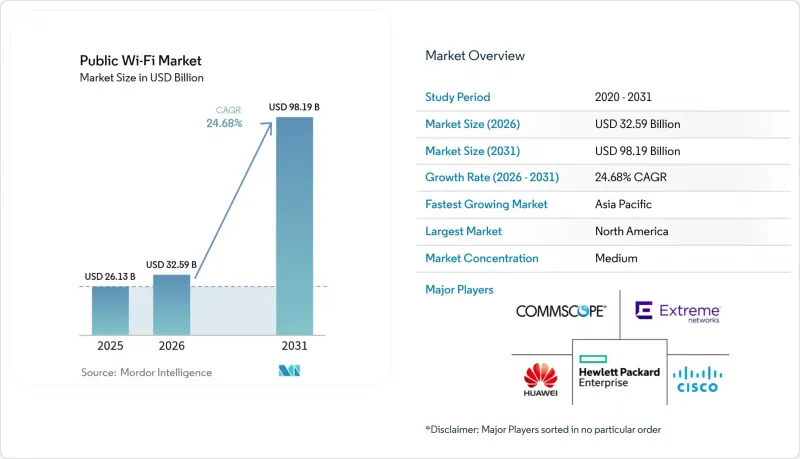
本報告按組件(硬體、軟體、服務)、部署模式(雲端管理、本地部署、混合部署)、安裝位置(室內、室外)、最終用戶產業(電信與IT、零售與電子商務、其他)以及地區(北美、南美、歐洲、亞太、中東和非洲)進行細分。市場預測以美元(USD)計價。
全球公共Wi-Fi市場趨勢與洞察
智慧城市主導的公共Wi-Fi部署
國家和地方政府正在支援大規模的Wi-Fi部署項目,以確保對硬體和服務多年的需求。總額達424.5億美元的BEAD計畫已向路易斯安那州撥款13.55億美元,向內華達州撥款4.166億美元,將公共Wi-Fi定位為主要連接層。菲律賓和西班牙也正在推行類似的舉措,以確保企業級網路基地台的可靠供應,這些接入點採用符合歐盟指令的節能設計。雖然3-5年的招標週期為供應商提供了可預測的收入,但在地採購規則和能耗上限會影響產品線藍圖的製定。這些公共資助的計畫共同提高了需求的可見性,穩定了公共Wi-Fi市場,並抵消了私部門支出的週期性波動。
連網設備流量的爆炸性成長正在推動網路卸載。
目前,平均每個辦公場所每位員工支援 15 到 20 台連網設備,而公共設施在高峰時段每個網路基地台通常會有超過 1000 名並髮用戶。將這些流量從擁擠的蜂巢式網路中分流出去已不再是可選項,而是一項策略挑戰,而 Wi-Fi 6E 的 6 GHz頻寬被視為一種能夠即時提升網路容量的措施。根據服務供應商的計劃,81% 的服務提供者打算在 2025 年前部署 OpenRoaming,他們認知到,無縫接入對於確保從流量分流中獲得足夠的收益至關重要。隨著 Wi-Fi 7 晶片組的成熟,營運商期望確定性延遲和更寬的頻道將使他們能夠處理那些原本會使 5G 宏網路過載的即時應用。
持續存在的網路安全和隱私漏洞
WPA3濫用事件的日益增多和日益嚴格的隱私法規使得合規變得更加複雜。 GDPR、HIPAA和PCI-DSS框架要求所有身分驗證流程都必須經過明確同意、提供稽核追蹤和加密,這迫使網路營運商採取零信任策略並實施頻繁的修補程式更新。醫療保健和金融業仍然保持謹慎,推遲部署計劃並隔離訪客流量以保護受監管資料。安全疊加層推高了整體擁有成本(TCO)並延長了核准週期,減緩了公共Wi-Fi市場原本強勁的普及勢頭。
細分市場分析
2025年,硬體市佔率維持在61.05%。這主要得益於網路基地台更新周期,該週期穩定了公共Wi-Fi實體基礎設施市場的規模。僅網路基地台就佔據了最大的銷售佔有率,而WLAN控制器的整合則反映了向雲端控制面板的轉變。 Wi-Fi 7的推出、能源效率法規的實施以及基於歐洲無線電設備指令的合規性更新,都在持續推動對硬體的需求,並保障供應商的利潤率。室內功率限制和室外耐候性要求持續影響產品型號的變化,促使供應商將自適應電源管理功能整合到ASIC設計中。
到2031年,軟體產業將以26.1%的複合年成長率持續成長,這主要得益於整合了配置、保障和貨幣化分析功能的AI原生雲平台。隨著網路規模的擴大,基於使用量的收費模式也不斷普及。因此,即使控制器叢集進程不斷推進,分配給雲端管理的公共Wi-Fi市場佔有率預計仍將持續成長。集中式控制面板簡化了MSP(託管服務供應商)的零接觸配置流程,支援進階漫遊分析,並滿足跨行業的合規性日誌要求。硬體可靠性和軟體智慧相輔相成,形成一個相互促進的價值循環,既能幫助現有企業維持產品差異化優勢,又能有效阻止僅靠價格競爭的新參與企業。
預計到 2025 年,雲端管理架構將佔總收入的 60.10%,在公共 Wi-Fi 市場(目前 SaaS 控制平面佔據主導地位)中保持顯著的市場佔有率。企業歡迎集中式故障排除和 AI 驅動的最佳化,這些功能無需現場維護即可提高運作。 SOC 2 和 ISO 27001 等認證緩解了資料主權方面的擔憂,使受監管行業能夠將訪客 SSID 策略和非 PII(個人識別資訊)分析資料遷移到公共雲端,同時將敏感工作負載保留在本地。
隨著各組織將本地閘道器整合到全球控制面板下,混合部署正以 26.3% 的複合年成長率快速成長。這種方法使醫院和銀行能夠在本地保留患者和交易數據,同時受益於訪客入口網站和行銷分析中的雲端規模遙測功能。本地部署環境目前僅在國防和超低延遲自動化領域佔據主導地位,在這些領域,空氣間隙的安全性和確定性抖動比雲端的便利性更為重要。這些趨勢共同確保了部署柔軟性仍然是公共 Wi-Fi 市場的關鍵採購標準。
區域分析
預計到2025年,北美將佔全球收入的37.90%,這主要得益於BEAD配額、企業向Wi-Fi 6E的遷移以及體育場館和大學中早期Wi-Fi 7試點計畫的開展。在美國,一些城市正在試行開放漫遊,以整合私人網路和市政網路;而加拿大則致力於彌合農村和原住民居住地區公共Wi-Fi存取的差距。在墨西哥的製造業走廊,即加工出口區(maquiladoras)集中的區域,Wi-Fi即服務(WaaS)正在被推廣,以克服資本支出(CAPEX)的障礙,從而為當地公共Wi-Fi市場創造額外收入。
預計到2031年,亞太地區的Wi-Fi成長將以26.2%的複合年成長率加速。在中國,公共Wi-Fi正被整合到全國智慧城市建設中,透過規模經濟降低平均服務費(ASP),並加速在二線城市的部署。在印度,「數位印度」Wi-Fi熱點正在擴大農村地區的網路連接,促進電子商務發展,並推動對能夠在波動的回程傳輸環境下運行的雲端管理儀錶板的需求。新加坡、馬來西亞和泰國正在對其交通和旅遊基礎設施進行現代化改造,採用Wi-Fi 7技術來實現自動駕駛班車和擴增實境(AR)導遊服務。
在歐洲,以隱私為中心的創新正在維持市場需求。德國和英國在企業向雲端遷移方面處於主導,法國和義大利正在城市地區為遊客擴展Wi-Fi網路,西班牙則將市政網路整合到智慧城市感測器網路中。遵守GDPR和能源效率指令迫使出口供應商採用資料最小化和低功耗硬體設計。儘管面臨宏觀經濟逆風,但這些努力預計將使公共Wi-Fi市場保持穩定成長。
其他好處:
- Excel格式的市場預測(ME)表
- 3個月的分析師支持
目錄
第1章:引言
- 研究假設和市場定義
- 調查範圍
第2章:調查方法
第3章執行摘要
第4章 市場狀況
- 市場概覽
- 市場促進因素
- 透過智慧城市專案部署公共Wi-Fi
- 連網型設備流量的爆炸性成長正在推動網路卸載。
- 升級到 Wi-Fi 6E-7 並實施 AI 驅動的自動化正在提高網路的投資回報率。
- 訂閱式 Wi-Fi 服務可降低資本支出 (CAPEX)。
- 實施 OpenRoaming 可實現無縫盈利。
- Edge Analytics-基於使用者遙測資料的廣告收入來源。
- 市場限制因素
- 與網路安全和隱私相關的漏洞依然存在。
- 無限量5G數據套餐正在消耗大量熱點使用量。
- 室外 6 GHz 頻段的授權費用
- 能源效率要求限制了AP的電力預算。
- 產業價值鏈分析
- 監理情勢
- 宏觀經濟因素的影響
- 技術展望
- 波特五力分析
第5章 市場規模與成長預測
- 按組件
- 硬體
- 網路基地台
- 無線區域網路控制器
- 無線熱點閘道器
- 軟體
- 服務
- 硬體
- 按部署模式
- 雲端管理
- 現場
- 混合
- 按位置類型
- 室內的
- 戶外的
- 按最終用戶行業分類
- 通訊/IT
- 零售與電子商務
- 旅遊與飯店
- 運輸/物流
- 政府/公共部門
- 教育
- 衛生保健
- 其他終端用戶產業
- 按地區
- 北美洲
- 美國
- 加拿大
- 墨西哥
- 南美洲
- 巴西
- 阿根廷
- 其他南美國家
- 歐洲
- 德國
- 英國
- 法國
- 義大利
- 西班牙
- 其他歐洲國家
- 亞太地區
- 中國
- 日本
- 印度
- 韓國
- 東南亞
- 其他亞太國家
- 中東
- 沙烏地阿拉伯
- 阿拉伯聯合大公國
- 土耳其
- 其他中東國家
- 非洲
- 南非
- 奈及利亞
- 其他非洲國家
- 北美洲
第6章 競爭情勢
- 市場集中度
- 策略趨勢
- 市佔率分析
- 公司簡介
- Cisco Systems Inc.
- Hewlett Packard Enterprise Company
- Huawei Technologies Co., Ltd.
- CommScope Holding Company Inc.
- Extreme Networks Inc.
- Juniper Networks Inc.
- Ubiquiti Inc.
- TP-Link Technologies Co., Ltd.
- D-Link Corporation
- Cambium Networks Corporation
- EnGenius Technologies Inc.
- Fon Wireless Limited
- GoZone WiFi LLC
- Purple WiFi Ltd.
- Cloud4Wi Inc.
- Boingo Wireless Inc.
- Aptilo Networks AB
- Tanaza SpA
- Aerohive Networks Inc.
- Hughes Systique Corporation
第7章 市場機會與未來展望
According to Mordor Intelligence, public wi-Fi market size in 2026 is estimated at USD 32.59 billion, growing from 2025 value of USD 26.13 billion with 2031 projections showing USD 98.19 billion, growing at 24.68% CAGR over 2026-2031.
This report is Segmented by Component (Hardware, Software, and Services), Deployment Model (Cloud Managed, On-Premises, and Hybrid), Location Type (Indoor, and Outdoor), End-User Vertical (Telecom and IT, Retail and E-Commerce, and More), and Geography (North America, South America, Europe, Asia Pacific, Middle East, and Africa). The Market Forecasts are Provided in Terms of Value (USD).
Global Public Wi-Fi Market Trends and Insights
Smart City-Funded Public Wi-Fi Rollouts
National and municipal governments are underwriting large-scale Wi-Fi buildouts that guarantee multi-year demand for hardware and services. The USD 42.45 billion BEAD program is allocating awards of USD 1.355 billion to Louisiana and USD 416.6 million to Nevada, earmarking public Wi-Fi as the primary connectivity layer. Comparable commitments are emerging in the Philippines and Spain, ensuring a pipeline of enterprise-grade access points with energy-efficient designs that meet EU directives. RFP cycles of 3-5 years generate predictable revenues for vendors, while local content rules and power budget caps influence the development of SKU roadmaps. Collectively, these publicly funded projects enhance demand visibility and stabilize the public Wi-Fi market, counterbalancing the otherwise cyclical patterns of private-sector spending.
Exploding Connected-Device Traffic Driving Network Offload
Average enterprise sites now support 15-20 connected devices per employee, and public venues routinely top 1,000 simultaneous users per access point at peak. Offloading that traffic from congested cellular networks has become strategic rather than optional, positioning Wi-Fi 6E's 6 GHz spectrum as an immediate capacity upgrade. Service-provider plans reveal 81% intend to enable OpenRoaming by 2025, recognizing that friction-free onboarding will be essential when offload revenues well. As Wi-Fi 7 chipsets mature, operators expect deterministic latency and wider channels to keep pace with real-time applications that otherwise hammer 5G macro networks.
Persistent Cyber-Security and Privacy Vulnerabilities
Rising WPA3 exploits and stricter privacy mandates add layers of complexity to compliance. GDPR, HIPAA, and PCI-DSS frameworks require explicit consent, audit trails, and encryption across all authentication flows, compelling network operators to adopt zero-trust postures and implement frequent patching cycles. Healthcare and finance remain cautious, delaying rollout timelines or segmenting guest traffic to isolate regulated data. Security overlays inflate TCO and cut into approval cycles, tempering the otherwise strong adoption momentum in the public Wi-Fi market.
Other drivers and restraints analyzed in the detailed report include:
- Wi-Fi 6E-7 Upgrades and AI Automation Boosting Network ROI
- Subscription-Based Wi-Fi-as-a-Service Trimming CAPEX
- 5G Unlimited-Data Plans Cannibalizing Hotspot Usage
For complete list of drivers and restraints, kindly check the Table Of Contents.
Segment Analysis
Hardware maintained a 61.05% share in 2025, driven by access-point refresh cycles that stabilize the public Wi-Fi market size for physical infrastructure. Access points alone accounted for the largest slice of revenue, and WLAN controller consolidation reflected the shift to cloud-based dashboards. Wi-Fi 7 rollouts, energy-efficiency mandates, and compliance renewals under Europe's Radio Equipment Directive reinforce continuous demand for hardware and protect vendor margins. Indoor power constraints and outdoor weatherization continue to influence SKU variants, prompting vendors to incorporate adaptive power management into their ASIC designs.
Software is expanding at a 26.1% CAGR through 2031, fueled by AI-native cloud platforms that unify configuration, assurance, and monetization analytics. Consumption billing models scale with network growth, and the public Wi-Fi market share allocated to cloud management is therefore set to widen even as controllers decluster. Centralized dashboards simplify zero-touch provisioning for MSPs, enable advanced roaming analytics, and satisfy cross-vertical compliance logging requirements. Combined, hardware reliability and software intelligence form a mutually reinforcing value loop that sustains product differentiation for incumbents and dissuades price-only challengers.
Cloud-managed architectures accounted for 60.10% of 2025 revenue, maintaining a significant market share in the public Wi-Fi market, where SaaS-delivered control planes dominate. Enterprises welcome centralized troubleshooting and AI-guided optimization that lifts uptime without site visits. Certification milestones, such as SOC 2 and ISO 27001, alleviate data-sovereignty concerns, enabling regulated industries to migrate guest SSID policies and non-PII analytics to public clouds while keeping sensitive workloads on-premises.
Hybrid adoption is growing at a 26.3% CAGR as organizations integrate local gateways under a global dashboard. This approach enables hospitals or banks to keep patient and transaction payloads local while benefiting from cloud-scale telemetry for guest portals and marketing analytics. On-premises dominance persists only in defense and ultra-low-latency automation, where air-gapped security or deterministic jitter takes precedence over cloud convenience. Together, these dynamics ensure deployment flexibility remains a core buying criterion across the public Wi-Fi market.
Complete Report Scope:
- By Component
- Hardware
- Access Points
- WLAN Controllers
- Wireless Hotspot Gateways
- Software
- Services
- Hardware
- By Deployment Model
- Cloud Managed
- On-Premises
- Hybrid
- By Location Type
- Indoor
- Outdoor
- By End-User Vertical
- Telecom and IT
- Retail and E-Commerce
- Travel and Hospitality
- Transportation and Logistics
- Government and Public Sector
- Education
- Healthcare
- Other End-User Verticals
- By Geography
- North America
- United States
- Canada
- Mexico
- South America
- Brazil
- Argentina
- Rest of South America
- Europe
- Germany
- United Kingdom
- France
- Italy
- Spain
- Rest of Europe
- Asia Pacific
- China
- Japan
- India
- South Korea
- South-East Asia
- Rest of Asia Pacific
- Middle East
- Saudi Arabia
- United Arab Emirates
- Turkey
- Rest of Middle East
- Africa
- South Africa
- Nigeria
- Rest of Africa
- North America
Geography Analysis
North America accounted for 37.90% of 2025 revenue, driven by BEAD allocations, enterprise migrations to Wi-Fi 6E, and early Wi-Fi 7 trials in stadiums and universities. U.S. cities are piloting open roaming to harmonize private and municipal networks, while Canada aims to close public Wi-Fi gaps in rural and Indigenous areas. Mexico's maquiladora manufacturing corridors are adopting WaaS to overcome CAPEX hurdles, thereby generating incremental revenue for the regional public Wi-Fi market.
The Asia Pacific is expected to accelerate at a 26.2% CAGR through 2031. China bundles public Wi-Fi into nationwide smart-city blueprints, achieving economies of scale that push unit ASPs lower and spur adoption in tier-two cities. India's Digital India Wi-Fi hotspots expand rural connectivity and stimulate e-commerce, reinforcing demand for cloud-managed dashboards that can operate on variable backhaul. Singapore, Malaysia, and Thailand modernize transport and tourism infrastructure, adopting Wi-Fi 7 to enable autonomous shuttles and augmented-reality visitor guides.
Europe sustains demand through privacy-centric innovation. Germany and the United Kingdom lead in enterprise cloud migration, France and Italy expand city-center tourist Wi-Fi, and Spain rolls municipal networks into smart-city sensor grids. Compliance with GDPR and the Energy Efficiency Directive drives exporter vendors to integrate data minimization and low-power hardware designs. Collectively, these initiatives are expected to preserve steady growth for the public Wi-Fi market despite macroeconomic headwinds.
- Cisco Systems Inc.
- Hewlett Packard Enterprise Company
- Huawei Technologies Co., Ltd.
- CommScope Holding Company Inc.
- Extreme Networks Inc.
- Juniper Networks Inc.
- Ubiquiti Inc.
- TP-Link Technologies Co., Ltd.
- D-Link Corporation
- Cambium Networks Corporation
- EnGenius Technologies Inc.
- Fon Wireless Limited
- GoZone WiFi LLC
- Purple WiFi Ltd.
- Cloud4Wi Inc.
- Boingo Wireless Inc.
- Aptilo Networks AB
- Tanaza S.p.A.
- Aerohive Networks Inc.
- Hughes Systique Corporation
Additional Benefits:
- The market estimate (ME) sheet in Excel format
- 3 months of analyst support
TABLE OF CONTENTS
1 INTRODUCTION
- 1.1 Study Assumptions and Market Definition
- 1.2 Scope of the Study
2 RESEARCH METHODOLOGY
3 EXECUTIVE SUMMARY
4 MARKET LANDSCAPE
- 4.1 Market Overview
- 4.2 Market Drivers
- 4.2.1 Smart city-funded public Wi-Fi rollouts
- 4.2.2 Exploding connected-device traffic driving network offload
- 4.2.3 Wi-Fi 6E-7 upgrades and AI automation boosting network ROI
- 4.2.4 Subscription-based Wi-Fi-as-a-Service trimming CAPEX
- 4.2.5 OpenRoaming adoption unlocking seamless monetization
- 4.2.6 Edge analytics-ads revenue streams via user telemetry
- 4.3 Market Restraints
- 4.3.1 Persistent cyber-security and privacy vulnerabilities
- 4.3.2 5G unlimited-data plans cannibalizing hotspot usage
- 4.3.3 Licensing costs for outdoor 6 GHz spectrum
- 4.3.4 Energy-efficiency mandates limiting AP power budgets
- 4.4 Industry Value Chain Analysis
- 4.5 Regulatory Landscape
- 4.6 Impact of Macroeconomic Factors
- 4.7 Technological Outlook
- 4.8 Porter's Five Forces Analysis
- 4.8.1 Threat of New Entrants
- 4.8.2 Bargaining Power of Suppliers
- 4.8.3 Bargaining Power of Buyers
- 4.8.4 Threat of Substitutes
- 4.8.5 Industry Rivalry
5 MARKET SIZE AND GROWTH FORECASTS (VALUE)
- 5.1 By Component
- 5.1.1 Hardware
- 5.1.1.1 Access Points
- 5.1.1.2 WLAN Controllers
- 5.1.1.3 Wireless Hotspot Gateways
- 5.1.2 Software
- 5.1.3 Services
- 5.1.1 Hardware
- 5.2 By Deployment Model
- 5.2.1 Cloud Managed
- 5.2.2 On-Premises
- 5.2.3 Hybrid
- 5.3 By Location Type
- 5.3.1 Indoor
- 5.3.2 Outdoor
- 5.4 By End-User Vertical
- 5.4.1 Telecom and IT
- 5.4.2 Retail and E-Commerce
- 5.4.3 Travel and Hospitality
- 5.4.4 Transportation and Logistics
- 5.4.5 Government and Public Sector
- 5.4.6 Education
- 5.4.7 Healthcare
- 5.4.8 Other End-User Verticals
- 5.5 By Geography
- 5.5.1 North America
- 5.5.1.1 United States
- 5.5.1.2 Canada
- 5.5.1.3 Mexico
- 5.5.2 South America
- 5.5.2.1 Brazil
- 5.5.2.2 Argentina
- 5.5.2.3 Rest of South America
- 5.5.3 Europe
- 5.5.3.1 Germany
- 5.5.3.2 United Kingdom
- 5.5.3.3 France
- 5.5.3.4 Italy
- 5.5.3.5 Spain
- 5.5.3.6 Rest of Europe
- 5.5.4 Asia Pacific
- 5.5.4.1 China
- 5.5.4.2 Japan
- 5.5.4.3 India
- 5.5.4.4 South Korea
- 5.5.4.5 South-East Asia
- 5.5.4.6 Rest of Asia Pacific
- 5.5.5 Middle East
- 5.5.5.1 Saudi Arabia
- 5.5.5.2 United Arab Emirates
- 5.5.5.3 Turkey
- 5.5.5.4 Rest of Middle East
- 5.5.6 Africa
- 5.5.6.1 South Africa
- 5.5.6.2 Nigeria
- 5.5.6.3 Rest of Africa
- 5.5.1 North America
6 COMPETITIVE LANDSCAPE
- 6.1 Market Concentration
- 6.2 Strategic Moves
- 6.3 Market Share Analysis
- 6.4 Company Profiles (includes Global level Overview, Market level overview, Core Segments, Financials as available, Strategic Information, Market Rank/Share for key companies, Products and Services, and Recent Developments)
- 6.4.1 Cisco Systems Inc.
- 6.4.2 Hewlett Packard Enterprise Company
- 6.4.3 Huawei Technologies Co., Ltd.
- 6.4.4 CommScope Holding Company Inc.
- 6.4.5 Extreme Networks Inc.
- 6.4.6 Juniper Networks Inc.
- 6.4.7 Ubiquiti Inc.
- 6.4.8 TP-Link Technologies Co., Ltd.
- 6.4.9 D-Link Corporation
- 6.4.10 Cambium Networks Corporation
- 6.4.11 EnGenius Technologies Inc.
- 6.4.12 Fon Wireless Limited
- 6.4.13 GoZone WiFi LLC
- 6.4.14 Purple WiFi Ltd.
- 6.4.15 Cloud4Wi Inc.
- 6.4.16 Boingo Wireless Inc.
- 6.4.17 Aptilo Networks AB
- 6.4.18 Tanaza S.p.A.
- 6.4.19 Aerohive Networks Inc.
- 6.4.20 Hughes Systique Corporation
7 MARKET OPPORTUNITIES AND FUTURE OUTLOOK
- 7.1 White-space and Unmet-Need Assessment

 Wi-Fi:市場佔有率分析、產業趨勢與統計、成長預測(2026-2031)戶外Wi-Fi:市場佔有率分析、產業趨勢與統計、成長預測(2026-2031年)
 Wi-Fi市場-2026-2032年全球市場預測
 Wi-Fi 7 企業解決方案市場預測至 2034 年-按交付方式、設施類型、應用、最終用戶和地區分類的全球分析
 MiFi市場:按設備類型、最終用戶和地區分類
 Wi-Fi市場趨勢
 2026年全球Wi-Fi漫遊最佳化市場報告2026年全球無線網路基地台市場報告2026年全球託管Wi-Fi解決方案市場報告
 Wi-Fi市場規模、佔有率和成長分析:按交付方式、部署方式、技術、應用、最終用戶產業和地區分類-2026-2033年產業預測