


 |
市場調查報告書
商品編碼
2121818
戶外Wi-Fi:市場佔有率分析、產業趨勢與統計、成長預測(2026-2031年)Outdoor Wi-Fi - Market Share Analysis, Industry Trends & Statistics, Growth Forecasts (2026 - 2031) |
||||||

※ 本網頁內容可能與最新版本有所差異。詳細情況請與我們聯繫。
根據 Mordor Intelligence 預測,戶外 Wi-Fi 市場規模將從 2025 年的 78 億美元成長到 2026 年的 85.3 億美元,然後在 2031 年達到 133.5 億美元,2026 年至 2031 年的複合年成長率為 9.35%。
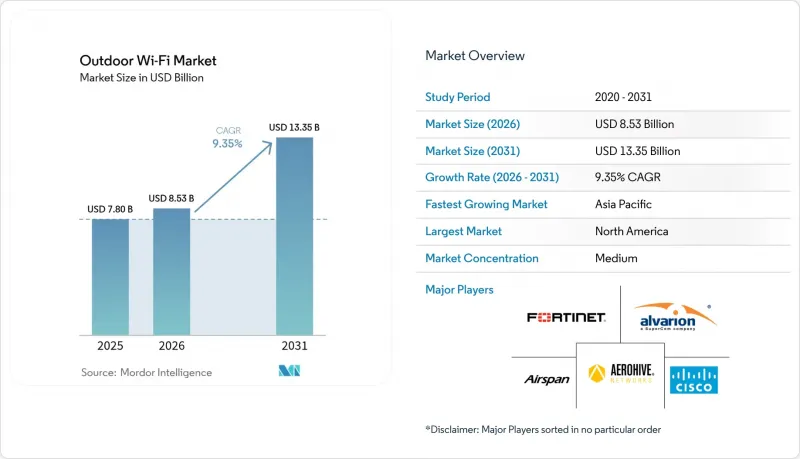
本報告按產品(WLAN控制器、網路基地台等)、服務(網路規劃與設計等)、部署模式(室外熱點、專用網路等)、終端用戶產業(醫療保健、教育、物流運輸等)和地區進行細分。市場預測以美元計價。
全球戶外Wi-Fi市場趨勢與洞察
物聯網邊緣設備的爆炸性成長
數十億低功耗感測器需要持續且經濟高效的戶外覆蓋,這促使網路架構從以用戶為中心的熱點轉向以機器為中心的網路。高通與意法半導體在2024年的合作將三頻段SoC和板載AI整合到MCU模組中,使戶外網路基地台能夠處理數千個並發連接。 Milesight和Morse Micro展示了低於1GHz頻段的Wi-Fi HaLow在遠距離智慧城市感知方面的有效性,顯示戶外Wi-Fi市場正在向遠距離、低功耗回程傳輸轉型。隨著設備密度的增加,對具有最佳化接收靈敏度、高級調度功能和雲端分析能力以防止網路擁塞的網路基地台(AP)的需求也日益成長。
智慧城市Wi-Fi專案快速發展
在市政預算中,戶外網路連接正日益被視為一項關鍵基礎設施優先事項。基於 Calix 的 Passpoint 平台,SmartTown Alliance 已幫助美國本地寬頻供應商在 2024 年將網路連線速度提升了 75%,平均每用戶收入 (ARPU) 提高了 3%。 Extreme Networks 在羅馬的部署,以及華為和 Telconet 在厄瓜多爾部署的 1700 個接入點等案例,都清晰地展現了市政舉措的規模和多樣性。這些項目為長期服務合約奠定了基礎,促進了公私合營資金籌措模式的發展,並推動了人工智慧原生網路營運平台的應用,從而顯著縮短了現場維護週期。
日益成長的安全和隱私擔憂
強制實施 WPA3、GDPR 合規性和零信任原則增加了部署的複雜性。室外網路拓撲缺乏實體邊界控制,使得以身分為中心的策略和 AI 驅動的異常檢測至關重要。 Juniper 的 Mist 透過整合基於機器學習的威脅評分功能,實現了威脅隔離的自動化。同時,醫療機構的部署案例凸顯了室外患者區域對 HIPAA 合規加密的要求。日益嚴格的監管,尤其是在歐洲,推高了審計成本,同時也刺激了對整合安全堆疊的需求,這使得那些將策略引擎、SASE 入口和邊緣防火牆捆綁在一起的供應商更受青睞。
細分市場分析
預計到2025年,網路基地台佔總營收的48.44%,凸顯其在戶外Wi-Fi市場的核心地位。整合邊緣運算的多頻段、IP67防護等級設備現已支援同時處理客戶端流量和物聯網回程傳輸,融合了使用者和機器的工作負載。其堅固耐用的設計能夠承受溫度和濕度的變化,而雲端遙測功能則支援預測性維護。瞻博網路(Juniper)、Extreme Networks和思科(Cisco)正在更新其產品線,使其具備Wi-Fi 6E/7無線功能、三頻掃描和用於定位服務的整合GPS。不斷成長的客戶端容量,加上智慧城市感測器數量的激增,正鞏固網路基地台作為戶外數位基礎設施基石的地位。
戶外無線橋接器以10.08%的複合年成長率快速成長,滿足了工業點對點影像傳輸、5G小型基地台回程傳輸以及預算受限地區光纖替代方案的需求。 Ceragon計劃收購Siklu,這將擴展毫米波選項,實現2公里鏈路上的多Gigabit吞吐量。隨著橋接器供應商整合Wi-Fi無線模組,戶外Wi-Fi市場也從中受益,這些模組能夠快速建構網狀網路,減少現場服務次數和維護時間。控制器和熱點閘道器仍然保持著重要的市場地位,尤其是在酒店業和交通樞紐,集中式會話管理和專屬式門戶仍然佔據主導地位。
預計到2025年,安裝和支援服務將佔市場佔有率的52.52%,這反映了電線杆安裝、佈線和射頻調整等任務的勞動密集型特徵。同時,託管服務預計將以每年10.12%的速度成長,這反映了企業縮減IT員工隊伍的趨勢以及涉及多個地點和供應商的生態系統的複雜性。託管服務提供者透過將全天候監控、無線韌體更新和合規性報告打包在一起,顯著降低了平均修復時間 (MTTR) 和資本支出 (CapEx) 風險。在戶外Wi-Fi產業,營運商正在將其網路營運中心 (NOC) 的功能擴展到基於訂閱的Wi-Fi運營,而像Calix的SmartTown Alliance這樣的託管服務供應商(MSP) 則正在共同利用網路基礎設施,在本地層面實現規模經濟。
網路規劃與設計仍然是諮詢業務中一個重要的成長領域,涵蓋了3D射頻建模、基於雷射雷達的障礙物偵測以及6GHz自適應頻率控制(AFC)的頻率共存模擬。培訓和諮詢服務正致力於填補日益成長的技能缺口,重點關注人工智慧驅動的故障排除、增強的安全態勢以及整合Wi-Fi和專用5G的跨域編配。
區域分析
預計到2025年,北美將佔全球銷售額的38.33%,這主要得益於其長期以來大力推進的寬頻計畫、智慧城市津貼以及對6GHz頻寬的明確規定。例如,奧爾丁獨立學區(ALSD)部署了8,000個網路基地台(AP),凸顯了教育產業在大規模部署中的重要角色。機場聯盟、公共產業合作社和醫院系統也保持著強勁的訂單預期。儘管由於美國聯邦通訊委員會(FCC)仍在最終確定6GHz標準功率頻段的AFC規則,該地區的戶外Wi-Fi市場仍面臨頻率監管方面的瓶頸,但供應商的準備工作和公共資金的投入正在逐步消除部署障礙。
亞太地區正以9.70%的複合年成長率引領戶外Wi-Fi市場成長。中國、印度和東南亞的大規模都市化推動了地方政府對連接基礎設施的建設,而日本則憑藉Wi-Fi 7試點運營和OpenRoaming的引入處於領先地位。國家級頻段分配加速了部署進程,政府促進數位化發展的指南也鼓勵了多廠商參與。電信業者(例如Claro Brasil,預計到2029年投資77億美元)的投資表明,大規模戶外無線網路正在不斷擴展。政府支持的農村寬頻項目,包括華為在尚比亞的“智慧鄉村示範項目”,正在展示除人口稠密的大都會圈以外的應用案例,將戶外Wi-Fi市場的覆蓋範圍擴展到農業地區。
在歐洲,我們看到以監管為導向的穩定擴張。 GDPR、人工智慧法案和ETSI輸出限制正在影響設計選擇,並推動注重隱私的零信任架構的採用。比利時和倫敦的早期OpenRoaming計畫表明,無縫認證模型的支持度正在不斷提高。官民合作關係正在加強交通走廊和歷史街區的部署,在文化遺產保護和現代連結之間取得平衡。南美洲、中東和非洲仍然是新興市場,但在政府連結目標的推動下,這些地區正成為具有重要戰略意義的區域。摩洛哥的目標是到2025年達到25%的5G覆蓋率,戶外Wi-Fi被視為補充性的流量卸載解決方案。使用衛星回程傳輸的Wi-Fi正在擴大人口稀少地區的覆蓋範圍,Gilat公司在拉丁美洲獲得的價值300萬美元的合約就是一個例子。
其他好處:
- Excel格式的市場預測(ME)表
- 3個月的分析師支持
目錄
第1章:引言
- 研究假設和市場定義
- 調查範圍
第2章:調查方法
第3章執行摘要
第4章 市場狀況
- 市場概覽
- 市場促進因素
- 物聯網邊緣設備的爆炸性成長
- 智慧城市Wi-Fi專案快速發展
- 對實現無縫連接的交通樞紐的需求
- Wi-Fi 6/6E 作為一種經濟高效的 5G 卸載解決方案
- 附室外Wi-Fi的電動車充電站
- Wi-Fi HaLow 相容的遠距工業感測
- 市場限制因素
- 日益成長的安全和隱私擔憂
- 頻寬擁塞和射頻干擾
- 引入耐候型接入點的成本
- 各國特定的EIRP限制限制了通訊範圍。
- 產業價值鏈分析
- 監理情勢
- 技術展望
- 波特五力分析
第5章 市場規模與成長預測
- 依產品
- 無線區域網路控制器
- 網路基地台
- 戶外無線橋接器
- 無線熱點閘道器
- 按服務
- 網路規劃與設計
- 實施與支持
- 託管服務
- 培訓和諮詢
- 按安裝模式
- 戶外熱點
- 私人網路
- 社區 Wi-Fi 網狀網路
- 物聯網回程傳輸網路
- 按最終用戶行業分類
- 衛生保健
- 教育
- 物流/運輸
- 旅遊與飯店
- 公共產業
- 智慧城市和地方政府
- 零售
- 石油天然氣/採礦
- 其他終端用戶產業
- 按地區
- 北美洲
- 南美洲
- 歐洲
- 亞太地區
- 中東和非洲
第6章 競爭情勢
- 市場集中度
- 策略趨勢
- 市佔率分析
- 公司簡介
- Aerohive Networks LLC
- Airspan Networks Holdings Inc.
- Alvarion Technologies Ltd.
- Cisco Systems, Inc.
- Fortinet, Inc.
- Hewlett Packard Enterprise Company(Aruba)
- Huawei Technologies Co., Ltd.
- Juniper Networks, Inc.
- NETGEAR, Inc.
- Nokia Solutions and Networks Oy
- Ubiquiti Inc.
- Zebra Technologies Corporation
- CommScope Holding Company, Inc.(Ruckus Networks)
- Cambium Networks Corporation
- Extreme Networks, Inc.
- D-Link Corporation
- TP-Link Technologies Co., Ltd.
- EnGenius Technologies Inc.
- Siklu Communication Ltd.
- Proxim Wireless Corporation
- RADWIN Ltd.
第7章 市場機會與未來展望
According to Mordor Intelligence, the outdoor wi-Fi market size is expected to grow from USD 7.80 billion in 2025 to USD 8.53 billion in 2026 and is forecast to reach USD 13.35 billion by 2031 at 9.35% CAGR over 2026-2031.
This report is Segmented by Product (WLAN Controllers, Access Points, and More), Service (Network Planning and Design, and More), Implementation Model (Outdoor Hotspots, Private Networks, and More), End-User Industry (Healthcare, Education, Logistics and Transportation, and More), and Geography. The Market Forecasts are Provided in Terms of Value (USD).
Global Outdoor Wi-Fi Market Trends and Insights
Explosive Growth of IoT Edge Devices
Billions of low-power sensors require continuous, cost-effective outdoor coverage, shifting architecture from user-centric hotspots to machine-centric grids. Qualcomm's 2024 alliance with STMicro embeds tri-radio SoCs and on-board AI in MCU modules, enabling outdoor access points to handle thousands of concurrent links. Milesight and Morse Micro validated sub-1 GHz Wi-Fi HaLow for long-range smart-city sensing, underscoring the Outdoor Wi-Fi market pivot toward extended-range, low-energy backhaul. Device density intensifies demand for APs with optimized receive sensitivity, advanced scheduling, and cloud analytics that pre-empt congestion.
Rapid Roll-out of Smart-City Wi-Fi Projects
Municipal budgets increasingly earmark outdoor connectivity as critical infrastructure. Calix's Passpoint-driven SmartTown Alliance delivered 75% connectivity gains and 3% ARPU uplift for U.S. rural broadband providers in 2024. Extreme Networks' Rome deployment and Huawei-Telconet's 1,700-AP Ecuador rollout illustrate the scale and diversity of municipal initiatives. Such programs anchor long-term service contracts, foster public-private funding models, and catalyze adoption of AI-native network operations platforms that slash field-maintenance cycles.
Escalating Security and Privacy Concerns
Mandatory WPA3, GDPR compliance, and zero-trust mandates heighten deployment complexity. Outdoor topologies lack physical perimeter controls, making identity-centric policies and AI-driven anomaly detection essential. Juniper's Mist embeds machine-learning threat scoring to automate containment, while healthcare campus rollouts illustrate HIPAA-grade encryption requirements for outdoor patient zones. Regulatory scrutiny, particularly in Europe, raises audit costs yet spurs demand for integrated security stacks, favoring vendors that bundle policy engines, SASE on-ramps, and edge firewalls.
Other drivers and restraints analyzed in the detailed report include:
- Transportation-Hub Demand for Seamless Connectivity
- Wi-Fi 6/6E as Cost-Effective 5G Offload
- Spectrum Congestion and RF Interference
For complete list of drivers and restraints, kindly check the Table Of Contents.
Segment Analysis
Access Points generated 48.44% of 2025 revenue, underlining their centrality to the Outdoor Wi-Fi market size. Multi-radio, IP67-rated units with integrated edge compute now support concurrent client traffic and IoT backhaul, blending user and machine workloads. Rugged designs withstand temperature swings and moisture, while cloud telemetry enables predictive maintenance. Juniper, Extreme Networks, and Cisco refresh portfolios with Wi-Fi 6E/7 radios, tri-band scanning, and integrated GPS for location services. Growing client capacity aligns with smart-city sensor surges, cementing Access Points as the nexus of outdoor digital infrastructure.
Outdoor Wireless Bridges, advancing at a 10.08% CAGR, respond to industrial point-to-point video, backhaul for 5G small cells, and fiber-replacement in budget-sensitive regions. Ceragon's planned integration of Siklu expands millimeter-wave options, pushing multi-gigabit throughput over 2-kilometer links. The Outdoor Wi-Fi market benefits as bridge vendors embed Wi-Fi radios for rapid mesh formation, reducing truck rolls and time-to-service. Controllers and hotspot gateways retain niche relevance where centralized session management or captive portals remain in force, particularly across hospitality and transport hubs.
Installation and Support services held 52.52% share in 2025, reflecting the labor-intensive nature of pole mounts, cabling, and RF tuning. Yet Managed Services are forecast to expand 10.12% annually, mirroring enterprises' lean IT staffing and the complexity of multi-site, multi-vendor ecosystems. Managed providers bundle 24X7 monitoring, over-the-air firmware, and compliance reporting, slashing mean-time-to-repair and CapEx risk. The Outdoor Wi-Fi industry sees telcos extending NOC capabilities into subscription-based Wi-Fi operations, while MSPs such as Calix's SmartTown Alliance pool footprints for rural economies of scale.
Network Planning and Design persists as a consultative growth niche, incorporating 3-D RF modeling, LiDAR-based obstructions, and spectrum coexistence simulations for 6 GHz AFC. Training and Consulting fill a widening skills gap, focusing on AI-driven troubleshooting, security posture hardening, and cross-domain orchestration that blends Wi-Fi with private 5G.
Complete Report Scope:
- By Product
- WLAN Controllers
- Access Points
- Outdoor Wireless Bridges
- Wireless Hotspot Gateways
- By Service
- Network Planning and Design
- Installation and Support
- Managed Services
- Training and Consulting
- By Implementation Model
- Outdoor Hotspots
- Private Networks
- Community Wi-Fi Mesh
- IoT Backhaul Networks
- By End-user Industry
- Healthcare
- Education
- Logistics and Transportation
- Travel and Hospitality
- Public Utilities
- Smart Cities and Municipalities
- Retail
- Oil and Gas / Mining
- Other End-user Industries
- By Geography
- North America
- South America
- Europe
- Asia-Pacific
- Middle East and Africa
Geography Analysis
North America, with 38.33% revenue in 2025, capitalizes on longstanding broadband initiatives, smart-city grants, and 6 GHz spectrum clarity. Projects such as Aldine ISD's 8,000-AP rollout underscore education's role in volume deployments. Airport consortia, utility cooperatives, and hospital systems sustain strong pipeline demand. The Outdoor Wi-Fi market here still faces spectrum-coordination bottlenecks as the FCC finalizes AFC rules for standard-power 6 GHz, but vendor readiness and public funding mitigate adoption headwinds.
Asia-Pacific is the Outdoor Wi-Fi market's growth engine, advancing 9.70% CAGR. Massive urbanization in China, India, and Southeast Asia drives municipal connectivity, while Japan pioneers Wi-Fi 7 pilots and OpenRoaming adoption. National spectrum allocations expedite deployments, and governmental digitization mandates encourage multivendor participation. Investments by carriers such as Claro Brasil (USD 7.7 billion through 2029) signal large-scale outdoor wireless expansion. Government-backed rural broadband, including Huawei's Smart Village Showcase in Zambia, illustrates use cases beyond dense metros, extending Outdoor Wi-Fi market reach into agrarian communities.
Europe registers steady yet regulation-focused expansion. GDPR, AI Act provisions, and ETSI power limits influence design choices, prompting privacy-centric zero-trust architectures. Early OpenRoaming projects in Belgium and London demonstrate traction for seamless authentication models. Public-private partnerships bolster deployments in transport corridors and historical districts, balancing heritage preservation with modern connectivity. South America and the Middle East and Africa remain emerging but strategic, fueled by government connectivity targets. Morocco's 25% 5G coverage goal by 2025 positions Outdoor Wi-Fi as complementary offload. Satellite-backhauled Wi-Fi, illustrated by Gilat's USD 3 million Latin American contract, extends reach in sparsely populated zones.
- Aerohive Networks LLC
- Airspan Networks Holdings Inc.
- Alvarion Technologies Ltd.
- Cisco Systems, Inc.
- Fortinet, Inc.
- Hewlett Packard Enterprise Company (Aruba)
- Huawei Technologies Co., Ltd.
- Juniper Networks, Inc.
- NETGEAR, Inc.
- Nokia Solutions and Networks Oy
- Ubiquiti Inc.
- Zebra Technologies Corporation
- CommScope Holding Company, Inc. (Ruckus Networks)
- Cambium Networks Corporation
- Extreme Networks, Inc.
- D-Link Corporation
- TP-Link Technologies Co., Ltd.
- EnGenius Technologies Inc.
- Siklu Communication Ltd.
- Proxim Wireless Corporation
- RADWIN Ltd.
Additional Benefits:
- The market estimate (ME) sheet in Excel format
- 3 months of analyst support
TABLE OF CONTENTS
1 INTRODUCTION
- 1.1 Study Assumptions and Market Definition
- 1.2 Scope of the Study
2 RESEARCH METHODOLOGY
3 EXECUTIVE SUMMARY
4 MARKET LANDSCAPE
- 4.1 Market Overview
- 4.2 Market Drivers
- 4.2.1 Explosive growth of IoT edge devices
- 4.2.2 Rapid roll-out of smart-city Wi-Fi projects
- 4.2.3 Transportation-hub demand for seamless connectivity
- 4.2.4 Wi-Fi 6/6E as cost-effective 5G offload
- 4.2.5 EV-charging stations bundling outdoor Wi-Fi
- 4.2.6 Wi-Fi HaLow-enabled long-range industrial sensing
- 4.3 Market Restraints
- 4.3.1 Escalating security and privacy concerns
- 4.3.2 Spectrum congestion and RF interference
- 4.3.3 Climate-hardening costs for rugged APs
- 4.3.4 Country-specific EIRP limits curbing range
- 4.4 Industry Value Chain Analysis
- 4.5 Regulatory Landscape
- 4.6 Technological Outlook
- 4.7 Porter's Five Forces Analysis
- 4.7.1 Bargaining Power of Suppliers
- 4.7.2 Bargaining Power of Consumers
- 4.7.3 Threat of New Entrants
- 4.7.4 Threat of Substitutes
- 4.7.5 Intensity of Competitive Rivalry
5 MARKET SIZE AND GROWTH FORECASTS (VALUE)
- 5.1 By Product
- 5.1.1 WLAN Controllers
- 5.1.2 Access Points
- 5.1.3 Outdoor Wireless Bridges
- 5.1.4 Wireless Hotspot Gateways
- 5.2 By Service
- 5.2.1 Network Planning and Design
- 5.2.2 Installation and Support
- 5.2.3 Managed Services
- 5.2.4 Training and Consulting
- 5.3 By Implementation Model
- 5.3.1 Outdoor Hotspots
- 5.3.2 Private Networks
- 5.3.3 Community Wi-Fi Mesh
- 5.3.4 IoT Backhaul Networks
- 5.4 By End-user Industry
- 5.4.1 Healthcare
- 5.4.2 Education
- 5.4.3 Logistics and Transportation
- 5.4.4 Travel and Hospitality
- 5.4.5 Public Utilities
- 5.4.6 Smart Cities and Municipalities
- 5.4.7 Retail
- 5.4.8 Oil and Gas / Mining
- 5.4.9 Other End-user Industries
- 5.5 By Geography
- 5.5.1 North America
- 5.5.2 South America
- 5.5.3 Europe
- 5.5.4 Asia-Pacific
- 5.5.5 Middle East and Africa
6 COMPETITIVE LANDSCAPE
- 6.1 Market Concentration
- 6.2 Strategic Moves
- 6.3 Market Share Analysis
- 6.4 Company Profiles (includes Global Level Overview, Market Level Overview, Core Segments, Financials as available, Strategic Information, Market Rank/Share for key companies, Products and Services, Recent Developments)
- 6.4.1 Aerohive Networks LLC
- 6.4.2 Airspan Networks Holdings Inc.
- 6.4.3 Alvarion Technologies Ltd.
- 6.4.4 Cisco Systems, Inc.
- 6.4.5 Fortinet, Inc.
- 6.4.6 Hewlett Packard Enterprise Company (Aruba)
- 6.4.7 Huawei Technologies Co., Ltd.
- 6.4.8 Juniper Networks, Inc.
- 6.4.9 NETGEAR, Inc.
- 6.4.10 Nokia Solutions and Networks Oy
- 6.4.11 Ubiquiti Inc.
- 6.4.12 Zebra Technologies Corporation
- 6.4.13 CommScope Holding Company, Inc. (Ruckus Networks)
- 6.4.14 Cambium Networks Corporation
- 6.4.15 Extreme Networks, Inc.
- 6.4.16 D-Link Corporation
- 6.4.17 TP-Link Technologies Co., Ltd.
- 6.4.18 EnGenius Technologies Inc.
- 6.4.19 Siklu Communication Ltd.
- 6.4.20 Proxim Wireless Corporation
- 6.4.21 RADWIN Ltd.
7 MARKET OPPORTUNITIES AND FUTURE OUTLOOK
- 7.1 White-space and Unmet-need Assessment

 Wi-Fi:市場佔有率分析、產業趨勢與統計、成長預測(2026-2031)公共 Wi-Fi:市場佔有率分析、行業趨勢和統計數據、成長預測(2026-2031 年)
 Wi-Fi市場-2026-2032年全球市場預測
 Wi-Fi 7 企業解決方案市場預測至 2034 年-按交付方式、設施類型、應用、最終用戶和地區分類的全球分析
 MiFi市場:按設備類型、最終用戶和地區分類
 Wi-Fi市場趨勢
 2026年全球Wi-Fi漫遊最佳化市場報告2026年全球無線網路基地台市場報告2026年全球託管Wi-Fi解決方案市場報告
 Wi-Fi市場規模、佔有率和成長分析:按交付方式、部署方式、技術、應用、最終用戶產業和地區分類-2026-2033年產業預測