


 |
市場調查報告書
商品編碼
2124547
光纖陀螺儀:市場佔有率分析、產業趨勢與統計、成長預測(2026-2031)Fiber Optic Gyroscope - Market Share Analysis, Industry Trends & Statistics, Growth Forecasts (2026 - 2031) |
||||||

※ 本網頁內容可能與最新版本有所差異。詳細情況請與我們聯繫。
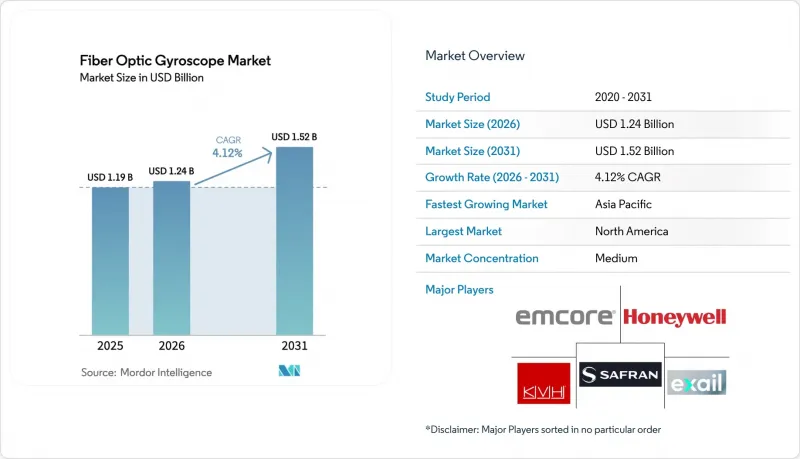
據 Mordor Intelligence 稱,2025 年光纖陀螺儀市值為 11.9 億美元,預計到 2031 年將從 2026 年的 12.4 億美元成長至 15.2 億美元,預測期(2026-2031 年)複合年成長率為 4.12%。
本報告按線圈類型(法蘭式、輪轂式、自主型)、檢測軸(單軸、雙軸、三軸)、技術(開放回路I-FOG、閉合迴路D-FOG)、裝置(指南針、慣性測量單元等)、光纖類型(單模、多模等)、裝置用戶產業(航空航太/商業航空等)和地區進行航空航太/商業航空等)和地區進行航空航太/商業航空等)和地區進行航空航太/商業航空等)和航太/商業航空等)和地區進行航空航太/商業航空等)和地區進行航空航太/商業航空等範圍。市場預測以美元計價。
全球光纖陀螺儀市場趨勢與洞察
北約成員國加速採購自主無人機和無人地面車輛。
北約成員國的國防部正將無人系統置於其現代化戰略的核心位置,如今,所有競標都明確要求具備慣性導航系統(INS)級別的導航能力,且偏差穩定性小於0.01°/小時。價值35億美元的美國「嵌入式GPS/INS」計畫就是一個典型的例子,該計畫將光纖陀螺儀市場供應商與多年交付計畫掛鉤。在歐洲,諾斯羅普·格魯曼公司獲得了一份價值2050萬英鎊(約合2739萬美元)的契約,用於為英國的掃雷艦提供系統,這也凸顯了類似的要求。這些合約不包括民用級微機電系統(MEMS)感測器,從而維持了對高利潤封閉回路型陀螺儀(FOG)的需求。除了這些引人注目的訂單外,聯合演習還表明,在隧道中運作的地面機器人會在幾分鐘內丟失基於MEMS的姿態信息,而光纖陀螺儀則可以保持數小時的精度,這進一步加速了光纖陀螺儀的普及應用。
歐洲強制要求使用 INS 級導航系統以符合 IMO 電子導航要求。
MSC.467(101) 規定,所有總噸位超過 500 噸的船舶必須在 2027 年前配備導航級慣性導航系統 (INS),並且大約
歐洲仍有12,000艘船舶需要升級改造。商船營運商目前正在對船舶進行MARINS和PHINS光纖陀螺儀系統的改造,這些系統已在海軍艦隊中成功應用,從而降低了認證風險。隨著新加坡計畫實施相關法規,受影響的船隊數量正在擴大,而光纖陀螺儀市場在這個亞太海事中心也隨之成長。由於維修時間有限,整合商正在預訂線圈和調製器,這導致短期內零件前置作業時間延長,有利於垂直整合的歐洲供應商。
微型無人機用MEMS陀螺儀短期設計訂單
重量低於5公斤的無人機可在12週的設計週期內交付,而售價低於50美元的MEMS陀螺儀也達到了大致的目標。大疆創新(DJI)的2025年產品線將佔據消費級無人機市場四分之三的佔有率,且無需任何光纖陀螺儀(FOG)管道,這一規模足以支撐以MEMS為中心的供應鏈。由於微型無人機在空中機器人領域佔據最大的銷售量,光纖陀螺儀供應商也意識到,在整個預測期內,該領域將不會受到光纖陀螺儀市場的影響。
細分市場分析
到了2025年,法蘭的光纖陀螺儀將佔據43.72%的市場佔有率,這充分證明其在飛彈和海軍環境中承受超過20g RMS衝擊時的可靠性。即使在發射過程中,其偏壓穩定性也能始終保持在0.01°/小時以內,此基準在自主型設計中尚未被廣泛認可。因此,主要的國防製造商繼續在其傳統的認證零件清單中保留帶法蘭的零件,僅憑更換週期就佔據了光纖陀螺儀市場相當大的佔有率。然而,火箭發射運營商和小型衛星製造商對重量的關注程度精確到克,而自主型光纖陀螺儀可以將組裝重量降低高達30%,這一優勢直接轉化為有效載荷裕度。因此,預計到2031年,自主型光纖陀螺儀的年複合成長率將達到5.72%,超過整體市場的成長速度,尤其是在衛星ADCS模組和遠端無人機領域,趨勢更為顯著。
在航太領域,Redwire Space為其CubeSat衛星平台指定使用每軸重量低於500克的自主型(FOG);而在國防航空航太領域,歐洲颱風戰鬥機由於其易於認證,繼續使用諾斯羅普·格魯曼公司的法蘭式LCR-100霧門。輪轂式線圈介於這兩種極端情況之間,以具有競爭力的價格提供適中的抗振性能,並在亞洲鐵路系統整合商中越來越受歡迎。中空纖維線圈的製造可行性可望憑藉其重量和熱優勢徹底改變設計方案,但目前商業化尚未達到預期時程。
由於自動駕駛車輛、飛彈和倉儲機器人等應用領域對六自由度(6-DOF)導航的需求,三軸架構在2025年佔了51.63%的銷售量。透過將所有軸整合在單一機殼內,顯著減少了佈線,簡化了溫度控管,並透過在共用處理器上啟用卡爾曼濾波來降低整體系統誤差。雖然雙軸光纖陀螺儀的市場佔有率落後於三軸,但它們受益於對中心點(垂直運動)和垂直加速度要求不高的領域的需求,例如艦載聲吶的穩定性。預計到2031年,雙軸陀螺儀將以6.13%的複合年成長率快速普及,尤其是在採用遠端操作的近海支援船舶領域。單軸陀螺儀仍用於艙室空間有限的維修項目中,但其應用範圍有限,導致光纖陀螺儀市場整體長期下滑。
在慕尼黑和鳳凰城的汽車測試車輛中,三軸霧陀螺儀已與雷射雷達和雷達陣列整合,在兩小時的自動駕駛循環測試中,漂移小於10厘米。同時,在海軍領域,通常會配備一個獨立的方位角陀螺儀作為備用,以防整合式慣性導航系統(INS)發生電子故障。這種冗餘設計解釋了為何儘管單軸陀螺儀的單位成本高於雙軸陀螺儀,但市場對這種小眾產品的需求依然強勁。
區域分析
預計到2025年,北美仍將維持光纖陀螺儀市場32.19%的最大佔有率。這主要得益於美國國防部簽訂的多年期生產契約,用於生產嵌入式GPS-INS單元和衛星星系有效載荷。此外,用於後勤任務的自主地面車輛的早期部署以及老舊飛機維修合約的持續進行,也進一步支撐了市場需求。同時,加拿大海軍以北極地區為重點的現代化建設以及墨西哥航太叢集的蓬勃發展,也進一步推動了市場需求。Honeywell亞利桑那州工廠近期獲得的一項量子感測器研究津貼表明,市場正朝著下一代陀螺儀長期過渡,儘管預計在目前的預測期內不會實現商業性部署。綜合以上因素,預計北美光纖陀螺儀市場規模將維持穩定成長,直到2031年。
歐洲緊隨其後,預計2025年將佔全球銷售額的約28%。這得歸功於國際海事組織(IMO)的《電子航行規則》,該規則要求到2027年,12,000艘商船必須安裝慣性導航系統(INS)等級的感測器。德國、法國和西班牙的鐵路現代化項目依賴於配備基於光纖陀螺儀(FOG)的慣性測量單元(IMU)的軌道形狀測量車輛,以維持250公里/小時的運行速度,從而持續為區域供應商帶來線圈訂單。國防費用也支撐了市場需求。英國簽署了一份價值2050萬英鎊(2739萬美元)的契約,為皇家海軍的掃雷艦提供封閉回路型單元,確保供應至2027年。儘管出口限制阻礙了俄羅斯市場的准入,但賽峰集團和艾克賽爾集團正利用不受《國際武器貿易條例》(ITAR)約束的供應鏈,在該地區獲取市場佔有率。
亞太地區預計將成為成長最快的地區,2026年至2031年的複合年成長率將達到6.17%,這主要得益於中國矽光電供應商的推動,這些供應商的光纖陀螺儀(FOG)價格比歐美同類產品低70%。日本內閣府的「太空技術戰略」正在加速建造需要抗輻射加固型光纖陀螺儀的衛星,而印度國防研究與發展組織(DRDO)正在資助國內戰鬥機和潛艇計畫。中國1.5萬公里地方鐵路的電氣化改造以及印度和韓國的大規模軌道監測系統訂單正在擴大光纖陀螺儀的工業應用。此外,沙烏地阿拉伯阿美公司的高溫鑽井計畫和阿拉伯聯合大公國擴大無人機(UAV)採購正在提振中東地區的需求,而巴西的航太和海洋工程產業則為南美市場提供了立足點。這些趨勢結合起來,正在使區域需求基礎多元化,並降低全球供應商的供應鏈風險。
其他好處:
- Excel格式的市場預測(ME)表
- 3個月的分析師支持
目錄
第1章:引言
- 研究假設和市場定義
- 調查範圍
第2章:調查方法
第3章執行摘要
第4章 市場狀況
- 市場概覽
- 市場促進因素
- 北約成員國加速採購自主無人機和無人地面車輛。
- 歐洲強制要求使用符合IMO電子導航標準的INS導航系統
- 由於中東地區石油和天然氣鑽探地下作業效率的提高,對高溫油氣混合物的需求正在增加。
- 亞洲鐵路號誌系統的電氣化正在推動對配備霧基慣性測量單元(IMU)的軌道形狀測量車輛的需求。
- 太空發射衛星群激增,需要耐輻射霧門(FOG)。
- 已開發國家機器人驅動型履約中心的成長
- 市場限制因素
- 在小型無人機(5公斤以下)的短週期設計中採用MEMS陀螺儀
- 纖維線圈的繞線良率損失超過 8%,導致平均售價 (ASP) 出現波動。
- 保偏光纖的出口限制前置作業時間(超過90天)
- 新興經濟體國內鈮酸鋰調節劑供應有限。
- 宏觀經濟因素對市場的影響
- 產業價值鏈分析
- 技術展望
- 波特五力分析
第5章 市場規模與成長預測
- 按線圈類型
- 帶法蘭
- 中心
- 自主型
- 軸向感測
- 1軸
- 2軸
- 3軸
- 透過技術(干涉法)
- 開放回路(I-FOG)
- 封閉回路型(D-FOG)
- 透過裝置
- 指南針
- 慣性測量單元(IMU)
- 慣性導航系統(INS)
- 姿態和方向參考系統(AHRS)
- 依纖維類型
- 單模光纖
- 多模光纖
- 保偏光纖
- 按最終用戶行業分類
- 國防,包括陸地、海軍和空軍,以及飛彈和太空。
- 航太和民用航空
- 汽車與交通運輸、高級駕駛輔助系統與自動駕駛、鐵路
- 機器人與工業自動化
- 石油和天然氣探勘/地下作業
- 海洋調查和水文調查
- 其他終端用戶產業
- 按地區
- 北美洲
- 美國
- 加拿大
- 墨西哥
- 歐洲
- 德國
- 英國
- 法國
- 義大利
- 西班牙
- 俄羅斯
- 其他歐洲國家
- 亞太地區
- 中國
- 日本
- 印度
- 韓國
- ASEAN
- 澳洲和紐西蘭
- 其他亞太國家
- 南美洲
- 巴西
- 阿根廷
- 其他南美國家
- 中東
- 沙烏地阿拉伯
- UAE
- 土耳其
- 其他中東國家
- 非洲
- 南非
- 奈及利亞
- 其他非洲國家
- 北美洲
第6章 競爭情勢
- 市場集中度
- 策略趨勢
- 市佔率分析
- 公司簡介
- Honeywell International Inc.
- Safran SA
- KVH Industries Inc.
- EMCORE Corporation
- Exail Group(iXblue SAS)
- Northrop Grumman LITEF GmbH
- Fizoptika Malta
- Optolink LLC
- Advanced Navigation Pty Ltd
- Cielo Inertial Solutions Ltd
- Colibrys SA
- NEDAERO
- Fibernetics LLC
- Japan Aviation Electronics Industry Ltd.
- VectorNav Technologies LLC
- Parker Meggitt PLC
- Redwire Space Inc.
- Shanghai Chenxu Optics
- Harxon Corporation
第7章 市場機會與未來展望
According to Mordor Intelligence, the fiber optic gyroscope market size was valued at USD 1.19 billion in 2025 and is estimated to grow from USD 1.24 billion in 2026 to reach USD 1.52 billion by 2031, at a CAGR of 4.12% during the forecast period (2026-2031).
This report is Segmented by Coil Type (Flanged, Hubbed, and Freestanding), Sensing Axis (1-Axis, 2-Axis, and 3-Axis), Technology (Open-Loop I-FOG, and Closed-Loop D-FOG), Device (Gyrocompass, IMU, and More), Fiber Type (Single-Mode, Multi-Mode, and More), End-User Industry (Aerospace/Commercial Aviation, and More), and Geography. The Market Forecasts are Provided in Terms of Value (USD).
Global Fiber Optic Gyroscope Market Trends and Insights
Accelerated Procurement of Autonomous UAVs and UGVs by NATO Allies
Defense ministries across NATO have placed unmanned systems at the center of modernization strategies, and each tender now specifies INS-grade navigation with bias stability below 0.01 °/hr. The United States Embedded GPS/INS program, valued at USD 3.5 billion, is a bellwether that locks fiber optic gyroscope market vendors into multi-year delivery schedules. In Europe, a GBP 20.5 million (USD 27.39 Million) award to Northrop Grumman for Royal Navy minehunters underscores similar requirements. These contracts exclude consumer-grade MEMS sensors and sustain high-margin closed-loop FOG demand. Beyond headline orders, joint exercises reveal that ground robots operating in tunnels lose MEMS heading within minutes, whereas FOGs maintain accuracy for hours, reinforcing adoption momentum.
Mandatory INS-Grade Navigation for IMO E-Navigation Compliance in Europe
MSC.467(101) obliges vessels above 500 GT to carry navigation-grade INS by 2027, and about
12,000 European hulls still need upgrades. Commercial shipping operators now retrofit the same MARINS and PHINS FOG systems already proven on naval fleets, curbing certification risk. Singapore's intent to mirror the regulation broadens the addressable fleet, pushing the fiber optic gyroscope market into Asia Pacific maritime hubs. Retrofit windows are tight, so integrators pre-order coils and modulators, creating a near-term spike in component lead times that favors vertically integrated European suppliers.
Short-Cycle Design Wins of MEMS Gyros in Mini Drones
Sub-5 kg drones ship within 12-week design cycles, and MEMS gyros priced below USD 50 meet their looser bias targets. DJI's 2025 product line owns three-quarters of the consumer-drone segment without a single FOG channel, and its scale anchors the supply chain around MEMS. Because mini drones represent the highest unit volumes in aerial robotics, FOG suppliers accept that this tranche remains out of reach for the fiber optic gyroscope market through the forecast window.
Other drivers and restraints analyzed in the detailed report include:
- Oil-and-Gas Downhole Drilling Efficiency Gains in the Middle East
- Electrification of Rail Signaling in Asia Driving Track-Geometry Cars with FOG IMUs
- Fiber Coil Winding Yield Loss Above 8% Raising ASP Volatility
For complete list of drivers and restraints, kindly check the Table Of Contents.
Segment Analysis
Flanged coils held an undisputed 43.72% share in 2025, testifying to their ruggedness in missile and naval environments that impose shocks above 20 g RMS. Bias stability consistently remains inside 0.01 °/hr during launch events, a benchmark no freestanding design has replicated at scale. Defense primes therefore keep flanged units on legacy qualified parts lists, and replacement cycles alone safeguard a sizable slice of the fiber optic gyroscope market. Nevertheless, rocket-launch providers and small-sat builders weigh every gram, and freestanding coils shave up to 30% of assembly mass, an advantage that translates directly into payload margin. As a result, freestanding coils are projected to outpace the overall market with a 5.72% CAGR to 2031, particularly inside satellite ADCS modules and long-endurance UAVs.
In space, Redwire Space specifies freestanding FOGs below 500 g per axis for CubeSat buses, while in defense aviation the Eurofighter Typhoon retains its flanged Northrop Grumman LCR-100 for qualification ease. Hubbed coils sit between the two extremes, offering moderate vibration tolerance at competitive price points, which resonates with Asian rail integrators. Should hollow-core fiber coils prove manufacturable, weight and thermal advantages might redefine design choices, yet commercial readiness sits beyond the current forecast horizon.
The three-axis architecture captured 51.63% of 2025 revenue thanks to 6-DOF navigation requirements in autonomous vehicles, guided missiles, and warehouse robots. Folding all axes into one enclosure slashes cabling, simplifies thermal management, and enables Kalman filtering on a shared processor, lowering total system error. Two-axis FOGs, while behind on share, benefit from segment needs where heave or vertical rate carries less weight, such as in hull-mounted sonar stabilization. With a 6.13% CAGR projection, dual-axis models will see the fastest pickup through 2031, especially on offshore support vessels adopting remote operation. Single-axis gyros linger in retrofit headings where compartment space is tight, yet their limited scope means secular decline across the fiber optic gyroscope market.
Automotive pilot fleets in Munich and Phoenix already embed three-axis FOGs alongside lidar and radar stacks, reporting drift under 10 cm across two-hour autonomy loops. Conversely, navies often keep standalone azimuth gyros as backup in case integrated INS units suffer electronic compromise. This redundancy explains why niche single-axis demand endures even though unit cost remains high relative to dual-axis alternatives.
Complete Report Scope:
- By Coil Type
- Flanged
- Hubbed
- Freestanding
- By Sensing Axis
- 1-Axis
- 2-Axis
- 3-Axis
- By Technology (Interferometric)
- Open-Loop (I-FOG)
- Closed-Loop (D-FOG)
- By Device
- Gyrocompass
- Inertial Measurement Unit (IMU)
- Inertial Navigation System (INS)
- Attitude and Heading Reference System (AHRS)
- By Fiber Type
- Single-Mode Fiber
- Multi-Mode Fiber
- Polarisation-Maintaining Fiber
- By End-User Industry
- Defense, Land/Naval/Air, Missile and Space
- Aerospace and Commercial Aviation
- Automotive and Transportation, ADAS and Autonomous, Rail
- Robotics and Industrial Automation
- Oil and Gas Exploration/Downhole
- Marine Surveying and Hydrography
- Other End-User Industries
- By Geography
- North America
- United States
- Canada
- Mexico
- Europe
- Germany
- United Kingdom
- France
- Italy
- Spain
- Russia
- Rest of Europe
- Asia Pacific
- China
- Japan
- India
- South Korea
- ASEAN
- Australia and New Zealand
- Rest of Asia Pacific
- South America
- Brazil
- Argentina
- Rest of South America
- Middle East
- Saudi Arabia
- UAE
- Turkey
- Rest of Middle East
- Africa
- South Africa
- Nigeria
- Rest of Africa
- North America
Geography Analysis
North America retained the largest fiber optic gyroscope market share at 32.19% in 2025, underpinned by multi-year United States Department of Defense production awards for Embedded GPS-INS units and satellite-constellation payloads. Early adoption of autonomous ground vehicles for logistics missions and a steady flow of retrofit contracts for legacy aircraft further anchor demand, while Canada's Arctic-focused naval modernization and Mexico's growing aerospace cluster add incremental volume. Recent quantum-sensor research grants awarded to Honeywell's Arizona plant hint at a long-term shift toward next-generation gyros, yet commercial deployment remains outside the current forecast window. Together, these factors keep the North American fiber optic gyroscope market size on a stable growth path through 2031.
Europe followed with roughly 28% of 2025 revenue, buoyed by International Maritime Organization e-navigation rules that force 12,000 commercial vessels to install INS-grade sensors by 2027. Rail modernization programs in Germany, France, and Spain rely on track-geometry cars equipped with FOG-based IMUs to maintain 250 km/h service, creating recurring coil orders for regional suppliers. Defense spending also supports volume; the United Kingdom's GBP 20.5 million (USD 27.39 Million) contract for Royal Navy minehunters locks in closed-loop units through 2027. Export restrictions limit Russian participation, but Safran and Exail capture regional share by leveraging ITAR-free supply chains.
Asia Pacific is forecast to post the fastest expansion at a 6.17% CAGR from 2026 to 2031, driven by China's silicon-photonics vendors that price FOGs up to 70% below Western equivalents. Japan's Cabinet Office Space Technology Strategy accelerates satellite builds that need radiation-hardened FOGs, while India's Defense Research and Development Organisation funds domestic programs for fighter aircraft and submarines. Electrification of 15 000 km of Chinese regional rail lines and large track-monitoring orders in India and South Korea broaden industrial uptake. Elsewhere, Saudi Aramco's high-temperature drilling campaigns and emerging UAV procurements in the United Arab Emirates lift Middle East volumes, whereas Brazil's aerospace and offshore sectors provide a foothold in South America. Collectively, these developments diversify the regional demand base and temper supply-chain risk for global vendors.
- Honeywell International Inc.
- Safran S.A.
- KVH Industries Inc.
- EMCORE Corporation
- Exail Group (iXblue SAS)
- Northrop Grumman LITEF GmbH
- Fizoptika Malta
- Optolink LLC
- Advanced Navigation Pty Ltd
- Cielo Inertial Solutions Ltd
- Colibrys SA
- NEDAERO
- Fibernetics LLC
- Japan Aviation Electronics Industry Ltd.
- VectorNav Technologies LLC
- Parker Meggitt PLC
- Redwire Space Inc.
- Shanghai Chenxu Optics
- Harxon Corporation
Additional Benefits:
- The market estimate (ME) sheet in Excel format
- 3 months of analyst support
TABLE OF CONTENTS
1 INTRODUCTION
- 1.1 Study Assumptions and Market Definition
- 1.2 Scope of the Study
2 RESEARCH METHODOLOGY
3 EXECUTIVE SUMMARY
4 MARKET LANDSCAPE
- 4.1 Market Overview
- 4.2 Market Drivers
- 4.2.1 Accelerated Procurement of Autonomous UAVs and UGVs by NATO Allies
- 4.2.2 Mandatory INS-Grade Navigation for IMO E-Navigation Compliance in Europe
- 4.2.3 Oil-and-Gas Downhole Drilling Efficiency Gains in Middle-East, Demanding High-Temp FOGs
- 4.2.4 Electrification of Rail Signalling in Asia Driving Track Geometry Cars with FOG IMUs
- 4.2.5 Surge in Space-Launch Constellations Requiring Radiation-Hard FOGs
- 4.2.6 Robotics Fulfilment Centres Growth in Developed Economies
- 4.3 Market Restraints
- 4.3.1 Short-Cycle Design Wins of MEMS Gyros in Mini Drones (Less than 5 kg)
- 4.3.2 Fiber Coil Winding Yield Loss Above 8% Raising ASP Volatility
- 4.3.3 Export-Control Lead-Times for Polarisation Maintaining Fiber (More than 90 Days)
- 4.3.4 Limited Indigenous Lithium-Niobate Modulator Supply in Emerging Economies
- 4.4 Impact of Macroeconomic Factors on the Market
- 4.5 Industry Value Chain Analysis
- 4.6 Technological Outlook
- 4.7 Porter's Five Forces Analysis
- 4.7.1 Bargaining Power of Suppliers
- 4.7.2 Bargaining Power of Buyers
- 4.7.3 Threat of New Entrants
- 4.7.4 Threat of Substitutes
- 4.7.5 Intensity of Competitive Rivalry
5 MARKET SIZE AND GROWTH FORECASTS (VALUE)
- 5.1 By Coil Type
- 5.1.1 Flanged
- 5.1.2 Hubbed
- 5.1.3 Freestanding
- 5.2 By Sensing Axis
- 5.2.1 1-Axis
- 5.2.2 2-Axis
- 5.2.3 3-Axis
- 5.3 By Technology (Interferometric)
- 5.3.1 Open-Loop (I-FOG)
- 5.3.2 Closed-Loop (D-FOG)
- 5.4 By Device
- 5.4.1 Gyrocompass
- 5.4.2 Inertial Measurement Unit (IMU)
- 5.4.3 Inertial Navigation System (INS)
- 5.4.4 Attitude and Heading Reference System (AHRS)
- 5.5 By Fiber Type
- 5.5.1 Single-Mode Fiber
- 5.5.2 Multi-Mode Fiber
- 5.5.3 Polarisation-Maintaining Fiber
- 5.6 By End-User Industry
- 5.6.1 Defense, Land/Naval/Air, Missile and Space
- 5.6.2 Aerospace and Commercial Aviation
- 5.6.3 Automotive and Transportation, ADAS and Autonomous, Rail
- 5.6.4 Robotics and Industrial Automation
- 5.6.5 Oil and Gas Exploration/Downhole
- 5.6.6 Marine Surveying and Hydrography
- 5.6.7 Other End-User Industries
- 5.7 By Geography
- 5.7.1 North America
- 5.7.1.1 United States
- 5.7.1.2 Canada
- 5.7.1.3 Mexico
- 5.7.2 Europe
- 5.7.2.1 Germany
- 5.7.2.2 United Kingdom
- 5.7.2.3 France
- 5.7.2.4 Italy
- 5.7.2.5 Spain
- 5.7.2.6 Russia
- 5.7.2.7 Rest of Europe
- 5.7.3 Asia Pacific
- 5.7.3.1 China
- 5.7.3.2 Japan
- 5.7.3.3 India
- 5.7.3.4 South Korea
- 5.7.3.5 ASEAN
- 5.7.3.6 Australia and New Zealand
- 5.7.3.7 Rest of Asia Pacific
- 5.7.4 South America
- 5.7.4.1 Brazil
- 5.7.4.2 Argentina
- 5.7.4.3 Rest of South America
- 5.7.5 Middle East
- 5.7.5.1 Saudi Arabia
- 5.7.5.2 UAE
- 5.7.5.3 Turkey
- 5.7.5.4 Rest of Middle East
- 5.7.6 Africa
- 5.7.6.1 South Africa
- 5.7.6.2 Nigeria
- 5.7.6.3 Rest of Africa
- 5.7.1 North America
6 COMPETITIVE LANDSCAPE
- 6.1 Market Concentration
- 6.2 Strategic Moves
- 6.3 Market Share Analysis
- 6.4 Company Profiles
- 6.4.1 Honeywell International Inc.
- 6.4.2 Safran S.A.
- 6.4.3 KVH Industries Inc.
- 6.4.4 EMCORE Corporation
- 6.4.5 Exail Group (iXblue SAS)
- 6.4.6 Northrop Grumman LITEF GmbH
- 6.4.7 Fizoptika Malta
- 6.4.8 Optolink LLC
- 6.4.9 Advanced Navigation Pty Ltd
- 6.4.10 Cielo Inertial Solutions Ltd
- 6.4.11 Colibrys SA
- 6.4.12 NEDAERO
- 6.4.13 Fibernetics LLC
- 6.4.14 Japan Aviation Electronics Industry Ltd.
- 6.4.15 VectorNav Technologies LLC
- 6.4.16 Parker Meggitt PLC
- 6.4.17 Redwire Space Inc.
- 6.4.18 Shanghai Chenxu Optics
- 6.4.19 Harxon Corporation
7 MARKET OPPORTUNITIES AND FUTURE OUTLOOK
- 7.1 White-Space and Unmet-Need Assessment

 三軸光纖陀螺儀市場:全球市場預測,2026-2032年
 光纖陀螺儀(FOG)市場規模、佔有率和成長分析:按軸類型、性能等級、應用、最終用戶、平台和地區分類-2026-2033年產業預測
 全球光纖陀螺儀市場規模、佔有率、趨勢和成長分析報告(2026-2034年)
 2026年光纖陀螺儀全球市場報告光纖陀螺線圈市場:按應用、軸、技術類型、最終用途、通道、光纖類型和整合方式分類,全球預測,2026-2032年
 光纖陀螺儀市場報告:趨勢、預測及競爭分析(至2031年)
 光纖陀螺儀市場機會、成長動力、產業趨勢分析及 2025 - 2034 年預測