


 |
市場調查報告書
商品編碼
2124526
IT連接器:市場佔有率分析、產業趨勢與統計、成長預測(2026-2031年)IT Connector - Market Share Analysis, Industry Trends & Statistics, Growth Forecasts (2026 - 2031) |
||||||

※ 本網頁內容可能與最新版本有所差異。詳細情況請與我們聯繫。
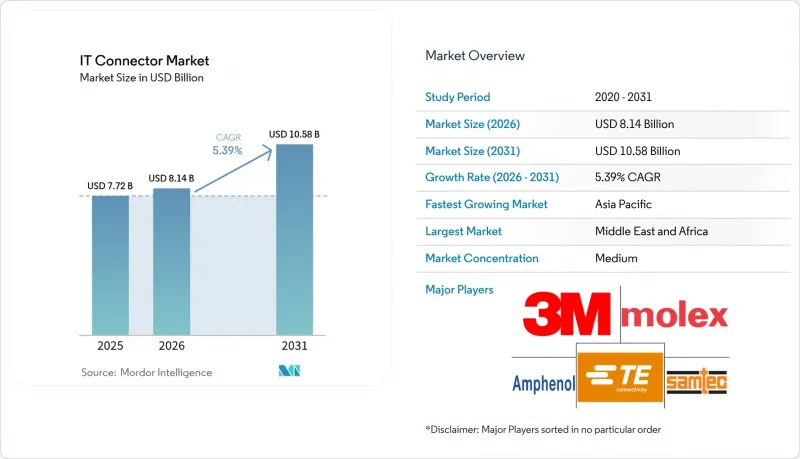
據 Mordor Intelligence 稱,IT 連接器市場預計到 2026 年價值 81.4 億美元,高於 2025 年的 77.2 億美元,預計到 2031 年將達到 105.8 億美元。
預計從 2026 年到 2031 年,其複合年成長率將達到 5.39%。
本報告按連接器類型(PCB連接器、IDC連接器等)、安裝方式(闆對板等)、數據速率等級(低於10 Gbps、10–25 Gbps等)、最終用戶行業(IT和電信等)、應用(伺服器和存儲等)、材料(標準熱塑性塑膠、無鹵化合物)和地區進行細分。市場預測以美元(USD)為單位。
全球IT連接器市場趨勢與洞察
超大規模資料中心對高速互連的需求激增
隨著頻寬密集型人工智慧叢集的頻寬傳輸速率超過 224 Gbps,連接器設計人員必須降低伺服器托盤空間有限情況下的插入損耗和溫升。 Molex 公司指出,由於用於 224 Gbps PAM4 連結的光收發器迅速普及,散熱如今與訊號完整性同等重要。這項工作涵蓋了從評估 PAM-6/PAM-8 調製方案到引入銅纜和光纖共封裝以縮短電通道長度等許多方面。超大規模資料中心業者營運商計劃每年運作120-130 個新站點,優先考慮可快速組裝的高密度連接器系統,同時將建設週期縮短至六週。
5G/6G 網路的快速部署正在推動射頻連接器的普及。
在越南等市場,2.6 GHz 和 3.5 GHz 頻段的頻率競標正在推動中頻段大型基地台和小型基地台的部署。大規模 MIMO 無線電技術正從 4T4R 擴展到 32T32R,加速向緊湊型 VSFF 介面的過渡,從而減少光纖數量。連接器供應商正積極響應,推出信噪比更高的產品,使去程傳輸機架的連接埠密度提高四倍。同時,中立業者正在擴大分散式天線系統 (DAS) 的部署,預計到 2028 年,DAS 的市場規模將達到 87 億美元。
銅和稀有金屬價格的波動推高了物料清單成本。
由於銅和鈀金價格飆升,多家元件廠商發布了價格調整通知,包括Panasonic於2025年1月宣布提高軟性PCB的價格。由於高速連接器採用厚銅合金和貴金屬鍍層,即使價格僅上漲5%,也可能對毛利率造成壓力。供應商們正在簽訂年度供貨契約,認證替代鍍層工藝,並致力於重新設計接觸梁以減輕重量,同時又不影響插拔速度。
細分市場分析
預計到2025年,PCB連接器將佔IT連接器市場規模的44.60%,這反映出其在包括主機板、儲存設備和工業控制器在內的各個領域的廣泛應用。可靠的引腳、成熟的插拔週期以及廣泛的組件生態系統鞏固了該類別在大批量生產應用中的地位。受《晶片法案》(CHIPS Act)的推動,國內PCB組裝的復甦持續促進了這一領域的發展,並帶動了對小間距夾層式連接器的國內需求成長。
受資料中心升級至支援單通道 112 Gbps 傳輸速率的 QSFP-DD 800 和 OSFP Xtreme 籠式封裝的推動,I/O/高速背板和插件連接器市場預計將以 5.55% 的複合年成長率成長。射頻/VSFF 連接器受益於 5G小型基地台密度的持續提高,而圓形和矩形外殼對於惡劣環境下的工業控制仍然至關重要。對於微型產品而言,即使在機器人手術和立方衛星應用中,節省即使一毫米的空間也能帶來顯著的價值。
闆對板連接仍將是模組化子組件的主要連接方式,到2025年將佔據35.40%的市場佔有率。堆疊式夾層連接和卡邊連接有助於OEM廠商解決筆記型電腦和開關閘刀中嚴格的Z軸高度限制。同時,線對板連接正以6.05%的複合年成長率成長,因為設計人員更傾向於使用線束來簡化電動車電池組和消費性電子產品的維護。
在基板空間有限的馬達驅動裝置和暖通空調壓縮機中,仍普遍採用線對線組件。如今,小型化趨勢正擴展到所有安裝方式。 Molex 強大的小型化系列產品在保持 IP67 防護等級的同時,可將尺寸縮小 20% 至 55%,直接滿足機器人和戶外通訊設備機殼的需求。
區域分析
預計到2025年,亞太地區將成為市場的主要驅動力,佔45.50%的市場收入。這主導中國垂直整合的電子產業基礎和印度快速發展的通訊骨幹網路。中國當地的連接器製造商正受益於旨在提高可靠性的省級激勵措施,預計到2024年,國內連接器產業規模將年增126億元。日本和韓國則透過在先進晶圓代工生產線中率先採用共封裝光學元件,為市場發展做出了貢獻。
北美位居第二。 《晶片與科學法案》已向台積電位於亞利桑那州的工廠投資66億美元,向英特爾投資85億美元,從而支持本地化先進基板和連接器籠的生態系統發展,這些基板和連接器籠符合224 Gbps PAM4熱要求。航太和國防計畫也正在推動符合軍用標準(MIL-STD)的穩健型、循環型產品的發展,這些產品能夠帶來高利潤率。
歐洲在汽車、工業4.0和醫療領域展現強勁實力。對無鹵塑膠的需求促使許多原始設備製造商(OEM)率先採用環保外殼。同時,中東和非洲地區預計將以5.92%的複合年成長率成長,這主要得益於超大規模資料中心業者建設區域性雲平台以及各國政府(尤其是沙烏地阿拉伯和阿拉伯聯合大公國)授予智慧城市光纖業務權益。南美洲的成長穩健但略顯緩慢,主要由巴西的電信業務和阿根廷的工業自動化計畫所推動。
其他好處:
- Excel格式的市場預測(ME)表
- 3個月的分析師支持
目錄
第1章:引言
- 市場分析與定義的前提條件
- 分析範圍
第2章 分析方法
第3章執行摘要
第4章 市場狀況
- 市場概覽
- 市場促進因素
- 超大規模資料中心對高速(超過 25 Gbps)互連的需求激增。
- 5G/6G 網路的快速部署正在推動亞洲地區射頻和 VSFF 連接器的日益普及。
- 基於汽車區域的EE架構正在推動電動車中高速闆對板連接器的採用。
- 共封裝光學元件的成長正在加速 I/O 連接器領域的創新。
- 邊緣人工智慧和工業IoT正在推動工廠自動化領域(主要集中在歐盟)對堅固耐用、密封性良好的連接器的需求。
- 在美國《晶片製造和整合產品法案》(CHIPS Act)的支持下,國內印刷基板的生產正在推動國內對連接器的需求。
- 市場限制因素
- 銅和稀有金屬價格的波動推高了物料清單(BOM)成本。
- PAM4 在 112 Gbps 以上的熱機械可靠性極限
- 汽車應用領域過長的PPAP週期延緩了連接器的設計與應用。
- 對無鹵塑膠日益嚴格的監管正在推高重新認證成本(歐盟)。
- 產業生態系分析
- 技術展望
- 波特五力分析
第5章:預測市場規模與成長率
- 依連接器類型
- PCB連接器
- IDC連接器
- IO/高速背板,插入式
- 圓形和方形
- RF/VSFF(SN、CS、MMC)
- 微型/奈米連接器
- 透過安裝配置
- 董事會
- 導線連接到電路板
- 線對線/電纜組件
- 按數據速率等級
- 10 Gbps 或更低
- 10~25 Gbps
- 25~56 Gbps
- 56 Gbps 或更高/PAM4 112G
- 按最終用戶行業分類
- 資訊科技和電信(包括資料中心)
- 家用電子電器和電腦
- 汽車和電動旅行
- 工業自動化/工業物聯網
- 醫療及醫療設備
- 透過使用
- 伺服器和儲存
- 5G/6G基地台
- 電動車動力傳動系統與高級駕駛輔助系統
- 工廠機器人和PLC
- 材料
- 標準熱塑性塑膠
- 無滷/環保化合物
- 按地區
- 北美洲
- 美國
- 加拿大
- 墨西哥
- 歐洲
- 德國
- 英國
- 法國
- 義大利
- 西班牙
- 俄羅斯
- 其他歐洲國家
- 亞太地區
- 中國
- 日本
- 韓國
- 印度
- ASEAN
- 其他亞太國家
- 南美洲
- 巴西
- 阿根廷
- 其他南美國家
- 中東和非洲
- 沙烏地阿拉伯
- 阿拉伯聯合大公國
- 土耳其
- 南非
- 其他中東和非洲國家
- 北美洲
第6章 競爭情勢
- 市場集中度
- 策略趨勢
- 市佔率分析
- 公司簡介
- 3M Company
- TE Connectivity Ltd.
- Molex Inc.(Koch)
- Amphenol Corporation
- Samtec Inc.
- Hirose Electric Co., Ltd.
- Aptiv PLC
- Yazaki Corporation
- Hon Hai Precision(FOXCONN)
- Phoenix Contact GmbH and Co. KG
- Harting Technology Group
- JST Mfg. Co., Ltd.
- WAGO Kontakttechnik
- Rosenberger Hochfrequenztechnik
- Bel Fuse Inc.
- Kyocera Corporation
- Luxshare Precision Industry
- JAE(Japan Aviation Electronics)
- Fischer Connectors SA
- CONEC Elektronische Bauelemente GmbH
- Omnetics Connector Corp.
- Wurth Elektronik GmbH and Co. KG
第7章 市場機會與未來展望
According to Mordor Intelligence, IT connector market size in 2026 is estimated at USD 8.14 billion, growing from 2025 value of USD 7.72 billion with 2031 projections showing USD 10.58 billion, growing at 5.39% CAGR over 2026-2031.
This report is Segmented by Connector Type (PCB Connectors, IDC Connectors, and More), Mounting Configuration (Board-To-Board, and More), Data-Rate Class (<=10 Gbps, 10-25 Gbps, and More), End-User Industry (IT and Telecom, and More), Application (Servers and Storage, and More), Materials (Standard Thermoplastics, Halogen-Free Compounds), and Geography. The Market Forecasts are Provided in Terms of Value (USD).
Global IT Connector Market Trends and Insights
Surging demand for high-speed interconnects in hyperscale data centers
Bandwidth-hungry AI clusters are transitioning beyond 224 Gbps per lane, forcing connector designers to mitigate insertion loss and thermal rise inside cramped server trays. Molex cites rapid uptake of optical transceivers for 224 Gbps PAM4 links, noting that heat removal is now as critical as signal integrity. Activities range from evaluating PAM-6 / PAM-8 modulation to deploying co-packaged copper and optics that shorten electrical channels. Hyperscalers plan to bring 120-130 new sites online every year, compressing build schedules to six weeks and favoring high-density connector systems that can be kitted and assembled rapidly.
Rapid 5G / 6G network roll-outs elevating RF connector adoption
Spectrum auctions in markets such as Vietnam for the 2.6 GHz and 3.5 GHz bands are fueling mid-band macro and small-cell deployments. Massive-MIMO radios are scaling from 4T4R to 32T32R, spurring the shift to compact VSFF interfaces that compress fiber counts. Connector vendors are responding with SN-class footprints that quadruple port density inside front-haul shelves, while carrier-neutral host operators expand distributed antenna systems valued at USD 8.7 billion by 2028.
Copper and rare-metal price volatility raising BOM costs
Surging copper and palladium prices have triggered multiple component price notices, such as Panasonic's January 2025 flex PCB increase. High-speed connectors use thick copper alloys and precious-metal platings, so even a 5% upswing can erode gross margins. Vendors are locking annual supply contracts, qualifying alternative platings, and redesigning contact beams to lower mass without compromising insertion cycles.
Other drivers and restraints analyzed in the detailed report include:
- Automotive zonal EE architectures boosting high-speed connectors
- Growth of co-packaged optics accelerating IO connector innovation
- Thermal-mechanical reliability limits at high data rates
For complete list of drivers and restraints, kindly check the Table Of Contents.
Segment Analysis
PCB connectors accounted for 44.60% of the IT connector market size in 2025, reflecting their ubiquity across motherboards, storage planes, and industrial controllers. Robust pin integrity, proven mating cycles, and broad component ecosystems keep this category entrenched in volume applications. The segment still benefits from the CHIPS Act-driven reshoring of PCB assembly, which lifts domestic demand for fine-pitch mezzanine formats.
The IO/high-speed backplane-and-pluggable group is forecast to grow at 5.55% CAGR, propelled by data center upgrades to QSFP-DD 800 and OSFP Xtreme cages capable of 112 Gbps per channel. RF/VSFF connectors benefit from 5G small-cell densification, while circular and rectangular housings remain essential for harsh-duty industrial controls. Microminiature options are seeing new use cases in robotic surgery and CubeSats that reward every millimeter saved.
Board-to-board held a 35.40% share in 2025 and remains the workhorse for modular sub-assemblies. Stacked mezzanine and card-edge variants help OEMs meet tight Z-height restrictions inside laptops and switch blades. However, wire-to-board is advancing at 6.05% CAGR as designers favor harnesses that simplify maintenance in EV battery packs and household appliances.
Wire-to-wire assemblies continue to service motor drives and HVAC compressors where board real estate is limited. The miniaturization trend now extends across all mounting styles; Molex's rugged miniaturized series offers 20-55% footprint reduction while retaining IP67 sealing, directly addressing robotics and outdoor telecom enclosures.
Complete Report Scope:
- By Connector Type
- PCB Connectors
- IDC Connectors
- IO/High-Speed Backplane and Pluggable
- Circular and Rectangular
- RF/VSFF (SN, CS, MMC)
- Microminiature/Nano Connectors
- By Mounting Configuration
- Board-to-Board
- Wire-to-Board
- Wire-to-Wire/Cable Assemblies
- By Data-Rate Class
- <=10 Gbps
- 10-25 Gbps
- 25-56 Gbps
- >=56 Gbps/PAM4 112 G
- By End-user Industry
- IT and Telecom (incl. Data Centers)
- Consumer Electronics and Computing
- Automotive and e-Mobility
- Industrial Automation/IIoT
- Healthcare and Medical Devices
- By Application
- Servers and Storage
- 5G/6G Base-Stations
- EV Powertrain and ADAS
- Factory Robotics and PLCs
- By Material
- Standard Thermoplastics
- Halogen-free/Eco-friendly Compounds
- Geography
- North America
- United States
- Canada
- Mexico
- Europe
- Germany
- United Kingdom
- France
- Italy
- Spain
- Russia
- Rest of Europe
- Asia-Pacific
- China
- Japan
- South Korea
- India
- ASEAN
- Rest of Asia-Pacific
- South America
- Brazil
- Argentina
- Rest of South America
- Middle East and Africa
- Saudi Arabia
- United Arab Emirates
- Turkey
- South Africa
- Rest of Middle East and Africa
- North America
Geography Analysis
Asia Pacific dominated with 45.50% market revenue in 2025, led by China's vertically integrated electronics base and India's fast-growing telecom backbone. Mainland connector producers benefit from provincial incentives aimed at reliability upgrades, with the domestic connector sector forecast to add RMB 12.6 billion year-on-year during 2024. Japan and South Korea contribute through the early adoption of co-packaged optics inside advanced foundry lines.
North America ranks second. The CHIPS and Science Act has already channeled USD 6.6 billion to TSMC Arizona and USD 8.5 billion to Intel, underpinning a localized ecosystem for advanced substrates and connector cages compliant with 224 Gbps PAM4 thermal requirements. Aerospace and defense programs also pull through rugged circular MIL-spec variants that command premium margins.
Europe plays to its strengths in automotive, Industry 4.0, and medical. The push for halogen-free plastics has turned many OEMs into early adopters of eco-class housings. Meanwhile, the Middle East and Africa is set for 5.92% CAGR as hyperscalers install regional cloud zones and governments award smart-city fiber concessions, particularly in Saudi Arabia and the UAE. South America shows steady but lower expansion, weighted toward Brazilian telecom and Argentine industrial automation projects.
- 3M Company
- TE Connectivity Ltd.
- Molex Inc. (Koch)
- Amphenol Corporation
- Samtec Inc.
- Hirose Electric Co., Ltd.
- Aptiv PLC
- Yazaki Corporation
- Hon Hai Precision (FOXCONN)
- Phoenix Contact GmbH and Co. KG
- Harting Technology Group
- JST Mfg. Co., Ltd.
- WAGO Kontakttechnik
- Rosenberger Hochfrequenztechnik
- Bel Fuse Inc.
- Kyocera Corporation
- Luxshare Precision Industry
- JAE (Japan Aviation Electronics)
- Fischer Connectors SA
- CONEC Elektronische Bauelemente GmbH
- Omnetics Connector Corp.
- Wurth Elektronik GmbH and Co. KG
Additional Benefits:
- The market estimate (ME) sheet in Excel format
- 3 months of analyst support
TABLE OF CONTENTS
1 INTRODUCTION
- 1.1 Study Assumptions and Market Definition
- 1.2 Scope of the Study
2 RESEARCH METHODOLOGY
3 EXECUTIVE SUMMARY
4 MARKET LANDSCAPE
- 4.1 Market Overview
- 4.2 Market Drivers
- 4.2.1 Surging Demand for High-Speed (>25 Gbps) Interconnects in Hyperscale Data Centers
- 4.2.2 Rapid 5G/6G Network Roll-outs Elevating RF and VSFF Connector Adoption in Asia
- 4.2.3 Automotive Zonal EE Architectures Boosting High-Speed Board-to-Board Connectors in EVs
- 4.2.4 Growth of Co-Packaged Optics Accelerating IO Connector Innovation
- 4.2.5 Edge-AI and Industrial IoT Driving Rugged, Sealed Connectors in Factory Automation (EU Focus)
- 4.2.6 United States CHIPS Act-Backed On-Shore PCB Production Lifts Domestic Connector Demand
- 4.3 Market Restraints
- 4.3.1 Copper and Rare-Metal Price Volatility Raising BOM Costs
- 4.3.2 Thermal-Mechanical Reliability Limits at >=112 Gbps PAM4
- 4.3.3 Lengthy Automotive PPAP Cycles Slowing Connector Design-ins
- 4.3.4 Regulatory Push for Halogen-Free Plastics Increasing Re-qualification Costs (EU)
- 4.4 Industry Ecosystem Analysis
- 4.5 Technological Outlook
- 4.6 Porter's Five Forces Analysis
- 4.6.1 Bargaining Power of Suppliers
- 4.6.2 Bargaining Power of Buyers
- 4.6.3 Threat of New Entrants
- 4.6.4 Threat of Substitutes
- 4.6.5 Competitive Rivalry
5 MARKET SIZE AND GROWTH FORECASTS (VALUES)
- 5.1 By Connector Type
- 5.1.1 PCB Connectors
- 5.1.2 IDC Connectors
- 5.1.3 IO/High-Speed Backplane and Pluggable
- 5.1.4 Circular and Rectangular
- 5.1.5 RF/VSFF (SN, CS, MMC)
- 5.1.6 Microminiature/Nano Connectors
- 5.2 By Mounting Configuration
- 5.2.1 Board-to-Board
- 5.2.2 Wire-to-Board
- 5.2.3 Wire-to-Wire/Cable Assemblies
- 5.3 By Data-Rate Class
- 5.3.1 <=10 Gbps
- 5.3.2 10-25 Gbps
- 5.3.3 25-56 Gbps
- 5.3.4 >=56 Gbps/PAM4 112 G
- 5.4 By End-user Industry
- 5.4.1 IT and Telecom (incl. Data Centers)
- 5.4.2 Consumer Electronics and Computing
- 5.4.3 Automotive and e-Mobility
- 5.4.4 Industrial Automation/IIoT
- 5.4.5 Healthcare and Medical Devices
- 5.5 By Application
- 5.5.1 Servers and Storage
- 5.5.2 5G/6G Base-Stations
- 5.5.3 EV Powertrain and ADAS
- 5.5.4 Factory Robotics and PLCs
- 5.6 By Material
- 5.6.1 Standard Thermoplastics
- 5.6.2 Halogen-free/Eco-friendly Compounds
- 5.7 Geography
- 5.7.1 North America
- 5.7.1.1 United States
- 5.7.1.2 Canada
- 5.7.1.3 Mexico
- 5.7.2 Europe
- 5.7.2.1 Germany
- 5.7.2.2 United Kingdom
- 5.7.2.3 France
- 5.7.2.4 Italy
- 5.7.2.5 Spain
- 5.7.2.6 Russia
- 5.7.2.7 Rest of Europe
- 5.7.3 Asia-Pacific
- 5.7.3.1 China
- 5.7.3.2 Japan
- 5.7.3.3 South Korea
- 5.7.3.4 India
- 5.7.3.5 ASEAN
- 5.7.3.6 Rest of Asia-Pacific
- 5.7.4 South America
- 5.7.4.1 Brazil
- 5.7.4.2 Argentina
- 5.7.4.3 Rest of South America
- 5.7.5 Middle East and Africa
- 5.7.5.1 Saudi Arabia
- 5.7.5.2 United Arab Emirates
- 5.7.5.3 Turkey
- 5.7.5.4 South Africa
- 5.7.5.5 Rest of Middle East and Africa
- 5.7.1 North America
6 COMPETITIVE LANDSCAPE
- 6.1 Market Concentration
- 6.2 Strategic Moves
- 6.3 Market Share Analysis
- 6.4 Company Profiles (includes Global level Overview, Market level overview, Core Segments, Financials as available, Strategic Information, Market Rank/Share, Products and Services, Recent Developments)
- 6.4.1 3M Company
- 6.4.2 TE Connectivity Ltd.
- 6.4.3 Molex Inc. (Koch)
- 6.4.4 Amphenol Corporation
- 6.4.5 Samtec Inc.
- 6.4.6 Hirose Electric Co., Ltd.
- 6.4.7 Aptiv PLC
- 6.4.8 Yazaki Corporation
- 6.4.9 Hon Hai Precision (FOXCONN)
- 6.4.10 Phoenix Contact GmbH and Co. KG
- 6.4.11 Harting Technology Group
- 6.4.12 JST Mfg. Co., Ltd.
- 6.4.13 WAGO Kontakttechnik
- 6.4.14 Rosenberger Hochfrequenztechnik
- 6.4.15 Bel Fuse Inc.
- 6.4.16 Kyocera Corporation
- 6.4.17 Luxshare Precision Industry
- 6.4.18 JAE (Japan Aviation Electronics)
- 6.4.19 Fischer Connectors SA
- 6.4.20 CONEC Elektronische Bauelemente GmbH
- 6.4.21 Omnetics Connector Corp.
- 6.4.22 Wurth Elektronik GmbH and Co. KG
7 MARKET OPPORTUNITIES AND FUTURE OUTLOOK
- 7.1 White-space and Unmet-need Assessment

 電源連接器市場:按產品類型、應用和地區分類
 全球前100大電子連接器製造商分析
 電子連接器市場:未來預測(至2034年)-按產品類型、連接器類型、安裝方式、材料、應用、最終用戶、銷售管道和地區分類的全球分析
 電纜連接器:市場佔有率分析、行業趨勢和統計數據、成長預測(2026-2031 年)
 2026年全球通用快速斷開接頭市場報告
 全球浮動連接器市場報告:歷史表現及預測(2021-2032年)
 歐洲連接器市場:2024年、2025年、2026年及2031年
 連接器產業年鑑(2026)2026年全球拖車7針連接器市場報告
 繼電器連接器市場報告:趨勢、預測和競爭分析(至2035年)