


 |
市場調查報告書
商品編碼
2124510
地暖:市場佔有率分析、產業趨勢與統計、成長預測(2026-2031)Underfloor Heating - Market Share Analysis, Industry Trends & Statistics, Growth Forecasts (2026 - 2031) |
||||||

※ 本網頁內容可能與最新版本有所差異。詳細情況請與我們聯繫。
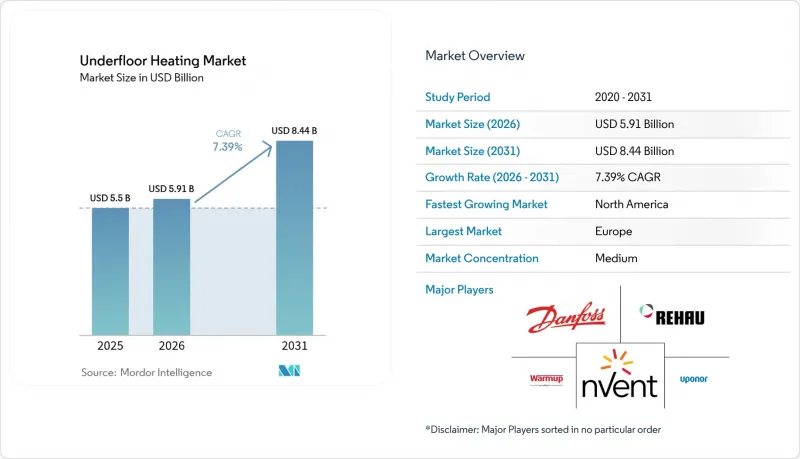
據 Mordor Intelligence 稱,2025 年地暖市場價值為 55 億美元,預計到 2031 年將達到 84.4 億美元,而 2026 年為 59.1 億美元,預測期(2026-2031 年)的複合年成長率為 7.39%。
本報告按「產品/服務」(硬體、服務)、「類型」(電熱水器)、「組件」(暖氣系統、控制系統等)、「安裝方式」(新安裝等)、「應用領域」(住宅、商業等)、「地板材料」(瓷磚、石材等)和「地區」(北美、歐洲等)對產業進行分類。市場規模和預測均以美元計價。
全球暖化市場趨勢及洞察
歐洲寒冷氣候地區對節能供暖的需求推動了熱水地暖的普及。
歐洲各國政府正將維修補貼與可再生能源的採用掛鉤,使熱水暖化成為主流建築規範。德國的《建築能源法》為符合其標準的系統提供高達70%的津貼。英國的《供熱網路技術保障計畫》制定了低溫供熱的性能標準。法國和義大利也推出了類似的獎勵,加速了市場普及。因此,由於規模化應用,組件價格正在下降,並且正在促進向太陽能和熱水地暖一體化系統的過渡,這符合歐盟的零排放目標。
在北歐國家,脫碳目標正在推動低溫輻射供暖的普及。
北歐各國當局建議供水溫度維持在 25–27 度C,以最大限度地提高熱泵的效率。丹麥的「熱泵池」計畫為可與地暖分水器無縫整合的水源熱泵提供 27,000 丹麥克朗的津貼。瑞典和挪威的區域供熱網路正在降低迴水溫度並減少系統熱損失。網路升級和建築能效提升的協同作用正在鞏固北歐地暖市場的長期需求。
南美洲新興市場的高昂初始安裝成本
熱水地暖系統的安裝成本為每平方英尺10至20美元,這在價格敏感型經濟體中可能難以負擔。外匯波動和對進口零件的依賴延長了投資回收期,限制了其在高階專案中的應用。低成本的電熱地暖由於電費高昂,運作成本也較高,凸顯了在地化生產的必要性。
細分市場分析
2024年,硬體仍將佔據銷售額的大部分,管道、電纜、歧管和執行器仍將作為必不可少的基礎組件進行採購。 Uponor等領導企業的標準化措施以及生物基PEX材料的創新正在減少隱性排放並降低總安裝成本。服務領域的銷售額雖然目前佔比小規模,但由於互聯平台的普及,對專業試運行和預測性維護訂閱服務的需求不斷成長,其複合年成長率(CAGR)高達8.92%。供應商現在將地板循環系統、智慧溫控器和安裝服務打包銷售,以確保性能保證並創造新的收入來源。在地暖市場,能夠降低生命週期風險並簡化業主決策流程的解決方案供應商越來越受到重視。
智慧控制設備需要根據使用情況進行客製化,並與建築管理系統整合,這增加了對技術人員的需求。售後服務最佳化合約有助於客戶達到監管機構規定的能源基準,將一次性設備銷售轉化為持續的收入來源。這些變化正在加強生態系統整合,並推動「硬體+服務」捆綁模式成為地暖市場的標準採購方式。
2025年,水循環系統憑藉其在各種安裝環境中卓越的運作成本效益,維持了60.85%的市場佔有率。同時,電熱地墊和電纜在空間受限的維修項目中表現出色,尤其是在需要最大限度減少地板厚度的情況下,其複合年成長率達到了8.34%。舒爾特(Schulter)的「DITRA-HEAT-E」組件總高度僅5.5毫米,無需改變門檻即可快速完成浴室維修。在多用戶住宅開發案中,採用熱水供暖、電加熱的混合佈局(關鍵區域採用熱水,潮濕區域採用電加熱)正變得越來越普遍。這種互補的部署模式正在擴大地暖的潛在市場。
由於熱水系統與熱泵和太陽能集熱器相容,因此在綠色建築領域仍然備受推崇。目前,控制系統可根據室外空氣感測器自動調節供水溫度,從而減少水泵的能量損失。電熱水系統憑藉先進的基於溫控器的分區控制和動態需量反應功能,具有很強的競爭力,並可從電力公司獲得補貼。隨著這些技術的進步,可以肯定的是,這兩種系統將在地暖市場共存,並在各自的項目類型中發展。
區域分析
即使到了2025年,歐洲仍將維持28.15%的市佔率。這得益於全部區域補貼計劃、低碳建築標準和成熟的承包商網路帶來的穩步普及。德國的補貼、英國的網路標準以及義大利的「生態獎勵計畫」提供了多層次的財政支持。北歐國家電網的脫碳進程與25 度C的溫控目標完美契合,從而打造了一個穩健的區域性地暖市場。歐洲製造商正投資於使用回收材料的PEX管道,從而提升產品全生命週期的環境性能,並鞏固其在該地區的技術領先地位。
亞太地區正呈現最快成長態勢,年複合成長率達10.28%,這主要得益於都市化進程、中產階級對舒適生活日益成長的期望以及各國智慧城市建設的推進。中國的熱泵推廣政策與低溫地暖應用產生了協同效應。日本和韓國的建築公司正在將地暖系統整合到智慧家庭系統中,利用物聯網控制技術進行能源管理,並根據居住情況進行個人化設定。在印度,輻射式地暖正被應用於豪華綜合用途大樓,以滿足日益嚴格的環保建築標準;而澳洲的度假村產業則正在使用與太陽能相連的熱水管道系統,以減少對柴油的依賴。
在北美,新建建築中地暖的普及率已相當成熟,同時政策推動了維修工程的激增。聯邦政府的電氣化計畫和2028年循環泵標準的實施,正在提升地暖的成本競爭力。隨著各州收緊對保溫性能的監管,預計維修集中區域的地暖市場規模將進一步擴大。
在中東,零售和旅館業的暖通空調系統改造正在推進,輻射式地暖有效緩解了高挑空間內的溫度分層問題。在南美,儘管面臨成本挑戰和貨幣疲軟的不利影響,但基礎設施投資正被用於將地暖系統整合到重點項目中。在非洲,由於承包商短缺和資金籌措,未來的發展仍處於理想階段,但有針對性的技能培訓計畫正在進行中。
其他好處:
- Excel格式的市場預測(ME)表
- 3個月的分析師支持
目錄
第1章:引言
- 研究假設和市場定義
- 調查範圍
第2章:調查方法
第3章執行摘要
第4章 市場狀況
- 市場概覽
- 市場促進因素
- 歐洲寒冷氣候地區對節能供暖的需求推動了熱水供暖系統的普及。
- 在北歐國家,由於脫碳目標,低溫輻射供暖具有優勢。
- 北美政府對電氣化維修的補貼
- 亞洲智慧家庭維修的快速發展正在推動智慧地暖控制系統的普及。
- 海灣合作理事會國家商業占地面積增加,採用地暖系統
- 大洋洲離網度假村透過太陽能和熱水利用解決方案降低成本
- 市場限制因素
- 南美洲新興市場的高昂初始實施成本
- 非洲缺乏技術熟練的承包商,阻礙了維修工程的廣泛發展。
- 與強制通風系統相比,預熱/冷卻延遲時間更長
- 熱帶地區潮濕氣候與地板材料相容性的問題。
- 價值供應鏈分析
- 監理展望
- 技術展望
- 波特五力分析
- 投資分析
第5章 市場規模與成長預測
- 報價
- 硬體
- 服務
- 依系統類型
- 電的
- 熱水循環型
- 按組件
- 暖氣管道和電纜
- 保溫板
- 歧管和混合單元
- 控制系統(恆溫器、感測器、致動器)
- 按安裝類型
- 新建工程
- 改裝
- 按地板材料
- 磁磚和石材
- 複合地板和工程木地板
- 地毯和毛毯
- 乙烯基和油氈
- 透過使用
- 住宅
- 獨立式住宅
- 多用戶住宅
- 商業的
- 辦公室
- 零售
- 飯店業
- 對機構而言
- 衛生保健
- 教育設施
- 產業
- 住宅
- 按地區
- 北美洲
- 美國
- 加拿大
- 墨西哥
- 南美洲
- 巴西
- 阿根廷
- 其他南美國家
- 歐洲
- 德國
- 英國
- 法國
- 義大利
- 西班牙
- 北歐的
- 比荷盧經濟聯盟
- 俄羅斯
- 其他歐洲國家
- 中東
- GCC
- 土耳其
- 其他中東國家
- 非洲
- 南非
- 奈及利亞
- 埃及
- 其他非洲國家
- 亞太地區
- 中國
- 日本
- 印度
- 韓國
- 東南亞
- 其他亞太國家
- 北美洲
第6章 競爭情勢
- 市場集中度
- 策略趨勢
- 市佔率分析
- 公司簡介
- Uponor Corporation
- Danfoss Group(incl. DEVI)
- nVent Electric plc(Raychem)
- Honeywell International Inc.
- Robert Bosch GmbH
- Mitsubishi Electric Corporation
- Siemens AG
- Schneider Electric SE
- Nexans SA
- Warmup PLC
- Rehau AG and Co.
- Pentair plc
- Watts Water Technologies Inc.
- Schluter Systems
- Nu-Heat UK Ltd.
- ThermoSoft International Corp.
- Flexel International Ltd.
- Eberle Controls GmbH
- Emmeti SpA
- Henco Industries
- Amuheat Pty Ltd.
第7章 市場機會與未來展望
According to Mordor Intelligence, the underfloor heating market size was valued at USD 5.5 billion in 2025 and estimated to grow from USD 5.91 billion in 2026 to reach USD 8.44 billion by 2031, at a CAGR of 7.39% during the forecast period (2026-2031).
This report Segments the Industry Into Offering (Hardware, Services), Type (Electric, Hydronic), Component (Heating Systems, Control Systems and More), Installation Type (New Installations, and More), Application (Residential, Commercial, and More), Floor Covering(Tiles and Stone, and More) and Geography (North America, Europe, and More). The Market Sizes and Forecasts are Provided in Terms of Value (USD).
Global Underfloor Heating Market Trends and Insights
Energy-Efficient Heating Demand in Cold-Climate Europe Driving Hydronic Adoption
Governments across Europe are tying renovation grants to renewable integration, pushing hydronic floor heating into mainstream building specifications. Germany's Building Energy Act funds up to 70% of compliant systems. The UK Heat Network Technical Assurance Scheme sets performance thresholds tailored to low-temperature heat distribution. Parallel incentives in France and Italy accelerate market penetration. The resulting scale lowers component prices and encourages a shift toward integrated solar-hydronic packages that align with the EU's zero-emission target.
Decarbonisation Targets Favour Low-Temperature Radiant Heating in Nordics
Nordic authorities promote supply temperatures of 25-27 °C that maximize heat-pump efficiency. Denmark's Heat Pump Pool offers DKK 27,000 grants for water-source units pairing seamlessly with underfloor manifolds. District-heating networks in Sweden and Norway gain lower return temperatures, reducing system losses. This synergy between grid upgrades and in-building efficiency cements long-run demand across the Nordic underfloor heating market.
High Up-front Installation Cost in Emerging South American Markets
Hydronic floor systems cost USD 10-20 per square foot to install, which can be challenging for affordability in price-sensitive economies. Currency volatility and reliance on imported components prolong payback periods, confining demand to upscale projects. Lower-cost electric mats face high tariff-driven running expenses, underscoring the need for localised production.
Other drivers and restraints analyzed in the detailed report include:
- Government Subsidies for Electrified Retrofitting in North America
- Rapid Smart-Home Renovations Boosting Intelligent Floor Heating Controls in Asia
- Limited Skilled Installers Restricting Retrofit Penetration in Africa
For complete list of drivers and restraints, kindly check the Table Of Contents.
Segment Analysis
Hardware generated the majority of 2024 revenue as pipes, cables, manifolds, and actuators remain non-negotiable building-block purchases. Standardisation efforts and bio-based PEX innovation by leaders such as Uponor cut embedded emissions and lower total installed cost. Services, although smaller in value, are growing at a 8.92% CAGR as connected platforms demand professional commissioning and predictive maintenance subscriptions. Vendors now package floor loops, smart thermostats, and installation services to safeguard performance warranties and create new margin streams. The underfloor heating market is increasingly rewarding solution providers that reduce lifecycle risk and streamline building owner decision-making processes.
Technician demand escalates because smart controls must be calibrated to occupancy profiles and integrated with building-management systems. After-sales optimisation contracts help customers hit energy-target benchmarks mandated by regulators, converting once-off equipment sales into annuity revenues. These shifts enhance ecosystem stickiness and cement hardware-plus-service bundles as the default procurement path within the underfloor heating market.
Hydronic loops retained a 60.85% share in 2025, thanks to superior operating cost economics in large footprints. Electric mats and cables, however, are registering an 8.34% CAGR by excelling in space-constrained renovations where minimal floor build-up is critical. The Schluter DITRA-HEAT-E assembly reduces total height to 5.5 mm, enabling rapid bathroom upgrades without door-threshold changes. Hybrid layouts, where hydronic supplies principal zones and electric patches serve wet rooms, are becoming common in multifamily developments. This complementary adoption pattern expands the addressable market for underfloor heating.
Hydronic systems continue to garner green-building accolades because they complement heat pumps and solar-thermal collectors. Controls now automatically adjust flow temperature based on outside-air sensors, reducing pump energy losses. Electric solutions compete through refined thermostatic zoning and dynamic demand-response functionality that unlock utility rebates. These technology pathways ensure both system categories will coexist and flourish in distinct project archetypes within the underfloor heating market.
Complete Report Scope:
- By Offering
- Hardware
- Services
- By System Type
- Electric
- Hydronic
- By Component
- Heating Pipes and Cables
- Insulation Panels
- Manifolds and Mixing Units
- Control Systems (Thermostats, Sensors and Actuators)
- By Installation Type
- New Construction
- Retrofit
- By Floor Covering
- Tiles and Stone
- Laminate and Engineered Wood
- Carpet and Rugs
- Vinyl and Linoleum
- By Application
- Residential
- Single-Family
- Multi-Family
- Commercial
- Offices
- Retail
- Hospitality
- Institutional
- Healthcare
- Educational Facilities
- Industrial
- Residential
- By Geography
- North America
- United States
- Canada
- Mexico
- South America
- Brazil
- Argentina
- Rest of South America
- Europe
- Germany
- United Kingdom
- France
- Italy
- Spain
- Nordics
- Benelux
- Russia
- Rest of Europe
- Middle East
- GCC
- Turkey
- Rest of Middle East
- Africa
- South Africa
- Nigeria
- Egypt
- Rest of Africa
- Asia-Pacific
- China
- Japan
- India
- South Korea
- Southeast Asia
- Rest of Asia-Pacific
- North America
Geography Analysis
Europe retained a 28.15% share in 2025 as region-wide grant schemes, low-carbon building codes, and mature installer networks underpin steady adoption. Germany's subsidies, the UK's network standards, and Italy's Eco Bonus provide multi-layered financial backing. Nordic grid decarbonisation aligns perfectly with 25 °C supply loops, creating a robust local underfloor heating market. European manufacturers invest in circular-material PEX pipelines, improving life-cycle credentials and safeguarding regional technological leadership.
The Asia-Pacific region exhibits the fastest trajectory, with a 10.28% CAGR, driven by urban densification, expanding middle-class comfort expectations, and national smart-city agendas. China's heat-pump schemes unlock synergistic low-temperature floor applications. Japanese and Korean builders utilize IoT controls for occupancy-driven energy management, integrating underfloor heating into home automation packages. India's premium mixed-use towers specify radiant floors to meet greener-building codes, while Australia's resort sector exploits solar-linked hydronic arrays to curb diesel reliance.
North America blends mature new-build uptake with policy-seeded retrofit momentum. Federal electrification incentives and 2028 circulator-pump standards enhance cost competitiveness. The underfloor heating market size for retrofit corridors is poised to expand as states tighten thermal envelope regulations.
The Middle East benefits from HVAC redesign in retail and hospitality, where radiant slabs counteract the effects of high ceiling stratification. South America faces affordability hurdles yet leverages infrastructure investment to integrate floor heating into flagship projects despite currency headwinds. Africa's pipeline remains aspirational, limited by installer scarcity and financing gaps, though targeted skills programmes are underway.
- Uponor Corporation
- Danfoss Group (incl. DEVI)
- nVent Electric plc (Raychem)
- Honeywell International Inc.
- Robert Bosch GmbH
- Mitsubishi Electric Corporation
- Siemens AG
- Schneider Electric SE
- Nexans SA
- Warmup PLC
- Rehau AG and Co.
- Pentair plc
- Watts Water Technologies Inc.
- Schluter Systems
- Nu-Heat UK Ltd.
- ThermoSoft International Corp.
- Flexel International Ltd.
- Eberle Controls GmbH
- Emmeti SpA
- Henco Industries
- Amuheat Pty Ltd.
Additional Benefits:
- The market estimate (ME) sheet in Excel format
- 3 months of analyst support
TABLE OF CONTENTS
1 INTRODUCTION
- 1.1 Study Assumptions and Market Definition
- 1.2 Scope of the Study
2 RESEARCH METHODOLOGY
3 EXECUTIVE SUMMARY
4 MARKET LANDSCAPE
- 4.1 Market Overview
- 4.2 Market Drivers
- 4.2.1 Energy-Efficient Heating Demand in Cold-Climate Europe Driving Hydronic Adoption
- 4.2.2 Decarbonisation Targets Favour Low-Temperature Radiant Heating in Nordics
- 4.2.3 Government Subsidies for Electrified Retrofitting in North America
- 4.2.4 Rapid Smart-Home Renovations Boosting Intelligent Floor Heating Controls in Asia
- 4.2.5 Rising Commercial Floor-Space in GCC Integrated with Underfloor Systems
- 4.2.6 Cost Savings from Solar-Hydronic Solutions in Off-Grid Oceania Resorts
- 4.3 Market Restraints
- 4.3.1 High Up-front Installation Cost in Emerging South American Markets
- 4.3.2 Limited Skilled Installers Restricting Retrofit Penetration in Africa
- 4.3.3 Latency in Heat-Up/Cool-Down vs. Forced-Air Systems
- 4.3.4 Moisture and Flooring-Material Compatibility Issues in Humid Tropics
- 4.4 Value / Supply-Chain Analysis
- 4.5 Regulatory Outlook
- 4.6 Technological Outlook
- 4.7 Porter's Five Forces Analysis
- 4.7.1 Bargaining Power of Suppliers
- 4.7.2 Bargaining Power of Buyers
- 4.7.3 Threat of New Entrants
- 4.7.4 Threat of Substitutes
- 4.7.5 Intensity of Rivalry
- 4.8 Investment Analysis
5 MARKET SIZE AND GROWTH FORECASTS (VALUE)
- 5.1 By Offering
- 5.1.1 Hardware
- 5.1.2 Services
- 5.2 By System Type
- 5.2.1 Electric
- 5.2.2 Hydronic
- 5.3 By Component
- 5.3.1 Heating Pipes and Cables
- 5.3.2 Insulation Panels
- 5.3.3 Manifolds and Mixing Units
- 5.3.4 Control Systems (Thermostats, Sensors and Actuators)
- 5.4 By Installation Type
- 5.4.1 New Construction
- 5.4.2 Retrofit
- 5.5 By Floor Covering
- 5.5.1 Tiles and Stone
- 5.5.2 Laminate and Engineered Wood
- 5.5.3 Carpet and Rugs
- 5.5.4 Vinyl and Linoleum
- 5.6 By Application
- 5.6.1 Residential
- 5.6.1.1 Single-Family
- 5.6.1.2 Multi-Family
- 5.6.2 Commercial
- 5.6.2.1 Offices
- 5.6.2.2 Retail
- 5.6.2.3 Hospitality
- 5.6.3 Institutional
- 5.6.3.1 Healthcare
- 5.6.3.2 Educational Facilities
- 5.6.4 Industrial
- 5.6.1 Residential
- 5.7 By Geography
- 5.7.1 North America
- 5.7.1.1 United States
- 5.7.1.2 Canada
- 5.7.1.3 Mexico
- 5.7.2 South America
- 5.7.2.1 Brazil
- 5.7.2.2 Argentina
- 5.7.2.3 Rest of South America
- 5.7.3 Europe
- 5.7.3.1 Germany
- 5.7.3.2 United Kingdom
- 5.7.3.3 France
- 5.7.3.4 Italy
- 5.7.3.5 Spain
- 5.7.3.6 Nordics
- 5.7.3.7 Benelux
- 5.7.3.8 Russia
- 5.7.3.9 Rest of Europe
- 5.7.4 Middle East
- 5.7.4.1 GCC
- 5.7.4.2 Turkey
- 5.7.4.3 Rest of Middle East
- 5.7.5 Africa
- 5.7.5.1 South Africa
- 5.7.5.2 Nigeria
- 5.7.5.3 Egypt
- 5.7.5.4 Rest of Africa
- 5.7.6 Asia-Pacific
- 5.7.6.1 China
- 5.7.6.2 Japan
- 5.7.6.3 India
- 5.7.6.4 South Korea
- 5.7.6.5 Southeast Asia
- 5.7.6.6 Rest of Asia-Pacific
- 5.7.1 North America
6 COMPETITIVE LANDSCAPE
- 6.1 Market Concentration
- 6.2 Strategic Moves
- 6.3 Market Share Analysis
- 6.4 Company Profiles (includes Global level Overview, Market level overview, Core Segments, Financials as available, Strategic Information, Market Rank/Share, Products and Services, Recent Developments)
- 6.4.1 Uponor Corporation
- 6.4.2 Danfoss Group (incl. DEVI)
- 6.4.3 nVent Electric plc (Raychem)
- 6.4.4 Honeywell International Inc.
- 6.4.5 Robert Bosch GmbH
- 6.4.6 Mitsubishi Electric Corporation
- 6.4.7 Siemens AG
- 6.4.8 Schneider Electric SE
- 6.4.9 Nexans SA
- 6.4.10 Warmup PLC
- 6.4.11 Rehau AG and Co.
- 6.4.12 Pentair plc
- 6.4.13 Watts Water Technologies Inc.
- 6.4.14 Schluter Systems
- 6.4.15 Nu-Heat UK Ltd.
- 6.4.16 ThermoSoft International Corp.
- 6.4.17 Flexel International Ltd.
- 6.4.18 Eberle Controls GmbH
- 6.4.19 Emmeti SpA
- 6.4.20 Henco Industries
- 6.4.21 Amuheat Pty Ltd.
7 MARKET OPPORTUNITIES AND FUTURE OUTLOOK
- 7.1 White-Space and Unmet-Need Assessment

 防凍脹地暖系統市場:全球市場預測,2026-2032年石墨烯地暖系統市場:全球市場預測,2026-2032年
 全球地暖市場(2032-2032):依產品類型(歧管和閥門、區域閥門、暖氣管路、佈線中心、熱執行器、加熱電纜、加熱墊、溫控器和感測器)、安裝類別(新建、維修)、供應類別和地區分類
 2026-2030年全球暖化市場
 地暖市場規模、佔有率、成長、全球產業分析、區域趨勢及2026-2034年預測地暖市場-2026-2032年全球市場預測
 2026 年至 2035 年商用地暖的市場機會、成長要素、產業趨勢與預測。
 2026年全球地暖市場報告全球電地暖市場:市場規模、佔有率、趨勢和成長分析(2026-2034)
 地暖市場分析及預測(至2035年):按類型、產品類型、技術、組件、應用、材質、安裝方法、設備、解決方案和最終用戶分類