


 |
市場調查報告書
商品編碼
2124493
農業包裝:市場佔有率分析、產業趨勢與統計、成長預測(2026-2031)Agricultural Packaging - Market Share Analysis, Industry Trends & Statistics, Growth Forecasts (2026 - 2031) |
||||||

※ 本網頁內容可能與最新版本有所差異。詳細情況請與我們聯繫。
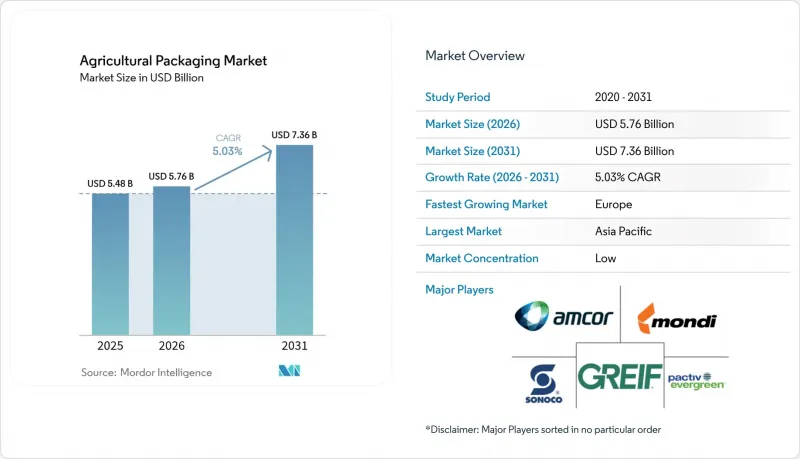
預計到 2026 年,農產品包裝市場價值將達到 57.6 億美元,高於 2025 年的 54.8 億美元,預計到 2031 年將達到 73.6 億美元。
預計從 2026 年到 2031 年,年複合成長率將達到 5.03%。
本報告按材料類型(塑膠、紙/紙板、金屬、複合材料、可生物分解薄膜)、應用領域(農藥、肥料、種子/性狀、作物保護用生技藥品)、產品形式(袋裝/包裝袋、散裝容器等)、容量範圍(25公斤以下/20公升以下、26-100公斤/21-200公斤地區進行細分。市場預測以美元計價。
全球農業包裝市場趨勢及洞察
農藥和化肥需求不斷成長
各國為提高作物產量而努力,全球農藥和化肥的消耗量持續成長。 2024年上半年,印度監管機構批准了416種新的農作物保護產品,涵蓋傳統殺蟲劑和新型活性成分,導致包裝量增加。經過40年的轉型,中國已成為全球最大的農藥出口國,因此需要符合多個出口市場法規的標準化包裝形式。在美國,針對亞洲進口2,4-D的反傾銷調查促使美國重新檢視其國內灌裝計畫。同時,菲律賓當局查獲假化學品,凸顯了防篡改包裝在保護品牌的重要性(pna.gov.ph)。在糧食安全計畫和精準噴灑設備普及的推動下,農業包裝市場對阻隔性複合材料(可防止洩漏並減少工人接觸)以及小容量專用包裝袋的需求不斷成長。
永續性驅動的材料創新
歐盟的《包裝和包裝指令》(PPWR) 規定,到2030年所有包裝材料必須可回收利用,目標是到那時達到30%的再生PET含量,到2040年提高到50%。 Mondi公司的紙基「Advantage Kraft Mulch」正在取代黑色PE地膜,這表明材料替代在實際應用中勢頭強勁。關於大麻硬質(大麻莖)模塑纖維和木質素基奈米複合材料的學術研究表明,生物基材可以展現出與石油基薄膜相當的防潮性和紫外線阻隔性能。 Greif公司的「EnviroRAP」紙板和Lactips公司的可食用薄膜的專利進一步證實了永續材料正從試點階段走向商業化規模。由於生產者延伸責任制(EPR)費用對不可回收材料不利,加工商正在加快對生物塑膠、單層複合材料和水性阻隔材料的研發投入。
對塑膠和揮發性有機化合物的監管壓力
《PPWR法案》禁止在食品接觸包裝中使用超過閾值的全氟烷基和多氟烷基物質,這將淘汰許多先前用於化肥袋的含氟聚合物塗層。加州SB 343法案將從2026年10月起禁止在未通過可回收性測試的包裝上使用「追逐箭頭」標誌,而SB 54法案則要求到2032年將塑膠使用量減少25%。奧勒岡州的《EPR法案》要求從2025年4月起詳細報告包裝重量,將增加小規模加工商的行政負擔。研究表明,目前的堆肥設施無法有效地將生物袋與傳統塑膠分離,這使得商業可堆肥性聲明變得複雜。總而言之,這些法規可能需要對設計進行更改,這可能導致農業包裝市場材料轉換成本增加和延誤。
細分市場分析
到2025年,塑膠將佔農業包裝市場46.05%的佔有率。這主要歸功於塑膠的耐用性、輕盈性和成熟的供應鏈。高密度聚苯乙烯桶和聚丙烯編織袋因其優異的抗穿刺性和耐化學性,在化肥和農藥應用中佔據主導地位。然而,農業包裝市場正迅速轉向可生物分解薄膜,這是成長最快的細分市場,預計到2031年年複合成長率(CAGR)將達到8.01%。歐洲法規要求到2030年PET中必須含有30%的再生材料,這迫使加工商要麼摻入廢舊樹脂,要麼徹底更換材料。 Mondi和Graif等製造商分別將紙基地膜和100%再生紙板襯墊商業化,在提供類似性能的同時,也能減輕生產者延伸責任(EPR)的負擔。
大麻纖維模塑基材和木質素生物奈米複合材料領域的學術突破加劇了市場競爭,因為它們展現出以往只有聚合物層壓材料才具備的防潮、抗氧和抗紫外線性能。儘管複合多層材料在高價值種子和微量營養素包裝領域仍佔據一席之地,但由於回收利用方面的擔憂以及層間分離成本較高,其成長速度較為緩慢。金屬桶被用作高揮發性除草劑的容器,但銷售量保持穩定,並未出現成長。總體而言,對永續性的需求正在重塑整個農業包裝市場的原料採購、模具投資和品牌訊息訊息。
到2025年,化肥將佔銷售額的38.02%,憑藉其在提高作物產量方面發揮的關鍵作用,佔據農業包裝市場最大的佔有率。由於顆粒狀營養物質需要耐磨結構,因此袋裝、軟性集裝袋(FIBC)和複合袋佔據主導地位。同時,儘管作物保護生物製品的基數較小,但由於生產商採用微生物接種劑和生物促效劑以符合殘留物法規,其複合年成長率(CAGR)高達7.45%。這些活性微生物需要冷藏和阻隔性氧包裝袋或硬質瓶才能保持其活性,推動了冷鏈相容包裝形式的創新。
儘管傳統合成農藥仍佔據市場很大佔有率,但隨著毒性監管日益嚴格,其成長速度正在放緩。種子性狀包裝需要改善防塵措施並設置精確的排粉孔,以保護其遺傳性能。世界各國政府都在直接投資包裝研發,美國農業部(USDA)已撥款1000萬美元設立“永續包裝創新實驗室”,專注於服務農產品出口商。這反映出人們越來越認知到包裝在促進貿易方面的作用。變色油墨和防篡改環等防偽措施正日益普及,成為發展中國家打擊仿冒品農產品的有效手段。
區域分析
預計到2025年,亞太地區將佔據全球農業包裝市場39.85%的佔有率。這主要得益於中國轉型成為全球最大的農藥出口國以及印度大力推動化肥強化種植。快速的機械化進程、種子和園藝產品電商管道的拓展以及政府對糧食安全的重視,都在推動該地區的發展前景。越南紙質包裝的銷售額清楚地反映了這種外溢效應,預計到2026年將達到35億美元,年均成長率達9.73%。隨著亞洲在全球農藥市場佔有率的快速成長,加工商正在擴大本地樹脂回收利用,並投資建造無溶劑複合生產線,以滿足下游品牌的需求。
在嚴格的循環經濟法規和願意為經認證的永續產品買單的富裕消費者的支持下,預計到2031年,歐洲將保持最高的成長率,年複合成長率將達到7.86%。僅《塑膠包裝廢棄物法規》(PPWR)一項就要求對包裝結構進行系統性的重新設計,為引入模塑纖維托盤、單一材料薄膜和可記錄產地資訊的智慧標籤創造了條件。此外,歐盟綠色交易的補貼正在促進將農場生質能轉化為包裝材料,從而縮短供應鏈。
在北美,受出口導向糧食和園藝產業的推動,需求依然強勁。美國農業部 (USDA) 預測出口量將創歷史新高,並依靠防潮內襯和QR碼托盤標籤來符合國際植物檢疫措施標準第15號 (ISPM-15) 的木材加工和可追溯性規定。中東和非洲雖然規模仍然較小,但將加速推進進口替代計劃,並擴大水產養殖業,因此需要適用於乾燥氣候的軟包裝和硬包裝。在拉丁美洲,巴西的機械化和生物肥料的推廣應用,為專業生產阻隔性多層包裝袋的製造商創造了新的機會。
其他好處:
- Excel格式的市場預測(ME)表
- 3個月的分析師支持
目錄
第1章:引言
- 研究假設和市場定義
- 調查範圍
第2章:調查方法
第3章執行摘要
第4章 市場狀況
- 市場概覽
- 市場促進因素
- 農藥需求不斷成長
- 永續性驅動的材料創新
- 農產品跨境貿易的擴張
- 引入機械化和散裝搬運
- 智慧/QR碼相容的可追溯包裝
- 市場限制因素
- 對塑膠和揮發性有機化合物的監管壓力
- 原物料價格波動
- 假冒農產品推高了合規成本。
- 供應鏈分析
- 監理情勢
- 技術展望
- 投資分析
- 波特五力分析
第5章 市場規模與成長預測
- 材料類型
- 塑膠
- 紙張和紙板
- 金屬
- 複合材料
- 可生物分解薄膜
- 透過使用
- 殺蟲劑
- 肥料
- 種子和性狀
- 作物保護生技藥品
- 按產品形式
- 包包
- 散裝容器(軟性貨櫃、桶、中型散裝容器)
- 小袋
- 硬質容器(罐頭、瓶子)
- 瓶蓋、蓋子、襯墊
- 按生產能力範圍分類
- 25公斤或以下/20公升或以下
- 26~100 kg/21~200 L
- 100公斤或以上 / 200公升(散裝)
- 按地區
- 北美洲
- 美國
- 加拿大
- 墨西哥
- 歐洲
- 德國
- 英國
- 法國
- 義大利
- 西班牙
- 俄羅斯
- 其他歐洲國家
- 亞太地區
- 中國
- 印度
- 日本
- 韓國
- 澳洲和紐西蘭
- 其他亞太國家
- 中東和非洲
- 中東
- 阿拉伯聯合大公國
- 沙烏地阿拉伯
- 土耳其
- 其他中東國家
- 非洲
- 南非
- 奈及利亞
- 埃及
- 其他非洲國家
- 中東
- 北美洲
第6章 競爭情勢
- 市場集中度
- 策略趨勢
- 市佔率分析
- 公司簡介
- Amcor plc
- Mondi Group
- Greif Inc.
- LC Packaging International
- NNZ Group
- Sonoco Products
- ProAmpac LLC
- BAG Corporation
- FlexPack FIBC
- Smurfit WestRock
- Silgan Holdings
- Bischof+Klein
- RKW Group
- NPP Group
- Western Packaging
- Pactiv Evergreen
- Anderson Packaging
- Bulk Lift International
- Mega Pack
第7章 市場機會與未來展望
According to Mordor Intelligence, the agricultural packaging market size in 2026 is estimated at USD 5.76 billion, growing from 2025 value of USD 5.48 billion with 2031 projections showing USD 7.36 billion, growing at 5.03% CAGR over 2026-2031.
This report is Segmented by Material Type (Plastic, Paper and Paperboard, Metal, Composite, Biodegradable Films), Application (Pesticides, Fertilizers, Seeds and Traits, Crop Protection Biologics), Product Form (Bags and Sacks, Bulk Containers, and More), Capacity Range (<=25 Kg/<=20 L, 26-100 Kg/21-200 L, and More), and Geography. The Market Forecasts are Provided in Terms of Value (USD).
Global Agricultural Packaging Market Trends and Insights
Growing Demand for Agro-Chemicals
Global pesticide and fertilizer consumption keeps rising as nations pursue higher yields. India's regulators cleared 416 new crop-protection products in H1 2024, spanning legacy insecticides and novel actives, thereby boosting packaging volumes. China's four-decade transition into the world's largest pesticide exporter demands standardized pack formats that comply with multiple destination-market rules. In the United States, anti-dumping probes on 2,4-D imports from Asia reshape domestic filling plans, while Philippine authorities' seizure of counterfeit chemicals underscores the role of tamper-evident packaging in brand protection pna.gov.ph. Driven by food-security programs and precision-application equipment, the agricultural packaging market welcomes higher-barrier laminates and smaller dose-specific pouches that reduce spillage and worker exposure.
Sustainability-Driven Material Innovations
The EU's PPWR obliges all packs to be recyclable by 2030 and fixes recycled-content quotas of 30% for PET by that date, rising to 50% by 2040. Mondi's paper-based Advantage Kraft Mulch replaces black PE mulch film, signalling material substitution momentum in field applications. Academic work on hemp-hurd molded fiber and lignin-based nanocomposites shows that bio-derived substrates can deliver moisture resistance and UV shielding comparable to petroleum-based films. Greif's EnviroRAP paperboard and Lactips' edible-film patents add further evidence that sustainable materials are moving from pilot to commercial scale. As EPR fees penalise unrecyclable formats, converters accelerate R&D spend on bio-resins, mono-material laminates, and water-based barriers.
Regulatory Pressure on Plastics and VOCs
The PPWR bans per- and polyfluoroalkyl substances above threshold limits in food-contact packs, eliminating numerous fluoropolymer coatings used on fertilizer bags. California's SB 343 will prohibit "chasing-arrows" symbols on packs that fail recyclability tests after October 2026, while SB 54 compels a 25% plastic reduction by 2032. Oregon's EPR law demands granular reporting of packaging weights from April 2025, raising administrative overhead for small converters. Studies reveal that current composting facilities cannot separate bio-bags from conventional plastics effectively, complicating claims of commercial compostability. Collectively, these statutes force design changes that may elevate costs and slow material changeovers in the agricultural packaging market.
Other drivers and restraints analyzed in the detailed report include:
- Expansion of Cross-Border Agri-Produce Trade
- Mechanisation and Bulk-Handling Adoption
- Raw-Material Price Volatility
For complete list of drivers and restraints, kindly check the Table Of Contents.
Segment Analysis
Plastic accounted for 46.05% of the agricultural packaging market share in 2025, thanks to its durability, lightweight, and ingrained supply chains. High-density polyethylene drums and polypropylene woven sacks dominate fertilizer and pesticide applications because they resist puncture and chemicals. Yet the agricultural packaging market is experiencing a rapid pivot toward biodegradable films, the fastest-growing sub-segment at an 8.01% CAGR through 2031. European regulations imposing 30% recycled content on PET by 2030 push converters to blend post-consumer resin or switch materials entirely.Producers such as Mondi and Greif commercialize paper-based mulch and 100% recycled paperboard liners, respectively, offering comparable performance while easing EPR liabilities.
The competitive intensity is rising as academic breakthroughs in hemp-fiber molded substrates and lignin-bionanocomposites promise moisture, oxygen, and UV performance formerly exclusive to polymer laminates. Composite multilayers maintain a niche in high-value seeds and micro-nutrient sachets, although recyclability concerns and layer-separation costs keep their growth modest. Metal pails serve ultra-volatile herbicides, but volumes are stable rather than expanding. Overall, sustainability imperatives are redefining raw-material procurement, tooling investments, and brand-owner messaging across the agricultural packaging market.
Fertilizers generated 38.02% of 2025 revenue, securing the largest slice of the agricultural packaging market size through their essential role in maximizing yields. Bags, FIBC, and laminated sacks dominate because granulated nutrients require abrasion-resistant structures. Conversely, crop-protection biologics, while starting from a smaller base, hold the highest 7.45% CAGR as growers adopt microbial inoculants and biostimulants to meet residue-limit regulations. These live organisms demand chilled, oxygen-barrier pouches or rigid bottles that preserve viability, driving innovation in cold-chain compatible formats.
Traditional synthetic pesticides continue to command large tonnage, yet their growth moderates under stricter toxicity norms. Seed-trait packaging seeks improved dust retention and precise dispensing holes to safeguard genetic performance. Governments are investing directly in packaging R&D; USDA earmarked USD 10 million for a Sustainable Packaging Innovation Lab focused on produce exporters, reflecting growing recognition of packaging as a trade enabler. Authenticity safeguards such as color-shift inks and tamper rings are proliferating to combat counterfeit agricultural inputs in developing markets.
Complete Report Scope:
- By Material Type
- Plastic
- Paper and Paperboard
- Metal
- Composite
- Biodegradable Films
- By Application
- Pesticides
- Fertilizers
- Seeds and Traits
- Crop Protection Biologics
- By Product Form
- Bags and Sacks
- Bulk Containers (FIBC, Drums, IBC)
- Pouches
- Rigid Containers (Cans, Bottles)
- Caps, Lids and Liners
- By Capacity Range
- <=25 kg / <=20 L
- 26 - 100 kg/ 21 - 200 L
- More than 100 kg/ 200 L (Bulk)
- By Geography
- North America
- United States
- Canada
- Mexico
- Europe
- Germany
- United Kingdom
- France
- Italy
- Spain
- Russia
- Rest of Europe
- Asia-Pacific
- China
- India
- Japan
- South Korea
- Australia and New Zealand
- Rest of Asia-Pacific
- Middle East and Africa
- Middle East
- United Arab Emirates
- Saudi Arabia
- Turkey
- Rest of Middle East
- Africa
- South Africa
- Nigeria
- Egypt
- Rest of Africa
- Middle East
- North America
Geography Analysis
Asia-Pacific anchored 39.85% of agricultural packaging market share in 2025, propelled by China's transformation into the world's largest pesticide exporter and India's fertilizer-intensification drive. Rapid mechanisation, expanding e-commerce channels for seeds and garden products, and governmental food-security priorities keep the regional outlook robust. Vietnam's paper-packaging sales illustrate the spill-over effect, forecast to reach USD 3.5 billion by 2026 on a 9.73% yearly climb. As Asia's share of global agri-chemicals balloons, converters increase local resin recycling and invest in solvent-free lamination lines to meet downstream brand requirements.
Europe is on track to log the fastest 7.86% CAGR through 2031, buoyed by stringent circular-economy legislation and affluent consumers willing to pay for certified-sustainable agricultural produce. The PPWR alone compels systematic redesign of pack structures, opening space for molded-fiber trays, mono-material films, and smart labels that capture provenance data. Additionally, EU Green Deal subsidies encourage on-farm biomass conversion into packaging feedstock, shortening supply chains.
North America maintains healthy demand on the back of export-oriented grain and horticulture segments. USDA forecasts highlight record outbound shipments that rely on moisture-barrier liners and QR-coded pallet tags to comply with ISPM-15 wood-treatment and traceability rules. The Middle East and Africa, while smaller today, show accelerating import-substitution programs and aquaculture expansion that will require both flexible and rigid packs suited to arid climates. Latin America benefits from Brazilian mechanisation and bio-fertilizer adoption, issuing new opportunities for producers specialising in high-barrier multilayer bags.
- Amcor plc
- Mondi Group
- Greif Inc.
- LC Packaging International
- NNZ Group
- Sonoco Products
- ProAmpac LLC
- BAG Corporation
- FlexPack FIBC
- Smurfit WestRock
- Silgan Holdings
- Bischof + Klein
- RKW Group
- NPP Group
- Western Packaging
- Pactiv Evergreen
- Anderson Packaging
- Bulk Lift International
- Mega Pack
Additional Benefits:
- The market estimate (ME) sheet in Excel format
- 3 months of analyst support
TABLE OF CONTENTS
1 INTRODUCTION
- 1.1 Study Assumptions and Market Definition
- 1.2 Scope of the Study
2 RESEARCH METHODOLOGY
3 EXECUTIVE SUMMARY
4 MARKET LANDSCAPE
- 4.1 Market Overview
- 4.2 Market Drivers
- 4.2.1 Growing demand for agro-chemicals
- 4.2.2 Sustainability-driven material innovations
- 4.2.3 Expansion of cross-border agri-produce trade
- 4.2.4 Mechanisation and bulk handling adoption
- 4.2.5 Smart / QR-enabled traceability packaging
- 4.3 Market Restraints
- 4.3.1 Regulatory pressure on plastics and VOCs
- 4.3.2 Raw-material price volatility
- 4.3.3 Counterfeit ag-inputs raising compliance cost
- 4.4 Supply-Chain Analysis
- 4.5 Regulatory Landscape
- 4.6 Technological Outlook
- 4.7 Investment Analysis
- 4.8 Porter's Five Forces Analysis
- 4.8.1 Bargaining Power of Suppliers
- 4.8.2 Bargaining Power of Buyers
- 4.8.3 Threat of New Entrants
- 4.8.4 Threat of Substitutes
- 4.8.5 Competitive Rivalry
5 MARKET SIZE AND GROWTH FORECASTS (VALUE)
- 5.1 By Material Type
- 5.1.1 Plastic
- 5.1.2 Paper and Paperboard
- 5.1.3 Metal
- 5.1.4 Composite
- 5.1.5 Biodegradable Films
- 5.2 By Application
- 5.2.1 Pesticides
- 5.2.2 Fertilizers
- 5.2.3 Seeds and Traits
- 5.2.4 Crop Protection Biologics
- 5.3 By Product Form
- 5.3.1 Bags and Sacks
- 5.3.2 Bulk Containers (FIBC, Drums, IBC)
- 5.3.3 Pouches
- 5.3.4 Rigid Containers (Cans, Bottles)
- 5.3.5 Caps, Lids and Liners
- 5.4 By Capacity Range
- 5.4.1 <=25 kg / <=20 L
- 5.4.2 26 - 100 kg/ 21 - 200 L
- 5.4.3 More than 100 kg/ 200 L (Bulk)
- 5.5 By Geography
- 5.5.1 North America
- 5.5.1.1 United States
- 5.5.1.2 Canada
- 5.5.1.3 Mexico
- 5.5.2 Europe
- 5.5.2.1 Germany
- 5.5.2.2 United Kingdom
- 5.5.2.3 France
- 5.5.2.4 Italy
- 5.5.2.5 Spain
- 5.5.2.6 Russia
- 5.5.2.7 Rest of Europe
- 5.5.3 Asia-Pacific
- 5.5.3.1 China
- 5.5.3.2 India
- 5.5.3.3 Japan
- 5.5.3.4 South Korea
- 5.5.3.5 Australia and New Zealand
- 5.5.3.6 Rest of Asia-Pacific
- 5.5.4 Middle East and Africa
- 5.5.4.1 Middle East
- 5.5.4.1.1 United Arab Emirates
- 5.5.4.1.2 Saudi Arabia
- 5.5.4.1.3 Turkey
- 5.5.4.1.4 Rest of Middle East
- 5.5.4.2 Africa
- 5.5.4.2.1 South Africa
- 5.5.4.2.2 Nigeria
- 5.5.4.2.3 Egypt
- 5.5.4.2.4 Rest of Africa
- 5.5.4.1 Middle East
- 5.5.1 North America
6 COMPETITIVE LANDSCAPE
- 6.1 Market Concentration
- 6.2 Strategic Moves
- 6.3 Market Share Analysis
- 6.4 Company Profiles (includes Global level Overview, Market level overview, Core Segments, Financials as available, Strategic Information, Market Rank/Share for key companies, Products and Services, and Recent Developments)
- 6.4.1 Amcor plc
- 6.4.2 Mondi Group
- 6.4.3 Greif Inc.
- 6.4.4 LC Packaging International
- 6.4.5 NNZ Group
- 6.4.6 Sonoco Products
- 6.4.7 ProAmpac LLC
- 6.4.8 BAG Corporation
- 6.4.9 FlexPack FIBC
- 6.4.10 Smurfit WestRock
- 6.4.11 Silgan Holdings
- 6.4.12 Bischof + Klein
- 6.4.13 RKW Group
- 6.4.14 NPP Group
- 6.4.15 Western Packaging
- 6.4.16 Pactiv Evergreen
- 6.4.17 Anderson Packaging
- 6.4.18 Bulk Lift International
- 6.4.19 Mega Pack
7 MARKET OPPORTUNITIES AND FUTURE OUTLOOK
- 7.1 White-space and Unmet-Need Assessment

 2026年全球農業化學品包裝市場報告
 農業化學品包裝:市場佔有率分析、產業趨勢與統計、成長預測(2026-2031)
 農業包裝市場:2026-2032年全球市場預測(按包裝材料、包裝形式、技術、分銷管道、應用和最終用戶分類)
 農業化學品包裝市場規模、佔有率、成長率、全球產業分析、區域分析及未來預測(2026-2034)
 農業化學品包裝市場規模、佔有率和趨勢分析報告:按材料、化學品、地區和細分市場分類(2026-2033 年)
 農業包裝市場報告:按材料、產品類型、阻隔性能、應用和地區分類(2026-2034 年)
 農業包裝市場分析及預測(至2035年):依類型、產品類型、材質、應用、技術、最終使用者、功能、形式、實施類型及解決方案分類農業包裝市場分析及預測(至2035年):依類型、產品類型、材質、應用、技術、最終用戶、形式、製程及功能分類全球農業包裝市場規模、佔有率、趨勢和成長分析報告(2026-2034年)
 農業包裝市場-全球產業規模、佔有率、趨勢、機會和預測:按產品、材料、應用、地區和競爭格局分類,2021-2031年