


 |
市場調查報告書
商品編碼
2116026
農業化學品包裝:市場佔有率分析、產業趨勢與統計、成長預測(2026-2031)Agriculture Chemical Packaging - Market Share Analysis, Industry Trends & Statistics, Growth Forecasts (2026 - 2031) |
||||||

※ 本網頁內容可能與最新版本有所差異。詳細情況請與我們聯繫。
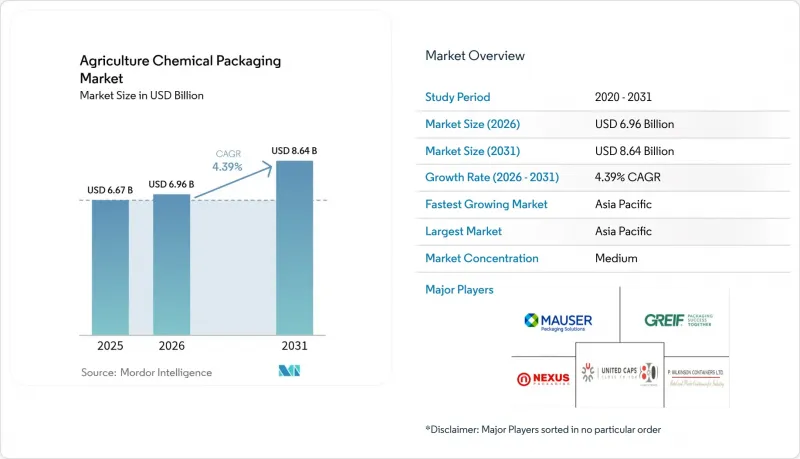
據 Mordor Intelligence 稱,2025 年農業化學品包裝市場價值為 66.7 億美元,預計到 2031 年將達到 86.4 億美元,而 2026 年為 69.6 億美元,預測期(2026-2031 年)的複合年成長率為 4.39%。
本報告按材料(塑膠、金屬、紙/紙板、複合材料)、產品類型(袋/包裝袋、瓶/容器、桶/IBC、瓶蓋/封口)、化學品(肥料、農藥、生技藥品、助劑/界面活性劑)和地區(北美、南美、歐洲及其他地區)進行細分。市場預測以美元計價。
全球農業化學品包裝市場趨勢及洞察
亞太地區農藥產量激增,推高了對容器的需求。
亞太地區農業化學品產量的不斷成長,對符合聯合國認證、能夠承受長途出口運輸並滿足危險品法規要求的散裝容器、桶裝容器和硬質瓶的需求空前高漲。中國、印度、越南和印尼產能的擴張正在推動規模經濟,降低單位包裝成本,使區域配方生產商在全球市場中更具競爭力。政府的化肥補貼計畫和永續包裝獎勵進一步刺激了對合規包裝的需求,並促進了對大批量桶裝生產線和本地IBC(整合生物濃縮)再生中心的投資。該地區生產的集中化正在重振本地瓶蓋、內襯和智慧標籤的供應鏈,從而縮短前置作業時間並降低物流成本。這些因素共同鞏固了亞太地區作為農業化學品包裝市場成長引擎的地位。
監理政策轉向閉合迴路IBC
歐盟和北美推行的生產者延伸責任制 (EPR) 以及減少垃圾掩埋廢棄物的目標,正將中型散貨箱(IBC) 從一次性資產轉變為可循環利用的物流平台。專業的回收、高壓清洗和再認證專案延長了容器的使用壽命,同時降低了對原生樹脂的需求和整個生命週期的排放。與購買全新 IBC 相比,成本降低 30-40% 成為推廣應用的獎勵,而自動化淨化生產線則確保了農藥、肥料和輔助應用領域品質的一致性。跨國配方生產商正擴大將閉合迴路合約納入供應商協議,這促使加工商投資建造區域性回收中心。在預測期內,這種模式將使收入來源從一次性容器銷售轉向經常性服務收入,同時也有助於企業實現淨零排放目標。
樹脂價格波動給加工商的利潤率帶來了壓力。
原油價格波動和裂解裝置意外停產導致聚乙烯和聚丙烯原料成本劇烈波動,對加工商的價差帶來壓力,因為農產品買家不願意接受頻繁的價格調整。季節性採購週期進一步加劇了時間錯配,使中型加工商面臨庫存損失的風險。雖然一些市場領導透過長期供應合約進行對沖或尋求後向整合到樹脂生產領域,但缺乏規模經濟的小型企業面臨更大的整合風險。利潤率的不確定性抑制了對阻隔性產品新生產線的資本投資,這可能會減緩農業化學品包裝市場的創新發展,並限制下一代永續包裝形式的供應。
細分市場分析
混合包裝解決方案預計到2025年將佔銷售額的18.86%,但其5.86%的成長率遠超過農業化學品包裝市場4.39%的成長率。這些多層纖維和塑膠桶身,結合可再生板外殼和高密度聚乙烯(HDPE)內襯,可減少高達60%的樹脂用量,從而滿足跨國農業供應商對減少碳足跡的要求。同時,塑膠仍保持55.48%的主導市場佔有率。這是因為吹塑成型的HDPE瓶、聚丙烯(PP)編織袋和低密度聚乙烯(LDPE)內襯仍然是成本敏感型通用肥料的標準選擇。金屬包裝在揮發性溶劑型農藥和加壓燻蒸劑領域仍佔有一席之地,在這些領域,防篡改性能比增加重量更為重要。紙和紙板包裝再次受到關注,其中95%紙質罐體既能保護乾燥製劑,又不影響其可回收性。在整個預測期內,混合複合複合材料有望滿足不斷成長的需求,尤其是在對低滲透性和更佳生命週期指標有嚴格要求的監管領域。由於這些特性與企業的ESG目標相符,隨著品牌所有者設定樹脂減量的關鍵績效指標並強制執行可再生材料含量標準,混合複合材料有望在農藥包裝市場佔據更大的佔有率。
嚴格的化學相容性測試證實,複合材料桶適用於高酸性肥料和某些除草劑,從而降低了傳統應用壁壘。快速改造纖維桶生產線的成本比安裝全新的全塑膠桶生產設備低20-25%,鼓勵加工商在樹脂價格不確定性日益加劇的情況下實現產品系列多元化。運輸成本的上漲也有利於輕質複合材料的發展,尤其是在鐵路基礎設施不發達的新興市場內陸物流領域。歐盟和北美的監管機構越來越傾向於將複合材料容器視為包裝稅下的首選方案,因為包裝稅會對使用原生塑膠進行處罰,這為早期採用者帶來了價格優勢。雖然牛皮紙和特殊黏合劑的原料供應鏈仍需進一步擴大規模,但複合材料容器預計將蠶食塑膠的市場佔有率,並鞏固其作為農業化學品包裝市場成長最快材料類別的地位。
區域分析
預計到2025年,亞太地區將佔全球銷售額的39.02%,並在銷量和銷售速度方面保持領先地位,到2031年將保持5.28%的複合年成長率。中國政府對環保包裝的獎勵措施以及印度擴大化肥補貼,正在推動對多層桶、阻隔性包裝袋和可重複填充容器的需求。東南亞作為替代生產基地的崛起,增加了該地區的貨櫃運輸量,而該地區低廉的人事費用也促進了回收設施的快速擴張。對本地化供應鏈的偏好進一步推動了對瓶蓋和封蓋組件生產的投資,從而減少了對進口的依賴並縮短了前置作業時間。
預計到2025年,北美將佔全球市場佔有率的24.18%,成為僅次於亞太地區的第二大市場。美國環保署(EPA)嚴格的變異性法規以及各州徵收的塑膠稅正在加速向高密度聚乙烯-乙烯-乙醇(HDPE-EVOH)多層瓶和閉合迴路中型散裝容器(IBC)的轉型,從而帶來更高價格的收入來源。生產商正在投資數位化托盤和區塊鏈標籤,以滿足分銷審計要求;在高產農業區,智慧滴灌和施肥系統正在推廣應用,靈活創新正成為主流。北美農藥包裝市場也受惠於某些農藥配方回流生產,從而提振了對國內包裝產能的需求。
到了2025年,歐洲將佔全球銷售額的19.62%,但它卻制定了許多全球監管基準。歐盟的《包裝和包裝廢棄物法規》正推動加工商試點使用含30%再生材料的高密度聚乙烯(HDPE)桶,並在每個容器上嵌入唯一識別碼。循環經濟的目標是促進跨國化學企業與專業回收商之間的夥伴關係,這種合作正在為適用於危險品應用的高品質廢舊消費樹脂創造原料庫。儘管歐洲的複合年成長率僅3.08%,但其創新成果正在影響技術向其他大陸的擴散,並重塑農業化學品包裝市場的競爭格局。
以巴西為中心的拉丁美洲以及中東和非洲地區合計約佔全球銷售額的17%。在巴西,生物來源農產品的使用正以每年超過15%的驚人速度成長,這催生了對強調低溫運輸完整性的專用包裝的需求。同時,海灣合作理事會(GCC)成員國正在試行利用海水淡化的滴灌項目,這需要適用於鹽鹼環境的水溶性營養包。儘管目前這些市場規模較小,但隨著為增強應對氣候變遷能力而增加投資,預計未來十年這些市場將顯著成長。
其他好處:
- Excel格式的市場預測(ME)表
- 3個月的分析師支持
目錄
第1章:引言
- 研究假設和市場定義
- 調查範圍
第2章:調查方法
第3章執行摘要
第4章 市場狀況
- 市場概覽
- 市場促進因素
- 亞太地區農藥產量激增,推高了貨櫃需求。
- 監管轉向閉合迴路IBC再處理
- 快速採用HDPE-EVOH多層瓶以符合VOC法規
- 滴灌施肥技術的推廣應用,帶動了小包裝肥料的普及。
- 歐盟智慧追蹤和PPWR下的追蹤授權
- 生物基阻隔樹脂的突破性進展降低了滲透性。
- 市場限制因素
- 樹脂價格的劇烈波動給加工企業的利潤率帶來了壓力。
- 使用後的消毒成本相對較高。
- 聯合國危險物品法規的變更增加了檢測成本。
- 農場級飲水站正在減少一次性產品的需求。
- 產業價值鏈分析
- 監理情勢
- 技術展望
- 波特五力分析
第5章 市場規模與成長預測
- 材料類型
- 塑膠
- 金屬
- 紙張和紙板
- 複合材料
- 依產品類型
- 袋子和小袋
- 瓶子和容器
- 桶和中型散貨箱
- 蓋子和封口
- 化學分類
- 肥料
- 殺蟲劑
- 生技藥品
- 助劑和界面活性劑
- 按地區
- 北美洲
- 美國
- 加拿大
- 墨西哥
- 南美洲
- 巴西
- 阿根廷
- 智利
- 歐洲
- 英國
- 德國
- 法國
- 義大利
- 西班牙
- 俄羅斯
- 亞太地區
- 中國
- 日本
- 印度
- 韓國
- 澳洲和紐西蘭
- 中東和非洲
- 中東
- 阿拉伯聯合大公國
- 沙烏地阿拉伯
- 其他中東國家
- 非洲
- 南非
- 奈及利亞
- 其他非洲國家
- 中東
- 北美洲
第6章 競爭情勢
- 市場集中度
- 策略趨勢
- 市佔率分析
- 公司簡介
- Greif, Inc.
- Mauser Packaging Solutions LLC
- Amcor plc
- Mondi plc
- United Caps Holding SA
- Ipackchem Group SAS
- ALPLA-Werke Alwin Lehner GmbH & Co KG
- BERICAP Holding GmbH
- Nexus Packaging Ltd
- P. Wilkinson Containers Ltd
- KSP International FZE
- Novolex Holdings LLC
- NNZ BV
- LC Packaging International BV
- Sonoco Products Company
- Smurfit Kappa Group plc
- Constantia Flexibles GmbH
- Flex-Pack Engineering LLC
第7章 市場機會與未來展望
According to Mordor Intelligence, the agriculture chemical packaging market size was valued at USD 6.67 billion in 2025 and estimated to grow from USD 6.96 billion in 2026 to reach USD 8.64 billion by 2031, at a CAGR of 4.39% during the forecast period (2026-2031).
This report is Segmented by Material Type (Plastic, Metal, Paper and Paperboard, and Composite), Product Type (Bags and Pouches, Bottles and Containers, Drums and IBCs, and Caps and Closures), Chemical (Fertilizer, Pesticide, Biologicals, and Adjuvants and Surfactants), and Geography (North America, South America, Europe, and More). The Market Forecasts are Provided in Terms of Value (USD).
Global Agriculture Chemical Packaging Market Trends and Insights
Surge in APAC Agrochemical Output Boosting Container Demand
Asia Pacific's rising agrochemical production volumes are generating unprecedented need for UN-certified bulk containers, drums, and rigid bottles that can withstand long-distance export shipping while meeting hazardous-materials protocols. Capacity expansions across China, India, Vietnam, and Indonesia are producing economies of scale that reduce per-unit packaging costs, enabling regional formulators to compete globally. Government fertilizer subsidy programs and sustainable packaging incentives further amplify demand for compliant packaging, channeling investments toward high-volume drum lines and localized IBC reconditioning centers. The concentration of production in the region is catalyzing localized supply chains for closures, liners, and smart labels, shortening lead times and lowering logistics spend. Collectively, these forces underpin Asia Pacific's status as the growth engine of the agriculture chemical packaging market.
Regulatory Shift Toward Closed-Loop IBC Re-conditioning
Extended producer responsibility schemes and landfill-reduction targets in the EU and North America are transforming intermediate bulk containers from single-use assets into multi-cycle logistics platforms. Specialized collection, high-pressure cleaning, and recertification programs extend container life while reducing virgin resin demand and cutting overall lifecycle emissions. Cost savings of 30-40% relative to new IBC purchases incentivize adoption, and automated decontamination lines ensure consistency across pesticide, fertilizer, and adjuvant applications. Multinational formulators increasingly specify closed-loop contracts in supplier agreements, prompting converters to invest in regional reconditioning hubs. Over the forecast horizon, the model shifts revenue mix from one-off container sales to recurring service income while satisfying corporate net-zero commitments.
Volatile Resin Prices Squeezing Converter Margins
Sharp swings in polyethylene and polypropylene feedstock costs, driven by crude price gyrations and unplanned cracker outages, compress converter spreads as agricultural buyers resist frequent price adjustments. Seasonal procurement cycles exacerbate timing mismatches, leaving mid-tier converters exposed to inventory losses. Some market leaders hedge through long-term supply agreements or integrate backward into resin production; smaller firms, lacking scale, confront heightened consolidation risk. Margin uncertainty curtails capital expenditure on new high-barrier lines, potentially delaying innovation rollouts and restricting supply of next-generation sustainable formats within the agriculture chemical packaging market.
Other drivers and restraints analyzed in the detailed report include:
- Rapid Adoption of HDPE-EVOH Multilayer Bottles for VOC Compliance
- Growth of Drip-Fertigation Driving Small-Dose Pouch Formats
- High Post-Use Decontamination Costs
For complete list of drivers and restraints, kindly check the Table Of Contents.
Segment Analysis
Composite solutions accounted for 18.86% of 2025 revenue yet are growing at 5.86% well above the 4.39% trajectory of the agriculture chemical packaging market. Their multilayer fiber-plastic drum bodies combine renewable paperboard exteriors with HDPE liners to cut resin use by up to 60% and facilitate carbon-footprint reductions requested by multinational crop-input suppliers. Meanwhile, plastic maintained a commanding 55.48% share because blow-molded HDPE bottles, PP woven sacks, and LDPE liners remain the default for cost-sensitive commodity fertilizers. Metals retain niche relevance for volatile solvent-based pesticides and pressurized fumigants where tamper resistance outweighs weight penalties. Paper and paperboard are re-entering the conversation via 95% paper-based cans that shield dry formulations without compromising recyclability. Over the forecast horizon, hybrid composites are poised to absorb incremental volume, particularly in regulated regions requiring lower permeation and improved life-cycle metrics. Their alignment with corporate ESG goals positions them to capture larger slices of the agriculture chemical packaging market size as brand owners set resin-reduction KPIs and mandate renewable content thresholds.
Rigorous chemical compatibility testing now validates composite drums for high-acid fertilizers and certain herbicides, easing historical adoption barriers. Rapid fiber-drum line retrofits cost 20-25% less than installing new all-plastic drum machines, encouraging converters to diversify portfolios amid resin price uncertainty. Elevated freight costs also favor lighter-weight composites, especially for inland distribution in emerging markets with underdeveloped rail infrastructure. Regulators in the EU and North America increasingly view composite containers as preferable under packaging taxes that penalize virgin-plastic intensity, creating pricing tailwinds for early adopters. Although raw-material supply chains for kraft paper and specialty adhesives require further scaling, composite formats appear set to erode plastic's share, reinforcing their status as the hot-growth material segment within the agriculture chemical packaging market.
Complete Report Scope:
- By Material Type
- Plastic
- Metal
- Paper and Paperboard
- Composite
- By Product Type
- Bags and Pouches
- Bottles and Containers
- Drums and Intermediate Bulk Containers
- Caps and Closures
- By Chemical
- Fertilizer
- Pesticide
- Biologicals
- Adjuvants and Surfactants
- By Geography
- North America
- United States
- Canada
- Mexico
- South America
- Brazil
- Argentina
- Chile
- Europe
- United Kingdom
- Germany
- France
- Italy
- Spain
- Russia
- Asia-Pacific
- China
- Japan
- India
- South Korea
- Australia and New Zealand
- Middle East and Africa
- Middle East
- United Arab Emirates
- Saudi Arabia
- Rest of Middle East
- Africa
- South Africa
- Nigeria
- Rest of Africa
- Middle East
- North America
Geography Analysis
Asia Pacific captured 39.02% of 2025 sales and is set to clock a 5.28% CAGR through 2031, preserving its lead in both volume and velocity. Government incentives for green packaging in China and the expansion of Indian fertilizer subsidies steer demand toward multilayer drums, high-barrier pouches, and refillable container programs. Southeast Asia's emergence as an alternative production hub amplifies intra-regional container shipments, and the region's lower labor costs support the rapid scaling of reconditioning depots. Preference for localized supply chains further spurs investment in cap and closure production, reducing dependency on imports and shortening turnaround times.
North America generated 24.18% of the 2025 value, ranking second behind the Asia Pacific. Tough EPA volatility rules and state-level plastic taxes are accelerating the shift toward HDPE-EVOH multilayer bottles and closed-loop IBC fleets, nurturing premium pricing streams. Producers invest in digitized pallets and blockchain-enabled labels to satisfy distribution audits, and yield-intensive row-crop belts adopt smart drip-fertigation that pulls flexible innovation into the mainstream. The agriculture chemical packaging market size in North America also benefits from the reshoring of certain pesticide formulations, reinforcing demand for domestic packaging capacity.
Europe contributed 19.62% of revenue in 2025 but sets many of the global regulatory benchmarks. The EU's Packaging and Packaging Waste Regulation spurs converters to pilot 30% recycled-content HDPE drums and to embed unique identifiers for each container. Circularity targets foster partnerships between chemical multinationals and specialized recyclers, and this collaboration is spawning feedstock pools for high-grade post-consumer resin suitable for hazardous-goods applications. Despite a modest 3.08% CAGR, Europe's innovation output influences technology diffusion into other continents, shaping the competitive dynamics of the agriculture chemical packaging market.
Latin America, anchored by Brazil, and the Middle East and Africa together account for roughly 17% of global revenue. In Brazil, the exponential uptake of biological crop inputs, advancing at more than 15% annually, creates specialized packaging needs that lean on cold-chain integrity. Meanwhile, Gulf Cooperation Council countries are piloting desalination-powered drip-irrigation projects that require water-soluble nutrient packs suitable for saline environments. Though smaller today, these markets represent substantial upside over the next decade as climate-resilience investments multiply.
- Greif, Inc.
- Mauser Packaging Solutions LLC
- Amcor plc
- Mondi plc
- United Caps Holding SA
- Ipackchem Group SAS
- ALPLA-Werke Alwin Lehner GmbH & Co KG
- BERICAP Holding GmbH
- Nexus Packaging Ltd
- P. Wilkinson Containers Ltd
- KSP International FZE
- Novolex Holdings LLC
- NNZ B.V.
- LC Packaging International B.V.
- Sonoco Products Company
- Smurfit Kappa Group plc
- Constantia Flexibles GmbH
- Flex-Pack Engineering LLC
Additional Benefits:
- The market estimate (ME) sheet in Excel format
- 3 months of analyst support
TABLE OF CONTENTS
1 INTRODUCTION
- 1.1 Study Assumptions and Market Definition
- 1.2 Scope of the Study
2 RESEARCH METHODOLOGY
3 EXECUTIVE SUMMARY
4 MARKET LANDSCAPE
- 4.1 Market Overview
- 4.2 Market Drivers
- 4.2.1 Surge in APAC agrochemical output boosting container demand
- 4.2.2 Regulatory shift toward closed-loop IBC re-conditioning
- 4.2.3 Rapid adoption of HDPE-EVOH multilayer bottles for VOC compliance
- 4.2.4 Growth of drip-fertigation driving small-dose pouch formats
- 4.2.5 Smart track-and-trace mandates under EU PPWR
- 4.2.6 Biobased barrier resin breakthroughs lowering permeation
- 4.3 Market Restraints
- 4.3.1 Volatile resin prices squeezing converter margins
- 4.3.2 High post-use decontamination costs
- 4.3.3 Evolving UN hazmat rules raising testing costs
- 4.3.4 Farm-level refill stations reducing single-use demand
- 4.4 Industry Value Chain Analysis
- 4.5 Regulatory Landscape
- 4.6 Technological Outlook
- 4.7 Porter's Five Forces Analysis
- 4.7.1 Bargaining Power of Suppliers
- 4.7.2 Bargaining Power of Buyers
- 4.7.3 Threat of New Entrants
- 4.7.4 Intensity of Competitive Rivalry
- 4.7.5 Threat of Substitute Products
5 MARKET SIZE AND GROWTH FORECASTS (VALUE)
- 5.1 By Material Type
- 5.1.1 Plastic
- 5.1.2 Metal
- 5.1.3 Paper and Paperboard
- 5.1.4 Composite
- 5.2 By Product Type
- 5.2.1 Bags and Pouches
- 5.2.2 Bottles and Containers
- 5.2.3 Drums and Intermediate Bulk Containers
- 5.2.4 Caps and Closures
- 5.3 By Chemical
- 5.3.1 Fertilizer
- 5.3.2 Pesticide
- 5.3.3 Biologicals
- 5.3.4 Adjuvants and Surfactants
- 5.4 By Geography
- 5.4.1 North America
- 5.4.1.1 United States
- 5.4.1.2 Canada
- 5.4.1.3 Mexico
- 5.4.2 South America
- 5.4.2.1 Brazil
- 5.4.2.2 Argentina
- 5.4.2.3 Chile
- 5.4.3 Europe
- 5.4.3.1 United Kingdom
- 5.4.3.2 Germany
- 5.4.3.3 France
- 5.4.3.4 Italy
- 5.4.3.5 Spain
- 5.4.3.6 Russia
- 5.4.4 Asia-Pacific
- 5.4.4.1 China
- 5.4.4.2 Japan
- 5.4.4.3 India
- 5.4.4.4 South Korea
- 5.4.4.5 Australia and New Zealand
- 5.4.5 Middle East and Africa
- 5.4.5.1 Middle East
- 5.4.5.1.1 United Arab Emirates
- 5.4.5.1.2 Saudi Arabia
- 5.4.5.1.3 Rest of Middle East
- 5.4.5.2 Africa
- 5.4.5.2.1 South Africa
- 5.4.5.2.2 Nigeria
- 5.4.5.2.3 Rest of Africa
- 5.4.5.1 Middle East
- 5.4.1 North America
6 COMPETITIVE LANDSCAPE
- 6.1 Market Concentration
- 6.2 Strategic Moves
- 6.3 Market Share Analysis
- 6.4 Company Profiles (includes Global level Overview, Market level overview, Core Segments, Financials as available, Strategic Information, Market Rank/Share for key companies, Products and Services, and Recent Developments)
- 6.4.1 Greif, Inc.
- 6.4.2 Mauser Packaging Solutions LLC
- 6.4.3 Amcor plc
- 6.4.4 Mondi plc
- 6.4.5 United Caps Holding SA
- 6.4.6 Ipackchem Group SAS
- 6.4.7 ALPLA-Werke Alwin Lehner GmbH & Co KG
- 6.4.8 BERICAP Holding GmbH
- 6.4.9 Nexus Packaging Ltd
- 6.4.10 P. Wilkinson Containers Ltd
- 6.4.11 KSP International FZE
- 6.4.12 Novolex Holdings LLC
- 6.4.13 NNZ B.V.
- 6.4.14 LC Packaging International B.V.
- 6.4.15 Sonoco Products Company
- 6.4.16 Smurfit Kappa Group plc
- 6.4.17 Constantia Flexibles GmbH
- 6.4.18 Flex-Pack Engineering LLC
7 MARKET OPPORTUNITIES AND FUTURE OUTLOOK

 2026年全球農業化學品包裝市場報告
 農業包裝:市場佔有率分析、產業趨勢與統計、成長預測(2026-2031)
 農業包裝市場:2026-2032年全球市場預測(按包裝材料、包裝形式、技術、分銷管道、應用和最終用戶分類)
 農業化學品包裝市場規模、佔有率、成長率、全球產業分析、區域分析及未來預測(2026-2034)
 農業化學品包裝市場規模、佔有率和趨勢分析報告:按材料、化學品、地區和細分市場分類(2026-2033 年)
 農業包裝市場報告:按材料、產品類型、阻隔性能、應用和地區分類(2026-2034 年)
 農業包裝市場分析及預測(至2035年):依類型、產品類型、材質、應用、技術、最終使用者、功能、形式、實施類型及解決方案分類農業包裝市場分析及預測(至2035年):依類型、產品類型、材質、應用、技術、最終用戶、形式、製程及功能分類全球農業包裝市場規模、佔有率、趨勢和成長分析報告(2026-2034年)
 農業包裝市場-全球產業規模、佔有率、趨勢、機會和預測:按產品、材料、應用、地區和競爭格局分類,2021-2031年