


 |
市場調查報告書
商品編碼
2124487
北美車隊管理解決方案:市場佔有率分析、產業趨勢與統計及成長預測(2026-2031 年)North America Fleet Management Solutions - Market Share Analysis, Industry Trends & Statistics, Growth Forecasts (2026 - 2031) |
||||||

※ 本網頁內容可能與最新版本有所差異。詳細情況請與我們聯繫。
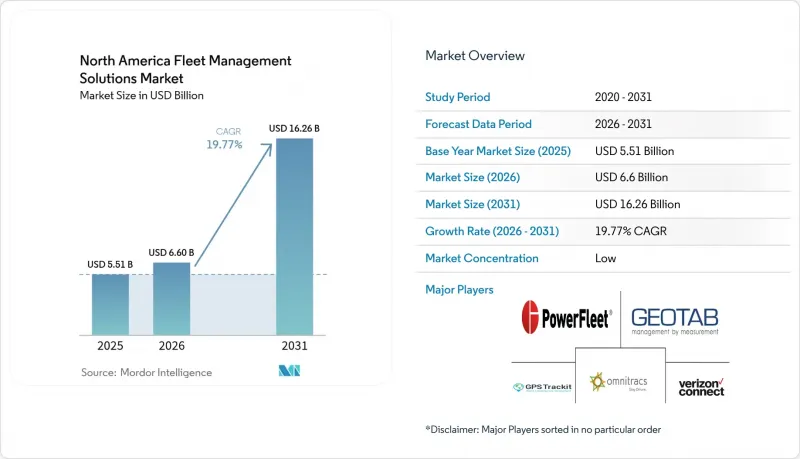
根據 Mordor Intelligence 預測,北美車輛管理解決方案市場規模將從 2025 年的 55.1 億美元成長到 2026 年的 66 億美元,然後在 2031 年達到 162.6 億美元,2026 年至 2031 年的複合年成長率為 19.77%。
本報告按部署類型(本地部署等)、應用領域(資產管理、資訊管理、駕駛員管理等)、最終用戶行業(運輸物流、能源公共產業等)、車隊規模(小規模車隊[1-50輛車]、中型車隊[51-250車]等)和地區進行細分。市場預測以美元計價。
北美車隊管理解決方案市場趨勢及洞察
有利的市場監管和營運效率
強制使用電子記錄器 (ELD) 和駕駛時間法規正在鞏固遠端資訊處理技術在北美卡車運輸網路中的應用。透過整合合規模組,承運商能夠獲得即時可視性,從而最佳化路線、減少怠速時間並降低燃油成本,使得降低總擁有成本 (TCO) 成為許多車隊的首要任務。美墨加協定 (USMCA) 下的統一法規簡化了跨境報告程序,相關平台實現了跨越三國運營的安全和環境數據的協調統一。
綠色車隊和淨零排放目標的興起
氣候變遷舉措正在重塑車輛部署策略,公共產業和消費品牌紛紛宣布了其小型車隊和部分大型車隊的電氣化計畫。聯邦政府對清潔車隊的獎勵以及各州零排放卡車法規,正迫使營運商將電動車調度、電池健康診斷和可再生能源供應整合到統一的控制面板中。同時追蹤內燃機和電動車輛指標的雙重需求,推動了車隊管理解決方案市場平台對混合動力傳動系統的採用。
人們持續擔憂資料隱私和駕駛員監控問題。
工會和州級隱私法規對收集和儲存記錄駕駛員行為的影像施加了限制。車隊營運商部署車載攝影機時,必須與工會達成協議,明確視訊用途、保存期限和存取權限。供應商正透過「隱私設計」架構來應對這些挑戰,該架構能夠隔離個人識別資訊並提供匿名化的評分系統。
細分市場分析
雲端服務佔據最大的市場佔有率,到2025年,其在車隊管理解決方案市場佔有率中將達到61.58%,這主要得益於服務供應商對訂閱模式經濟效益和即時功能更新的偏好。混合架構結合了邊緣處理(用於對延遲敏感的安全警報)和雲端分析(用於策略規劃),預計到2031年將以22.04%的複合年成長率高速成長。在資料主權和間歇性連線等情況下,本地部署環境仍將繼續使用,但隨著雲端容錯和加密標準的成熟,其相對佔有率預計將會下降。
大型貨運公司正擴大在其倉庫試點部署混合節點,用於處理高頻寬感測器數據,並在夜間將其與區域數據湖同步。管理緊急車輛的政府機構仍然依賴經過FedRAMP或同等框架認證的私有雲端。此外,衛星回程傳輸方案的擴展使得即使在以前被認為是「連接沙漠」的長程航線上,雲端部署也變得更加容易。
截至2025年,資產管理仍將佔車輛管理解決方案市場規模的28.44%,但安全和合規相關模組的成長速度最快,複合年成長率達23.71%,這主要得益於行車記錄器人工智慧和自動化電子駕駛員及車輛檢查報告的普及。駕駛員培訓儀錶板和風險評估矩陣可與保險公司入口網站無縫整合,從而縮短理賠處理時間。
營運規劃人員透過將交通分析和天氣資訊疊加到核心位置資料上,實現了個位數的燃油消耗降低。永續性報告和電池電量管理正逐漸成為進階附加功能,使供應商能夠向現有客戶提升銷售。跨套件儀表板提高了數據一致性,並最大限度地減少了調度員因頻繁切換螢幕而造成的疲勞。
其他好處:
- Excel格式的市場預測(ME)表
- 3個月的分析師支持
目錄
第1章:引言
- 研究假設和市場定義
- 調查範圍
第2章:調查方法
第3章執行摘要
第4章 市場狀況
- 市場概覽
- 市場促進因素
- 除了有利的市場監管外,營運效率也越來越受到重視。
- 綠色車隊和企業淨零排放目標的出現
- 技術進步降低了整體擁有成本
- 映像基礎的安全分析技術的整合正在逐步推進。
- 電動車相容型車載資訊服務平台的普及
- 人工智慧驅動的混合資產車隊預測性維護(缺乏媒體報導)
- 市場限制因素
- 人們對資料隱私和駕駛員監控的擔憂依然強烈。
- 農村地區和長途走廊的行動電話覆蓋有限。
- 聯網汽車面臨的網路安全威脅日益增加(通報不足)
- 跨境車輛營運法規存在差異(報告不足)
- 宏觀經濟因素的影響
- 產業價值鏈分析
- 監理情勢
- 技術展望
- 波特五力分析
第5章 市場規模與成長預測
- 不同的發展
- 現場
- 雲
- 混合
- 透過使用
- 資產管理
- 資訊管理
- 駕駛員管理
- 安全與合規管理
- 風險管理
- 營運管理
- 其他用途
- 按最終用戶行業分類
- 運輸/物流
- 能源公用事業
- 建造
- 製造業
- 其他終端用戶產業
- 以擁有單元數量計算
- 小規模車隊(1-50車)
- 中型車隊(51-250 台)
- 大型車隊(251輛或以上)
- 國家
- 美國
- 加拿大
- 墨西哥
第6章 競爭情勢
- 市場集中度
- 策略趨勢
- 市佔率分析
- 公司簡介
- Geotab Inc.
- Verizon Communications Inc.(Verizon Connect)
- Trimble Inc.
- Samsara Inc.
- Omnitracs LLC
- PowerFleet Inc.
- MiX Telematics Ltd.
- Teletrac Navman(Vontier Corporation)
- Zonar Systems Inc.
- GPS Trackit Inc.
- Inseego Corp.
- Motive Technologies Inc.
- Fleet Complete(Constellation Software Inc.)
- Gurtam UAB
- Donlen LLC(Hertz Global Holdings Inc.)
- Enterprise Fleet Management Inc.
- ARI Fleet Management Company
- Azuga Inc.(Bridgestone Americas Inc.)
- KeepTruckin Inc.
- Michelin Connected Fleet(Sascar Tecnologia Automotiva SA)
第7章 市場機會與未來展望
According to Mordor Intelligence, the North America fleet management solutions market size is expected to grow from USD 5.51 billion in 2025 to USD 6.6 billion in 2026 and is forecast to reach USD 16.26 billion by 2031 at 19.77% CAGR over 2026-2031.
This report is Segmented by Deployment (On-Premise, and More), Application (Asset Management, Information Management, Driver Management, and More), End-User Industry (Transportation and Logistics, Energy and Utilities, and More), Fleet Size (Small Fleet [1-50 Vehicles], Medium Fleet [51-250 Vehicles], and More), and Geography. The Market Forecasts are Provided in Terms of Value (USD).
North America Fleet Management Solutions Market Trends and Insights
Favourable Market Regulations and Operational Efficiency
Electronic-logging-device and hours-of-service mandates are anchoring telematics adoption across the continental trucking network. As carriers integrate compliance modules, they unlock real-time visibility that improves routing, idle-time reduction, and fuel spend, enabling many fleets to shift cost-of-ownership to the top of the agenda. Consolidated rules under the USMCA are simplifying cross-border reporting, allowing platforms to harmonize safety and environmental data for tri-national operations.
Advent of Green Fleets and Net-Zero Targets
Climate commitments are reshaping acquisition strategies, with utilities and consumer brands publishing timelines to electrify light-duty and portioned heavy-duty assets. Federal clean-fleet incentives and state-level zero-emission truck regulations are pushing operators to blend EV scheduling, battery-health diagnostics, and renewable-energy sourcing into a single dashboard. The dual need to track both internal-combustion and electric metrics is a catalyst for mixed-powertrain modules within fleet management solutions market platforms.
Persistent Data-Privacy and Driver Surveillance Concerns
Labor groups and provincial-level privacy statutes limit the capture and retention of driver-behaviour footage. Fleets deploying inward-facing cameras must negotiate union agreements outlining purpose, storage duration, and access rights. Vendors are countering with privacy-by-design architectures that segment personally identifiable information and provide anonymized scoreboards.
Other drivers and restraints analyzed in the detailed report include:
- Technological Advances Lowering Total Cost of Ownership
- Growing Integration of Video-Based Safety Analytics
- Rising Cybersecurity Threats to Connected Vehicles
For complete list of drivers and restraints, kindly check the Table Of Contents.
Segment Analysis
Cloud services held the largest stake, delivering 61.58% fleet management solutions market share in 2025 as operators favoured subscription economics and instant feature updates. Hybrid architectures are forecast to post a leading 22.04% CAGR to 2031, combining edge processing for latency-sensitive safety alerts with cloud analytics for strategic planning. On-premises instances persist where data-sovereignty or intermittent connectivity requires local hosting, but the relative slice is expected to erode as cloud resilience and encryption standards mature.
Large shippers increasingly pilot hybrid nodes at depots to process high-bandwidth sensor feeds while synchronizing with regional data lakes overnight. Government agencies managing emergency vehicles still lean on private clouds vetted under FedRAMP or equivalent frameworks. The expansion of satellite-backhaul options is also easing cloud adoption along long-haul corridors previously deemed connectivity deserts.
While asset management retained 28.44% of the fleet management solutions market size in 2025, safety and compliance modules are charting the fastest expansion at 23.71% CAGR as dash-cam AI and electronic driver-vehicle-inspection-report automation gain traction. Driver coaching dashboards and risk-scoring matrices integrate seamlessly with insurer portals, reducing claims cycles.
Operational planners are layering congestion analytics and weather overlays atop core location data to carve fuel consumption by single-digit percentages. Sustainability reporting and battery-state-of-charge orchestration are emerging as premium add-ons, allowing vendors to upsell existing clients. Cross-suite dashboards improve data coherence, minimizing swivel-chair workflow fatigue for dispatchers.
Complete Report Scope:
- By Deployment
- On-Premise
- Cloud
- Hybrid
- By Application
- Asset Management
- Information Management
- Driver Management
- Safety and Compliance Management
- Risk Management
- Operations Management
- Other Applications
- By End-User Industry
- Transportation and Logistics
- Energy and Utilities
- Construction
- Manufacturing
- Other End-User Industries
- By Fleet Size
- Small Fleets (1-50 vehicles)
- Medium Fleets (51-250 vehicles)
- Large Fleets (251+ vehicles)
- By Country
- United States
- Canada
- Mexico
List of Companies Covered in this Report:
- Geotab Inc.
- Verizon Communications Inc. (Verizon Connect)
- Trimble Inc.
- Samsara Inc.
- Omnitracs LLC
- PowerFleet Inc.
- MiX Telematics Ltd.
- Teletrac Navman (Vontier Corporation)
- Zonar Systems Inc.
- GPS Trackit Inc.
- Inseego Corp.
- Motive Technologies Inc.
- Fleet Complete (Constellation Software Inc.)
- Gurtam UAB
- Donlen LLC (Hertz Global Holdings Inc.)
- Enterprise Fleet Management Inc.
- ARI Fleet Management Company
- Azuga Inc. (Bridgestone Americas Inc.)
- KeepTruckin Inc.
- Michelin Connected Fleet (Sascar Tecnologia Automotiva S.A.)
Additional Benefits:
- The market estimate (ME) sheet in Excel format
- 3 months of analyst support
TABLE OF CONTENTS
1 INTRODUCTION
- 1.1 Study Assumptions and Market Definition
- 1.2 Scope of the Study
2 RESEARCH METHODOLOGY
3 EXECUTIVE SUMMARY
4 MARKET LANDSCAPE
- 4.1 Market Overview
- 4.2 Market Drivers
- 4.2.1 Favorable market regulations coupled with growing emphasis on operational efficiency
- 4.2.2 Advent of Green Fleets and corporate net-zero targets
- 4.2.3 Technological advancements lowering total cost of ownership
- 4.2.4 Growing integration of video-based safety analytics
- 4.2.5 Uptake of EV-ready telematics platforms
- 4.2.6 AI-enabled predictive maintenance for mixed-asset fleets (under-reported)
- 4.3 Market Restraints
- 4.3.1 Persistent data-privacy and driver surveillance concerns
- 4.3.2 Limited cellular coverage in rural/long-haul corridors
- 4.3.3 Rising cybersecurity threats to connected vehicles (under-reported)
- 4.3.4 Fragmented regulatory landscape for cross-border fleets (under-reported)
- 4.4 Impact of Macroeconomic Factors
- 4.5 Industry Value-Chain Analysis
- 4.6 Regulatory Landscape
- 4.7 Technological Outlook
- 4.8 Porter's Five Forces Analysis
- 4.8.1 Bargaining Power of Suppliers
- 4.8.2 Bargaining Power of Consumers
- 4.8.3 Threat of New Entrants
- 4.8.4 Threat of Substitute Products
- 4.8.5 Intensity of Competitive Rivalry
5 MARKET SIZE AND GROWTH FORECASTS (VALUE)
- 5.1 By Deployment
- 5.1.1 On-Premise
- 5.1.2 Cloud
- 5.1.3 Hybrid
- 5.2 By Application
- 5.2.1 Asset Management
- 5.2.2 Information Management
- 5.2.3 Driver Management
- 5.2.4 Safety and Compliance Management
- 5.2.5 Risk Management
- 5.2.6 Operations Management
- 5.2.7 Other Applications
- 5.3 By End-User Industry
- 5.3.1 Transportation and Logistics
- 5.3.2 Energy and Utilities
- 5.3.3 Construction
- 5.3.4 Manufacturing
- 5.3.5 Other End-User Industries
- 5.4 By Fleet Size
- 5.4.1 Small Fleets (1-50 vehicles)
- 5.4.2 Medium Fleets (51-250 vehicles)
- 5.4.3 Large Fleets (251+ vehicles)
- 5.5 By Country
- 5.5.1 United States
- 5.5.2 Canada
- 5.5.3 Mexico
6 COMPETITIVE LANDSCAPE
- 6.1 Market Concentration
- 6.2 Strategic Moves
- 6.3 Market Share Analysis
- 6.4 Company Profiles
- 6.4.1 Geotab Inc.
- 6.4.2 Verizon Communications Inc. (Verizon Connect)
- 6.4.3 Trimble Inc.
- 6.4.4 Samsara Inc.
- 6.4.5 Omnitracs LLC
- 6.4.6 PowerFleet Inc.
- 6.4.7 MiX Telematics Ltd.
- 6.4.8 Teletrac Navman (Vontier Corporation)
- 6.4.9 Zonar Systems Inc.
- 6.4.10 GPS Trackit Inc.
- 6.4.11 Inseego Corp.
- 6.4.12 Motive Technologies Inc.
- 6.4.13 Fleet Complete (Constellation Software Inc.)
- 6.4.14 Gurtam UAB
- 6.4.15 Donlen LLC (Hertz Global Holdings Inc.)
- 6.4.16 Enterprise Fleet Management Inc.
- 6.4.17 ARI Fleet Management Company
- 6.4.18 Azuga Inc. (Bridgestone Americas Inc.)
- 6.4.19 KeepTruckin Inc.
- 6.4.20 Michelin Connected Fleet (Sascar Tecnologia Automotiva S.A.)
7 MARKET OPPORTUNITIES AND FUTURE OUTLOOK
- 7.1 White-space and Unmet-Need Assessment

 2026年全球車隊管理系統市場報告
 中東車隊管理市場(第一版)
 歐洲車隊管理:市場佔有率分析、產業趨勢與統計、成長預測(2026-2031 年)
 自動駕駛車隊管理市場預測至2034年-按自動駕駛等級、車隊能力、部署模式、車輛類別、最終用戶和地區分類的全球分析車隊管理市場預測至2034年—全球解決方案、車隊類型、車輛類型、部署模式、通訊技術、應用程式、最終用戶、銷售管道和區域分析
 乘用車車隊管理市場:全球市場預測,2026-2032年
 施工機械車隊管理軟體市場機會、成長要素、產業趨勢分析及2026-2035年預測
 2026-2034年全球重型車輛車隊維修服務市場規模、佔有率、趨勢與成長分析報告
 全球車隊管理市場(至 2032 年):按解決方案(車隊管理、車輛維護與診斷、性能管理、車輛分析與報告)和車隊類型(客運計程車、商用車輛、公共交通)分類車隊管理解決方案市場預測至2034年-全球分析(按組件、部署模式、車隊類型、車輛類型、功能、最終用戶和地區分類)