

 |
市場調查報告書
商品編碼
2124460
客戶資訊系統:市場佔有率分析、產業趨勢與統計、成長預測(2026-2031)Customer Information System - Market Share Analysis, Industry Trends & Statistics, Growth Forecasts (2026 - 2031) |
||||||

※ 本網頁內容可能與最新版本有所差異。詳細情況請與我們聯繫。
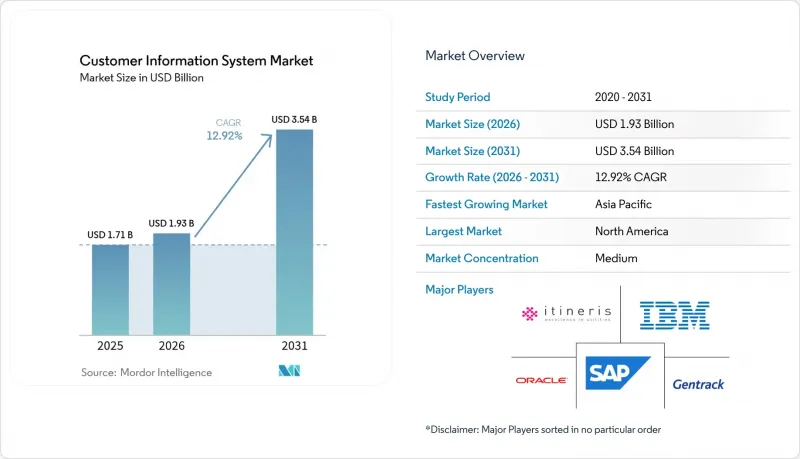
根據 Mordor Intelligence 預測,客戶資訊系統市場規模將從 2025 年的 17.1 億美元成長到 2026 年的 19.3 億美元,到 2031 年將達到 35.4 億美元,2026 年至 2031 年的複合年成長率為 12.92%。
本報告按部署類型(雲端和本地部署)、組件(解決方案和服務)、最終用戶(CRM(銀行、金融服務和保險、零售、電信等)、CIS(用水和污水管理、能源和公共產業等))以及地區(北美、南美、歐洲、亞太、中東和非洲)進行細分。市場預測以美元計價。
全球客戶資訊系統市場趨勢與洞察
公共產業的數位轉型舉措
北美公共產業正將客戶資訊系統 (CIS) 的現代化改造納入更廣泛的數位轉型藍圖,以提升客戶體驗和營運效率。增強的自助服務入口網站、整合的工作流引擎和跨通路通訊使公共產業能夠即時整合和管理資料、資產和人員。該專案的成功體現在公共產業同時提高可再生能源採用率和客戶滿意度的案例中,這表明新一代 CIS 可以同時支持永續性和服務目標。在預算分配方面,模組化升級越來越受歡迎,首先從更換計費引擎開始,然後逐步添加分析和移動功能,這有助於分攤資本成本並儘早實現收益。
分散式能源(DER)的擴張正在推動對即時客戶分析的需求。
隨著屋頂太陽能發電、電池儲能和電動車的日益普及,電力公司需要即時掌握電網動態,以維持電網平衡並吸引產消者參與。現代客戶資訊系統(CIS)平台處理來自智慧電錶的數據流,將其與計量引擎進行匹配,然後為需量反應演算法提供信息,從而為電網和終端用戶創造價值。即時結算也為虛擬電廠(VPP)的新獎勵機制奠定了基礎,將CIS註冊記錄與批發市場參與聯繫起來。已實施人工智慧賦能的CIS模組的電力公司報告稱,已取得顯著成效,例如客服中心效率更高、現場服務次數減少,這表明分析能力在滿足消費者日益成長的期望的同時,還能帶來可觀的收益。
大型電力公司遷移舊有系統高成本
替換一套已運行數十年的高度客製化客戶資訊系統(CIS)需要並行運行、徹底的資料清理和複雜的系統整合。超過2億美元的計畫資本支出凸顯了其面臨的財務挑戰。過渡期間的雙軌運作環境也將增加營運預算。因此,各大公用事業公司正在分階段淘汰該項目,首先從風險較低的計費區域入手,並制定可重複使用的過渡手冊,以降低後續階段的成本。
細分市場分析
即使到了2025年,本地部署系統預計仍將佔據客戶資訊系統(CIS)市場60.35%的佔有率。這是因為許多大型公共產業優先考慮直接控制和已建立的協作機制。然而,雲端客戶資訊系統(CIS)的市場規模預計將以18.05%的複合年成長率(CAGR)快速成長,這反映出中型公共產業對敏捷性和成本透明度的追求。將雲端CIS與現代客戶關係管理(CRM)和人力資源管理工具整合的公共產業報告稱,產品推出速度更快,意外服務中斷次數更少,這凸顯了採用雲端技術帶來的商業優勢。
雲端採用加速的驅動力來自靈活的計費處理能力、更短的硬體更新周期以及內建的災害復原功能。允許將雲端使用費累計營運費用的財務會計準則進一步促進了雲端採用,尤其是在資本預算受到嚴格審查的價格規定市場。尋求面向未來的公共產業正擴大採用混合模式,將關鍵數據保留在本地,同時將敏感度較低的工作負載遷移到雲端,以平衡資料主權和創新能力。
區域分析
到2025年,北美將佔客戶資訊系統市場收入的34.22%。高級計量基礎設施(AMI)的早期應用和嚴格的計費準確性要求正在推動持續投資,而虛擬電廠試點計畫則對客戶資訊系統(CIS)註冊流程和近乎即時的結算提出了更高的要求。該地區的電力公司正積極採用聊天機器人和自助服務應用程式,以減少電話諮詢並提高客戶滿意度。高昂的遷移成本和隱私義務正在減緩專案進度,促使許多業者採取分階段遷移計畫。
亞太地區預計將以15.23%的複合年成長率成長,成長速度超過其他任何地區。電力公司正同步推進智慧電錶的大規模部署,並升級客戶資訊系統(CIS),以支援分時電價和預付功能。各國為減少技術和商業性損失而採取的措施,已將電錶到現金的現代化改造列為優先事項,而不斷成長的中產階級期望也推動了對數位化服務管道的需求。區域人才短缺正在推動外包,這為提供承包CIS-AMI解決方案的系統整合商創造了商機。
歐洲客戶資訊系統市場受到一系列法規的限制,這些法規要求實現透明計費、即時支付和嚴格的網路安全。電力公司正在調整其客戶資訊系統投資計劃,以配合年度報告截止日期,避免受到處罰。需求面響應(DSR)指令正在推動靈活計費,這需要相應的系統來管理精細的小時收費系統。同時,在南美、中東和非洲等新興經濟體,客戶資訊系統正在實施,以支援預付費電力和水費項目,從而提高收入並擴大服務覆蓋範圍。
歐洲是客戶資訊系統 (CIS) 的重要市場,預計從 2020 年到 2025 年將以約 9.85% 的複合年成長率穩步成長。英國、德國、法國和西班牙是推動該地區市場成長的主要國家。該地區市場的特點是日益成長的環境問題以及政府支持數位轉型措施的有利政策。歐洲公共產業越來越注重透過先進的 CIS 解決方案實現客戶營運現代化,這些解決方案將計費、顧客關懷和統一計量與通用資料庫和技術堆疊的優勢相結合。市場正經歷著向雲端解決方案的顯著轉變,許多供應商正在開發行動應用程式,以提供能源洞察並改善客戶參與。該地區對資料隱私和安全法規的高度重視正在推動更複雜、更合規的 CIS 解決方案的開發。再生能源來源和智慧電網技術的整合為 CIS 供應商開發更先進、更靈活的解決方案創造了新的機會。
亞太地區正迅速崛起為客戶資訊系統 (CIS) 的快速成長市場,預計 2025 年至 2030 年的複合年成長率 (CAGR) 約為 13.92%。該地區的市場動態受到快速都市化、人口成長以及公共產業基礎設施現代化投資增加的影響。中國和印度是成長的主要驅動力,兩國均大力投資於智慧電網技術和數位轉型 (DX) 計劃。該地區正經歷從舊有系統向先進 CIS 解決方案的重大轉變,尤其是在電力和能源供應領域。智慧電錶和高級計量基礎設施 (AMI) 的日益普及為 CIS解決方案供應商創造了新的機會。各國政府為促進數位轉型和智慧城市發展而推出的各項措施也對市場產生了正面影響。該地區的公共產業越來越注重透過計費流程自動化和增強客戶參與平台來改善客戶體驗。對減少輸配電損耗的日益重視也推動了先進 CIS 解決方案的採用。
拉丁美洲的客戶資訊系統市場正穩步成長,其驅動力來自對老舊電網基礎設施現代化改造和提升客戶服務能力的日益成長的需求。該地區的電力公司正致力於部署先進的自動化系統,以最佳化計費、即時管理配電網路並改善消費者資料存取。該市場的一個關鍵特徵是主要經濟體對智慧城市項目和數位轉型(DX)的投資不斷增加。該地區各國政府正撥出預算用於現有城市的現代化改造和推出新的智慧城市項目,以振興整體經濟。政府的支持也推動了智慧電網和系統運作相關技術的應用。該地區的電力公司日益認知到數位化互動管道和客戶自助服務平台對於提高營運效率和客戶滿意度的重要性。
在中東和非洲地區,人們對節能的日益關注以及智慧電網技術的廣泛應用,為客戶資訊系統供應商創造了獨特的商機。中東地區以石油經濟為主,商業、住宅和工業項目正迎來大量投資,這些項目都需要高效節能且精準的計量解決方案。政府在智慧電錶部署方面的措施和政策,為市場成長創造了有利環境。在非洲,對改善公共產業基礎設施和減少非技術性損耗的需求不斷成長,推動了市場發展。智慧電錶解決方案在該地區,尤其是在都市區,正得到越來越廣泛的應用。旨在改善公共產業營運和客戶服務的各項數位轉型(DX)舉措,也對市場產生了正面影響。此外,對再生能源來源併網和高效收費系統的需求,也為該地區的客戶資訊系統解決方案供應商創造了新的機會。
其他好處:
- Excel格式的市場預測(ME)表
- 3個月的分析師支持
目錄
第1章:引言
- 研究假設和市場定義
- 調查範圍
第2章:調查方法
第3章執行摘要
第4章 市場狀況
- 市場概覽
- 市場促進因素
- 北美公共產業公司數位轉型舉措
- 對即時客戶分析日益成長的需求正在推動分散式能源(DER)的擴張。
- 關於聲明準確性的監管義務(歐洲)
- 獨立國協-亞洲一體化的勢頭
- 一家中型公共產業公司採用雲端原生CIS
- 新興市場對收費預付收費的需求
- 市場限制因素
- 大型電力公司遷移舊有系統成本高昂
- 資料隱私和主權問題
- 公共產業部門(發展中地區)特有的IT人才短缺
- 供應商鎖定風險限制了柔軟性。
- 監理展望
- 技術展望
- 波特五力分析
- 對影響產業的宏觀經濟因素進行評估
- 投資分析
第5章 市場規模與成長預測
- 不同的發展
- 雲
- 現場
- 按組件
- 解決方案
- 服務
- 最終用戶
- CRM
- BFSI
- 零售
- 電訊
- CIS
- 用水和污水管理
- 能源公用事業
- 其他最終用戶
- CRM
- 按地區
- 北美洲
- 美國
- 加拿大
- 墨西哥
- 南美洲
- 巴西
- 阿根廷
- 智利
- 秘魯
- 其他南美國家
- 歐洲
- 德國
- 英國
- 法國
- 義大利
- 西班牙
- 其他歐洲國家
- 亞太地區
- 中國
- 日本
- 韓國
- 印度
- 澳洲
- 紐西蘭
- 其他亞太國家
- 中東
- 阿拉伯聯合大公國
- 沙烏地阿拉伯
- 土耳其
- 其他中東國家
- 非洲
- 南非
- 其他非洲國家
- 北美洲
第6章 競爭情勢
- Strategic Developments
- Vendor Positioning Analysis
- 公司簡介
- Oracle Corporation
- Fluentgrid Limited
- IBM Corporation
- Wipro Limited
- Cayenta CIS(Harris Computer)
- Gentrack Group Limited
- SAP SE
- Itineris NV
- HydroComp Enterprises Ltd
- Open International LLC
- Hansen Technologies
- Vertex One
- Advanced Utility Systems
- National Information Solutions Co-op(NISC)
- OpenText Corporation
- Milestone Utility Services
- Salesforce Inc.
- SilverBlaze Solutions
- Cayenta
- Open Smartflex
第7章 市場機會與未來展望
According to Mordor Intelligence, the customer information system market size is expected to grow from USD 1.71 billion in 2025 to USD 1.93 billion in 2026 and is forecast to reach USD 3.54 billion by 2031 at 12.92% CAGR over 2026-2031.
This report is Segmented by Deployment (Cloud, and On-Premises), Component (Solutions, and Services), End-User (CRM (BFSI, Retail, Telecommunications, and More), CIS (Water and Wastewater Management, Energy and Utilities, and More)), and Geography (North America, South America, Europe, Asia-Pacific, Middle East, and Africa). The Market Forecasts are Provided in Terms of Value (USD).
Global Customer Information System Market Trends and Insights
Digital Transformation Initiatives by Utilities
North American utilities are embedding CIS modernization into broader digital transformation roadmaps to lift customer experience and unlock operational efficiencies. Enhanced self-service portals, integrated workflow engines, and cross-channel communications enable utilities to orchestrate data, assets, and people in real time. Program success is evident in cases where utilities simultaneously raised renewable penetration and customer satisfaction, showing that a next-generation CIS can underpin both sustainability and service goals. Budget allocations increasingly favor modular upgrades that replace billing engines first, then layer on analytics and mobility features to spread capital costs while accelerating benefits.
Real-Time Customer Analytics Demand with DER Growth
As rooftop solar, battery storage, and electric vehicles proliferate, utilities need minute-level insights to balance the grid and engage prosumers. Modern CIS platforms process smart-meter streams, match them to tariff engines, and feed demand-response algorithms that create value for both the grid and end customers. Real-time settlement also underpins new compensation schemes for virtual power plants, tying CIS enrollment records to wholesale-market participation. Utilities adopting AI-enabled CIS modules report tangible improvements in call-center efficiency and lower truck rolls, demonstrating how analytics deliver bottom-line results while meeting rising consumer expectations.
High Legacy Migration Costs for Large Utilities
Replacing decades-old, heavily customized CIS installations demands parallel operations, rigorous data cleansing, and complex system integration. Capital programs exceeding USD 200 million highlight the financial hurdle; operating budgets also rise due to dual-running environments during cut-overs. Large utilities therefore phase projects, starting with low-risk billing territories while building reusable migration runbooks to reduce later waves' costs.
Other drivers and restraints analyzed in the detailed report include:
- Regulatory Mandates for Billing Accuracy
- CIS-AMI Integration Momentum
- Data Privacy and Sovereignty Concerns
For complete list of drivers and restraints, kindly check the Table Of Contents.
Segment Analysis
On-premises systems retained 60.35% of customer information system market share in 2025 as many large utilities value direct control and established integrations. Yet the customer information system market size for cloud deployments is projected to surge at an 18.05% CAGR, reflecting mid-sized utilities' drive for agility and cost transparency. Utilities linking cloud CIS with modern CRM and workforce-management tools report faster product launches and fewer unplanned outages, reinforcing cloud's business case.
Accelerated cloud take-up stems from elastic processing for bill calculations, reduced hardware refresh cycles, and embedded disaster recovery. Financial accounting rules letting cloud fees qualify as operating expense further sweeten adoption, especially in rate-regulated markets where capital budgets are tightly scrutinized. Utilities aiming to future-proof investments increasingly pursue hybrid models-maintaining critical data on-premises while shifting non-sensitive workloads to the cloud-to balance sovereignty and innovation.
Complete Report Scope:
- By Deployment
- Cloud
- On-Premises
- By Component
- Solutions
- Services
- By End-User
- CRM
- BFSI
- Retail
- Telecommunications
- CIS
- Water and Wastewater Management
- Energy and Utilities
- Other End-Users
- CRM
- By Geography
- North America
- United States
- Canada
- Mexico
- South America
- Brazil
- Argentina
- Chile
- Peru
- Rest of South America
- Europe
- Germany
- United Kingdom
- France
- Italy
- Spain
- Rest of Europe
- Asia-Pacific
- China
- Japan
- South Korea
- India
- Australia
- New Zealand
- Rest of Asia-Pacific
- Middle East
- United Arab Emirates
- Saudi Arabia
- Turkey
- Rest of Middle East
- Africa
- South Africa
- Rest of Africa
- North America
Geography Analysis
North America accounted for 34.22% of customer information system market revenue in 2025. Early AMI penetration coupled with stringent billing-accuracy mandates sustains ongoing investment, while virtual power plant pilots require CIS enrollment workflows and near-real-time settlement. Utilities in the region actively integrate chatbots and self-service apps to deflect calls and raise customer-satisfaction metrics. High migration costs and privacy obligations temper project pace, leading many operators to adopt phased cut-over plans.
Asia-Pacific is forecast to expand at a 15.23% CAGR, the fastest of any region, as utilities pair mass smart-meter rollouts with CIS upgrades that support time-of-use tariffs and prepaid functions. National programs to curb technical and commercial losses make meter-to-cash modernization a priority, while rising middle-class expectations boost demand for digital service channels. Regional talent shortages encourage outsourcing, creating opportunities for system integrators offering turnkey CIS-AMI solutions.
Europe's customer information system market is shaped by regulation that compels transparent invoicing, instant payments, and rigorous cybersecurity. Utilities align CIS investment schedules with annual reporting deadlines to avoid penalties. Demand-side response directives encourage flexible billing, necessitating engines that manage granular time-block tariffs. Meanwhile, emerging economies in South America and the Middle East and Africa deploy CIS to support prepaid electricity and water programs, improving revenue collection and broadening access.
Europe represents a significant market for customer information systems, demonstrating robust growth with approximately 9.85% CAGR from 2020 to 2025. The United Kingdom, Germany, France, and Spain are the key countries driving regional market growth. The region's market is characterized by increasing environmental concerns and favorable government policies supporting digital transformation initiatives. European utilities are increasingly focusing on modernizing their customer operations through advanced CIS solutions that combine billing, customer care, and uniform metering with the advantages of a common database and technological stack. The market is witnessing a significant shift towards cloud-based solutions, with many vendors developing mobile applications to offer energy insights and enhanced customer engagement. The region's strong emphasis on data privacy and security regulations has led to the development of more sophisticated and compliant CIS solutions. The integration of renewable energy sources and smart grid technologies has created new opportunities for CIS providers to develop more advanced and flexible solutions.
The Asia Pacific region is emerging as a high-growth market for customer information systems, with a projected CAGR of approximately 13.92% from 2025 to 2030. The market dynamics in this region are shaped by rapid urbanization, population growth, and increasing investments in utility infrastructure modernization. China and India are the primary growth drivers, with both countries making significant investments in smart grid technologies and digital transformation initiatives. The region is witnessing a notable shift from legacy systems to advanced CIS solutions, particularly in the electricity and power supply sectors. The increasing adoption of smart meters and advanced metering infrastructure is creating new opportunities for CIS solution providers. The market is also benefiting from various government initiatives promoting digital transformation and smart city development. The region's utilities are increasingly focusing on improving customer experience through automated billing processes and enhanced customer engagement platforms. The growing emphasis on reducing transmission and distribution losses is driving the adoption of sophisticated CIS solutions.
The Latin American market for customer information systems is experiencing steady growth, driven by the increasing need to modernize aging power grid infrastructure and enhance customer service capabilities. The region's utilities are focusing on implementing advanced and automated systems to optimize their billing capabilities, manage distribution networks in real-time, and provide consumers with enhanced data accessibility. The market is characterized by growing investments in smart city projects and digital transformation initiatives across major economies. Governments across the region are allocating budgets to modernize existing cities and establish new smart city projects to improve the overall economy. The support from governments is also driving the adoption of technologies supporting the operations of smart grids and systems. The region's utilities are increasingly recognizing the importance of digital engagement channels and customer self-service platforms to improve operational efficiency and customer satisfaction.
The Middle East and Africa region presents unique opportunities for customer information system providers, driven by the increasing focus on energy conservation and expanding deployment of smart grid technologies. The Middle Eastern region, largely an oil-based economy, is witnessing significant investments in commercial, residential, and industrial projects that require energy-efficient and accurate meter solutions. Government initiatives and policies connected with smart meter deployment are creating favorable conditions for market growth. In Africa, the market is driven by the growing need to improve utility infrastructure and reduce non-technical losses. The region is witnessing increasing adoption of smart metering solutions, particularly in urban areas. The market is also benefiting from various digital transformation initiatives aimed at improving utility operations and customer service delivery. The integration of renewable energy sources and the need for efficient billing systems are creating new opportunities for CIS solution providers in the region.
- Oracle Corporation
- Fluentgrid Limited
- IBM Corporation
- Wipro Limited
- Cayenta CIS (Harris Computer)
- Gentrack Group Limited
- SAP SE
- Itineris NV
- HydroComp Enterprises Ltd
- Open International LLC
- Hansen Technologies
- Vertex One
- Advanced Utility Systems
- National Information Solutions Co-op (NISC)
- OpenText Corporation
- Milestone Utility Services
- Salesforce Inc.
- SilverBlaze Solutions
- Cayenta
- Open Smartflex
Additional Benefits:
- The market estimate (ME) sheet in Excel format
- 3 months of analyst support
TABLE OF CONTENTS
1 Introduction
- 1.1 Study Assumptions and Market Definition
- 1.2 Scope of the Study
2 Research Methodology
3 Executive Summary
4 Market Landscape
- 4.1 Market Overview
- 4.2 Market Drivers
- 4.2.1 Digital Transformation Initiatives by Utilities (North America)
- 4.2.2 Real-Time Customer Analytics Demand with DER Growth
- 4.2.3 Regulatory Mandates for Billing Accuracy (Europe)
- 4.2.4 CIS-AMI Integration Momentum (Asia)
- 4.2.5 Cloud-Native CIS Adoption by Mid-Sized Utilities
- 4.2.6 Flexible and Pre-paid Billing Needs in Emerging Markets
- 4.3 Market Restraints
- 4.3.1 High Legacy Migration Costs for Large Utilities
- 4.3.2 Data Privacy and Sovereignty Concerns
- 4.3.3 Utility-Specific IT-Talent Shortage (Developing Regions)
- 4.3.4 Vendor Lock-In Risks Limiting Flexibility
- 4.4 Regulatory Outlook
- 4.5 Technological Outlook
- 4.6 Porter's Five Forces Analysis
- 4.6.1 Bargaining Power of Suppliers
- 4.6.2 Bargaining Power of Buyers
- 4.6.3 Threat of New Entrants
- 4.6.4 Threat of Substitutes
- 4.6.5 Intensity of Competitive Rivalry
- 4.7 Assessment of the Macroeconomic Factors on the Industry
- 4.8 Investment Analysis
5 Market Size and Growth Forecasts (Value)
- 5.1 By Deployment
- 5.1.1 Cloud
- 5.1.2 On-Premises
- 5.2 By Component
- 5.2.1 Solutions
- 5.2.2 Services
- 5.3 By End-User
- 5.3.1 CRM
- 5.3.1.1 BFSI
- 5.3.1.2 Retail
- 5.3.1.3 Telecommunications
- 5.3.2 CIS
- 5.3.2.1 Water and Wastewater Management
- 5.3.2.2 Energy and Utilities
- 5.3.2.3 Other End-Users
- 5.3.1 CRM
- 5.4 By Geography
- 5.4.1 North America
- 5.4.1.1 United States
- 5.4.1.2 Canada
- 5.4.1.3 Mexico
- 5.4.2 South America
- 5.4.2.1 Brazil
- 5.4.2.2 Argentina
- 5.4.2.3 Chile
- 5.4.2.4 Peru
- 5.4.2.5 Rest of South America
- 5.4.3 Europe
- 5.4.3.1 Germany
- 5.4.3.2 United Kingdom
- 5.4.3.3 France
- 5.4.3.4 Italy
- 5.4.3.5 Spain
- 5.4.3.6 Rest of Europe
- 5.4.4 Asia-Pacific
- 5.4.4.1 China
- 5.4.4.2 Japan
- 5.4.4.3 South Korea
- 5.4.4.4 India
- 5.4.4.5 Australia
- 5.4.4.6 New Zealand
- 5.4.4.7 Rest of Asia-Pacific
- 5.4.5 Middle East
- 5.4.5.1 United Arab Emirates
- 5.4.5.2 Saudi Arabia
- 5.4.5.3 Turkey
- 5.4.5.4 Rest of Middle East
- 5.4.6 Africa
- 5.4.6.1 South Africa
- 5.4.6.2 Rest of Africa
- 5.4.1 North America
6 Competitive Landscape
- 6.1 Strategic Developments
- 6.2 Vendor Positioning Analysis
- 6.3 Company Profiles (includes Global level Overview, Market level overview, Core Segments, Financials as available, Strategic Information, Products and Services, and Recent Developments)
- 6.3.1 Oracle Corporation
- 6.3.2 Fluentgrid Limited
- 6.3.3 IBM Corporation
- 6.3.4 Wipro Limited
- 6.3.5 Cayenta CIS (Harris Computer)
- 6.3.6 Gentrack Group Limited
- 6.3.7 SAP SE
- 6.3.8 Itineris NV
- 6.3.9 HydroComp Enterprises Ltd
- 6.3.10 Open International LLC
- 6.3.11 Hansen Technologies
- 6.3.12 Vertex One
- 6.3.13 Advanced Utility Systems
- 6.3.14 National Information Solutions Co-op (NISC)
- 6.3.15 OpenText Corporation
- 6.3.16 Milestone Utility Services
- 6.3.17 Salesforce Inc.
- 6.3.18 SilverBlaze Solutions
- 6.3.19 Cayenta
- 6.3.20 Open Smartflex
7 Market Opportunities and Future Outlook
- 7.1 White-Space and Unmet-Need Assessment

 客戶資訊管理市場:2026-2032年全球市場預測(按交付方式、組織規模、部署方式、應用程式和最終用戶分類)
 2026年全球費率設計分析市場報告
 客戶資訊系統市場規模、佔有率和成長分析:按組件、部署類型、用途、應用、組織規模、最終用戶和地區分類-2026-2033年產業預測
 全球客戶資訊系統市場規模、佔有率、趨勢和成長分析報告(2026-2034年)客戶資訊系統市場:組件、部署模式、企業規模、應用、最終用途-2026-2032年全球市場預測2026年全球客戶資訊系統市場報告2026年全球公用事業客戶資訊系統(CIS)軟體市場報告
 2026-2030年全球客戶資訊系統市場
 客戶資訊系統的全球市場:提供區分·部署模式·用途·終端用戶產業·各地區的機會及預測 (2018-2032年)
 客戶資訊系統市場規模、佔有率、趨勢分析報告:2025 年至 2030 年按組件、應用、地區和細分市場預測