


 |
市場調查報告書
商品編碼
2124446
南美洲一次電池:市場佔有率分析、產業趨勢與統計及成長預測(2026-2031 年)South America Primary Battery - Market Share Analysis, Industry Trends & Statistics, Growth Forecasts (2026 - 2031) |
||||||

※ 本網頁內容可能與最新版本有所差異。詳細情況請與我們聯繫。
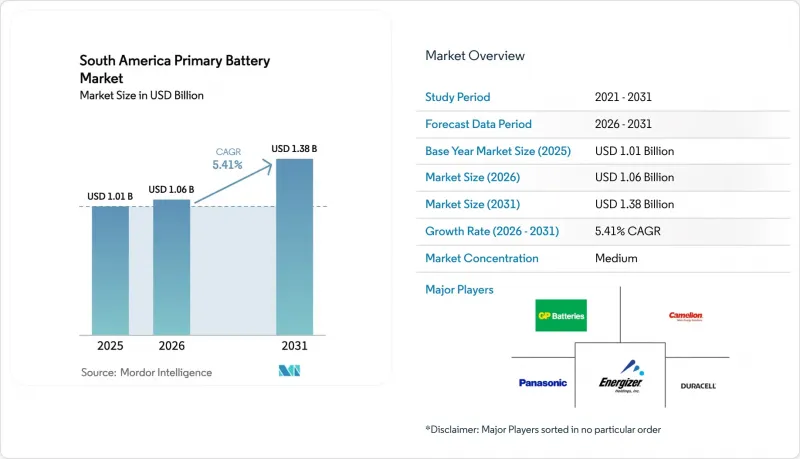
據 Mordor Intelligence 稱,2025 年南美洲一次電池市值為 10.1 億美元,預計到 2031 年將從 2026 年的 10.6 億美元成長至 13.8 億美元,預測期(2026-2031 年)的複合年成長率為 5.41%。
本報告涵蓋以下類別:類型(鹼性電池、一次鋰電池、鋅空氣電池、鋅碳/氯化物電池、氧化銀電池、其他)、形狀(圓柱形、紐扣形、棱柱形/封裝形、其他)、應用(家用電子電器、工業和OEM、醫療保健、國防和航太、物聯網感測器和智慧基礎設施)以及智利地區(巴西、阿根廷、智利等地區)。
南美洲一次電池市場趨勢與洞察
家用電子電器的滲透率不斷提高
到2025年,超過70%的成年人將使用智慧型手機,而從無線遊戲手把到LED手電筒等各種配件仍將依賴鹼性電池(AA和AAA型)。與Roxas Americanas和家樂福巴西的零售合作,使勁量(Energizer)在2025會計年度對拉丁美洲的鹼性電池出貨量增加了9%。哥倫比亞和秘魯的消費者對價格較為敏感,仍傾向於使用一次性電池,以避免購買可充電電池的前期成本。聖誕節和狂歡節期間玩具的需求進一步推動了電池的更換週期。雖然USB充電周邊設備在商店中的市場佔有率不斷擴大,但成熟的設備生態系統正在減緩電池的快速更換。
政府對農村離網電氣化的獎勵
巴西在2024年撥款4.5億雷亞爾(約9,000萬美元)用於向原住民居住地區分發太陽能發電套件。這些套件將太陽能組件與一次性鋰電池相結合,以彌補陰天期間的電力短缺。智利證券委員會(SEC)於2025年強制要求艾森州和麥哲倫州的偏遠地區使用零下備用電池,並建議使用Li-SOCl2電池。同年,秘魯向洛雷托州的每戶家庭提供了12,000套LED燈和收音機套件,從而產生了對D型電池定期更換的需求。這些措施將使競標規模更加多樣化,鞏固末端分銷網路,並最終促進未來的零售。
充電電池可快速更換
在巴西和智利的大型零售商中,USB充電式LED手電筒、遊戲手把和無線音箱正逐漸被一次性電池供電的產品所取代。勁量公司預測,到2025會計年度,拉丁美洲的鹼性電池銷量將下降4%,部分降幅將被價格上漲和鋰一次電池的成長所抵銷。雖然夜間充電的便利性正在加速都市區(擁有穩定電網)的這種轉變,但鹼性電池在農村地區仍然佔據主導地位。消費者意識宣傳活動有限,低收入族群對總擁有成本(TCO)的認知較為薄弱。
細分市場分析
由於AA和AAA型電池在零售通路的廣泛普及,鹼性電池預計在2025年仍將佔總銷售量的50.5%。相較之下,鋰離子一次電池預計到2031年將以每年8.7%的速度成長,為醫療植入、工業IoT節點和國防無線電設備等需要數十年使用壽命的設備提供動力。由於65歲及以上人口每年成長3.2%,鋅空氣電池正在助聽器市場佔據主導地位。針對汞含量的監管壓力正在加速鋅碳電池的淘汰。
氧化銀電池的價格是鹼性電池的三到五倍,用於智利礦山的精密手錶和氣體探測器中。具有特殊化學成分的電池,例如二硫化鐵鋰電池,專為巴塔哥尼亞和安第斯山脈等極端溫度環境下的國防應用而設計,預計將於2026年上市。因此,儘管鹼性電池在銷售上仍然佔據主導地位,但預計鋰電池在南美洲一次電池市場的規模將會擴大。
其他好處:
- Excel格式的市場預測(ME)表
- 3個月的分析師支持
目錄
第1章:引言
- 研究假設和市場定義
- 調查範圍
第2章:調查方法
第3章執行摘要
第4章 市場狀況
- 市場概覽
- 市場促進因素
- 家用電器普及率的提高
- 政府對農村離網供電的獎勵
- 關鍵醫療設備對一次電池的需求不斷成長
- 隨著極端天氣事件的增多,災害防備包的需求也不斷增加。
- 電池供電的物聯網感測器在巴西農產品中的普及。
- 安地斯國家國防採購中策略通訊系統的升級
- 市場限制因素
- 由於採用了可充電電池技術,更換速度很快。
- 加強對鎘/汞含量廢棄物處置的監管
- 巴西港口物流與進口關稅的變化
- 在阿根廷,一項試點性的「電池共享」服務正在拉低一次性產品的銷售。
- 供應鏈分析
- 監理情勢
- 技術展望
- 波特五力模型
第5章 市場規模與成長預測
- 按類型
- 鹼性電池
- 一次鋰電池(Li-MnO2、Li-SOCl2、Li-CFx)
- 鋅空氣電池
- 鋅碳/氯化物
- 氧化銀及其他
- 按外形規格
- 圓柱形(AA、AAA、C、D)
- 紐扣電池和紐扣電池
- 棱鏡/封裝類型
- 其他(特殊形狀)
- 透過使用
- 家用電子產品
- 工業和OEM
- 醫療保健
- 國防/航太
- 物聯網感測器和智慧基礎設施
- 按地區
- 巴西
- 阿根廷
- 哥倫比亞
- 智利
- 秘魯
- 其他南美國家
第6章 競爭情勢
- 市場集中度
- 策略趨勢(併購、聯盟、購電協議)
- 市場佔有率分析(主要公司的市場排名和佔有率)
- 公司簡介
- Duracell Inc.
- Energizer Holdings Inc.
- Panasonic Corp.
- GP Batteries International Ltd.
- Camelion Battery Co. Ltd.
- Saft Groupe SA
- Toshiba Corp.
- VARTA AG
- Maxell Holdings Ltd.
- Sony Corp.
- FDK Corp.
- Ultralife Corp.
- Spectrum Brands Holdings Inc.
- Rayovac Brasil(PRIMO Industria)
- Eveready Industries India Ltd.(SA export)
- Zhejiang Ningbo Hi-Watt Battery
- Wuhan FULI Battery
- Ningbo Sonyun Battery
- Shenzhen MUSTANG Battery
- Zhongyin(BB Battery)
第7章 市場機會與未來展望
According to Mordor Intelligence, the South America primary battery market size was valued at USD 1.01 billion in 2025 and is estimated to grow from USD 1.06 billion in 2026 to reach USD 1.38 billion by 2031, at a CAGR of 5.41% during the forecast period (2026-2031).
This report is Segmented by Type (Alkaline, Primary Lithium, Zinc-Air, Zinc-Carbon/Chloride, and Silver-Oxide and Others), Form Factor (Cylindrical, Coin and Button Cells, Prismatic/Packaged, and Others), Application (Consumer Electronics, Industrial and OEM, Medical and Healthcare, Defence and Aerospace, and IoT Sensor and Smart-Infrastructure), and Geography (Brazil, Argentina, Chile, and More)
South America Primary Battery Market Trends and Insights
Expanding Consumer-Electronics Penetration
Smartphone adoption passed 70% of adults in 2025, and accessories ranging from wireless gaming controllers to LED flashlights still depend on alkaline AA and AAA cells. Retail partnerships with Lojas Americanas and Carrefour Brasil lifted Energizer's Latin America alkaline shipments by 9% in fiscal 2025. Price-sensitive buyers in Colombia and Peru continue to favor disposable batteries over upfront rechargeable costs. Seasonal toy demand during Christmas and Carnival further sustains replacement cycles. Although USB-rechargeable peripherals are gaining shelf space, entrenched device ecosystems delay rapid substitution.
Government Incentives for Rural Off-Grid Electrification
Brazil allocated BRL 450 million (USD 90 million) in 2024 to distribute solar-battery kits across indigenous territories, pairing photovoltaic modules with primary lithium cells that buffer cloudy intervals. Chile's SEC mandated sub-zero-rated backup cells for off-grid sites in Aysen and Magallanes in 2025, favoring Li-SOCl2 chemistry. Peru supplied 12,000 LED lamps and radio kits to Loreto households the same year, creating a recurring D-cell replacement stream. These initiatives produce lumpy tenders but cement last-mile distribution networks that later benefit retail sales.
Rapid Substitution by Rechargeable Chemistries
USB-rechargeable LED flashlights, gaming controllers, and wireless speakers are replacing disposable-battery models in major Brazilian and Chilean retailers. Energizer's fiscal-2025 Latin America alkaline volume slipped 4%, partly offset by higher prices and lithium-primary growth. Urban households with stable grids can charge overnight, accelerating the shift, while rural areas remain alkaline-centric. Consumer education remains limited, delaying total-cost-of-ownership awareness in lower-income segments.
Other drivers and restraints analyzed in the detailed report include:
- Proliferation of Battery-Powered IoT Sensors in Brazilian Agribusiness
- Growing Demand for Primary Cells in Critical Medical Devices
- Stricter Disposal Rules on Cadmium / Mercury Content
For complete list of drivers and restraints, kindly check the Table Of Contents.
Segment Analysis
Alkaline batteries maintained 50.5% of 2025 revenue thanks to ubiquitous AA and AAA devices in retail channels. In contrast, primary lithium chemistries are projected to grow 8.7% annually through 2031, powering medical implants, industrial IoT nodes, and defense radios that need decade-long service lives. Zinc-air cells dominate the hearing-aid segment as the population aged 65+ expands 3.2% per year. Regulatory pressure on mercury content accelerates the phase-out of zinc-carbon variants.
Silver-oxide cells, priced three to five times higher than alkaline, serve precision watches and gas detectors in Chile's mines. Specialty chemistries like lithium-iron-disulfide target extreme temperatures in Patagonian and Andean defense applications with a commercial launch slated for 2026. As a result, the South America primary battery market size for lithium chemistries is set to widen its footprint, even as alkaline remains the volume leader.
Complete Report Scope:
- By Type
- Alkaline
- Primary Lithium (Li-MnO2, Li-SOCl2, Li-CFx)
- Zinc-Air
- Zinc-Carbon/Chloride
- Silver-Oxide and Others
- By Form Factor
- Cylindrical (AA, AAA, C, D)
- Coin and Button Cells
- Prismatic/Packaged
- Others (Special shapes)
- By Application
- Consumer Electronics
- Industrial and OEM
- Medical and Healthcare
- Defence and Aerospace
- IoT Sensors and Smart-Infrastructure
- By Geography
- Brazil
- Argentina
- Colombia
- Chile
- Peru
- Rest of South America
List of Companies Covered in this Report:
- Duracell Inc.
- Energizer Holdings Inc.
- Panasonic Corp.
- GP Batteries International Ltd.
- Camelion Battery Co. Ltd.
- Saft Groupe SA
- Toshiba Corp.
- VARTA AG
- Maxell Holdings Ltd.
- Sony Corp.
- FDK Corp.
- Ultralife Corp.
- Spectrum Brands Holdings Inc.
- Rayovac Brasil (PRIMO Industria)
- Eveready Industries India Ltd. (SA export)
- Zhejiang Ningbo Hi-Watt Battery
- Wuhan FULI Battery
- Ningbo Sonyun Battery
- Shenzhen MUSTANG Battery
- Zhongyin (BB Battery)
Additional Benefits:
- The market estimate (ME) sheet in Excel format
- 3 months of analyst support
TABLE OF CONTENTS
1 Introduction
- 1.1 Study Assumptions & Market Definition
- 1.2 Scope of the Study
2 Research Methodology
3 Executive Summary
4 Market Landscape
- 4.1 Market Overview
- 4.2 Market Drivers
- 4.2.1 Expanding consumer-electronics penetration
- 4.2.2 Government incentives for rural off-grid electrification
- 4.2.3 Growing demand for primary cells in critical medical devices
- 4.2.4 Disaster-preparedness kits amid rising extreme-weather events
- 4.2.5 Proliferation of battery-powered IoT sensors in Brazilian agribusiness
- 4.2.6 Tactical communications upgrades in Andean defence procurements
- 4.3 Market Restraints
- 4.3.1 Rapid substitution by rechargeable chemistries
- 4.3.2 Stricter disposal rules on cadmium / mercury content
- 4.3.3 Port-logistics & import-tariff volatility in Brazil
- 4.3.4 Pilot "battery-sharing" services dampening single-use sales in Argentina
- 4.4 Supply-Chain Analysis
- 4.5 Regulatory Landscape
- 4.6 Technological Outlook
- 4.7 Porter's Five Forces
- 4.7.1 Bargaining Power of Suppliers
- 4.7.2 Bargaining Power of Consumers
- 4.7.3 Threat of New Entrants
- 4.7.4 Threat of Substitute Products
- 4.7.5 Intensity of Competitive Rivalry
5 Market Size & Growth Forecasts
- 5.1 By Type
- 5.1.1 Alkaline
- 5.1.2 Primary Lithium (Li-MnO2, Li-SOCl2, Li-CFx)
- 5.1.3 Zinc-Air
- 5.1.4 Zinc-Carbon/Chloride
- 5.1.5 Silver-Oxide and Others
- 5.2 By Form Factor
- 5.2.1 Cylindrical (AA, AAA, C, D)
- 5.2.2 Coin and Button Cells
- 5.2.3 Prismatic/Packaged
- 5.2.4 Others (Special shapes)
- 5.3 By Application
- 5.3.1 Consumer Electronics
- 5.3.2 Industrial and OEM
- 5.3.3 Medical and Healthcare
- 5.3.4 Defence and Aerospace
- 5.3.5 IoT Sensors and Smart-Infrastructure
- 5.4 By Geography
- 5.4.1 Brazil
- 5.4.2 Argentina
- 5.4.3 Colombia
- 5.4.4 Chile
- 5.4.5 Peru
- 5.4.6 Rest of South America
6 Competitive Landscape
- 6.1 Market Concentration
- 6.2 Strategic Moves (M&A, Partnerships, PPAs)
- 6.3 Market Share Analysis (Market Rank/Share for key companies)
- 6.4 Company Profiles (includes Global level Overview, Market level overview, Core Segments, Financials as available, Strategic Information, Products & Services, and Recent Developments)
- 6.4.1 Duracell Inc.
- 6.4.2 Energizer Holdings Inc.
- 6.4.3 Panasonic Corp.
- 6.4.4 GP Batteries International Ltd.
- 6.4.5 Camelion Battery Co. Ltd.
- 6.4.6 Saft Groupe SA
- 6.4.7 Toshiba Corp.
- 6.4.8 VARTA AG
- 6.4.9 Maxell Holdings Ltd.
- 6.4.10 Sony Corp.
- 6.4.11 FDK Corp.
- 6.4.12 Ultralife Corp.
- 6.4.13 Spectrum Brands Holdings Inc.
- 6.4.14 Rayovac Brasil (PRIMO Industria)
- 6.4.15 Eveready Industries India Ltd. (SA export)
- 6.4.16 Zhejiang Ningbo Hi-Watt Battery
- 6.4.17 Wuhan FULI Battery
- 6.4.18 Ningbo Sonyun Battery
- 6.4.19 Shenzhen MUSTANG Battery
- 6.4.20 Zhongyin (BB Battery)
7 Market Opportunities & Future Outlook
- 7.1 White-space & Unmet-Need Assessment

 N型電池市場:按類型、容量、應用、最終用戶、國家和地區分類-全球產業分析、市場規模、市場佔有率及2026-2033年預測
 一次電池:市場佔有率分析、產業趨勢與統計、成長預測(2026-2031)
 一次電池市場規模、佔有率、趨勢和預測:按類型、最終用途行業和地區分類,2026-2034年
 一次電池市場-全球產業規模、佔有率、趨勢、機會和預測:按類型、應用、分銷管道、最終用戶、地區和競爭格局分類,2021-2031年
 2026年全球鋰一次電池市場報告N型電池全球市場報告(2026年)
 鹼性一次電池市場規模、佔有率、成長及全球產業分析:依類型、應用和地區劃分的洞察與預測(2024-2032 年)初級消費電池市場-全球產業規模、佔有率、趨勢、機會及預測(按電池化學成分、應用、地區和競爭情況,2020-2030 年預測)
 2025-2029年全球一次電池市場亞太地區一次電池-市場佔有率分析、產業趨勢和成長預測(2025-2030 年)