


 |
市場調查報告書
商品編碼
2124434
亞太地區壓縮機市場:市佔率分析、產業趨勢與統計及成長預測(2026-2031年)Asia-Pacific Compressor - Market Share Analysis, Industry Trends & Statistics, Growth Forecasts (2026 - 2031) |
||||||

※ 本網頁內容可能與最新版本有所差異。詳細情況請與我們聯繫。
據 Mordor Intelligence 稱,亞太地區的壓縮機市場預計在 2026 年達到 142.3 億美元,預計在預測期(2026-2031 年)內將以 6.13% 的複合年成長率成長,到 2031 年達到 191.6 億美元。
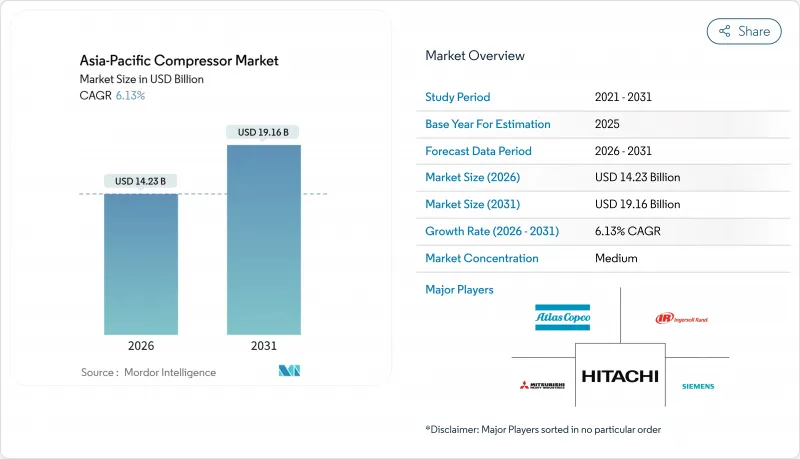
本報告按類型(容積式/動力式)、便攜性(固定式/可攜式)、壓力等級(低壓、中壓、高壓、超高壓)、最終用戶(石油和天然氣、製造/工業、暖通盟空調製冷/建築服務、汽車/運輸、其他)和地區(中國、印度、日本、韓國、東南亞國協、澳大利亞/紐西蘭和其他亞太地區)進行分類。
亞太地區壓縮機市場趨勢及洞察
快速的工業化和製造業擴張
預計到2025年,中國製造業增加價值將佔全球製造業增加價值的約30%。同時,印度的生產連結獎勵計畫計畫撥款6,940立方公尺(約8.3億美元)用於空調和LED生產線,從而提振了螺桿式和往復式壓縮機的訂單。東南亞國協在2024年吸引了2,240億美元的外國直接投資,越南和泰國新建的電子和汽車產業園區也已投入運作,這些園區都需要壓縮空氣網路。印度的德里-孟買-清奈-班加羅爾走廊正在採用變頻驅動(VSD)標準,加速了定速設備的更新換代。高附加價值製造業、半導體、電動車電池和生物製藥行業對滿足更嚴格公差要求的無油離心式壓縮機設計提出了更高的要求。在印尼和印度,儘管鋼鐵產量保持穩定,但鋁和銅的提煉正在成長,這進一步推動了對兆瓦級離心式壓縮機的需求。
嚴格的能源效率法規正在推動旋轉螺桿式變頻驅動器的普及。
新加坡於2024年實施了工業壓縮機最低能源效率標準(MEP),強制要求貼上能源效率標籤並逐步淘汰低效型號。越南將於2025年修訂《建築標準法》,強制安裝以變頻壓縮機為核心的熱回收式暖通空調系統。澳洲的保障機制對高排放設施進行處罰,加速過渡到可降低20-30%電力消耗的旋轉螺桿式壓縮機。日本的「頂級跑者」計畫和韓國的「綠色新政」不斷收緊標準,而馬來西亞的能源效率計畫旨在2030年將工業部門的能源強度降低10%。在亞太地區的壓縮機市場,變頻壓縮機維修18-24個月的投資回收期正鼓勵中小企業採用這項技術。
無油變頻壓縮機的初始成本較高
無油螺桿式壓縮機的價格比有油式壓縮機高出40-60%,變頻驅動(VSD)機組的價格也高出15-25%,這阻礙了印度、印尼和越南的中小型企業(SME)採用無油式壓縮機。雖然高階機型在對污染敏感的環境中具有整體擁有成本優勢,但許多用戶往往等到設備故障才升級。據基洛斯卡氣動公司(Kirloskar Pneumatic)稱,由於預算限制,60%的無油式壓縮機諮詢在12個月內未能促成交易。入門級50馬力無油螺桿式壓縮機的標價為25,000美元,而同等配置的有油式壓縮機售價為15,000美元,許多小規模維修車間難以承受如此巨大的價格差異。租賃模式,即「空氣即服務」(Air-as-a-service),可以減輕資本投入負擔,但其在亞太地區壓縮機市場的滲透率仍低於10%。
細分市場分析
到2025年,容積式壓縮機將佔亞太地區壓縮機市場的67.8%,主要得益於工廠和氣體收集領域對螺旋式和往復式壓縮機的日益普及。隨著石化和液化天然氣投資的成長,動力式壓縮機(主要是離心式壓縮機)預計將以6.5%的複合年成長率成長。在亞太地區壓縮機市場,隨著乙烯裂解裝置和氨循環裝置的成長,動力式壓縮機的市場規模預計將進一步擴大,因為這些裝置更傾向於使用兆瓦級的離心式壓縮機組。三菱重工和西門子的磁浮軸承系統可在20年內降低高達40%的營運成本。變速螺桿式壓縮機正在縮小與動力式壓縮機的效率差距,而轉葉壓縮機則在無塵室這一細分市場得到應用,因為無塵室對ISO 8573-1 0級潔淨度要求極高。
數位孿生技術的引入延長了往復式壓縮機的檢測週期,而日立整合感測器的混合式螺桿壓縮機則使汽車噴漆車間的能耗降低了15%。這些創新技術共同凸顯了亞太地區壓縮機市場中容積式壓縮機和動態壓縮機之間傳統界線日益模糊的趨勢。
到2025年,固定式設備將佔總需求的74.1%,這些設備整合到工廠和煉油廠的集中式網路中。同時,可攜式設備正以7.2%的複合年成長率快速成長,這主要得益於印度、越南和澳洲等地的公路、鐵路和礦區的需求。承包商為了避免資本支出(CAPEX),正在增加壓縮機的租賃,這加速了租賃公司的設備更新換代,並促進了服務和零件的銷售。在亞太地區的壓縮機市場,固定式設備仍佔據主導地位,但符合都市區噪音和排放氣體法規的電池供電可攜式正在逐步擴大市場佔有率。凱撒公司將於2024年推出的鋰離子電池型號,運作為4-6小時,目標市場是新加坡和香港的中央商務區(CBD)專案。
其他好處:
- Excel格式的市場預測(ME)表
- 3個月的分析師支持
目錄
第1章:引言
- 研究假設和市場定義
- 調查範圍
第2章:調查方法
第3章執行摘要
第4章 市場狀況
- 市場概覽
- 市場促進因素
- 快速的工業化和製造業擴張
- 嚴格的能源效率法規有利於旋轉螺桿式和變頻驅動機組。
- 液化天然氣和天然氣管道的擴建正在推動高壓氣體壓縮機的需求。
- 部署氫能基礎設施需要專用的氫氣(H2)壓縮機。
- 數位服務合約與預測性維護平台
- 亞太地區中產階級對暖通空調和冷鏈的需求激增
- 市場限制因素
- 無油變頻壓縮機的初始成本較高
- 原物料價格波動對OEM廠商的利潤率帶來了壓力。
- 缺乏能夠管理先進系統的熟練工程師
- 租賃住宅的日益普及正在減緩新建住宅的銷售。
- 供應鏈分析
- 監理情勢
- 技術展望
- 波特五力模型
第5章 市場規模與成長預測
- 按類型
- 正位移
- 往復式
- 旋轉螺桿
- 轉葉
- 動態的
- 離心式
- 軸
- 正位移
- 透過便攜性
- 固定式
- 可攜式的
- 按壓力等級
- 低壓(20 巴或以下)
- 中等壓力(20-100 巴)
- 高壓(100-300 巴)
- 超高壓(超過300巴)
- 最終用戶
- 石油和天然氣
- 發電
- 製造業和工業
- 化工/石油化工
- 暖通空調冷凍建築設備
- 汽車和運輸業
- 食品/飲料
- 醫療和藥品
- 按地區
- 中國
- 印度
- 日本
- 韓國
- 東南亞國協
- 澳洲和紐西蘭
- 其他亞太國家
第6章 競爭情勢
- 市場集中度
- 策略趨勢(併購、聯盟、購電協議)
- 市場佔有率分析(主要公司的市場排名和佔有率)
- 公司簡介
- Atlas Copco AB
- Ingersoll Rand Inc.
- Mitsubishi Heavy Industries Ltd
- Siemens AG
- Hitachi Industrial Equipment Systems Co Ltd
- Kobelco Compressors(Kobe Steel Ltd)
- Gardner Denver Holdings
- Kaeser Kompressoren SE
- ELGi Equipments Ltd
- Kirloskar Pneumatic Co Ltd
- Baker Hughes Co
- Ariel Corporation
- Doosan Corporation
- Trane Technologies plc
- Aerzener Maschinenfabrik GmbH
- Sullair LLC
- Howden Group
- Burckhardt Compression AG
- Fusheng Group
- Kaishan Compressor Co Ltd
第7章 市場機會與未來展望
According to Mordor Intelligence, the Asia-Pacific compressor market size is estimated at USD 14.23 billion in 2026, and is expected to reach USD 19.16 billion by 2031, at a CAGR of 6.13% during the forecast period (2026-2031).
This report is Segmented by Type (Positive Displacement and Dynamic), Portability (Stationary and Portable), Pressure Rating (Low, Medium, High, and Ultra-High), End-User (Oil and Gas, Manufacturing and Industrial, HVAC-R and Building Services, Automotive and Transportation, and More), and Geography (China, India, Japan, South Korea, ASEAN Countries, Australia and New Zealand, and Rest of Asia-Pacific)
Asia-Pacific Compressor Market Trends and Insights
Rapid Industrialization & Manufacturing Expansion
China delivered about 30% of global manufacturing value-added in 2025, while India's production-linked incentive program earmarked INR 6,940 crore (USD 830 million) for air-conditioner and LED lines, spurring orders for rotary-screw and reciprocating units. ASEAN economies attracted USD 224 billion in foreign direct investment in 2024, with Vietnam and Thailand commissioning new electronics and automotive parks that require compressed-air networks. India's Delhi-Mumbai and Chennai-Bengaluru corridors embed VSD standards that trigger a replacement cycle away from fixed-speed machines. Higher-value manufacturing, semiconductors, EV batteries, and biologics demand oil-free and centrifugal designs with tighter tolerances. Stabilizing steel output but rising aluminum and copper smelting in Indonesia and India further lift multi-megawatt centrifugal demand.
Stringent Energy-Efficiency Regulations Favouring Rotary-Screw & VSD Units
Singapore enforced Minimum Energy Performance Standards for industrial compressors in 2024, mandating efficiency labels and phasing out low-performance models. Vietnam's 2025 building-code revision requires heat-recovery HVAC systems built around VSD compressors. Australia's Safeguard Mechanism penalizes high-emission facilities, accelerating rotary-screw upgrades that cut electricity use 20-30%. Japan's Top Runner program and South Korea's Green New Deal keep tightening benchmarks, while Malaysia's energy-efficiency plan targets a 10% cut in industrial intensity by 2030. Across the Asia-Pacific compressor market, payback periods of 18-24 months for VSD retrofits are catalyzing small- and mid-size enterprise adoption.
High Upfront Cost of Oil-Free & VSD Compressors
Oil-free rotary-screw machines command a 40-60% premium over lubricated alternatives, while VSD packages add 15-25%, deterring small enterprises in India, Indonesia, and Vietnam. Total cost of ownership favors premium units in contamination-sensitive settings, yet many users defer upgrades until failures occur. Kirloskar Pneumatic reported that 60% of oil-free inquiries did not convert within 12 months, citing budget constraints. Entry-level oil-free 50-hp screws list at USD 25,000 against USD 15,000 for lubricated peers, a delta many small workshops struggle to justify. "Air-as-a-service" leasing softens capex but remains under 10% penetration across the Asia-Pacific compressor market.
Other drivers and restraints analyzed in the detailed report include:
- LNG & Gas-Pipeline Build-Out Boosting High-Pressure Gas Compressors
- Hydrogen Infrastructure Roll-Out Requiring Specialty H2 Compressors
- Raw-Material Price Volatility Squeezing OEM Margins
For complete list of drivers and restraints, kindly check the Table Of Contents.
Segment Analysis
Positive displacement machines controlled 67.8% of the Asia-Pacific compressor market in 2025, buoyed by rotary-screw and reciprocating uptake across factory floors and gas-gathering fields. Dynamic compressors, led by centrifugal designs, are forecast to grow at a 6.5% CAGR as petrochemical and LNG investments proliferate. The Asia-Pacific compressor market size for dynamic units is projected to widen alongside ethylene crackers and ammonia loops that favor multi-megawatt centrifugal trains. Magnetic-bearing systems from Mitsubishi Heavy Industries and Siemens trim operating costs up to 40% over two decades. Variable-speed screws are narrowing the efficiency gap with dynamics, while rotary-vane machines find cleanroom niches where ISO 8573-1 Class 0 purity is mandatory.
Digital twins lengthen service intervals for reciprocating models, and Hitachi's hybrid screw with embedded sensors cuts automotive paint-shop energy by 15%. Collectively, these innovations underscore how the Asia-Pacific compressor market continues to blur traditional boundaries between displacement and dynamic classes.
Stationary equipment represented 74.1% of 2025 demand, integrated into centralized factory and refinery grids. Portable units, however, are expanding at a 7.2% CAGR, leveraged by expressways, rail, and mining sites across India, Vietnam, and Australia. Contractors increasingly rent compressors to avoid capex, accelerating fleet turnover at rental houses and lifting service-parts revenue. The Asia-Pacific compressor market share for stationary units will remain dominant, yet incremental gains accrue to battery-electric portables, which address urban noise and emission curbs. Kaeser's lithium-ion model, launched in 2024, targets CBD projects in Singapore and Hong Kong with 4-6 hours of runtime.
Complete Report Scope:
- By Type
- Positive Displacement
- Reciprocating
- Rotary Screw
- Rotary Vane
- Dynamic
- Centrifugal
- Axial
- Positive Displacement
- By Portability
- Stationary
- Portable
- By Pressure Rating
- Low (Up to 20 bar)
- Medium (20 to 100 bar)
- High (100 to 300 bar)
- Ultra-High (Above 300 bar)
- By End-User
- Oil and Gas
- Power Generation
- Manufacturing and Industrial
- Chemicals and Petrochemicals
- HVAC-R and Building Services
- Automotive and Transportation
- Food and Beverage
- Healthcare and Pharmaceuticals
- By Geography
- China
- India
- Japan
- South Korea
- ASEAN Countries
- Australia and New Zealand
- Rest of Asia-Pacific
List of Companies Covered in this Report:
- Atlas Copco AB
- Ingersoll Rand Inc.
- Mitsubishi Heavy Industries Ltd
- Siemens AG
- Hitachi Industrial Equipment Systems Co Ltd
- Kobelco Compressors (Kobe Steel Ltd)
- Gardner Denver Holdings
- Kaeser Kompressoren SE
- ELGi Equipments Ltd
- Kirloskar Pneumatic Co Ltd
- Baker Hughes Co
- Ariel Corporation
- Doosan Corporation
- Trane Technologies plc
- Aerzener Maschinenfabrik GmbH
- Sullair LLC
- Howden Group
- Burckhardt Compression AG
- Fusheng Group
- Kaishan Compressor Co Ltd
Additional Benefits:
- The market estimate (ME) sheet in Excel format
- 3 months of analyst support
TABLE OF CONTENTS
1 Introduction
- 1.1 Study Assumptions & Market Definition
- 1.2 Scope of the Study
2 Research Methodology
3 Executive Summary
4 Market Landscape
- 4.1 Market Overview
- 4.2 Market Drivers
- 4.2.1 Rapid industrialisation & manufacturing expansion
- 4.2.2 Stringent energy-efficiency regulations favouring rotary-screw & VSD units
- 4.2.3 LNG & gas-pipeline build-out boosting high-pressure gas compressors
- 4.2.4 Hydrogen infrastructure roll-out requiring specialty H2 compressors
- 4.2.5 Digital service contracts & predictive-maintenance platforms
- 4.2.6 Surging HVAC & cold-chain demand among APAC middle class
- 4.3 Market Restraints
- 4.3.1 High upfront cost of oil-free & VSD compressors
- 4.3.2 Raw-material price volatility squeezing OEM margins
- 4.3.3 Shortage of skilled technicians for advanced systems
- 4.3.4 Rising rental penetration dampening new-unit sales
- 4.4 Supply-Chain Analysis
- 4.5 Regulatory Landscape
- 4.6 Technological Outlook
- 4.7 Porter's Five Forces
- 4.7.1 Bargaining Power of Suppliers
- 4.7.2 Bargaining Power of Consumers
- 4.7.3 Threat of New Entrants
- 4.7.4 Threat of Substitutes
- 4.7.5 Intensity of Rivalry
5 Market Size & Growth Forecasts
- 5.1 By Type
- 5.1.1 Positive Displacement
- 5.1.1.1 Reciprocating
- 5.1.1.2 Rotary Screw
- 5.1.1.3 Rotary Vane
- 5.1.2 Dynamic
- 5.1.2.1 Centrifugal
- 5.1.2.2 Axial
- 5.1.1 Positive Displacement
- 5.2 By Portability
- 5.2.1 Stationary
- 5.2.2 Portable
- 5.3 By Pressure Rating
- 5.3.1 Low (Up to 20 bar)
- 5.3.2 Medium (20 to 100 bar)
- 5.3.3 High (100 to 300 bar)
- 5.3.4 Ultra-High (Above 300 bar)
- 5.4 By End-User
- 5.4.1 Oil and Gas
- 5.4.2 Power Generation
- 5.4.3 Manufacturing and Industrial
- 5.4.4 Chemicals and Petrochemicals
- 5.4.5 HVAC-R and Building Services
- 5.4.6 Automotive and Transportation
- 5.4.7 Food and Beverage
- 5.4.8 Healthcare and Pharmaceuticals
- 5.5 By Geography
- 5.5.1 China
- 5.5.2 India
- 5.5.3 Japan
- 5.5.4 South Korea
- 5.5.5 ASEAN Countries
- 5.5.6 Australia and New Zealand
- 5.5.7 Rest of Asia-Pacific
6 Competitive Landscape
- 6.1 Market Concentration
- 6.2 Strategic Moves (M&A, Partnerships, PPAs)
- 6.3 Market Share Analysis (Market Rank/Share for key companies)
- 6.4 Company Profiles (includes Global level Overview, Market level overview, Core Segments, Financials as available, Strategic Information, Products & Services, and Recent Developments)
- 6.4.1 Atlas Copco AB
- 6.4.2 Ingersoll Rand Inc.
- 6.4.3 Mitsubishi Heavy Industries Ltd
- 6.4.4 Siemens AG
- 6.4.5 Hitachi Industrial Equipment Systems Co Ltd
- 6.4.6 Kobelco Compressors (Kobe Steel Ltd)
- 6.4.7 Gardner Denver Holdings
- 6.4.8 Kaeser Kompressoren SE
- 6.4.9 ELGi Equipments Ltd
- 6.4.10 Kirloskar Pneumatic Co Ltd
- 6.4.11 Baker Hughes Co
- 6.4.12 Ariel Corporation
- 6.4.13 Doosan Corporation
- 6.4.14 Trane Technologies plc
- 6.4.15 Aerzener Maschinenfabrik GmbH
- 6.4.16 Sullair LLC
- 6.4.17 Howden Group
- 6.4.18 Burckhardt Compression AG
- 6.4.19 Fusheng Group
- 6.4.20 Kaishan Compressor Co Ltd
7 Market Opportunities & Future Outlook
- 7.1 White-space & Unmet-need Assessment

 V型壓縮機市場:依類型、應用、電源、最終用戶、國家及地區分類-全球產業分析、市場規模、市佔率及2026年至2033年預測
 2026年全球機械蒸氣再壓縮(MVR)壓縮機市場報告
 液封壓縮機市場-2026-2032年全球市場預測
 螺桿式壓縮機市場規模、佔有率和成長分析:按類型、壓力範圍、應用、最終用途、配銷通路和地區分類-2026-2033年產業預測
 壓縮機:市佔率分析、產業趨勢與統計、成長預測(2026-2031)壓縮機市場:2026-2032年全球市場預測(按類型、驅動系統、潤滑方式、壓力範圍、冷卻方式、級數、移動性、應用和分銷管道分類)
 汽車空調壓縮機市場規模、佔有率和成長分析:按類型、車輛類型、銷售管道和地區分類-2026-2033年產業預測
 2026-2030年全球壓縮機市場
 2026-2030年全球往復式壓縮機市場
 MVR壓縮機:2026-2032年全球市佔率及排名、總營收及需求預測