


 |
市場調查報告書
商品編碼
2124432
輪胎簾布用織物:市場佔有率分析、行業趨勢和統計數據、成長預測(2026-2031)Tire Cord Fabrics - Market Share Analysis, Industry Trends & Statistics, Growth Forecasts (2026 - 2031) |
||||||

※ 本網頁內容可能與最新版本有所差異。詳細情況請與我們聯繫。
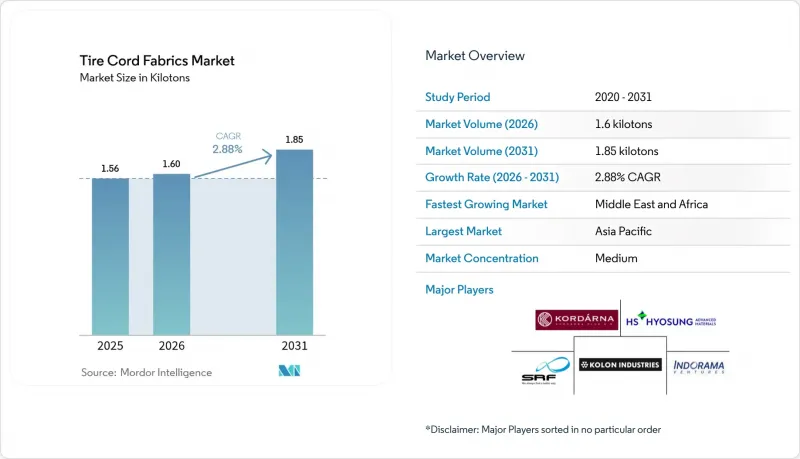
據 Mordor Intelligence 稱,2025 年輪胎簾布簾子佈市場價值為 1.56 千噸,預計到 2026 年將成長至 1.6 千噸,到 2031 年將成長至 1.85 千噸,預測期(2026-2031 年)複合年成長率為 2.88%。
本報告按纖維類型(尼龍、聚酯纖維、人造絲、芳香聚醯胺、玻璃纖維、聚乙烯醇)、輪胎類型(斜交/對角線、半子午線、子午線)、車輛類型(汽車、飛機、工業產品、其他)和地區(亞太地區、北美、歐洲、南美、中東和非洲)進行細分。市場預測以噸為單位。
全球輪胎簾布簾子佈市場趨勢及洞察
全球汽車產量增加及營運車輛數量擴大
隨著汽車產業整體生產的復甦,輪胎製造商為補充近期供應鏈中斷造成的庫存缺口,對增強纖維的需求也大幅成長。重型卡車、巴士和拖車的需求成長更為顯著,因為這些車輛每條輪胎所需的簾布層數量高於乘用車。全球汽車保有量的穩定成長支撐了對替換輪胎的需求,尤其是在新興經濟體,儘管面臨宏觀經濟逆風,這些地區的保有量仍在持續上升。物流車輛的電氣化專案也提振了需求,因為電動卡車需要更堅固的汽車胎體和更高的簾布層密度。主要輪胎製造商產能的同步成長正在形成同步上升趨勢,這將支撐輪胎簾布層市場的中期成長。
新興市場迅速採用子午線輪胎
在印度和東南亞,斜交輪胎正被子午線輪胎取代,每條子午線輪胎所需的簾布層數約增加40%。政府的燃油效率法規和使用者對更長輪胎使用壽命的需求正在加速這一轉變。在農業機械領域,這一趨勢更為顯著,因為IF/VF子午線技術需要使用高強度簾布層來打造更堅固的汽車胎體。這項轉變將持續到2030年,形成持續的需求成長動力,並與北美和歐洲成熟的市場需求趨勢相輔相成。能夠在輪胎製造廠附近擴大聚酯和尼龍生產線的供應商,將最有利於搶佔這一市場佔有率。
石化原料價格波動
聚酯和尼龍的生產依賴對二甲苯、己二酸和己內醯胺,這些原料的價格都與原油價格有密切關係。原油價格的急劇上漲會擠壓繩狀紡織品製造商的利潤空間,而價格的急劇下跌則會抑制對上游工程的投資,對供應穩定性構成風險。中國在紡織中間體市場的主導地位意味著,區域性供應中斷和貿易摩擦可能立即導致全球價格波動。大型輪胎製造商可以透過避險來規避風險,但小型紡織品製造商卻面臨營運資金緊張的困境,這可能會限制短期供應。
細分市場分析
到2025年,聚酯纖維將維持42.05%的輪胎簾布簾子佈市場佔有率,主要得益於其在乘用車和商用車輪胎中優異的性價比。其卓越的經濟性、豐富的原料以及與自動化織布機的兼容性,都鞏固了其主導地位。芳香聚醯胺雖然產量較小,但預計到2031年將以3.14%的複合年成長率成長,這主要受電動車和超高性能輪胎需求的推動,這些輪胎對耐熱性和抗張強度的要求超過了聚酯纖維的極限。尼龍在斜交輪胎和特種越野輪胎領域仍佔據重要地位,但隨著子午線輪胎的普及,其產量正在逐漸下降。人造絲由於供應限制和疲勞壽命短,市場佔有率持續下滑,但玻璃纖維和聚乙烯醇(PVA)簾子佈等細分市場在工業和航空航太應用領域保持穩定。隨著人們對永續性的需求日益成長,生物基聚酯和再生單體的試點引入正在取得進展,預計在本十年後半期,創新公司將重新定義纖維等級。
聚酯高密度低散射(HMLS)等級產品幫助主要製造商與全球輪胎原始設備製造商(OEM)簽訂了長期契約,使其免受原料價格波動的影響。芳香聚醯胺供應商獲得了高利潤率,許多供應商正在將上游工程整合到纖維前體化工領域,以穩定供應。聚酯與芳香聚醯胺或玻璃纖維混合製成的混紡簾線可提供最佳剛度,從而最佳化駕乘舒適性,為差異化成長提供途徑。
區域分析
預計到2025年,亞太地區將佔據48.10%的市場佔有率,這反映了該地區石化原料、高速紡織廠和大型輪胎工廠等生產群集。中國在HMLS聚酯RFF浸漬方面擁有規模優勢和先進技術,而印度汽車產業的成長正在鞏固其國內消費基礎。泰國和印尼等東南亞國家正在透過建造出口型輪胎工廠來拓展其供應鏈,幫助該地區成為輪胎簾布簾子佈的核心市場。
中東和非洲地區正以2.96%的複合年成長率(CAGR)保持全球最快的成長速度。各國政府正利用石油收入資助多元化項目,包括輪胎及零件的生產。沙烏地阿拉伯的工業園區正吸引與外國公司的合資企業,而摩洛哥則利用與歐盟和美國的貿易協定,將自身打造成為北非的出口中心。土耳其和南非憑藉其成熟的汽車產業,正成為進一步推動成長的中心。
北美和歐洲仍然是創新中心,監管壓力要求降低滾動阻力並使用永續材料,從而推動了對先進簾布層解決方案的需求。電動車的高普及率、嚴格的燃油效率標準以及無氣輪胎的早期測試,都促成了高階規格的形成,並滲透到全球供應鏈中。拉丁美洲在農業機械需求的推動下正經歷穩定成長,儘管外匯波動和經濟週期偶爾會導致成長放緩。總體而言,不斷變化的地理分佈迫使簾布層供應商在低成本生產和接近性高階客戶之間尋求平衡,預計這將進一步加劇輪胎簾布層市場的地域多元化。
其他好處:
- Excel格式的市場預測(ME)表
- 3個月的分析師支持
目錄
第1章:引言
- 研究假設和市場定義
- 調查範圍
第2章:調查方法
第3章執行摘要
第4章 市場狀況
- 市場概覽
- 市場促進因素
- 全球汽車產量增加及營運車輛數量擴大
- 新興市場迅速採用子午線輪胎
- 電動車輪胎更換頻率增加
- 對輕質高密度混紡和混合簾線降低阻力的需求
- RFF採用「綠色」黏合劑技術
- 市場限制因素
- 石化原料價格波動
- 汽車生產中周期性驅動的產能過剩/短缺
- 無氣/非充氣輪胎的興起
- 價值鏈分析
- 波特五力模型
第5章 市場規模與成長預測
- 纖維類型
- 尼龍
- 聚酯纖維
- 人造絲
- 芳香聚醯胺
- 玻璃
- PVA
- 按輪胎類型
- 偏置/對角線
- 半徑向
- 徑向
- 車輛類型
- 車
- 飛機
- 工業產品
- 其他
- 按地區
- 亞太地區
- 中國
- 印度
- 日本
- 韓國
- 東南亞國協
- 其他亞太國家
- 北美洲
- 美國
- 加拿大
- 墨西哥
- 歐洲
- 德國
- 英國
- 法國
- 義大利
- 俄羅斯
- 北歐國家
- 其他歐洲國家
- 南美洲
- 巴西
- 阿根廷
- 其他南美國家
- 中東和非洲
- 沙烏地阿拉伯
- 土耳其
- 南非
- 其他中東和非洲國家
- 亞太地區
第6章 競爭情勢
- 市場集中度
- 策略趨勢
- 市佔率和排名分析
- 公司簡介
- Beihai Fiberglass
- Bekaert
- Benninger AG
- Century Enka Limited
- Cordenka GmbH & Co KG
- Cordus
- Far Eastern Group
- Firestone Fibers & Textiles
- GURIS
- HYOSUNG ADVANCED MATERIALS
- Indorama Ventures Public Company Limited
- Kolon Industries Inc.
- KORDRNA Plus as
- Milliken & Company
- Oerlikon Management AG
- SRF Limited
- TEIJIN LIMITED
- TORAY INDUSTRIES, INC
第7章 市場機會與未來展望
目錄
第1章:引言
- 研究假設和市場定義
- 調查範圍
第2章:調查方法
第3章執行摘要
第4章 市場狀況
- 市場概覽
- 市場促進因素
- 全球汽車產量增加及營運車輛數量擴大
- 新興市場迅速採用子午線輪胎
- 電動車輪胎更換頻率增加
- 對輕質高密度混紡和混合簾線降低阻力的需求
- RFF採用「綠色」黏合劑技術
- 市場限制因素
- 石化原料價格波動
- 汽車生產中周期性驅動的產能過剩/短缺
- 無氣/非充氣輪胎的興起
- 價值鏈分析
- 波特五力模型
第5章 市場規模與成長預測
- 纖維類型
- 尼龍
- 聚酯纖維
- 人造絲
- 芳香聚醯胺
- 玻璃
- PVA
- 按輪胎類型
- 偏置/對角線
- 半徑向
- 徑向
- 車輛類型
- 車
- 飛機
- 工業產品
- 其他
- 按地區
- 亞太地區
- 中國
- 印度
- 日本
- 韓國
- 東南亞國協
- 其他亞太國家
- 北美洲
- 美國
- 加拿大
- 墨西哥
- 歐洲
- 德國
- 英國
- 法國
- 義大利
- 俄羅斯
- 北歐國家
- 其他歐洲國家
- 南美洲
- 巴西
- 阿根廷
- 其他南美國家
- 中東和非洲
- 沙烏地阿拉伯
- 土耳其
- 南非
- 其他中東和非洲國家
- 亞太地區
第6章 競爭情勢
- 市場集中度
- 策略趨勢
- 市佔率和排名分析
- 公司簡介
- Beihai Fiberglass
- Bekaert
- Benninger AG
- Century Enka Limited
- Cordenka GmbH & Co KG
- Cordus
- Far Eastern Group
- Firestone Fibers & Textiles
- GURIS
- HYOSUNG ADVANCED MATERIALS
- Indorama Ventures Public Company Limited
- Kolon Industries Inc.
- KORDRNA Plus as
- Milliken & Company
- Oerlikon Management AG
- SRF Limited
- TEIJIN LIMITED
- TORAY INDUSTRIES, INC
第7章 市場機會與未來展望
According to Mordor Intelligence, the tire cord fabrics market size was valued at 1.56 kilotons in 2025 and estimated to grow from 1.6 kilotons in 2026 to reach 1.85 kilotons by 2031, at a CAGR of 2.88% during the forecast period (2026-2031).
This report is Segmented by Fiber (Nylon, Polyester, Rayon, Aramid, Glass, and PVA), Tire Type (Bias/Diagonal, Semi-Radial, and Radial), Vehicle Type (Automotive, Aircrafts, Industrial Products, and Others), and Geography (Asia-Pacific, North America, Europe, South America, and Middle-East and Africa). The Market Forecasts are Provided in Terms of Volume (Tons).
Global Tire Cord Fabrics Market Trends and Insights
Rising Global Vehicle Production and Parc Expansion
Industry-wide vehicle output recovery is driving bulk orders for reinforcement textiles as tire factories rebuild inventories that ran down during recent supply-chain disruptions. Heavy-duty trucks, buses, and trailers consume greater quantities of cord fabric per tire than passenger cars, magnifying demand gains. A steadily expanding global vehicle parc sustains replacement volumes, especially in emerging economies where ownership rates continue to climb despite macroeconomic headwinds. Electrification programs in logistics fleets add incremental pull because electric trucks require stiffer carcasses and higher cord density. Parallel capacity additions at leading tire makers create a synchronized upswing that underpins medium-term growth for the tire cord fabrics market.
Rapid Radial-Tire Adoption in Emerging Markets
Across India and Southeast Asia, bias-ply tires are giving way to radial designs that need roughly 40% more cord fabric per unit. Government fuel-efficiency mandates and user demand for longer service life accelerate the changeover. Farm-equipment segments amplify the effect because IF and VF radial technologies require stronger carcasses built with high-tensile cords. The conversion progresses through 2030, producing a durable volume tailwind that compensates for mature demand profiles in North America and Europe. Suppliers capable of ramping polyester and nylon output near local tire clusters are best placed to capture this share.
Petrochemical Feedstock Price Volatility
Polyester and nylon rely on paraxylene, adipic acid, and caprolactam, all of which fluctuate with crude-oil cycles. Sudden surges compress margins for cord weavers, while sharp declines discourage upstream investment, creating supply-security risks. China's dominant position in fiber intermediates means regional outages or trade tensions can translate quickly into global price swings. Although large tire companies can hedge, smaller fabric producers face working-capital stress that may constrain near-term supply.
Other drivers and restraints analyzed in the detailed report include:
- Lightweight HMLS and Hybrid-Cord Demand for Lower Rolling Resistance
- Adoption of RFF "Green" Adhesion Chemistries
- Cyclical Over-/Under-Capacity in Auto Production
For complete list of drivers and restraints, kindly check the Table Of Contents.
Segment Analysis
Polyester retained 42.05% of tire cord fabrics market share in 2025 owing to its cost-to-performance balance across passenger and commercial tires. The segment's favorable economics, abundant feedstock, and compatibility with automated weaving underpin its leadership. Aramid, while accounting for a smaller volume base, records a 3.14% CAGR through 2031, powered by EV and ultra-high-performance fitments that demand heat resistance and tensile strength beyond polyester's ceiling. Nylon sustains relevance in bias constructions and specialty off-road tires but confronts gradual volume erosion as radial penetration rises. Rayon continues to retreat because of supply constraints and shorter fatigue life, whereas glass and PVA cord niches stay stable in industrial and aircraft applications. Sustainability imperatives encourage trials of bio-derived polyesters and recycled monomer streams, positioning innovators to redefine fiber hierarchies later in the decade.
Polyester's HMLS grades help leading producers lock in long-term contracts with global tire OEMs, cushioning them against raw-material swings. Aramid suppliers command premium margins and often integrate backward into fiber precursor chemistries to secure supply. Hybrid cords combining polyester with aramid or glass enable tailored stiffness for fine-tuned ride comfort, offering an avenue for differentiated growth.
Complete Report Scope:
- By Fiber
- Nylon
- Polyester
- Rayon
- Aramid
- Glass
- PVA
- By Tire Type
- Bias / Diagonal
- Semi-Radial
- Radial
- By Vehicle Type
- Automotive
- Aircrafts
- Industrial Products
- Others
- By Geography
- Asia-Pacific
- China
- India
- Japan
- South Korea
- ASEAN Countries
- Rest of Asia-Pacific
- North America
- United States
- Canada
- Mexico
- Europe
- Germany
- United Kingdom
- France
- Italy
- Russia
- Nordic Countries
- Rest of Europe
- South America
- Brazil
- Argentina
- Rest of South America
- Middle-East and Africa
- Saudi Arabia
- Turkey
- South Africa
- Rest of Middle-East and Africa
- Asia-Pacific
Geography Analysis
Asia-Pacific's 48.10% share in 2025 reflects production clusters that co-locate petrochemical feedstocks, high-speed weaving mills, and major tire plants. China combines scale with rising competency in HMLS polyester and RFF dipping, while India's automotive growth adds a deep domestic consumption layer. Southeast Asian economies such as Thailand and Indonesia extend the supply chain with export-oriented tire plants, helping the region anchor the tire cord fabrics market.
The Middle East and Africa records a 2.96% CAGR, the fastest worldwide. Governments channel oil revenue into diversification programs that include tire and component production. Saudi Arabia's industrial zones attract foreign joint ventures, while Morocco leverages trade pacts with the EU and the United States to become a North-African export base. Turkey and South Africa, with established auto sectors, provide additional anchor points for growth.
North America and Europe remain innovation hubs where regulatory pressure for low-rolling-resistance and sustainable materials drives demand for advanced cord solutions. High adoption of EVs, stringent fuel-economy standards, and early trials of airless tires shape premium specifications that ripple back through global supply chains. Latin America grows steadily on agricultural equipment demand, but currency volatility and economic cycles inject periodic softness. Overall, shifting geographic footprints prompt cord suppliers to balance low-cost manufacturing with proximity to high-spec customers, ensuring the tire cord fabrics market keeps diversifying regionally.
- Beihai Fiberglass
- Bekaert
- Benninger AG
- Century Enka Limited
- Cordenka GmbH & Co KG
- Cordus
- Far Eastern Group
- Firestone Fibers & Textiles
- GURIS
- HYOSUNG ADVANCED MATERIALS
- Indorama Ventures Public Company Limited
- Kolon Industries Inc.
- KORDRNA Plus a.s.
- Milliken & Company
- Oerlikon Management AG
- SRF Limited
- TEIJIN LIMITED
- TORAY INDUSTRIES, INC
Additional Benefits:
- The market estimate (ME) sheet in Excel format
- 3 months of analyst support
TABLE OF CONTENTS
1 Introduction
- 1.1 Study Assumptions and Market Definition
- 1.2 Scope of the Study
2 Research Methodology
3 Executive Summary
4 Market Landscape
- 4.1 Market Overview
- 4.2 Market Drivers
- 4.2.1 Rising global vehicle production and parc expansion
- 4.2.2 Rapid radial-tire adoption in emerging markets
- 4.2.3 Higher EV-related tire-replacement frequency
- 4.2.4 Lightweight HMLS and hybrid-cord demand for lower RR
- 4.2.5 Adoption of RFF "green" adhesion chemistries
- 4.3 Market Restraints
- 4.3.1 Petrochemical feedstock price volatility
- 4.3.2 Cyclical over-/under-capacity in auto production
- 4.3.3 Rise of airless / non-pneumatic tire concepts
- 4.4 Value Chain Analysis
- 4.5 Porter's Five Forces
- 4.5.1 Threat of New Entrants
- 4.5.2 Bargaining Power of Buyers
- 4.5.3 Bargaining Power of Suppliers
- 4.5.4 Threat of Substitute Products
- 4.5.5 Degree of Competition
5 Market Size and Growth Forecasts (Volume)
- 5.1 By Fiber
- 5.1.1 Nylon
- 5.1.2 Polyester
- 5.1.3 Rayon
- 5.1.4 Aramid
- 5.1.5 Glass
- 5.1.6 PVA
- 5.2 By Tire Type
- 5.2.1 Bias / Diagonal
- 5.2.2 Semi-Radial
- 5.2.3 Radial
- 5.3 By Vehicle Type
- 5.3.1 Automotive
- 5.3.2 Aircrafts
- 5.3.3 Industrial Products
- 5.3.4 Others
- 5.4 By Geography
- 5.4.1 Asia-Pacific
- 5.4.1.1 China
- 5.4.1.2 India
- 5.4.1.3 Japan
- 5.4.1.4 South Korea
- 5.4.1.5 ASEAN Countries
- 5.4.1.6 Rest of Asia-Pacific
- 5.4.2 North America
- 5.4.2.1 United States
- 5.4.2.2 Canada
- 5.4.2.3 Mexico
- 5.4.3 Europe
- 5.4.3.1 Germany
- 5.4.3.2 United Kingdom
- 5.4.3.3 France
- 5.4.3.4 Italy
- 5.4.3.5 Russia
- 5.4.3.6 Nordic Countries
- 5.4.3.7 Rest of Europe
- 5.4.4 South America
- 5.4.4.1 Brazil
- 5.4.4.2 Argentina
- 5.4.4.3 Rest of South America
- 5.4.5 Middle-East and Africa
- 5.4.5.1 Saudi Arabia
- 5.4.5.2 Turkey
- 5.4.5.3 South Africa
- 5.4.5.4 Rest of Middle-East and Africa
- 5.4.1 Asia-Pacific
6 Competitive Landscape
- 6.1 Market Concentration
- 6.2 Strategic Moves
- 6.3 Market Share/Ranking Analysis
- 6.4 Company Profiles (includes Global-level Overview, Market-level Overview, Core Segments, Financials, Strategic Info, Market Rank/Share, Products and Services, Recent Developments)
- 6.4.1 Beihai Fiberglass
- 6.4.2 Bekaert
- 6.4.3 Benninger AG
- 6.4.4 Century Enka Limited
- 6.4.5 Cordenka GmbH & Co KG
- 6.4.6 Cordus
- 6.4.7 Far Eastern Group
- 6.4.8 Firestone Fibers & Textiles
- 6.4.9 GURIS
- 6.4.10 HYOSUNG ADVANCED MATERIALS
- 6.4.11 Indorama Ventures Public Company Limited
- 6.4.12 Kolon Industries Inc.
- 6.4.13 KORDRNA Plus a.s.
- 6.4.14 Milliken & Company
- 6.4.15 Oerlikon Management AG
- 6.4.16 SRF Limited
- 6.4.17 TEIJIN LIMITED
- 6.4.18 TORAY INDUSTRIES, INC
7 Market Opportunities and Future Outlook
- 7.1 White-space and Unmet-Need Assessment

 鋼製輪胎簾子線市場-2026-2032年全球市場預測輪胎簾布和輪胎織物市場:按產品形式、材料、紗線類型、織物類型、最終用戶和分銷管道分類-2026-2032年全球市場預測
 輪胎簾布市場分析與預測(至2035年):類型、產品類型、技術、應用、材料類型、製造流程、最終用戶、功能
 輪胎簾布和輪胎纖維市場:按產品類型和地區分類
 輪胎簾布簾子佈-2026-2032年全球市佔率及排名、總收入及需求預測
 鋼絲輪胎簾布:市場佔有率分析、產業趨勢與統計、成長預測(2026-2031)
 全球輪胎簾布和輪胎織物市場規模、佔有率、趨勢和成長分析報告(2026-2034年)
 2026年全球輪胎簾布纖維市場報告
 增強型綠色輪胎簾布市場-全球產業規模、佔有率、趨勢、機會及預測(依材料類型、應用、通路、地區及競爭格局分類,2021-2031年)
 全球輪胎簾布市場報告、績效及預測(2020-2031年)