


 |
市場調查報告書
商品編碼
2124424
歐洲屋頂瓦:市場佔有率分析、行業趨勢和統計數據、成長預測(2026-2031)European Roof Tiles - Market Share Analysis, Industry Trends & Statistics, Growth Forecasts (2026 - 2031) |
||||||

※ 本網頁內容可能與最新版本有所差異。詳細情況請與我們聯繫。
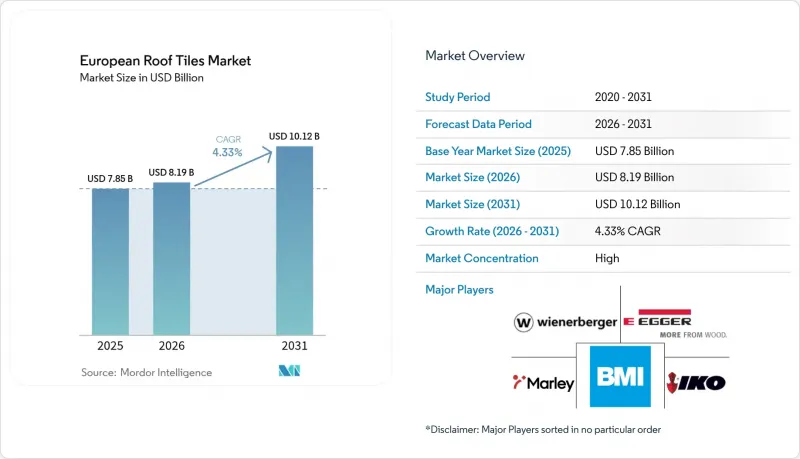
據 Mordor Intelligence 稱,歐洲屋頂瓦市場預計到 2026 年價值 81.9 億美元,高於 2025 年的 78.5 億美元,預計到 2031 年將達到 101.2 億美元。
預計從 2026 年到 2031 年,其複合年成長率將達到 4.33%。
本報告按產品類型(粘土瓦、混凝土瓦、太陽能屋頂瓦)、終端用戶行業(住宅、商業、基礎設施、工業/公共)、施工類型(新建、屋頂更換/維修)和地區(德國、英國、法國、義大利、西班牙、俄羅斯、北歐國家、土耳其和其他歐洲國家)進行細分。市場預測以美元計價。
歐洲屋頂瓦市場趨勢與洞察
歐盟綠建築法規正在加速屋頂瓦片的普及。
根據修訂後的《建築能源性能指令》,年能耗超過290千瓦時/平方公尺的建築物必須在2030年前進行節能改造。因此,採購規範現在強調採用具有高隔熱性能和整合太陽能發電功能的屋頂系統。隨著地方政府推動「翻新浪潮」策略,符合新U值標準的混凝土瓦和黏土瓦正成為公共競標中的標準選項。一些先行製造商已將預先認證可與建築整合光伏(BIPV)相容的瓦片推向市場,從而在分階段合規期限之前搶佔了先機。一旦該指令作為國家法律全面實施,後入場者將面臨被排除在計畫最終候選名單之外的風險。
歐洲老舊住宅存量的「翻新浪潮」正在興起。
四分之三的歐洲住宅建於1990年以前,不符合現行的能源效率標準。布魯塞爾的目標是到2030年完成3500萬套房屋的翻新,而屋頂維修是重中之重,因為它可以立即減少熱量損失。對於注重預算的屋主來說,混凝土瓦仍然是標準之選,因為其安裝方式簡單易行,最大限度地減少了人工成本和對日常生活的影響。製造商正在利用可預測的更換週期,並將產能的提升與區域性的維修資助計劃相結合。分銷商正在擴展即時庫存服務,以幫助承包商確保專案按時完工,從而獲得相應的補貼。
與瀝青或金屬屋頂相比,價格差異較大。
黏土和混凝土屋頂材料的價格仍然比瀝青屋頂材料高出40%至60%,這限制了它們在價格敏感的東歐市場的普及程度。 2024年至2025年間天然氣和水泥價格的急劇上漲將進一步擴大這一價格差距,迫使製造商在承擔成本上漲風險和漲價(但提價可能導致銷售量下降)之間做出選擇。然而,在人事費用高於材料成本的地區,屋主越來越重視屋頂瓦片的使用壽命,成本效益的討論也從初始成本轉向了全生命週期成本。
細分市場分析
隨著強制性屋頂太陽能發電裝置的普及,太陽能屋頂瓦片以6.85%的複合年成長率成長,超過了其他所有類型的屋頂瓦片。預計到2025年,混凝土屋頂瓦片將保持47.62%的歐洲市場佔有率,這反映了其成本優勢以及覆蓋維修活動頻繁地區的廣泛物流網路。黏土瓦片憑藉其傳統美感和數百年的使用壽命,在歷史建築修復市場佔據主導地位。製造商正將其傳統產品線與建築一體化光伏(BIPV)產品相結合,以拓展相關領域的銷售,而弧形太陽能瓦片則解決了以往的美觀問題。
歐洲屋瓦市場正逐漸形成三級價值體系:銷售量有限的高價太陽能瓦、作為旗艦產品的主流混凝土瓦,以及用於設計或保護/修復用途的陶瓦。工廠現代化改造的重點在於數位化窯爐控制,以降低燃氣消耗,這與各公司實現淨零排放的藍圖相符。跨國併購活動日益頻繁,建構出兼具通用混凝土生產能力和專利太陽能產品系列的平台,進一步重塑了歐洲屋頂瓦產業的格局。
其他好處:
- Excel格式的市場預測(ME)表
- 3個月的分析師支持
目錄
第1章:引言
- 研究假設和市場定義
- 調查範圍
第2章:調查方法
第3章執行摘要
第4章 市場狀況
- 市場概覽
- 市場促進因素
- 歐盟綠建築法規正在加速磁磚的普及應用。
- 歐洲老舊住宅存量正掀起一波翻新。
- 粘土/混凝土屋頂瓦的耐久性和生命週期永續性優勢
- 因極端天氣事件等氣候因素導致的屋頂更換。
- 強制安裝屋頂太陽能電池板促進了整合式太陽能屋頂瓦片的普及。
- 市場限制因素
- 與瀝青屋頂或金屬板屋頂相比,價格較高
- 技術純熟勞工磁磚安裝工人短缺
- 能源和原料(黏土、水泥、天然氣)價格波動
- 價值鏈分析
- 波特五力模型
第5章 市場規模與成長預測
- 依產品類型
- 黏土瓦
- 混凝土屋頂瓦
- 太陽能車頂瓦(光電建築整合)
- 按最終用戶行業分類
- 住宅
- 商業的
- 基礎設施
- 對於行業和機構
- 依建築類型
- 新建工程
- 屋頂更換/翻新
- 按地區
- 德國
- 英國
- 法國
- 義大利
- 西班牙
- 俄羅斯
- 北歐的
- 土耳其
- 其他歐洲國家
第6章 競爭情勢
- 市場集中度
- 策略趨勢
- 市佔率** / 排名分析
- 公司簡介
- BMI Group
- Crown Roof Tiles
- Edilians
- EGGER
- Eurocell Plc
- IKO Industries Ltd
- INDUSTRIE COTTO POSSAGNO SpA
- Marley
- Sika AG
- Solarstone OU
- Tegola Canadese Srl
- Vortex Hydra SRL
- Wienerberger AG
第7章 市場機會與未來展望
According to Mordor Intelligence, european roof tiles market size in 2026 is estimated at USD 8.19 billion, growing from 2025 value of USD 7.85 billion with 2031 projections showing USD 10.12 billion, growing at 4.33% CAGR over 2026-2031.
This report is Segmented by Product Type (Clay Tiles, Concrete Tiles, Solar Roof Tiles), End-User Industry (Residential, Commercial, Infrastructure, Industrial and Institutional), Construction Type (New Construction, Re-roofing/Renovation), and Geography (Germany, United Kingdom, France, Italy, Spain, Russia, Nordics, Turkey, Rest of Europe). The Market Forecasts are Provided in Terms of Value (USD).
European Roof Tiles Market Trends and Insights
EU Green-Building Mandates Accelerate Tile Adoption
The recast Energy Performance of Buildings Directive compels buildings consuming more than 290 kWh/m2 annually to undergo energy renovations by 2030. Consequently, procurement specifications now emphasize roof systems that offer high insulation values and integrate solar generation capacity. Concrete and clay tiles that meet emerging U-value thresholds are becoming default choices in public tenders as local governments align with the Renovation Wave strategy. Early-mover manufacturers roll out tiles pre-certified for BIPV compatibility, positioning themselves ahead of phased compliance deadlines. Late adopters risk exclusion from project shortlists once national transpositions of the directive are fully in force.
Renovation Wave Across Aging European Housing Stock
Three out of every four European dwellings were built before 1990 and fall short of present-day efficiency norms. Brussels targets 35 million renovations by 2030, and roofs top retrofit priority lists because they deliver immediate heat-loss reductions. Concrete tiles remain the default choice for budget-sensitive owners because familiar installation practices limit labor hours and project disruption. Manufacturers leverage predictable replacement cycles to synchronize capacity additions with regional renovation funding programs. Distributors expand just-in-time inventory services, ensuring installers can meet tight subsidy-linked project timelines.
Premium Pricing Versus Asphalt and Sheet-Metal Roofs
Clay and concrete solutions remain 40-60% pricier than asphalt alternatives, limiting penetration in price-sensitive Eastern European markets. Inflationary spikes in gas and cement during 2024-2025 widened this gap, forcing manufacturers to choose between absorbing costs or raising prices at the risk of volume losses. Nevertheless, where labor costs exceed material costs, owners increasingly value tiles' extended lifespans, shifting the affordability discussion from upfront expense to lifecycle economics.
Other drivers and restraints analyzed in the detailed report include:
- Durability and Life-Cycle Sustainability Advantages of Clay/Concrete Tiles
- Integrated Solar Roof Tiles Boosted by Rooftop-PV Rules
- Skilled-Labor Shortages in Specialist Tile Installation
For complete list of drivers and restraints, kindly check the Table Of Contents.
Segment Analysis
Solar tiles expanded at a 6.85% CAGR, outpacing all other formats as rooftop-PV obligations proliferated. Concrete maintained a 47.62% share of the European roof tile market in 2025, reflecting its cost advantages and logistical reach into renovation-heavy zones. Clay tiles have captured the heritage restoration market due to their authentic aesthetics and 100-year durability claims. Manufacturers merge traditional lines with BIPV variants to capture adjacency sales, while curved solar formats erase earlier aesthetic objections.
The European roof tiles market increasingly maps to a three-tier value hierarchy: solar tiles at premium price points but limited volume, concrete as a mainstream workhorse, and clay for design-driven or conservation contexts. Plant modernization focuses on digital kiln control to cut gas usage, aligning with corporate net-zero roadmaps. Cross-border acquisitions accelerate, creating platforms that balance commodity concrete capacity with patent-protected solar portfolios, further consolidating the European roof tiles industry.
Complete Report Scope:
- By Product Type
- Clay Tiles
- Concrete Tiles
- Solar Roof Tiles (BIPV)
- By End-user Industry
- Residential
- Commercial
- Infrastructure
- Industrial and Institutional
- By Construction Type
- New Construction
- Re-roofing / Renovation
- By Geography
- Germany
- United Kingdom
- France
- Italy
- Spain
- Russia
- Nordics
- Turkey
- Rest of Europe
List of Companies Covered in this Report:
- BMI Group
- Crown Roof Tiles
- Edilians
- EGGER
- Eurocell Plc
- IKO Industries Ltd
- INDUSTRIE COTTO POSSAGNO SpA
- Marley
- Sika AG
- Solarstone OU
- Tegola Canadese S.r.l.
- Vortex Hydra SRL
- Wienerberger AG
Additional Benefits:
- The market estimate (ME) sheet in Excel format
- 3 months of analyst support
TABLE OF CONTENTS
1 Introduction
- 1.1 Study Assumptions and Market Definition
- 1.2 Scope of the Study
2 Research Methodology
3 Executive Summary
4 Market Landscape
- 4.1 Market Overview
- 4.2 Market Drivers
- 4.2.1 EU green-building mandates accelerate tile adoption
- 4.2.2 Renovation wave across aging European housing stock
- 4.2.3 Durability and life-cycle sustainability advantages of clay/concrete tiles
- 4.2.4 Climate-driven re-roofing after extreme weather events
- 4.2.5 Integrated solar roof-tiles boosted by mandatory rooftop-PV rules
- 4.3 Market Restraints
- 4.3.1 Premium pricing versus asphalt and sheet-metal roofs
- 4.3.2 Skilled-labour shortages in specialist tile installation
- 4.3.3 Volatile energy and raw-material costs (clay, cement, gas)
- 4.4 Value Chain Analysis
- 4.5 Porter's Five Forces
- 4.5.1 Bargaining Power of Suppliers
- 4.5.2 Bargaining Power of Buyers
- 4.5.3 Threat of New Entrants
- 4.5.4 Threat of Substitute Products and Services
- 4.5.5 Degree of Competition
5 Market Size and Growth Forecasts (Value)
- 5.1 By Product Type
- 5.1.1 Clay Tiles
- 5.1.2 Concrete Tiles
- 5.1.3 Solar Roof Tiles (BIPV)
- 5.2 By End-user Industry
- 5.2.1 Residential
- 5.2.2 Commercial
- 5.2.3 Infrastructure
- 5.2.4 Industrial and Institutional
- 5.3 By Construction Type
- 5.3.1 New Construction
- 5.3.2 Re-roofing / Renovation
- 5.4 By Geography
- 5.4.1 Germany
- 5.4.2 United Kingdom
- 5.4.3 France
- 5.4.4 Italy
- 5.4.5 Spain
- 5.4.6 Russia
- 5.4.7 Nordics
- 5.4.8 Turkey
- 5.4.9 Rest of Europe
6 Competitive Landscape
- 6.1 Market Concentration
- 6.2 Strategic Moves
- 6.3 Market Share**/Ranking Analysis
- 6.4 Company Profiles (includes Global level Overview, Market level overview, Core Segments, Financials as available, Strategic Information, Market Rank/Share, Products and Services, Recent Developments)
- 6.4.1 BMI Group
- 6.4.2 Crown Roof Tiles
- 6.4.3 Edilians
- 6.4.4 EGGER
- 6.4.5 Eurocell Plc
- 6.4.6 IKO Industries Ltd
- 6.4.7 INDUSTRIE COTTO POSSAGNO SpA
- 6.4.8 Marley
- 6.4.9 Sika AG
- 6.4.10 Solarstone OU
- 6.4.11 Tegola Canadese S.r.l.
- 6.4.12 Vortex Hydra SRL
- 6.4.13 Wienerberger AG
7 Market Opportunities and Future Outlook
- 7.1 White-space and Unmet-need Assessment

 再生塑膠屋頂瓦市場規模、佔有率和成長分析:按產品類型、原料、應用、分銷管道和地區分類-2026-2033年產業預測
 屋頂瓦:市場佔有率分析、產業趨勢與統計、成長預測(2026-2031)
 屋瓦市場:按類型、應用和地區分類
 全球屋頂瓦市場規模、佔有率、趨勢及成長分析報告(2026-2034年)
 2026年全球再生塑膠屋頂瓦市場報告
 全球屋瓦市場按材料、安裝類型、應用和銷售管道分類,2026-2032年預測
 屋頂瓦市場規模、佔有率及成長分析(按材質、結構、最終用戶和地區分類)-2026-2033年產業預測
 屋頂瓦市場 - 全球產業規模、佔有率、趨勢、機會和預測,按類型(粘土瓦、混凝土瓦等)、按最終用戶領域(住宅和非住宅)、按地區、按競爭進行細分,2020-2030 年預測