


 |
市場調查報告書
商品編碼
2120507
屋頂瓦:市場佔有率分析、產業趨勢與統計、成長預測(2026-2031)Roofing Tiles - Market Share Analysis, Industry Trends & Statistics, Growth Forecasts (2026 - 2031) |
||||||

※ 本網頁內容可能與最新版本有所差異。詳細情況請與我們聯繫。
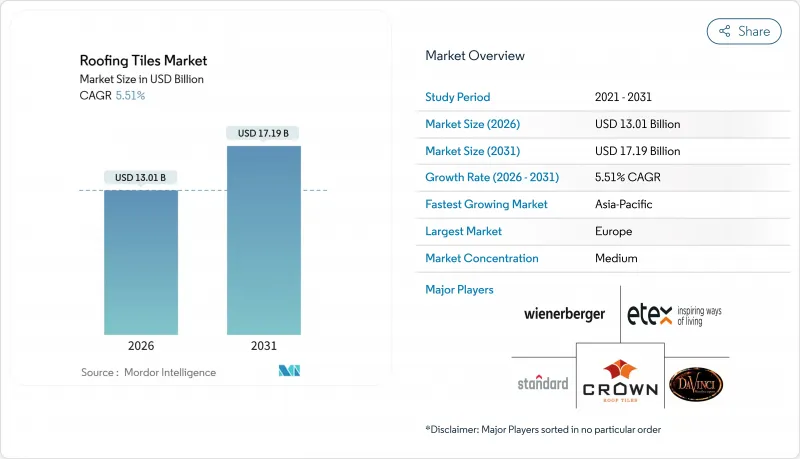
根據 Mordor Intelligence 估計,2026 年屋頂瓦片市值為 130.1 億美元,預計在預測期(2026-2031 年)內將以 5.51% 的複合年成長率成長,到 2031 年達到 171.9 億美元。
本報告按材料類型(混凝土、粘土、其他)、建設活動(維修/屋頂改造、新建)、最終用途(住宅、非住宅)和地區(亞太、北美、歐洲、南美、中東和非洲)進行細分。市場預測以美元計價。
全球屋瓦市場趨勢與洞察
都市化進程與新建建設活動的擴張
在印度、印尼、越南和菲律賓,由於城市人口成長和公共基礎設施改善推動了新住宅的開發,住宅開工量正在增加。勞動力向農村城市遷移,推動了對耐候性強、能夠緩解城市熱島效應並符合政府節能獎勵的屋頂材料的需求。沙烏地阿拉伯和阿拉伯聯合大公國(阿拉伯聯合大公國)的開發商正在大型企劃中採用高太陽反射率指數(SRI)的瓦片系統,以滿足各自國家能源效率框架的要求。重量減輕20-30%的輕質混凝土型材正逐漸被新興市場的木造建築所採用,從而擴大了目標市場。製造商正在東南亞地區實現生產本地化,以最大限度地降低運輸成本並遵守碳排放邊境政策。
老舊住宅存量導致屋頂更換需求增加。
北美和歐洲戰後經濟繁榮時期安裝的屋頂正接近使用壽命終點,在紫外線輻射強烈的地區和沿海地區,屋頂更換週期已縮短至15-18年。法國的《氣候適應力法案》旨在2030年實現每年37萬套住宅維修,其中許多項目都包括屋頂維修,可減少高達40%的冬季熱量損失。在美國,住宅在2023年花費了458億美元用於屋頂工程。在冰雹易發的州,保險公司要求屋頂必須達到4級抗衝擊等級才能維持保險。加州第24號法規等措施正在推動對「冷屋頂」瓦片的需求,這種瓦片能夠帶來可衡量的節能效果,並符合公用事業公司補貼的條件。
價格極具競爭力的瀝青瓦和金屬板
瀝青瓦在美國住宅屋頂市場仍然佔據很大佔有率,因為其安裝成本比混凝土瓦或粘土瓦低 40-50%。
細分市場分析
由於混凝土瓦具有成本效益高、抗壓強度高等優點,預計2025年,將佔據屋頂瓦市場47.05%的佔有率。同時,受歷史保護區和高階沿海住宅需求的推動,陶瓦的年複合成長率(CAGR)為6.74%。維納伯格(Wienerberger)位於匈牙利的碳中和工廠年產量達300萬平方米,為低碳瓦生產領域的投資提供了有力支撐。像Edilians這樣的粘土瓦供應商提供超過380種顏色選擇,幫助歷史街區在滿足太陽能再投資指數(SRI)要求的同時,又不影響該地區的傳統美感。包括BRAVA的再生聚乙烯產品系列在內的合成複合複合材料,憑藉50年的保固,正在鹽鹼環境中佔有一席之地。再生骨材骨材瓦比傳統產品輕15-20%,無需屋頂襯墊加固即可安裝在木質屋頂上。
預計到2025年,由於混凝土瓦的結構荷載限制相對寬鬆,將主要用於多用戶住宅和商業建築項目,而粘土瓦則主要用於滿足豪華住宅的需求。隨著生產線維修為低碳窯爐和太陽能供電模式,黏土瓦預計將實現最快的成長。儘管製造商正在將業務多元化拓展至金屬瓦和纖維水泥瓦,但預計到2026年,這些材料的總銷售量仍將保持在低位。
區域分析
2025年,歐洲在屋頂瓦市場維持了40.02%的佔有率。這得歸功於歐盟強制推行的「冷屋頂」法規和積極的維修配額目標。光是法國就強制要求每年維修37萬套住宅,直至2030年。 Edilians等領先企業供應太陽反射指數(SRI)達到80或更高的黏土瓦,在兼顧能源效率的同時,也兼顧了文化遺產保護標準。在北歐的維修工程中,輕質瓦是維修住宅的首選,無需額外的結構加固。同時,西班牙和葡萄牙向美洲和中東出口高太陽反射指數的陶瓦。 2024年,Wienerberger以6億歐元收購Teleal,進一步擴大了西歐的經銷網路,推動了產業整合的進程。
隨著印度、印尼、越南和菲律賓擴大住宅和建設計畫,亞太地區預計將成為成長最快的地區,到2031年複合年成長率將達到7.19%。印尼的都市化預計到2030年將達到71%,而印度政府的各項計畫正在推動住宅開工量的強勁成長。在日本和韓國,抗震標準正在推動輕質黏土瓦片(可嵌入太陽能電池)的應用。在中國,由於房地產行業的槓桿率下降,需求仍然疲軟,但沿海地區的維修項目正在支撐對高太陽反射率(SRI)瓦片的需求,這些瓦片有助於緩解都市區熱島效應。
北美地區的需求正受到德克薩斯州、佛羅裡達州和科羅拉多主要保險公司強制要求使用抗衝擊屋頂的推動。加州第24號法規規定了陡坡屋頂的SRI基準值,刺激了受城市熱島效應影響地區向瓦片屋頂的轉變。在加拿大,安大略省和不列顛哥倫比亞省的獨棟住宅開工量在降息後有所回升。同時,在墨西哥,近岸外包趨勢正在推動新建商業屋頂的建設,其中對冷屋頂混凝土瓦的需求尤其突出。在南美洲,這種屋頂材料的應用主要集中在巴西的住宅領域,該領域目前仍處於復甦趨勢中。
其他好處:
- Excel格式的市場預測(ME)表
- 3個月的分析師支持
目錄
第1章:引言
- 研究假設和市場定義
- 調查範圍
第2章:調查方法
第3章執行摘要
第4章 市場狀況
- 市場概覽
- 市場促進因素
- 亞太地區和非洲的都市化以及活性化的新建設活動
- 北美和歐洲老舊住宅存量,推動了屋頂更換的需求。
- 由於極端天氣事件造成的保險賠償,使用混凝土瓦代替瀝青的趨勢日益成長。
- 針對受城市熱島效應影響的城市,強制要求安裝冷屋頂(例如,加州第 24 號法規、歐盟環境影響設計指令)。
- 採用 3D 列印技術生產的輕質瓷磚可以減少安裝時間和物流成本。
- 碳邊境調節稅正在加速低碳窯爐技術的應用。
- 市場限制因素
- 價格極具競爭力的瀝青瓦和金屬板
- 由於技術純熟勞工短缺,安裝成本不斷上漲。
- 能源價格波動會降低黏土窯的獲利能力。
- 乾旱地區實施限水措施
- 價值供應鏈分析
- 監理情勢
- 技術展望
- 波特五力模型
第5章 市場規模與成長預測
- 材料類型
- 具體的
- 黏土
- 其他類型(合成/複合材料、金屬等)
- 透過建設活動
- 維修和重建
- 新建工程
- 按最終用途類別
- 住宅
- 非住宅
- 商業
- 基礎設施
- 工業和公共設施
- 按地區
- 亞太地區
- 中國
- 印度
- 日本
- 韓國
- 東南亞國協
- 其他亞太國家
- 北美洲
- 美國
- 加拿大
- 墨西哥
- 歐洲
- 德國
- 英國
- 法國
- 義大利
- 北歐國家
- 其他歐洲國家
- 南美洲
- 巴西
- 阿根廷
- 其他南美國家
- 中東和非洲
- 沙烏地阿拉伯
- 阿拉伯聯合大公國
- 南非
- 埃及
- 其他中東和非洲國家
- 亞太地區
第6章 競爭情勢
- 市場集中度
- 策略趨勢
- 市佔率和排名分析
- 公司簡介
- BRAVA
- CeDUR
- Crown Roof Tiles
- Eagle Roofing Products
- Etex Group
- Hangzhou Singer Building Materials Co., Ltd.
- IKO Industries, Inc.
- Imerys
- KPG Roofings
- LA ESCANDELLA
- LUDOWICI ROOF TILES
- MCA Clay Roof Tile
- Standard Industries Inc.(BMI Group)
- Vande Hey Raleigh
- Verea Clay Tile
- Westlake DaVinci Roofscapes LLC
- Wienerberger AG
第7章 市場機會與未來展望
According to Mordor Intelligence, the roofing tiles market size is estimated at USD 13.01 billion in 2026, and is expected to reach USD 17.19 billion by 2031, at a CAGR of 5.51% during the forecast period (2026-2031).
This report is Segmented by Material Type (Concrete, Clay, and Other Types), Construction Activity (Renovation and Replacement and New Construction), End-Use Sector (Residential and Non-Residential), and Geography (Asia-Pacific, North America, Europe, South America, and Middle East and Africa). Market Forecasts are Provided in Terms of Value (USD).
Global Roofing Tiles Market Trends and Insights
Rising Urbanization and New-Build Activity
Residential starts in India, Indonesia, Vietnam, and the Philippines are expanding as urban populations grow and public infrastructure programs unlock greenfield housing. Workforce migration into secondary cities supports demand for weather-resilient roofs that mitigate heat-island effects and qualify for government energy incentives. Developers in Saudi Arabia and the UAE are specifying high-SRI tile systems for mega-projects to satisfy national energy-efficiency frameworks. Lightweight concrete profiles with 20-30% lower mass are enabling use on wood-framed structures in emerging markets, widening the addressable base. Manufacturers are localizing production in Southeast Asia to minimize freight costs and navigate carbon-border policies.
Aging Housing Stock Fuels Reroofing
North American and European roofs installed during post-war booms are reaching end-of-life, compressing the reroof cycle to 15-18 years in high-UV or coastal zones. France's Climate & Resilience Act targets 370,000 annual home renovations through 2030, and many projects include roof upgrades that reduce winter heat loss by up to 40%. In the United States, homeowners spent USD 45.8 billion on roofing projects in 2023, with insurers in hail-prone states requiring Class 4 impact ratings to retain coverage. Programs such as California Title 24 boost demand for cool-roof tiles that deliver measurable energy savings and qualify for utility rebates.
Cost-Competitive Asphalt Shingles and Metal Panels
Asphalt shingles retain a major share of U.S. residential roofing because installed costs remain 40-50% lower than those of concrete or clay tiles.
Other drivers and restraints analyzed in the detailed report include:
- Concrete-Tile Substitution After Extreme-Weather Losses
- Mandatory Cool-Roof Codes in Heat-Island Cities
- Skilled-Labor Shortages Raise Installation Costs
For complete list of drivers and restraints, kindly check the Table Of Contents.
Segment Analysis
Concrete commanded a 47.05% roofing tiles market share in 2025 due to cost efficacy and compressive strength, yet clay is growing at a 6.74% CAGR on heritage-zone preference and premium coastal demand. Wienerberger's CO2-neutral plant in Hungary produces 3 million m2 annually and underscores investment in low-carbon tile production. Clay suppliers such as Edilians offer more than 380 colors, helping historic districts comply with SRI requirements without altering vernacular aesthetics. Synthetic composites, including BRAVA's recycled-polyethylene lines, are carving niche share in salt-spray environments with 50-year warranties. Recycled-aggregate concrete tiles, 15-20% lighter than legacy products, enable installation on wood-framed roofs without deck reinforcement.
Concrete tiles were used largely in multifamily and commercial projects in 2025 because structural load limits are more generous, while clay tiles primarily served premium residential demand. Clay is projected to capture the fastest growth as production lines retrofit to low-carbon kilns and photovoltaic-ready formats. Manufacturers are diversifying into metal and fiber-cement tiles, yet these materials combined capture low volumes through 2026.
Complete Report Scope:
- By Material Type
- Concrete
- Clay
- Other Types (Synthetic / Composite, Metal, etc.)
- By Construction Activity
- Renovation and Replacement
- New Construction
- By End-use Sector
- Residential
- Non-residential
- Commercial
- Infrastructure
- Industrial and Institutional
- By Geography
- Asia-Pacifc
- China
- India
- Japan
- South Korea
- ASEAN Countries
- Rest of Asia-Pacific
- North America
- United States
- Canada
- Mexico
- Europe
- Germany
- United Kingdom
- France
- Italy
- NORDIC Countries
- Rest of Europe
- South America
- Brazil
- Argentina
- Rest of South America
- Middle East and Africa
- Saudi Arabia
- United Arab Emirates
- South Africa
- Egypt
- Rest of Middle East and Africa
- Asia-Pacifc
Geography Analysis
Europe sustained a 40.02% share of the roofing tiles market in 2025, upheld by EU-mandated cool-roof codes and aggressive renovation quotas. France alone mandates 370,000 annual home retrofits through 2030, and leaders such as Edilians supply clay tiles with SRI more than 80 that satisfy both energy and heritage criteria. Nordic retrofit programs prefer lightweight tiles to upgrade timber-framed dwellings without extra structural reinforcement, while Spain and Portugal export high-SRI clay tiles to the Americas and Middle East. Consolidation advanced when Wienerberger acquired Terreal for EUR 600 million in 2024, broadening distribution across Western Europe.
Asia-Pacific is the fastest-growing region at 7.19% CAGR through 2031 as India, Indonesia, Vietnam, and the Philippines expand housing and infrastructure pipelines. Urbanization in Indonesia is projected to hit 71% by 2030, and government programs in India underpin strong residential starts. Seismic codes in Japan and South Korea drive adoption of lightweight clay profiles that integrate photovoltaic cells. Chinese demand remains muted amid property deleveraging, but retrofit activity in coastal provinces supports high-SRI tiles that mitigate urban heat.
North American demand is propelled by leading insurers in Texas, Florida, and Colorado that require impact-rated roofs. California Title 24 mandates SRI thresholds on steep-slope roofs, driving tile substitution in heat-island areas. Canada's single-family starts rebounded in Ontario and British Columbia after rate cuts, while Mexico's nearshoring trend fuels new commercial roofs that favor cool-roof concrete tiles. South American uptake remains concentrated in Brazil's recovering residential sector.
- BRAVA
- CeDUR
- Crown Roof Tiles
- Eagle Roofing Products
- Etex Group
- Hangzhou Singer Building Materials Co., Ltd.
- IKO Industries, Inc.
- Imerys
- KPG Roofings
- LA ESCANDELLA
- LUDOWICI ROOF TILES
- MCA Clay Roof Tile
- Standard Industries Inc. (BMI Group)
- Vande Hey Raleigh
- Verea Clay Tile
- Westlake DaVinci Roofscapes LLC
- Wienerberger AG
Additional Benefits:
- The market estimate (ME) sheet in Excel format
- 3 months of analyst support
TABLE OF CONTENTS
1 Introduction
- 1.1 Study Assumptions and Market Definition
- 1.2 Scope of the Study
2 Research Methodology
3 Executive Summary
4 Market Landscape
- 4.1 Market Overview
- 4.2 Market Drivers
- 4.2.1 Rising Urbanisation and New-Build Activity in APAC And Africa
- 4.2.2 Ageing Housing Stock Drives Reroofing Demand in North America and Europe
- 4.2.3 Concrete-Tile Substitution for Asphalt After Extreme-Weather Insurance Losses
- 4.2.4 Mandatory Cool-Roof Codes in Heat-Island Cities (e.g., CA Title 24, EU EPBD)
- 4.2.5 3-D-Printed Lightweight Tiles Shorten Installation Time and Cut Logistics Costs
- 4.2.6 Carbon-Border Levies Accelerate Adoption of Low-Carbon Kiln Technology
- 4.3 Market Restraints
- 4.3.1 Cost-Competitive Asphalt Shingles and Metal Panels
- 4.3.2 Skilled-Labour Shortages Raise Installation Costs
- 4.3.3 Volatile Energy Prices Disrupt Clay-Kiln Economics
- 4.3.4 Water-Extraction Limits in Drought-Prone Regions
- 4.4 Value / Supply-Chain Analysis
- 4.5 Regulatory Landscape
- 4.6 Technological Outlook
- 4.7 Porter's Five Forces
- 4.7.1 Bargaining Power of Suppliers
- 4.7.2 Bargaining Power of Buyers
- 4.7.3 Threat of New Entrants
- 4.7.4 Threat of Substitutes
- 4.7.5 Degree of Competition
5 Market Size and Growth Forecasts (Value)
- 5.1 By Material Type
- 5.1.1 Concrete
- 5.1.2 Clay
- 5.1.3 Other Types (Synthetic / Composite, Metal, etc.)
- 5.2 By Construction Activity
- 5.2.1 Renovation and Replacement
- 5.2.2 New Construction
- 5.3 By End-use Sector
- 5.3.1 Residential
- 5.3.2 Non-residential
- 5.3.2.1 Commercial
- 5.3.2.2 Infrastructure
- 5.3.2.3 Industrial and Institutional
- 5.4 By Geography
- 5.4.1 Asia-Pacifc
- 5.4.1.1 China
- 5.4.1.2 India
- 5.4.1.3 Japan
- 5.4.1.4 South Korea
- 5.4.1.5 ASEAN Countries
- 5.4.1.6 Rest of Asia-Pacific
- 5.4.2 North America
- 5.4.2.1 United States
- 5.4.2.2 Canada
- 5.4.2.3 Mexico
- 5.4.3 Europe
- 5.4.3.1 Germany
- 5.4.3.2 United Kingdom
- 5.4.3.3 France
- 5.4.3.4 Italy
- 5.4.3.5 NORDIC Countries
- 5.4.3.6 Rest of Europe
- 5.4.4 South America
- 5.4.4.1 Brazil
- 5.4.4.2 Argentina
- 5.4.4.3 Rest of South America
- 5.4.5 Middle East and Africa
- 5.4.5.1 Saudi Arabia
- 5.4.5.2 United Arab Emirates
- 5.4.5.3 South Africa
- 5.4.5.4 Egypt
- 5.4.5.5 Rest of Middle East and Africa
- 5.4.1 Asia-Pacifc
6 Competitive Landscape
- 6.1 Market Concentration
- 6.2 Strategic Moves
- 6.3 Market Share(%)/Ranking Analysis
- 6.4 Company Profiles (includes Global level Overview, Market level overview, Core Segments, Financials as available, Strategic Information, Market Rank/Share for key companies, Products and Services, and Recent Developments)
- 6.4.1 BRAVA
- 6.4.2 CeDUR
- 6.4.3 Crown Roof Tiles
- 6.4.4 Eagle Roofing Products
- 6.4.5 Etex Group
- 6.4.6 Hangzhou Singer Building Materials Co., Ltd.
- 6.4.7 IKO Industries, Inc.
- 6.4.8 Imerys
- 6.4.9 KPG Roofings
- 6.4.10 LA ESCANDELLA
- 6.4.11 LUDOWICI ROOF TILES
- 6.4.12 MCA Clay Roof Tile
- 6.4.13 Standard Industries Inc. (BMI Group)
- 6.4.14 Vande Hey Raleigh
- 6.4.15 Verea Clay Tile
- 6.4.16 Westlake DaVinci Roofscapes LLC
- 6.4.17 Wienerberger AG
7 Market Opportunities and Future Outlook
- 7.1 White-space and Unmet-need Assessment

 再生塑膠屋頂瓦市場規模、佔有率和成長分析:按產品類型、原料、應用、分銷管道和地區分類-2026-2033年產業預測
 歐洲屋頂瓦:市場佔有率分析、行業趨勢和統計數據、成長預測(2026-2031)
 屋瓦市場:按類型、應用和地區分類
 全球屋頂瓦市場規模、佔有率、趨勢及成長分析報告(2026-2034年)
 2026年全球再生塑膠屋頂瓦市場報告
 全球屋瓦市場按材料、安裝類型、應用和銷售管道分類,2026-2032年預測
 屋頂瓦市場規模、佔有率及成長分析(按材質、結構、最終用戶和地區分類)-2026-2033年產業預測
 屋頂瓦市場 - 全球產業規模、佔有率、趨勢、機會和預測,按類型(粘土瓦、混凝土瓦等)、按最終用戶領域(住宅和非住宅)、按地區、按競爭進行細分,2020-2030 年預測