


 |
市場調查報告書
商品編碼
2124423
中東和非洲木器塗料市場:市場佔有率分析、行業趨勢和統計數據以及成長預測(2026-2031 年)Middle-East And Africa Wood Coatings - Market Share Analysis, Industry Trends & Statistics, Growth Forecasts (2026 - 2031) |
||||||

※ 本網頁內容可能與最新版本有所差異。詳細情況請與我們聯繫。
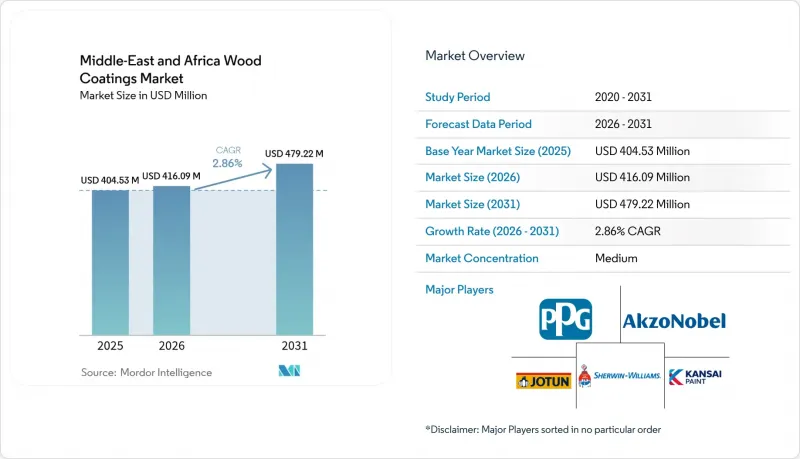
根據 Mordor Intelligence 預測,中東和非洲的木器塗料市場規模將從 2025 年的 4.0453 億美元成長到 2026 年的 4.1609 億美元,到 2031 年將達到 4.7922 億美元,2026 年至 20312.86%。
本報告按樹脂類型(聚氨酯、聚酯、硝化纖維素及其他)、技術(水性、溶劑型、紫外光固化、粉末固化)、應用領域(家具及設備、門窗及其他)和地區(南非、埃及、摩洛哥、奈及利亞、阿爾及利亞、肯亞、沙烏地阿拉伯、阿拉伯聯合大公國及其他)進行細分。市場預測以美元計價。
中東和非洲木器塗料市場趨勢及洞察。
海灣合作理事會與東非建築計畫的激增
公共資本支出正改變各類建築的需求格局。沙烏地阿拉伯公共投資基金(PIF)已投資400億美元用於酒店業的室內裝修項目,而酒店業大量使用木材,這推動了耐濕性高達90%的船用級聚氨酯塗料的應用。在肯亞,一項經濟適用住宅計畫強制要求細木工使用本地木材,從而提振了室內木材的需求。儘管亞的斯亞貝巴的房地產熱潮蓬勃發展,但由於衣索比亞的關稅政策限制了水性底漆的進口,溶劑型塗料仍然佔據主導地位。因此,塗料製造商正在並行營運兩條生產線,以滿足海灣國家高性能專案和東非注重成本效益的住宅運作的需求。
該地區家具製造地的擴張
2024年,摩洛哥家具出口額達3.58億美元,主要產自卡薩布蘭卡和丹吉爾的工廠。這些工廠採用雙組分聚氨酯塗料,以滿足歐洲的耐刮標準。肯亞價值4.52億美元的家具產業持續面臨窯乾木材短缺的困境,紫外線固化塗料的缺陷率居高不下,進一步鞏固了硝化纖維素塗料的市場主導地位。南非西開普省的製造商正轉向工程木材,並根據該省的空氣品質計劃,將溶劑排放量減少了35%。出口型企業需要符合品質標準的穩定塗料,而肯亞和南非的小規模工坊則往往更注重價格而非性能。
嚴格的VOC法規/類似REACH的法規
埃及250克/公升的揮發性有機化合物(VOC)限值導致許多硝化纖維素基產品無法達到標準,迫使它們以高出15-20%的成本進口水性替代品。摩洛哥現在要求出口到歐洲的產品提供VOC聲明,這為小規模工坊增加了沉重的檢測成本。南非當局在2024年發布了14項整改建議,威脅要關閉不符合標準的工廠。海灣合作理事會(GCC)的專案對符合LEED標準的低VOC塗料的需求不斷成長,水性塗料的市場滲透率從2022年的30%上升到2024年的48%。維修噴塗生產線的資本成本仍然是一個障礙,迫使肯亞和奈及利亞的許多工廠儘管利潤率較低,但仍繼續使用溶劑型產品。
細分市場分析
預計到2025年,聚氨酯將佔據中東和非洲木器塗料市場59.10%的佔有率,並在2031年之前以2.94%的複合年成長率成長。在吉達、杜哈和杜拜,承包商通常會指定雙組分聚氨酯用於戶外細木工,因為在濕度高達90%的環境中,分層是一個令人擔憂的問題。聚酯塗料在沙烏地阿拉伯乾燥的內陸地區仍然很受歡迎,市佔率約為10.20%,但在熱循環作用下會出現脆化現象。由於埃及的VOC法規迫使出口商停止使用傳統配方,硝化纖維素的市佔率已降至10%。以「Bayhydur」和「Laromer」品牌銷售的水性聚氨酯分散體在北非實現了兩位數的成長,因為分銷商強調符合歐盟法規。由於土耳其和埃及的MDF工廠中數位印刷技術的普及,UV固化丙烯酸樹脂的市場佔有率正在迅速擴大。
在東非,聚氨酯的高階市場與經濟型市場並存,後者包括單組分丙烯酸樹脂和硝化纖維素,後者仍佔據主導地位。這種兩極化迫使供應商營運平行的供應鏈。在預測期內,隨著沿岸地區旅遊項目的增加,聚氨酯的市場佔有率可能會逐步上升,而硝化纖維素在出口導向產業叢集中的市場佔有率預計將繼續下降。
其他好處
- Excel格式的市場預測(ME)表
- 3個月的分析師支持
目錄
第1章:引言
- 研究假設和市場定義
- 調查範圍
第2章:調查方法
第3章執行摘要
第4章 市場狀況
- 市場概覽
- 市場促進因素
- 海灣合作理事會與東非建築計畫的激增
- 該地區家具製造地的擴張
- 監理重心轉向水生系統
- 大型企劃。
- 複合板數位印刷技術的興起
- 市場限制因素
- 嚴格的VOC法規/類似REACH的法規
- 石油樹脂價格波動
- 供不應求
- 價值鏈分析
- 波特五力模型
第5章 市場規模與成長預測
- 依樹脂類型
- 聚氨酯
- 聚酯纖維
- 硝化纖維素
- 丙烯酸樹脂
- 其他
- 透過技術
- 水溶液
- 溶劑型
- 紫外線固化型
- 粉末
- 透過使用
- 家具及設備
- 門窗
- 內閣
- 其他
- 按地區
- 南非
- 埃及
- 摩洛哥
- 奈及利亞
- 阿爾及利亞
- 肯亞
- 沙烏地阿拉伯
- 阿拉伯聯合大公國
- 伊朗
- 其他中東和非洲國家
第6章 競爭情勢
- 市場集中度
- 策略趨勢
- 市佔率和排名分析
- 公司簡介
- Akzo Nobel NV
- Asian Paints Ltd.
- Caparol Paints(DAW SE)
- Crown Paints Kenya PLC
- Hempel A/S
- IVM Chemicals SRL
- Jotun
- Kansai Paint Co., Ltd.
- KAPCI Coatings
- Mas Paints
- National Paints Factories Co. Ltd.
- Nippon Paint Holdings Co., Ltd.
- PPG Industries Inc.
- Ritver
- RPM International Inc.
- Sipes Egypt
- The Sherwin-Williams Company
第7章 市場機會與未來展望
According to Mordor Intelligence, the Middle East and Africa wood coatings market size is expected to grow from USD 404.53 million in 2025 to USD 416.09 million in 2026 and is forecast to reach USD 479.22 million by 2031 at 2.86% CAGR over 2026-2031.
This report is Segmented by Resin Type (Polyurethane, Polyester, Nitrocellulose, and More), Technology (Water-Borne, Solvent-Borne, UV Cured, and Powder), Application (Furniture and Fixtures, Doors and Windows, and More), and Geography (South Africa, Egypt, Morocco, Nigeria, Algeria, Kenya, Saudi Arabia, UAE, and More). Market Forecasts are Provided in Terms of Value (USD).
Middle-East And Africa Wood Coatings Market Trends and Insights
Surge in GCC and East Africa Construction Pipeline
Public capital outlays are reshaping demand across building types. Saudi Arabia's Public Investment Fund has directed USD 40 billion to projects that prioritize wood-intensive hospitality interiors, driving the specification of marine-grade polyurethane that withstands 90% humidity. Kenya's affordable-housing program, which stipulates the use of locally sourced timber for the joinery, boosted interior-wood demand. Ethiopian customs tariffs discourage waterborne primer imports, so solvent lines remain dominant despite Addis Ababa's real estate boom. Formulators therefore operate dual production lines to serve both high-performance Gulf projects and cost-sensitive East African housing.
Expansion of Regional Furniture Manufacturing Hubs
Morocco exported USD 358 million in furniture during 2024, led by Casablanca and Tangier plants that have adopted two-component polyurethane to meet European scratch-resistance standards. Kenya's furniture sector, valued at USD 452 million, continues to struggle with a shortage of kiln-dried timber; reject rates for UV-cured finishes remain high, reinforcing nitrocellulose's dominance. South Africa's Western Cape manufacturers pivoted to engineered wood, reducing solvent emissions by 35% in line with provincial air-quality plans. Export-oriented hubs demand consistent, compliant coatings, whereas small workshops in Kenya and South Africa often prioritize price over performance.
Stringent VOC / REACH-Like Regulations
Egypt's 250 g/L cap disqualified many nitrocellulose lines, forcing import of water-borne alternatives at 15-20% higher cost. Morocco now requires VOC declarations for exports to Europe, adding testing overhead that small workshops struggle to absorb. South African authorities issued 14 compliance notices in 2024; non-compliant plants faced shutdown threats. GCC projects increasingly request LEED-aligned low-VOC coatings, pushing water-borne penetration from 30% in 2022 to 48% in 2024. Capital costs for spray-line retrofits remain a hurdle, so many Kenyan and Nigerian shops keep solvent products despite lower margins.
Other drivers and restraints analyzed in the detailed report include:
- Regulatory Shift Toward Water-Borne Systems
- Tourism Mega-Projects Demanding Premium Wood Finishes
- Petro-Resin Price Volatility
For complete list of drivers and restraints, kindly check the Table Of Contents.
Segment Analysis
Polyurethane captured 59.10% of the Middle-East and Africa wood coatings market share in 2025 and is rising at a 2.94% CAGR through 2031. Contractors in Jeddah, Doha, and Dubai routinely specify two-component PU for exterior joinery where 90% humidity threatens delamination. Polyester, which holds around 10.20%, remains popular in dry, inland Saudi regions, but exhibits brittleness under thermal cycling. Nitrocellulose fell to 10% because Egypt's VOC cap forced exporters to drop legacy formulas. Water-borne polyurethane dispersions, marketed under the Bayhydur and Laromer brands, experienced double-digit growth in North Africa after distributors highlighted their EU compliance. UV-cured acrylics are expanding fast thanks to digital printing at Turkish and Egyptian MDF plants.
Polyurethane's premium tier coexists with a value tier of single-component acrylics and residual nitrocellulose, which dominate the East African domestic furniture market. The bifurcation pressures vendors to run parallel supply chains. Over the forecast horizon, polyurethane's share may inch higher as Gulf tourism projects multiply, while nitrocellulose continues to retreat in export-oriented clusters.
Complete Report Scope:
- By Resin Type
- Polyurethane
- Polyester
- Nitrocellulose
- Acrylics
- Others
- By Technology
- Water-borne
- Solvent-borne
- UV cured
- Powder
- By Application
- Furniture and Fixtures
- Doors and Windows
- Cabinets
- Others
- By Geography
- South Africa
- Egypt
- Morocco
- Nigeria
- Algeria
- Kenya
- Saudi Arabia
- United Arab Emirates
- Iran
- Rest of Middle East and Africa
List of Companies Covered in this Report:
- Akzo Nobel N.V.
- Asian Paints Ltd.
- Caparol Paints (DAW SE)
- Crown Paints Kenya PLC
- Hempel A/S
- IVM Chemicals SRL
- Jotun
- Kansai Paint Co., Ltd.
- KAPCI Coatings
- Mas Paints
- National Paints Factories Co. Ltd.
- Nippon Paint Holdings Co., Ltd.
- PPG Industries Inc.
- Ritver
- RPM International Inc.
- Sipes Egypt
- The Sherwin-Williams Company
Additional Benefits:
- The market estimate (ME) sheet in Excel format
- 3 months of analyst support
TABLE OF CONTENTS
1 Introduction
- 1.1 Study Assumptions and Market Definition
- 1.2 Scope of the Study
2 Research Methodology
3 Executive Summary
4 Market Landscape
- 4.1 Market Overview
- 4.2 Market Drivers
- 4.2.1 Surge in GCC and East-Africa construction pipeline
- 4.2.2 Expansion of regional furniture manufacturing hubs
- 4.2.3 Regulatory shift toward water-borne systems
- 4.2.4 Tourism mega-projects demanding premium wood finishes
- 4.2.5 Rise of digital-printing on engineered wood
- 4.3 Market Restraints
- 4.3.1 Stringent VOC / REACH-like regulations
- 4.3.2 Petro-resin price volatility
- 4.3.3 Shortage of kiln-dried timber supply
- 4.4 Value Chain Analysis
- 4.5 Porter's Five Forces
- 4.5.1 Bargaining Power of Suppliers
- 4.5.2 Bargaining Power of Consumers
- 4.5.3 Threat of New Entrants
- 4.5.4 Threat of Substitutes
- 4.5.5 Degree of Competition
5 Market Size and Growth Forecasts (Value)
- 5.1 By Resin Type
- 5.1.1 Polyurethane
- 5.1.2 Polyester
- 5.1.3 Nitrocellulose
- 5.1.4 Acrylics
- 5.1.5 Others
- 5.2 By Technology
- 5.2.1 Water-borne
- 5.2.2 Solvent-borne
- 5.2.3 UV cured
- 5.2.4 Powder
- 5.3 By Application
- 5.3.1 Furniture and Fixtures
- 5.3.2 Doors and Windows
- 5.3.3 Cabinets
- 5.3.4 Others
- 5.4 By Geography
- 5.4.1 South Africa
- 5.4.2 Egypt
- 5.4.3 Morocco
- 5.4.4 Nigeria
- 5.4.5 Algeria
- 5.4.6 Kenya
- 5.4.7 Saudi Arabia
- 5.4.8 United Arab Emirates
- 5.4.9 Iran
- 5.4.10 Rest of Middle East and Africa
6 Competitive Landscape
- 6.1 Market Concentration
- 6.2 Strategic Moves
- 6.3 Market Share(%)/Ranking Analysis
- 6.4 Company Profiles (includes Global level Overview, Market level overview, Core Segments, Financials as available, Strategic Information, Market Rank/Share for key companies, Products and Services, and Recent Developments)
- 6.4.1 Akzo Nobel N.V.
- 6.4.2 Asian Paints Ltd.
- 6.4.3 Caparol Paints (DAW SE)
- 6.4.4 Crown Paints Kenya PLC
- 6.4.5 Hempel A/S
- 6.4.6 IVM Chemicals SRL
- 6.4.7 Jotun
- 6.4.8 Kansai Paint Co., Ltd.
- 6.4.9 KAPCI Coatings
- 6.4.10 Mas Paints
- 6.4.11 National Paints Factories Co. Ltd.
- 6.4.12 Nippon Paint Holdings Co., Ltd.
- 6.4.13 PPG Industries Inc.
- 6.4.14 Ritver
- 6.4.15 RPM International Inc.
- 6.4.16 Sipes Egypt
- 6.4.17 The Sherwin-Williams Company
7 Market Opportunities and Future Outlook
- 7.1 White-space and Unmet-need Assessment

 木材塗料市場:全球,2026-2032年
 木器塗料市場:全球市場預測(2026-2032年)
 木器塗料:市場佔有率分析、產業趨勢與統計、成長預測(2026-2031)
 2026-2030年全球木器塗料市場2026-2034年全球木器塗料樹脂市場規模、佔有率、趨勢和成長分析報告
 木器塗料市場:依樹脂類型、技術、應用和地區分類。
 木器塗料市場:按塗料類型、樹脂類型、配製技術、應用和地區分類(2026-2034 年)水性木器塗料市場報告:按應用和地區分類 2026-2034 年木材調理劑市場:按類型、材料、應用、通路、最終用途分類,全球預測(2026-2032年)建築漆市場:依技術、樹脂類型、最終用途、應用和銷售管道分類-2026-2032年全球預測