


 |
市場調查報告書
商品編碼
2121611
木器塗料:市場佔有率分析、產業趨勢與統計、成長預測(2026-2031)Wood Coatings - Market Share Analysis, Industry Trends & Statistics, Growth Forecasts (2026 - 2031) |
||||||

※ 本網頁內容可能與最新版本有所差異。詳細情況請與我們聯繫。
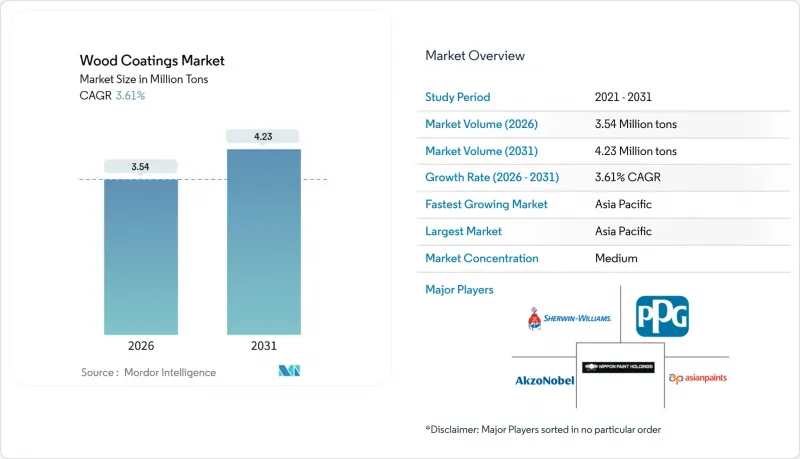
據 Mordor Intelligence 稱,2026 年木材塗料市場規模預計為 354 萬噸,預計到 2031 年將達到 423 萬噸,在預測期(2026-2031 年)內複合年成長率為 3.61%。
本報告按樹脂類型(聚氨酯、丙烯酸、硝化纖維素、聚酯及其他)、工藝(水性、溶劑型、紫外光固化、粉末塗料)、應用領域(家具及配件、門窗、櫥櫃等)和地區(亞太、北美、歐洲、南美、中東和非洲)進行細分。市場預測以噸為單位。
全球木器塗料市場趨勢及洞察
亞太地區模組化與RTA家具的蓬勃發展
在印度的正規家具市場,組裝家具(RTA)產品目前佔比高達60-70%,這推動了對快乾水性面漆的需求,此類面漆需能在24小時內承受平板包裝的衝擊。越南的木材和家具出口額預計將在2024年達到163億美元,年增21%。由於歐盟買家要求供應商符合歐盟防腐劑法規(EUDR),當地產業協會的目標是到2025年達到180億美元。泰國在2024年生產了663萬件木製家具,較去年同期成長14.46%。同時,印尼的家具出口額達到20.2億美元,木製品佔其出口總額的50%以上。中國叢集的家具銷售額在2024年前10個月達到5,355.2億元(約739億美元),出口額達549.32億美元,年增7.2%。這些生產基地偏好雙組分聚氨酯透明塗層,在室溫下固化後,其鉛筆硬度可達 2H 或更高,預計這一因素將使該地區的複合年成長率增加 0.8 個百分點。
歐盟主導向低VOC水性配方過渡
歐盟指令2004/42/EC將室內木器塗料的揮發性有機化合物(VOC)含量限制在400克/公升以內,室外塗料的VOC含量限制在300克/公升以內,這迫使人們對大量使用溶劑的醇酸樹脂和硝化纖維素漆進行重新評估。此外,歐盟法規(EU) 2023/1464將甲醛排放量限制在0.062毫克/立方公尺以內,從而提高了板材製造商的材料規格要求。歐盟生態標章目前要求室內塗料的VOC含量低於30克/公升,而只有水性分散體才能可靠地達到此標準。阿克蘇諾貝爾公司宣布,其2024年銷售額的60%將來自永續產品;PPG公司在泰國羅勇府開設了一家水性塗料工廠,以服務歐盟家具出口商。加州空氣資源委員會(CARB)也推出了類似的法規,將透明塗料的VOC含量上限設定為550克/公升,預計這將使長期複合年成長率(CAGR)提高0.6個百分點。
樹脂和溶劑價格波動
2025年第三季度,甲苯二異氰酸酯均價達到每噸14,700元人民幣(2,041美元/噸),聚合物型MDI均價達到每噸15,200元人民幣(2,110美元/噸)。此外,受不可抗力事件影響,對歐洲的供應量僅為合約量的70%。乙烯價格突破每磅30美分後,美國石化產品生產商物價指數在2024年12月至2025年3月期間飆升13.1%。 2025年4月,亞洲石腦油均價為每噸547美元,仍比2020-2022年均價高出18%。這些價格波動導致化學企業縮短合約期限並推遲庫存積累,造成短期複合年成長率下降0.5個百分點。
細分市場分析
預計到2025年,聚氨酯將佔木器塗料市場60.14%的佔有率,並在2031年之前以3.82%的複合年成長率成長。這主要歸功於其2H或更高的鉛筆硬度和高光學透明度,這些特性對於使用實木的室內裝潢至關重要。丙烯酸塗料因其優異的紫外線穩定性和易於配製成水性塗料而需求不斷成長。由於鄰苯二甲酸酐價格上漲,硝化纖維素和聚酯塗料的利潤率面臨壓力。新興的香草醛嵌段異氰酸酯單組分塗料具有12個月的適用期,並在120 度C下即可脫粘,使其成為目前越南工廠普遍使用的紅外線烤箱的理想選擇。丙烯酸-胺甲酸乙酯混合物將在 2025 年佔水性子市場的 9%,到 2031 年可能達到 14%,因為它們有助於配方達到歐盟生態標章 VOC <30 克/公升的目標。
更嚴格的法規正在加速這項轉型。歐盟木材加工最佳利用技術(BAT)標準要求對硝化纖維素進行封閉回路型溶劑回收,而升級這些設施的成本為每個工作間20萬至50萬歐元。為此,聚氨酯生產商正在開發在室溫下穩定、加熱15分鐘即可完全固化的體系,以滿足印尼和印度RTA(已烹調)工廠的加工能力。生物基多元醇的需求日益成長,這種多元醇可以取代高達50%的石化成分,尤其受到尋求LEED v4認證的買家的青睞,吸引了從巴西和印度的中小型配方生產商到全球原始設備製造商(OEM)的關注。
區域分析
預計到2025年,亞太地區將佔全球木器塗料市場規模的56.68%,並將以3.91%的複合年成長率成長至2031年。中國家具銷售額達5,355.2億元人民幣(約739億美元),出口額達549.32億美元,顯示沿海工廠正透過自動化來應對樹脂價格上漲。越南、印度和印尼的人事費用比廣東省低40%至50%,為它們帶來了優勢。此外,印度的生產連結獎勵計畫計畫(PLI)對國內家具銷售額的成長進行4%至6%的補貼,這鼓勵塗料生產商將生產集中在艾哈默德巴德和普納附近。
北美對木器塗料的需求呈現顯著成長,這主要得益於美國強勁的房屋翻新需求以及加拿大每年持續24萬套新房的建設量。預計到2024年,墨西哥對美國的家具出口額將達到48億美元,年增9%,將進一步推動近岸外包的發展動能。
歐洲市場規模龐大,預計在不久的將來將實現顯著成長。德國、法國、義大利和英國佔該地區需求的62%,而「翻新浪潮」計畫將支持相關支出直至2030年。巴西住宅市場的復甦正在推動南美木器塗料市場的成長,而在中東和非洲,沙烏地阿拉伯「2030願景」推動的房地產市場快速擴張,也提振了對阻燃木器塗料的需求。
其他好處:
- Excel格式的市場預測(ME)表
- 三個月的分析師支持
目錄
第1章:引言
- 研究假設和市場定義
- 調查範圍
第2章:調查方法
第3章執行摘要
第4章 市場狀況
- 市場概覽
- 市場促進因素
- 亞太地區模組化與RTA家具的蓬勃發展
- 歐盟主導向低VOC水性配方過渡
- 北美豪華室內裝潢趨勢
- 高層木造建築的日益普及,加速了對透明抗紫外線塗料的需求。
- 利用人工智慧驅動的線上配色技術,可以減少廢棄物並擴大塗層加工能力。
- 市場限制因素
- 樹脂和溶劑的價格波動
- 加強對甲醛和揮發性有機化合物的監管
- PFAS的逐步淘汰正在威脅性能增強添加劑的供應。
- 價值鏈分析
- 波特五力模型
第5章 市場規模與成長預測
- 依樹脂類型
- 聚氨酯
- 丙烯酸纖維
- 硝化纖維素
- 聚酯纖維
- 其他
- 透過技術
- 水溶液
- 溶劑型
- 紫外線固化型
- 粉末塗裝
- 透過使用
- 家具及設備
- 門窗
- 內閣
- 其他用途(地板材料、露臺、模壓製品等)
- 按地區
- 亞太地區
- 中國
- 印度
- 日本
- 韓國
- 馬來西亞
- 泰國
- 印尼
- 越南
- 其他亞太國家
- 北美洲
- 美國
- 加拿大
- 墨西哥
- 歐洲
- 德國
- 英國
- 法國
- 義大利
- 西班牙
- 北歐的
- 俄羅斯
- 其他歐洲國家
- 南美洲
- 巴西
- 阿根廷
- 哥倫比亞
- 其他南美國家
- 中東和非洲
- 沙烏地阿拉伯
- 阿拉伯聯合大公國
- 卡達
- 南非
- 奈及利亞
- 埃及
- 其他中東和非洲國家
- 亞太地區
第6章 競爭情勢
- 市場集中度
- 策略趨勢
- 市佔率和排名分析
- 公司簡介
- Akzo Nobel NV
- Asian Paints
- Axalta Coating Systems
- Benjamin Moore & Co.
- Ceramic Industrial Coatings
- Hempel A/S
- Jotun
- Kansai Nerolac Paints Limited
- KAPCI Coating
- MAS Paints
- National Paints Factories Co. Ltd.
- Nippon Paint Holdings Co., Ltd.
- PPG Industries Inc.
- Ritver
- RPM International Inc.
- Teknos Group
- The Sherwin-Williams Company
第7章 市場機會與未來展望
According to Mordor Intelligence, the wood coatings market size is estimated at 3.54 million tons in 2026, and is expected to reach 4.23 million tons by 2031, at a CAGR of 3.61% during the forecast period (2026-2031).
This report is Segmented by Resin Type (Polyurethane, Acrylic, Nitrocellulose, Polyester, and Others), Technology (Water-Borne, Solvent-Borne, UV-Cured, and Powder Coatings), Application (Furniture and Fixtures, Doors and Windows, Cabinets, and More), and Geography (Asia-Pacific, North America, Europe, South America, and Middle East and Africa). Market Forecasts are Provided in Terms of Volume (Tons).
Global Wood Coatings Market Trends and Insights
Modular and RTA Furniture Boom in Asia-Pacific
Ready-to-assemble formats now account for 60-70% of India's organized furniture sales, pushing finishing lines toward fast-curing waterborne topcoats that tolerate flat-pack boxing within 24 hours. Vietnam's wood and furniture exports jumped 21% in 2024 to USD 16.3 billion, and the local association targets USD 18 billion in 2025 as EU buyers seek EUDR-compliant suppliers. Thailand produced 6.63 million wooden furniture pieces in 2024, up 14.46%, while Indonesia shipped USD 2.02 billion of furniture, keeping wooden articles above 50% of export value. China's coastal clusters generated CNY 535.52 billion (USD 73.9 billion) in furniture revenue during the first ten months of 2024, with exports climbing 7.2% to USD 54.932 billion. These production hubs favor two-component polyurethane clears that hit >=2H pencil hardness at ambient cure, positioning the driver to add 0.8 percentage points to the regional CAGR.
EU-Led Shift to Low-VOC Waterborne Formulations
Directive 2004/42/EC caps VOC content at 400 g/L for interior and 300 g/L for exterior wood finishes, forcing a reevaluation of solvent-heavy alkyds and nitrocellulose lacquers. Regulation (EU) 2023/1464 also limits formaldehyde release to 0.062 mg/m3, tightening material specs for panel producers. The EU Ecolabel now requires interior coatings below 30 g/L VOC, a threshold only waterborne dispersions reliably meet. Akzo Nobel disclosed that 60% of its 2024 sales stemmed from sustainable products, and PPG opened a waterborne plant in Rayong, Thailand, to serve EU-bound furniture exporters. California Air Resources Board mirrors the restriction with a 550 g/L limit for clear finishes, reinforcing the 0.6 point uplift in long-term CAGR.
Resin and Solvent Price Volatility
Toluene diisocyanate averaged CNY 14,700/ton (USD 2,041/ton) and polymeric MDI hit CNY 15,200/ton (USD 2,110/ton) in Q3 2025, with force-majeure events limiting European volumes to 70% of contracts. The U.S. Producer Price Index for petrochemicals leaped 13.1% between December 2024 and March 2025 as ethylene exceeded 30 ¢/lb. Asian naphtha averaged USD 547/ton in April 2025, still 18% above the 2020-22 mean. Such swings drive formulators to shorten contract length and delay inventory builds, clipping 0.5 points from near-term CAGR.
Other drivers and restraints analyzed in the detailed report include:
- Premium Interior Decor Trend in North America
- Mass-Timber High-Rise Adoption Accelerating Clear UV Finish Demand
- Stricter Formaldehyde / VOC Caps
For complete list of drivers and restraints, kindly check the Table Of Contents.
Segment Analysis
Polyurethane commanded 60.14% of the Wood Coatings market in 2025 and will progress at a 3.82% CAGR through 2031, owing to >=2H pencil hardness and optical clarity essential for mass-timber interiors. Acrylics are witnessing rising demand and are on the back of better UV stability and easy waterborne blending. Nitrocellulose and polyester coatings face a margin squeeze from higher phthalic anhydride prices. Emerging blocked-isocyanate one-packs based on vanillin show 12-month pot life and deblock at 120 °C, mapping neatly onto infrared ovens now common in Vietnamese factories. Acrylic-urethane hybrids captured 9% of the waterborne subsegment in 2025 and could reach 14% by 2031 as they help formulators meet the EU Ecolabel VOC <30 g/L target.
Regulatory stick is speeding the shift. The EU BAT reference for wood treatment mandates closed-loop solvent recovery for nitrocellulose, an upgrade that costs EUR 200,000-500,000 per booth. Polyurethane players reply with systems stable at room temperature yet curing fully during a 15-minute bake, matching throughput at Indonesian and Indian RTA plants. Demand for biobased polyols, able to replace up to 50% of petrochemical content, is rising among buyers pursuing LEED v4 credits, placing smaller Brazilian and Indian formulators on the radar of global OEMs.
Complete Report Scope:
- By Resin Type
- Polyurethane
- Acrylic
- Nitrocellulose
- Polyester
- Others
- By Technology
- Water-borne
- Solvent-borne
- UV-Cured
- Powder Coatings
- By Application
- Furniture and Fixtures
- Doors and Windows
- Cabinets
- Other Applications (including Floors, Decks, and Molding Products)
- By Geography
- Asia-Pacific
- China
- India
- Japan
- South Korea
- Malaysia
- Thailand
- Indonesia
- Vietnam
- Rest of Asia-Pacific
- North America
- United States
- Canada
- Mexico
- Europe
- Germany
- United Kingdom
- France
- Italy
- Spain
- Nordics
- Russia
- Rest of Europe
- South America
- Brazil
- Argentina
- Colombia
- Rest of South America
- Middle East and Africa
- Saudi Arabia
- United Arab Emirates
- Qatar
- South Africa
- Nigeria
- Egypt
- Rest of Middle East and Africa
- Asia-Pacific
Geography Analysis
Asia-Pacific accounted for 56.68% of the Wood Coatings market size in 2025 and is projected to rise at a 3.91% CAGR through 2031. China's CNY 535.52 billion (USD 73.9 billion) furniture revenue and USD 54.932 billion export haul show coastal plants absorbing resin inflation via automation. Vietnam, India, and Indonesia benefit from 40-50% lower labor costs than Guangdong, and India's Production Linked Incentive scheme rebates 4-6% of incremental domestic furniture sales, enticing coatings makers to co-locate near Ahmedabad and Pune.
Wood coatings demand in North America is witnessing considerable gains as U.S. remodeling stays elevated and Canada maintains 240,000 annual housing starts. Mexican furniture exports to the United States reached USD 4.8 billion in 2024, up 9% year-over-year, underscoring nearshoring momentum.
Europe accounted for a considerable market size and is anticipated to register considerable gains in the near future. Germany, France, Italy, and the United Kingdom account for 62% of regional demand, and the Renovation Wave program anchors spending through 2030. Brazil's housing recovery drives South America's wood coatings market growth, while the Middle East and Africa's demand is rising as Saudi Arabia's Vision 2030 real-estate surge fuels demand for fire-retardant wood coatings.
- Akzo Nobel N.V.
- Asian Paints
- Axalta Coating Systems
- Benjamin Moore & Co.
- Ceramic Industrial Coatings
- Hempel A/S
- Jotun
- Kansai Nerolac Paints Limited
- KAPCI Coating
- MAS Paints
- National Paints Factories Co. Ltd.
- Nippon Paint Holdings Co., Ltd.
- PPG Industries Inc.
- Ritver
- RPM International Inc.
- Teknos Group
- The Sherwin-Williams Company
Additional Benefits:
- The market estimate (ME) sheet in Excel format
- 3 months of analyst support
TABLE OF CONTENTS
1 Introduction
- 1.1 Study Assumptions and Market Definition
- 1.2 Scope of the Study
2 Research Methodology
3 Executive Summary
4 Market Landscape
- 4.1 Market Overview
- 4.2 Market Drivers
- 4.2.1 Modular and RTA Furniture Boom in Asia-Pacific
- 4.2.2 EU-Led Shift to Low-VOC Waterborne Formulations
- 4.2.3 Premium Interior Decor Trend in North America
- 4.2.4 Mass-Timber High-rise Adoption Accelerating Clear UV Finish Demand
- 4.2.5 AI-Enabled Inline Color Matching Reduces Waste, Expands Coatings Throughput
- 4.3 Market Restraints
- 4.3.1 Resin and Solvent Price Volatility
- 4.3.2 Stricter Formaldehyde / VOC Caps
- 4.3.3 PFAS Phase-out Threatening Performance Additives Supply
- 4.4 Value Chain Analysis
- 4.5 Porter's Five Forces
- 4.5.1 Bargaining Power of Suppliers
- 4.5.2 Bargaining Power of Buyers
- 4.5.3 Threat of New Entrants
- 4.5.4 Threat of Substitutes
- 4.5.5 Degree of Competition
5 Market Size and Growth Forecasts (Volume)
- 5.1 By Resin Type
- 5.1.1 Polyurethane
- 5.1.2 Acrylic
- 5.1.3 Nitrocellulose
- 5.1.4 Polyester
- 5.1.5 Others
- 5.2 By Technology
- 5.2.1 Water-borne
- 5.2.2 Solvent-borne
- 5.2.3 UV-Cured
- 5.2.4 Powder Coatings
- 5.3 By Application
- 5.3.1 Furniture and Fixtures
- 5.3.2 Doors and Windows
- 5.3.3 Cabinets
- 5.3.4 Other Applications (including Floors, Decks, and Molding Products)
- 5.4 By Geography
- 5.4.1 Asia-Pacific
- 5.4.1.1 China
- 5.4.1.2 India
- 5.4.1.3 Japan
- 5.4.1.4 South Korea
- 5.4.1.5 Malaysia
- 5.4.1.6 Thailand
- 5.4.1.7 Indonesia
- 5.4.1.8 Vietnam
- 5.4.1.9 Rest of Asia-Pacific
- 5.4.2 North America
- 5.4.2.1 United States
- 5.4.2.2 Canada
- 5.4.2.3 Mexico
- 5.4.3 Europe
- 5.4.3.1 Germany
- 5.4.3.2 United Kingdom
- 5.4.3.3 France
- 5.4.3.4 Italy
- 5.4.3.5 Spain
- 5.4.3.6 Nordics
- 5.4.3.7 Russia
- 5.4.3.8 Rest of Europe
- 5.4.4 South America
- 5.4.4.1 Brazil
- 5.4.4.2 Argentina
- 5.4.4.3 Colombia
- 5.4.4.4 Rest of South America
- 5.4.5 Middle East and Africa
- 5.4.5.1 Saudi Arabia
- 5.4.5.2 United Arab Emirates
- 5.4.5.3 Qatar
- 5.4.5.4 South Africa
- 5.4.5.5 Nigeria
- 5.4.5.6 Egypt
- 5.4.5.7 Rest of Middle East and Africa
- 5.4.1 Asia-Pacific
6 Competitive Landscape
- 6.1 Market Concentration
- 6.2 Strategic Moves
- 6.3 Market Share/Ranking Analysis
- 6.4 Company Profiles (includes Global level Overview, Market level overview, Core Segments, Financials as available, Strategic Information, Products and Services, Recent Developments)
- 6.4.1 Akzo Nobel N.V.
- 6.4.2 Asian Paints
- 6.4.3 Axalta Coating Systems
- 6.4.4 Benjamin Moore & Co.
- 6.4.5 Ceramic Industrial Coatings
- 6.4.6 Hempel A/S
- 6.4.7 Jotun
- 6.4.8 Kansai Nerolac Paints Limited
- 6.4.9 KAPCI Coating
- 6.4.10 MAS Paints
- 6.4.11 National Paints Factories Co. Ltd.
- 6.4.12 Nippon Paint Holdings Co., Ltd.
- 6.4.13 PPG Industries Inc.
- 6.4.14 Ritver
- 6.4.15 RPM International Inc.
- 6.4.16 Teknos Group
- 6.4.17 The Sherwin-Williams Company
7 Market Opportunities and Future Outlook
- 7.1 White-space and Unmet-Need Assessment

 木材塗料市場:全球,2026-2032年
 中東和非洲木器塗料市場:市場佔有率分析、行業趨勢和統計數據以及成長預測(2026-2031 年)
 木器塗料市場:全球市場預測(2026-2032年)
 2026-2030年全球木器塗料市場2026-2034年全球木器塗料樹脂市場規模、佔有率、趨勢和成長分析報告
 木器塗料市場:依樹脂類型、技術、應用和地區分類。
 木器塗料市場:按塗料類型、樹脂類型、配製技術、應用和地區分類(2026-2034 年)水性木器塗料市場報告:按應用和地區分類 2026-2034 年木材調理劑市場:按類型、材料、應用、通路、最終用途分類,全球預測(2026-2032年)建築漆市場:依技術、樹脂類型、最終用途、應用和銷售管道分類-2026-2032年全球預測