


 |
市場調查報告書
商品編碼
2124404
多廠商支援服務:市場佔有率分析、產業趨勢與統計資料、成長預測(2026-2031 年)Multi Vendor Support Services - Market Share Analysis, Industry Trends & Statistics, Growth Forecasts (2026 - 2031) |
||||||

※ 本網頁內容可能與最新版本有所差異。詳細情況請與我們聯繫。
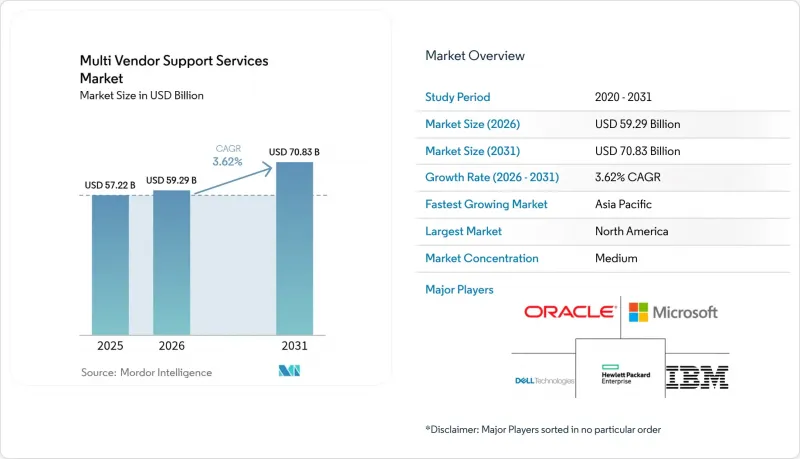
根據 Mordor Intelligence 預測,多廠商支援服務的市場規模預計將從 2025 年的 572.2 億美元成長到 2026 年的 592.9 億美元,然後在 2031 年達到 708.3 億美元,2026 年至 2031 年的複合成長率為 3.62%。
本報告按服務類型(專業服務和託管服務)、公司規模(大型企業和中小企業)、支援管道(現場、遠端/虛擬、混合)、最終用戶行業(IT和電信、銀行、金融服務和保險、醫療保健、能源和發電、製造業及其他)以及地區進行細分。市場預測以美元計價。
全球多廠商支援服務市場趨勢與洞察
OEM服務維護成本不斷上漲
隨著硬體利潤率的下降,原始設備製造商 (OEM) 不斷提高年度維護費用,導致與獨立支援公司之間的成本差距進一步擴大。這些獨立支援公司通常能以低 50% 至 80% 的成本提供同等的服務等級協定 (SLA)。採購部門現在以總擁有成本 (TCO) 而非名義採購價格作為基準,混合模式:關鍵任務資產由 OEM 提供支持,而傳統資產則遷移到第三方供應商。在經濟情勢不明朗的情況下,財務長 (CFO)主導的審查力度加大,加速了向基本契約的轉變,這種合約既能保證正常運行時間,又能控制運作。即使是監管嚴格的組織,只要供應商能夠證明其符合行業特定法規,也會加入這一轉變。由於這些財務影響,降低成本已成為新競標中的首要選擇標準。
多供應商IT環境日益複雜
目前,由於最佳組合策略和雲端運算的快速普及,典型的企業通常使用五到七個不同製造商的設備。這種異質架構加劇了互通性挑戰,並暴露了以原始設備製造商 (OEM) 為中心的傳統支援模式的不足。因此,企業期望合作夥伴能夠提供涵蓋伺服器、儲存、網路和雲端平台的端到端事件解決方案。這種複雜性帶來的附加價值有利於那些擁有多元技術認證專業知識和集中式指揮中心的服務整合商,該中心能夠協調多方之間的升級流程。市場對能夠提供事件隊列和 SLA 合規性「單一介面」視圖的整合儀表板的需求日益成長。
與第三方存取相關的安全和隱私問題
高調的供應鏈安全漏洞事件促使人們對不斷擴大的供應商生態系統進行更嚴格的監控,歐盟《數位營運彈性法案》等框架要求銀行展現出健全的第三方風險管治。安全團隊擔心特權遠端工具會成為攻擊的中介,導致實質審查調查完成前合約週期延誤。領先的支援公司正透過零信任架構、嚴格的背景調查以及網路保險來應對這項挑戰,其保障力度有時甚至超過原始設備製造商 (OEM) 的產品。隨著風險緩解最佳實務的日趨成熟,其應用速度雖然放緩,但並未停滯不前。
細分市場分析
到2025年,託管服務將佔多廠商支援服務市場70.65%的佔有率,這反映出市場越來越傾向於可預測、以結果為導向且能降低營運風險的模式。服務提供者正在將全天候監控、零件物流和合規性報告整合到多年期合約中,從而統一不同的服務等級協定 (SLA)。隨著人工智慧工具推動自動化進程,單位成本不斷下降,預計2026年至2031年間,多廠商支援服務市場中託管服務的市場規模將以5.23%的複合年成長率成長。專業服務對於系統遷移和複雜升級仍然至關重要,但由於按專案計費的收費,其成長速度預計將會放緩。
先進的服務供應商透過引入機器學習引擎來預測故障並安排準時零件交付,從而提高資產正常運行時間,以實現差異化運轉率。將預測分析與自動化運作手冊結合,可以建立服務信用模型,從而縮短平均維修時間 (MTTR) 並最佳化獎勵。此外,集中化的工單資料管理簡化了證據收集,有助於應對監管審計。這些功能結合,能夠增強客戶忠誠度,提高續約率,並最終提升服務提供者的企業價值。
到2025年,大型企業將佔據69.10%的銷售佔有率,反映出它們龐大的舊有系統和複雜的合規要求。然而,隨著雲端運算經濟效益的提升,中小企業正成為成長最快的客戶群,預計到2031年將以4.86%的複合年成長率成長。付費使用制,加上標準化的支援服務,無需大量資本投入,即使是小規模IT團隊也能獲得企業級服務。服務供應商利用遠端監控和模板化的運作手冊,無論客戶的員工規模如何,都能實現規模經濟效益。
中小企業對產品和服務需求最高的行業是製造業、醫療保健業和專業服務業,這些行業的監管要求和運作要求與大型企業類似。供應商正透過模組化服務來滿足這一需求,將安全性、備份和硬體維護整合到一張發票中。這種簡化方案受到了尋求供應商整合和精簡管治的中型企業財務長的青睞,並在實施後促成了更長的合約期限。
區域分析
預計到2025年,北美將佔全球整體收入的34.60%。這主要得益於該地區對雲端運算的早期採用、成熟的採購團隊以及有利於專業合作夥伴的嚴格資料保護法規。該地區的企業往往頻繁地升級硬體,對延壽服務產生了穩定的需求。高昂的人事費用也進一步提升了主導遠端支援的經濟效益,促使服務供應商在美國和加拿大建立人工智慧卓越中心。
歐洲憑藉生態設計法規(該法規提倡可修復性)和隱私框架(例如GDPR,該框架強化了審計要求),在綠色IT領域中保持著強勁的地位。多供應商協議通常包含綠色IT指標,獎勵那些能夠透過延長資產使用壽命來減少碳排放的供應商。德國和北歐國家的政府機構在長期夥伴關係處於領先地位,並將永續性指標(KPI)整合到績效儀錶板中。
亞太地區是成長的主要驅動力,預計到2031年將達到4.03%的複合年成長率。印度、中國和印尼的企業正在跨越傳統架構,採用雲端原生工作負載,從一開始就需要支援異質環境。本地服務整合商正在快速擴張,而全球企業則正在開設區域服務中心和雙語服務台,以滿足不斷成長的需求。監管成熟度因市場而異,但通用是積極主動的數位轉型,其目標遠超本地OEM廠商的保固要求,因此多供應商提案的重要性日益凸顯。
在南美、中東和非洲,儘管絕對支出可能較小,但人們對「遠程優先」模式表現出濃厚的興趣,以克服勞動力短缺和地理分散的問題。合約規模受外匯波動和財務限制,但由於資料中心密度低,高運作顯得特別重要,這也凸顯了預測性維護解決提案的價值。
其他好處
- Excel格式的市場預測(ME)表
- 3個月的分析師支持
目錄
第1章:引言
- 研究假設和市場定義
- 調查範圍
第2章:調查方法
第3章執行摘要
第4章 市場狀況
- 市場概覽
- 市場促進因素
- OEM服務維護成本不斷上漲
- 多供應商IT環境日益複雜
- 推動成本最佳化和供應商整合
- 較短的OEM支援週期/快速淘汰
- 與永續性相關的強制延長使用壽命
- 人工智慧驅動的預測性維護功能
- 市場限制因素
- 與第三方存取相關的安全和隱私問題
- OEM廠商的抵制以及保固失效的風險
- 全球傳統硬體技能人才短缺
- 合規/數據主權面臨的複雜挑戰
- 價值鏈分析
- 監理情勢
- 技術展望
- 波特五力分析
- 評估宏觀經濟趨勢對市場的影響
第5章 市場規模與成長預測
- 按服務類型
- 專業服務
- 託管服務
- 按公司規模
- 大公司
- 中小企業
- 支援管道
- 現場
- 遠端/虛擬
- 混合
- 按最終用戶行業分類
- 資訊科技/通訊
- BFSI
- 衛生保健
- 能源和發電
- 製造業
- 零售
- 其他
- 按地區
- 北美洲
- 美國
- 加拿大
- 墨西哥
- 歐洲
- 德國
- 英國
- 法國
- 義大利
- 西班牙
- 其他歐洲國家
- 亞太地區
- 中國
- 日本
- 印度
- 韓國
- 澳洲
- 其他亞太國家
- 南美洲
- 巴西
- 阿根廷
- 其他南美國家
- 中東和非洲
- 中東
- 沙烏地阿拉伯
- 阿拉伯聯合大公國
- 土耳其
- 其他中東國家
- 非洲
- 南非
- 埃及
- 奈及利亞
- 其他非洲地區
- 中東
- 北美洲
第6章 競爭情勢
- 市場集中度
- 策略趨勢
- 市佔率分析
- 公司簡介
- IBM Corporation
- Dell Technologies Inc
- Hewlett Packard Enterprise Co
- Oracle Corporation
- Cisco Systems Inc
- Microsoft Corporation
- Fujitsu Ltd
- Atos SE
- Evernex Group SAS
- Park Place Technologies
- Service Express LLC
- Hitachi Vantara LLC
- NetApp Inc
- Quantum Corporation
- Rimini Street Inc
- Clear Technologies Inc
- Technogroup IT-Service GmbH
- Blue Sky Group Ltd
- Softcat plc
第7章 市場機會與未來展望
According to Mordor Intelligence, the multi vendor support services market size is expected to grow from USD 57.22 billion in 2025 to USD 59.29 billion in 2026 and is forecast to reach USD 70.83 billion by 2031 at 3.62% CAGR over 2026-2031.
This report is Segmented by Service Type (Professional and Managed), Enterprise Size (Large Enterprises and Small and Medium Enterprises (SMEs)), Support Channel (On-Site, Remote / Virtual, and Hybrid), End-User Vertical (IT and Telecommunication, BFSI, Healthcare, Energy and Power, Manufacturing, and More), and Geography. The Market Forecasts are Provided in Terms of Value (USD).
Global Multi Vendor Support Services Market Trends and Insights
Rising Maintenance Cost of OEM Services
OEMs continue to lift annual maintenance prices as hardware margins erode, widening the cost differential against independent support firms that frequently deliver equivalent SLAs at 50-80% lower expense. Procurement teams now benchmark total cost of ownership rather than headline purchase prices, spurring hybrid models that retain OEM cover for mission-critical assets while offloading legacy estates to third-party providers. CFO-led scrutiny has intensified under uncertain economic conditions, accelerating the switch to outcome-based contracts that guarantee uptime while capping spend. Even heavily regulated organizations are joining the shift, provided providers evidence compliance with sector-specific controls. The financial effect has made cost-savings a primary selection criterion in new tenders.
Growing Complexity of Multi-Vendor IT Estates
Typical enterprises now run equipment from five to seven manufacturers, a product of best-of-breed strategies and rapid cloud adoption. Heterogeneous stacks increase interoperability challenges and expose gaps in traditional OEM-centric support models. Companies therefore expect partners to own end-to-end incident resolution across servers, storage, networking, and cloud platforms. This complexity premium rewards service integrators with certified expertise on disparate technologies and centralized command centers capable of orchestrating multi-party escalations. Demand is rising for unified dashboards that provide single-pane-of-glass visibility into incident queues and SLA compliance.
Security and Privacy Concerns with Third-Party Access
High-profile supply-chain breaches have heightened scrutiny of extended vendor ecosystems, with frameworks such as the EU Digital Operational Resilience Act obliging banks to evidence robust third-party risk governance. Security teams fear that privileged remote tools could become attack vectors, delaying contracting cycles while due-diligence checks are completed. Leading support firms are responding with zero-trust architectures, rigorous background screening, and cyber-insurance protections that in several cases exceed OEM offerings. Adoption momentum is therefore tempered but not derailed, as risk-mitigation best practices mature.
Other drivers and restraints analyzed in the detailed report include:
- Cost-Optimization and Vendor Consolidation Push
- Shorter OEM Support-Window / Rapid Obsolescence
- OEM Resistance and Warranty-Void Threats
For complete list of drivers and restraints, kindly check the Table Of Contents.
Segment Analysis
Managed services accounted for 70.65% of the Multi Vendor Support Services market share in 2025, evidencing enterprise preference for predictable, outcome-based models that offload operational risk. Providers package 24X7 monitoring, parts logistics, and compliance reporting into multi-year contracts that harmonize disparate SLAs. The Multi Vendor Support Services market size for managed services is forecast to expand at a 5.23% CAGR from 2026 to 2031 as AI-powered tools elevate automation and lower unit costs. Professional services remain vital for migrations and complex upgrades but are expected to grow more slowly, constrained by one-time project billing.
Advanced providers differentiate by embedding machine-learning engines that anticipate failures and schedule just-in-time parts delivery, raising asset uptime. Predictive analytics combined with automated runbooks shrink mean-time-to-repair, enabling service-credit models that align incentives. The managed approach also supports regulatory audits, as centralized ticket data simplifies evidence gathering. Collectively, these attributes reinforce customer loyalty and underpin higher renewal rates that elevate provider valuations.
Large organizations retained 69.10% revenue share in 2025, reflecting extensive legacy estates and complex compliance demands. Yet SMEs are the fastest-growing constituency, logging a 4.86% CAGR through 2031 as cloud economics level the playing field. Consumption-based pricing plus standardized support bundles remove the need for hefty capital outlays, making enterprise-grade services accessible to smaller IT teams. Providers leverage remote monitoring and templated runbooks to deliver scale benefits irrespective of client headcount.
SME demand is strongest in manufacturing, healthcare, and professional-services niches where regulatory and uptime requirements mirror those of larger peers. Vendors respond with modular offerings that bundle security, backup, and hardware maintenance into a single invoice. This simplification resonates with mid-market CFOs eager to consolidate suppliers and streamline governance, translating into longer contract tenures once onboarded.
Complete Report Scope:
- By Service Type
- Professional
- Managed
- By Enterprise Size
- Large Enterprises
- Small and Medium Enterprises (SMEs)
- By Support Channel
- On-site
- Remote / Virtual
- Hybrid
- By End-user Vertical
- IT and Telecommunication
- BFSI
- Healthcare
- Energy and Power
- Manufacturing
- Retail
- Other End-user Verticals
- By Geography
- North America
- United States
- Canada
- Mexico
- Europe
- Germany
- United Kingdom
- France
- Italy
- Spain
- Rest of Europe
- Asia-Pacific
- China
- Japan
- India
- South Korea
- Australia
- Rest of Asia-Pacific
- South America
- Brazil
- Argentina
- Rest of South America
- Middle East and Africa
- Middle East
- Saudi Arabia
- United Arab Emirates
- Turkey
- Rest of Middle East
- Africa
- South Africa
- Egypt
- Nigeria
- Rest of Africa
- Middle East
- North America
Geography Analysis
North America commanded 34.60% of global revenue in 2025, underpinned by early cloud adoption, sophisticated procurement teams, and stringent data-protection rules that favor specialized partners. The region's enterprises tend to refresh hardware frequently, generating a steady pipeline for lifecycle-extension services. High labor costs also magnify the economic argument for automation-driven remote support, prompting providers to establish AI centers of excellence in the United States and Canada.
Europe maintains a solid position, buoyed by ecodesign regulations that encourage repairability and by privacy frameworks such as GDPR that elevate audit requirements. Multi-vendor contracts often incorporate green-IT metrics, rewarding providers that can document carbon savings from extended asset life. Government agencies in Germany and the Nordics are pioneering long-term partnerships that weave sustainability KPIs into performance dashboards.
Asia-Pacific is the growth engine, expected to post a 4.03% CAGR to 2031. Enterprises in India, China, and Indonesia are leapfrogging legacy architectures, adopting cloud-native workloads that require heterogeneous support from day one. Local service integrators are scaling rapidly, while global players open regional service hubs and bilingual helpdesks to tap rising demand. Regulatory maturity varies by market, but the common thread is an aggressive digital-transformation agenda that outstrips local OEM warranty provisions, reinforcing the multi-vendor proposition.
South America and the Middle East and Africa register smaller absolute spending yet demonstrate strong interest in remote-first models to overcome talent shortages and geographical dispersion. Currency volatility and fiscal constraints temper contract sizes, but low data-center density makes high uptime even more critical, enhancing the value narrative for predictive maintenance propositions.
- IBM Corporation
- Dell Technologies Inc
- Hewlett Packard Enterprise Co
- Oracle Corporation
- Cisco Systems Inc
- Microsoft Corporation
- Fujitsu Ltd
- Atos SE
- Evernex Group SAS
- Park Place Technologies
- Service Express LLC
- Hitachi Vantara LLC
- NetApp Inc
- Quantum Corporation
- Rimini Street Inc
- Clear Technologies Inc
- Technogroup IT-Service GmbH
- Blue Sky Group Ltd
- Softcat plc
Additional Benefits:
- The market estimate (ME) sheet in Excel format
- 3 months of analyst support
TABLE OF CONTENTS
1 INTRODUCTION
- 1.1 Study Assumptions and Market Definition
- 1.2 Scope of the Study
2 RESEARCH METHODOLOGY
3 EXECUTIVE SUMMARY
4 MARKET LANDSCAPE
- 4.1 Market Overview
- 4.2 Market Drivers
- 4.2.1 Rising maintenance cost of OEM services
- 4.2.2 Growing complexity of multi-vendor IT estates
- 4.2.3 Cost-optimisation and vendor consolidation push
- 4.2.4 Shorter OEM support-window / rapid obsolescence
- 4.2.5 Sustainability-linked life-extension mandates
- 4.2.6 AI-driven predictive maintenance capabilities
- 4.3 Market Restraints
- 4.3.1 Security and privacy concerns with third-party access
- 4.3.2 OEM resistance and warranty-void threats
- 4.3.3 Global shortage of legacy-hardware skill sets
- 4.3.4 Compliance / data-sovereignty complexities
- 4.4 Value Chain Analysis
- 4.5 Regulatory Landscape
- 4.6 Technological Outlook
- 4.7 Porter's Five Forces Analysis
- 4.7.1 Bargaining Power of Suppliers
- 4.7.2 Bargaining Power of Consumers
- 4.7.3 Threat of New Entrants
- 4.7.4 Threat of Substitutes
- 4.7.5 Intensity of Competitive Rivalry
- 4.8 Assessment of the Impact of Macroeconomic Trends on the Market
5 MARKET SIZE AND GROWTH FORECASTS (VALUE)
- 5.1 By Service Type
- 5.1.1 Professional
- 5.1.2 Managed
- 5.2 By Enterprise Size
- 5.2.1 Large Enterprises
- 5.2.2 Small and Medium Enterprises (SMEs)
- 5.3 By Support Channel
- 5.3.1 On-site
- 5.3.2 Remote / Virtual
- 5.3.3 Hybrid
- 5.4 By End-user Vertical
- 5.4.1 IT and Telecommunication
- 5.4.2 BFSI
- 5.4.3 Healthcare
- 5.4.4 Energy and Power
- 5.4.5 Manufacturing
- 5.4.6 Retail
- 5.4.7 Other End-user Verticals
- 5.5 By Geography
- 5.5.1 North America
- 5.5.1.1 United States
- 5.5.1.2 Canada
- 5.5.1.3 Mexico
- 5.5.2 Europe
- 5.5.2.1 Germany
- 5.5.2.2 United Kingdom
- 5.5.2.3 France
- 5.5.2.4 Italy
- 5.5.2.5 Spain
- 5.5.2.6 Rest of Europe
- 5.5.3 Asia-Pacific
- 5.5.3.1 China
- 5.5.3.2 Japan
- 5.5.3.3 India
- 5.5.3.4 South Korea
- 5.5.3.5 Australia
- 5.5.3.6 Rest of Asia-Pacific
- 5.5.4 South America
- 5.5.4.1 Brazil
- 5.5.4.2 Argentina
- 5.5.4.3 Rest of South America
- 5.5.5 Middle East and Africa
- 5.5.5.1 Middle East
- 5.5.5.1.1 Saudi Arabia
- 5.5.5.1.2 United Arab Emirates
- 5.5.5.1.3 Turkey
- 5.5.5.1.4 Rest of Middle East
- 5.5.5.2 Africa
- 5.5.5.2.1 South Africa
- 5.5.5.2.2 Egypt
- 5.5.5.2.3 Nigeria
- 5.5.5.2.4 Rest of Africa
- 5.5.5.1 Middle East
- 5.5.1 North America
6 COMPETITIVE LANDSCAPE
- 6.1 Market Concentration
- 6.2 Strategic Moves
- 6.3 Market Share Analysis
- 6.4 Company Profiles (includes Global level Overview, Market level overview, Core Segments, Financials as available, Strategic Information, Market Rank/Share for key companies, Products and Services, and Recent Developments)
- 6.4.1 IBM Corporation
- 6.4.2 Dell Technologies Inc
- 6.4.3 Hewlett Packard Enterprise Co
- 6.4.4 Oracle Corporation
- 6.4.5 Cisco Systems Inc
- 6.4.6 Microsoft Corporation
- 6.4.7 Fujitsu Ltd
- 6.4.8 Atos SE
- 6.4.9 Evernex Group SAS
- 6.4.10 Park Place Technologies
- 6.4.11 Service Express LLC
- 6.4.12 Hitachi Vantara LLC
- 6.4.13 NetApp Inc
- 6.4.14 Quantum Corporation
- 6.4.15 Rimini Street Inc
- 6.4.16 Clear Technologies Inc
- 6.4.17 Technogroup IT-Service GmbH
- 6.4.18 Blue Sky Group Ltd
- 6.4.19 Softcat plc
7 MARKET OPPORTUNITIES AND FUTURE OUTLOOK
- 7.1 White-space and Unmet-need Assessment

 2026年全球多廠商支援服務市場報告
 多廠商支援服務市場-全球產業規模、佔有率、趨勢、機會和預測:按服務類型、業務應用、組織規模、最終用戶、地區和競爭格局分類,2021-2031年
 按服務類型、部署方式、應用程式和最終用戶分類的多供應商實驗室服務市場,全球預測,2026-2032年按測試設備類型、服務類型、最終用戶產業、提供者類型、合約類型和收入模式分類的多廠商測試設備服務市場,全球預測,2026-2032年
 多廠商支援服務市場規模、佔有率和成長分析(按服務類型、公司規模、服務交付模式、應用、垂直行業和地區分類)-2026-2033年產業預測