


 |
市場調查報告書
商品編碼
2124375
內容服務平台:市場佔有率分析、產業趨勢與統計、成長預測(2026-2031)Content Services Platforms - Market Share Analysis, Industry Trends & Statistics, Growth Forecasts (2026 - 2031) |
||||||

※ 本網頁內容可能與最新版本有所差異。詳細情況請與我們聯繫。
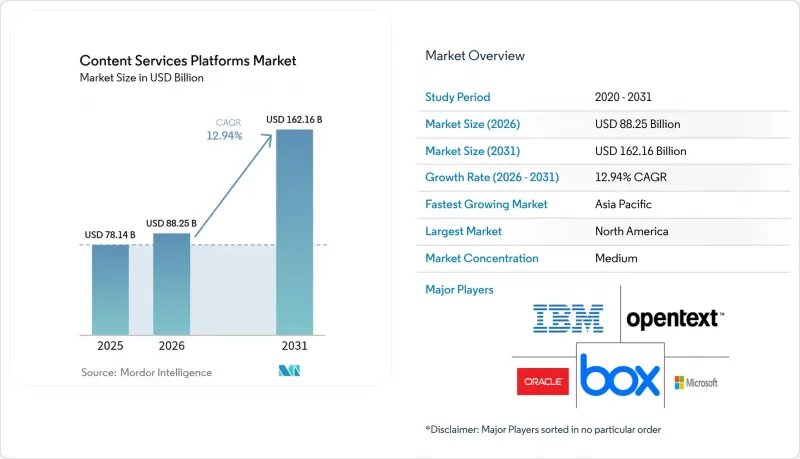
根據 Mordor Intelligence 預測,內容服務平台市場規模預計將從 2025 年的 781.4 億美元成長到 2026 年的 882.5 億美元,並預計到 2031 年將達到 1,621.6 億美元。
預計 2026 年至 2031 年的複合年成長率為 12.94%。
本報告按組件(解決方案和服務)、部署模式(本地部署和雲端部署)、最終用戶公司規模(中小企業和大型企業)、最終用戶行業(銀行、金融服務和保險 (BFSI)、政府和公共部門、醫療保健和生命科學、IT 和電信以及其他行業)以及地區進行細分。市場預測以美元 (USD) 為單位。
全球內容服務平台市場趨勢及洞察
雲端原生技術採用的勢頭
遷移到雲端原生平台的企業正透過 Microsoft SharePoint Online 和 OneDrive 等領先解決方案實現可擴展性和整合訪問,同時降低高達 40% 的基礎設施成本。 API 優先架構能夠以極低的延遲處理分散式協作,其需求正因遠端辦公的興起而不斷成長。過去無力承擔強大文件管理解決方案的中型企業,如今無需購買資本密集伺服器,即可部署功能豐富的 SaaS 解決方案。雲端供應商的持續交付功能支援每季更新 AI 功能,並確保符合 SOC 2 和 ISO 27001 等框架的要求,這些框架越來越強調全端雲端解決方案。超大規模資料中心內建的災害復原功能進一步加速了老舊本地儲存庫的淘汰進程。
非結構化資料量迅速成長
隨著視訊會議、物聯網感測器和全通路客戶接點的普及,預計到2025年,非結構化資料將佔企業資料總量的80%左右,這一資料量遠遠超出傳統文件共用系統的處理能力。現代平台整合了自然語言處理(NLP)和電腦視覺技術,可以將合約、電子郵件和圖像轉換為搜尋的信息,使醫療服務提供者能夠在滿足HIPAA合規性要求的同時,提取寶貴的臨床見解。自動標記、版本控制和保留設定有助於滿足訴訟風險較高行業的審計要求。隨著資料量的激增,演算法分類透過將不必要的記錄移至冷資料儲存層並防止重複內容的擴散,從而有助於控制儲存成本。
對資料隱私和網路安全的擔憂
2024 年 Change Healthcare 資料外洩事件導致超過 1 億名患者的記錄曝光,引發了人們對雲端儲存庫的嚴格審查。受監管行業現在要求採用零信任實踐、字段級加密和地理數據居住,這導致供應商評估時間延長和實施成本上升。 「被遺忘權」條款迫使平台在分散式快取中自動執行細粒度刪除,增加了架構的複雜性。董事會正在增加網路安全預算,但對聲譽損害的擔憂意味著實施過程仍然謹慎,尤其是在國防和公共安全領域。
細分市場分析
預計到2025年,這些解決方案將佔據67.82%的市場佔有率,並繼續保持其絕對領先地位。這些解決方案包括文件管理、工作流程自動化、資料擷取和安全管治模組,它們構成了內容服務平台的核心功能。然而,服務領域是成長最快的,預計到2031年將達到17.12%的複合年成長率。這主要得益於企業採用人工智慧驅動的內容工作流程後,對專家整合、諮詢和支援能力的需求不斷成長。特別是整合和部署服務,它們將現代內容平台與傳統企業系統連接起來,正受益於這項任務的複雜性。另一方面,隨著企業需要人工智慧分類法開發和監管合規框架的專業知識,諮詢服務也不斷擴展。
在軟體領域,文件和記錄管理解決方案佔據主導地位,為各行各業的內容儲存、版本控制和生命週期管理提供至關重要的基礎功能。隨著企業實現流程自動化並基於內容分析和業務規則實施智慧路由,工作流程和案例管理解決方案也呈現強勁成長動能。隨著資料保護條例日益嚴格,企業需要更先進的策略執行能力來適應全球市場不斷變化的合規要求,資訊安全和管治解決方案的重要性也日益凸顯。
預計到2025年,雲端採用模式將佔據78.05%的市場佔有率,並保持最強勁的成長勢頭,到2031年複合年成長率將達到19.21%。這反映了企業傾向於選擇可擴展、經濟高效的解決方案,從而消除基礎設施管理的額外開銷。隨著供應商整合需要大量運算資源和頻繁模型更新的高階人工智慧功能(這些功能在本地部署中無法實現),雲端的主導地位進一步增強。 Box Inc. 的多租戶SaaS架構支援快速功能部署和自動化安全更新,在減輕IT部門負擔的同時,還能提供對生成式人工智慧、進階分析和智慧自動化等尖端功能的存取。
在監管嚴格的行業和政府機構中,由於資料主權要求必須對高度敏感的內容儲存庫進行本地管理,因此本地部署仍然十分普遍。然而,即使是傳統的本地部署用戶也擴大採用混合架構,利用雲端服務處理敏感度較低的內容,同時將關鍵資料保留在自己的私人基礎設施中。部署模式的選擇通常與組織規模密切相關;擁有專用 IT 資源的大型企業傾向於維護本地環境,而中小企業則普遍傾向於選擇無需專業知識即可提供企業級功能的雲端解決方案。
區域分析
到2025年,北美將佔全球整體收入的38.05%。這主要得益於美國的強勁成長,美國「雲端優先」策略和積極的人工智慧應用正在推動高價值項目的發展。強大的合作夥伴生態系統使財富500強企業能夠將內容智慧整合到其ERP、CRM和分析系統中,而聯邦資料管治指令正在推動公共部門對內容智慧的採用。加拿大金融機構正在部署文件管理平台以洗錢防制,墨西哥出口製造商正在將品質記錄數位化,以符合美國進口審計的要求。
在歐洲,基於GDPR的罰款促使企業實現資料主體進入許可權工作流程和刪除程序的自動化,並保持強勁的發展動能。德國在各工業領域引領工業4.0的普及,而英國金融城的金融機構則優先考慮向監管機構即時報告。法國的數位化服務策略刺激了對自主雲端解決方案的需求,北歐國家則強調碳中和資料中心,進而影響供應商的託管藍圖。該地區的多語言環境進一步推動了對人工智慧驅動的翻譯和摘要模組的需求。
亞太地區預計將以13.88%的複合年成長率成長,受益於各國雄心勃勃的數位化計畫以及寬頻和行動技術的日益普及。中國的「中國製造2025」政策正在加速智慧工廠的部署,這些工廠將品管文件整合到一個統一的儲存庫中。印度「數位印度」框架下的公共部門舉措正在推動基於在地化內容分類系統的電子管治平台的建置。在日本,知識收集自動化正隨著勞動力老化的加劇而不斷推進,而澳洲和新加坡則扮演著跨國公司合規營運區域中心的角色。預計到2030年,這項發展動能將縮小與北美之間的差距,並進一步提升內容服務平台市場在新興經濟體的影響力。
其他好處:
- Excel格式的市場預測(ME)表
- 3個月的分析師支持
目錄
第1章:引言
- 研究假設和市場定義
- 調查範圍
第2章:調查方法
第3章執行摘要
第4章 市場狀況
- 市場概覽
- 市場促進因素
- 雲端原生技術的應用正在加速發展。
- 非結構化資料量正在迅速成長。
- 遵守法規的壓力日益增大
- 利用人工智慧生成技術的自主內容工作流程
- 低程式碼產業驅動CSP部署
- 透過併購實現平台整合
- 市場限制因素
- 資料隱私和網路安全問題
- 整合舊有系統的複雜性
- 超大規模資料中心業者營運商的商品搭售給獨立供應商帶來了壓力。
- 缺乏與人工智慧分類相關的技能
- 產業生態系分析
- 監理情勢
- 技術展望
- 波特五力分析
- 投資分析
第5章 市場規模與成長預測
- 按組件
- 解決方案/軟體
- 文件和記錄管理
- 數據收集
- 工作流程管理
- 資訊安全與管治
- 個案管理
- 其他解決方案/軟體
- 服務
- 整合與部署
- 諮詢
- 支援與維護
- 解決方案/軟體
- 按部署模式
- 現場
- 雲
- 按最終用戶公司規模分類
- 小型企業
- 大公司
- 按最終用戶行業分類
- 銀行、金融服務和保險(BFSI)
- 政府/公共部門
- 醫療保健和生命科學
- 資訊科技和電訊
- 運輸/物流
- 其他終端用戶產業
- 按地區
- 北美洲
- 美國
- 加拿大
- 墨西哥
- 歐洲
- 德國
- 英國
- 法國
- 俄羅斯
- 其他歐洲國家
- 亞太地區
- 中國
- 日本
- 印度
- 韓國
- 澳洲
- 其他亞太國家
- 中東和非洲
- 中東
- 沙烏地阿拉伯
- 阿拉伯聯合大公國
- 其他中東國家
- 非洲
- 南非
- 埃及
- 其他非洲國家
- 南美洲
- 巴西
- 阿根廷
- 其他南美國家
- 中東
- 北美洲
第6章 競爭情勢
- 市場集中度
- 策略趨勢
- 市佔率分析
- 公司簡介
- International Business Machines Corporation
- Microsoft Corporation
- OpenText Corporation
- Box, Inc.
- Oracle Corporation
- Hyland Software, Inc.
- Laserfiche
- Micro Focus International plc
- Adobe Inc.
- M-Files Corporation
- Newgen Software Technologies Limited
- Fabasoft AG
- Everteam Global Services
- DocuWare GmbH
- Alfresco Software, Inc.
- SERgroup Holding International GmbH
- Objective Corporation Limited
- iManage, LLC
- Nuxeo Corporation
- Kyocera Document Solutions Inc.
- GRM Information Management Services, Inc.
- Xerox Holdings Corporation
第7章 市場機會與未來展望
According to Mordor Intelligence, content services platforms market size in 2026 is estimated at USD 88.25 billion, growing from 2025 value of USD 78.14 billion with 2031 projections showing USD 162.16 billion, growing at 12.94% CAGR over 2026-2031.
This report is Segmented by Component (Solutions, and Services), Deployment Model (On-Premises, and Cloud), End-User Enterprise Size (Small and Medium-Sized Enterprises, and Large Enterprises), End-User Industry Vertical (BFSI, Government and Public Sector, Healthcare and Life Sciences, IT and Telecom, and More), and Geography. The Market Forecasts are Provided in Terms of Value (USD).
Global Content Services Platforms Market Trends and Insights
Cloud-Native Adoption Momentum
Enterprises migrating to cloud-native platforms gain scalability and unified access while reducing infrastructure costs by up to 40% through exemplars such as Microsoft SharePoint Online and OneDrive. Remote work trends amplify demand because API-first architectures handle distributed collaboration with minimal latency. Mid-market firms, once priced out of robust document management solutions, now deploy feature-rich SaaS offerings without the need for capital-intensive servers. Cloud providers' continuous delivery enables quarterly AI feature refreshes, ensuring compliance with frameworks such as SOC 2 and ISO 27001, which increasingly prioritize full-stack cloud solutions. Disaster recovery built into hyperscale data centers further encourages wholesale retirement of aging on-premises repositories.
Surging Unstructured Data Volumes
Video meetings, IoT sensors, and omnichannel customer touchpoints are expected to inflate unstructured data to an estimated 80% of enterprise totals by 2025, overwhelming traditional file shares. Modern platforms integrate NLP and computer vision, transforming contracts, emails, and images into searchable intelligence, enabling healthcare providers to maintain HIPAA compliance while surfacing valuable clinical insights. Automated tagging, versioning, and retention schedules help satisfy audit demands in litigation-heavy sectors. As data footprints swell, algorithmic classification limits storage spend by moving obsolete records to cold tiers and preventing the proliferation of duplicative content.
Data-Privacy and Cyber-Security Concerns
The 2024 Change Healthcare breach, exposing records of over 100 million patients, heightened scrutiny of cloud repositories. Regulated sectors now demand zero-trust postures, field-level encryption, and regional data residency, which elongate vendor evaluations and raise deployment costs. "Right to be forgotten" clauses force platforms to automate granular deletion across distributed caches, adding architectural complexity. Boards allocate larger cyber budgets, yet the specter of reputational damage continues to sustain cautious rollouts, especially in defense and public safety domains.
Other drivers and restraints analyzed in the detailed report include:
- Heightened Regulatory-Compliance Pressure
- Generative-AI Powered Autonomous Content Workflows
- Legacy-System Integration Complexity
For complete list of drivers and restraints, kindly check the Table Of Contents.
Segment Analysis
Solutions maintain a commanding market leadership position with a 67.82% share in 2025, encompassing document management, workflow automation, data capture, and security governance modules that form the core functionality of content services platforms. However, services represent the fastest-growing component, with a 17.12% CAGR through 2031, driven by increasing demand for specialized integration, consulting, and support capabilities as organizations deploy AI-powered content workflows. Integration and deployment services, particularly those involved in connecting modern content platforms with legacy enterprise systems, benefit from the complexity of this task. Meanwhile, consulting services expand as organizations require expertise in AI taxonomy development and regulatory compliance frameworks.
Document and records management solutions dominate the software segment, providing foundational capabilities for content storage, version control, and lifecycle management that remain essential across all industry verticals. Workflow management and case management solutions show strong growth as organizations automate manual processes and implement intelligent routing based on content analysis and business rules. Information security and governance solutions gain prominence as data protection regulations intensify and organizations require sophisticated policy enforcement capabilities that can adapt to evolving compliance requirements across global markets.
Cloud deployment models are expected to command a 78.05% market share in 2025 and maintain the strongest growth trajectory at a 19.21% CAGR through 2031, reflecting an enterprise preference for scalable, cost-effective solutions that eliminate infrastructure management overhead. The cloud advantage intensifies as vendors integrate advanced AI capabilities that require significant computational resources and frequent model updates that are impractical for on-premises deployments. Box Inc.'s Multi-tenant SaaS architectures enable rapid feature rollouts and automatic security updates, reducing the IT burden while providing access to cutting-edge functionality, including generative AI, advanced analytics, and intelligent automation.
On-premises deployments persist in highly regulated industries and government agencies where data sovereignty requirements mandate local control over sensitive content repositories. However, even traditional on-premises customers are increasingly adopting hybrid architectures that leverage cloud services for non-sensitive content while maintaining critical data within their private infrastructure. The deployment model choice often correlates with organizational size, as large enterprises with dedicated IT resources maintain on-premises capabilities while small and medium enterprises overwhelmingly prefer cloud solutions that provide enterprise-grade functionality without requiring specialized technical expertise.
Complete Report Scope:
- By Component
- Solutions / Software
- Document and Records Management
- Data Capture
- Workflow Management
- Information Security and Governance
- Case Management
- Other Solutions / Software
- Services
- Integration and Deployment
- Consulting
- Support and Maintenance
- Solutions / Software
- By Deployment Model
- On-Premises
- Cloud
- By End-user Enterprise Size
- Small and Medium-sized Enterprises
- Large Enterprises
- By End-user Industry Vertical
- Banking, Financial Services and Insurance (BFSI)
- Government and Public Sector
- Healthcare and Life Sciences
- Information Technology and elecom
- Transportation and Logistics
- Other End-user Industry Verticals
- By Geography
- North America
- United States
- Canada
- Mexico
- Europe
- Germany
- United Kingdom
- France
- Russia
- Rest of Europe
- Asia-Pacific
- China
- Japan
- India
- South Korea
- Australia
- Rest of Asia-Pacific
- Middle East and Africa
- Middle East
- Saudi Arabia
- United Arab Emirates
- Rest of Middle East
- Africa
- South Africa
- Egypt
- Rest of Africa
- South America
- Brazil
- Argentina
- Rest of South America
- Middle East
- North America
Geography Analysis
North America generated 38.05% of global revenue in 2025, primarily driven by the United States, where cloud-first mandates and aggressive AI adoption are fueling high-value projects. Deep partner ecosystems enable Fortune 500 firms to integrate content intelligence into their ERP, CRM, and analytics stacks, while federal data-governance directives expand public-sector adoption. Canadian financial institutions are embracing platforms for anti-money laundering documentation, and Mexico's export manufacturers are digitizing quality records to meet U.S. import audits.
Europe sustains solid momentum as GDPR fines motivate enterprises to automate data-subject-access workflows and deletion procedures. Germany leads industrial deployments aligned with Industry 4.0, whereas the United Kingdom's City institutions prioritize real-time regulatory filings. France's digital-services agenda injects demand for sovereign-cloud options, and the Nordics favor carbon-neutral data centers, influencing vendor hosting roadmaps. The region's multilingual landscape further boosts AI-driven translation and summarization modules.
Asia-Pacific, projected to grow at 13.88% CAGR, benefits from ambitious national digitization programs, expanding broadband and mobile penetration. China's "Made in China 2025" policy accelerates smart-factory rollouts that embed quality-control documentation in unified repositories. India's public-sector initiatives, under the Digital India umbrella, foster e-governance platforms built on localized content taxonomies. Japan's aging workforce spurs automation of knowledge capture, while Australia and Singapore serve as regional hubs for multinational compliance operations. This momentum is expected to narrow the gap with North America by 2030, further elevating the content services platforms market profile in emerging economies.
- International Business Machines Corporation
- Microsoft Corporation
- OpenText Corporation
- Box, Inc.
- Oracle Corporation
- Hyland Software, Inc.
- Laserfiche
- Micro Focus International plc
- Adobe Inc.
- M-Files Corporation
- Newgen Software Technologies Limited
- Fabasoft AG
- Everteam Global Services
- DocuWare GmbH
- Alfresco Software, Inc.
- SERgroup Holding International GmbH
- Objective Corporation Limited
- iManage, LLC
- Nuxeo Corporation
- Kyocera Document Solutions Inc.
- GRM Information Management Services, Inc.
- Xerox Holdings Corporation
Additional Benefits:
- The market estimate (ME) sheet in Excel format
- 3 months of analyst support
TABLE OF CONTENTS
1 INTRODUCTION
- 1.1 Study Assumptions and Market Definition
- 1.2 Scope of the Study
2 RESEARCH METHODOLOGY
3 EXECUTIVE SUMMARY
4 MARKET LANDSCAPE
- 4.1 Market Overview
- 4.2 Market Drivers
- 4.2.1 Cloud-native adoption momentum
- 4.2.2 Surging unstructured data volumes
- 4.2.3 Heightened regulatory compliance pressure
- 4.2.4 Generative-AI powered autonomous content workflows
- 4.2.5 Low-code industry accelerators for CSP rollout
- 4.2.6 M and A-driven platform consolidation
- 4.3 Market Restraints
- 4.3.1 Data-privacy and cyber-security concerns
- 4.3.2 Legacy-system integration complexity
- 4.3.3 Hyperscaler bundling squeezing independent vendors
- 4.3.4 Scarcity of AI-taxonomy skillsets
- 4.4 Industry Ecosystem Analysis
- 4.5 Regulatory Landscape
- 4.6 Technological Outlook
- 4.7 Porter's Five Forces Analysis
- 4.7.1 Bargaining Power of Suppliers
- 4.7.2 Bargaining Power of Buyers
- 4.7.3 Threat of New Entrants
- 4.7.4 Threat of Substitutes
- 4.7.5 Intensity of Rivalry
- 4.8 Investment Analysis
5 MARKET SIZE AND GROWTH FORECASTS (VALUE)
- 5.1 By Component
- 5.1.1 Solutions / Software
- 5.1.1.1 Document and Records Management
- 5.1.1.2 Data Capture
- 5.1.1.3 Workflow Management
- 5.1.1.4 Information Security and Governance
- 5.1.1.5 Case Management
- 5.1.1.6 Other Solutions / Software
- 5.1.2 Services
- 5.1.2.1 Integration and Deployment
- 5.1.2.2 Consulting
- 5.1.2.3 Support and Maintenance
- 5.1.1 Solutions / Software
- 5.2 By Deployment Model
- 5.2.1 On-Premises
- 5.2.2 Cloud
- 5.3 By End-user Enterprise Size
- 5.3.1 Small and Medium-sized Enterprises
- 5.3.2 Large Enterprises
- 5.4 By End-user Industry Vertical
- 5.4.1 Banking, Financial Services and Insurance (BFSI)
- 5.4.2 Government and Public Sector
- 5.4.3 Healthcare and Life Sciences
- 5.4.4 Information Technology and elecom
- 5.4.5 Transportation and Logistics
- 5.4.6 Other End-user Industry Verticals
- 5.5 By Geography
- 5.5.1 North America
- 5.5.1.1 United States
- 5.5.1.2 Canada
- 5.5.1.3 Mexico
- 5.5.2 Europe
- 5.5.2.1 Germany
- 5.5.2.2 United Kingdom
- 5.5.2.3 France
- 5.5.2.4 Russia
- 5.5.2.5 Rest of Europe
- 5.5.3 Asia-Pacific
- 5.5.3.1 China
- 5.5.3.2 Japan
- 5.5.3.3 India
- 5.5.3.4 South Korea
- 5.5.3.5 Australia
- 5.5.3.6 Rest of Asia-Pacific
- 5.5.4 Middle East and Africa
- 5.5.4.1 Middle East
- 5.5.4.1.1 Saudi Arabia
- 5.5.4.1.2 United Arab Emirates
- 5.5.4.1.3 Rest of Middle East
- 5.5.4.2 Africa
- 5.5.4.2.1 South Africa
- 5.5.4.2.2 Egypt
- 5.5.4.2.3 Rest of Africa
- 5.5.4.3 South America
- 5.5.4.3.1 Brazil
- 5.5.4.3.2 Argentina
- 5.5.4.3.3 Rest of South America
- 5.5.4.1 Middle East
- 5.5.1 North America
6 COMPETITIVE LANDSCAPE
- 6.1 Market Concentration
- 6.2 Strategic Moves
- 6.3 Market Share Analysis
- 6.4 Company Profiles (includes Global level Overview, Market level overview, Core Segments, Financials as available, Strategic Information, Market Rank/Share for key companies, Products and Services, and Recent Developments)
- 6.4.1 International Business Machines Corporation
- 6.4.2 Microsoft Corporation
- 6.4.3 OpenText Corporation
- 6.4.4 Box, Inc.
- 6.4.5 Oracle Corporation
- 6.4.6 Hyland Software, Inc.
- 6.4.7 Laserfiche
- 6.4.8 Micro Focus International plc
- 6.4.9 Adobe Inc.
- 6.4.10 M-Files Corporation
- 6.4.11 Newgen Software Technologies Limited
- 6.4.12 Fabasoft AG
- 6.4.13 Everteam Global Services
- 6.4.14 DocuWare GmbH
- 6.4.15 Alfresco Software, Inc.
- 6.4.16 SERgroup Holding International GmbH
- 6.4.17 Objective Corporation Limited
- 6.4.18 iManage, LLC
- 6.4.19 Nuxeo Corporation
- 6.4.20 Kyocera Document Solutions Inc.
- 6.4.21 GRM Information Management Services, Inc.
- 6.4.22 Xerox Holdings Corporation
7 MARKET OPPORTUNITIES AND FUTURE OUTLOOK
- 7.1 White-space and Unmet-Need Assessment

 亞太地區內容服務平台:市場佔有率分析、產業趨勢與統計及成長預測(2026-2031)品牌內容服務:市場佔有率分析、產業趨勢與統計、成長預測(2026-2031)
 內容服務平台市場-2026-2032年全球市場預測
 2026年全球內容服務平台市場報告
 全球內容服務平台市場規模、佔有率、趨勢和成長分析報告(2026-2034)
 內容服務平台市場規模、佔有率和成長分析(按組件、企業規模、部署類型、業務功能、產業和地區分類)-2026-2033年產業預測多語言字幕服務市場按服務類型、語言對、文件格式、字幕類型、垂直行業和配銷通路分類 - 全球預測 2025-2030