


 |
市場調查報告書
商品編碼
2118894
品牌內容服務:市場佔有率分析、產業趨勢與統計、成長預測(2026-2031)Branded Content Services - Market Share Analysis, Industry Trends & Statistics, Growth Forecasts (2026 - 2031) |
||||||

※ 本網頁內容可能與最新版本有所差異。詳細情況請與我們聯繫。
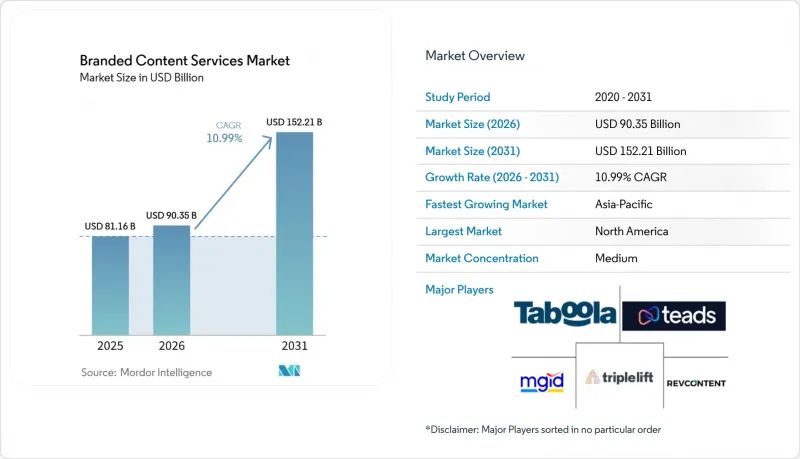
根據 Mordor Intelligence 預測,品牌內容服務市場規模將從 2025 年的 811.6 億美元和 2026 年的 903.5 億美元成長到 2031 年的 1522.1 億美元,2026 年至 2031 年的年複合成長率(CAGR)%為 10.99%。
本報告按平台模式(封閉式平台、開放式網路發布商、混合平台)、裝置(行動裝置、桌上型電腦/筆記型電腦、聯網電視、平板電腦)、產業(零售/電子商務、媒體/娛樂、醫療保健/生命科學、旅遊/飯店、消費品等)和地區進行細分。市場預測以美元(USD)為單位。
全球品牌內容服務市場趨勢與洞察
向非侵入式廣告形式過渡
消費者對干擾性廣告的抵觸情緒,使得非侵入式廣告形式成為有效品牌傳播的核心要素,尤其是在觀眾可以跳過、封鎖或忽略標準廣告單元的情況下。儘管美國數位廣告收入在2024年超過1,500億美元,但即便涵蓋範圍廣,用戶對標準展示廣告和前置式廣告形式的參與度仍持續下降。當廣告的呈現方式與編輯內容、主題和受眾觀看行為相契合時,品牌內容服務市場將從中受益。原生報導和創作者主導的廣告形式能夠減少傳統廣告帶來的干擾,從而促進更長時間的互動和更強的記憶。此外,領先的出版商正在提高編輯標準以維護受眾信任,這提高了對贊助內容的品質要求,並使其執行更加依賴編輯規劃。這賦予了經驗豐富的製作公司更大的權力,並增強了出版商在商業項目談判中的議價能力。
在出版商和社交環境中,影片優先成為內容消費的主要方式。
隨著社群媒體、聯網電視和短影片應用程式的設計都以影片觀看為核心,影片資源的重複分發也變得輕而易舉,影片的重要性日益凸顯。聯網電視廣告主正在增加廣告預算,70% 的廣告主預計到 2026 年平均增幅將達到 17%。這推動了品牌內容服務市場的發展,因為高階品牌正將預算轉向可尋址的數位影片環境,將內容融入觀看體驗中。創作者影片的功能不僅限於自然發布;效用還可以根據品牌獨特的受眾數據,作為付費媒體使用。創作者影片的製作和分發系統在社交平臺上的整合度越來越高,使得成功的內容能夠適應多種投放管道。因此,影片內容正逐漸成為持續媒體投資週期的一部分,而不再是一次性的創新活動。
對贊助性編輯內容的揭露和可信度審查
在主要廣告市場,資訊揭露要求日益嚴格,內容在發布前擴大需要經過法務部門、平台和出版商的審核。美國聯邦貿易委員會 (FTC) 已就代言廣告、網紅內容和評論的清晰醒目披露發布了指南。歐盟委員會的《人工智慧法案》也強制要求某些人工智慧產生的內容必須透明。在品牌內容服務市場,如果專案包含贊助報導或人工智慧驅動的創新,核准週期往往會更長,尤其是在宣傳活動面向多個市場時。這些審核可能會限制在需要快速部署的宣傳活動中使用合成影像,因此創新、法務和出版商團隊之間可能需要儘早進行協調。清晰的資訊揭露仍然至關重要,因為模糊的贊助內容會損害與廣告商的關係以及出版商讀者的信任。
細分市場分析
2025年,封閉式平台佔據了品牌內容服務市場規模的57.62%。 Meta、TikTok、YouTube和LinkedIn擁有大規模的使用者群體,並具備成熟的創作者與品牌之間的變現系統。這些平台的資訊流格式使得贊助內容更容易與用戶的常規活動同步推送,模糊了付費廣告位與用戶觀看體驗之間的界線。 Meta的夥伴關係廣告模式在2026年第一季實現了100億美元的年化收入,顯示創作者內容的商業性價值正在不斷提升。 LinkedIn於2026年6月推出了創作者市場,將其品牌內容基礎設施擴展到了企業用戶群。封閉式平台透過將內容創作、定向、分發和報告功能整合到單一的營運環境中,持續吸引廣告預算。
開放網路出版商網路之間的競爭並非僅僅依靠簡單的覆蓋範圍,而是依靠編輯品質、品牌安全和檢驗的第一方受眾。紐約時報的T Brand Studio、BBC的StoryWorks、衛報的Guardian Labs、金融時報的Commercial以及赫斯特工作室都利用這些優勢來支援高階整合。混合平台,例如Taboola、Outbrain、MGID和TripleLift等公司,將程式化投放與出版商專屬的廣告資源結合。預計混合平台在2026年至2031年間的複合年成長率將達到11.63%。 2026年6月,Taboola向外部人工智慧公司、聊天機器人開發人員和虛擬助理供應商開放了其為DeeperDive提供支援的獲利系統。這表明混合平台營運商正在從內容建議轉向人工智慧驅動的內容發現基礎設施。
區域分析
到2025年,北美將佔據品牌內容服務市場37.62%的佔有率。該地區匯集了許多原生廣告平台、優質發行商工作室和零售媒體網路。預計到2025年,美國創作者經濟領域的廣告支出將達到371億美元,2026年將達到439億美元。這使得該地區成為創作者主導品牌內容項目的最大市場,儘管隨著發行商整合的推進,競爭格局正在改變。
2026年7月,Lupa Systems完成了《紐約雜誌》、Vox Media Podcast Network和Vox的收購。 Penske Media Corporation收購了Vox Media剩餘的數位品牌組合,包括The Verge、Eater、SB Nation、Popsugar、Punch和Thrillist。南美洲市場規模仍然較小,但在社群影片的普及和本地零售媒體網路擴張的推動下,巴西和阿根廷市場持續成長。衡量基礎設施和創作者變現的挑戰限制了機構投資者在該地區的品牌投資。在歐洲,德國、英國和法國的需求正在成長,但資料保護和人工智慧透明度方面的合規要求增加了實施難度。
英國高階出版集團持續為高參與度受眾提供強大的工作室基礎設施。亞太地區預計在2026年至2031年間將以12.43%的複合年成長率成長,主要受影片消費、中國超級應用電商體係以及印度和韓國聯網電視普及的推動。日本網路廣告市場預計在2025年達到4.0459兆日圓(約267.9億美元),2026年網路廣告媒體支出預計將達到3.584兆日圓(約237.4億美元)。日本影片廣告年增14.7%,TikTok在日本的每月活躍用戶預計在2026年超過4,200萬。在中東,政府主導的媒體投資和奢侈品牌的宣傳活動正在推動市場發展,而非洲,尤其是南非和奈及利亞,仍處於起步階段。
其他好處:
- Excel格式的市場預測(ME)表
- 3個月的分析師支持
目錄
第1章:引言
- 研究假設和市場定義
- 調查範圍
第2章:調查方法
第3章執行摘要
第4章 市場狀況
- 市場概覽
- 市場促進因素
- 向非侵入式廣告形式過渡
- 在出版商和社群環境中,影片優先的內容消費模式盛行。
- 無 cookie 媒體組合中第一方和情境定向的需求
- 創作者經濟正在擴展到運作品牌推廣項目。
- 零售媒體與商業內容的融合
- 人工智慧主導的創新適應與績效衡量
- 市場限制因素
- 關於贊助編輯內容的揭露和可靠性檢驗
- 投資報酬率歸因在出版商、創作者和平台之間分散。
- 與人工智慧產生的資產和藝人肖像權相關的版權管理風險。
- 主要出版社的編輯防火牆和管治限制
- 產業價值鏈分析
- 監理情勢
- 技術展望
- 波特五力分析
- 宏觀經濟因素對市場的影響
第5章 市場規模與成長預測
- 按平台模式
- 封閉式平台
- 開放網路出版商網路
- 混合平台
- 透過裝置
- 移動的
- 桌上型筆記型電腦
- 聯網電視
- 藥片
- 按行業
- 零售與電子商務
- 媒體與娛樂
- 醫療保健和生命科學
- 旅遊與飯店
- 消費品
- 其他(銀行、金融服務和保險、教育、汽車/IT、電信)
- 按地區
- 北美洲
- 美國
- 加拿大
- 墨西哥
- 南美洲
- 巴西
- 阿根廷
- 智利
- 其他南美國家
- 歐洲
- 德國
- 英國
- 法國
- 義大利
- 西班牙
- 其他歐洲國家
- 亞太地區
- 中國
- 日本
- 印度
- 韓國
- 澳洲
- 其他亞太國家
- 中東
- 沙烏地阿拉伯
- 阿拉伯聯合大公國
- 卡達
- 其他中東國家
- 非洲
- 南非
- 埃及
- 奈及利亞
- 其他非洲國家
- 北美洲
第6章 競爭情勢
- 市場集中度
- 策略趨勢
- 市佔率分析
- 公司簡介
- Taboola.com Ltd.
- Outbrain Inc.
- MGID Inc.
- TripleLift, Inc.
- Life360, Inc.
- Revcontent, LLC
- Thomson Reuters Corporation
- The New York Times Company
- Vox Media, LLC
- Hearst Communications, Inc.
- BBC Studios Limited
- Future plc
- Penske Media Corporation
- Gannett Co., Inc.
- Dotdash Meredith, Inc.
- Advance Magazine Publishers Inc.
- Guardian News & Media Limited
- Financial Times Limited
- A360media LLC
- BuzzFeed, Inc.
第7章 市場機會與未來展望
According to Mordor Intelligence, the branded content services market size is projected to expand from USD 81.16 billion in 2025 and USD 90.35 billion in 2026 to USD 152.21 billion by 2031, registering a CAGR of 10.99% between 2026 to 2031.
This report is Segmented by Platform Model (Closed Platforms, Open Web Publisher Networks, and Hybrid Platforms), Device (Mobile, Desktop and Laptop, Connected TV, and Tablet), Industry Verticals (Retail and E-Commerce, Media and Entertainment, Healthcare and Life Sciences, Travel and Hospitality, Consumer Goods, and More), and Geography. The Market Forecasts are Provided in Terms of Value (USD).
Global Branded Content Services Market Trends and Insights
Shift Toward Non-Intrusive Advertising Formats
Consumer resistance to interruptive advertising has made less disruptive formats a core requirement for effective brand communication, especially where audiences can skip, block, or ignore standard ad units. U.S. digital advertising revenue exceeded USD 150 billion in 2024, although broad reach did not resolve declining engagement with standard display and pre-roll formats. The branded content services market benefits when advertising is presented in a form that fits the editorial setting, the subject matter, and the audience's viewing behavior. Native articles and creator-hosted formats can support longer engagement and stronger recall because they reduce the disruption associated with conventional advertising. Premium publishers are also raising editorial standards to protect audience trust, which increases the quality expected from sponsored work and makes execution more dependent on editorial planning. This supports experienced studios and gives publishers more leverage when they negotiate commercial programs.
Video-First Content Consumption Across Publisher and Social Environments
Video is gaining importance because social feeds, connected TV, and short-form video applications are designed for video viewing and make video assets easier to distribute repeatedly. Connected TV advertisers are increasing their spending plans, with 70% expecting to raise spending by an average of 17% in 2026. This supports the branded content services market by moving premium brand budgets toward addressable digital video environments where content can be integrated into the viewing experience. Creator video can also be used as paid media against a brand's own audience data, which makes it more useful beyond a single organic post. The production and distribution systems for creator video are becoming more closely connected across social platforms, allowing a successful asset to be adapted across several placements. As a result, video content is becoming part of a recurring media investment cycle rather than a separate creative experiment.
Disclosure and Trust Scrutiny Around Sponsored Editorial Content
Disclosure requirements are becoming more demanding across major advertising jurisdictions, so legal, platform, and publisher reviews increasingly occur before content can be released. The Federal Trade Commission provides guidance on clear and conspicuous disclosures for endorsements, influencer content, and reviews. The European Commission's AI Act framework also sets transparency duties for certain AI-generated content. The branded content services market faces longer approval cycles when programs include sponsored editorial work or AI-assisted creative, particularly when a campaign is intended for several jurisdictions. These checks can limit the use of synthetic likenesses in campaigns that need to move quickly and can require earlier coordination between creative, legal, and publisher teams. Clear labeling remains important because unclear sponsored content can damage both the advertiser relationship and the publisher's audience trust.
Other drivers and restraints analyzed in the detailed report include:
- First-Party and Contextual Targeting Demand in a Cookieless Media Mix
- Creator Economy Scaling Into Always-On Brand Programs
- ROI Attribution Fragmentation Across Publishers, Creators, and Platforms
For complete list of drivers and restraints, kindly check the Table Of Contents.
Segment Analysis
Closed platforms held 57.62% of branded content services market size in 2025. Meta, TikTok, YouTube, and LinkedIn combine large audiences with mature creator-to-brand monetization systems. Their in-feed formats make sponsored content easier to distribute alongside ordinary audience activity, reducing the separation between a paid placement and the surrounding viewing experience. Meta's partnership advertising format reached an annualized revenue run rate of USD 10 billion in the first quarter of 2026, which showed the growing commercial role of creator-produced content. LinkedIn launched its Creator Marketplace in June 2026, extending branded content infrastructure to professional audiences as closed platforms continue to attract budgets by linking content creation, targeting, distribution, and reporting within a single operating environment.
Open web publisher networks compete through editorial quality, brand safety, and verified first-party audiences rather than raw reach. The New York Times T Brand Studio, BBC StoryWorks, Guardian Labs, Financial Times Commercial, and Hearst studios use these strengths to support premium integrations. Hybrid platforms bridge programmatic distribution with publisher-native placements through firms such as Taboola, Outbrain, MGID, and TripleLift. Hybrid platforms are projected to grow at an 11.63% CAGR from 2026 to 2031. In June 2026, Taboola opened the monetization system behind DeeperDive to external AI companies, chatbot developers, and virtual assistant providers, showing how hybrid operators are adapting from content recommendation to infrastructure for AI-mediated discovery.
Complete Report Scope:
- By Platform Model
- Closed Platforms
- Open Web Publisher Networks
- Hybrid Platforms
- By Device
- Mobile
- Desktop and Laptop
- Connected TV
- Tablet
- By Industry Verticals
- Retail and E-commerce
- Media and Entertainment
- Healthcare and Life Sciences
- Travel and Hospitality
- Consumer Goods
- Other Industry Verticals (BFSI, Education,Automotive & IT and Telecom )
- By Geography
- North America
- United States
- Canada
- Mexico
- South America
- Brazil
- Argentina
- Chile
- Rest of South America
- Europe
- Germany
- United Kingdom
- France
- Italy
- Spain
- Rest of Europe
- Asia-Pacific
- China
- Japan
- India
- South Korea
- Australia
- Rest of Asia-Pacific
- Middle East
- Saudi Arabia
- United Arab Emirates
- Qatar
- Rest of Middle East
- Africa
- South Africa
- Egypt
- Nigeria
- Rest of Africa
- North America
Geography Analysis
North America held 37.62% of the branded content services market share in 2025. The region has a high concentration of native advertising platforms, premium publisher studios, and retail media networks. U.S. creator economy advertising spend reached USD 37.1 billion in 2025 and is projected to reach USD 43.9 billion in 2026. This makes the region the largest setting for creator-led branded content programs, while publisher consolidation is changing the competitive structure.
In July 2026, Lupa Systems completed its acquisition of New York Magazine, the Vox Media Podcast Network, and Vox. Penske Media Corporation acquired the remaining Vox Media digital brand portfolio, including The Verge, Eater, SB Nation, Popsugar, Punch, and Thrillist. South America remains smaller but is growing in Brazil and Argentina as social video use and local retail media networks expand. Measurement infrastructure and creator monetization gaps limit institutional brand investment in the region. Europe has growing demand in Germany, the United Kingdom, and France, but data protection and AI transparency obligations add execution requirements.
Premium publishing groups in the United Kingdom continue to provide strong studio infrastructure for quality-engaged audiences. Asia-Pacific is projected to grow at a 12.43% CAGR from 2026 to 2031, supported by video consumption, super-app commerce systems in China, and connected TV adoption in India and South Korea. Japan's internet advertising market reached JPY 4.0459 trillion in 2025 (USD 26.79 billion), and internet ad media fees are estimated at JPY 3.584 trillion (USD 23.74 billion), in 2026. Video advertising in Japan recorded 14.7% year-on-year growth, while TikTok surpassed 42 million monthly users in the country in 2026. The Middle East is emerging through sovereign media investments and luxury campaigns, while Africa remains earlier stage, led by South Africa and Nigeria.
- Taboola.com Ltd.
- Outbrain Inc.
- MGID Inc.
- TripleLift, Inc.
- Life360, Inc.
- Revcontent, LLC
- Thomson Reuters Corporation
- The New York Times Company
- Vox Media, LLC
- Hearst Communications, Inc.
- BBC Studios Limited
- Future plc
- Penske Media Corporation
- Gannett Co., Inc.
- Dotdash Meredith, Inc.
- Advance Magazine Publishers Inc.
- Guardian News & Media Limited
- Financial Times Limited
- A360media LLC
- BuzzFeed, Inc.
Additional Benefits:
- The market estimate (ME) sheet in Excel format
- 3 months of analyst support
TABLE OF CONTENTS
1 INTRODUCTION
- 1.1 Study Assumptions and Market Definition
- 1.2 Scope of the Study
2 RESEARCH METHODOLOGY
3 EXECUTIVE SUMMARY
4 MARKET LANDSCAPE
- 4.1 Market Overview
- 4.2 Market Drivers
- 4.2.1 Shift Toward Non-Intrusive Advertising Formats
- 4.2.2 Video-First Content Consumption Across Publisher and Social Environments
- 4.2.3 First-Party and Contextual Targeting Demand in a Cookieless Media Mix
- 4.2.4 Creator Economy Scaling Into Always-On Brand Programs
- 4.2.5 Retail Media and Commerce Content Convergence
- 4.2.6 AI-Led Creative Adaptation and Performance Measurement
- 4.3 Market Restraints
- 4.3.1 Disclosure and Trust Scrutiny Around Sponsored Editorial Content
- 4.3.2 ROI Attribution Fragmentation Across Publishers, Creators, and Platforms
- 4.3.3 Rights Management Risk for AI-Generated Assets and Talent Likeness
- 4.3.4 Editorial Firewall and Governance Constraints at Premium Publishers
- 4.4 Industry Value Chain Analysis
- 4.5 Regulatory Landscape
- 4.6 Technological Outlook
- 4.7 Porter's Five Forces Analysis
- 4.7.1 Bargaining Power of Buyers
- 4.7.2 Bargaining Power of Suppliers
- 4.7.3 Threat of New Entrants
- 4.7.4 Threat of Substitutes
- 4.7.5 Intensity of Competitive Rivalry
- 4.8 Impact of Macroeconomic Factors on the Market
5 MARKET SIZE AND GROWTH FORECASTS (VALUE)
- 5.1 By Platform Model
- 5.1.1 Closed Platforms
- 5.1.2 Open Web Publisher Networks
- 5.1.3 Hybrid Platforms
- 5.2 By Device
- 5.2.1 Mobile
- 5.2.2 Desktop and Laptop
- 5.2.3 Connected TV
- 5.2.4 Tablet
- 5.3 By Industry Verticals
- 5.3.1 Retail and E-commerce
- 5.3.2 Media and Entertainment
- 5.3.3 Healthcare and Life Sciences
- 5.3.4 Travel and Hospitality
- 5.3.5 Consumer Goods
- 5.3.6 Other Industry Verticals (BFSI, Education,Automotive & IT and Telecom )
- 5.4 By Geography
- 5.4.1 North America
- 5.4.1.1 United States
- 5.4.1.2 Canada
- 5.4.1.3 Mexico
- 5.4.2 South America
- 5.4.2.1 Brazil
- 5.4.2.2 Argentina
- 5.4.2.3 Chile
- 5.4.2.4 Rest of South America
- 5.4.3 Europe
- 5.4.3.1 Germany
- 5.4.3.2 United Kingdom
- 5.4.3.3 France
- 5.4.3.4 Italy
- 5.4.3.5 Spain
- 5.4.3.6 Rest of Europe
- 5.4.4 Asia-Pacific
- 5.4.4.1 China
- 5.4.4.2 Japan
- 5.4.4.3 India
- 5.4.4.4 South Korea
- 5.4.4.5 Australia
- 5.4.4.6 Rest of Asia-Pacific
- 5.4.5 Middle East
- 5.4.5.1 Saudi Arabia
- 5.4.5.2 United Arab Emirates
- 5.4.5.3 Qatar
- 5.4.5.4 Rest of Middle East
- 5.4.6 Africa
- 5.4.6.1 South Africa
- 5.4.6.2 Egypt
- 5.4.6.3 Nigeria
- 5.4.6.4 Rest of Africa
- 5.4.1 North America
6 COMPETITIVE LANDSCAPE
- 6.1 Market Concentration
- 6.2 Strategic Moves
- 6.3 Market Share Analysis
- 6.4 Company Profiles (includes Global Level Overview, Market Level Overview, Core Segments, Financials as available, Strategic Information, Market Rank/Share, Products and Services, Recent Developments)
- 6.4.1 Taboola.com Ltd.
- 6.4.2 Outbrain Inc.
- 6.4.3 MGID Inc.
- 6.4.4 TripleLift, Inc.
- 6.4.5 Life360, Inc.
- 6.4.6 Revcontent, LLC
- 6.4.7 Thomson Reuters Corporation
- 6.4.8 The New York Times Company
- 6.4.9 Vox Media, LLC
- 6.4.10 Hearst Communications, Inc.
- 6.4.11 BBC Studios Limited
- 6.4.12 Future plc
- 6.4.13 Penske Media Corporation
- 6.4.14 Gannett Co., Inc.
- 6.4.15 Dotdash Meredith, Inc.
- 6.4.16 Advance Magazine Publishers Inc.
- 6.4.17 Guardian News & Media Limited
- 6.4.18 Financial Times Limited
- 6.4.19 A360media LLC
- 6.4.20 BuzzFeed, Inc.
7 MARKET OPPORTUNITIES AND FUTURE OUTLOOK
- 7.1 White-Space and Unmet-Need Assessment

 亞太地區內容服務平台:市場佔有率分析、產業趨勢與統計及成長預測(2026-2031)內容服務平台:市場佔有率分析、產業趨勢與統計、成長預測(2026-2031)
 內容服務平台市場-2026-2032年全球市場預測
 2026年全球內容服務平台市場報告
 全球內容服務平台市場規模、佔有率、趨勢和成長分析報告(2026-2034)
 內容服務平台市場規模、佔有率和成長分析(按組件、企業規模、部署類型、業務功能、產業和地區分類)-2026-2033年產業預測多語言字幕服務市場按服務類型、語言對、文件格式、字幕類型、垂直行業和配銷通路分類 - 全球預測 2025-2030