


 |
市場調查報告書
商品編碼
2124336
雲端供應鏈管理:市場佔有率分析、產業趨勢與統計、成長預測(2026-2031)Cloud Supply Chain Management - Market Share Analysis, Industry Trends & Statistics, Growth Forecasts (2026 - 2031) |
||||||

※ 本網頁內容可能與最新版本有所差異。詳細情況請與我們聯繫。
根據 Mordor Intelligence 預測,雲端供應鏈管理市場規模將從 2025 年的 119.5 億美元成長到 2026 年的 139.8 億美元,然後在 2031 年達到 305.6 億美元,2026 年至 2031 年的複合年成長率為 16.95%。
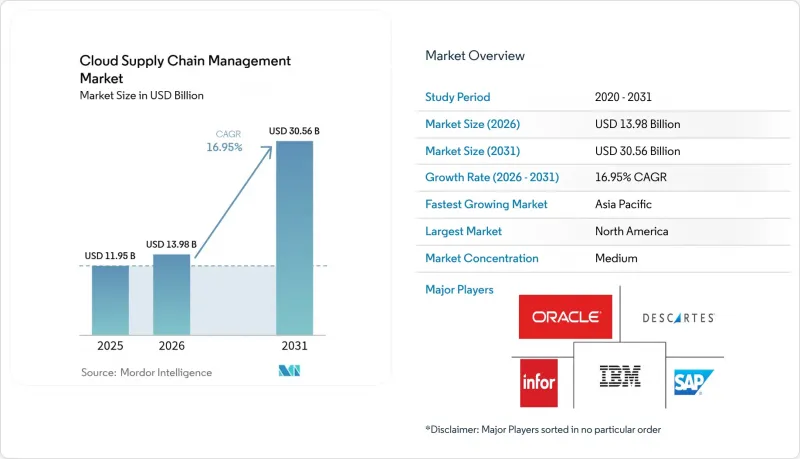
本報告按解決方案(需求規劃和預測等)、部署類型(混合雲端、公共雲端、私有雲端)、企業規模(大型企業、中小企業)、最終用戶產業(零售、食品飲料等)和地區(北美、南美等)進行細分。市場預測以美元計價。
全球雲端供應鏈管理市場趨勢與洞察
需求計劃中基於雲端的解決方案的快速普及
從電子表格遷移到雲端原生預測工具的企業現在可以利用POS資料、天氣API和社群媒體情緒,每小時更新需求訊號。隨著生成式人工智慧的出現,規劃人員可以用自然語言分析預測結果,並模擬促銷的效果。即使準確率略有提高,也能將安全庫存降低兩位數,進而釋放營運資金。零售和消費品行業的領導企業一直是這項技術的先驅,但隨著雲端資料湖支援安全、租戶隔離的機器學習和訓練模型,其應用範圍正在不斷擴大。
電子商務擴張需要靈活的供應鏈網路
預計到2024年,電子商務將佔零售總額的21%,品牌需要集中管理分散的庫存,以兌現當日送達的承諾。基於雲端的供應鏈管理平台透過將訂單路由至最近的地點來最大限度地減少分流出貨。預置的連接器連接了履約中心、宅配業者和報關行,自動計算接收成本並處理跨越數十個司法管轄區的退貨。對於購物車金額低於50美元的跨境經銷商而言,這項功能至關重要。
人們越來越關注安全和資料隱私問題
在多租戶架構中,高度敏感的定價、預測和運輸資料集中儲存在一個位置。 2024年,一家物流軟體供應商發生資料外洩事件,導致4萬名客戶的貨物清單外洩。這促使人們更加關注加密、存取控制和資料居住方面的合規性。歐盟的《一般資料保護規範》(GDPR)和中國的《個人資料保護法》使跨境資料傳輸變得更加複雜,導致一些公司選擇由私人區域和客戶管理的金鑰。這些額外的控制措施可能會增加供應商成本,並可能減緩基於雲端的供應鏈管理的普及速度。
細分市場分析
運輸和物流管理在雲端供應鏈管理市場中佔據最大佔有率,預計到2025年將佔總收入的27.12%。托運人依靠即時預計到達時間 (ETA)、動態路線最佳化和承運商績效儀錶板來最佳化營運。北美強制使用的電子記錄設備 (ELD) 和歐洲的行車記錄器法規正在提供遠端資訊處理數據,並提高預計到達時間的預測準確性。數位貨運市場透過開放API連接,使規劃人員無需手動競標即可比較不同運輸方式的運費。隨著零售商將天氣和社會情緒等外部因素納入考慮以最大限度地減少庫存積壓,需求計劃和預測的重要性日益凸顯。庫存和倉庫管理採用電腦視覺技術進行循環盤點,進而降低高周轉率物流中心(DC) 的人事費用。產品生命週期管理 (PLM) 模組也擴展到流程產業,將配方修訂和合規記錄關聯起來。銷售和營運計劃 (S&OP) 整合了財務整合功能,允許在單一儀錶板上核對銷售量和收入預測。採購模組整合了供應商風險評分,該評分綜合考慮了財務狀況、ESG評級和地緣政治風險。訂單管理引擎利用訂單滿足率、利潤率和準時交貨保證邏輯來協調履約。在產品主資料管理方面,利用區塊鏈建立不可竄改的溯源鏈已成為日益成長的趨勢。
「數位孿生驅動規劃」以21.25%的複合年成長率快速成長,成為解決方案領域成長最快的細分市場。製藥、半導體和重工業企業正在建立網路圖,以模擬多層材料清單(BOM)中的各種中斷情況。負責人可以在確保庫存之前,虛擬測試替代採購方案和緩衝庫存變更。圖資料庫可以識別可能成為單點故障的供應商,而雲端運算每小時可以運行數千個蒙特卡羅模擬場景。 2024年預計的零件短缺導致全球組裝停工,促使企業採用情境主導的營運模式,這項能力也因此備受關注。
2025年,公共雲端將佔據雲端供應鏈管理市場60.58%的佔有率。企業優先考慮供應商管理的基礎設施和快速部署,避免耗時6到12個月的本地部署專案。遍佈30多個國家的區域資料中心滿足資料居住要求,並確保營運工作流程的延遲低於毫秒級。私有雲端在國防和能源相關企業中仍然很受歡迎,用於保護敏感藍圖和地震資料。這些環境利用虛擬機器管理程式和OpenStack層在企業防火牆內模擬彈性擴充。
混合雲端預計以 19.05% 的複合年成長率成長,兼顧了管治和敏捷性。製藥公司將臨床試驗方案和病患資料檢驗在符合良好臨床實務 (GCP) 標準的私人節點上,同時在季度銷售與營運計畫 (S&OP) 週期內將分析工作負載卸載到公共租戶。 AWS Outposts 和 Azure Stack 等服務擴展了本機託管服務,提供了一套一致的工具集。該模型利用事件流整合來同步主資料,避免數據過時。 ISO 27001 和 SOC 2 認證的管理架構為稽核合規性奠定了基礎,並影響部署選擇。
區域分析
預計到2025年,北美地區將佔總收入的34.41%。美國海關與邊防安全(CBP) 的自動化商業環境 (ACE) API 可自動產生報關單,進而降低進口商的清關成本。超大規模資料中心業者營運商的早期基礎設施建設確保了對時間敏感的控制塔和貨物可視化儀表板的低延遲存取。加拿大《加拿大食品安全條例》迫使農產品出口商建立從農場到餐桌的可追溯性,推動了雲端投資。墨西哥的近岸外包趨勢促使電子和汽車組裝製造商將其與供應商的合作關係數位化,以降低跨太平洋運輸的風險。
亞太地區預計將成為該地區成長最快的區域,複合年成長率將達到18.05%。中國、印度和越南的契約製造製造商正在對其二級和三級合作夥伴進行數位化改造,以實現全球品牌設定的準時交付目標。中國的「一帶一路」鐵路走廊正在提升多模態路線最佳化的需求。印度的商品和服務稅(GST)電子帳單已全面數位化,並與雲端系統連接,可即時匹配納稅義務。在日本,由於司機隊伍老化,人工智慧驅動的路線整合正在被引入;而澳洲的資源出口商正在實現出口單證的自動化,以加快船舶預訂速度。
在歐洲,由於《一般資料保護規則》(GDPR) 和《企業永續性報告指令》的推動,合規功能被納入供應商的提案書 (RFP) 中,因此自動化技術的採用正在迅速推進。德國汽車產業正在採用基於約束的規劃方法來管理多階段生產能力。在英國,脫歐後的法規正在加速自動化關稅分類的採用。在法國,奢侈品產業正利用需求預測來應對短暫的季節性週期,從而大幅減少折扣。俄羅斯的資料在地化法仍然是一個障礙,迫使企業遷移到國內雲端服務,導致全球合作夥伴的進度延遲。
其他好處:
- Excel格式的市場預測(ME)表
- 3個月的分析師支持
目錄
第1章:引言
- 研究假設和市場定義
- 調查範圍
第2章:調查方法
第3章執行摘要
第4章 市場狀況
- 市場概覽
- 市場促進因素
- 需求計劃中基於雲端的解決方案的快速普及
- 隨著電子商務的擴張,需要靈活的供應鏈網路。
- 成本效益和擴充性正在推動從本地 SCM 遷移到雲端。
- 將數位孿生技術整合到即時供應鏈模擬中
- 碳計量的強制實施正在推進,基於雲端的視覺化平台正在推廣。
- 供應商向可組合微服務架構的遷移正在加速升級。
- 市場限制因素
- 人們越來越關注安全和資料隱私問題
- 複雜的舊有系統阻礙了雲端遷移
- 雲端原生產業供應鏈人才短缺
- 對主權雲的需求不斷成長,導致部署去中心化。
- 宏觀經濟因素對市場的影響
- 產業價值鏈分析
- 技術展望
- 監理情勢
- 波特五力分析
- 投資分析
第5章 市場規模與成長預測
- 透過解決方案
- 需求計劃和需求預測
- 庫存和倉庫管理
- 產品生命週期管理
- 運輸/物流管理
- 銷售和業務規劃
- 採購與尋源
- 訂單管理
- 產品主資料管理
- 依部署類型
- 混合雲端
- 公共雲端
- 私有雲端
- 按組織規模
- 大公司
- 小型企業
- 按最終用戶行業分類
- 零售
- 食品/飲料
- 製造業
- 車
- 石油和天然氣
- 衛生保健
- 家用電子產品
- 航太/國防
- 製藥
- 按地區
- 北美洲
- 美國
- 加拿大
- 墨西哥
- 南美洲
- 巴西
- 阿根廷
- 其他南美國家
- 歐洲
- 英國
- 德國
- 法國
- 義大利
- 西班牙
- 俄羅斯
- 其他歐洲國家
- 亞太地區
- 中國
- 日本
- 印度
- 韓國
- 澳洲
- 其他亞太國家
- 中東
- 沙烏地阿拉伯
- 阿拉伯聯合大公國
- 土耳其
- 其他中東國家
- 非洲
- 南非
- 奈及利亞
- 埃及
- 其他非洲國家
- 北美洲
第6章 競爭情勢
- 市場集中度
- 策略趨勢
- 市佔率分析
- 公司簡介
- SAP SE
- Oracle Corporation
- Infor Inc.
- The Descartes Systems Group Inc.
- International Business Machines Corporation
- Blue Yonder Group Inc.
- Manhattan Associates Inc.
- Logility Inc.
- Kinaxis Inc.
- Korber Supply Chain Software GmbH
- CloudLogix Inc.
- Tecsys Inc.
- E2open Parent Holdings Inc.
- One Network Enterprises Inc.
- MercuryGate International Inc.
- Freightos Limited
- Project44 Holdings Inc.
- Llamasoft Inc.(Coupa Software Inc.)
- o9 Solutions Inc.
- Elementum SCM Inc.
- ClearMetal Inc.
- Verusen Inc.
- Cognizant Technology Solutions Corporation
- Amazon Web Services Inc.(AWS Supply Chain)
第7章 市場機會與未來展望
According to Mordor Intelligence, the cloud supply chain management market size is expected to grow from USD 11.95 billion in 2025 to USD 13.98 billion in 2026 and is forecast to reach USD 30.56 billion by 2031 at 16.95% CAGR over 2026-2031.
This report is Segmented by Solution (Demand Planning and Forecasting, and More), Deployment Type (Hybrid Cloud, Public Cloud, and Private Cloud), Organization Size (Large Enterprises, and Small and Medium Enterprises), End-User Industry (Retail, Food and Beverage, and More), and Geography (North America, South America, and More). The Market Forecasts are Provided in Terms of Value (USD).
Global Cloud Supply Chain Management Market Trends and Insights
Rapid Adoption of Cloud-Based Solutions for Demand Planning
Organizations replacing spreadsheets with cloud-native forecasting gain hourly demand-signal refreshes, fed by point-of-sale feeds, weather APIs, and social media sentiment. Generative AI now lets planners interrogate forecasts in natural language and simulate promotional lifts. Even minor accuracy gains cut safety stock by double-digit percentages, releasing working capital. Retail and consumer-goods leaders paved the way, but adoption is broadening as cloud data lakes support a secure, tenant-isolated model for machine learning and training.
Expansion of E Commerce Requiring Agile Supply Networks
With e-commerce penetration expected to reach 21% of retail sales by 2024, brands must orchestrate distributed inventory to meet same-day commitments. Cloud supply chain management market platforms route orders to the closest node, minimizing split shipments. Pre-built connectors link fulfillment centers, parcel carriers, and customs brokers, automating landed-cost calculations and returns processing across dozens of jurisdictions. The capability is critical for cross-border sellers managing baskets under USD 50.
Heightened Security and Data Privacy Concerns
Multi-tenant architectures concentrate sensitive pricing, forecast, and shipment data. A 2024 breach at a logistics software provider exposed manifests for 40,000 customers, elevating scrutiny on encryption, access controls, and data-residency compliance. The European Union's GDPR and China's Personal Information Protection Law complicate cross-border transfers, prompting some firms to opt for private regions or customer-managed keys. Added controls increase vendor costs and can slow the deployment of cloud supply chain management.
Other drivers and restraints analyzed in the detailed report include:
- Cost Efficiency and Scalability Driving Migration from On-Premise SCM
- Integration of Digital Twins for Real-Time Supply Chain Simulation
- Complex Legacy Systems Hindering Cloud Migration
For complete list of drivers and restraints, kindly check the Table Of Contents.
Segment Analysis
Transportation and Logistics Management contributed the largest slice of the cloud supply chain management market, holding 27.12% of the revenue in 2025. Shippers rely on real-time estimated arrival times, dynamic route optimization, and carrier performance dashboards to optimize their operations. Electronic logging device mandates in North America and tachograph rules in Europe feed telematics data that elevates predictive ETAs. Digital freight marketplaces interface through open APIs, letting planners benchmark rates across modes without manual tenders. Demand Planning and forecasting are on the rise as retailers integrate external variables, such as weather and social sentiment, to minimize excess stock. Inventory and Warehouse Management now embeds computer vision for cycle counting, reducing labor in high-velocity DCs. Product Lifecycle Management (PLM) modules have expanded into process industries, linking recipe revisions to compliance records. Sales and Operations Planning integrates finance links, allowing volume and revenue forecasts to be reconciled in a single cockpit. Procurement modules inject supplier risk scores that mix financial health, ESG ratings, and geopolitical exposure. Order Management engines orchestrate multichannel fulfillment using fill-rate, margin, and delivery-promise logic. Product Master Data Management increasingly leverages blockchain to build immutable provenance chains.
Digital Twin Enabled Planning, advancing at a 21.25% CAGR, is the fastest-growing solution subsegment. Pharmaceutical, semiconductor, and heavy-industrial firms construct network graphs that simulate disruptions across multi-tier bills of material. Planners can test alternate sourcing or buffer stock moves virtually before committing inventory. Graph databases spotlight single-point-of-failure suppliers, while cloud compute executes thousands of Monte Carlo scenarios hourly. The capability gained prominence after 2024 component shortages halted assembly lines worldwide, prompting firms to adopt scenario-driven operating models.
Public Cloud held 60.58% of the cloud supply chain management market in 2025. Organizations prize the vendor-managed infrastructure and speed of activation, avoiding 6-12 month on-premise projects. Regional data centers spread across more than 30 countries ensure data residency and sub-10 ms latency for operational workflows. Private Cloud persists among defense and energy firms, protecting classified diagrams or seismic data. These environments utilize hypervisor or OpenStack layers to simulate elastic scaling within corporate firewalls.
Hybrid Cloud, projected to grow 19.05% CAGR, balances governance and agility. Pharmaceutical companies store clinical trial protocols and patient data on private nodes validated under Good Clinical Practice, while offloading analytics workloads to public tenants during quarterly S&OP cycles. Offerings such as AWS Outposts and Azure Stack extend managed services on-premise, enabling consistent tooling. The model depends on event-stream integration to synchronize master data without stale reads. Certified controls under ISO 27001 and SOC 2 underpin audit readiness and influence deployment choices.
Complete Report Scope:
- By Solution
- Demand Planning and Forecasting
- Inventory and Warehouse Management
- Product Lifecycle Management
- Transportation and Logistics Management
- Sales and Operations Planning
- Procurement and Sourcing
- Order Management
- Product Master Data Management
- By Deployment Type
- Hybrid Cloud
- Public Cloud
- Private Cloud
- By Organization Size
- Large Enterprises
- Small and Medium Enterprises
- By End-User Industry
- Retail
- Food and Beverage
- Manufacturing
- Automotive
- Oil and Gas
- Healthcare
- Consumer Electronics
- Aerospace and Defense
- Pharmaceuticals
- By Geography
- North America
- United States
- Canada
- Mexico
- South America
- Brazil
- Argentina
- Rest of South America
- Europe
- United Kingdom
- Germany
- France
- Italy
- Spain
- Russia
- Rest of Europe
- Asia Pacific
- China
- Japan
- India
- South Korea
- Australia
- Rest of Asia Pacific
- Middle East
- Saudi Arabia
- United Arab Emirates
- Turkey
- Rest of Middle East
- Africa
- South Africa
- Nigeria
- Egypt
- Rest of Africa
- North America
Geography Analysis
North America delivered 34.41% of 2025 revenue. U.S. Customs and Border Protection's Automated Commercial Environment APIs automate customs entry creation, lowering brokerage costs for importers. Early hyperscaler buildouts ensure low-latency access for time-sensitive control towers and freight visibility dashboards. Canada's Safe Food for Canadians Regulations push agri-food exporters to establish farm-to-fork traceability, spurring cloud investments. Mexico's near-shoring trend has electronics and auto assemblers digitizing supplier collaboration to bypass Pacific shipping risks.
The Asia Pacific is poised for the fastest regional growth, with an 18.05% CAGR. Contract manufacturers in China, India, and Vietnam digitize tier-2 and tier-3 partners to meet just-in-time milestones set by global brands. China's Belt and Road rail corridors heighten the need for multi-modal route optimization. India's fully digital Goods and Services Tax e-invoicing feeds cloud systems that reconcile tax liabilities in real time. Japan's aging driver population fuels the adoption of AI-powered route consolidation, while Australia's commodity exporters automate export documentation to speed vessel bookings.
Europe maintains a significant uptake, owing to the GDPR and the Corporate Sustainability Reporting Directive, which embeds compliance functionality into vendor RFPs. Germany's automotive sector employs constraint-based planning to manage multi-tier capacity. The United Kingdom's post-Brexit rules accelerate the adoption of automated tariff classification. France's luxury segment relies on short seasonal calendars and uses demand sensing to slash markdowns. Russia's data-localization law remains a barrier, steering companies to domestic cloud alternatives that add latency for global partners.
- SAP SE
- Oracle Corporation
- Infor Inc.
- The Descartes Systems Group Inc.
- International Business Machines Corporation
- Blue Yonder Group Inc.
- Manhattan Associates Inc.
- Logility Inc.
- Kinaxis Inc.
- Korber Supply Chain Software GmbH
- CloudLogix Inc.
- Tecsys Inc.
- E2open Parent Holdings Inc.
- One Network Enterprises Inc.
- MercuryGate International Inc.
- Freightos Limited
- Project44 Holdings Inc.
- Llamasoft Inc. (Coupa Software Inc.)
- o9 Solutions Inc.
- Elementum SCM Inc.
- ClearMetal Inc.
- Verusen Inc.
- Cognizant Technology Solutions Corporation
- Amazon Web Services Inc. (AWS Supply Chain)
Additional Benefits:
- The market estimate (ME) sheet in Excel format
- 3 months of analyst support
TABLE OF CONTENTS
1 INTRODUCTION
- 1.1 Study Assumptions and Market Definition
- 1.2 Scope of the Study
2 RESEARCH METHODOLOGY
3 EXECUTIVE SUMMARY
4 MARKET LANDSCAPE
- 4.1 Market Overview
- 4.2 Market Drivers
- 4.2.1 Rapid Adoption of Cloud Based Solutions for Demand Planning
- 4.2.2 Expansion of E Commerce Requiring Agile Supply Networks
- 4.2.3 Cost Efficiency and Scalability Driving Migration from On Premise SCM
- 4.2.4 Integration of Digital Twins for Real Time Supply Chain Simulation
- 4.2.5 Rising Carbon Accounting Mandates Promoting Cloud Visibility Platforms
- 4.2.6 Vendor Transition to Composable Microservices Accelerating Upgrades
- 4.3 Market Restraints
- 4.3.1 Heightened Security and Data Privacy Concerns
- 4.3.2 Complex Legacy Systems Hindering Cloud Migration
- 4.3.3 Shortage of Cloud Native Supply Chain Talent
- 4.3.4 Increasing Sovereign Cloud Requirements Fragmenting Deployments
- 4.4 Impact of Macroeconomic Factors on the Market
- 4.5 Industry Value Chain Analysis
- 4.6 Technological Outlook
- 4.7 Regulatory Landscape
- 4.8 Porter's Five Forces Analysis
- 4.8.1 Bargaining Power of Suppliers
- 4.8.2 Bargaining Power of Consumers
- 4.8.3 Threat of New Entrants
- 4.8.4 Intensity of Competitive Rivalry
- 4.8.5 Threat of Substitutes
- 4.9 Investment Analysis
5 MARKET SIZE AND GROWTH FORECASTS (VALUE)
- 5.1 By Solution
- 5.1.1 Demand Planning and Forecasting
- 5.1.2 Inventory and Warehouse Management
- 5.1.3 Product Lifecycle Management
- 5.1.4 Transportation and Logistics Management
- 5.1.5 Sales and Operations Planning
- 5.1.6 Procurement and Sourcing
- 5.1.7 Order Management
- 5.1.8 Product Master Data Management
- 5.2 By Deployment Type
- 5.2.1 Hybrid Cloud
- 5.2.2 Public Cloud
- 5.2.3 Private Cloud
- 5.3 By Organization Size
- 5.3.1 Large Enterprises
- 5.3.2 Small and Medium Enterprises
- 5.4 By End-User Industry
- 5.4.1 Retail
- 5.4.2 Food and Beverage
- 5.4.3 Manufacturing
- 5.4.4 Automotive
- 5.4.5 Oil and Gas
- 5.4.6 Healthcare
- 5.4.7 Consumer Electronics
- 5.4.8 Aerospace and Defense
- 5.4.9 Pharmaceuticals
- 5.5 By Geography
- 5.5.1 North America
- 5.5.1.1 United States
- 5.5.1.2 Canada
- 5.5.1.3 Mexico
- 5.5.2 South America
- 5.5.2.1 Brazil
- 5.5.2.2 Argentina
- 5.5.2.3 Rest of South America
- 5.5.3 Europe
- 5.5.3.1 United Kingdom
- 5.5.3.2 Germany
- 5.5.3.3 France
- 5.5.3.4 Italy
- 5.5.3.5 Spain
- 5.5.3.6 Russia
- 5.5.3.7 Rest of Europe
- 5.5.4 Asia Pacific
- 5.5.4.1 China
- 5.5.4.2 Japan
- 5.5.4.3 India
- 5.5.4.4 South Korea
- 5.5.4.5 Australia
- 5.5.4.6 Rest of Asia Pacific
- 5.5.5 Middle East
- 5.5.5.1 Saudi Arabia
- 5.5.5.2 United Arab Emirates
- 5.5.5.3 Turkey
- 5.5.5.4 Rest of Middle East
- 5.5.6 Africa
- 5.5.6.1 South Africa
- 5.5.6.2 Nigeria
- 5.5.6.3 Egypt
- 5.5.6.4 Rest of Africa
- 5.5.1 North America
6 COMPETITIVE LANDSCAPE
- 6.1 Market Concentration
- 6.2 Strategic Moves
- 6.3 Market Share Analysis
- 6.4 Company Profiles (includes Global level Overview, Market level overview, Core Segments, Financials as available, Strategic Information, Market Rank/Share for key companies, Products and Services, and Recent Developments)
- 6.4.1 SAP SE
- 6.4.2 Oracle Corporation
- 6.4.3 Infor Inc.
- 6.4.4 The Descartes Systems Group Inc.
- 6.4.5 International Business Machines Corporation
- 6.4.6 Blue Yonder Group Inc.
- 6.4.7 Manhattan Associates Inc.
- 6.4.8 Logility Inc.
- 6.4.9 Kinaxis Inc.
- 6.4.10 Korber Supply Chain Software GmbH
- 6.4.11 CloudLogix Inc.
- 6.4.12 Tecsys Inc.
- 6.4.13 E2open Parent Holdings Inc.
- 6.4.14 One Network Enterprises Inc.
- 6.4.15 MercuryGate International Inc.
- 6.4.16 Freightos Limited
- 6.4.17 Project44 Holdings Inc.
- 6.4.18 Llamasoft Inc. (Coupa Software Inc.)
- 6.4.19 o9 Solutions Inc.
- 6.4.20 Elementum SCM Inc.
- 6.4.21 ClearMetal Inc.
- 6.4.22 Verusen Inc.
- 6.4.23 Cognizant Technology Solutions Corporation
- 6.4.24 Amazon Web Services Inc. (AWS Supply Chain)
7 MARKET OPPORTUNITIES AND FUTURE OUTLOOK
- 7.1 White-space and Unmet-Need Assessment

 供應鏈管理市場:按組件、物流管理模型、部署模式、最終用戶和組織規模分類-2026-2032年全球市場預測
 農業供應鏈管理市場規模、佔有率和成長分析:按組件、部署類型、應用、行業用戶類型和地區分類-2026-2033年產業預測
 超大規模資料中心業者在供應鏈規劃解決方案中的作用農業供應鏈管理市場:按組件、部署方式、應用、組織規模和最終用戶分類-2026-2032年全球市場預測雲端供應鏈管理市場:2026年至2032年全球市場預測,依組件、部署類型、產業、應用和企業規模分類
 2026年全球供應鏈管理機器學習市場報告
 供應鏈管理市場:市場規模、佔有率、成長率、全球產業分析、按類型、應用和地區分類的分析以及未來預測(2026-2034 年)2026年全球機場供應鏈管理市場報告全球供應鏈管理市場規模、佔有率、趨勢和成長分析報告(2026-2034年)
 供應鏈管理市場規模、佔有率和趨勢分析報告:按組件、部署、組織、產業、地區和細分市場預測(2025-2030 年)