


 |
市場調查報告書
商品編碼
2124331
自動化測試:市場佔有率分析、產業趨勢與統計、成長預測(2026-2031)Automation Testing - Market Share Analysis, Industry Trends & Statistics, Growth Forecasts (2026 - 2031) |
||||||

※ 本網頁內容可能與最新版本有所差異。詳細情況請與我們聯繫。
根據 Mordor Intelligence 預測,自動化測試市場規模預計在 2026 年達到 404.4 億美元,到 2031 年達到 789.4 億美元,在整個預測期內複合年成長率為 14.32%。
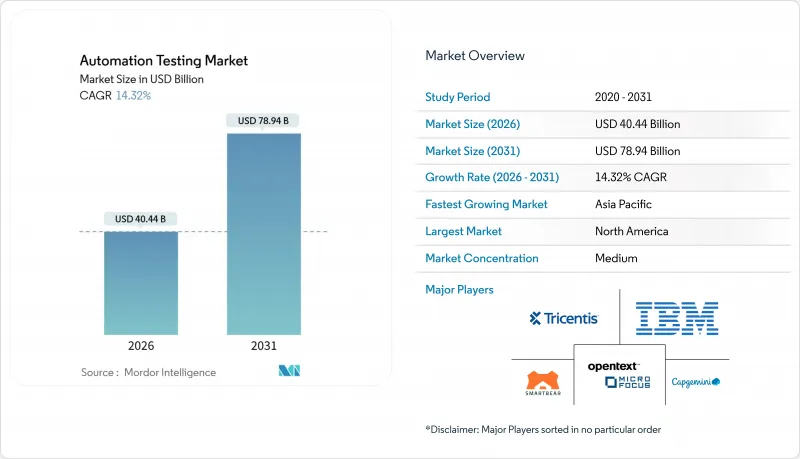
本報告按元件(解決方案和服務)、測試類型(功能測試和非功能測試)、部署模式(本地部署和雲端部署)、最終用戶產業(IT和電信、銀行、金融服務和保險等)、組織規模(大型企業和中小企業)、介面(Web、行動裝置等)以及地區(北美、歐洲等)進行細分。市場預測以美元計價。
全球自動化測試市場趨勢及洞察
擴大敏捷和DevOps在持續測試中的應用
企業正將自動化回歸測試套件直接整合到持續整合管道中,從而將發布週期從季度縮短至每週。微軟報告稱,到 2025 年,Azure DevOps 中的平行測試作業數量將同比成長 43%,這表明其門控管理方式正從人工核准轉向「策略即代碼」。交付速度的提升減少了探索性測試的時間,迫使團隊將過去依賴人工判斷的冒煙測試、整合測試和端到端場景測試自動化。根據 Docker 2024 年的一項調查,68% 的 DevOps 從業者會在每次提交時執行自動化測試,高於前一年的 51%。因此,測試平台正在與 Git 程式碼庫和可觀測性堆疊進行原生整合,從而催生了對整合式 DevOps 工具鏈的需求,這些工具鏈能夠提供缺陷遙測的即時可見性。
人工智慧驅動的測試創建和維護工具
生成式人工智慧透過將自然語言說明的需求轉換為可執行腳本,並在使用者介面元素變更時自動修復選擇器,從而降低了維護成本(傳統上,維護成本佔品質保證預算的 40% 之多)。 IBM 的 watsonx 程式碼助理將 COBOL 業務邏輯轉換為用於主框架載入的測試案例。 Tricentis 透過收購 Waldo 和 Virtuoso,將自然語言創建功能整合到其平台中。這使得測試人員只需用簡單的英語說明場景,即可在幾分鐘內獲得 Selenium 腳本。 Applitools Visual AI 能夠偵測像素級迴歸,並在先導計畫中將誤報率降低了 60%。這些進步使企業能夠在不相應增加人員的情況下擴大測試覆蓋範圍,而品質保證工程師則可以專注於基於風險的優先排序。
早期階段對工具和技能進行了大量投資
企業級框架需要支付許可費、進行基礎設施建設並提升員工技能,這對中小企業 (SME) 而言構成了財務障礙。普華永道 (PwC) 2025 年的一項調查發現,42% 的中小企業表示預算限制是自動化安全測試的主要障礙。人才短缺進一步加劇了這一障礙,領英 (LinkedIn) 2024 年的一份報告指出,北美對自動化工程師的需求將是供應的 2.3 倍。無力承擔具有競爭力的薪資和長期訂閱合約的公司被迫推遲自動化專案的實施,導致長期的人工瓶頸、發布延遲和缺陷漏檢率上升。
細分市場分析
到 2025 年,解決方案將佔據自動化測試市場 61.72% 的佔有率,這反映出企業對可直接整合到其 DevOps 管線中的打包功能、效能和安全測試模組的依賴。同時,服務業預計將經歷最快的成長,到 2031 年的複合年成長率將達到 15.23%。這是因為買家將腳本維護和混合雲端整合外包給專家,從而將品質保證從固定人員轉移到按需專家服務。託管服務提供者透過根據持續交付迭代更新回歸測試包來縮短前置作業時間,使內部團隊能夠專注於風險優先排序。
監管審計中對可追溯性矩陣的需求不斷成長,推動了服務相關自動化測試市場的發展。這種成長的驅動力源自於諮詢服務需要將測試案例對應到 GDPR 和 ISO 13485 等合規條款。供應商正在將諮詢、框架調優和執行管理整合到基於結果的合約中,將曾經的資本支出轉化為可擴展的營運成本,從而能夠隨著發布速度的加快而擴展。
至2025年,功能測試套件將維持58.33%的自動化測試市場佔有率,凸顯其在檢驗使用者工作流程的基礎性作用。效能、安全性和可近性等非功能性類別預計將以16.94%的複合年成長率成長,成為該領域中成長最快的類別。這主要歸功於零信任架構和WCAG 3標準的推動,這些標準促使延遲、漏洞和可用性指標被納入董事會層級的風險評估系統。
各組織正在將 Apache JMeter 負載測試腳本和靜態分析掃描整合到儀表板中,以追蹤功能覆蓋率,並將服務等級目標與缺陷趨勢關聯起來。由於安全漏洞和頁面載入延遲對品牌形象的損害遠大於功能缺陷,採購團隊正在將更多預算分配給非功能性測試工具,從而使自動化測試市場的規模朝著在這兩類支出之間取得平衡的方向發展。
區域分析
北美地區得益於成熟的DevOps應用、聯邦政府的無障礙要求以及創業投資資金加速人工智慧原生平台的部署,預計到2025年將佔全球收入的39.54%。美國公司正在將GitHub Copilot和IBM WatsonX整合到其管線中,以便在每次提交時自動產生單元測試和整合測試。加拿大銀行正在實現回歸測試自動化,以滿足監管機構的彈性要求,而墨西哥製造商則正在將測試功能整合到其與美國當局交換海關資料的供應鏈入口網站中。
預計亞太地區將實現最快成長,到2031年複合年成長率將達到16.13%。印度的數位公共基礎設施(DPI)計畫要求對Aadhaar和UPI API進行全國性的檢驗。在中國,基於《個人資訊保護法》(PIPL)的資料主權法規已經實施,國內混合雲端網路的建置也穩步推進。一個日本工業集團與HeadSpin Device Labs合作,在不同氣候區檢驗汽車韌體;澳洲政府機構強制要求其公共入口網站進行符合WCAG標準的測試,從而促進Deque Systems和Applitools等公司的無障礙工具的應用。
在歐洲,隨著《歐洲無障礙法案》和《一般資料保護規範》(GDPR)的整合,自動化檢驗和資料匿名化變得至關重要,市場需求仍然強勁。德國汽車製造商正在邊緣環境下測試ADAS軟體的延遲性能,英國金融業則聘請託管服務供應商來實現災害復原測試的自動化。一家法國醫療保健集團也在檢驗HL7 FHIR資料交換,這是該國數位健康計畫的一部分。雖然投資主要集中在中東和非洲的智慧城市和舉措平台,但拉丁美洲的成長正得益於中小企業的參與度提高,這主要歸功於無程式碼工具的在地化功能。
其他好處:
- Excel格式的市場預測(ME)表
- 3個月的分析師支持
目錄
第1章:引言
- 研究假設和市場定義
- 調查範圍
第2章:調查方法
第3章執行摘要
第4章 市場狀況
- 市場概覽
- 市場促進因素
- 擴大敏捷和DevOps在持續測試中的應用
- 人工智慧驅動的測試創建和維護工具
- 擴展雲端原生和微服務架構
- 低程式碼或無程式碼自動化正在推動品質保證的普及。
- 強制性數位無障礙標準(WCAG 3)正在推動自動化無障礙測試的普及。
- 邊緣和物聯網韌體中設備端回歸測試的必要性
- 市場限制因素
- 初期階段對工具和技能進行了大量投資
- 整合舊有系統的複雜性
- 雲端測試中的資料隱私挑戰
- 人工智慧框架快速過時的風險
- 產業價值鏈分析
- 監理情勢
- 技術展望
- 波特五力分析
- 宏觀經濟因素對市場的影響
第5章 市場規模與成長預測
- 按組件
- 解決方案
- 功能測試
- API 測試
- 安全測試
- 合規性測試
- 可用性測試
- 負載和效能測試
- 其他解決方案
- 服務
- 專業服務
- 託管服務
- 解決方案
- 按測試類型
- 功能測試
- 無法使用
- 表現
- 安全
- 可用性
- 部署模式
- 現場
- 雲
- 民眾
- 私人的
- 混合
- 按最終用戶行業分類
- IT/通訊
- BFSI
- 醫療保健和生命科學
- 零售與電子商務
- 運輸/物流
- 製造業
- 政府/公共部門
- 能源公用事業
- 其他終端用戶產業
- 按組織規模
- 大公司
- 小型企業
- 透過介面
- Web
- 移動的
- 桌面
- API/微服務
- 物聯網/嵌入式
- 按地區
- 北美洲
- 美國
- 加拿大
- 墨西哥
- 南美洲
- 巴西
- 阿根廷
- 其他南美國家
- 歐洲
- 德國
- 英國
- 法國
- 義大利
- 西班牙
- 俄羅斯
- 其他歐洲國家
- 亞太地區
- 中國
- 日本
- 韓國
- 印度
- 澳洲
- 紐西蘭
- 其他亞太國家
- 中東
- 阿拉伯聯合大公國
- 沙烏地阿拉伯
- 土耳其
- 其他中東國家
- 非洲
- 南非
- 奈及利亞
- 肯亞
- 其他非洲國家
- 北美洲
第6章 競爭情勢
- 市場集中度
- 策略趨勢
- 市佔率分析
- 公司簡介
- IBM Corporation
- OpenText Corporation(Micro Focus)
- Capgemini SE
- Tricentis USA Corp
- SmartBear Software Inc.
- Parasoft Corporation
- Cigniti Technologies Ltd.
- Keysight Technologies Inc.
- Sauce Labs Inc.
- Accenture plc
- Microsoft Corporation
- Katalon Inc.
- BrowserStack Inc.
- LambdaTest Inc.
- Leapwork A/S
- Applitools Ltd.
- Ranorex GmbH
- Worksoft Inc.
- Perfecto(Perforce Software Inc.)
- Functionize Inc.
- Testim.io Ltd.
- Virtuoso QA Ltd.
- Eggplant(Keysight)
- mabl Inc.
- HeadSpin Inc.
第7章 市場機會與未來展望
According to Mordor Intelligence, the automation testing market size reached USD 40.44 billion in 2026 and is projected to attain USD 78.94 billion by 2031, reflecting a 14.32% CAGR across the forecast period.
This report is Segmented by Component (Solutions, and Services), Testing Type (Functional, and Non-Functional), Deployment Mode (On-Premises, and Cloud), End-User Industry (IT and Telecommunications, BFSI, and More), Organization Size (Large Enterprises, and SMEs), Interface (Web, Mobile, and More), and Geography (North America, Europe, and More). The Market Forecasts are Provided in Terms of Value (USD).
Global Automation Testing Market Trends and Insights
Rising Adoption of Agile and DevOps for Continuous Testing
Organizations embed automated regression suites directly into continuous-integration pipelines, compressing release cycles from quarterly to weekly cadences. Microsoft reported a 43% year-over-year rise in parallel test jobs on Azure DevOps in 2025, indicating a shift from manual approvals toward policy-as-code gating. Higher delivery velocity narrows windows for exploratory testing, pushing teams to automate smoke, integration, and end-to-end scenarios once reserved for human judgment. Docker's 2024 survey noted that 68% of DevOps practitioners run automated tests on every commit, up from 51% a year earlier. As a result, test platforms integrate natively with Git repositories and observability stacks, surfacing defect telemetry in real time and creating demand for unified DevOps toolchains.
AI-Driven Test-Creation and Maintenance Tools
Generative AI turns natural-language requirements into executable scripts and self-heals selectors when UI elements change, trimming maintenance costs that historically consumed up to 40% of QA budgets. IBM's watsonx Code Assistant converts COBOL business logic into test cases for mainframe workloads. Tricentis folded natural-language authoring into its platform via the Waldo and Virtuoso acquisitions, enabling testers to describe scenarios in plain English and receive Selenium scripts in minutes. Applitools Visual AI flags pixel-level regressions and reduced false-positive alerts by 60% during pilot projects. These advances allow enterprises to expand coverage without proportional head-count growth, shifting QA engineers toward risk-based prioritization.
High Up-Front Tool and Skills Investment
Enterprise-grade frameworks require license fees, infrastructure provisioning, and staff upskilling, forming a capital barrier for SMEs. PwC's 2025 survey indicated 42% of smaller firms cite budget constraints as the chief obstacle to automated security testing. The talent gap compounds the hurdle, with LinkedIn's 2024 report showing demand for automation engineers outstripping supply by a factor of 2.3 in North America. Firms unable to fund competitive salaries or long-term subscriptions delay automation programs, perpetuating manual bottlenecks that slow releases and raise defect-escape rates.
Other drivers and restraints analyzed in the detailed report include:
- Expansion of Cloud-Native and Micro-Services Architectures
- Low-Code or No-Code Automation Democratizing QA
- Legacy-System Integration Complexity
For complete list of drivers and restraints, kindly check the Table Of Contents.
Segment Analysis
Solutions accounted for a 61.72% automation testing market share in 2025, reflecting enterprises' reliance on packaged functional, performance, and security modules that plug directly into DevOps pipelines. Services, however, are projected to capture the fastest-growth lane with a 15.23% CAGR through 2031 as buyers outsource script maintenance and hybrid-cloud integration to specialists, shifting quality assurance from fixed headcount to on-demand expertise. Managed providers update regression packs in lockstep with continuous-delivery sprints, shrinking lead times and freeing internal teams to focus on risk prioritization.
The automation testing market size tied to services is growing as regulatory audits demand traceability matrices, driving demand for consulting hours that map test cases to compliance clauses under the GDPR and ISO 13485. Vendors bundle advisory, framework tuning, and managed execution into outcome-based contracts, converting what once were capital purchases into operating expenses that scale with release velocity.
Functional suites retained a 58.33% market share in automation testing in 2025, confirming their foundational role in validating user workflows. Non-functional categories, performance, security, and accessibility are set to expand at a 16.94% CAGR, the fastest clip in this segmentation, as zero-trust architectures and WCAG 3 mandates elevate latency, vulnerability, and usability metrics to board-level risk registers.
Organizations integrate Apache JMeter load scripts and static-analysis scans into the same dashboards that track functional coverage, correlating service-level objectives with defect trends. As breaches and slow page loads inflict brand damage that exceeds functional defects, procurement teams allocate larger budgets to non-functional tooling, shifting the automation testing market size toward balanced spending across the two categories.
Complete Report Scope:
- By Component
- Solutions
- Functional Testing
- API Testing
- Security Testing
- Compliance Testing
- Usability Testing
- Load and Performance Testing
- Other Solutions
- Services
- Professional Services
- Managed Services
- Solutions
- By Testing Type
- Functional
- Non-Functional
- Performance
- Security
- Usability
- By Deployment Mode
- On-Premises
- Cloud
- Public
- Private
- Hybrid
- By End-User Industry
- IT and Telecommunications
- BFSI
- Healthcare and Life Sciences
- Retail and E-Commerce
- Transportation and Logistics
- Manufacturing
- Government and Public Sector
- Energy and Utilities
- Other End-User Industries
- By Organization Size
- Large Enterprises
- Small and Medium Enterprises
- By Interface
- Web
- Mobile
- Desktop
- API / Micro-Services
- IoT / Embedded
- By Geography
- North America
- United States
- Canada
- Mexico
- South America
- Brazil
- Argentina
- Rest of South America
- Europe
- Germany
- United Kingdom
- France
- Italy
- Spain
- Russia
- Rest of Europe
- Asia Pacific
- China
- Japan
- South Korea
- India
- Australia
- New Zealand
- Rest of Asia Pacific
- Middle East
- United Arab Emirates
- Saudi Arabia
- Turkey
- Rest of Middle East
- Africa
- South Africa
- Nigeria
- Kenya
- Rest of Africa
- North America
Geography Analysis
North America contributed 39.54% of the 2025 revenue, supported by mature DevOps adoption, federal accessibility mandates, and venture funding that accelerates the rollouts of AI-native platforms. United States enterprises integrate GitHub Copilot and IBM watsonx into pipelines, auto-generating unit and integration tests on every commit. Canadian banks automate regression checks to satisfy regulatory resilience guidelines, while Mexican manufacturers embed testing into supply-chain portals that exchange customs data with U.S. authorities.
Asia Pacific is projected to record the fastest expansion at a 16.13% CAGR through 2031. India's Digital Public Infrastructure programs demand validation of Aadhaar and UPI APIs at a national scale. China enforces PIPL data-sovereignty rules, prompting hybrid-cloud grids located within national borders. Japanese industrial conglomerates partner with HeadSpin device labs to vet automotive firmware across climate zones, and Australian agencies require WCAG-aligned testing for citizen portals, driving adoption of accessibility tools from Deque Systems and Applitools.
Europe maintains robust demand as the European Accessibility Act and GDPR converge, necessitating automated validation and data anonymization. German automakers test ADAS software under edge-latency scenarios, the United Kingdom's financial sector hires managed-service providers to automate disaster-recovery test runs, and French healthcare groups validate HL7 FHIR data exchanges under national digital-health initiatives. Middle East and Africa investment concentrates in smart-city and fintech platforms, while Latin American growth benefits from localization features in no-code tools that broaden SME participation.
- IBM Corporation
- OpenText Corporation (Micro Focus)
- Capgemini SE
- Tricentis USA Corp
- SmartBear Software Inc.
- Parasoft Corporation
- Cigniti Technologies Ltd.
- Keysight Technologies Inc.
- Sauce Labs Inc.
- Accenture plc
- Microsoft Corporation
- Katalon Inc.
- BrowserStack Inc.
- LambdaTest Inc.
- Leapwork A/S
- Applitools Ltd.
- Ranorex GmbH
- Worksoft Inc.
- Perfecto (Perforce Software Inc.)
- Functionize Inc.
- Testim.io Ltd.
- Virtuoso QA Ltd.
- Eggplant (Keysight)
- mabl Inc.
- HeadSpin Inc.
Additional Benefits:
- The market estimate (ME) sheet in Excel format
- 3 months of analyst support
TABLE OF CONTENTS
1 INTRODUCTION
- 1.1 Study Assumptions and Market Definition
- 1.2 Scope of the Study
2 RESEARCH METHODOLOGY
3 EXECUTIVE SUMMARY
4 MARKET LANDSCAPE
- 4.1 Market Overview
- 4.2 Market Drivers
- 4.2.1 Rising Adoption of Agile and DevOps for Continuous Testing
- 4.2.2 AI-Driven Test-Creation and Maintenance Tools
- 4.2.3 Expansion of Cloud-Native and Micro-Services Architectures
- 4.2.4 Low-Code or No-Code Automation Democratising QA
- 4.2.5 Digital-Accessibility Mandates (WCAG 3) Spurring Automated Accessibility Testing
- 4.2.6 On-Device Regression Needs for Edge and IoT Firmware
- 4.3 Market Restraints
- 4.3.1 High Up-Front Tool and Skills Investment
- 4.3.2 Legacy-System Integration Complexity
- 4.3.3 Data-Privacy Hurdles for Cloud-Based Testing
- 4.3.4 Rapid AI-Framework Obsolescence Risk
- 4.4 Industry Value Chain Analysis
- 4.5 Regulatory Landscape
- 4.6 Technological Outlook
- 4.7 Porter's Five Forces Analysis
- 4.7.1 Bargaining Power of Suppliers
- 4.7.2 Bargaining Power of Consumers
- 4.7.3 Threat of New Entrants
- 4.7.4 Threat of Substitutes
- 4.7.5 Intensity of Competitive Rivalry
- 4.8 Impact of Macroeconomic Factors on the Market
5 MARKET SIZE AND GROWTH FORECASTS (VALUES)
- 5.1 By Component
- 5.1.1 Solutions
- 5.1.1.1 Functional Testing
- 5.1.1.2 API Testing
- 5.1.1.3 Security Testing
- 5.1.1.4 Compliance Testing
- 5.1.1.5 Usability Testing
- 5.1.1.6 Load and Performance Testing
- 5.1.1.7 Other Solutions
- 5.1.2 Services
- 5.1.2.1 Professional Services
- 5.1.2.2 Managed Services
- 5.1.1 Solutions
- 5.2 By Testing Type
- 5.2.1 Functional
- 5.2.2 Non-Functional
- 5.2.2.1 Performance
- 5.2.2.2 Security
- 5.2.2.3 Usability
- 5.3 By Deployment Mode
- 5.3.1 On-Premises
- 5.3.2 Cloud
- 5.3.2.1 Public
- 5.3.2.2 Private
- 5.3.2.3 Hybrid
- 5.4 By End-User Industry
- 5.4.1 IT and Telecommunications
- 5.4.2 BFSI
- 5.4.3 Healthcare and Life Sciences
- 5.4.4 Retail and E-Commerce
- 5.4.5 Transportation and Logistics
- 5.4.6 Manufacturing
- 5.4.7 Government and Public Sector
- 5.4.8 Energy and Utilities
- 5.4.9 Other End-User Industries
- 5.5 By Organization Size
- 5.5.1 Large Enterprises
- 5.5.2 Small and Medium Enterprises
- 5.6 By Interface
- 5.6.1 Web
- 5.6.2 Mobile
- 5.6.3 Desktop
- 5.6.4 API / Micro-Services
- 5.6.5 IoT / Embedded
- 5.7 By Geography
- 5.7.1 North America
- 5.7.1.1 United States
- 5.7.1.2 Canada
- 5.7.1.3 Mexico
- 5.7.2 South America
- 5.7.2.1 Brazil
- 5.7.2.2 Argentina
- 5.7.2.3 Rest of South America
- 5.7.3 Europe
- 5.7.3.1 Germany
- 5.7.3.2 United Kingdom
- 5.7.3.3 France
- 5.7.3.4 Italy
- 5.7.3.5 Spain
- 5.7.3.6 Russia
- 5.7.3.7 Rest of Europe
- 5.7.4 Asia Pacific
- 5.7.4.1 China
- 5.7.4.2 Japan
- 5.7.4.3 South Korea
- 5.7.4.4 India
- 5.7.4.5 Australia
- 5.7.4.6 New Zealand
- 5.7.4.7 Rest of Asia Pacific
- 5.7.5 Middle East
- 5.7.5.1 United Arab Emirates
- 5.7.5.2 Saudi Arabia
- 5.7.5.3 Turkey
- 5.7.5.4 Rest of Middle East
- 5.7.6 Africa
- 5.7.6.1 South Africa
- 5.7.6.2 Nigeria
- 5.7.6.3 Kenya
- 5.7.6.4 Rest of Africa
- 5.7.1 North America
6 COMPETITIVE LANDSCAPE
- 6.1 Market Concentration
- 6.2 Strategic Moves
- 6.3 Market Share Analysis
- 6.4 Company Profiles
- 6.4.1 IBM Corporation
- 6.4.2 OpenText Corporation (Micro Focus)
- 6.4.3 Capgemini SE
- 6.4.4 Tricentis USA Corp
- 6.4.5 SmartBear Software Inc.
- 6.4.6 Parasoft Corporation
- 6.4.7 Cigniti Technologies Ltd.
- 6.4.8 Keysight Technologies Inc.
- 6.4.9 Sauce Labs Inc.
- 6.4.10 Accenture plc
- 6.4.11 Microsoft Corporation
- 6.4.12 Katalon Inc.
- 6.4.13 BrowserStack Inc.
- 6.4.14 LambdaTest Inc.
- 6.4.15 Leapwork A/S
- 6.4.16 Applitools Ltd.
- 6.4.17 Ranorex GmbH
- 6.4.18 Worksoft Inc.
- 6.4.19 Perfecto (Perforce Software Inc.)
- 6.4.20 Functionize Inc.
- 6.4.21 Testim.io Ltd.
- 6.4.22 Virtuoso QA Ltd.
- 6.4.23 Eggplant (Keysight)
- 6.4.24 mabl Inc.
- 6.4.25 HeadSpin Inc.
7 MARKET OPPORTUNITIES AND FUTURE OUTLOOK
- 7.1 White-Space and Unmet-Need Assessment

 全球自動化測試市場規模、佔有率、趨勢和成長分析報告(2026-2034)
 2026-2030年全球自動化測試市場
 自動化測試市場機會、成長要素、產業趨勢分析及2026-2035年預測
 人工智慧自動化測試市場預測至2034年—按組件、部署類型、組織規模、技術、應用、最終用戶和地區分類的全球分析
 自動化測試市場分析及預測(至 2035 年):按類型、產品類型、服務、技術、組件、應用、部署類型、最終用戶、功能和解決方案分類全球自動化測試市場:市場規模、佔有率、成長率、產業分析、依類型、應用和地區劃分的分析及預測(2026-2034 年)
 自動化測試市場 - 全球產業規模、佔有率、趨勢、機會及預測(按組件、測試類型、介面、垂直產業、地區和競爭格局分類,2021-2031 年)
 日本自動化測試市場報告:按組件、端點介面、公司規模、最終用戶和地區分類(2026-2034 年)
 自動化測試市場規模、佔有率和成長分析(按組件、介面、組織規模、最終用戶和地區分類)-2026-2033年產業預測