


 |
市場調查報告書
商品編碼
2124325
汽車乙太網路:市場佔有率分析、產業趨勢與統計及成長預測(2026-2031 年)Automotive Ethernet - Market Share Analysis, Industry Trends & Statistics, Growth Forecasts (2026 - 2031) |
||||||

※ 本網頁內容可能與最新版本有所差異。詳細情況請與我們聯繫。
據 Mordor Intelligence 稱,2025 年汽車乙太網路市值為 35 億美元,預計到 2031 年將達到 119.3 億美元,而 2026 年為 42.9 億美元,預測期(2026-2031 年)的複合年成長率為 22.70%。
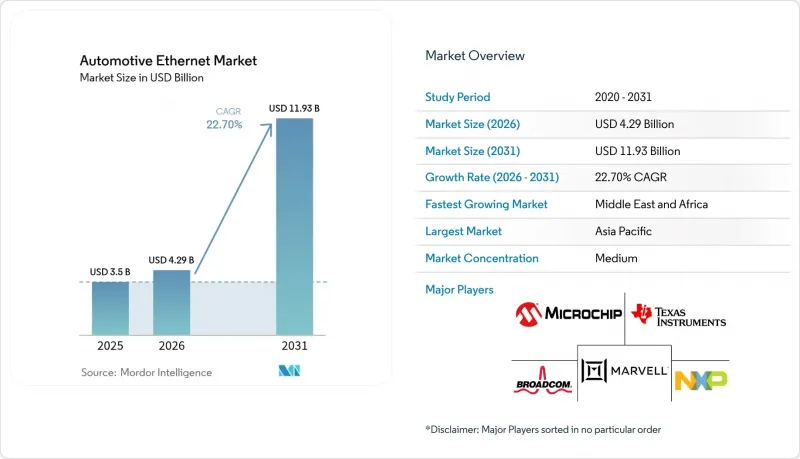
本報告按組件(硬體、軟體、服務)、頻寬/運行速度(例如,10 Mbps [10BASE-T1S]、100 Mbps [100BASE-T1])、應用(例如,ADAS 和自動駕駛感測器、資訊娛樂和遠端資訊處理、動力傳動系統)、車輛類型(例如,乘用車、輕型商用車)以及地區進行市場細分。市場預測以美元 (USD) 為單位。
全球汽車乙太網路市場趨勢與洞察
車載資訊娛樂系統和高級駕駛輔助系統(ADAS)的頻寬需求激增
先進的攝影機、雷達和雷射雷達陣列能夠以高達 40 Gbps 的速率傳輸原始數據,而這些數據需要以極低的延遲到達中央處理器。因此,可擴展至 100 Mbps 至 10 Gbps 的乙太網路骨幹網路正在取代上限為 10 Mbps 的傳統匯流排,從而實現高解析度地圖繪製和沈浸式車載體驗。豪華汽車品牌已在其約 60% 的高階車型中配備了乙太網路資訊娛樂系統,預計這一趨勢將在預測期內蔓延至量產車型領域。此外,即時多感測器融合技術(需要確定性的延遲預算以確保安全演算法正常運作)也在加速向Gigabit級鏈路的過渡。這些因素共同推動了網路吞吐量的提升,並促進了晶片組的持續創新。
低成本單對乙太網路的快速普及
單對乙太網路省去了兩對差分線,可減輕線束重量高達 40%,佈線成本降低近 20%,這些優勢可直接轉化為電動車續航里程的提升。 10BASE-T1S 支援多點拓撲結構,允許多個邊緣感測器共用一對雙絞線,而無需複雜的閘道器。中國領先的 OEM 廠商已發布了配備 SPE 的原型車,用於連接車門、座椅和照明模組。 Analog Devices 等供應商也提供整合 MACsec 的 PHY,以簡化安全合規流程。早期部署已證實,簡化的佈線可加速基於區域的架構部署,並支援對成本敏感的平台的擴展。
與互通性和傳統ECU相容性相關的挑戰
許多量產平台仍然依賴CAN和LIN協議,這些協議不會在一夜之間消失。橋接閘道器需要在滿足時序約束的前提下轉換協議,這增加了材料清單(BOM)成本和軟體複雜性。預計到2025年,汽車中央閘道器模組市場規模將達到21億美元,這清楚地顯示了這種過渡架構的規模。因此,奇瑞等中國汽車製造商正在開發乙太網路閘道器,旨在與儀表板上的CAN總線共存。這表明,儘管遷移策略可以緩解但無法完全消除與整合相關的挑戰。在未來兩年內,隨著車輛逐步邁向完全乙太網路時代,這些閘道器仍將至關重要。
細分市場分析
2025年,硬體業務將佔總營收的62.35%,主要驅動力來自構成汽車網路基礎的PHY收發器、交換器和控制器。 Microchip等廠商的多代產品藍圖正在單晶片上實現100 Mbps至1 Gbps的傳輸能力,顯著提升了成本績效。服務業務雖然絕對收入較小,但成長速度最快,複合年成長率高達26.95%,這主要得益於OEM廠商擴大將合規性測試、TSN調優和深層封包檢測等業務外包。 Keysight的自動化合規性測試套件正在加速IEEE合規性測試,這反映了其對專業測試服務的高價定位。總體而言,儘管晶片出貨量仍然是收入的主要來源,但這一趨勢表明服務業務已成為重要的策略成長驅動力。
同時,隨著基於區域的架構日益成熟,支援安全啟動、網路編配和空中下載 (OTA) 配置的軟體堆疊的重要性也日益凸顯。即時作業系統供應商正在將 ISO 26262 認證相關文件打包,以簡化部署,而承包解決方案在汽車乙太網路市場已被證明比單一組件更有價值。隨著資料量的成長,雲端連結的分析平台將作為相鄰的服務層出現,進一步豐富汽車乙太網路產業的收入來源。
至2025年,100BASE-T1將維持41.10%的市場佔有率,滿足車身控制和資訊娛樂系統在100Mbps以下速度的需求。其成熟的成本曲線和OPEN聯盟的互通性使其更具吸引力,並在吞吐量和價格之間保持了平衡。 2.5/5/10Gbps等級的乙太網路展現最高的成長率,到2031年複合年成長率將達到36.60%,預計到預測期末,高速汽車乙太網路市場規模將達到數十億美元。隨著10GBASE-T1 PHY整合到交換器晶片中,供應鏈的準備工作正在不斷完善,從而實現單封裝區域骨幹網路。
10BASE-T1S 透過提供 10 Mbps 多點連接能力,實現邊緣感測器連接,並在確定性延遲要求不高的場景下降低閘道器成本。同時,1000BASE-T1 扮演過渡角色,連結當前需求與未來的區域分類。總體而言,向Gigabit和多Gigabit層的過渡正在推動汽車乙太網路市場的擴張,因為它能夠實現諸如即時物件分類和高清車載串流等新的軟體定義功能。
區域分析
預計到2025年,亞太地區將佔全球需求的47.60%,主要得益於中國向聯網汽車和自動駕駛汽車的快速轉型。隨著GB/T 45503-2025等國家標準對ECU一致性測試方法的製定,預計2025年,中國汽車乙太網路市場規模將超過120億元人民幣(約17億美元)。本土半導體巨頭正在縮短設計週期,使國內OEM廠商能夠快速迭代開發針對特定區域的原型產品。日本和韓國正透過垂直整合的電子和汽車供應鏈擴大其區域主導地位,並計劃在2025年前推出SPE生產線。
北美正利用其軟體生態系統和創業投資管道,試行先進的軟體定義汽車。監管機構正將網路安全作為重點,因為美國商務部正在考慮限制在聯網汽車中使用有爭議的半導體組件。底特律和矽谷的原始設備製造商 (OEM) 正在加速採用空中下載 (OTA) 框架,從而推動對Gigabit骨幹網的需求。與中國的貿易緊張局勢給物理層晶片的物流帶來了供應鏈風險,促使企業採取近岸外包策略和雙重採購契約,以確保專案按計劃進行。
儘管中東和非洲市場規模較小,但其成長速度卻是所有地區中最快的,預計到2031年複合年成長率將達到24.75%。沙烏地阿拉伯和阿拉伯聯合大公國政府鼓勵本地組裝和推廣電動車,這促使全球汽車製造商進口配備乙太網路功能的高階車型。智慧城市的建設與高速車聯網相輔相成,加速了訊號優先控制和車聯網(V2X)等安全功能的開發。歐洲高階品牌正利用自由貿易區推廣其最新車型,進一步推動乙太網路在全部區域的應用。
其他好處:
- Excel格式的市場預測(ME)表
- 3個月的分析師支持
目錄
第1章:引言
- 研究假設和市場定義
- 調查範圍
第2章:調查方法
第3章執行摘要
第4章 市場狀況
- 市場概覽
- 市場促進因素
- 車載資訊娛樂系統和高級駕駛輔助系統(ADAS)的頻寬需求激增
- 低成本單對乙太網路(SPE)的快速普及
- 電動車和自動駕駛平台向基於區域的電子電氣架構過渡
- OPEN聯盟和IEEE TSN規範的OEM標準化
- OEM廠商正在推動端到端OTA軟體管道的部署,這需要千兆乙太網路骨幹。
- 歐盟和中國的減重獎勵使乙太網路優於 CAN-FD。
- 市場限制因素
- 與傳統ECU的互通性和相容性相關的挑戰
- 車輛等級網路安全和功能安全認證面臨的挑戰
- 超過 5 Gbps 的多千兆位元 EMC/EMI 合規成本
- 由於美國和中國關稅的變化,PHY晶片供應鏈受到干擾。
- 價值供應鏈分析
- 監理情勢
- 技術趨勢(TSN、多千兆、PoDL、區域化)
- 波特五力分析
- 宏觀經濟趨勢對市場的影響
第5章 市場規模與成長預測
- 按組件
- 硬體
- 軟體
- 服務
- 頻寬/運行速度
- 10 Mbps(10BASE-T1S)
- 100 Mbps(100BASE-T1)
- 1 Gbps(1000BASE-T1)
- 2.5/5/10 Gbps 多千兆 (2.5G/5G/10GBASE-T1)
- 透過使用
- ADAS和自動駕駛感應器
- 資訊娛樂和車載資訊系統
- 動力傳動系統
- 底盤和安全裝置
- 身體和舒適度
- 診斷和OTA更新
- 車輛類型
- 搭乘用車
- 輕型商用車
- 大型商用車輛/卡車和巴士
- 非公路和農業用途
- 按地區
- 北美洲
- 美國
- 加拿大
- 墨西哥
- 南美洲
- 巴西
- 阿根廷
- 其他南美國家
- 歐洲
- 德國
- 法國
- 英國
- 義大利
- 西班牙
- 俄羅斯
- 其他歐洲國家
- 亞太地區
- 中國
- 日本
- 印度
- 韓國
- 澳洲
- 其他亞太國家
- 中東和非洲
- 中東
- 沙烏地阿拉伯
- UAE
- 土耳其
- 其他中東國家
- 非洲
- 南非
- 埃及
- 奈及利亞
- 其他非洲國家
- 中東
- 北美洲
第6章 競爭情勢
- 市場集中度
- 策略趨勢
- 市佔率分析
- 公司簡介
- Broadcom Inc.
- NXP Semiconductors NV
- Marvell Technology Group Ltd.
- Microchip Technology Inc.
- Texas Instruments Inc.
- Molex Incorporated
- TE Connectivity Ltd.
- Cadence Design Systems Inc.
- Keysight Technologies Inc.
- TTTech Auto AG
- AMD Xilinx
- Analog Devices Inc.
- Renesas Electronics Corp.
- Realtek Semiconductor Corp.
- Rohde and Schwarz GmbH
- Vector Informatik GmbH
- Aptiv PLC
- Infineon Technologies AG
- Continental AG
- HMS Networks AB
- Aeonsemi Corp.
- Aukua Systems Inc.
- Spirent Communications PLC
第7章 市場機會與未來展望
According to Mordor Intelligence, the automotive ethernet market size was valued at USD 3.5 billion in 2025 and estimated to grow from USD 4.29 billion in 2026 to reach USD 11.93 billion by 2031, at a CAGR of 22.70% during the forecast period (2026-2031).
This report is Segmented by Component (Hardware, Software, and Services), Bandwidth/Operating Speed (10 Mbps [10BASE-T1S], 100 Mbps [100BASE-T1], and More), Application (ADAS and Autonomous Sensors, Infotainment and Telematics, Powertrain, and More), Vehicle Type (Passenger Cars, Light Commercial Vehicles, and More), and Geography. The Market Forecasts are Provided in Terms of Value (USD).
Global Automotive Ethernet Market Trends and Insights
Surging Infotainment & ADAS Bandwidth Demand
Advanced camera, radar, and LiDAR arrays can stream up to 40 Gbps of raw data that must reach centralized processors with minimal latency. Ethernet backbones scaling from 100 Mbps to 10 Gbps are therefore replacing legacy buses capped at 10 Mbps, enabling high-resolution mapping and immersive cabin experiences. Luxury brands already equip roughly 60% of premium models with Ethernet infotainment links, a pattern expected to cascade to volume segments over the forecast window. Real-time multi-sensor fusion is also accelerating the shift to gigabit-class links because safety algorithms require deterministic latency budgets. Together, these forces keep network throughput on an upward trajectory and underpin continuous chipset innovation.
Rapid Adoption of Low-Cost Single-Pair Ethernet
Single-pair Ethernet eliminates two differential pairs, cutting harness weight by up to 40% and wiring cost by nearly 20%, benefits that directly extend the range of electric vehicles. 10BASE-T1S supports multidrop topologies, allowing multiple edge sensors to share a single twisted pair without complex gateways. Leading OEM programs in China are already releasing pre-production vehicles with SPE to connect door, seat, and lighting modules, while suppliers such as Analog Devices offer PHYs with integrated MACsec to simplify security compliance. Early deployments confirm that simplified cabling accelerates zonal architecture rollouts and scales cost-sensitive platforms.
Interoperability & Legacy ECU Compatibility Issues
Many mass-production platforms still rely on CAN or LIN domains that do not disappear overnight. Bridging gateways must translate protocols while safeguarding timing constraints, adding bill-of-materials cost and software complexity. The Automotive Central Gateway Module market, valued at USD 2.1 billion in 2025, highlights the scale of this interim architecture. Chinese OEMs such as Chery have thus designed Ethernet gateways tailored to coexist with instrument-cluster CAN buses, proving that transition strategies can mitigate but not fully erase integration pain. Over the next two years, these gateways will remain essential as fleets slowly migrate toward full Ethernet zones.
Other drivers and restraints analyzed in the detailed report include:
- EV & Autonomous Platforms Shift to Zonal E/E Architectures
- OEM Standardization via OPEN Alliance & IEEE TSN Profiles
- Vehicle-Level Cybersecurity & Functional-Safety Certification Hurdles
For complete list of drivers and restraints, kindly check the Table Of Contents.
Segment Analysis
The hardware segment held 62.35% of 2025 revenue, led by PHY transceivers, switches, and controllers that anchor every in-vehicle network. Multi-generation roadmaps from vendors such as Microchip add 100 Mbps to 1 Gbps capabilities on a single die, underscoring performance-per-dollar improvements. The services sub-segment, though smaller in absolute revenue, is the fastest riser at a 26.95% CAGR because OEMs increasingly outsource compliance, TSN tuning, and deep packet inspection. Keysight's automated compliance suits accelerate IEEE conformance, reflecting how test expertise commands premium fees. Collectively, this dynamic positions services as a strategic growth lever even as silicon volumes remain the revenue anchor.
In parallel, software stacks that support secure boot, network orchestration, and over-the-air configuration gain relevance as zonal architectures mature. Real-time operating systems suppliers bundle ISO 26262 certification artifacts to simplify adoption, proving that the Automotive Ethernet market rewards turnkey solutions over discrete components. As data volumes rise, cloud-linked analytics platforms will likely emerge as an adjacent services layer, further diversifying revenue pools in the Automotive Ethernet industry.
100BASE-T1 retains a 41.10% share in 2025, serving body control and infotainment needs that top out below 100 Mbps. Its mature cost curve and OPEN Alliance interoperability profile sustain its appeal, balancing throughput against price. The 2.5/5/10 Gbps class exhibits the strongest upside with a 36.60% CAGR through 2031, moving the Automotive Ethernet market size for high-speed links into the multi-billion-dollar range by the end of the forecast window. Supply-chain readiness is improving as switch silicon integrates 10GBASE-T1 PHYs, allowing single-package zonal backbones.
10BASE-T1S addresses edge sensor connectivity by providing 10 Mbps multidrop capability, removing gateway cost where deterministic latency is less critical. Meanwhile, 1000BASE-T1 plays an intermediate role, bridging today's needs and tomorrow's zonal ambitions. Overall, the shift toward gigabit and multi-gigabit tiers unlocks new software-defined features, including real-time object classification and high-definition cabin streaming, reinforcing the Automotive Ethernet market expansion.
Complete Report Scope:
- By Component
- Hardware
- Software
- Services
- By Bandwidth/Operating Speed
- 10 Mbps (10BASE-T1S)
- 100 Mbps (100BASE-T1)
- 1 Gbps (1000BASE-T1)
- 2.5/5/10 Gbps Multi-Gig (2.5G/5G/10GBASE-T1)
- By Application
- ADAS and Autonomous Sensors
- Infotainment and Telematics
- Powertrain
- Chassis and Safety
- Body and Comfort
- Diagnostics and OTA Updates
- By Vehicle Type
- Passenger Cars
- Light Commercial Vehicles
- Heavy Commercial/Truck and Bus
- Off-Highway and Agriculture
- By Geography
- North America
- United States
- Canada
- Mexico
- South America
- Brazil
- Argentina
- Rest of South America
- Europe
- Germany
- France
- United Kingdom
- Italy
- Spain
- Russia
- Rest of Europe
- Asia-Pacific
- China
- Japan
- India
- South Korea
- Australia
- Rest of Asia-Pacific
- Middle East and Africa
- Middle East
- Saudi Arabia
- UAE
- Turkey
- Rest of Middle East
- Africa
- South Africa
- Egypt
- Nigeria
- Rest of Africa
- Middle East
- North America
Geography Analysis
Asia-Pacific commands 47.60% of global 2025 demand, anchored by China's rapid transition to connected and automated vehicles. The Chinese Automotive Ethernet market size is projected to surpass RMB 12 billion (USD 1.7 billion) in 2025 as national standards such as GB/T 45503-2025 define ECU compliance test methods. Local silicon champions shorten design cycles, benefiting domestic OEMs that iterate quickly on zonal prototypes. Japan and South Korea extend regional dominance through vertically integrated electronics and automotive supply chains, deploying SPE production lines by 2025.
North America leverages its software ecosystem and venture-capital pipeline to pilot advanced software-defined vehicles. Regulatory bodies emphasize cybersecurity, as the U.S. Department of Commerce weighs restrictions on suspect semiconductor inputs in connected vehicles. OEMs in Detroit and Silicon Valley accelerate OTA frameworks, fostering demand for gigabit backbones. Trade frictions with China inject supply-chain risk around PHY chip logistics, prompting near-shoring strategies and dual-sourcing agreements to sustain program schedules.
The Middle East & Africa holds a smaller base but exhibits the fastest regional growth at 24.75% CAGR through 2031. Governments in Saudi Arabia and the UAE incentivize local assembly and electric-vehicle uptake, encouraging global OEMs to import Ethernet-enabled premium models. Smart-city deployments complement high-speed vehicle networks, allowing traffic-signal priority and V2X safety features to flourish. Premium European brands leverage free-trade zones to position their latest models, further accelerating Ethernet penetration across the region.
- Broadcom Inc.
- NXP Semiconductors N.V.
- Marvell Technology Group Ltd.
- Microchip Technology Inc.
- Texas Instruments Inc.
- Molex Incorporated
- TE Connectivity Ltd.
- Cadence Design Systems Inc.
- Keysight Technologies Inc.
- TTTech Auto AG
- AMD Xilinx
- Analog Devices Inc.
- Renesas Electronics Corp.
- Realtek Semiconductor Corp.
- Rohde and Schwarz GmbH
- Vector Informatik GmbH
- Aptiv PLC
- Infineon Technologies AG
- Continental AG
- HMS Networks AB
- Aeonsemi Corp.
- Aukua Systems Inc.
- Spirent Communications PLC
Additional Benefits:
- The market estimate (ME) sheet in Excel format
- 3 months of analyst support
TABLE OF CONTENTS
1 Introduction
- 1.1 Study Assumptions and Market Definition
- 1.2 Scope of the Study
2 Research Methodology
3 Executive Summary
4 Market Landscape
- 4.1 Market Overview
- 4.2 Market Drivers
- 4.2.1 Surging infotainment and ADAS bandwidth demand
- 4.2.2 Rapid adoption of low-cost single-pair Ethernet (SPE)
- 4.2.3 EV and autonomous platforms shifting to zonal E/E architectures
- 4.2.4 OEM standardisation via OPEN Alliance and IEEE TSN profiles
- 4.2.5 OEM push for end-to-end OTA software pipelines needing GbE backbones
- 4.2.6 Weight-reduction incentives in EU/China favouring Ethernet over CAN-FD
- 4.3 Market Restraints
- 4.3.1 Interoperability and legacy ECU compatibility issues
- 4.3.2 Vehicle-level cyber-security and functional-safety certification hurdles
- 4.3.3 Multi-gig EMC/EMI compliance costs above 5 Gbps
- 4.3.4 US-China tariff volatility on PHY chip supply chains
- 4.4 Value/Supply-Chain Analysis
- 4.5 Regulatory Landscape
- 4.6 Technological Outlook (TSN, Multi-Gig, PoDL, Zonal)
- 4.7 Porter's Five Forces Analysis
- 4.7.1 Bargaining Power of Suppliers
- 4.7.2 Bargaining Power of Consumers
- 4.7.3 Threat of New Entrants
- 4.7.4 Threat of Substitutes
- 4.7.5 Intensity of Competitive Rivalry
- 4.8 Impact of Macroeconomic Trends on the Market
5 Market Size and Growth Forecasts (VALUE)
- 5.1 By Component
- 5.1.1 Hardware
- 5.1.2 Software
- 5.1.3 Services
- 5.2 By Bandwidth/Operating Speed
- 5.2.1 10 Mbps (10BASE-T1S)
- 5.2.2 100 Mbps (100BASE-T1)
- 5.2.3 1 Gbps (1000BASE-T1)
- 5.2.4 2.5/5/10 Gbps Multi-Gig (2.5G/5G/10GBASE-T1)
- 5.3 By Application
- 5.3.1 ADAS and Autonomous Sensors
- 5.3.2 Infotainment and Telematics
- 5.3.3 Powertrain
- 5.3.4 Chassis and Safety
- 5.3.5 Body and Comfort
- 5.3.6 Diagnostics and OTA Updates
- 5.4 By Vehicle Type
- 5.4.1 Passenger Cars
- 5.4.2 Light Commercial Vehicles
- 5.4.3 Heavy Commercial/Truck and Bus
- 5.4.4 Off-Highway and Agriculture
- 5.5 By Geography
- 5.5.1 North America
- 5.5.1.1 United States
- 5.5.1.2 Canada
- 5.5.1.3 Mexico
- 5.5.2 South America
- 5.5.2.1 Brazil
- 5.5.2.2 Argentina
- 5.5.2.3 Rest of South America
- 5.5.3 Europe
- 5.5.3.1 Germany
- 5.5.3.2 France
- 5.5.3.3 United Kingdom
- 5.5.3.4 Italy
- 5.5.3.5 Spain
- 5.5.3.6 Russia
- 5.5.3.7 Rest of Europe
- 5.5.4 Asia-Pacific
- 5.5.4.1 China
- 5.5.4.2 Japan
- 5.5.4.3 India
- 5.5.4.4 South Korea
- 5.5.4.5 Australia
- 5.5.4.6 Rest of Asia-Pacific
- 5.5.5 Middle East and Africa
- 5.5.5.1 Middle East
- 5.5.5.1.1 Saudi Arabia
- 5.5.5.1.2 UAE
- 5.5.5.1.3 Turkey
- 5.5.5.1.4 Rest of Middle East
- 5.5.5.2 Africa
- 5.5.5.2.1 South Africa
- 5.5.5.2.2 Egypt
- 5.5.5.2.3 Nigeria
- 5.5.5.2.4 Rest of Africa
- 5.5.5.1 Middle East
- 5.5.1 North America
6 Competitive Landscape
- 6.1 Market Concentration
- 6.2 Strategic Moves
- 6.3 Market Share Analysis
- 6.4 Company Profiles (includes Global level Overview, Market level overview, Core Segments, Financials as available, Strategic Information, Market Rank/Share, Products and Services, Recent Developments)
- 6.4.1 Broadcom Inc.
- 6.4.2 NXP Semiconductors N.V.
- 6.4.3 Marvell Technology Group Ltd.
- 6.4.4 Microchip Technology Inc.
- 6.4.5 Texas Instruments Inc.
- 6.4.6 Molex Incorporated
- 6.4.7 TE Connectivity Ltd.
- 6.4.8 Cadence Design Systems Inc.
- 6.4.9 Keysight Technologies Inc.
- 6.4.10 TTTech Auto AG
- 6.4.11 AMD Xilinx
- 6.4.12 Analog Devices Inc.
- 6.4.13 Renesas Electronics Corp.
- 6.4.14 Realtek Semiconductor Corp.
- 6.4.15 Rohde and Schwarz GmbH
- 6.4.16 Vector Informatik GmbH
- 6.4.17 Aptiv PLC
- 6.4.18 Infineon Technologies AG
- 6.4.19 Continental AG
- 6.4.20 HMS Networks AB
- 6.4.21 Aeonsemi Corp.
- 6.4.22 Aukua Systems Inc.
- 6.4.23 Spirent Communications PLC
7 Market Opportunities and Future Outlook
- 7.1 White-space and Unmet-Need Assessment

 2026-2030年全球汽車乙太網路市場
 汽車乙太網路市場:按組件、技術、應用、車輛類型和最終用戶分類-2026-2032年全球市場預測
 車用乙太網路市場分析及預測(至2035年):類型、產品、服務、技術、組件、應用、部署模式、最終用戶、功能、安裝類型
 汽車乙太網路收發器及控制器IC市場機會、成長要素、產業趨勢分析及2026-2035年預測
 汽車乙太網路市場預測至2034年—按組件、頻寬、車輛類型、應用、最終用戶和地區分類的全球分析汽車乙太網路PHY晶片市場機會、成長要素、產業趨勢分析及2026-2035年預測
 2026年全球汽車乙太網路市場報告
 汽車乙太網路市場規模、佔有率和成長分析(按類型、組件、頻寬、車輛類型、應用和地區分類)-2026-2033年產業預測
 汽車乙太網路市場-全球產業規模、佔有率、趨勢、機會和預測(按類型、組件、應用、地區和競爭格局分類,2020-2030 年預測)
 汽車乙太網路市場規模、佔有率、成長及全球產業分析:依類型、應用和地區劃分的洞察與預測(2024-2032 年)