


 |
市場調查報告書
商品編碼
2038772
汽車乙太網路PHY晶片市場機會、成長要素、產業趨勢分析及2026-2035年預測Automotive Ethernet PHY Chip Market Opportunity, Growth Drivers, Industry Trend Analysis, and Forecast 2026 - 2035 |
||||||

2025 年全球汽車乙太網路 PHY 晶片市場價值為 11 億美元,預計到 2035 年將達到 46 億美元,複合年成長率為 14.8%。
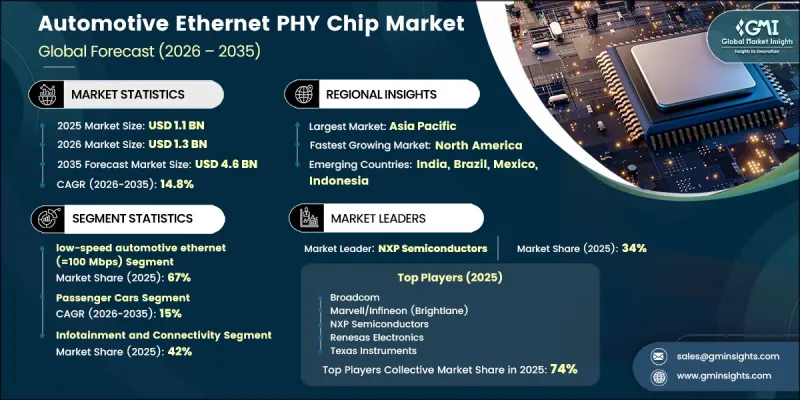
市場成長的驅動力在於汽車電子架構的快速發展,這需要更快、更可靠、頻寬更寬的通訊系統。汽車乙太網路PHY晶片在利用單一非屏蔽雙絞線實現複雜汽車網路中的穩定資料傳輸方面發揮著至關重要的作用。隨著先進數位系統在車輛中的整合不斷深入,對能夠支援即時數據交換的強大通訊介面的需求日益成長。互聯出行的擴展、電氣化趨勢以及軟體定義汽車平臺的普及,進一步強化了對可擴展網路解決方案的需求。同時,高級駕駛輔助系統(ADAS)和自動駕駛技術的日益普及,迫使汽車製造商部署高速通訊基礎設施,這進一步提升了乙太網路PHY晶片在下一代車輛設計中的重要性。
| 市場範圍 | |
|---|---|
| 開始年份 | 2025 |
| 預測期 | 2026-2035 |
| 上市時的市場規模 | 11億美元 |
| 預測金額 | 46億美元 |
| 複合年成長率 | 14.8% |
現代汽車對安全、可靠且節能的通訊系統的需求日益成長,也推動了汽車乙太網路PHY晶片市場的發展。這些晶片旨在承受嚴苛的汽車環境,包括極端溫度變化、電磁干擾和持續機械振動,確保長期穩定運作。此外,符合嚴格的汽車品質和功能安全標準也進一步推動了其在全球各類汽車平臺上的應用。
預計到2025年,低速車載乙太網路(低於100 Mbps)市佔率將達到67%。該細分市場之所以能夠保持主導地位,主要得益於其與現有車輛通訊架構的廣泛整合。它支援透過單根非屏蔽雙絞線進行高效的全雙工數據傳輸,適用於資訊娛樂系統、閘道器功能和基本的車載連接應用。
預計2026年至2035年,乘用車市場將以15%的複合年成長率成長。該市場涵蓋多種車型,並且由於電子設備負載和連接需求的不斷成長,仍然是汽車乙太網路PHY晶片的主要應用領域。在乘用車領域,多種PHY晶片正被整合到各種系統中,包括資訊娛樂系統、基於攝影機的安全系統、閘道器和車身電子設備,這主要得益於消費者對先進安全和數位化功能的日益成長的期望。
預計到2025年,中國汽車乙太網路PHY晶片市場規模將達到3.305億美元,主要得益於政府大力推動智慧汽車網聯網汽車發展的政策舉措。數位駕駛座系統、自動駕駛技術和車載資訊服務解決方案的日益普及,正促使本土汽車製造商將高速網路架構整合到新的汽車平臺中。
目錄
第1章:調查方法
第2章執行摘要
第3章業界考察
- 生態系分析
- 供應商情況
- 利潤率分析
- 成本結構
- 每個階段增加的價值
- 影響價值鏈的因素
- 中斷
- 影響產業的因素
- 促進因素
- 電動車和高級駕駛輔助系統(ADAS)的廣泛應用
- 向軟體定義車輛(SDV)過渡
- 新興市場汽車產量增加
- 對低延遲和安全資料傳輸的需求
- 產業潛在風險與挑戰
- 汽車級晶片的開發成本很高
- 互聯系統中的網路安全漏洞
- 市場機遇
- 自動駕駛和V2X生態系統的發展
- 電動汽車電池管理和遠端資訊處理技術的擴展
- 促進因素
- 成長潛力分析
- 監理情勢
- 北美洲
- 美國國家公路交通安全管理局 (NHTSA) 安全法規
- ISO 26262 功能安全標準
- 汽車網路安全要求
- 個人資訊保護與電子文件法(PIPEDA)
- 歐洲
- 歐盟通用安全法規
- 一般資料保護規則(GDPR)
- 聯合國歐洲經濟委員會 R155、R156
- ISO 26262,IEC 61508
- 亞太地區
- 中國(PIPL、CSL、DSL、汽車資料法)
- 印度(AIS、Bharat NCAP)
- 日本的旅遊法規
- 韓國網路安全法
- 拉丁美洲
- 巴西(LGPD,安全標準)
- 墨西哥的汽車法規
- 阿根廷框架
- 區域認證
- 中東和非洲
- 阿拉伯聯合大公國出行法規
- 沙烏地阿拉伯的安全與網路安全
- 南非安全和資料法
- 北美洲
- 波特五力分析
- PESTEL 分析
- 科技與創新趨勢
- 當前技術趨勢
- 新興技術
- 價格分析(基於初步調查)
- 對過去價格趨勢的分析
- 按玩家類型分類的定價策略
- 人工智慧和生成式人工智慧對市場的影響
- 利用人工智慧改造現有經營模式
- 細分市場生成式人工智慧用例和實施藍圖
- 風險、局限性和監管考量
- 永續性和環境方面
- 碳足跡評估
- 融入循環經濟
- 電子廢棄物管理要求
- 綠色製造舉措
- 預測假設和情境分析(基於初步研究)
- 基本案例-驅動複合年成長率的關鍵宏觀經濟與產業變量
- 樂觀情境-宏觀經濟與產業的順風
- 悲觀情景-宏觀經濟放緩或產業逆風
第4章 競爭情勢
- 介紹
- 企業市佔率分析
- 北美洲
- 歐洲
- 亞太地區
- 拉丁美洲
- 中東和非洲(MEA)
- 主要市場公司的競爭分析
- 競爭定位矩陣
- 戰略展望矩陣
- 主要進展
- 併購
- 夥伴關係和聯盟
- 新產品發布
- 業務拓展計劃及資金籌措
- 企業級分層基準測試
- 排名分類標準與遴選標準
- 按收入、地區和創新能力分類的層級定位矩陣。
第5章 市場估價與預測:依產品分類,2022-2035年
- 低速汽車乙太網路(=100 Mbps)
- 10BASE-T1S
- 100BASE-T1
- Gigabit汽車乙太網路(1000BASE-T1)
- 多Gigabit汽車乙太網路(超過 1 Gbps)
- 2.5/5/10GBASE-T1
- 未來標準(25G+)
第6章 市場估價與預測:依車輛類型分類,2022-2035年
- 搭乘用車
- 掀背車
- 轎車
- SUV
- 商用車輛
- 輕型商用車(LCV)
- 中型商用車(MCV)
- 重型商用車(HCV)
第7章 市場估計與預測:依應用領域分類,2022-2035年
- ADAS和自動駕駛
- 雷達系統
- LiDAR感測器
- 相機
- 感測器融合
- 網域控制器
- 資訊娛樂和互聯
- 顯示系統
- 音響系統
- 車載資訊系統
- 無線更新
- 連線閘道器
- 動力傳動系統和車輛動力學
- 引擎控制
- 變速箱控制
- 電池管理
- 底盤控制
- 溫度控管
- 車輛電子設備和舒適性
- 門模組
- 照明系統
- 空調控制
- 座椅控制
- 存取控制
- 閘道器和骨幹網
- 中央門戶
- 區域控制器
- 乙太網路切換器
- 診斷系統
- 安全閘道器
第8章 市場估計與預測:依地區分類,2022-2035年
- 北美洲
- 美國
- 加拿大
- 歐洲
- 德國
- 英國
- 法國
- 義大利
- 西班牙
- 北歐國家
- 俄羅斯
- 亞太地區
- 中國
- 印度
- 日本
- 澳洲
- 韓國
- 東南亞
- 拉丁美洲
- 巴西
- 墨西哥
- 阿根廷
- 中東和非洲(MEA)
- 南非
- 沙烏地阿拉伯
- 阿拉伯聯合大公國
第9章:公司簡介
- 世界公司
- Analog Devices
- Broadcom
- Marvell/Infineon
- Intel
- Marvell Technology
- NXP Semiconductors
- Qualcomm Technologies
- Texas Instruments
- 當地公司
- Cadence Design Systems(PHY IP)
- MaxLinear
- MediaTek
- onsemi
- Realtek Semiconductor
- Renesas Electronics
- Rohm Semiconductor
- STMicroelectronics
- 新興企業/顛覆者
- Alphawave IP
- Aquantia
- Canova Tech
- Ethernovia
- Kandou Bus
- Valens Semiconductor
The Global Automotive Ethernet PHY Chip Market was valued at USD 1.1 billion in 2025 and is estimated to grow at a CAGR of 14.8% to reach USD 4.6 billion by 2035.
Market growth is driven by the rapid evolution of in-vehicle electronic architectures that require faster, more reliable, and higher-bandwidth communication systems. Automotive Ethernet PHY chips play a critical role in enabling stable data transmission across complex vehicle networks using single unshielded twisted pair cables. Increasing integration of advanced digital systems in vehicles is accelerating demand for robust communication interfaces that can support real-time data exchange. The expansion of connected mobility, electrification trends, and software-defined vehicle platforms is further strengthening the need for scalable networking solutions. At the same time, rising adoption of advanced driver assistance systems and autonomous driving technologies is pushing automotive manufacturers to deploy high-speed communication infrastructure, reinforcing the importance of Ethernet PHY chips in next-generation vehicle design.
| Market Scope | |
|---|---|
| Start Year | 2025 |
| Forecast Year | 2026-2035 |
| Start Value | $1.1 Billion |
| Forecast Value | $4.6 Billion |
| CAGR | 14.8% |
The automotive Ethernet PHY chip market is also shaped by growing requirements for safety, reliability, and energy-efficient communication systems in modern vehicles. These chips are designed to withstand harsh automotive environments, including extreme temperature variations, electromagnetic interference, and continuous mechanical vibration, ensuring long-term operational stability. Compliance with stringent automotive quality and functional safety standards further enhances their adoption across global vehicle platforms.
The low-speed automotive Ethernet segment (<=100 Mbps) segment held 67% share in 2025. This segment continues to lead due to its widespread integration in existing vehicle communication architectures. It supports efficient full-duplex data transmission over single unshielded twisted pair cables, making it suitable for infotainment systems, gateway functions, and basic in-vehicle connectivity applications.
The passenger cars segment is expected to grow at a CAGR of 15% from 2026 to 2035. This category includes multiple vehicle types and remains the primary adopter of automotive Ethernet PHY chips due to increasing electronic content and connectivity demand. Passenger vehicles integrate multiple PHY chips across infotainment systems, camera-based safety systems, gateways, and body electronics, driven by rising consumer expectations for advanced safety and digital features.
China Automotive Ethernet PHY Chip Market reached USD 330.5 million in 2025 supported by strong policy initiatives promoting intelligent and connected vehicles. Expanding adoption of digital cockpit systems, autonomous driving technologies, and telematics solutions is encouraging local manufacturers to incorporate high-speed networking architectures into new vehicle platforms.
Key players operating in the Global Automotive Ethernet PHY Chip Industry include Texas Instruments, Broadcom, Analog Devices, Qualcomm Technologies, NXP Semiconductors, Microchip Technology, Intel, MaxLinear, Marvell / Infineon, and Cadence Design Systems (PHY IP). Companies in the Automotive Ethernet PHY Chip Market focus on advanced product innovation, energy-efficient design, and compliance with stringent automotive safety standards to strengthen their market position. Manufacturers are investing heavily in next-generation high-speed PHY solutions that support increasing data traffic in connected and autonomous vehicles. Strategic partnerships with automotive OEMs and Tier-1 suppliers are helping accelerate integration of Ethernet technologies into new vehicle platforms. Companies are also expanding R&D capabilities to enhance signal integrity, reduce power consumption, and improve system reliability under harsh operating conditions. In addition, firms are scaling production capacity and strengthening supply chain resilience to meet rising global demand.
Table of Contents
Chapter 1 Methodology
- 1.1 Research approach
- 1.2 Quality Commitments
- 1.2.1 GMI AI policy & data integrity commitment
- 1.2.1.1 Source consistency protocol
- 1.2.1 GMI AI policy & data integrity commitment
- 1.3 Research Trail & Confidence Scoring
- 1.3.1 Research Trail Components
- 1.3.2 Scoring Components
- 1.4 Data Collection
- 1.4.1 Partial list of primary sources
- 1.5 Data mining sources
- 1.5.1 Paid sources
- 1.5.1.1 Sources, by region
- 1.5.1 Paid sources
- 1.6 Base estimates and calculations
- 1.6.1 Base year calculation
- 1.7 Forecast Model
- 1.7.1 Quantified market impact analysis
- 1.7.1.1 Mathematical impact of growth parameters on forecast
- 1.7.1 Quantified market impact analysis
- 1.8 Research transparency addendum
- 1.8.1 Source attribution framework
- 1.8.2 Quality assurance metrics
- 1.8.3 Our commitment to trust
Chapter 2 Executive Summary
- 2.1 Industry 360° synopsis, 2022 - 2035
- 2.2 Key market trends
- 2.2.1 Regional
- 2.2.2 Product
- 2.2.3 Vehicle
- 2.2.4 Application
- 2.3 TAM Analysis, 2026-2035
- 2.4 CXO perspectives: Strategic imperatives
Chapter 3 Industry Insights
- 3.1 Industry ecosystem analysis
- 3.1.1 Supplier landscape
- 3.1.2 Profit margin analysis
- 3.1.3 Cost structure
- 3.1.4 Value addition at each stage
- 3.1.5 Factor affecting the value chain
- 3.1.6 Disruptions
- 3.2 Industry impact forces
- 3.2.1 Growth drivers
- 3.2.1.1 Increasing adoption of EVs and ADAS
- 3.2.1.2 Shift to software-defined vehicles (SDV)
- 3.2.1.3 Rising vehicle production in emerging markets
- 3.2.1.4 Demand for low-latency, secure data transmission
- 3.2.2 Industry pitfalls and challenges
- 3.2.2.1 High development costs for automotive-grade chips
- 3.2.2.2 Cybersecurity vulnerabilities in connected systems
- 3.2.3 Market opportunities
- 3.2.3.1 Growth in autonomous driving and V2X ecosystems
- 3.2.3.2 Expansion of EV battery management and telematics
- 3.2.1 Growth drivers
- 3.3 Growth potential analysis
- 3.4 Regulatory landscape
- 3.4.1 North America
- 3.4.1.1 National Highway Traffic Safety Administration safety regulations
- 3.4.1.2 ISO 26262 functional safety standards
- 3.4.1.3 Automotive cybersecurity requirements
- 3.4.1.4 Personal Information Protection and Electronic Documents Act (PIPEDA)
- 3.4.2 Europe
- 3.4.2.1 EU General Safety Regulation
- 3.4.2.2 General Data Protection Regulation (GDPR)
- 3.4.2.3 UNECE R155, R156
- 3.4.2.4 ISO 26262, IEC 61508
- 3.4.3 Asia Pacific
- 3.4.3.1 China (PIPL, CSL, DSL, automotive data laws)
- 3.4.3.2 India (AIS, Bharat NCAP)
- 3.4.3.3 Japan mobility regulations
- 3.4.3.4 South Korea cybersecurity laws
- 3.4.4 Latin America
- 3.4.4.1 Brazil (LGPD, safety standards)
- 3.4.4.2 Mexico automotive regulations
- 3.4.4.3 Argentina frameworks
- 3.4.4.4 Regional certifications
- 3.4.5 Middle East & Africa
- 3.4.5.1 UAE mobility regulations
- 3.4.5.2 Saudi Arabia safety & cybersecurity
- 3.4.5.3 South Africa safety & data laws
- 3.4.1 North America
- 3.5 Porter's analysis
- 3.6 Pestel analysis
- 3.7 Technology and innovation landscape
- 3.7.1 Current technological trends
- 3.7.2 Emerging technologies
- 3.8 Pricing Analysis (Driven by Primary Research)
- 3.8.1 Historical Price Trend Analysis
- 3.8.2 Pricing Strategy by Player Type
- 3.9 Impact of AI & generative AI on the market
- 3.9.1 AI-Driven Disruption of Existing Business Models
- 3.9.2 GenAI Use Cases & Adoption Roadmap by Segment
- 3.9.3 Risks, limitations & regulatory considerations
- 3.10 Sustainability & environmental aspects
- 3.10.1 Carbon Footprint Assessment
- 3.10.2 Circular Economy Integration
- 3.10.3 E-Waste Management Requirements
- 3.10.4 Green Manufacturing Initiatives
- 3.11 Forecast assumptions & scenario analysis (Driven by Primary Research)
- 3.11.1 Base Case - Key Macro & Industry Variables Driving CAGR
- 3.11.2 Optimistic Scenarios - Favourable macro and industry tailwinds
- 3.11.3 Pessimistic Scenario - Macroeconomic slowdown or industry headwinds
Chapter 4 Competitive Landscape, 2025
- 4.1 Introduction
- 4.2 Company market share analysis
- 4.2.1 North America
- 4.2.2 Europe
- 4.2.3 Asia Pacific
- 4.2.4 LATAM
- 4.2.5 MEA
- 4.3 Competitive analysis of major market players
- 4.4 Competitive positioning matrix
- 4.5 Strategic outlook matrix
- 4.6 Key developments
- 4.6.1 Mergers & acquisitions
- 4.6.2 Partnerships & collaborations
- 4.6.3 New product launches
- 4.6.4 Expansion plans and funding
- 4.7 Company tier benchmarking
- 4.7.1 Tier classification criteria & qualifying thresholds
- 4.7.2 Tier positioning matrix by revenue, geography & innovation
Chapter 5 Market Estimates & Forecast, By Product, 2022 - 2035 ($Mn, units)
- 5.1 Key trends
- 5.2 Low-Speed Automotive Ethernet (=100 Mbps)
- 5.2.1 10BASE-T1S
- 5.2.2 100BASE-T1
- 5.3 Gigabit Automotive Ethernet (1000BASE-T1)
- 5.4 Multi-Gigabit Automotive Ethernet (>1 Gbps)
- 5.4.1 2.5/5/10GBASE-T1
- 5.4.2 Future Standards (25G+)
Chapter 6 Market Estimates & Forecast, By Vehicle, 2022 - 2035 ($Mn, Units)
- 6.1 Key trends
- 6.2 Passenger Cars
- 6.2.1 Hatchback
- 6.2.2 Sedan
- 6.2.3 SUV
- 6.3 Commercial Vehicles
- 6.3.1 Light Commercial Vehicles (LCV)
- 6.3.2 Medium Commercial Vehicles (MCV)
- 6.3.3 Heavy Commercial Vehicles (HCV)
Chapter 7 Market Estimates & Forecast, By Application, 2022 - 2035 ($Mn, Units)
- 7.1 Key trends
- 7.2 ADAS and Autonomous Driving
- 7.2.1 Radar Systems
- 7.2.2 LiDAR Sensors
- 7.2.3 Cameras
- 7.2.4 Sensor Fusion
- 7.2.5 Domain Controllers
- 7.3 Infotainment and Connectivity
- 7.3.1 Display Systems
- 7.3.2 Audio Systems
- 7.3.3 Telematics
- 7.3.4 Over-the-Air Updates
- 7.3.5 Connectivity Gateways
- 7.4 Powertrain and Vehicle Dynamics
- 7.4.1 Engine Control
- 7.4.2 Transmission Control
- 7.4.3 Battery Management
- 7.4.4 Chassis Control
- 7.4.5 Thermal Management
- 7.5 Body Electronics and Comfort
- 7.5.1 Door Modules
- 7.5.2 Lighting Systems
- 7.5.3 Climate Control
- 7.5.4 Seat Control
- 7.5.5 Access Control
- 7.6 Gateway and Backbone
- 7.6.1 Central Gateways
- 7.6.2 Zone Controllers
- 7.6.3 Ethernet Switches
- 7.6.4 Diagnostic Systems
- 7.6.5 Security Gateways
Chapter 8 Market Estimates & Forecast, By Region, 2022 - 2035 ($Mn, Units)
- 8.1 Key trends
- 8.2 North America
- 8.2.1 US
- 8.2.2 Canada
- 8.3 Europe
- 8.3.1 Germany
- 8.3.2 UK
- 8.3.3 France
- 8.3.4 Italy
- 8.3.5 Spain
- 8.3.6 Nordics
- 8.3.7 Russia
- 8.4 Asia Pacific
- 8.4.1 China
- 8.4.2 India
- 8.4.3 Japan
- 8.4.4 Australia
- 8.4.5 South Korea
- 8.4.6 Southeast Asia
- 8.5 Latin America
- 8.5.1 Brazil
- 8.5.2 Mexico
- 8.5.3 Argentina
- 8.6 MEA
- 8.6.1 South Africa
- 8.6.2 Saudi Arabia
- 8.6.3 UAE
Chapter 9 Company Profiles
- 9.1 Global Players
- 9.1.1 Analog Devices
- 9.1.2 Broadcom
- 9.1.3 Marvell / Infineon
- 9.1.4 Intel
- 9.1.5 Marvell Technology
- 9.1.6 NXP Semiconductors
- 9.1.7 Qualcomm Technologies
- 9.1.8 Texas Instruments
- 9.2 Regional Players
- 9.2.1 Cadence Design Systems (PHY IP)
- 9.2.2 MaxLinear
- 9.2.3 MediaTek
- 9.2.4 onsemi
- 9.2.5 Realtek Semiconductor
- 9.2.6 Renesas Electronics
- 9.2.7 Rohm Semiconductor
- 9.2.8 STMicroelectronics
- 9.3 Emerging Players/Disruptors
- 9.3.1 Alphawave IP
- 9.3.2 Aquantia
- 9.3.3 Canova Tech
- 9.3.4 Ethernovia
- 9.3.5 Kandou Bus
- 9.3.6 Valens Semiconductor

 2026-2030年全球汽車乙太網路市場
 汽車乙太網路:市場佔有率分析、產業趨勢與統計及成長預測(2026-2031 年)
 汽車乙太網路市場:按組件、技術、應用、車輛類型和最終用戶分類-2026-2032年全球市場預測
 車用乙太網路市場分析及預測(至2035年):類型、產品、服務、技術、組件、應用、部署模式、最終用戶、功能、安裝類型
 汽車乙太網路收發器及控制器IC市場機會、成長要素、產業趨勢分析及2026-2035年預測
 汽車乙太網路市場預測至2034年—按組件、頻寬、車輛類型、應用、最終用戶和地區分類的全球分析
 2026年全球汽車乙太網路市場報告
 汽車乙太網路市場規模、佔有率和成長分析(按類型、組件、頻寬、車輛類型、應用和地區分類)-2026-2033年產業預測
 汽車乙太網路市場-全球產業規模、佔有率、趨勢、機會和預測(按類型、組件、應用、地區和競爭格局分類,2020-2030 年預測)
 汽車乙太網路市場規模、佔有率、成長及全球產業分析:依類型、應用和地區劃分的洞察與預測(2024-2032 年)