


 |
市場調查報告書
商品編碼
2124311
託管通訊服務:市場佔有率分析、行業趨勢和統計數據、成長預測(2026-2031 年)Telecom Managed Services - Market Share Analysis, Industry Trends & Statistics, Growth Forecasts (2026 - 2031) |
||||||

※ 本網頁內容可能與最新版本有所差異。詳細情況請與我們聯繫。
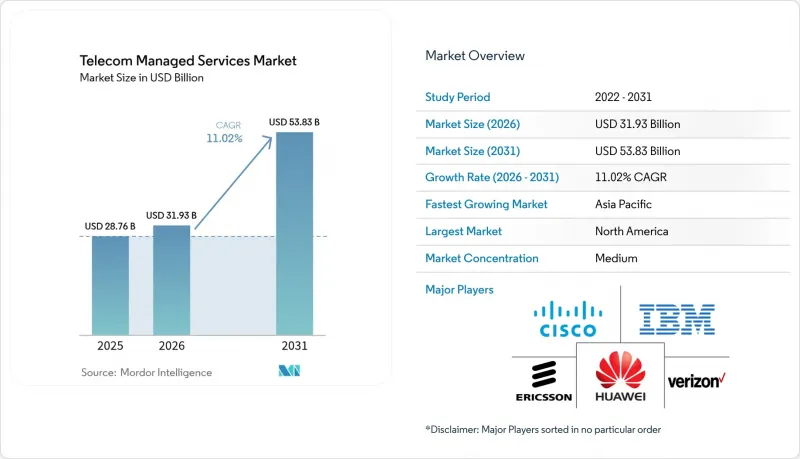
據 Mordor Intelligence 稱,2025 年通訊管理服務市值為 287.6 億美元,預計到 2031 年將達到 538.3 億美元,而 2026 年為 319.3 億美元,預測期(2026-2031 年)的複合年成長率為 11.02%。
本報告按組織規模(大型企業、中小企業)、服務類型(託管資料中心服務、資安管理服務、其他)、部署模式(本地部署、雲端託管)、營運商類型(行動網路營運商、行動虛擬網路營運商、網際網路服務供應商)、最終用戶產業(消費者、企業、其他)和地區進行細分。市場預測以美元計價。
全球通訊管理服務市場趨勢與洞察
5G網路切片正在推動業務轉型。
企業採用 5G 網路切片技術正在改變通訊管理服務市場。這是因為企業需要隔離的虛擬網路,並確保其效能能夠滿足關鍵任務需求。 Verizon 與 FIFA 為 2026 年世界盃提供的合作,凸顯了賽事組織者如何依靠私有網路切片來提供低延遲影片串流和互動式球迷體驗。特斯拉等製造業領導企業正在利用私有 5G 網路統籌自主生產線,從而催生了傳統 IT 團隊無法處理的專業管理服務合約。新加坡電信在東南亞的智慧工廠部署表明,提供能夠可靠滿足嚴格延遲和可靠性目標的優質網路切片具有巨大的獲利潛力。同時運行多個具有不同 QoS 參數的網路切片的複雜性,使得外部專業知識至關重要,這也推動了汽車、醫療保健和娛樂等行業的多年期外包合約的簽訂。
採用雲端原生OSS/BSS可以提高營運效率。
電信業者正從單體系統遷移到雲端原生架構,進而持續推動電信託管服務市場的發展。愛立信的雲端原生套件幫助T-Mobile將網路營運成本降低了30%,並將服務推出週期從數週縮短至數小時。諾基亞在2024年以23億美元收購Infinera,顯示組成軟硬體產品組合對於向容器化環境的無縫過渡至關重要。託管服務供應商(MSP)正在提供營運商內部仍缺乏的Kubernetes工程、CI/CD管線和微服務編配技能。隨著營運商逐步淘汰傳統平台,雲端託管模式能夠實現彈性擴展,並快速部署用於工業IoT的邊緣運算服務。
DevSecOps人才短缺限制了服務交付。
電信業DevSecOps職缺平均需要4.2個月才能填補,而一般IT職位平均只需2.8個月,這意味著DevSecOps職位的年薪成長高達18%。在5G雲端原生環境中,人才短缺問題尤其嚴重,因為工程師需要同時具備無線技術專長和容器安全知識。 MSP(託管服務提供者)正透過開設全球培訓中心和學院來應對這項挑戰,但人才培養所需的時間卻拖慢了專案進度,並限制了服務提供者擴展服務組合的速度。
細分市場分析
到2025年,大型企業將佔據55.72%的收入佔有率,並透過涵蓋傳輸、IT和安全等領域的全球運營,推動託管通訊服務市場的發展。它們的預算足以支援客製化解決方案,包括網路切片、私有5G網路和整合式可觀測性儀表板。相較之下,預計到2031年,中小企業(SME)的複合年成長率將達到11.15%,從而為服務供應商創造新的需求。隨著標準化的「按需收費」套餐計劃消除了重要的資金壁壘,中小企業的託管通訊服務市場預計將穩定成長。醫療診所、中型製造商和本地零售商正在推動這一成長,他們透過外包高度合規的通訊技術堆疊來彌補自身內部專業知識的不足。
中小企業傾向於選擇雲端優先網路、託管式SD-WAN和承包安全閘道器,即使沒有高技能技術人員也能滿足產業法規要求。同時,跨國公司正在利用人工智慧驅動的自動化技術來簡化複雜龐大的多供應商環境,並組成內部團隊專注於創新專案。中小企業的價格優勢套餐和高度客製化的企業級框架相結合,要求供應商採取兩種截然不同的市場部署策略。
預計到2025年,託管網路服務將維持32.08%的收入佔有率,凸顯其作為通訊託管服務市場核心細分領域的地位。然而,由於電信業者面臨國家支持的威脅和嚴格的資料位置監管,託管安全服務正以11.78%的複合年成長率快速成長。在零信任架構的普及和5G核心網路保護的推動下,託管安全領域內的通訊託管服務市場規模預計將顯著擴大。資料中心、通訊和行動服務保持著穩定的中個位數成長率,而分析即服務(AaaS)正成為新的收入來源。
安全需求涵蓋威脅搜尋、安全營運中心即服務 (SOCaaS) 以及本地和多重雲端環境中的合規性報告。服務供應商正透過人工智慧驅動的異常檢測和網路邊緣的自動化策略執行來脫穎而出。網路管理是一個成熟的領域,但正透過意圖式網路和閉合迴路保障進行重組。雖然該領域仍然重要,但其動態性不如安全領域。
區域分析
預計到2025年,北美將佔據市場主導地位,佔全球收入的30.88%,這主要得益於5G的早期部署、企業雲的高採用率以及鼓勵私有網路試驗的有利法規結構。 Verizon的固定無線接取用戶已超過420萬,提前完成了預期目標,凸顯了市場對託管寬頻替代方案的強勁需求。 AT&T的光纖用戶已連續17個季度成長,也印證了市場對營運商營運的託管連接的強勁需求。隨著競爭日益激烈,營運商正擴大將高度自動化、分析和安全任務外包,以求脫穎而出。
亞太地區是成長最快的地區,預計到2031年複合年成長率將達到11.53%,這主要得益於大規模5G基礎設施建設和政府主導的「工業4.0」計畫。中國計劃在2024年部署340萬個5G基地台,這將帶來前所未有的網路管理需求。日本正專注於為智慧工廠提供私人5G網路,而印度的Reliance Jio公司已成立專門業務部門,致力於為中型製造商提供商業化的私人網路和管理服務。韓國NAVER Cloud取得首張私有5G執照,顯示超大規模資料中心業者服務商正在進軍企業連結市場。
在歐洲,儘管網路普及率已趨於成熟,但仍保持中等個位數的穩定成長。然而,諸如《網路韌性法案》之類的法規結構正迫使電信業者出於合規目的將安全和報告任務外包。在中東、非洲和南美洲,外包對降低營運成本和擴大服務覆蓋範圍(尤其是服務不足的地區)的興趣日益濃厚。區域營運商正在採用託管衛星回程傳輸和節能型無線存取網服務,以應對複雜的地形和高昂的能源成本。
其他好處
- Excel格式的市場預測(ME)表
- 3個月的分析師支持
目錄
第1章:引言
- 研究假設和市場定義
- 調查範圍
第2章:調查方法
第3章執行摘要
第4章 市場狀況
- 市場概覽
- 市場促進因素
- 5G 的部署正在加速企業對託管網路切片的需求。
- 一級電信業者雲端原生OSS/BSS採用現狀
- 轉向基於績效的服務等級協定降低了託管服務提供者的客戶流失率。
- 人工智慧驅動的預測性維護可降低營運成本。
- 對零信任架構的需求正在推動託管安全服務的成長。
- 用於工業4.0的私有5G園區網路
- 市場限制因素
- 電信業DevSecOps人員技能缺口導致通貨膨脹
- 對雲端託管網路功能中供應商鎖定問題的擔憂。
- 對延遲要求較高的 5G URLLC 應用場景限制了外包給外部方。
- 不同地區對法規的遵守情況各不相同。
- 供應鏈分析
- 監理情勢
- 技術展望
- 波特五力模型
- 對影響市場的宏觀經濟因素進行評估
第5章 市場規模與成長預測
- 按組織規模
- 大公司
- 小型企業
- 按服務類型
- 託管資料中心服務
- 資安管理服務
- 主機服務
- 託管資料和資訊服務
- 託管通訊服務
- 行動化運營服務
- 按部署模式
- 現場
- 雲端託管
- 按電信業者類型分類
- 行動通訊業者(MNO)
- 行動虛擬網路營運商(MVNO)
- 網際服務供應商(ISP)
- 按最終用戶行業分類
- 消費者群體
- 企業部門
- 政府/公共安全
- 按地區
- 北美洲
- 美國
- 加拿大
- 墨西哥
- 南美洲
- 巴西
- 阿根廷
- 其他南美國家
- 歐洲
- 德國
- 英國
- 法國
- 義大利
- 西班牙
- 其他歐洲國家
- 亞太地區
- 中國
- 日本
- 印度
- 韓國
- 東南亞
- 其他亞太國家
- 中東和非洲
- 中東
- 沙烏地阿拉伯
- 阿拉伯聯合大公國
- 土耳其
- 其他中東國家
- 非洲
- 南非
- 奈及利亞
- 埃及
- 其他非洲地區
- 中東
- 北美洲
第6章 競爭情勢
- 市場集中度
- 策略趨勢
- 市佔率分析
- 公司簡介
- Cisco Systems
- Huawei Technologies
- IBM
- Ericsson
- Verizon Business
- AT&T
- NTT Data
- Nokia
- ZTE
- Tech Mahindra
- Amdocs
- Fujitsu
- Comarch
- Lumen Technologies
- Orange Business Services
- Accenture
- HCL Technologies
- Cognizant
- Capgemini
- Tata Communications
第7章 市場機會與未來展望
According to Mordor Intelligence, the telecom managed services market size was valued at USD 28.76 billion in 2025 and estimated to grow from USD 31.93 billion in 2026 to reach USD 53.83 billion by 2031, at a CAGR of 11.02% during the forecast period (2026-2031).
This report is Segmented by Organization Size (Large Enterprises, Smes), Service Type (Managed Data Center Services, Managed Security Services, and More), Deployment Model (On-Premises, Cloud/Hosted), Telecom Operator Type (MNO, MVNO, ISP), End-User Vertical (Consumer Segment, Enterprise Segment, and More), and by Geography. The Market Forecasts are Provided in Terms of Value (USD).
Global Telecom Managed Services Market Trends and Insights
5G Network Slicing Drives Enterprise Transformation
Enterprise adoption of 5G network slicing is reshaping the telecom managed services market as organizations require isolated virtual networks with guaranteed performance for mission-critical applications. Verizon's collaboration with FIFA for the 2026 World Cup highlights how event operators rely on private slices to deliver low-latency video streams and interactive fan experiences. Manufacturing leaders such as Tesla use private 5G to orchestrate autonomous production lines, pushing specialized managed service contracts that traditional IT teams cannot support. Singtel's Southeast Asian smart-factory deployments demonstrate monetization potential by offering premium slices that lock in stringent latency and reliability targets. The complexity of simultaneously operating multiple slices each with distinct QoS parameters makes external expertise indispensable, stimulating multi-year outsourcing deals across automotive, healthcare and entertainment verticals.
Cloud-Native OSS/BSS Adoption Accelerates Operational Efficiency
Operators are migrating from monolithic systems to cloud-native architectures, generating sustained demand in the telecom managed services market. Ericsson's cloud-native suite helped T-Mobile cut network operations costs by 30% and compress service-launch cycles from weeks to hours. Nokia's USD 2.3 billion purchase of Infinera in 2024 indicates that integrated hardware-software portfolios are critical for seamless migration to containerized environments. Managed service providers (MSPs) supply Kubernetes engineering, CI/CD pipelines and microservices orchestration skills that remain scarce in-house. As operators decommission legacy platforms, cloud-hosted models unlock elastic scaling, enabling rapid introduction of edge computing services for industrial IoT.
DevSecOps Talent Shortage Constrains Service Delivery
Telecommunications DevSecOps vacancies remain open for 4.2 months on average versus 2.8 months for general IT roles, pushing wage inflation to 18% annually. The scarcity is most acute in 5G cloud-native environments, where engineers must combine radio expertise with container security. MSPs are responding with global training hubs and graduate academies, but onboarding cycles lengthen project timelines and limit the speed at which providers can scale service portfolios.
Other drivers and restraints analyzed in the detailed report include:
- AI-Driven Predictive Maintenance Transforms Network Operations
- Zero-Trust Security Architectures Drive Managed Security Demand
- Vendor Lock-in Concerns Slow Cloud Migration
For complete list of drivers and restraints, kindly check the Table Of Contents.
Segment Analysis
Large enterprises accounted for 55.72% revenue in 2025, underpinning the telecom managed services market with global rollouts that span transport, IT and security domains. Their budgets support tailored solutions encompassing network slicing, private 5G and unified observability dashboards. In contrast, SMEs expand at an 11.15% CAGR to 2031, unlocking fresh volume for service providers. The telecom managed services market size for SMEs is projected to climb steadily as standardized, pay-as-you-grow bundles remove hefty capital barriers. Healthcare clinics, mid-tier manufacturers and regional retailers collectively drive this surge by outsourcing compliance-heavy communication stacks to offset limited in-house expertise.
SMEs gravitate toward cloud-first networking, managed SD-WAN and turnkey security gateways that meet sector regulations without deep technical staffing. Meanwhile, multinationals leverage AI-assisted automation to rationalize sprawling multi-vendor estates, freeing up internal teams for innovation initiatives. The convergence of price-competitive packages for SMEs and highly customized enterprise frameworks ensures that providers must maintain dual go-to-market plays.
Managed network services retained 32.08% revenue share in 2025, underscoring their status as the core layer of the telecom managed services market. Yet managed security is the fastest riser at a 11.78% CAGR as operators confront nation-state threats and stringent data-residency rules. The telecom managed services market size for managed security is expected to swell notably, propelled by zero-trust rollouts and 5G core protection. Data center, communication and mobility services grow at steady mid-single-digit rates, while analytics-as-a-service emerges as an adjacent revenue stream.
Security demand spans threat hunting, SOC-as-a-service and compliance reporting across on-prem and multicloud estates. Providers differentiate via AI-powered anomaly detection and automated policy enforcement at network edges. Network management, though mature, is undergoing reinvention through intent-based networking and closed-loop assurance, keeping the segment relevant but less dynamic than security.
Complete Report Scope:
- By Organization Size
- Large Enterprises
- Small Enterprises
- By Service Type
- Managed Data Center Services
- Managed Security Services
- Managed Network Services
- Managed Data and Information Services
- Managed Communication Services
- Managed Mobility Services
- By Deployment Model
- On-Premises
- Cloud / Hosted
- By Telecom Operator Type
- Mobile Network Operator (MNO)
- Mobile Virtual Network Operator (MVNO)
- Internet Service Provider (ISP)
- By End-user Vertical
- Consumer Segment
- Enterprise Segment
- Government and Public Safety
- By Geography
- North America
- United States
- Canada
- Mexico
- South America
- Brazil
- Argentina
- Rest of South America
- Europe
- Germany
- United Kingdom
- France
- Italy
- Spain
- Rest of Europe
- Asia-Pacific
- China
- Japan
- India
- South Korea
- Southeast Asia
- Rest of Asia-Pacific
- Middle East and Africa
- Middle East
- Saudi Arabia
- United Arab Emirates
- Turkey
- Rest of Middle East
- Africa
- South Africa
- Nigeria
- Egypt
- Rest of Africa
- Middle East
- North America
Geography Analysis
North America led with 30.88% revenue in 2025 owing to early 5G deployment, high enterprise cloud adoption and supportive regulatory frameworks that encourage private-network experimentation. Verizon surpassed 4.2 million fixed-wireless access subscribers ahead of schedule, attesting to strong demand for managed broadband alternatives. AT&T posted 17 consecutive quarters of fiber subscriber gains, underscoring the robust appetite for carrier-operated managed connectivity. Mature competition pushes operators to outsource advanced automation, analytics and security tasks to sharpen differentiation.
Asia Pacific is the fastest-growing region at an 11.53% CAGR through 2031, buoyed by large-scale 5G infrastructure builds and government-backed Industry 4.0 programs. China deployed 3.4 million 5G base stations by 2024, fuelling unprecedented network-management requirements. Japan emphasized private 5G for smart factories, while India's Reliance Jio established a business unit to commercialize private networks and managed services for midsize manufacturers. South Korea's first private 5G licence issued to NAVER Cloud shows how hyperscalers are entering enterprise connectivity.
Europe registers steady mid-single-digit growth amid mature penetration levels, yet regulatory frameworks such as the Cyber Resilience Act press operators to outsource compliance-driven security and reporting. Middle East and Africa and South America exhibit rising interest in outsourcing to streamline OpEx and extend coverage into underserved areas. Regional players adopt managed satellite backhaul and energy-efficient RAN services to cope with challenging terrains and energy costs.
- Cisco Systems
- Huawei Technologies
- IBM
- Ericsson
- Verizon Business
- AT&T
- NTT Data
- Nokia
- ZTE
- Tech Mahindra
- Amdocs
- Fujitsu
- Comarch
- Lumen Technologies
- Orange Business Services
- Accenture
- HCL Technologies
- Cognizant
- Capgemini
- Tata Communications
Additional Benefits:
- The market estimate (ME) sheet in Excel format
- 3 months of analyst support
TABLE OF CONTENTS
1 INTRODUCTION
- 1.1 Study Assumptions and Market Definition
- 1.2 Scope of the Study
2 RESEARCH METHODOLOGY
3 EXECUTIVE SUMMARY
4 MARKET LANDSCAPE
- 4.1 Market Overview
- 4.2 Market Drivers
- 4.2.1 5G roll-out accelerating enterprise demand for managed network slicing
- 4.2.2 Cloud-native OSS/BSS adoption among Tier-1 operators
- 4.2.3 Shift to outcome-based SLAs lowering churn for MSPs
- 4.2.4 AI-driven predictive maintenance cutting OPEX
- 4.2.5 Demand for zero-trust architectures pushing managed security
- 4.2.6 Private 5G campus networks for Industry 4.0
- 4.3 Market Restraints
- 4.3.1 Skill-gap inflation in telecom DevSecOps talent
- 4.3.2 Vendor lock-in fears for cloud-hosted network functions
- 4.3.3 Latency-sensitive 5G URLLC use-cases limiting off-prem outsourcing
- 4.3.4 Fragmented regulatory compliance across regions
- 4.4 Supply-Chain Analysis
- 4.5 Regulatory Landscape
- 4.6 Technological Outlook
- 4.7 Porter's Five Forces
- 4.7.1 Bargaining Power of Suppliers
- 4.7.2 Bargaining Power of Buyers
- 4.7.3 Threat of New Entrants
- 4.7.4 Threat of Substitutes
- 4.7.5 Intensity of Competitive Rivalry
- 4.8 Assessment of Macroeconomic Factors on the Market
5 MARKET SIZE AND GROWTH FORECASTS (VALUE)
- 5.1 By Organization Size
- 5.1.1 Large Enterprises
- 5.1.2 Small Enterprises
- 5.2 By Service Type
- 5.2.1 Managed Data Center Services
- 5.2.2 Managed Security Services
- 5.2.3 Managed Network Services
- 5.2.4 Managed Data and Information Services
- 5.2.5 Managed Communication Services
- 5.2.6 Managed Mobility Services
- 5.3 By Deployment Model
- 5.3.1 On-Premises
- 5.3.2 Cloud / Hosted
- 5.4 By Telecom Operator Type
- 5.4.1 Mobile Network Operator (MNO)
- 5.4.2 Mobile Virtual Network Operator (MVNO)
- 5.4.3 Internet Service Provider (ISP)
- 5.5 By End-user Vertical
- 5.5.1 Consumer Segment
- 5.5.2 Enterprise Segment
- 5.5.3 Government and Public Safety
- 5.6 By Geography
- 5.6.1 North America
- 5.6.1.1 United States
- 5.6.1.2 Canada
- 5.6.1.3 Mexico
- 5.6.2 South America
- 5.6.2.1 Brazil
- 5.6.2.2 Argentina
- 5.6.2.3 Rest of South America
- 5.6.3 Europe
- 5.6.3.1 Germany
- 5.6.3.2 United Kingdom
- 5.6.3.3 France
- 5.6.3.4 Italy
- 5.6.3.5 Spain
- 5.6.3.6 Rest of Europe
- 5.6.4 Asia-Pacific
- 5.6.4.1 China
- 5.6.4.2 Japan
- 5.6.4.3 India
- 5.6.4.4 South Korea
- 5.6.4.5 Southeast Asia
- 5.6.4.6 Rest of Asia-Pacific
- 5.6.5 Middle East and Africa
- 5.6.5.1 Middle East
- 5.6.5.1.1 Saudi Arabia
- 5.6.5.1.2 United Arab Emirates
- 5.6.5.1.3 Turkey
- 5.6.5.1.4 Rest of Middle East
- 5.6.5.2 Africa
- 5.6.5.2.1 South Africa
- 5.6.5.2.2 Nigeria
- 5.6.5.2.3 Egypt
- 5.6.5.2.4 Rest of Africa
- 5.6.5.1 Middle East
- 5.6.1 North America
6 COMPETITIVE LANDSCAPE
- 6.1 Market Concentration
- 6.2 Strategic Moves
- 6.3 Market Share Analysis
- 6.4 Company Profiles (includes Global level Overview, Market level overview, Core Segments, Financials as available, Strategic Information, Market Rank/Share for key companies, Products and Services, and Recent Developments)
- 6.4.1 Cisco Systems
- 6.4.2 Huawei Technologies
- 6.4.3 IBM
- 6.4.4 Ericsson
- 6.4.5 Verizon Business
- 6.4.6 AT&T
- 6.4.7 NTT Data
- 6.4.8 Nokia
- 6.4.9 ZTE
- 6.4.10 Tech Mahindra
- 6.4.11 Amdocs
- 6.4.12 Fujitsu
- 6.4.13 Comarch
- 6.4.14 Lumen Technologies
- 6.4.15 Orange Business Services
- 6.4.16 Accenture
- 6.4.17 HCL Technologies
- 6.4.18 Cognizant
- 6.4.19 Capgemini
- 6.4.20 Tata Communications
7 MARKET OPPORTUNITIES AND FUTURE OUTLOOK
- 7.1 White-space and Unmet-Need Assessment

 通訊管理服務市場:通訊管理服務、部署模式、組織規模與產業-2026-2032年全球市場預測
 通訊管理服務市場規模、佔有率和趨勢分析報告:按服務類型、部署模式、企業規模、地區和細分市場預測(2026-2033 年)
 全球電信管理服務市場規模、佔有率、趨勢和成長分析報告(2026-2034)
 2026年全球通訊管理服務市場報告
 電信管理服務市場 - 全球產業規模、佔有率、趨勢、機會及預測(按服務類型、部署模式、組織規模、地區和競爭格局分類,2021-2031 年)
 通訊管理服務市場預測至2032年:按服務類型、部署模式、通訊業者類型、組織規模、最終用戶和地區分類的全球分析全球託管通訊服務市場:2032 年預測 - 按服務類型、部署方式、組織規模、最終用戶和地區進行分析全球電信託管服務市場規模(按服務類型、組織規模、地區、範圍和預測)