


 |
市場調查報告書
商品編碼
2124295
工作指導管理:市場佔有率分析、產業趨勢與統計、成長預測(2026-2031)Work Order Management - Market Share Analysis, Industry Trends & Statistics, Growth Forecasts (2026 - 2031) |
||||||

※ 本網頁內容可能與最新版本有所差異。詳細情況請與我們聯繫。
據 Mordor Intelligence 稱,工單管理市場預計到 2026 年價值 9.8 億美元,高於 2025 年的 9.1 億美元,預計到 2031 年將達到 14.1 億美元。
預計 2026 年至 2031 年的複合年成長率為 7.52%。
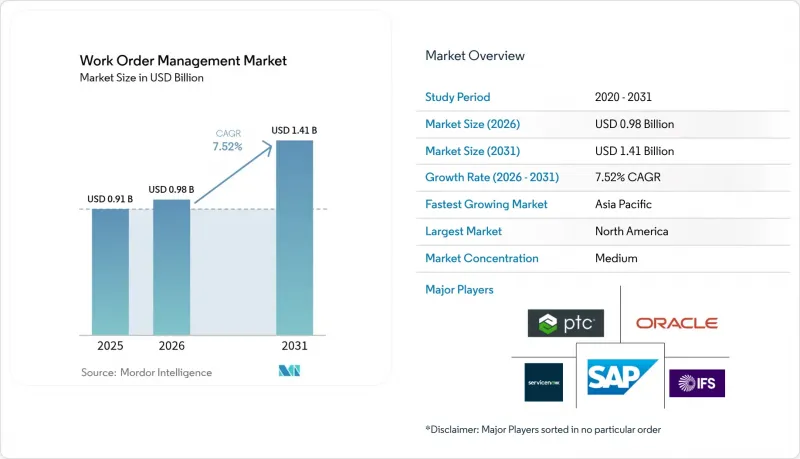
本報告按元件(軟體和服務)、部署類型(雲端、本地部署、混合部署)、組織規模(中小企業、大型企業)、最終用戶產業(醫療保健、IT和電信、其他)、應用模組(庫存管理、預測性維護、其他)和地區進行細分。市場預測以美元計價。
全球工單管理市場趨勢與洞察
基於雲端的現場服務平台的快速普及
企業正轉向多租戶軟體,這種軟體無需伺服器、備份和年度維護費用。訂閱協議允許企業按需擴展授權技術人員的數量,從而靈活調整服務能力以應對季節性工作負載。新冠疫情使行動同步變得至關重要,並鞏固了人們對跨地域團隊即時可見性的期望。受監管的公共產業和國防機構正在採用混合部署模式,將資產資料儲存在本地,同時在雲端運行調度邏輯,以平衡安全性和移動性。領先的供應商報告稱,超過四分之三的新現場服務合約都指定採用純雲端架構。
對預測性維護功能的需求日益成長
機器學習模型將感測器遙測資料與歷史工單關聯起來,以預測故障並在故障發生前製定乾預計劃。避免一次意外停機有時就能抵銷企業平台的年度成本。 PTC 將 ServiceMax 和 ThingWorx 整合,就是一個很好的例子,供應商正在聘請物聯網專家來實現資產效能的端到端管理。監管機構鼓勵公共產業採用預測性維護來降低野火風險,加速了能源產業的應用。這種方法有利於擁有成熟可靠性管理團隊的組織,也拉大了數位化領導企業與落後企業的差距。
雲端採用中的資料安全和隱私問題
2024年,針對現場服務供應商的勒索軟體攻擊事件激增,凸顯了第三方託管環境的漏洞。醫療機構因違反HIPAA法規,每次違規將面臨超過100萬美元的罰款,促使他們謹慎地進行雲端遷移。儘管供應商透過SOC 2 II型審計和端到端AES-256加密來應對,但買家的疑慮仍然存在。新的歐洲NIS2法規要求關鍵服務供應商在24小時內報告網路安全事件,加重了合規負擔。因此,一些公司正在推遲雲端採用計劃,直到其內部安全團隊更加成熟。
細分市場分析
2025年,服務收入將佔總營收的33.90%,但其成長速度遠超軟體,複合年成長率(CAGR)為7.88%。實施合作夥伴負責遷移遺留資料、設定核准流程以及將現場應用程式與企業資源計劃(ERP)系統整合等任務,這些活動對於全球製造商而言可能需要耗費一整個會計年度的時間。對於沒有內部IT團隊的公司而言,託管服務極具吸引力,因為它允許他們將升級和網路安全的責任轉移給供應商。培訓預算至少佔專案總支出的15%,有助於工程師更快掌握新技術並縮短投資回收期。因此,服務已成為供應商深化客戶關係的重要策略工具。
軟體仍然是工單管理市場的基礎,它透過統一的介面實現調度、行動作業執行和資產追蹤的自動化。該領域受益於穩定的訂閱續訂和功能增強,例如人工智慧驅動的調度助理。供應商透過捆綁庫存管理和客戶管理等相關模組來提高平均合約價值。雖然軟體的成長速度落後於服務業,但它仍然是新客戶的關鍵切入點,並構成了一個更廣泛的生態系統的基礎。
預計到2025年,雲端平台將佔據63.05%的市場佔有率,並以8.05%的複合年成長率成長至2031年。基於營運成本的定價模式無需在伺服器上投入大量資金,而自動更新則可在無需手動打補丁的情況下維護系統安全。供應商正在整合高級分析和自然語言介面,這些功能在本地環境中部署成本高。混合模式透過在本地保留資產遙測數據,同時在雲端運行調度演算法,滿足了受監管行業的需求。
在國防和關鍵基礎設施領域,本地部署仍然普遍存在,因為資料主權和空氣間隙網路仍然至關重要。然而,隨著資訊長們制定「雲端優先」藍圖,本地部署的相對佔有率預計將繼續下降。這種轉變正促使供應商優先考慮多租戶架構並逐步淘汰永久許可證,從而將收入確認方式轉向經常性訂閱收入。
區域分析
預計到2025年,北美將佔全球收入的38.20%。這主要得益於雲端平台的早期應用、廣泛的整合商生態系統以及美國職業安全與健康管理局 (OSHA) 強制要求使用書面維護程序。美國在該地區處於領先地位,利用其大規模資源規劃系統部署基礎來推動現場服務模組的交叉銷售。加拿大緊隨其後,尤其是在能源領域,營運商正在協調廣大地理區域內的維護工作。墨西哥正在崛起為近岸製造中心,需要現代化的維護基礎設施。
預計到2031年,亞太地區將以8.65%的複合年成長率成長,這主要得益於中國政府推動工業IoT應用的舉措以及印度的智慧城市計畫。在日本,勞動力老化正在加速現場服務營運的自動化,而公共產業和交通運輸領域對感測器的投資進一步擴大了市場需求。供應商正在對其解決方案進行本地化,以解決語言和法規合規問題,這使得亞太地區成為重要的成長引擎。
在歐洲,嚴格的GDPR和資料主權法規減緩了向雲端的轉型,但人們對混合部署的興趣日益濃厚。德國汽車和機械產業對預測性維護的需求仍然強勁,英國公共產業也在增加投資,以達到英國天然氣和電力市場監管局(Ofgem)的可靠性目標。在法國和俄羅斯,由於更傾向於本地部署環境,雲端技術的普及速度較為緩慢。在中東,沙烏地阿拉伯和阿拉伯聯合大公國的大型企劃正在推動雲端技術的普及;而在非洲,南非在採礦業的雲端技術應用方面處於領先地位。南美洲的情況則較為複雜。巴西正在投資製造業和能源領域,但貨幣波動抑制了阿根廷及其周邊市場的支出。
其他好處
- Excel格式的市場預測(ME)表
- 3個月的分析師支持
目錄
第1章:引言
- 研究假設和市場定義
- 調查範圍
第2章:調查方法
第3章執行摘要
第4章 市場狀況
- 市場概覽
- 市場促進因素
- 基於雲端的現場服務平台的快速普及
- 對預測性維護功能的需求日益成長
- 行動工作者的興起和自備設備辦公室(BYOD)政策的普及
- 物聯網和資產感測器的整合
- 工業領域向基於績效的服務合約轉型
- ESG有義務報告與維護相關的碳足跡
- 市場限制因素
- 雲端採用中的資料安全和隱私問題
- 與傳統ERP系統整合的複雜性
- 開發人工智慧驅動的叫車演算法的人員短缺
- 遠端資產位置衛星網際網路延遲成本增加
- 產業價值鏈分析
- 監理情勢
- 技術展望
- 宏觀經濟因素的影響
- 波特五力分析
第5章 市場規模與成長預測
- 按組件
- 軟體
- 服務
- 依部署類型
- 基於雲端的
- 現場
- 混合
- 按組織規模
- 中小企業
- 大公司
- 按最終用途行業分類
- 製造業
- 能源與公共產業
- 衛生保健
- 資訊科技/通訊
- 運輸/物流
- 政府
- 零售
- 其他
- 透過應用模組
- 工單管理
- 資產管理
- 庫存管理
- 預防性維護
- 調度和派遣
- 報告與分析
- 客戶管理
- 按地區
- 北美洲
- 美國
- 加拿大
- 墨西哥
- 歐洲
- 德國
- 英國
- 法國
- 義大利
- 其他歐洲國家
- 亞太地區
- 中國
- 日本
- 印度
- 韓國
- 澳洲
- 其他亞太國家
- 中東和非洲
- 中東
- 沙烏地阿拉伯
- 阿拉伯聯合大公國
- 其他中東國家
- 非洲
- 南非
- 埃及
- 其他非洲地區
- 中東
- 南美洲
- 巴西
- 阿根廷
- 南美洲其他地區
- 北美洲
第6章 競爭情勢
- 市場集中度
- 策略趨勢
- 市佔率分析
- 公司簡介
- ServiceNow Inc.
- PTC Inc.
- IFS AB
- Oracle Corporation
- SAP SE
- Microsoft Corporation
- ClickSoftware Technologies Ltd.
- Infor Inc.
- IBM Corporation
- Verizon Communications Inc.(Verizon Connect)
- Trimble Inc.
- Fiix Software ULC
- UpKeep Technologies Inc.
- Dude Solutions Inc.
- MaintainX Inc.
- Limble Solutions Inc.
- Hippo CMMS(iOFFICE LP)
- eMaint Enterprises LLC
- Accruent LLC(Maintenance Connection)
- Praxedo SA
第7章 市場機會與未來展望
According to Mordor Intelligence, the work order management market size in 2026 is estimated at USD 0.98 billion, growing from 2025 value of USD 0.91 billion with 2031 projections showing USD 1.41 billion, growing at 7.52% CAGR over 2026-2031.
This report is Segmented by Component (Software and Services), Deployment Type (Cloud-Based, On-Premises, and Hybrid), Organization Size (Small and Medium Enterprises and Large Enterprises), End-Use Industry (Healthcare, IT and Telecom, and More), Application Module (Inventory Management, Preventive Maintenance, and More), and Geography. The Market Forecasts are Provided in Terms of Value (USD).
Global Work Order Management Market Trends and Insights
Rapid Adoption of Cloud-Based Field Service Platforms
Enterprises are migrating to multitenant software that eliminates the need for servers, backups, and annual maintenance fees. Subscription contracts scale technician seats on demand, enabling firms to flex capacity for seasonal workloads. Mobile synchronization became mandatory during the COVID-19 pandemic, cementing expectations for real-time visibility across geographically dispersed teams. Regulated utilities and defense agencies adopt hybrid deployment, keeping asset data on-premises while running scheduling logic in the cloud to strike a balance between security and mobility. Leading vendors report that more than three-quarters of new field service contracts specify cloud-only architecture.
Growing Demand for Predictive Maintenance Capabilities
Machine-learning models correlate sensor telemetry with historical work orders to forecast failures and schedule interventions before breakdowns. Avoiding a single unplanned shutdown can offset the annual cost of an enterprise platform. Vendors acquire IoT specialists to deliver end-to-end asset performance, as illustrated by PTC's integration of ServiceMax with ThingWorx. Regulatory agencies encourage utilities to deploy predictive maintenance to mitigate wildfire risk, thereby accelerating its adoption in the energy sector. The approach favors organizations with mature reliability teams, widening the gap between digital leaders and laggards.
Data Security and Privacy Concerns in Cloud Deployments
Ransomware incidents targeting field service providers rose sharply in 2024, highlighting vulnerabilities in third-party hosting environments. Healthcare organizations face fines exceeding USD 1 million per breach under HIPAA, prompting cautious migration paths. Vendors respond with SOC 2 Type II audits and end-to-end AES-256 encryption, yet buyer skepticism persists. New European NIS2 rules require essential service operators to report cyber events within 24 hours, adding compliance overhead. Consequently, some firms defer cloud adoption until internal security teams mature.
Other drivers and restraints analyzed in the detailed report include:
- Increasing Mobile Workforce and BYOD Policies
- Integration With IoT and Asset Sensors
- High Integration Complexity With Legacy ERP Systems
For complete list of drivers and restraints, kindly check the Table Of Contents.
Segment Analysis
Services contributed 33.90% of 2025 revenue, yet they are expanding at a 7.88% CAGR, faster than software. Implementation partners migrate legacy data, configure approval workflows, and link field applications to enterprise resource planning systems, activities that can span a full fiscal year for global manufacturers. Managed services appeal to firms that lack in-house IT staff, shifting the responsibility for upgrades and cybersecurity to vendors. Training budgets represent at least 15% of total project spend, which helps lift technician adoption and shorten payback periods. Consequently, services are a strategic lever for vendors to deepen account relationships.
Software remains the backbone of the work order management market, automating dispatch, mobile execution, and asset tracking through a unified interface. The segment benefits from steady subscription renewals and feature expansion, including artificial intelligence dispatch assistants. Vendors bundle adjacent modules, including inventory and customer management, to boost average contract value. Although software growth trails services, it remains the primary entry point for new customers and underpins the broader ecosystem.
Cloud platforms captured a 63.05% share in 2025 and are projected to grow at an 8.05% CAGR through 2031. Operating expenditure pricing eliminates capital budgets for servers, and automatic updates keep installations secure without manual patches. Vendors embed advanced analytics and natural-language interfaces that would be cost-prohibitive on premises. Hybrid models satisfy regulated sectors by keeping asset telemetry onsite while running scheduling algorithms in the cloud.
On-premises installations persist in defense and critical infrastructure, where data sovereignty and air-gapped networks remain non-negotiable. Nevertheless, their relative share will continue to decline as CIOs plan cloud-first roadmaps. The shift drives vendors to prioritize multitenant architectures and to sunset perpetual licenses, moving revenue recognition toward recurring subscription streams.
Complete Report Scope:
- By Component
- Software
- Services
- By Deployment Type
- Cloud-Based
- On-Premises
- Hybrid
- By Organization Size
- Small and Medium Enterprises (SMEs)
- Large Enterprises
- By End-Use Industry
- Manufacturing
- Energy and Utilities
- Healthcare
- IT and Telecom
- Transportation and Logistics
- Government
- Retail
- Other End-Use Industry
- By Application Module
- Work Order Management
- Asset Management
- Inventory Management
- Preventive Maintenance
- Scheduling and Dispatch
- Reporting and Analytics
- Customer Management
- By Geography
- North America
- United States
- Canada
- Mexico
- Europe
- Germany
- United Kingdom
- France
- Italy
- Rest of Europe
- Asia-Pacific
- China
- Japan
- India
- South Korea
- Australia
- Rest of Asia-Pacific
- Middle East and Africa
- Middle East
- Saudi Arabia
- United Arab Emirates
- Rest of Middle East
- Africa
- South Africa
- Egypt
- Rest of Africa
- Middle East
- South America
- Brazil
- Argentina
- Rest of South America
- North America
Geography Analysis
North America accounted for 38.20% of 2025 revenue, driven by the early adoption of cloud platforms, an extensive integrator ecosystem, and compliance requirements from OSHA that mandate the use of documented maintenance procedures. The United States drives the region, leveraging large installed resource-planning bases to cross-sell field service modules. Canada follows suit, especially in the energy sector, where operators coordinate maintenance across wide geographic areas. Mexico is emerging as a hub for nearshore manufacturing, requiring modern maintenance infrastructure.
The Asia Pacific is forecast to grow at an 8.65% CAGR through 2031, benefiting from government mandates that encourage industrial IoT deployment in China and smart city initiatives in India. Japan's aging workforce is accelerating the automation of field service dispatch, while investments in sensors across utilities and transportation are amplifying demand. Vendors localize solutions for language and regulatory compliance, positioning Asia Pacific as the primary growth engine.
Europe's stringent GDPR and data-sovereignty rules slow cloud migration but raise interest in hybrid deployments. Germany's automotive and machinery sectors generate strong demand for predictive maintenance, and the United Kingdom's utilities invest to meet Ofgem reliability targets. France and Russia adopt at a modest pace due to on-premises preferences. The Middle East is seeing momentum from mega-projects in Saudi Arabia and the United Arab Emirates, while South Africa leads African adoption in the mining sector. South America is a mixed region: Brazil invests in manufacturing and energy, whereas currency volatility restrains spending in Argentina and its neighboring markets.
- ServiceNow Inc.
- PTC Inc.
- IFS AB
- Oracle Corporation
- SAP SE
- Microsoft Corporation
- ClickSoftware Technologies Ltd.
- Infor Inc.
- IBM Corporation
- Verizon Communications Inc. (Verizon Connect)
- Trimble Inc.
- Fiix Software ULC
- UpKeep Technologies Inc.
- Dude Solutions Inc.
- MaintainX Inc.
- Limble Solutions Inc.
- Hippo CMMS (iOFFICE LP)
- eMaint Enterprises LLC
- Accruent LLC (Maintenance Connection)
- Praxedo SA
Additional Benefits:
- The market estimate (ME) sheet in Excel format
- 3 months of analyst support
TABLE OF CONTENTS
1 INTRODUCTION
- 1.1 Study Assumptions and Market Definition
- 1.2 Scope of the Study
2 RESEARCH METHODOLOGY
3 EXECUTIVE SUMMARY
4 MARKET LANDSCAPE
- 4.1 Market Overview
- 4.2 Market Drivers
- 4.2.1 Rapid Adoption of Cloud-Based Field Service Platforms
- 4.2.2 Growing Demand for Predictive Maintenance Capabilities
- 4.2.3 Increasing Mobile Workforce and BYOD Policies
- 4.2.4 Integration With IoT AND Asset Sensors
- 4.2.5 Shift Toward Outcome-Based Service Contracts in Industrial Verticals
- 4.2.6 ESG-Mandated Reporting of Maintenance-Related Carbon Footprint
- 4.3 Market Restraints
- 4.3.1 Data Security and Privacy Concerns in Cloud Deployments
- 4.3.2 High Integration Complexity With Legacy ERP Systems
- 4.3.3 Talent Shortage in AI-Enabled Dispatch Algorithm Development
- 4.3.4 Rising Satellite Internet Latency Costs in Remote Asset Locations
- 4.4 Industry Value Chain Analysis
- 4.5 Regulatory Landscape
- 4.6 Technological Outlook
- 4.7 Impact of Macroeconomic Factors
- 4.8 Porter's Five Forces Analysis
- 4.8.1 Threat of New Entrants
- 4.8.2 Bargaining Power of Suppliers
- 4.8.3 Bargaining Power of Buyers
- 4.8.4 Threat of Substitutes
- 4.8.5 Competitive Rivalry
5 MARKET SIZE AND GROWTH FORECASTS (VALUE)
- 5.1 By Component
- 5.1.1 Software
- 5.1.2 Services
- 5.2 By Deployment Type
- 5.2.1 Cloud-Based
- 5.2.2 On-Premises
- 5.2.3 Hybrid
- 5.3 By Organization Size
- 5.3.1 Small and Medium Enterprises (SMEs)
- 5.3.2 Large Enterprises
- 5.4 By End-Use Industry
- 5.4.1 Manufacturing
- 5.4.2 Energy and Utilities
- 5.4.3 Healthcare
- 5.4.4 IT and Telecom
- 5.4.5 Transportation and Logistics
- 5.4.6 Government
- 5.4.7 Retail
- 5.4.8 Other End-Use Industry
- 5.5 By Application Module
- 5.5.1 Work Order Management
- 5.5.2 Asset Management
- 5.5.3 Inventory Management
- 5.5.4 Preventive Maintenance
- 5.5.5 Scheduling and Dispatch
- 5.5.6 Reporting and Analytics
- 5.5.7 Customer Management
- 5.6 By Geography
- 5.6.1 North America
- 5.6.1.1 United States
- 5.6.1.2 Canada
- 5.6.1.3 Mexico
- 5.6.2 Europe
- 5.6.2.1 Germany
- 5.6.2.2 United Kingdom
- 5.6.2.3 France
- 5.6.2.4 Italy
- 5.6.2.5 Rest of Europe
- 5.6.3 Asia-Pacific
- 5.6.3.1 China
- 5.6.3.2 Japan
- 5.6.3.3 India
- 5.6.3.4 South Korea
- 5.6.3.5 Australia
- 5.6.3.6 Rest of Asia-Pacific
- 5.6.4 Middle East and Africa
- 5.6.4.1 Middle East
- 5.6.4.1.1 Saudi Arabia
- 5.6.4.1.2 United Arab Emirates
- 5.6.4.1.3 Rest of Middle East
- 5.6.4.2 Africa
- 5.6.4.2.1 South Africa
- 5.6.4.2.2 Egypt
- 5.6.4.2.3 Rest of Africa
- 5.6.4.1 Middle East
- 5.6.5 South America
- 5.6.5.1 Brazil
- 5.6.5.2 Argentina
- 5.6.5.3 Rest of South America
- 5.6.1 North America
6 COMPETITIVE LANDSCAPE
- 6.1 Market Concentration
- 6.2 Strategic Moves
- 6.3 Market Share Analysis
- 6.4 Company Profiles (includes Global Level Overview, Market Level Overview, Core Segments, Financials as Available, Strategic Information, Market Rank/Share for Key Companies, Products AND Services, and Recent Developments)
- 6.4.1 ServiceNow Inc.
- 6.4.2 PTC Inc.
- 6.4.3 IFS AB
- 6.4.4 Oracle Corporation
- 6.4.5 SAP SE
- 6.4.6 Microsoft Corporation
- 6.4.7 ClickSoftware Technologies Ltd.
- 6.4.8 Infor Inc.
- 6.4.9 IBM Corporation
- 6.4.10 Verizon Communications Inc. (Verizon Connect)
- 6.4.11 Trimble Inc.
- 6.4.12 Fiix Software ULC
- 6.4.13 UpKeep Technologies Inc.
- 6.4.14 Dude Solutions Inc.
- 6.4.15 MaintainX Inc.
- 6.4.16 Limble Solutions Inc.
- 6.4.17 Hippo CMMS (iOFFICE LP)
- 6.4.18 eMaint Enterprises LLC
- 6.4.19 Accruent LLC (Maintenance Connection)
- 6.4.20 Praxedo SA
7 MARKET OPPORTUNITIES AND FUTURE OUTLOOK
- 7.1 White-space and Unmet-Need Assessment

 人機協作系統市場:全球市場預測,2026-2032年
 2026年全球工作流程管理系統市場報告
 2026-2030年全球工作流程管理系統市場工作流程管理系統市場:2026-2032年全球市場預測(依系統類型、工作流程類型、部署模式、企業規模、應用程式和最終用戶分類)
 工作流程管理系統市場報告:按元件、部署模式、產業和地區分類(2026-2034 年)
 Frost Radar™ - 協作工作管理,2026
 人機協作工作系統:市場佔有率分析、產業趨勢與統計及成長預測(2026-2031)2026年全球工作流程管理軟體市場報告
 2026-2030年全球數位病理工作流程軟體市場
 工作流程管理系統市場分析及預測(至2035年):依類型、產品類型、服務、技術、組件、應用、部署類型、最終用戶、模組及功能分類