


 |
市場調查報告書
商品編碼
2063420
人機協作工作系統:市場佔有率分析、產業趨勢與統計及成長預測(2026-2031)Human-AI Collaborative Work Systems - Market Share Analysis, Industry Trends & Statistics, Growth Forecasts (2026 - 2031) |
||||||

※ 本網頁內容可能與最新版本有所差異。詳細情況請與我們聯繫。
根據 Mordor Intelligence 預測,人機協作工作系統市場規模預計在 2025 年達到 32.9 億美元,在 2026 年達到 45.9 億美元,在 2031 年達到 232.8 億美元。
預計從 2026 年到 2031 年,其複合年成長率將達到 38.37%。
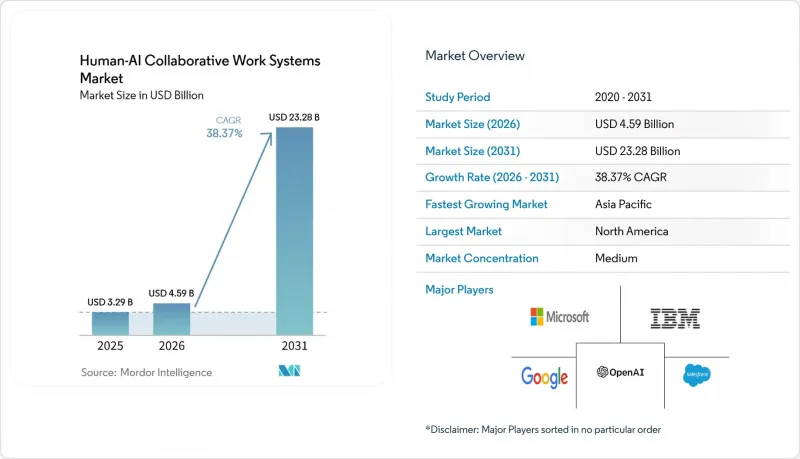
本報告按部署類型(本地部署、雲端部署、混合部署)、組件(軟體、服務)、最終用戶行業(IT與電信、醫療保健與生命科學、製造業、銀行、金融服務和保險、零售與電子商務、教育及其他)、組織規模(大型企業、中小企業)和地區進行細分。市場預測以美元計價。
全球人機協作工作系統市場趨勢與洞察
企業對生成式人工智慧助理的應用正在不斷擴大。
企業正將助理直接整合到決策工作流程中,而不再僅僅將其視為生產力附加元件。微軟宣布,到 2025 年底,將有超過 65,000 家公司使用 Azure OpenAI 服務,幾乎是 2024 年初的四倍。同時,儘管 Microsoft 365 版 Copilot 的付費授權席位已超過 1,500 萬,但這僅佔 Office裝置量的不到 4%,這意味著其成長空間龐大。 Salesforce的客戶在使用 Agentforce 後,報告指出案例解決時間在 2025 年底發布後縮短了 30% 至 50%。 IBM 正在內部向 27 萬名員工部署 WatsonX,目標是到 2027 年累積實現 45 億美元的生產力提升,這充分證明了其投資回報率的有效性。這些案例凸顯了早期採用者在將部署擴展到所有知識工作者之前,檢驗了其經濟效益。
多模態大規模語言模式的進步增強了協作能力
能夠理解文字、圖像、音訊和影片的多模態模型正在為設計、臨床診斷和工業維護等領域的協作開闢新的可能性。谷歌的Gemini預計2025年12月將有7.5億月有效用戶,但許多受監管產業的客戶為了遵守資料居住法規,選擇在本地部署。 Adobe已將Firefly整合到Creative Cloud中,讓行銷人員無需額外聘請設計師即可產生個人化的視覺素材。在醫療保健領域,FDA已批准到2024年將有超過950種人工智慧驅動的醫療設備上市,其中許多設備基於視覺和語言模型,可簡化放射成像流程。向邊緣推理的轉變滿足了零售收銀台和自主機器人等場景的低延遲需求。
缺乏標準化的人機對話協議
目前尚無通用協定定義智慧體如何接收指令、提出驗證問題或將問題回報給人工客服。 ISO/IEC 42001 概述了管理體系,但並未定義技術交接的細節。 IEEE P7001 透明度標準仍處於自願階段,預計要到 2027 年才能最終確定。企業報告稱,近 40% 的整合時間都花費在協調不同供應商的認證方案、回饋機制和稽核日誌上。這種分散化會減緩多智慧體部署的速度,並增加切換成本,尤其是在監管嚴格的金融和醫療保健領域,因為這些領域的每個決策路徑都必須記錄在案。
細分市場分析
混合模式預計將推動成長,從2026年到2031年將以38.97%的複合年成長率成長。這是因為受嚴格監管的行業正在本地處理敏感數據,同時將不太關鍵的推理處理卸載到雲端。使用Azure Stack和Google分散式雲端的金融機構正在利用現代變壓器模型進行風險評分,同時將客戶的個人識別資訊(PII)保留在其管轄範圍內。製造工廠正在展示混合架構如何滿足資料主權和毫秒響應要求,其中邊緣節點執行低延遲品質檢查,而集中式伺服器則對模型進行微調。
儘管如此,到2025年,雲端採用仍將佔據人機協作工作系統市場47.22%的最大佔有率。這是因為純SaaS模式最大限度地減少了前期投資,並加速了價值驗證(PoV)。對於需要空氣間隙安全性的國防和公共部門機構而言,本地部署環境仍然至關重要。供應商現在將單一控制平面捆綁到各種環境中,從而提高了可觀測性和成本管治。這種架構的柔軟性正在推動人機協作工作系統市場的擴張,因為越來越多的「後期大眾」採用者希望在不犧牲效能的前提下實現合規性。
預計到2025年,軟體收入將佔總收入的63.49%,而服務板塊預計將以40.37%的複合年成長率更快成長,因為企業對整合、客製化工作流程設計和定期模型調整的需求日益成長。歐盟人工智慧立法和美國行業特定法規規定的持續審計義務要求企業在每次模型迭代後更新公平性和偏見報告,這項工作擴大外包給系統整合商。到2026年初,Accenture已培訓了超過4萬名生成式人工智慧顧問,以滿足不斷成長的需求。
以託管服務為導向的人機協作工作系統市場在缺乏內部資料科學家的中小企業中成長最為迅速。 monday.com 和 ClickUp 提供的承包訂閱套餐將平台存取和支援服務捆綁在一起,降低了准入門檻。預計這一趨勢將重塑人機協作工作系統產業的合約模式,因為一些供應商會將專業服務與基於結果的定價掛鉤,使獎勵與生產力提升而非按小時計費掛鉤。
區域分析
預計到2025年,北美將佔全球收入的34.57%,這主要得益於超大規模資料中心業者資料中心營運商的資本投資以及在軟體、通訊和專業服務的早期試驗。微軟已投資375億美元用於人工智慧最佳化資料中心,這些資料中心目前為Azure OpenAI服務提供支援。同時, 銷售團隊報告稱,其Agentforce試點部署中有70%的客戶來自美國,反映出該公司快速進行技術測試的企業文化。然而,由於HIPAA和GLBA相關訴訟,風險負責人正在嚴格審查資料流,醫療保健和銀行業部署計劃正在延長。
亞太地區預計將成為最具活力的地區,複合年成長率將達到39.57%。中國斥資1兆元人民幣(約1,389億美元)的國家人工智慧計畫正在資助百度、阿里巴巴和騰訊等公司開發本土模型,重點在於中文流暢性和本地化應用。印度蓬勃發展的IT服務業正在利用人工智慧提高計費營運效率,這得益於政府補貼和龐大的英語人才庫。日本和韓國則專注於製造業和半導體設計,以應對人口老化和全球供應鏈轉型帶來的挑戰。然而,嚴格的資料主權法律迫使跨國公司維護並行系統,導致營運成本飆升。
歐洲正在努力平衡創新與嚴格合規之間的關係。歐盟人工智慧法規定的透明度要求延長了採購週期,同時也為管治專家創造了機會。德國在工業領域的應用方面處於領先地位,尤其是在汽車預測性維護方面。同時,英國正利用其人工智慧安全實驗室,透過部署前測試來增強企業董事會的信心。巴西、阿拉伯聯合大公國和南非雲端區域的建設正逐步將拉丁美洲、中東和非洲納入人機協作工作系統市場,儘管支出仍集中在跨國公司的子公司。
其他好處:
- Excel格式的市場預測(ME)表
- 3個月的分析師支持
目錄
第1章:引言
- 研究假設和市場定義
- 調查範圍
第2章:調查方法
第3章執行摘要
第4章 市場狀況
- 市場概覽
- 市場促進因素
- 企業採用生成式人工智慧助理的速度正在加快。
- 多模態大規模語言模式的進步增強了協作能力
- 對混合式工作編配平台的需求日益成長
- RPA機器人與互動式代理的整合
- 低程式碼和無程式碼人工智慧開發工具的可用性
- 加強人工智慧可審計性和透明度的合規要求
- 市場限制因素
- 缺乏標準化的人機互動協議
- 資料隱私問題限制了團隊之間的資料共用。
- 高昂的初始整合和培訓成本
- 工人因害怕失去工作而進行抵抗
- 宏觀經濟因素對市場的影響
- 產業價值鏈分析
- 監理情勢
- 技術展望
- 波特五力分析
第5章 市場規模與成長預測
- 部署模式
- 現場
- 雲
- 混合
- 按組件
- 軟體
- 服務
- 按最終用戶行業分類
- 資訊科技/通訊
- 醫療保健和生命科學
- 製造業
- BFSI
- 零售與電子商務
- 教育
- 政府/公共部門
- 其他終端用戶產業
- 按組織規模
- 大公司
- 小型企業
- 按地區
- 北美洲
- 美國
- 加拿大
- 墨西哥
- 南美洲
- 巴西
- 阿根廷
- 其他南美國家
- 歐洲
- 英國
- 德國
- 法國
- 義大利
- 西班牙
- 其他歐洲國家
- 亞太地區
- 中國
- 日本
- 印度
- 韓國
- 其他亞太國家
- 中東和非洲
- 中東
- 阿拉伯聯合大公國
- 沙烏地阿拉伯
- 其他中東國家
- 非洲
- 南非
- 埃及
- 其他非洲國家
- 中東
- 北美洲
第6章 競爭情勢
- 市場集中度
- 策略趨勢
- 市佔率分析
- 公司簡介
- Microsoft Corporation
- Google LLC
- IBM Corporation
- OpenAI, LLC
- Salesforce, Inc.
- Adobe Inc.
- Atlassian Corporation
- ServiceNow, Inc.
- UiPath, Inc.
- Automation Anywhere, Inc.
- Zoho Corporation Pvt. Ltd.
- monday.com Ltd.
- Slack Technologies, LLC
- Notion Labs, Inc.
- GitHub, Inc.
- Figma, Inc.
- Zoom Video Communications, Inc.
- ClickUp Technologies Inc.
- Airtable, Inc.
- Workday, Inc.
第7章 市場機會與未來展望
According to Mordor Intelligence, the human-AI collaborative work systems market size is projected to be USD 3.29 billion in 2025, USD 4.59 billion in 2026, and reach USD 23.28 billion by 2031, growing at a CAGR of 38.37% from 2026 to 2031.
This report is Segmented by Deployment Mode (On-Premise, Cloud, and Hybrid), Component (Software, and Services), End-User Industry (IT and Telecom, Healthcare and Life Sciences, Manufacturing, BFSI, Retail and E-Commerce, Education, and More), Organization Size (Large Enterprises, and Small and Medium Enterprises), and Geography. The Market Forecasts are Provided in Terms of Value (USD).
Global Human-AI Collaborative Work Systems Market Trends and Insights
Escalating Enterprise Adoption of Generative AI Assistants
Organizations are embedding assistants directly into decision workflows rather than treating them as separate productivity add-ons. Microsoft disclosed that more than 65,000 enterprises consumed Azure OpenAI Service by late 2025, almost quadrupling its early-2024 count, while Copilot for Microsoft 365 surpassed 15 million paid seats, yet still touched less than 4% of the Office installed base, showing substantial headroom. Salesforce customers using Agentforce reported 30-50% reductions in case-resolution time after its late-2025 launch. IBM's internal roll-out of watsonx across 270,000 employees targets USD 4.5 billion in cumulative productivity gains by 2027, reinforcing the ROI narrative. These examples underscore how early adopters validate economic impact before extending deployment across all knowledge workers.
Advances in Multimodal Large Language Models Enhancing Collaboration
Multimodal models that understand text, images, audio, and video are opening new collaboration frontiers in design, clinical diagnostics, and industrial maintenance. Google's Gemini hit 750 million monthly active users in December 2025, with many regulated-industry customers opting for on-premises deployments to comply with data-residency rules. Adobe embedded Firefly into Creative Cloud, enabling marketers to generate personalized visual assets without hiring extra designers. In healthcare, the FDA approved more than 950 AI-enabled medical devices through 2024, many of which are powered by vision-language models that streamline radiology reads. The move toward edge inference addresses low-latency requirements in retail checkout and autonomous robotics scenarios.
Lack of Standardized Human-AI Interaction Protocols
No common protocol governs how agents receive instructions, ask clarifying questions, or escalate to humans. ISO/IEC 42001 outlines management systems but leaves technical hand-off details undefined. IEEE's P7001 transparency standard remains voluntary and will not be finalized until 2027. Enterprises report that close to 40% of integration time is spent harmonizing authentication schemes, feedback loops, and audit logs across vendors. This fragmentation slows multi-agent adoption and increases switching costs, particularly inside regulated finance and healthcare environments that must document every decision path.
Other drivers and restraints analyzed in the detailed report include:
- Rising Demand for Hybrid-Work Orchestration Platforms
- Integration of RPA Bots With Conversational Agents
- Data-Privacy Concerns Limiting Cross-Team Data Sharing
For complete list of drivers and restraints, kindly check the Table Of Contents.
Segment Analysis
Hybrid models are forecast to lead growth, advancing at a 38.97% CAGR from 2026-2031, as heavily regulated sectors process sensitive data on-premise while offloading non-critical inference to the cloud. Financial institutions using Azure Stack or Google Distributed Cloud keep customer PII within local jurisdiction while still using the latest transformer models for risk scoring. In manufacturing plants, edge nodes execute low-latency quality inspections while centralized servers refine models, demonstrating how a hybrid architecture solves both data sovereignty and millisecond response constraints.
Cloud deployments nonetheless sustained the largest 47.22% share of the human-AI collaborative work systems market in 2025 because pure SaaS minimizes upfront capital outlays and accelerates proof of value. On-premises remains relevant for defense and public-sector agencies that require air-gapped security. Vendors now bundle a single control plane spanning environments, easing observability and cost governance. The architectural flexibility widens the market for human-AI collaborative work systems, as late-majority adopters demand compliance without sacrificing performance.
While software captured 63.49% revenue in 2025, services will expand more quickly at a 40.37% CAGR as enterprises seek integration, custom workflow design, and periodic model re-tuning. Continuous audit obligations outlined in the EU AI Act and sectoral U.S. rules oblige organizations to refresh fairness and bias reports for each model iteration, a task often outsourced to systems integrators. By early 2026, Accenture had trained more than 40,000 consultants in generative AI to meet surging demand.
The human-AI collaborative work systems market for managed services is growing fastest among small and medium enterprises that lack in-house data scientists. Turnkey subscription bundles from monday.com or ClickUp wrap platform access with support, lowering entry barriers. Some vendors tie professional services to outcome-based pricing, aligning incentives around productivity lifts rather than hourly billing, a trend expected to reshape contracting norms across the human-AI collaborative work systems industry.
Geography Analysis
North America retained 34.57% revenue in 2025, anchored by hyperscaler capex and early experimentation across software, telecom, and professional services. Microsoft invested USD 37.5 billion in AI-optimized data centers that now underpin Azure OpenAI Service, while Salesforce saw 70% of Agentforce pilots originate from U.S. customers, reflecting a culture of rapid technology trials. Nonetheless, litigation under HIPAA and GLBA prolongs deployment timelines in healthcare and banking as risk officers scrutinize data flow.
Asia-Pacific is projected to be the most dynamic region, registering a 39.57% CAGR. China's CNY 1 trillion (USD 138.9 billion approximately) national AI program funds domestic model development by Baidu, Alibaba, and Tencent, emphasizing Mandarin fluency and local domain adaptation. India's thriving IT services sector embeds AI to raise billable efficiency, supported by government subsidies and a vast English-speaking talent pool. Japan and South Korea focus on manufacturing and semiconductor design to offset aging demographics and global supply-chain shifts. However, stringent data-sovereignty laws force multinational companies to maintain parallel instances, inflating operating costs.
Europe balances innovation with strict compliance. The EU AI Act's transparency mandates lengthen procurement cycles yet create opportunities for governance specialists. Germany leads industrial adoption, particularly in automotive predictive maintenance, whereas the United Kingdom leverages its AI Safety Institute for pre-deployment testing that reassures corporate boards. Cloud region build-outs in Brazil, the United Arab Emirates, and South Africa are gradually pulling Latin America and the Middle East, and Africa into the human-AI collaborative work systems market, though spending remains concentrated in multinational subsidiaries.
- Microsoft Corporation
- Google LLC
- IBM Corporation
- OpenAI, L.L.C.
- Salesforce, Inc.
- Adobe Inc.
- Atlassian Corporation
- ServiceNow, Inc.
- UiPath, Inc.
- Automation Anywhere, Inc.
- Zoho Corporation Pvt. Ltd.
- monday.com Ltd.
- Slack Technologies, L.L.C.
- Notion Labs, Inc.
- GitHub, Inc.
- Figma, Inc.
- Zoom Video Communications, Inc.
- ClickUp Technologies Inc.
- Airtable, Inc.
- Workday, Inc.
Additional Benefits:
- The market estimate (ME) sheet in Excel format
- 3 months of analyst support
TABLE OF CONTENTS
1 INTRODUCTION
- 1.1 Study Assumptions and Market Definition
- 1.2 Scope of the Study
2 RESEARCH METHODOLOGY
3 EXECUTIVE SUMMARY
4 MARKET LANDSCAPE
- 4.1 Market Overview
- 4.2 Market Drivers
- 4.2.1 Escalating Enterprise Adoption of Generative AI Assistants
- 4.2.2 Advances in Multimodal Large Language Models Enhancing Collaboration
- 4.2.3 Rising Demand for Hybrid-Work Orchestration Platforms
- 4.2.4 Integration of RPA Bots with Conversational Agents
- 4.2.5 Availability of Low-Code and No-Code AI Development Tools
- 4.2.6 Growing Compliance Mandates for AI Auditability and Transparency
- 4.3 Market Restraints
- 4.3.1 Lack of Standardized Human-AI Interaction Protocols
- 4.3.2 Data-Privacy Concerns Limiting Cross-Team Data Sharing
- 4.3.3 High Upfront Integration and Training Costs
- 4.3.4 Workforce Resistance Due to Job-Displacement Anxiety
- 4.4 Impact of Macroeconomic Factors on the Market
- 4.5 Industry Value Chain Analysis
- 4.6 Regulatory Landscape
- 4.7 Technological Outlook
- 4.8 Porter's Five Forces Analysis
- 4.8.1 Bargaining Power of Suppliers
- 4.8.2 Bargaining Power of Buyers
- 4.8.3 Threat of New Entrants
- 4.8.4 Threat of Substitutes
- 4.8.5 Intensity of Competitive Rivalry
5 MARKET SIZE AND GROWTH FORECASTS (VALUE)
- 5.1 By Deployment Mode
- 5.1.1 On-Premise
- 5.1.2 Cloud
- 5.1.3 Hybrid
- 5.2 By Component
- 5.2.1 Software
- 5.2.2 Services
- 5.3 By End-User Industry
- 5.3.1 IT and Telecom
- 5.3.2 Healthcare and Life Sciences
- 5.3.3 Manufacturing
- 5.3.4 BFSI
- 5.3.5 Retail and E-commerce
- 5.3.6 Education
- 5.3.7 Government and Public Sector
- 5.3.8 Other End-user Industries
- 5.4 By Organization Size
- 5.4.1 Large Enterprises
- 5.4.2 Small and Medium Enterprises
- 5.5 By Geography
- 5.5.1 North America
- 5.5.1.1 United States
- 5.5.1.2 Canada
- 5.5.1.3 Mexico
- 5.5.2 South America
- 5.5.2.1 Brazil
- 5.5.2.2 Argentina
- 5.5.2.3 Rest of South America
- 5.5.3 Europe
- 5.5.3.1 United Kingdom
- 5.5.3.2 Germany
- 5.5.3.3 France
- 5.5.3.4 Italy
- 5.5.3.5 Spain
- 5.5.3.6 Rest of Europe
- 5.5.4 Asia-Pacific
- 5.5.4.1 China
- 5.5.4.2 Japan
- 5.5.4.3 India
- 5.5.4.4 South Korea
- 5.5.4.5 Rest of Asia-Pacific
- 5.5.5 Middle East and Africa
- 5.5.5.1 Middle East
- 5.5.5.1.1 United Arab Emirates
- 5.5.5.1.2 Saudi Arabia
- 5.5.5.1.3 Rest of Middle East
- 5.5.5.2 Africa
- 5.5.5.2.1 South Africa
- 5.5.5.2.2 Egypt
- 5.5.5.2.3 Rest of Africa
- 5.5.5.1 Middle East
- 5.5.1 North America
6 COMPETITIVE LANDSCAPE
- 6.1 Market Concentration
- 6.2 Strategic Moves
- 6.3 Market Share Analysis
- 6.4 Company Profiles (includes Global Level Overview, Market Level Overview, Core Segments, Financials as available, Strategic Information, Market Rank/Share, Products and Services, Recent Developments)
- 6.4.1 Microsoft Corporation
- 6.4.2 Google LLC
- 6.4.3 IBM Corporation
- 6.4.4 OpenAI, L.L.C.
- 6.4.5 Salesforce, Inc.
- 6.4.6 Adobe Inc.
- 6.4.7 Atlassian Corporation
- 6.4.8 ServiceNow, Inc.
- 6.4.9 UiPath, Inc.
- 6.4.10 Automation Anywhere, Inc.
- 6.4.11 Zoho Corporation Pvt. Ltd.
- 6.4.12 monday.com Ltd.
- 6.4.13 Slack Technologies, L.L.C.
- 6.4.14 Notion Labs, Inc.
- 6.4.15 GitHub, Inc.
- 6.4.16 Figma, Inc.
- 6.4.17 Zoom Video Communications, Inc.
- 6.4.18 ClickUp Technologies Inc.
- 6.4.19 Airtable, Inc.
- 6.4.20 Workday, Inc.
7 MARKET OPPORTUNITIES AND FUTURE OUTLOOK
- 7.1 White-Space and Unmet-Need Assessment

 工作流程管理系統市場:2026-2032年全球市場預測(依系統類型、工作流程類型、部署模式、企業規模、應用程式和最終用戶分類)
 從協作工作管理 (CWM) 到自我調整工作編配
 工作流程管理系統市場報告:按元件、部署模式、產業和地區分類(2026-2034 年)Frost Radar™ - 協作工作管理,2026
 2026年全球工作流程管理軟體市場報告
 2026-2030年全球數位病理工作流程軟體市場
 工作流程管理系統市場分析及預測(至2035年):依類型、產品類型、服務、技術、組件、應用、部署類型、最終用戶、模組及功能分類全球工作流程管理系統市場規模、佔有率、趨勢和成長分析報告(2026-2034年)
 工單管理系統市場 - 全球產業規模、佔有率、趨勢、機會和預測(2021-2031 年)(按組件、部署類型、組織規模、最終用戶、地區和競爭格局分類)按部署方式、公司規模、產業垂直領域和組件分類的製造工作流程軟體市場-全球預測,2026-2032年