


 |
市場調查報告書
商品編碼
2124285
智慧投顧服務:市場佔有率分析、產業趨勢與統計、成長預測(2026-2031 年)Robo-advisory Services - Market Share Analysis, Industry Trends & Statistics, Growth Forecasts (2026 - 2031) |
||||||

※ 本網頁內容可能與最新版本有所差異。詳細情況請與我們聯繫。
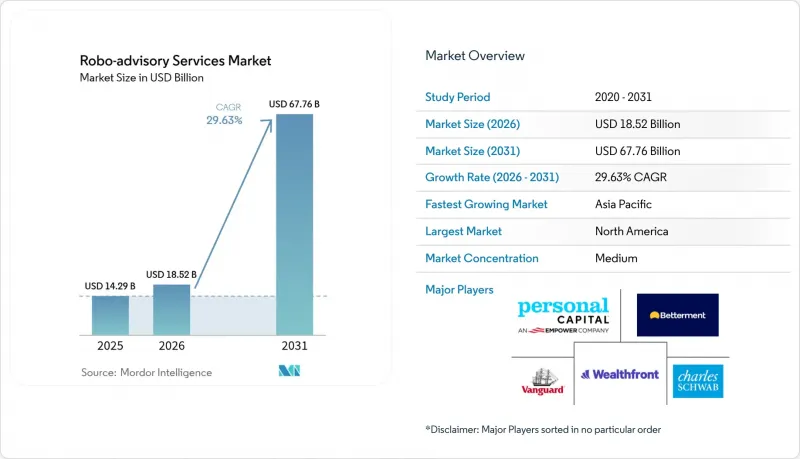
根據 Mordor Intelligence 估計,到 2026 年,智慧投顧服務市值將達到 185.2 億美元,高於 2025 年的 142.9 億美元,預計到 2031 年將達到 677.6 億美元。
預計從 2026 年到 2031 年,其複合年成長率將達到 29.63%。
本報告按經營模式(純智慧投顧和混合智慧投顧)、服務類型(投資建議、財富管理等)、提供者類型(金融科技公司、銀行和信用社、傳統資產管理公司和證券公司)、最終用戶(個人投資者、高淨值人士以及中小企業和公司的財務部門)和地區進行分類。
全球機器人諮詢服務市場趨勢及洞察
銀行、金融服務和保險業的數位化
雲端原生基礎設施和API驅動架構使銀行能夠將智慧投顧模組整合到現有核心系統中,而無需對舊有系統進行大規模重寫。摩根大通基於人工智慧的現金管理工具已證明演算法諮詢的擴充性,為2500名客戶減少了90%的人工處理工作。西門子財資部的數位轉型每年可節省2,000萬美元成本,並凸顯了可程式設計結算和區塊鏈基礎設施如何支援即時再平衡。歐洲證券及市場管理局(ESMA)發布了人工智慧指南,闡明了合規保障措施,以鼓勵機構投資者採用人工智慧。
個人財務管理的成本效益
雖然自動化投資組合管理費用通常為0.25%至0.50%,但傳統金融機構的收費為1%至2%,這一差異將導致2025年全球智慧投顧資產規模增加超過1兆美元。 Betterment的分級收費模式清楚地展現了利潤率的槓桿效應。該公司管理著500億美元的資產,並將效率優勢傳遞給了用戶。貝萊德的「Aperio」平台執行了130萬筆交易,並累計了1.64億美元的稅負,將演算法速度轉化為稅後超額收益。
細分市場分析
預計到2025年,混合型智慧投顧將佔總收入的60.10%,成為智慧投顧服務市場佔有率中最大的單一細分市場。同時,純智慧投顧的複合年成長率(CAGR)為34.35%。投資者被混合模式的吸引力所吸引,該模式兼具低成本和高效性,同時也能在市場波動時提供人工保障。
平台的細分越來越傾向於基於人生階段而非資產規模。 Robinhood即將推出的「簡易版」智慧投顧展現了一種巧妙的融合,既滿足了美國證券交易委員會(SEC)的要求,又贏得了用戶的信任:它採用演算法進行資產配置,同時由人工進行選股。
到2025年,財富管理服務將佔總支出的38.15%,成為智慧投顧服務市場中佔有率最大的部分,該市場預計將達到54.5億美元。相較之下,受投資者對稅後超額收益(alpha)需求的推動,稅損收割業務正以33.20%的複合年成長率加速成長。
透過將直接指數投資與自動收割結合,可以將淨收益提高1-2個百分點。貝萊德旗下「Aperio」的成功表明,機構級演算法如今已惠及高淨值個人客戶,使他們能夠在2026年稅法改革之前鞏固客戶忠誠度。
區域分析
在監管環境趨於穩定以及Betterment和Wealthfront等先鋒平台的支持下,北美地區預計到2025年將繼續佔全球整體消費總額的37.75%。該地區以股東利益為中心的稅收制度和高普及率的數位銀行服務,即使在費用大幅下降的情況下,也支撐著高階定價模式。
歐洲的MiFID II生態系統正在提升投資者保護和透明度,並推動數位顧問的跨境擴張。儘管歐洲證券及市場管理局(ESMA)的人工智慧指南進一步規範了演算法揭露,但企業仍需根據各國的具體情況調整資料隱私義務。像Scalable Capital這樣的泛歐平台正透過語言在地化、風險問卷本地化以及與退休金計畫的整合,挖掘潛在需求。
亞太地區以32.90%的複合年成長率領先。新加坡、日本和印度的監管沙盒機制允許新創公司快速迭代改進服務,而不斷成長的中產階級儲蓄則推動了資產管理規模(AUM)的流入。 Revolut在新加坡推出的智慧投顧服務最低投資額僅100美元,而Syfe進軍香港市場則預示著一場爭奪大眾富裕階層的競爭即將拉開帷幕。三菱日聯金融集團(MUFG)收購WealthNavi凸顯了領先本土企業的擴充性,並為智慧投顧ETF在東京證券交易所的交叉上市鋪平了道路。
其他好處
- Excel格式的市場預測(ME)表
- 3個月的分析師支持
目錄
第1章:引言
- 研究假設和市場定義
- 調查範圍
第2章:調查方法
第3章執行摘要
第4章 市場狀況
- 市場概覽
- 市場促進因素
- 銀行、金融服務和保險業的數位化
- 個人財務管理的成本效益
- 千禧世代和Z世代對DIY投資的興趣日益濃厚。
- 人工智慧驅動的高度個人化引導可以提高用戶參與度。
- 將智慧投顧整合到薪資福利平台中
- 市場限制因素
- 缺乏人性和同理心
- 各地區監管及信託責任方面存在不確定性
- 演算法偏見風險會造成合規責任
- 產業價值鏈分析
- 監理情勢
- 技術展望
- 產業吸引力—五力分析
- 供應商的議價能力
- 買方的議價能力
- 新進入者的威脅
- 替代品的威脅
- 競爭公司之間的競爭
- 宏觀經濟因素對市場的影響
第5章 市場規模與成長預測
- 按經營模式
- 純粹的智慧投顧
- 混合型智慧投顧
- 按服務類型
- 投資建議
- 財富管理
- 退休後計劃
- 稅務虧損抵扣
- 目標導向型規劃
- 按提供者類型
- 金融科技公司
- 銀行和信用社
- 傳統資產管理公司及證券公司
- 最終用戶
- 個人投資者
- 高淨值人士 (HNWI)
- 中小企業和公司的財務部門
- 按地區
- 北美洲
- 美國
- 加拿大
- 墨西哥
- 南美洲
- 巴西
- 阿根廷
- 智利
- 其他南美國家
- 歐洲
- 德國
- 英國
- 法國
- 義大利
- 西班牙
- 俄羅斯
- 其他歐洲國家
- 亞太地區
- 中國
- 印度
- 日本
- 韓國
- 新加坡
- 馬來西亞
- 澳洲
- 其他亞太國家
- 中東和非洲
- 中東
- 沙烏地阿拉伯
- 土耳其
- 以色列
- 其他中東國家
- 非洲
- 南非
- 奈及利亞
- 其他非洲國家
- 中東
- 北美洲
第6章 競爭情勢
- 市場集中度
- 策略趨勢
- 市佔率分析
- 公司簡介
- Vanguard Group Inc.
- Charles Schwab & Co. Inc.(Intelligent Portfolios)
- Empower Advisory Group Inc.(Personal Capital)
- Betterment LLC
- Wealthfront Corporation
- BlackRock Inc.(FutureAdvisor)
- FMR LLC(Fidelity Go)
- M1 Holdings Inc.(M1 Finance)
- Acorns Grow Inc.
- Stash Financial Inc.
- Robinhood Advisory LLC(Robinhood Portfolio)
- Ellevest Inc.
- SigFig Wealth Management LLC
- SoFi Technologies Inc.(SoFi Invest)
- Nutmeg Saving & Investment Ltd.
- Scalable Capital GmbH
- Raisin DS GmbH(WeltSparen Invest)
- Bambu Global Pte Ltd.
- Wahed Invest LLC
- Syfe Pte Ltd.
- Stockspot Pty Ltd.
- Groww(Nextbillion Technology Pvt Ltd.)
- Freetrade Ltd.
- SmartWealth(Emirates NBD)
- Revolut Ltd(Wealth & Trading)
第7章 市場機會與未來展望
According to Mordor Intelligence, robo advisory services market size in 2026 is estimated at USD 18.52 billion, growing from 2025 value of USD 14.29 billion with 2031 projections showing USD 67.76 billion, growing at 29.63% CAGR over 2026-2031.
This report is Segmented by Business Model (Pure Robo-Advisor and Hybrid Robo-Advisor), Service Type (Investment Advisory, Wealth Management, and More), Provider Type (FinTech Firms, Banks and Credit Unions, and Traditional Wealth Managers/Broker-Dealers), End-User (Retail Investors, High-Net-Worth Individuals, and SMEs and Corporate Treasuries), and Geography.
Global Robo-advisory Services Market Trends and Insights
Digitisation of the BFSI industry
Cloud-native infrastructure and API-driven architectures are enabling banks to plug robo modules into legacy cores without wholesale rewrites. JPMorgan's AI-based cash-management tool cut manual processing by 90% for 2,500 clients, proving scalability for algorithmic advice. Siemens Treasury's digital migration shaved USD 20 million in yearly costs, underscoring how programmable payments and blockchain rails support real-time rebalancing. Europe's ESMA has issued AI guidance that clarifies compliance guardrails, fostering institutional uptake.
Cost-efficiency in personal finance management
Automated portfolios typically charge 0.25-0.50% versus 1-2% at traditional firms, a spread that unlocked more than USD 1 trillion in global robo assets in 2025. Betterment's tiered model illustrates margin leverage: the firm manages USD 50 billion while passing efficiency gains to users. BlackRock's Aperio platform executed 1.3 million trades and harvested USD 164 million in tax losses, turning algorithmic speed into after-tax alpha.
Other drivers and restraints analyzed in the detailed report include:
- Growing millennial and Gen-Z preference for DIY investing
- AI-powered hyper-personalised nudges boost engagement
- Lack of human touch and empathy
- Regulatory and fiduciary uncertainty across regions
For complete list of drivers and restraints, kindly check the Table Of Contents.
Segment Analysis
Hybrid advisers captured 60.10% of 2025 revenue, equal to the largest single slice of robo-advisory services market share, while pure robos are expanding at a 34.35% CAGR. Investors gravitate to the hybrid promise of low-cost efficiency with a human backstop during volatility.
Platforms increasingly segment by life stage rather than wealth tier. Robinhood's upcoming plain-vanilla robo uses algorithms for allocation but retains human security selection, illustrating a nuanced blend that meets SEC expectations and user comfort levels.
Wealth management services retained 38.15% of 2025 spending, representing the largest slice of the robo-advisory services market size at USD 5.45 billion. By contrast, tax-loss harvesting is accelerating at 33.20% CAGR, riding investor demand for after-tax alpha.
Direct indexing coupled with automated harvesting can add 1-2 percentage points of net returns. BlackRock's Aperio success shows that institutional-grade algorithms can now be delivered to affluent retail accounts, locking in loyalty ahead of the 2026 tax-code revisions.
Complete Report Scope:
- By Business Model
- Pure Robo-advisor
- Hybrid Robo-advisor
- By Service Type
- Investment Advisory
- Wealth Management
- Retirement Planning
- Tax-loss Harvesting
- Goal-based Planning
- By Provider Type
- FinTech Firms
- Banks and Credit Unions
- Traditional Wealth Managers/Broker-Dealers
- By End-user
- Retail Investors
- High-Net-Worth Individuals (HNWI)
- SMEs and Corporate Treasuries
- By Geography
- North America
- United States
- Canada
- Mexico
- South America
- Brazil
- Argentina
- Chile
- Rest of South America
- Europe
- Germany
- United Kingdom
- France
- Italy
- Spain
- Russia
- Rest of Europe
- Asia-Pacific
- China
- India
- Japan
- South Korea
- Singapore
- Malaysia
- Australia
- Rest of Asia-Pacific
- Middle East and Africa
- Middle East
- Saudi Arabia
- Turkey
- Israel
- Rest of Middle East
- Africa
- South Africa
- Nigeria
- Rest of Africa
- Middle East
- North America
Geography Analysis
North America retained 37.75% of global spending in 2025 on the back of regulatory clarity and early-mover platforms such as Betterment and Wealthfront. The region's shareholder-friendly tax frameworks and high digital-banking penetration sustain premium pricing models despite fierce fee compression.
Europe's MiFID II ecosystem promotes investor protection and transparency, encouraging cross-border expansion for digital advisers. ESMA's AI guidelines further standardize algorithmic disclosures, though firms must still reconcile data-privacy obligations country by country. Pan-European platforms like Scalable Capital are localizing language, risk questionnaires, and pension integrations to unlock addressable demand.
Asia-Pacific posts the highest 32.90% CAGR. Regulatory sandboxes in Singapore, Japan, and India let start-ups iterate rapidly, while rising middle-class savings pools drive AUM inflows. Revolut's Singapore robo launched with only USD 100 minimums, and Syfe's Hong Kong build-out signals a mass-affluent land grab. MUFG's WealthNavi acquisition validates the scalability of local champions and paves a path for cross-listing of robo ETFs on the Tokyo Stock Exchange.
- Vanguard Group Inc.
- Charles Schwab & Co. Inc. (Intelligent Portfolios)
- Empower Advisory Group Inc. (Personal Capital)
- Betterment LLC
- Wealthfront Corporation
- BlackRock Inc. (FutureAdvisor)
- FMR LLC (Fidelity Go)
- M1 Holdings Inc. (M1 Finance)
- Acorns Grow Inc.
- Stash Financial Inc.
- Robinhood Advisory LLC (Robinhood Portfolio)
- Ellevest Inc.
- SigFig Wealth Management LLC
- SoFi Technologies Inc. (SoFi Invest)
- Nutmeg Saving & Investment Ltd.
- Scalable Capital GmbH
- Raisin DS GmbH (WeltSparen Invest)
- Bambu Global Pte Ltd.
- Wahed Invest LLC
- Syfe Pte Ltd.
- Stockspot Pty Ltd.
- Groww (Nextbillion Technology Pvt Ltd.)
- Freetrade Ltd.
- SmartWealth (Emirates NBD)
- Revolut Ltd (Wealth & Trading)
Additional Benefits:
- The market estimate (ME) sheet in Excel format
- 3 months of analyst support
TABLE OF CONTENTS
1 INTRODUCTION
- 1.1 Study Assumptions and Market Definition
- 1.2 Scope of the Study
2 RESEARCH METHODOLOGY
3 EXECUTIVE SUMMARY
4 MARKET LANDSCAPE
- 4.1 Market Overview
- 4.2 Market Drivers
- 4.2.1 Digitisation of the BFSI industry
- 4.2.2 Cost-efficiency in personal finance management
- 4.2.3 Growing millennial and Gen-Z preference for DIY investing
- 4.2.4 AI-powered hyper-personalised nudges boost engagement
- 4.2.5 Embedded robo-advice within payroll/benefits platforms
- 4.3 Market Restraints
- 4.3.1 Lack of human touch and empathy
- 4.3.2 Regulatory and fiduciary uncertainty across regions
- 4.3.3 Algorithmic-bias risk creating compliance liabilities
- 4.4 Industry Value Chain Analysis
- 4.5 Regulatory Landscape
- 4.6 Technological Outlook
- 4.7 Industry Attractiveness - Porter's Five Forces Analysis
- 4.7.1 Bargaining Power of Suppliers
- 4.7.2 Bargaining Power of Buyers
- 4.7.3 Threat of New Entrants
- 4.7.4 Threat of Substitute Products
- 4.7.5 Intensity of Competitive Rivalry
- 4.8 Impact of Macroeconomic Factors on the Market
5 MARKET SIZE AND GROWTH FORECASTS (VALUES)
- 5.1 By Business Model
- 5.1.1 Pure Robo-advisor
- 5.1.2 Hybrid Robo-advisor
- 5.2 By Service Type
- 5.2.1 Investment Advisory
- 5.2.2 Wealth Management
- 5.2.3 Retirement Planning
- 5.2.4 Tax-loss Harvesting
- 5.2.5 Goal-based Planning
- 5.3 By Provider Type
- 5.3.1 FinTech Firms
- 5.3.2 Banks and Credit Unions
- 5.3.3 Traditional Wealth Managers/Broker-Dealers
- 5.4 By End-user
- 5.4.1 Retail Investors
- 5.4.2 High-Net-Worth Individuals (HNWI)
- 5.4.3 SMEs and Corporate Treasuries
- 5.5 By Geography
- 5.5.1 North America
- 5.5.1.1 United States
- 5.5.1.2 Canada
- 5.5.1.3 Mexico
- 5.5.2 South America
- 5.5.2.1 Brazil
- 5.5.2.2 Argentina
- 5.5.2.3 Chile
- 5.5.2.4 Rest of South America
- 5.5.3 Europe
- 5.5.3.1 Germany
- 5.5.3.2 United Kingdom
- 5.5.3.3 France
- 5.5.3.4 Italy
- 5.5.3.5 Spain
- 5.5.3.6 Russia
- 5.5.3.7 Rest of Europe
- 5.5.4 Asia-Pacific
- 5.5.4.1 China
- 5.5.4.2 India
- 5.5.4.3 Japan
- 5.5.4.4 South Korea
- 5.5.4.5 Singapore
- 5.5.4.6 Malaysia
- 5.5.4.7 Australia
- 5.5.4.8 Rest of Asia-Pacific
- 5.5.5 Middle East and Africa
- 5.5.5.1 Middle East
- 5.5.5.1.1 Saudi Arabia
- 5.5.5.1.2 Turkey
- 5.5.5.1.3 Israel
- 5.5.5.1.4 Rest of Middle East
- 5.5.5.2 Africa
- 5.5.5.2.1 South Africa
- 5.5.5.2.2 Nigeria
- 5.5.5.2.3 Rest of Africa
- 5.5.5.1 Middle East
- 5.5.1 North America
6 COMPETITIVE LANDSCAPE
- 6.1 Market Concentration
- 6.2 Strategic Moves
- 6.3 Market Share Analysis
- 6.4 Company Profiles (includes Global level Overview, Market level overview, Core Segments, Financials as available, Strategic Information, Market Rank/Share for key companies, Products and Services, and Recent Developments)
- 6.4.1 Vanguard Group Inc.
- 6.4.2 Charles Schwab & Co. Inc. (Intelligent Portfolios)
- 6.4.3 Empower Advisory Group Inc. (Personal Capital)
- 6.4.4 Betterment LLC
- 6.4.5 Wealthfront Corporation
- 6.4.6 BlackRock Inc. (FutureAdvisor)
- 6.4.7 FMR LLC (Fidelity Go)
- 6.4.8 M1 Holdings Inc. (M1 Finance)
- 6.4.9 Acorns Grow Inc.
- 6.4.10 Stash Financial Inc.
- 6.4.11 Robinhood Advisory LLC (Robinhood Portfolio)
- 6.4.12 Ellevest Inc.
- 6.4.13 SigFig Wealth Management LLC
- 6.4.14 SoFi Technologies Inc. (SoFi Invest)
- 6.4.15 Nutmeg Saving & Investment Ltd.
- 6.4.16 Scalable Capital GmbH
- 6.4.17 Raisin DS GmbH (WeltSparen Invest)
- 6.4.18 Bambu Global Pte Ltd.
- 6.4.19 Wahed Invest LLC
- 6.4.20 Syfe Pte Ltd.
- 6.4.21 Stockspot Pty Ltd.
- 6.4.22 Groww (Nextbillion Technology Pvt Ltd.)
- 6.4.23 Freetrade Ltd.
- 6.4.24 SmartWealth (Emirates NBD)
- 6.4.25 Revolut Ltd (Wealth & Trading)
7 MARKET OPPORTUNITIES AND FUTURE OUTLOOK
- 7.1 White-space and Unmet-need Assessment

 2026年全球智慧投顧市場報告
 智慧投顧市場-2026-2032年全球市場預測
 智慧投顧市場報告:經營模式、服務類型、提供者、最終用戶和地區分類(2026-2034 年)
 智慧投顧市場規模、佔有率和成長率;全球產業分析;按類型、應用和地區進行的分析;以及未來預測(2026-2034 年)。2026年人工智慧驅動型機器人諮詢全球市場報告全球智慧投顧市場規模、佔有率、趨勢和成長分析報告(2026-2034)全球智慧投顧市場:機會與策略展望(至2034年)
 智慧投顧市場規模、佔有率和成長分析(按類型、提供者、服務類型、最終用戶和地區分類)-2026-2033年產業預測
 智慧投顧市場-全球產業規模、佔有率、趨勢、機會及預測,依商業模式、供應商、服務類型、最終用戶(零售投資者、高淨值人士)、地區和競爭格局分類,2020-2030年預測
 全球智慧投顧市場:預測至 2032 年-按組件、類型、提供者類型、經營模式、服務內容、最終用戶和地區進行分析