


 |
市場調查報告書
商品編碼
2124260
亞洲工業4.0:市場佔有率分析、產業趨勢與統計及成長預測(2026-2031年)Asia Industry 4.0 - Market Share Analysis, Industry Trends & Statistics, Growth Forecasts (2026 - 2031) |
||||||

※ 本網頁內容可能與最新版本有所差異。詳細情況請與我們聯繫。
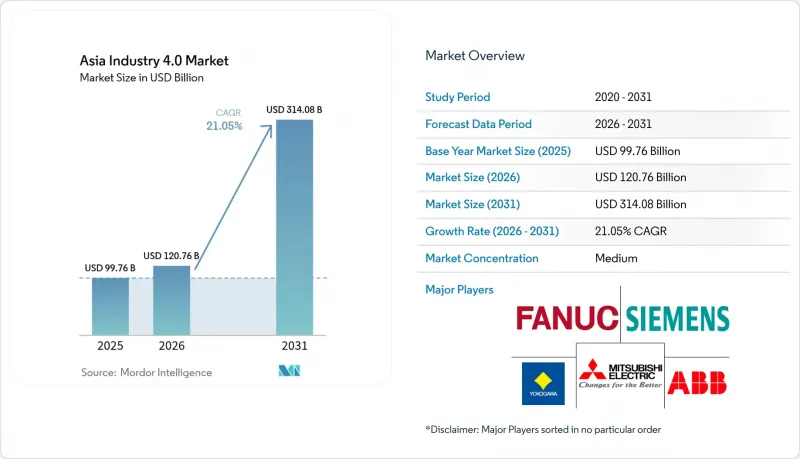
根據 Mordor Intelligence 預測,亞洲工業 4.0 市場規模將從 2025 年的 997.6 億美元成長到 2026 年的 1,207.6 億美元,然後在 2031 年達到 3,140.8 億美元,2026 年至 2031 年的複合年成長率為 21.05%。
本報告按技術類型(工業機器人、工業物聯網平台及連接、人工智慧和機器學習、其他)、終端用戶產業(離散製造、汽車、石油和天然氣、其他)、部署模式(本地部署、雲端部署、其他)、組織規模(大型企業和中小企業)以及地區(中國、日本、印度、其他)進行細分。市場預測以美元計價。
亞洲工業4.0市場洞察與趨勢
促進數位化製造的經濟措施正在加速產業轉型。
在亞洲,各國政府對智慧工廠的累積支持,包括補貼、稅收優惠和低利率貸款,已超過2000億美元。中國的「十四五」規劃和印度的生產連結獎勵計畫計畫(PLI)正在降低自動化項目的資金籌措門檻,並擴大供應商參與公共採購的範圍。日本的「社會5.0」和韓國的「K-Digital新政」推出了額外的津貼勞動力技能提升計劃,以鼓勵供應商採用基於整合平台的解決方案。亞洲工業4.0市場正直接受益,零件製造商、系統整合商和軟體供應商在多個行業的需求同時成長。早期獲得獎勵策略支持的製造商報告稱,在實施兩年內,生產力提高了15-20%,這正在推動後續投資的良性循環。
工業機器人需求的激增正在改變電子產品和電動車的供應鏈。
到2024年,亞洲將佔全球機器人部署量的70%,光是中國就有29萬台新機器人投入運作,用於半導體封裝和電池組裝。上海電動車產能的擴張和韓國電池產能的提升,都需要微米級的精度,而這只有高密度機器人單元才能實現。更短的生產週期和全天候無人值守運作,符合原始設備製造商(OEM)即使在價值鏈中斷的情況下也能保持產能穩定的目標,從而推動了亞洲工業4.0市場向自動化生產的轉型。機器人製造商現在將視覺感測器和基於人工智慧的品質分析功能整合到機器人系統中,以提高系統的附加價值,並在競爭激烈的競標中脫穎而出。在大批量電子產品生產線上,投資回收期通常不到兩年,因此財務部門優先考慮引入多機器人單元,而不是進行人工的漸進式升級。
儘管從長遠來看有許多好處,但高昂的初始投資是推廣應用的一大障礙。
向智慧工廠維修通常每個工廠的成本在1000萬美元到5000萬美元之間,這遠遠超過了中型製造商傳統設備升級的預算。越南和印尼的本地銀行很少為軟體等無形資產提供長期貸款,導致企業必須自行融資或面臨專案延期。投資回報的前景取決於透過預測性維護降低成本和減少缺陷產品,但這些概念對財務部門來說比較陌生,因此即使內部收益率符合公司標準,核准通過率仍然很低。結果,亞洲工業4.0市場呈現兩極化,資金雄厚的跨國公司領先,而本地供應商則落後於人。雖然能夠最大限度地減少資本投入的訂閱模式正在興起,但由於擔心供應商鎖定和總擁有成本(TCO)框架模糊不清,這些模式的普及程度有限。
細分市場分析
到2025年,受電子和電池領域自動化需求持續成長的推動,工業機器人將佔據亞洲工業4.0市場23.05%的佔有率。同時,數位孿生平台正以22.15%的複合年成長率成長,透過實現虛擬試運行、預測性維護和場景規劃,成為實體自動化不可或缺的合作夥伴。預計到2031年,亞洲工業4.0市場中與數位孿生訂閱相關的市場規模將成長兩倍,因為基於授權的收入模式將取代大量軟體銷售。區域性原始設備製造商(OEM)正在將數位孿生與機器人單元捆綁銷售,以最大限度地縮短推出時間,將新生產線的檢驗週期從六個月縮短至三週。工業物聯網(IIoT)連接和邊緣分析也正經歷兩位數的成長,這得益於5G的日益普及和感測器成本的下降。區塊鏈仍然是一項小眾技術,但在食品安全和藥品序列化領域正受到越來越多的關注,而延展實境(XR)應用則為偏遠或農村地區的工廠提供遠端維護支援。隨著工廠經理整合供應商,提供整合數位孿生、分析和人工智慧視覺技術的解決方案的供應商有望獲得更大的市場佔有率。
亞洲半導體晶圓廠正在部署人工智慧輔助光學檢測工具,以實現5奈米及以下製程節點晶片所需的亞微米級缺陷檢測精度。這些工具可將資料直接輸入數位孿生模型,從而實現設計與製造的閉迴路銜接。日本機器人製造商正在其機械手臂上整合基於英偉達GPU的人工智慧推理模組,無需外部伺服器即可提高機器人單元的柔軟性。邊緣閘道器配備了時間敏感網路(TSN)功能,以維持同步多機器人操作所需的確定性流量。隨著計算成本的降低,模擬吞吐量得到提升,使製造商能夠在進行任何實體更改之前測試數百種參數組合。這種綜合方法正在鞏固亞洲工業4.0市場作為硬體和軟體協同演進的創新沙盒的地位。
到2025年,離散製造業在亞洲工業4.0市場中仍將佔據20.65%的佔有率,這主要得益於消費性電子產品的大規模組裝。同時,航太和國防企業正以21.95%的複合年成長率採用積層製造、數位孿生和預測分析技術,以滿足嚴格的零件公差和可追溯性要求。日本、韓國和印度的政府國防現代化預算正在為關鍵承包商向智慧工廠維修資金支持,從而加速其供應商生態系統的擴張。中國和東南亞的電動車平台正在進一步提高機器人部署密度,尤其是在電池和電力電子生產線上。半導體晶圓廠正在擴大先進節點的生產,以滿足日益成長的人工智慧晶片需求,這推動了缺陷檢測視覺系統和亞微米級運動控制器的應用。
食品飲料加工商正在整合基於區塊鏈的可追溯性技術,以符合新的安全標籤法規;石油天然氣公司則在部署人工智慧驅動的資產健康管理平台,以延長油井壽命。能源和公共產業公司正在投資建造數位化控制中心,以同步分散式可再生能源資產,這加速了預測性維護軟體在渦輪機和逆變器系統中的部署。這些趨勢共同作用,正在使亞洲工業4.0市場的客戶群更加多元化,並降低技術供應商面臨的細分市場集中度風險。隨著高價值垂直市場的成熟,來自維護、升級和數據分析的業務收益預計將超過硬體成長,供應商的經營模式也可能重組為永續的收入來源。
其他好處
- Excel格式的市場預測(ME)表
- 3個月的分析師支持
目錄
第1章:引言
- 研究假設和市場定義
- 調查範圍
第2章:調查方法
第3章執行摘要
第4章 市場狀況
- 市場概覽
- 市場促進因素
- 促進亞洲數位化製造業發展的經濟措施
- 電子和電動車供應鏈對工業機器人的需求激增
- 政府出資發放代金券,支持中小企業數位轉型。
- 實現超低延遲控制的專用 5G 園區網路
- 透過強制推行碳中和生產來促進營運成本最佳化。
- 提高各地區供應鏈韌性的措施(例如,「中國+1」)
- 市場限制因素
- 前期資本投資成本高,且投資回收期有不確定性。
- OT/IT人員嚴重短缺,變革管理停滯不前。
- 工業數據標準碎片化阻礙了互通性。
- 聯網OT資產的網路保險費飆漲。
- 供應鏈分析
- 監理情勢
- 技術展望
- 波特五力分析
- 宏觀經濟因素對市場的影響
- 投資分析
第5章 市場規模與成長預測
- 依技術類型
- 工業機器人
- 工業物聯網平台和連接
- 人工智慧和機器學習
- 用於工業追溯的區塊鏈
- 擴增實境/混合實境
- 數位孿生
- 3D列印/積層製造
- 其他技術類型
- 按最終用戶行業分類
- 離散製造
- 車
- 石油和天然氣
- 能源與公共產業
- 電子與鑄造
- 飲食
- 航太/國防
- 其他
- 按部署模式
- 現場
- 雲
- 混合
- 按組織規模
- 大公司
- 中小企業
- 國家
- 中國
- 日本
- 印度
- 韓國
- 東南亞
- 亞太其他地區
第6章 競爭情勢
- 市場集中度
- 策略趨勢
- 市佔率分析
- 公司簡介
- ABB Ltd.
- Mitsubishi Electric Corporation
- Siemens AG
- Fanuc Corporation
- Yaskawa Electric Corporation
- Yokogawa Electric Corporation
- Omron Corporation
- Robert Bosch GmbH
- Schneider Electric SE
- Rockwell Automation Inc.
- Honeywell International Inc.
- Emerson Electric Co.
- Cisco Systems Inc.
- Intel Corporation
- IBM Corporation
- SAP SE
- PTC Inc.
- Fujitsu Ltd.
- Hitachi Ltd.
- Keyence Corporation
- Panasonic Corporation
- Huawei Technologies Co. Ltd.
- Samsung Electronics Co. Ltd.
- Denso Corporation
第7章 市場機會與未來展望
According to Mordor Intelligence, the Asia industry 4.0 market size is expected to grow from USD 99.76 billion in 2025 to USD 120.76 billion in 2026 and is forecast to reach USD 314.08 billion by 2031 at 21.05% CAGR over 2026-2031.
This report is Segmented by Technology Type (Industrial Robotics, Iiot Platforms and Connectivity, AI and ML, and More), End-User Industry (Discrete Manufacturing, Automotive, Oil and Gas, and More), Deployment Model (On-Premise, Cloud, and More), Organisation Size (Large Enterprises and SMEs), and Geography (China, Japan, India, and More). The Market Forecasts are Provided in Terms of Value (USD).
Insights and Trends of Asia Industry 4.0 Market
Pro-digital manufacturing stimulus packages accelerate industrial transformation
Across Asia, cumulative government commitments exceed USD 200 billion for subsidies to smart factories, tax holidays, and low-interest loans. China's 14th Five-Year Plan and India's Production Linked Incentive schemes are lowering capital hurdles for automation projects and widening supplier eligibility in public procurement. Japan's Society 5.0 and South Korea's K-Digital New Deal introduce additional grants and workforce upskilling programs that encourage vendors to adopt integrated, platform-based offerings. The Asia Industry 4.0 market benefits directly as component makers, systems integrators, and software providers experience synchronized demand across multiple verticals. Manufacturers receiving early stimulus support report 15%-20% productivity lifts within two years of deployment, reinforcing a positive feedback loop for follow-on investment.
Surging industrial-robotics demand transforms electronics and EV supply chains
In 2024, seventy percent of global robot installations took place in Asia, with China alone commissioning 290,000 new units for semiconductor packaging and battery-cell assembly. Growing electric-vehicle output in Shanghai and battery expansion in South Korea require micron-scale accuracy that only high-density robotics cells can deliver. Shorter takt times and 24/7 lights-out operations align with OEM goals to stabilize throughput during supply-chain shocks, reinforcing the Asia Industry 4.0 market's migration toward autonomous production. Robotics makers now bundle vision sensors and AI-based quality analytics, enhancing system value and differentiating offerings in crowded bidding contests. Rapid paybacks often under two years in high-volume electronics lines are convincing finance teams to prioritize multi-robot cells over incremental manual upgrades.
High upfront capital expenditure creates adoption barriers despite long-term benefits
Smart-factory retrofits often require USD 10-50 million per site, surpassing conventional equipment-replacement budgets for mid-tier manufacturers. Local banks in Vietnam and Indonesia rarely extend long-term loans for intangible software assets, forcing equity funding or delayed projects. Payback estimates hinge on predictive-maintenance savings and scrap reductions that remain unfamiliar to finance teams, suppressing approval rates even when internal rates of return align with corporate thresholds. The Asia Industry 4.0 market thus exhibits a bifurcation, where cash-rich multinational companies advance, while domestic suppliers lag behind. Capex-light subscription models are emerging, but uptake is limited by perceived vendor lock-in and ambiguous total cost-of-ownership frameworks.
Other drivers and restraints analyzed in the detailed report include:
- Government-funded SME digital-transformation vouchers democratize advanced manufacturing
- Private 5G campus networks enable ultra-low-latency industrial control systems
- Skills shortage and organizational resistance impede technology integration
For complete list of drivers and restraints, kindly check the Table Of Contents.
Segment Analysis
Industrial Robotics commanded a 23.05% share of the Asia Industry 4.0 market in 2025, driven by continued demand for electronics and battery-cell automation. However, Digital Twin platforms are growing at a 22.15% CAGR, asserting themselves as indispensable companions to physical automation by enabling virtual commissioning, predictive maintenance, and scenario planning. The Asia Industry 4.0 market size tied to digital-twin subscriptions is expected to triple by 2031 as license-based revenue models replace one-time software sales. Regional OEMs are bundling twins with robotics cells to minimize ramp-up times, cutting new-line validation from six months to three weeks. IIoT connectivity and edge analytics also experience double-digit growth, driven by the increasing availability of 5G and declining sensor costs. Blockchain remains a niche technology, but it is gaining traction in food safety and pharmaceutical serialization, while XR applications are assisting with remote maintenance for remote, rural factories. Vendors offering integrated stacks that merge twins, analytics, and AI vision stand to capture a higher wallet share as plant managers consolidate their suppliers.
Asian semiconductor fabs are adopting AI-assisted optical inspection tools that achieve sub-micron defect detection accuracy, a requirement for chips below the 5nm node. These tools feed data directly into digital-twin models, closing the loop between design and manufacturing. Japanese robotics manufacturers are now incorporating Nvidia-based GPU modules for on-arm AI inference, enhancing robotics cell flexibility without the need for external servers. Edge gateways ship with Time-Sensitive Networking (TSN) features to maintain deterministic traffic, crucial for synchronized multi-robot operations. As computing costs decrease, simulation throughput increases, allowing manufacturers to test hundreds of parameter combinations before a single physical change is made. This holistic approach cements the Asia Industry 4.0 market as an innovation sandbox where hardware and software co-evolve.
Discrete manufacturing retained 20.65% of the Asia Industry 4.0 market share in 2025, driven by high-volume assembly of consumer electronics. Yet aerospace and defense companies are embracing additive manufacturing, digital twins, and predictive analytics at a 21.95% CAGR to meet stringent component tolerances and traceability mandates. Government defense-modernization budgets in Japan, South Korea, and India finance smart-factory retrofits at prime contractors, accelerating their supplier ecosystems. Electric-vehicle platforms in China and Southeast Asia further stimulate robotics density, particularly in battery and power electronics lines. Semiconductor fabs are expanding advanced-node production to meet the growing demand for AI chips, thereby increasing the adoption of defect-inspection vision systems and sub-micron motion controllers.
Food and beverage processors integrate blockchain traceability to comply with new safety labeling laws, while oil and gas operators deploy AI-driven asset-integrity platforms to extend well life. Energy and utilities firms invest in digital control centers that synchronize distributed renewable assets, driving the adoption of predictive maintenance software across turbine and inverter fleets. These dynamics collectively broaden the Asia Industry 4.0 market's customer mix, reducing segment concentration risk for technology vendors. As high-value verticals mature, service revenue from maintenance, upgrades, and data analytics is expected to outpace hardware growth, reshaping vendor business models toward recurring income streams.
Complete Report Scope:
- By Technology Type
- Industrial Robotics
- IIoT Platforms and Connectivity
- Artificial Intelligence and Machine Learning
- Blockchain for Industrial Traceability
- Extended / Augmented / Mixed Reality
- Digital Twin
- 3-D Printing / Additive Manufacturing
- Other Technology Types
- By End-user Industry
- Discrete Manufacturing
- Automotive
- Oil and Gas
- Energy and Utilities
- Electronics and Foundry
- Food and Beverage
- Aerospace and Defence
- Other End-user Industries
- By Deployment Model
- On-premise
- Cloud
- Hybrid
- By Organisation Size
- Large Enterprises
- Small and Medium-sized Enterprises (SMEs)
- By Country
- China
- Japan
- India
- South Korea
- South-East Asia
- Rest of Asia-Pacific
List of Companies Covered in this Report:
- ABB Ltd.
- Mitsubishi Electric Corporation
- Siemens AG
- Fanuc Corporation
- Yaskawa Electric Corporation
- Yokogawa Electric Corporation
- Omron Corporation
- Robert Bosch GmbH
- Schneider Electric SE
- Rockwell Automation Inc.
- Honeywell International Inc.
- Emerson Electric Co.
- Cisco Systems Inc.
- Intel Corporation
- IBM Corporation
- SAP SE
- PTC Inc.
- Fujitsu Ltd.
- Hitachi Ltd.
- Keyence Corporation
- Panasonic Corporation
- Huawei Technologies Co. Ltd.
- Samsung Electronics Co. Ltd.
- Denso Corporation
Additional Benefits:
- The market estimate (ME) sheet in Excel format
- 3 months of analyst support
TABLE OF CONTENTS
1 INTRODUCTION
- 1.1 Study Assumptions and Market Definition
- 1.2 Scope of the Study
2 RESEARCH METHODOLOGY
3 EXECUTIVE SUMMARY
4 MARKET LANDSCAPE
- 4.1 Market Overview
- 4.2 Market Drivers
- 4.2.1 Pro-digital manufacturing stimulus packages across Asia
- 4.2.2 Surging demand for industrial robotics in electronics and EV supply chains
- 4.2.3 Government-funded SME digital-transformation vouchers
- 4.2.4 Private 5G campus networks enabling ultra-low-latency control
- 4.2.5 Carbon-neutral manufacturing mandates driving OPEX optimisation
- 4.2.6 Regional supply-chain resilience schemes (e.g., "China + 1")
- 4.3 Market Restraints
- 4.3.1 High upfront capex and unclear pay-back windows
- 4.3.2 Acute OT-IT skills shortage and change-management inertia
- 4.3.3 Fragmented industrial data standards hindering interoperability
- 4.3.4 Escalating cyber-insurance premiums for connected OT assets
- 4.4 Supply-Chain Analysis
- 4.5 Regulatory Landscape
- 4.6 Technological Outlook
- 4.7 Porter's Five Forces Analysis
- 4.7.1 Bargaining Power of Suppliers
- 4.7.2 Bargaining Power of Buyers
- 4.7.3 Threat of New Entrants
- 4.7.4 Threat of Substitutes
- 4.7.5 Intensity of Competitive Rivalry
- 4.8 Impact of Macroeconomic Factors on the Market
- 4.9 Investment Analysis
5 MARKET SIZE AND GROWTH FORECASTS (VALUE)
- 5.1 By Technology Type
- 5.1.1 Industrial Robotics
- 5.1.2 IIoT Platforms and Connectivity
- 5.1.3 Artificial Intelligence and Machine Learning
- 5.1.4 Blockchain for Industrial Traceability
- 5.1.5 Extended / Augmented / Mixed Reality
- 5.1.6 Digital Twin
- 5.1.7 3-D Printing / Additive Manufacturing
- 5.1.8 Other Technology Types
- 5.2 By End-user Industry
- 5.2.1 Discrete Manufacturing
- 5.2.2 Automotive
- 5.2.3 Oil and Gas
- 5.2.4 Energy and Utilities
- 5.2.5 Electronics and Foundry
- 5.2.6 Food and Beverage
- 5.2.7 Aerospace and Defence
- 5.2.8 Other End-user Industries
- 5.3 By Deployment Model
- 5.3.1 On-premise
- 5.3.2 Cloud
- 5.3.3 Hybrid
- 5.4 By Organisation Size
- 5.4.1 Large Enterprises
- 5.4.2 Small and Medium-sized Enterprises (SMEs)
- 5.5 By Country
- 5.5.1 China
- 5.5.2 Japan
- 5.5.3 India
- 5.5.4 South Korea
- 5.5.5 South-East Asia
- 5.5.6 Rest of Asia-Pacific
6 COMPETITIVE LANDSCAPE
- 6.1 Market Concentration
- 6.2 Strategic Moves
- 6.3 Market Share Analysis
- 6.4 Company Profiles (includes Global level Overview, Market level overview, Core Segments, Financials as available, Strategic Information, Market Rank/Share for key companies, Products and Services, and Recent Developments)
- 6.4.1 ABB Ltd.
- 6.4.2 Mitsubishi Electric Corporation
- 6.4.3 Siemens AG
- 6.4.4 Fanuc Corporation
- 6.4.5 Yaskawa Electric Corporation
- 6.4.6 Yokogawa Electric Corporation
- 6.4.7 Omron Corporation
- 6.4.8 Robert Bosch GmbH
- 6.4.9 Schneider Electric SE
- 6.4.10 Rockwell Automation Inc.
- 6.4.11 Honeywell International Inc.
- 6.4.12 Emerson Electric Co.
- 6.4.13 Cisco Systems Inc.
- 6.4.14 Intel Corporation
- 6.4.15 IBM Corporation
- 6.4.16 SAP SE
- 6.4.17 PTC Inc.
- 6.4.18 Fujitsu Ltd.
- 6.4.19 Hitachi Ltd.
- 6.4.20 Keyence Corporation
- 6.4.21 Panasonic Corporation
- 6.4.22 Huawei Technologies Co. Ltd.
- 6.4.23 Samsung Electronics Co. Ltd.
- 6.4.24 Denso Corporation
7 MARKET OPPORTUNITIES AND FUTURE OUTLOOK
- 7.1 White-space and Unmet-Need Assessment

 工業4.0:市場佔有率分析、產業趨勢與統計、成長預測(2026-2031年)
 工業4.0市場預測至2034年-按組件、技術、應用、最終用戶和地區分類的全球分析
 2026年全球化學4.0市場報告2026年工業4.0人工智慧(AI)全球市場報告
 工業4.0市場規模、佔有率、成長率及全球市場分析:按類型、應用和地區分類,並預測2026-2034年
 工業4.0與智慧製造:2026-2030年2026年全球機場4.0市場報告2026年工業4.0全球市場報告
 工業4.0市場分析及預測(至2035年):依類型、產品類型、服務、技術、組件、應用、流程、最終用戶、功能、解決方案分類工業4.0全球市場規模、佔有率、趨勢和成長分析報告(2026-2034年)