


 |
市場調查報告書
商品編碼
2124248
工業4.0:市場佔有率分析、產業趨勢與統計、成長預測(2026-2031年)Industry 4.0 - Market Share Analysis, Industry Trends & Statistics, Growth Forecasts (2026 - 2031) |
||||||

※ 本網頁內容可能與最新版本有所差異。詳細情況請與我們聯繫。
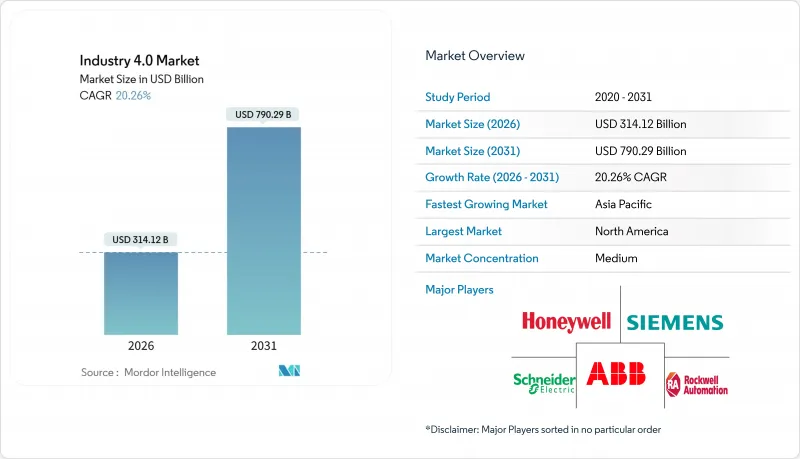
根據 Mordor Intelligence 預測,工業 4.0 市場規模預計將在 2026 年達到 3,141.2 億美元,並在 2031 年擴大到 7,902.9 億美元。
這表明在預測期內複合年成長率將達到 20.26%,凸顯了整個全球生產網路中網路和物理系統進行必要整合的結構性轉變。
本報告按技術類型(工業機器人、工業物聯網等)、元件(硬體、軟體/平台、服務)、部署模式(本地部署、雲端部署、混合部署)、最終用戶產業(離散製造、汽車等)和地區(北美、南美、歐洲、中東和非洲、亞太地區)進行細分。市場預測以美元計價。
工業4.0市場洞察與趨勢
政府支持措施和多方合作
政府計畫正透過資助試點計畫、系統化最佳實踐以及提供人力資源發展藍圖,加速網實整合系統的應用。德國投資2億歐元(約2.26億美元)建置5G測試平台,旨在2025年檢驗機器對機器(M2M)協議,從而降低中型供應商的整合風險。英國的「智慧製造」(Made Smarter)舉措撥款1.2億英鎊(約1.56億美元)支持中小型製造商的自動化,使許多項目的投資回收期縮短至三年以內。新加坡先進再製造技術中心(ARTC)與全球原始設備製造商(OEM)合作,展示了一項預測性維護計劃,成功將意外停機時間減少了40%,這一成果已被納入「智慧產業準備指數」。印度的生產連結獎勵計畫(PLI)計畫提供高達25%的資本補貼,促使電子和製藥業對協作機器人的訂單激增。這些系統性的努力將引進週期從幾年縮短到每季一次,並建立了一個事實上的標準,簡化了供應商的選擇。
工業機器人和協作機器人的需求激增
2024年,全球機器人部署量將達到54.2萬台,是10年前的兩倍,主要得益於價格下降以及模組化架構帶來的全新應用場景。預計到2025年,協作機器人(cobot)的出貨量將佔總出貨量的18%,反映出製造商正在大力推動能夠與人類工人安全共存的彈性自動化。目前,協作機器人已被應用於汽車組裝上,用於諸如擋風玻璃粘合和電池模組安裝等任務——這些任務既需要精準操作,又允許機器人與人類近距離工作。台灣和韓國的半導體代晶圓代工廠在2025年部署超過3.5萬台機器人,以彌補人手不足並實現亞微米級的良率目標。供應商正在整合視覺感測器和力/扭矩回饋功能,以實現自適應抓取,從而將自動化擴展到先前由人工完成的高混合、小批量生產環境中。
二級和三級供應商的投資報酬率存在不確定性
一項針對800家製造商的2025年調查顯示,70%的中小型供應商推遲了工業4.0投資,因為投資回收期超過五年。然而,五年這項基準與訂單的波動性並不相符。德勤的一項調查發現,到2024年,58%的中小企業推遲了自動化項目,因為生產量的波動可能導致資產在完全收回成本之前閒置。識別這些影響是一項挑戰。一家德國一級供應商投資300萬歐元(340萬美元)建立了一套數位孿生系統,但由於同時進行了多項流程變更,該公司難以確定該系統對降低12%的廢品率究竟做出了哪些貢獻。雖然補貼可以降低初始成本,但對於沒有內部工程能力的公司來說,申請流程的負擔可能過重,可能導致資金使用延遲。
細分市場分析
2025年,工業自動化技術佔銷售額的38.33%,其可程式邏輯控制器(PLC)以及對工業4.0市場至關重要的監控系統為生產線提供支援。區塊鏈目前僅佔支出的個位數百分比,但預計到2031年將以22.81%的年均成長率成長,因為監管機構正在收緊藥品和汽車零件的可追溯性法規。雀巢和沃爾瑪於2025年加入了一個由500家公司組成的食品聯盟,增強了人們對授權帳本的信心,從而確保冷鏈的完整性。工業IoT感測器佔技術預算的19%,可將振動、溫度和壓力資料匯總到預測性維護模型中。人工智慧(AI)佔14%的佔有率,主要用於視覺檢測和需求預測,但隨著邊緣晶片的出現,推理成本降低,其應用場景正在不斷擴展。隨著航太組裝降低複雜飛機操作的錯誤率,擴增實境(XR)平台的應用成長了21%。數位孿生技術佔總支出的11%,並幫助汽車製造商在投資前模擬產能變化。
積層製造技術的日益普及正在重塑備件物流系統。通用電氣航空航太公司計劃在2025年採用粉末層熔融技術生產10萬個燃油噴嘴零件,從而前置作業時間從18個月大幅縮短至3個月。邊緣運算和私有5G基礎設施佔據7%的市場佔有率,並且隨著製造商採用本地分析來滿足資料主權要求並降低雲端資料傳輸成本,其市場佔有率正在快速成長。由於汽車召回和藥品序列化等相關法規要求數據追蹤必須具有防篡改性,基於區塊鏈的工業4.0應用市場規模預計將顯著擴大。將人工智慧視覺、邊緣推理和授權型帳本結合的供應商正在工業4.0領域確立其端到端合規提供者的地位。
2025年,硬體收入佔總收入的42.21%,這反映了工業4.0市場大規模位轉型所需的機器人、感測器和邊緣伺服器等關鍵設備的採購。軟體產業預計到2031年將以21.57%的複合年成長率成長,這主要得益於從永久授權向SaaS模式的轉變,SaaS模式降低了中小企業的首年成本,並確保了持續更新。西門子MindSphere透過採用付費使用制,並將預測性維護和能源儀錶板整合到單一合約中,在2025年獲得了1200家新客戶。 SAP的「數位化製造雲」與50多個設備品牌整合,實現了跨多個地點的庫存和品質數據的統一可見性。由於買家將複雜的維修工作外包,包括整合和託管支援在內的服務收入佔總收入的31%。據羅克韋爾自動化公司稱,2025年65%的訂單都附帶了多年服務合約。
硬體投資主要集中在邊緣人工智慧加速器和智慧攝影機。英特爾計劃在2025年向工業客戶交付230萬個推理處理器,將神經網路整合到攝影機中,以便在本地處理影像並減少網路流量。監理壓力也在推動軟體需求。美國食品藥物管理局(FDA)強制要求在連續藥物生產過程中實施統計過程控制,這促使製藥廠採用即時數據歷史記錄器並與實驗室資訊系統整合。因此,基於SaaS的數位孿生、歷史記錄器和分析工具的工業4.0市場成長速度超過了硬體預算的成長速度,凸顯了工業4.0產業向數據驅動型營運的長期轉變。
區域分析
預計到2025年,北美將佔全球銷售額的35.13%,這主要得益於超大規模資料中心業者資料中心850億美元的投資,這些資料中心為模擬和人工智慧工作負載提供低延遲運算服務。預計到2025年,墨西哥將吸引400億美元的製造業投資,因為企業紛紛將生產轉移到近岸地區以降低關稅風險。這一趨勢正在推動對感測器和機器人的需求。美國製造業拓展夥伴關係(MEP)表明,中小企業能夠以可擴展的方式採用相關技術,這證實了聯邦政府的技術支援正在加速數位化技術在跨國公司以外的普及。隨著買家要求嵌入式零信任控制措施,美國網路安全和基礎設施安全局(CISA)的網路安全指南正在影響供應商的產品藍圖。
亞太地區預計到2031年將以21.18%的複合年成長率成長,這主要得益於中國1.4兆美元的「中國製造2025」計畫、印度260億美元的「生產連結獎勵計畫計畫」以及日本的「社會5.0」政策。 「社會5.0」政策旨在利用數位化工具應對勞動力老化所帶來的挑戰。韓國已投資150億美元用於智慧工廠項目,重點發展半導體和電池生產線,目標是2025年前實現亞微米級精度。新加坡的「智慧產業成熟度指數」已幫助評估了300家企業的成熟度,從而實現分階段的數位轉型,避免過度投資。
預計到2025年,歐洲將佔全球銷售額的22%,主要得益於德國的「工業4.0」平台和英國的補貼。隨著SaaS定價與現金流掛鉤,中型企業對數位孿生的投資成長了42%。歐盟的「碳邊境調節機制」於2026年1月生效,加速了能源管理系統的普及,這些系統能夠記錄排放數據以符合關稅規定。中東地區佔4%的市場佔有率,其支出主要集中在石油和天然氣行業的遠端監控方面,例如沙烏地阿美上游部門的應用。非洲佔2%的市場佔有率,但南非汽車工廠和奈及利亞食品加工廠已初見成效。然而,基礎設施不平衡和勞動力短缺阻礙了規模化發展。
其他好處:
- Excel格式的市場預測(ME)表
- 3個月的分析師支持
目錄
第1章:引言
- 研究假設和市場定義
- 調查範圍
第2章:調查方法
第3章執行摘要
第4章 市場狀況
- 市場概覽
- 市場促進因素
- 政府主導的政策和相關人員之間的合作
- 工業機器人和協作機器人需求激增
- 中小企業主導的快速數位轉型項目
- 邊緣和專用 5G 的部署可實現超低延遲的工廠網路。
- 智慧型能源和自最佳化工廠的脫碳溢價
- 人工智慧驅動的衍生設計降低了原型製作的成本和時間。
- 市場限制因素
- 二線和三線供應商的投資報酬率前景不明朗。
- 員工技能發展和工會對引進協作機器人的反對
- 與網路實體安全相關的法律責任和修補程式管理成本
- 現有資產中互通性標準的碎片化
- 產業價值鏈分析
- 監理情勢
- 技術展望
- 波特五力分析
- 宏觀經濟因素對市場的影響
第5章 市場規模與成長預測
- 依技術類型
- 工業機器人
- 工業IoT(IIoT)
- 人工智慧和機器學習
- 區塊鏈
- 擴增實境(AR/VR/MR)
- 數位孿生
- 3D列印/積層製造
- 邊緣運算和私有5G
- 按組件
- 硬體
- 軟體/平台
- 服務(整合、諮詢、支援)
- 按部署模式
- 現場
- 雲
- 混合
- 按最終用戶行業分類
- 離散製造
- 車
- 石油和天然氣
- 能源公用事業
- 電子和半導體代晶圓代工廠
- 食品/飲料
- 航太/國防
- 醫療和製藥
- 物流和倉儲
- 按地區
- 北美洲
- 美國
- 加拿大
- 墨西哥
- 南美洲
- 巴西
- 其他南美國家
- 歐洲
- 德國
- 英國
- 法國
- 義大利
- 西班牙
- 北歐的
- 其他歐洲國家
- 中東
- 沙烏地阿拉伯
- 阿拉伯聯合大公國
- 其他中東國家
- 非洲
- 南非
- 奈及利亞
- 其他非洲國家
- 亞太地區
- 中國
- 日本
- 韓國
- 印度
- 新加坡
- 澳洲
- 其他亞太國家
- 北美洲
第6章 競爭情勢
- 市場集中度
- 策略趨勢
- 市佔率分析
- 公司簡介
- ABB Ltd
- Siemens AG
- Schneider Electric SE
- Rockwell Automation Inc.
- Honeywell International Inc.
- Robert Bosch GmbH
- Emerson Electric Co.
- General Electric Co.
- Cisco Systems Inc.
- Intel Corporation
- Fanuc Corporation
- Denso Corporation
- Mitsubishi Electric Corp.
- Yaskawa Electric Corp.
- PTC Inc.
- SAP SE
- Dassault Systemes SE
- IBM Corp.
- Microsoft Corp.
- Oracle Corp.
第7章 市場機會與未來展望
According to Mordor Intelligence, the industry 4.0 market reached USD 314.12 billion in 2026 and is projected to climb to USD 790.29 billion by 2031, reflecting a 20.26% CAGR over the forecast period, underscoring the structural shift toward mandatory cyber-physical convergence across global production networks.
This report is Segmented by Technology Type (Industrial Robotics, Iiot, and More), Component (Hardware, Software/Platforms, and Services), Deployment Model (On-Premises, Cloud, and Hybrid), End-User Industry (Discrete Manufacturing, Automotive, and More), and Geography (North America, South America, Europe, Middle East, Africa, Asia-Pacific). The Market Forecasts are Provided in Terms of Value (USD).
Insights and Trends of Industry 4.0 Market
Favorable Government Initiatives And Multi-Stakeholder Collaborations
National programs are accelerating cyber-physical adoption by underwriting pilot expenses, codifying best practices, and providing workforce training roadmaps. Germany channeled EUR 200 million (USD 226 million) in 2025 to 5G testbeds that validate machine-to-machine protocols, cutting integration risk for mid-sized suppliers. The United Kingdom's Made Smarter initiative earmarked GBP 120 million (USD 156 million) to subsidize automation for smaller manufacturers, shortening payback periods to below three years for many projects. Singapore's Advanced Remanufacturing and Technology Centre partnered with global OEMs to demonstrate predictive-maintenance programs that trimmed unplanned downtime by 40%, a milestone now embedded in the Smart Industry Readiness Index. India's Production-Linked Incentive mechanism offers capital subsidies up to 25%, driving a surge in collaborative-robot orders across electronics and pharmaceutical verticals. These orchestrated efforts squeeze deployment cycles from years to quarters and create de facto standards that ease vendor selection.
Surging Demand For Industrial And Collaborative Robotics
Global robot installations reached 542,000 units in 2024, doubling the volume of a decade earlier as price declines and modular architectures unlocked new use cases. Cobots captured 18% of 2025 shipments, reflecting manufacturers' push for flexible automation that can coexist safely with human workers. Automotive assembly lines now rely on cobots for windshield bonding and battery-module insertion, tasks demanding precision but tolerant of human proximity. Semiconductor foundries across Taiwan and South Korea installed more than 35,000 robots in 2025 to offset labor shortages while meeting sub-micron yield targets. Vendors are embedding vision sensors and force-torque feedback to enable adaptive gripping, extending automation to high-mix environments previously relegated to manual labor.
Uncertain ROI Perception Among Tier-2 And Tier-3 Suppliers
A 2025 survey of 800 manufacturers revealed that 70% of smaller suppliers delayed Industry 4.0 investments due to payback horizons beyond five years, a threshold misaligned with volatile order books. Deloitte found that 58% of SMEs deferred automation projects in 2024 because potential volume swings could strand assets prior to full cost recovery. Attribution is challenging; a German tier-one spent EUR 3 million (USD 3.4 million) on a digital-twin suite yet struggled to isolate its contribution to a 12% scrap reduction because multiple process changes occurred simultaneously. While subsidies alleviate upfront costs, application paperwork can overwhelm firms without in-house engineering capacity, delaying access to funds.
Other drivers and restraints analyzed in the detailed report include:
- Rapid SME-Led Digital Transformation Programs
- Edge And Private 5G Rollouts Enabling Ultra-Low-Latency Factory Networks
- Workforce Upskilling And Union Push-Back On Cobot Adoption
For complete list of drivers and restraints, kindly check the Table Of Contents.
Segment Analysis
Industry automation technologies held 38.33% revenue in 2025, anchoring production lines with programmable logic controllers and supervisory systems vital to the Industry 4.0 market. Blockchain, though only mid-single-digit spending today, is forecast to grow at 22.81% annually through 2031 as regulators tighten traceability rules for pharmaceuticals and vehicle components. Nestle and Walmart joined a 500-member food consortium in 2025, raising confidence in permissioned ledgers for cold-chain integrity. Industrial IoT sensors captured 19% of technology budgets, funneling vibration, temperature, and pressure data into predictive-maintenance models. Artificial intelligence held 14% share, mainly vision inspection and demand forecasting, but edge-compatible chips are lowering inference costs, broadening use cases. Extended-reality platforms posted a 21% jump as aerospace assemblers cut error rates on complex airframe tasks. Digital twins represented 11% of spending, aiding automotive firms in simulating capacity changes before committing capital.
Expanded use of additive manufacturing is reshaping spare-parts logistics. GE Aerospace produced 100,000 fuel-nozzle parts via powder-bed fusion in 2025, slashing lead times from 18 months to three. Edge computing and private 5G infrastructure, at 7% share, are growing swiftly as manufacturers adopt on-premises analytics to satisfy data-sovereignty mandates and lower cloud egress fees. The Industry 4.0 market size for blockchain-centric applications is expected to widen considerably as automotive recalls and pharmaceutical serialisation laws enforce immutable data trails. Vendors combining AI vision, edge inference, and permissioned ledgers now position themselves as end-to-end compliance providers in the Industry 4.0 industry.
Hardware captured 42.21% of 2025 revenue, reflecting robot, sensor, and edge-server purchases indispensable to large-scale digitization in the Industry 4.0 market. Software is projected to grow at a 21.57% CAGR through 2031 as perpetual licenses give way to SaaS, slicing first-year costs for SMEs and ensuring continuous updates. Siemens MindSphere attracted 1,200 new clients in 2025 on pay-as-you-go rates, bundling predictive maintenance and energy dashboards under one contract. SAP Digital Manufacturing Cloud integrated with over 50 equipment brands, enabling unified visibility across multi-site inventory and quality data. Services, including integration and managed support, accounted for 31% revenue as buyers outsource complex retrofits; Rockwell Automation noted 65% of 2025 bookings carried multi-year service terms.
Hardware spending is concentrating in edge-AI accelerators and smart cameras. Intel shipped 2.3 million inference processors to industrial clients in 2025, embedding neural networks inside cameras, cutting network traffic by processing images locally. Regulatory pressure also drives software demand; the FDA requires statistical process control for continuous drug manufacturing, prompting pharma plants to adopt real-time data historians and lab-information links. In turn, the Industry 4.0 market size for SaaS-based twins, historians, and analytics tools is widening faster than hardware budgets, underscoring a secular transition toward data-driven operations within the Industry 4.0 industry.
Complete Report Scope:
- By Technology Type
- Industrial Robotics
- Industrial Internet of Things (IIoT)
- Artificial Intelligence and Machine Learning
- Blockchain
- Extended Reality (AR/VR/MR)
- Digital Twin
- 3D Printing / Additive Manufacturing
- Edge Computing and Private 5G
- By Component
- Hardware
- Software / Platforms
- Services (Integration, Consulting, Support)
- By Deployment Model
- On-Premises
- Cloud
- Hybrid
- By End-User Industry
- Discrete Manufacturing
- Automotive
- Oil and Gas
- Energy and Utilities
- Electronics and Semiconductor Foundry
- Food and Beverage
- Aerospace and Defense
- Healthcare and Pharma
- Logistics and Warehousing
- By Geography
- North America
- United States
- Canada
- Mexico
- South America
- Brazil
- Rest of South America
- Europe
- Germany
- United Kingdom
- France
- Italy
- Spain
- Nordics
- Rest of Europe
- Middle East
- Saudi Arabia
- United Arab Emirates
- Rest of Middle East
- Africa
- South Africa
- Nigeria
- Rest of Africa
- Asia-Pacific
- China
- Japan
- South Korea
- India
- Singapore
- Australia
- Rest of Asia-Pacific
- North America
Geography Analysis
North America commanded 35.13% revenue in 2025, aided by USD 85 billion hyperscaler data-center spending that supplies low-latency compute for simulations and AI workloads. Mexico drew USD 40 billion manufacturing investment in 2025 as firms nearshored to cut tariff exposure, a trend bolstering sensor and robotics demand. The U.S. Manufacturing Extension Partnership demonstrated scalable SME adoption, reinforcing that federal technical assistance accelerates digital penetration beyond multinationals. Cybersecurity guidelines from CISA are shaping vendor roadmaps as buyers demand built-in zero-trust controls.
Asia Pacific is forecast to grow at a 21.18% CAGR through 2031, powered by China's USD 1.4 trillion Made in China 2025 agenda, India's USD 26 billion Production-Linked Incentive schemes, and Japan's Society 5.0 policy that aligns digital tools with aging-workforce challenges. South Korea invested USD 15 billion in smart-factory programs in 2025, concentrating on semiconductor and battery-cell lines requiring sub-micron tolerances. Singapore's Smart Industry Readiness Index helped 300 firms benchmark maturity, enabling phased digital rollouts that avoid over-capitalization.
Europe held 22% revenue in 2025, underpinned by Germany's Industrie 4.0 platform and U.K. subsidies. Mittelstand firms ramped digital-twin investment by 42% as SaaS pricing harmonized with cash flows. The European Union's Carbon Border Adjustment Mechanism, effective January 2026, has spurred energy-management installations that log emissions data for tariff compliance. The Middle East, with 4% share, channels spending into remote monitoring for oil and gas, exemplified by Saudi Aramco's upstream deployments. Africa, at 2%, shows early gains in South African automotive plants and Nigerian food processors, although infrastructure gaps and skills shortages limit scale.
- ABB Ltd
- Siemens AG
- Schneider Electric SE
- Rockwell Automation Inc.
- Honeywell International Inc.
- Robert Bosch GmbH
- Emerson Electric Co.
- General Electric Co.
- Cisco Systems Inc.
- Intel Corporation
- Fanuc Corporation
- Denso Corporation
- Mitsubishi Electric Corp.
- Yaskawa Electric Corp.
- PTC Inc.
- SAP SE
- Dassault Systemes SE
- IBM Corp.
- Microsoft Corp.
- Oracle Corp.
Additional Benefits:
- The market estimate (ME) sheet in Excel format
- 3 months of analyst support
TABLE OF CONTENTS
1 INTRODUCTION
- 1.1 Study Assumptions and Market Definition
- 1.2 Scope of the Study
2 RESEARCH METHODOLOGY
3 EXECUTIVE SUMMARY
4 MARKET LANDSCAPE
- 4.1 Market Overview
- 4.2 Market Drivers
- 4.2.1 Favorable Government Initiatives and Multi-Stakeholder Collaborations
- 4.2.2 Surging Demand for Industrial and Collaborative Robotics
- 4.2.3 Rapid SME-Led Digital Transformation Programs
- 4.2.4 Edge and Private 5G Rollouts Enabling Ultra-Low-Latency Factory Networks
- 4.2.5 Decarbonisation Premiums for Smart-Energy, Self-Optimising Plants
- 4.2.6 AI-Powered Generative Design Cutting Prototyping Cost and Time
- 4.3 Market Restraints
- 4.3.1 Uncertain ROI Perception Among Tier-2 and Tier-3 Suppliers
- 4.3.2 Workforce Upskilling and Union Push-Back on Cobot Adoption
- 4.3.3 Cyber-Physical Security Liabilities and Patch-Management Costs
- 4.3.4 Fragmented Interoperability Standards Across Brownfield Assets
- 4.4 Industry Value Chain Analysis
- 4.5 Regulatory Landscape
- 4.6 Technological Outlook
- 4.7 Porter's Five Forces Analysis
- 4.7.1 Bargaining Power of Suppliers
- 4.7.2 Bargaining Power of Buyers
- 4.7.3 Threat of New Entrants
- 4.7.4 Threat of Substitutes
- 4.7.5 Intensity of Competitive Rivalry
- 4.8 Impact of Macroeconomic Factors on the Market
5 MARKET SIZE AND GROWTH FORECASTS (VALUE)
- 5.1 By Technology Type
- 5.1.1 Industrial Robotics
- 5.1.2 Industrial Internet of Things (IIoT)
- 5.1.3 Artificial Intelligence and Machine Learning
- 5.1.4 Blockchain
- 5.1.5 Extended Reality (AR/VR/MR)
- 5.1.6 Digital Twin
- 5.1.7 3D Printing / Additive Manufacturing
- 5.1.8 Edge Computing and Private 5G
- 5.2 By Component
- 5.2.1 Hardware
- 5.2.2 Software / Platforms
- 5.2.3 Services (Integration, Consulting, Support)
- 5.3 By Deployment Model
- 5.3.1 On-Premises
- 5.3.2 Cloud
- 5.3.3 Hybrid
- 5.4 By End-User Industry
- 5.4.1 Discrete Manufacturing
- 5.4.2 Automotive
- 5.4.3 Oil and Gas
- 5.4.4 Energy and Utilities
- 5.4.5 Electronics and Semiconductor Foundry
- 5.4.6 Food and Beverage
- 5.4.7 Aerospace and Defense
- 5.4.8 Healthcare and Pharma
- 5.4.9 Logistics and Warehousing
- 5.5 By Geography
- 5.5.1 North America
- 5.5.1.1 United States
- 5.5.1.2 Canada
- 5.5.1.3 Mexico
- 5.5.2 South America
- 5.5.2.1 Brazil
- 5.5.2.2 Rest of South America
- 5.5.3 Europe
- 5.5.3.1 Germany
- 5.5.3.2 United Kingdom
- 5.5.3.3 France
- 5.5.3.4 Italy
- 5.5.3.5 Spain
- 5.5.3.6 Nordics
- 5.5.3.7 Rest of Europe
- 5.5.4 Middle East
- 5.5.4.1 Saudi Arabia
- 5.5.4.2 United Arab Emirates
- 5.5.4.3 Rest of Middle East
- 5.5.5 Africa
- 5.5.5.1 South Africa
- 5.5.5.2 Nigeria
- 5.5.5.3 Rest of Africa
- 5.5.6 Asia-Pacific
- 5.5.6.1 China
- 5.5.6.2 Japan
- 5.5.6.3 South Korea
- 5.5.6.4 India
- 5.5.6.5 Singapore
- 5.5.6.6 Australia
- 5.5.6.7 Rest of Asia-Pacific
- 5.5.1 North America
6 COMPETITIVE LANDSCAPE
- 6.1 Market Concentration
- 6.2 Strategic Moves
- 6.3 Market Share Analysis
- 6.4 Company Profiles (includes Global Level Overview, Market Level Overview, Core Segments, Financials as Available, Strategic Information, Market Rank/Share for Key Companies, Products and Services, and Recent Developments)
- 6.4.1 ABB Ltd
- 6.4.2 Siemens AG
- 6.4.3 Schneider Electric SE
- 6.4.4 Rockwell Automation Inc.
- 6.4.5 Honeywell International Inc.
- 6.4.6 Robert Bosch GmbH
- 6.4.7 Emerson Electric Co.
- 6.4.8 General Electric Co.
- 6.4.9 Cisco Systems Inc.
- 6.4.10 Intel Corporation
- 6.4.11 Fanuc Corporation
- 6.4.12 Denso Corporation
- 6.4.13 Mitsubishi Electric Corp.
- 6.4.14 Yaskawa Electric Corp.
- 6.4.15 PTC Inc.
- 6.4.16 SAP SE
- 6.4.17 Dassault Systemes SE
- 6.4.18 IBM Corp.
- 6.4.19 Microsoft Corp.
- 6.4.20 Oracle Corp.
7 MARKET OPPORTUNITIES AND FUTURE OUTLOOK
- 7.1 White-Space and Unmet-Need Assessment

 亞洲工業4.0:市場佔有率分析、產業趨勢與統計及成長預測(2026-2031年)
 工業4.0市場預測至2034年-按組件、技術、應用、最終用戶和地區分類的全球分析
 2026年全球化學4.0市場報告2026年工業4.0人工智慧(AI)全球市場報告
 工業4.0市場規模、佔有率、成長率及全球市場分析:按類型、應用和地區分類,並預測2026-2034年
 工業4.0與智慧製造:2026-2030年2026年全球機場4.0市場報告2026年工業4.0全球市場報告
 工業4.0市場分析及預測(至2035年):依類型、產品類型、服務、技術、組件、應用、流程、最終用戶、功能、解決方案分類工業4.0全球市場規模、佔有率、趨勢和成長分析報告(2026-2034年)