


 |
市場調查報告書
商品編碼
2124249
教育領域的虛擬實境:市場佔有率分析、產業趨勢與統計及成長預測(2026-2031)Virtual Reality In Education - Market Share Analysis, Industry Trends & Statistics, Growth Forecasts (2026 - 2031) |
||||||

※ 本網頁內容可能與最新版本有所差異。詳細情況請與我們聯繫。
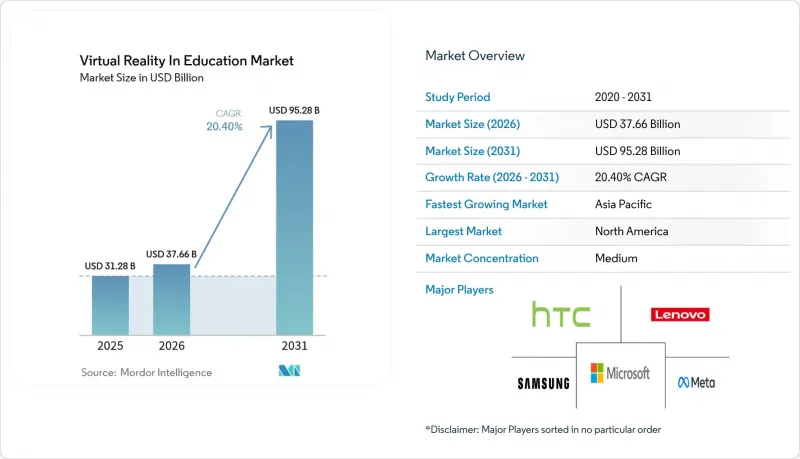
據 Mordor Intelligence 稱,2025 年教育領域的虛擬實境 (VR) 市場價值為 312.8 億美元,預計到 2031 年將達到 952.8 億美元,而 2026 年為 376.6 億美元,預測期(2026-2031 年)的複合年成長率為 20.4%。
本報告按組件(硬體、軟體、服務)、最終用戶(學術機構、企業培訓)、設備類型(獨立式頭戴裝置、有線PC- VR頭戴裝置、其他)、應用領域(STEM和技術教育、醫療保健培訓、其他)以及地區(北美、其他)進行細分。市場預測以美元計價。
全球教育領域虛擬實境市場趨勢及洞察。
互動式和個人化學習的需求日益成長
教育機構越來越重視能夠適應不同學習風格的身臨其境型學習。研究表明,VR學習者的自信心比課堂學習者高出275%,完成課程的速度也快四倍。大學指出,目前的VR課程缺乏設計思考技能,這為那些將技術嚴謹性與教學法結合的供應商創造了新的機會。人工智慧驅動的引擎能夠為每位學習者最佳化學習內容。例如,zSpace的「職業教練AI」可以將本地勞動市場數據與個人化學習路徑相匹配。可控的虛擬環境還能減輕有情緒障礙學生的焦慮,同時提升學習記憶力。隨著以學習者為中心的模式逐漸成為主流,VR教育市場正成為教育機構提升學習成果的核心基礎設施。
相關人員參與度的提高,使得他們的接受度也隨之提高。
量化結果令教育管理者、家長和企業學習與發展(L&D)負責人印象深刻。在護理課程中,當情境模擬在虛擬實境(VR)環境中進行時,參與率高達95%,而傳統臨床環境下的參與率僅為15%。製造業報告稱,在使用VR進行安全訓練後,職場減少了43%。在數學課堂上,學生透過操作3D物件來理解抽象概念,學習參與度顯著提高。 Meta與13所大學合作進行的項目,不僅提升了教育機構的信譽,也樹立了一個鼓勵其他學校效仿的典範。這些成果正在教育領域的VR市場中形成投資與接受的良性循環。
缺乏與課程相符的高品質VR內容
許多應用優先考慮娛樂性而非教育效果,導致教育工作者,尤其是在非英語市場的教育工作者,難以獲得符合學習標準的資源。教師們難以找到融合評量工具和建構主義教學方法的VR模組,儘管硬體供應充足,但VR的普及應用仍然受到阻礙。雖然醫療保健等專業領域需要符合監管要求,但經過檢驗的場景仍然稀缺。像Pearson和XR Bootcamp這樣的合作計畫代表著初步進展,但不足以滿足全球需求。在內容庫擴充之前,VR教育市場的成長不太可能跟上底層硬體能力的提升。
細分市場分析
到2025年,硬體在教育領域VR市場佔有率中佔比將達到60.72%,主要得益於學校和培訓中心對設備的日益普及。然而,服務領域預計將以22.2%的複合年成長率成長,因為教育機構越來越傾向於採用包含內容、裝置管理和分析功能的訂閱方案。預計到2031年左右,教育領域VR服務市場的規模將超過軟體銷售額。儘管由於獨立頭戴裝置價格相對親民,硬體仍然十分重要,但平台供應商已經開始提供持續更新服務,從而縮短了更換週期。
此外,訂閱模式降低了預算有限的學區進行資本投資的門檻。 ArborXR 向學習分析領域的轉型以及 zSpace 的人工智慧指導工具表明,供應商正在將其硬體業務轉型為能夠產生持續收入的生態系統。如今,能夠改善教育設計的培訓和諮詢服務已成為提案(RFP) 的關鍵組成部分。這些趨勢表明,採購模式正朝著基於結果的方向發展,從而增強了整個教育虛擬實境市場的持續收入來源。
教育機構仍佔據教育領域虛擬實境市場64.62%的佔有率,這反映了中小學和大學早期津貼的試點計畫。同時,企業培訓正以22.9%的複合年成長率快速成長,這主要得益於其在安全、合規和客戶服務等領域可衡量的投資報酬率。預計到2031年,企業在教育領域虛擬實境市場的佔有率將與學術機構持平。醫療和採礦業的公司在實施身臨其境型培訓計畫後,事故率降低了40%以上,投資回收期也縮短了。
企業正優先考慮軟性技能和產品知識模組,這推動了對與快速編寫工具和分析功能整合的需求。學術領域持續成長,但也面臨預算週期和課程核准流程等挑戰。對於供應商而言,建立能夠同時滿足這兩個領域需求的多元化產品組合,將有助於增強其在教育虛擬實境市場中應對經濟波動的能力。
區域分析
由於其強大的津貼項目和成熟的教育科技生態系統,預計到2025年,北美將佔全球收入的38.95%。政府創新津貼2.77億美元用於身臨其境型代數工具的開發,而國家科學基金會(NSF)則投資2,500萬美元用於研發,並促進與大學的合作。企業應用正在向醫療保健、零售和科技產業等領域擴展,像Interplay Learning這樣的公司正在擴展VR模組以應對人才短缺問題。這些因素正在推動教育領域虛擬實境市場的穩定擴張,但隨著應用範圍的擴大,預計成長速度將會放緩。
預計到2031年,亞太地區的複合年成長率將達到21.5%,位居全球之首。光是在中國,2025年各省就收到了超過1500萬美元的職業培訓虛擬實境實驗室建設項目競標;在日本,「DX高中」計畫為每所學校提供高達1000萬日元的津貼,用於數位化升級改造。韓國的教育機構正在採用虛擬實境技術來降低技術培訓的設備成本,這項做法引起了世界銀行研究人員的注意。這些協調一致的措施正在加速虛擬實境技術在課堂上的應用,有望縮小韓國與北美在虛擬實境教育市場的差距。
在歐洲,13億歐元的「數位歐洲計畫」預算撥款,以及額外撥給包括虛擬世界課程在內的專業學院的1.08億歐元,正推動著虛擬實境技術的發展。蘇格蘭地方政府在全國部署「ClassVR」系統,顯示地方機構正在積極採用系統化的採購方式。在南美和中東等新興市場,隨著硬體價格降至300美元以下,虛擬實境技術的普及正在推進,但基礎設施的限制目前限制著其廣泛應用。整體而言,政策的協調性和資金投入的密度仍然是預測虛擬實境教育市場區域擴張的關鍵因素。
其他好處
- Excel格式的市場預測(ME)表
- 3個月的分析師支持
目錄
第1章:引言
- 研究假設和市場定義
- 調查範圍
第2章:調查方法
第3章執行摘要
第4章 市場狀況
- 市場概覽
- 市場促進因素
- 互動式和個人化學習的需求日益成長
- 相關人員參與度的提高,使得他們的接受度也隨之提高。
- 價格下降和獨立VR頭戴裝置顯的普及
- 新冠疫情后政府和機構對教育科技的資助
- 將眼動追蹤分析整合到自適應虛擬實境中
- 透過 WebXR 標準降低整體擁有成本
- 市場限制因素
- 缺乏與課程相符的高品質VR內容
- 教育機構的初始成本和維護成本都很高。
- 課堂上生物識別資料隱私問題的擔憂
- 教師培訓面臨的挑戰和對教學方法的抵制
- 監理情勢
- 技術展望
- 產業價值鏈分析
- 波特五力分析
- 價格分析 - VR應用程式分發與定價模式
- 主要用例和實施範例
- 中國課堂實施方案
- 企業透過VR培訓提升服務品質。
- 虛擬實地考察(例如,Google探險)
- 對影響市場的宏觀經濟因素進行評估
- 投資分析
第5章 市場規模與成長預測
- 按組件
- 硬體
- 軟體
- 服務
- 最終用戶
- 學術機構
- K-12教育
- 高等教育
- 企業培訓
- 資訊科技/通訊
- 衛生保健
- 零售與電子商務
- 其他企業用戶
- 學術機構
- 依設備類型
- 獨立式耳機
- 有線PC VR頭戴裝置
- 智慧型手機相容的虛擬實境
- 混合實境(MR)頭戴式顯示器
- 按應用程式字段
- STEM(科學、技術、工程和數學)和技術教育
- 醫療衛生訓練
- 語言與藝術教育
- 職業技術技能
- 軟性技能和團隊合作
- 按地區
- 北美洲
- 美國
- 加拿大
- 墨西哥
- 南美洲
- 巴西
- 阿根廷
- 其他南美國家
- 歐洲
- 德國
- 英國
- 法國
- 西班牙
- 其他歐洲國家
- 亞太地區
- 中國
- 印度
- 日本
- 韓國
- ASEAN
- 其他亞太國家
- 中東和非洲
- 中東
- 沙烏地阿拉伯
- 阿拉伯聯合大公國
- 土耳其
- 其他中東國家
- 非洲
- 南非
- 奈及利亞
- 肯亞
- 其他非洲地區
- 中東
- 北美洲
第6章 競爭情勢
- 市場集中度
- 策略趨勢
- 市佔率分析
- 公司簡介
- Meta Platforms, Inc.
- HTC Corporation
- Lenovo Group Limited
- Samsung Electronics Co., Ltd.
- Microsoft Corporation
- Sony Group Corporation
- Alphabet Inc.
- Pico Technology Co., Ltd.
- Valve Corporation
- Unity Technologies SF
- Epic Games, Inc.
- zSpace, Inc.
- EON Reality, Inc.
- Avantis Systems Ltd.
- Veative Labs Pvt. Ltd.
- Virtalis Holdings Limited
- Nearpod, Inc.
- Labster ApS
- Immerse VR Ltd.
- VictoryXR, Inc.
- Dreamscape Immersive, Inc.
- Alchemy Immersive Limited
第7章 市場機會與未來展望
According to Mordor Intelligence, the virtual reality in education market size was valued at USD 31.28 billion in 2025 and estimated to grow from USD 37.66 billion in 2026 to reach USD 95.28 billion by 2031, at a CAGR of 20.4% during the forecast period (2026-2031).
This report is Segmented by Component (Hardware, Software, and Services), End User (Academic Institutions, and Corporate Training), Device Type (Standalone Headsets, Tethered PC-VR Headsets, and More), Application Area (STEM and Technical Education, Medical and Healthcare Training, and More), and Geography (North America, and More). The Market Forecasts are Provided in Terms of Value (USD).
Global Virtual Reality In Education Market Trends and Insights
Rising Demand for Interactive and Personalized Learning
Institutions increasingly value immersive lessons that adapt to diverse learning styles, with studies showing VR learners achieve 275% higher confidence and complete courses four times faster than classroom cohorts. Universities highlight gaps in design-thinking skills within current VR curricula, opening opportunities for providers that combine technical rigor with pedagogy. AI-driven engines tailor content to each learner; zSpace's Career Coach AI, for instance, matches local labor-market data to personalized study pathways Controlled virtual environments also reduce anxiety for students with emotional impairments while boosting retention. As learner-centric models move mainstream, the virtual reality in education market becomes core infrastructure for institutions seeking improved outcomes.
Greater Stakeholder Acceptance from Higher Engagement
Quantified gains are persuading administrators, parents, and corporate L&D heads alike. Nursing programs see 95% participation when scenarios run in VR versus 15% in traditional labs. Manufacturing firms report 43% drops in workplace injuries after VR safety drills. Classroom engagement spikes in mathematics when students manipulate 3-D objects that clarify abstract concepts. Meta's program with 13 universities demonstrates institutional confidence, creating reference sites that spur peer adoption. These outcomes generate a virtuous cycle of investment and acceptance for the virtual reality in education market.
Scarcity of Quality Curriculum-Aligned VR Content
Many applications prioritize entertainment over pedagogy, leaving educators short of materials that match learning standards, especially outside English-speaking markets. Teachers struggle to locate VR modules that embed assessment tools and constructivist methods, hampering adoption despite hardware availability. Specialized domains such as medicine need regulatory compliance, yet the pipeline of validated scenarios remains thin. Partnerships like Pearson-XR Bootcamp illustrate early progress but are insufficient to satisfy global demand. Until content libraries scale, growth of the virtual reality in education market will trail underlying hardware capability.
Other drivers and restraints analyzed in the detailed report include:
- Falling Prices and Ubiquity of Standalone VR Headsets
- Government/Institutional EdTech Funding Post-Pandemic
- Teacher Training Gaps and Pedagogical Resistance
For complete list of drivers and restraints, kindly check the Table Of Contents.
Segment Analysis
Hardware captured 60.72% of the virtual reality in education market share in 2025 on the strength of device rollouts across schools and training centers. However, the services segment is on pace for 22.2% CAGR as institutions favor subscription bundles that bundle content, device management, and analytics. The virtual reality in education market size tied to services is poised to overtake software revenue approaching 2031. Standalone headset affordability keeps hardware relevant, yet platform vendors are already bundling perpetual updates, reducing replacement cycles.
Subscription models also mitigate capital-expenditure barriers for districts with limited budgets. ArborXR's shift into learning analytics and zSpace's AI-powered guidance tools illustrate how vendors convert hardware footholds into recurring-revenue ecosystems. Training and consulting services that improve instructional design now factor prominently in RFPs. These patterns signal a pivot toward outcomes-based procurement, reinforcing recurrent income streams across the virtual reality industry.
Academic institutions still own 64.62% of the virtual reality in education, reflecting early grant-funded pilots across K-12 and universities. Yet corporate training advances at 22.9% CAGR, propelled by measurable ROI in safety, compliance, and customer-service scenarios. The virtual reality in education market size attributable to enterprises is projected to approach parity with academia by 2031. Corporations in healthcare and mining have logged 40%-plus error reductions after immersive programs, shortening payback periods.
Enterprises champion soft-skills and product-knowledge modules, fueling demand for rapid-authoring tools and analytics integrations. Academic growth continues but faces budget cycles and curriculum-approval processes. For vendors, diversified portfolios that address both segments offer resilience against economic swings within the virtual reality industry.
Complete Report Scope:
- By Component
- Hardware
- Software
- Services
- By End User
- Academic Institutions
- K-12 Learning
- Higher Education
- Corporate Training
- IT and Telecom
- Healthcare
- Retail and E-commerce
- Other Corporate Users
- Academic Institutions
- By Device Type
- Standalone Headsets
- Tethered PC-VR Headsets
- Smartphone-Enabled VR
- Mixed-Reality Head-Mounted Displays
- By Application Area
- STEM and Technical Education
- Medical and Healthcare Training
- Language and Arts Learning
- Vocational and Technical Skills
- Soft-Skills and Team Collaboration
- By Geography
- North America
- United States
- Canada
- Mexico
- South America
- Brazil
- Argentina
- Rest of South America
- Europe
- Germany
- United Kingdom
- France
- Spain
- Rest of Europe
- Asia-Pacific
- China
- India
- Japan
- South Korea
- ASEAN
- Rest of Asia-Pacific
- Middle East and Africa
- Middle East
- Saudi Arabia
- United Arab Emirates
- Turkey
- Rest of Middle East
- Africa
- South Africa
- Nigeria
- Kenya
- Rest of Africa
- Middle East
- North America
Geography Analysis
North America retained 38.95% of 2025 revenue thanks to robust grant programs and a mature EdTech ecosystem. The Administration's USD 277 million innovation grants earmark immersive algebra tools, while the National Science Foundation commits USD 25 million to R&D, seeding university partnerships. Corporate uptake spans healthcare, retail, and skilled trades as companies such as Interplay Learning scale VR modules for talent shortages. These forces keep the virtual reality market in education expanding at a healthy clip, though growth moderates as penetration rises.
Asia Pacific is set to log the fastest regional CAGR of 21.5% through 2031. China's provinces issued tenders exceeding USD 15 million for vocational VR labs in 2025 alone, while Japan's DX High School scheme funds up to JPY 10 million per campus for digital upgrades. South Korean institutions deploy VR to cut equipment costs in technical training, an approach highlighted by World Bank researchers. These coordinated policies accelerate classroom integration, positioning Asia Pacific to narrow its gap with North America in the virtual reality in education market.
Europe benefits from the Digital Europe Programme's EUR 1.3 billion allocation and EUR 108 million for specialist academies that include virtual-worlds curricula. Scotland's council-wide ClassVR rollout shows regional bodies embracing systemic procurement. Emerging markets in South America and the Middle East follow as hardware prices dip below USD 300, though infrastructure constraints still curb immediate uptake. Overall, policy alignment and funding density remain the primary predictors of regional traction for the virtual reality in education market.
- Meta Platforms, Inc.
- HTC Corporation
- Lenovo Group Limited
- Samsung Electronics Co., Ltd.
- Microsoft Corporation
- Sony Group Corporation
- Alphabet Inc.
- Pico Technology Co., Ltd.
- Valve Corporation
- Unity Technologies SF
- Epic Games, Inc.
- zSpace, Inc.
- EON Reality, Inc.
- Avantis Systems Ltd.
- Veative Labs Pvt. Ltd.
- Virtalis Holdings Limited
- Nearpod, Inc.
- Labster ApS
- Immerse VR Ltd.
- VictoryXR, Inc.
- Dreamscape Immersive, Inc.
- Alchemy Immersive Limited
Additional Benefits:
- The market estimate (ME) sheet in Excel format
- 3 months of analyst support
TABLE OF CONTENTS
1 INTRODUCTION
- 1.1 Study Assumptions and Market Definition
- 1.2 Scope of the Study
2 RESEARCH METHODOLOGY
3 EXECUTIVE SUMMARY
4 MARKET LANDSCAPE
- 4.1 Market Overview
- 4.2 Market Drivers
- 4.2.1 Rising demand for interactive and personalized learning
- 4.2.2 Greater stakeholder acceptance from higher engagement
- 4.2.3 Falling prices and ubiquity of standalone VR headsets
- 4.2.4 Government/Institutional EdTech funding post-COVID
- 4.2.5 Integration of eye-tracking analytics for adaptive VR
- 4.2.6 WebXR standards lowering total cost of ownership
- 4.3 Market Restraints
- 4.3.1 Scarcity of quality curriculum-aligned VR content
- 4.3.2 High upfront and maintenance costs for institutions
- 4.3.3 Biometric data-privacy concerns in classrooms
- 4.3.4 Teacher training gaps and pedagogical resistance
- 4.4 Regulatory Landscape
- 4.5 Technological Outlook
- 4.6 Industry Value Chain Analysis
- 4.7 Porter's Five Forces Analysis
- 4.7.1 Bargaining Power of Suppliers
- 4.7.2 Bargaining Power of Consumers
- 4.7.3 Threat of New Entrants
- 4.7.4 Threat of Substitutes
- 4.7.5 Intensity of Competitive Rivalry
- 4.8 Pricing Analysis - VR App Distribution and Pricing Models
- 4.9 Key Use-Cases and Implementation Case Studies
- 4.9.1 China's classroom roll-out programmes
- 4.9.2 Corporate VR training for service standardisation
- 4.9.3 Virtual field trips (e.g., Google Expeditions)
- 4.10 Assessment of Macroeconomic Factors on the Market
- 4.11 Investment Analysis
5 MARKET SIZE AND GROWTH FORECASTS (VALUE)
- 5.1 By Component
- 5.1.1 Hardware
- 5.1.2 Software
- 5.1.3 Services
- 5.2 By End User
- 5.2.1 Academic Institutions
- 5.2.1.1 K-12 Learning
- 5.2.1.2 Higher Education
- 5.2.2 Corporate Training
- 5.2.2.1 IT and Telecom
- 5.2.2.2 Healthcare
- 5.2.2.3 Retail and E-commerce
- 5.2.2.4 Other Corporate Users
- 5.2.1 Academic Institutions
- 5.3 By Device Type
- 5.3.1 Standalone Headsets
- 5.3.2 Tethered PC-VR Headsets
- 5.3.3 Smartphone-Enabled VR
- 5.3.4 Mixed-Reality Head-Mounted Displays
- 5.4 By Application Area
- 5.4.1 STEM and Technical Education
- 5.4.2 Medical and Healthcare Training
- 5.4.3 Language and Arts Learning
- 5.4.4 Vocational and Technical Skills
- 5.4.5 Soft-Skills and Team Collaboration
- 5.5 By Geography
- 5.5.1 North America
- 5.5.1.1 United States
- 5.5.1.2 Canada
- 5.5.1.3 Mexico
- 5.5.2 South America
- 5.5.2.1 Brazil
- 5.5.2.2 Argentina
- 5.5.2.3 Rest of South America
- 5.5.3 Europe
- 5.5.3.1 Germany
- 5.5.3.2 United Kingdom
- 5.5.3.3 France
- 5.5.3.4 Spain
- 5.5.3.5 Rest of Europe
- 5.5.4 Asia-Pacific
- 5.5.4.1 China
- 5.5.4.2 India
- 5.5.4.3 Japan
- 5.5.4.4 South Korea
- 5.5.4.5 ASEAN
- 5.5.4.6 Rest of Asia-Pacific
- 5.5.5 Middle East and Africa
- 5.5.5.1 Middle East
- 5.5.5.1.1 Saudi Arabia
- 5.5.5.1.2 United Arab Emirates
- 5.5.5.1.3 Turkey
- 5.5.5.1.4 Rest of Middle East
- 5.5.5.2 Africa
- 5.5.5.2.1 South Africa
- 5.5.5.2.2 Nigeria
- 5.5.5.2.3 Kenya
- 5.5.5.2.4 Rest of Africa
- 5.5.5.1 Middle East
- 5.5.1 North America
6 COMPETITIVE LANDSCAPE
- 6.1 Market Concentration
- 6.2 Strategic Moves
- 6.3 Market Share Analysis
- 6.4 Company Profiles (includes Global level Overview, Market level overview, Core Segments, Financials as available, Strategic Information, Market Rank/Share for key companies, Products and Services, and Recent Developments)
- 6.4.1 Meta Platforms, Inc.
- 6.4.2 HTC Corporation
- 6.4.3 Lenovo Group Limited
- 6.4.4 Samsung Electronics Co., Ltd.
- 6.4.5 Microsoft Corporation
- 6.4.6 Sony Group Corporation
- 6.4.7 Alphabet Inc.
- 6.4.8 Pico Technology Co., Ltd.
- 6.4.9 Valve Corporation
- 6.4.10 Unity Technologies SF
- 6.4.11 Epic Games, Inc.
- 6.4.12 zSpace, Inc.
- 6.4.13 EON Reality, Inc.
- 6.4.14 Avantis Systems Ltd.
- 6.4.15 Veative Labs Pvt. Ltd.
- 6.4.16 Virtalis Holdings Limited
- 6.4.17 Nearpod, Inc.
- 6.4.18 Labster ApS
- 6.4.19 Immerse VR Ltd.
- 6.4.20 VictoryXR, Inc.
- 6.4.21 Dreamscape Immersive, Inc.
- 6.4.22 Alchemy Immersive Limited
7 MARKET OPPORTUNITIES AND FUTURE OUTLOOK
- 7.1 White-space and Unmet-Need Assessment

 虛擬實境(VR)全球市場規模、佔有率、趨勢和成長分析報告(2026-2034)
 基於太空的虛擬實境(VR)市場規模、佔有率和成長分析:按產品、應用、最終用戶和地區分類-2026-2033年產業預測
 虛擬實境(VR):市場佔有率分析、產業趨勢與統計數據、成長預測(2026-2031)
 觸覺虛擬實境市場-2026-2032年全球市場預測虛擬實境市場:依技術、組件、設備和最終用戶分類-2026-2032年全球市場預測VR/AR/MR(虛擬實境/擴增實境/混合實境):市場佔有率分析、產業趨勢和統計數據、成長預測(2026-2031)
 虛擬實境療法市場規模、佔有率及成長分析(慢性疼痛):依療法、疼痛適應症、給藥平台、最終用戶、患者年齡層及地區分類-2026-2033年產業預測
 2026年全球會議與遠距臨場系統市場報告
 元宇宙驅動的教育市場預測至2034年:按組件、部署模式、技術、組織規模、應用、最終用戶和地區分類的全球分析2026年全球遠距臨場系統視訊會議市場報告