


 |
市場調查報告書
商品編碼
2124231
抗菌消毒劑:市場佔有率分析、行業趨勢和統計數據以及成長預測(2026-2031 年)Antiseptics And Disinfectants - Market Share Analysis, Industry Trends & Statistics, Growth Forecasts (2026 - 2031) |
||||||

※ 本網頁內容可能與最新版本有所差異。詳細情況請與我們聯繫。
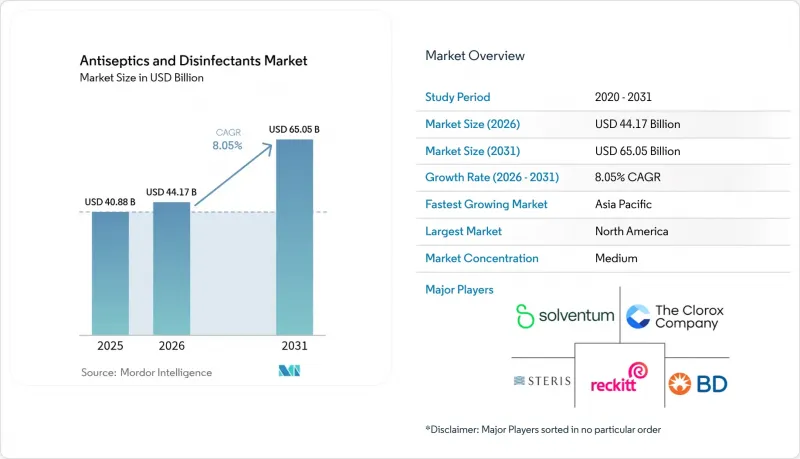
根據 Mordor Intelligence 預測,抗菌和消毒劑市場預計將從 2025 年的 408.8 億美元成長到 2026 年的 441.7 億美元,到 2031 年達到 650.5 億美元,2026 年至 2031 年的複合年成長率為 8.05%。
本報告按產品類型(季銨化合物及其他)、劑型(液體、噴霧劑/氣霧劑、擦拭巾、凝膠/泡沫)、應用(表面消毒劑及其他)、最終用戶(醫院/診所及其他)和地區(北美、歐洲、亞太、中東/非洲、南美)進行細分。市場預測以美元計價。
全球抗菌消毒劑市場趨勢及洞察
醫院感染帶來的負擔在全球日益嚴重。
在任何一天,每31名住院患者中就有1人會感染醫療相關感染疾病(HAI),每年新增數百萬例可預防的病例。儘管2023-2024年間中央靜脈導管和導管相關感染疾病有所下降,但腹部子宮切除術部位感染疾病的增加抵消了這一降幅,暴露出醫護人員在遵循操作規程方面存在的不足。成本研究表明,單次中心靜脈導管相關血流感染的成本可高達99,900美元,而未感染患者的成本僅為8,500美元,這迫使醫院採用高性能的表面和醫療設備消毒劑。 [1] 美國醫院獲得性疾病減少計畫(HACRP)的報銷削減進一步加劇了這種財務緊迫性。急性照護和長期照護機構之間的差異為提供整合培訓、藥物輸送設備和合規性分析的承包消毒服務創造了新的機會。
永久實施疫情後設施衛生規程
由於新冠疫情的影響,清潔頻率的增加如今已成為醫療保健和商業房地產等各領域的正式操作流程。加拿大將於2025年5月生效的《除生物劑法規》規定了更高的功效和安全標準,與疫情期間的標準類似。利潔時(Reckitt)的Lysol空氣消毒劑是首個獲得美國環保署(EPA)批准,可有效殺滅空氣傳播病原體的產品,它充分體現了新的監管框架如何開拓相鄰領域並促進品牌優質化。房東擴大將消毒頻率納入租賃協議,支出也從一次性清潔產品購買轉向多年服務合約。藝康集團(Ecolab)的機構部門透過銷售可自動訂購補貨的物聯網連接分配器,將衛生合規轉變為一項管理服務,並在2024年第四季實現了6%的內部成長。
多個地區有嚴格的化學品登記和標籤要求
歐洲化學品管理局 (ECHA) 對乙醇的審查始於 2024 年,但預計將延長至 2026 年,這將導致該產品在所有 27 個成員國的上市受阻[3]。美國環保署 (EPA) 於 2024 年 6 月制定的殘留物檢測方法將使每個 SKU 的檢驗成本增加 5 萬至 10 萬美元。加州有毒物質控制部 (DTSC) 可能將季銨化合物指定為“優先產品”,這將迫使對更安全的替代品進行分析,從而影響 400 家醫院。加拿大的三級除生物劑監管規定可能需要對新的活性成分進行長達 24 個月的審查,進一步延長產品上市時間。小規模製造商缺乏同時處理多項申請所需的監管負責人,並且正在被能夠將合規成本分攤到其全球產品系列中的跨國公司蠶食市場佔有率。
細分市場分析
由於季銨化合物具有廣譜殺菌作用且每次使用成本低,預計到2025年,其在抗菌消毒劑市場銷售額中佔比將達27.43%。同時,酵素性清潔劑的市場需求持續成長,預計到2031年將以10.43%的複合年成長率成長,這主要得益於其能夠有效去除複雜關節鏡刮刀和機器人手術器械上的生物膜,同時避免腐蝕。酵素基抗菌消毒劑的市場規模預計將從2026年的61億美元增加到2031年的111億美元。目前,採用ISO 14644輪調方案的醫院每季交替使用酵素基、氧化型和季銨類產品,以控制微生物的適應性。 2024年,對殘留物接受度極低的製藥無塵室為藝康生命科學部門貢獻了兩位數的成長。
在水處理系統消毒領域,氯基化合物仍然佔據主導地位,而醛類和酚類產品由於加州有毒物質控制部(DTSC)的監管而市場佔有率不斷下降。酒精類產品在乾洗手劑市場佔據主導地位,但由於異丙醇價格預計到2025年將在每噸1,300美元至1,600美元之間波動,其原料成本波動較大。優碘鼻內拭子可在10分鐘內達到99.7%的微生物滅菌率,顯示小眾給藥系統可獲得高價。在抗菌劑和消毒劑市場,獲得與機器人手術用金屬和聚合物材料相容性認證的供應商仍然備受青睞,這降低了手術室管理人員的風險。
到2025年,散裝液體產品將佔配方銷售額的51.25%,這主要得益於抗菌消毒劑市場中地板清潔和器械浸泡應用的需求成長。同時,擦拭巾的複合年成長率(CAGR)為10.78%,因為門診診所更傾向於使用一次性產品,以避免稀釋誤差。 Sani-Cloth採用一種織物,可在整個接觸時間內保持季銨鹽活性成分,該特性已獲得美國環保署(EPA)的檢驗。因此,該公司的產品在美國臨床擦拭巾市場中佔據領先地位。與同等濃度的濃縮液液相比,每罐預浸泡濕巾的毛利率可提高30-40%,這為製造商提供了轉向這種產品的盈利動力。
噴霧劑和氣霧劑產品,例如“Lysol空氣消毒劑”,在獲得美國環保署(EPA)批准其在空氣中的有效性後,已證明其作為一種新型抗菌給藥途徑的有效性。凝膠和泡沫,特別是符合世界衛生組織(WHO)標準的70%酒精配方,在外科洗手消毒中越來越受歡迎,因為防止滴漏至關重要。擦拭巾將消毒劑、塗抹工具和劑量整合於單一產品單元(SKU)中,簡化了採購負責人的庫存管理,從而進一步促進了其應用。消毒擦拭巾的普及使抗菌和消毒劑市場受益,擦拭巾減少了日間手術中心(ASC)高週轉率手術室的停機時間。
區域分析
預計到2025年,北美將佔全球銷售額的42.32%,並將繼續保持抗菌和消毒產品最大市場的地位。這主要得益於聯邦醫療保險(Medicare)對醫院感染的嚴格處罰以及該地區成熟的感染控制人員配備體系。北美完善的基礎設施正在推動加值服務包的普及,這些服務包能夠減輕護理人員的工作負擔,並以電子方式記錄合規性。原料價格的壓力,尤其是異丙醇價格的波動,持續影響處方集的使用,並增加了濃縮濕紙巾的吸引力,因為濃縮擦拭巾可以減輕運輸重量。
亞太地區預計將以9.43%的複合年成長率成長至2031年,主要成長動力來自中國計畫到2024年新增13萬張病床,以及印度計畫到2027年新增60萬張病床。高病床運轉率推動了配備自動消毒劑分發系統的新型隔離病房的建設。已獲得ISO 13485認證並實施基於雲端的庫存管理系統的跨國公司正在贏得主導印度市場的私人醫院連鎖機構的競標。
在歐洲,除生物劑法規的複雜性限制了市場表現。由於歐盟生物製品法規(BPR)對乙醇的審查(審查於2024年啟動),產品上市已被暫時擱置,儘管預計最終所有27個成員國的功效標準將趨於統一。在中東和非洲,醫療旅遊的專科醫院計畫正在穩步推進,從而提振了對經美國環保署(EPA)註冊和歐盟CE認證的消毒劑的需求。南美洲的銷售成長正在放緩。巴西的統一醫療系統採用集中競標採購,優先考慮最低價格,這促使了本地合約配製業務的發展。
其他好處
- Excel格式的市場預測(ME)表
- 3個月的分析師支持
目錄
第1章:引言
- 研究假設和市場定義
- 調查範圍
第2章:調查方法
第3章執行摘要
第4章 市場狀況
- 市場概覽
- 市場促進因素
- 醫院感染帶來的負擔日益嚴重,在全球日益凸顯。
- 永久實施疫情後設施衛生規程。
- 手術數量的增加以及複雜醫療設備的再處理
- 醫院和門診護理基礎設施的快速擴張
- 嚴格的職業安全法規要求消毒。
- 消費者越來越傾向於使用預防性自我護理消毒劑
- 市場限制因素
- 多個地區有嚴格的化學品登記和標籤要求
- 先進醫療設備中材料相容性的局限性
- 主要原料(醇類、季銨鹽、氯氣)價格波動
- 耐消毒劑微生物的出現
- 價值供應鏈分析
- 監理情勢
- 技術展望
- 波特五力分析
第5章 市場規模與成長預測
- 依產品類型
- 季銨化合物
- 氯化合物
- 醇和醛
- 雙胍類衍生物和碘類衍生物
- 酵素
- 酚類及其他
- 配方
- 液體
- 噴霧劑和氣霧劑
- 擦拭巾
- 凝膠泡沫
- 透過使用
- 表面消毒劑
- 醫療設備消毒劑
- 酵素性清潔劑
- 皮膚和傷口消毒劑
- 最終用戶
- 醫院和診所
- 門診及日間手術中心
- 長期照護機構
- 製藥和生物技術製造
- 其他
- 按地區
- 北美洲
- 美國
- 加拿大
- 墨西哥
- 歐洲
- 德國
- 英國
- 法國
- 義大利
- 西班牙
- 其他歐洲國家
- 亞太地區
- 中國
- 日本
- 印度
- 澳洲
- 韓國
- 其他亞太國家
- 中東和非洲
- GCC
- 南非
- 其他中東和非洲國家
- 南美洲
- 巴西
- 阿根廷
- 南美洲其他地區
- 北美洲
第6章 競爭情勢
- 市場集中度
- 市佔率分析
- 公司簡介
- BASF SE
- Becton Dickinson & Co.(BD)
- Cardinal Health Inc.
- The Clorox Company
- Diversey Holdings, Ltd.
- Ecolab Inc.
- GSK Plc
- GOJO Industries, Inc.
- Johnson & Johnson(Ethicon, ASP)
- Kimberly-Clark Corporation
- Lonza Group AG
- Metrex Research, LLC
- Molnlycke Health Care AB
- Procter & Gamble Co.
- Reckitt Benckiser Group Plc
- Schulke & Mayr GmbH
- Solventum Corporation
- STERIS Plc
- Whiteley Corporation
第7章 市場機會與未來展望
According to Mordor Intelligence, the antiseptics and disinfectants market size is expected to increase from USD 40.88 billion in 2025 to USD 44.17 billion in 2026 and reach USD 65.05 billion by 2031, growing at a CAGR of 8.05% over 2026-2031.
This report is Segmented by Product Type (Quaternary Ammonium Compounds, and More), Formulation (Liquids, Sprays & Aerosols, Wipes, and Gels & Foams), Application (Surface Disinfectants, and More), End User (Hospitals & Clinics, and More), and Geography (North America, Europe, Asia-Pacific, Middle East & Africa, and South America). The Market Forecasts are Provided in Terms of Value (USD).
Global Antiseptics And Disinfectants Market Trends and Insights
Escalating Burden of Healthcare-Associated Infections Worldwide
Healthcare-associated infections (HAIs) affect 1 in 31 inpatients on any given day, adding millions of preventable cases each year. Declines in central-line and catheter infections between 2023 and 2024 have been offset by rising abdominal-hysterectomy site infections, exposing gaps in protocol adherence. Cost studies show that a single central-line bloodstream infection can cost up to USD 99,900 in care, compared with USD 8,500 for uninfected patients, pressing hospitals to adopt advanced surface and device disinfectants[1]. Reimbursement penalties under the U.S. Hospital-Acquired Condition Reduction Program amplify this financial urgency. A divergence between acute-care and long-term-care settings creates white-space for turnkey disinfection-as-a-service offerings that blend training, dosing hardware, and compliance analytics.
Post-Pandemic Institutional Hygiene Protocols Becoming Permanent
COVID-19 elevated cleaning frequencies that have now crystallized into formal operating procedures across healthcare and commercial real estate. Canada's Biocides Regulations, effective May 2025, codify higher efficacy and safety standards that mirror the pandemic era. EPA approval of Reckitt's Lysol Air Sanitizer-the first agent cleared for airborne pathogen claims-illustrates how regulatory novelty opens adjacent categories and drives brand premium. Landlords increasingly include disinfection cadence in lease covenants, shifting spend from ad hoc janitorial supplies to multi-year service contracts. Ecolab's Institutional segment logged 6% organic growth in Q4 2024 by selling IoT-linked dispensers that auto-reorder refills, turning hygiene compliance into a managed service.
Stringent Multi-Region Chemical Registration Requirements
The European Chemicals Agency's review of ethanol, opened in 2024, is likely to extend into 2026, freezing product launches across 27 member states[3]. The U.S. EPA's June 2024 residue test methods add USD 50,000-100,000 in validation costs per SKU. California's Department of Toxic Substances Control may list quaternary ammonium compounds as a Priority Product, forcing safer-alternative analyses that ripple through 400 hospitals. Canada's three-tier Biocides Regulations can require up to 24 months of review for novel actives, lengthening time-to-market. Small manufacturers lack the regulatory staff to navigate simultaneous dossiers, ceding share to multinationals that amortize compliance across global portfolios.
Other drivers and restraints analyzed in the detailed report include:
- Rising Surgical Procedure Volumes and Complex Device Reprocessing
- Rapid Expansion of Hospitals and Ambulatory Care Infrastructure
- Material Compatibility Limitations with Advanced Medical Devices
For complete list of drivers and restraints, kindly check the Table Of Contents.
Segment Analysis
Quaternary ammonium compounds accounted for 27.43% of 2025 revenue in the Antiseptics and Disinfectants market, benefiting from a broad spectrum of microbicidal activity and low per-dose cost. Yet enzymatic cleaners are growing at 10.43% CAGR through 2031, fueled by the need to break down biofilms on complex arthroscopic shavers and robotic instruments without corrosion. The Antiseptics and Disinfectants market size for enzymatic formulations is projected to expand from USD 6.1 billion in 2026 to USD 11.1 billion by 2031. Hospitals adopting ISO 14644 rotation protocols now cycle enzymatic, oxidizing, and quaternary products each quarter to blunt microbial adaptation. Pharmaceutical cleanrooms, where residue tolerance is minimal, contributed double-digit gains to Ecolab's Life Sciences sales in 2024.
Chlorine compounds remain staples for water-system disinfection, while aldehydes and phenolics retreat under regulatory scrutiny from California's DTSC. Alcohols dominate hand antisepsis but face input cost swings as isopropyl prices hover between USD 1,300-1,600 per ton into 2025. Povidone-iodine intranasal swabs that deliver 99.7% microbial reduction in 10 minutes illustrate how niche delivery systems can command premium pricing. The Antiseptics and Disinfectants market continues to reward suppliers that certify material compatibility with robotic-surgery metals and polymers, reducing risk for operating-room managers.
Bulk liquids delivered 51.25% of formulation revenue in 2025, driven by floor-cleaning and instrument-soak applications in the Antiseptics and Disinfectants market. Wipes, however, are growing at a 10.78% CAGR, as outpatient centers prefer single-use formats that eliminate dilution errors. Sani-Cloth leads the U.S. clinical wipe segment with a fabric that retains quaternary actives throughout the full contact time, a feature validated by the EPA. Each pre-saturated canister commands 30-40% higher gross margin than an equivalent liter of concentrate, giving manufacturers a profit motive to push conversion.
Sprays and aerosols, such as Lysol Air Sanitizer, validate new delivery vectors for antimicrobials after securing EPA approval for airborne claims. Gels and foams, especially 70% alcohol formulations that meet WHO standards, gain traction for surgical-scrub applications where drip control matters. Because wipes ship disinfectant, applicator, and dose in a single SKU, procurement officers can simplify inventory management, thereby furthering adoption. The Antiseptics and Disinfectants market benefits from wipes, which shorten turnover times in crowded ASC schedules.
Complete Report Scope:
- By Product Type
- Quaternary Ammonium Compounds
- Chlorine Compounds
- Alcohols & Aldehydes
- Biguanides & Iodine Derivatives
- Enzymes
- Phenolics & Others
- By Formulation
- Liquids
- Sprays & Aerosols
- Wipes
- Gels & Foams
- By Application
- Surface Disinfectants
- Medical-Device Disinfectants
- Enzymatic Cleaners
- Skin & Wound Antiseptics
- By End User
- Hospitals & Clinics
- Ambulatory & Day-Surgery Centers
- Long-Term Care Facilities
- Pharma & Biotech Manufacturing
- Other End Users
- Geography
- North America
- United States
- Canada
- Mexico
- Europe
- Germany
- United Kingdom
- France
- Italy
- Spain
- Rest of Europe
- Asia-Pacific
- China
- Japan
- India
- Australia
- South Korea
- Rest of Asia-Pacific
- Middle East & Africa
- GCC
- South Africa
- Rest of Middle East & Africa
- South America
- Brazil
- Argentina
- Rest of South America
- North America
Geography Analysis
North America, with 42.32% of 2025 revenue, remains the largest Antiseptics and Disinfectants market owing to strict Medicare penalties for hospital-acquired conditions and mature infection-control staffing models. The region's mature infrastructure favors premium service bundles that reduce nursing workload and electronically document compliance. Raw-material pricing pressure, notably volatility in isopropyl alcohol, continues to squeeze formularies and elevate the appeal of concentrated wipes that reduce shipment weight.
Asia-Pacific is projected to lead growth at 9.43% CAGR through 2031, underpinned by China's 130,000 new beds added in 2024 and India's planned 600,000 beds by 2027. High bed-occupancy rates are driving the construction of new isolation wards, each fitted with automated disinfectant dosing systems. Multinationals with ISO 13485 certification and cloud-based stock controls win tenders from private hospital chains dominating India's market.
Europe's performance is tempered by the complexity of biocide regulation. The ethanol review under EU BPR, opened in 2024, has paused product launches but will ultimately harmonize efficacy criteria across 27 member states. The Middle East and Africa enjoy a steady pipeline of specialty hospitals aimed at medical tourists, spurring demand for EPA-registered and CE-marked disinfectants. South America sees slower unit growth; Brazil's Unified Health System procures through centralized tenders that emphasize the lowest bid, encouraging local toll blending.
- BASF
- Becton Dickinson & Co. (BD)
- Cardinal Health
- The Clorox Company
- Diversey Holdings, Ltd.
- Ecolab
- GlaxoSmithKline
- GOJO Industries, Inc.
- Johnson & Johnson (Ethicon, ASP)
- Kimberly-Clark Worldwide
- Lonza Group
- Metrex Research, LLC
- Molnlycke Health Care
- Procter & Gamble
- Reckitt Benckiser Group
- Schulke & Mayr GmbH
- Solventum Corporation
- STERIS Plc
- Whiteley Corporation
Additional Benefits:
- The market estimate (ME) sheet in Excel format
- 3 months of analyst support
TABLE OF CONTENTS
1 Introduction
- 1.1 Study Assumptions & Market Definition
- 1.2 Scope Of The Study
2 Research Methodology
3 Executive Summary
4 Market Landscape
- 4.1 Market Overview
- 4.2 Market Drivers
- 4.2.1 Escalating Burden of Healthcare-Associated Infections Worldwide
- 4.2.2 Post-Pandemic Institutional Hygiene Protocols Becoming Permanent
- 4.2.3 Rising Surgical Procedure Volumes and Complex Device Reprocessing
- 4.2.4 Rapid Expansion of Hospitals and Ambulatory Care Infrastructure
- 4.2.5 Stringent Occupational Safety Regulations Mandating Disinfection
- 4.2.6 Growing Consumer Shift Toward Preventive Self-Care Antiseptics
- 4.3 Market Restraints
- 4.3.1 Stringent Multi-Region Chemical Registration & Labeling Requirements
- 4.3.2 Material Compatibility Limitations With Advanced Medical Devices
- 4.3.3 Volatility in Key Raw Material Prices (Alcohols, QACs, Chlorine)
- 4.3.4 Emergence of Disinfectant-Resistant Microorganisms
- 4.4 Value / Supply-Chain Analysis
- 4.5 Regulatory Landscape
- 4.6 Technological Outlook
- 4.7 Porter's Five Forces Analysis
- 4.7.1 Threat Of New Entrants
- 4.7.2 Bargaining Power Of Buyers
- 4.7.3 Bargaining Power Of Suppliers
- 4.7.4 Threat Of Substitutes
- 4.7.5 Intensity Of Competitive Rivalry
5 Market Size & Growth Forecasts (Value, USD)
- 5.1 By Product Type
- 5.1.1 Quaternary Ammonium Compounds
- 5.1.2 Chlorine Compounds
- 5.1.3 Alcohols & Aldehydes
- 5.1.4 Biguanides & Iodine Derivatives
- 5.1.5 Enzymes
- 5.1.6 Phenolics & Others
- 5.2 By Formulation
- 5.2.1 Liquids
- 5.2.2 Sprays & Aerosols
- 5.2.3 Wipes
- 5.2.4 Gels & Foams
- 5.3 By Application
- 5.3.1 Surface Disinfectants
- 5.3.2 Medical-Device Disinfectants
- 5.3.3 Enzymatic Cleaners
- 5.3.4 Skin & Wound Antiseptics
- 5.4 By End User
- 5.4.1 Hospitals & Clinics
- 5.4.2 Ambulatory & Day-Surgery Centers
- 5.4.3 Long-Term Care Facilities
- 5.4.4 Pharma & Biotech Manufacturing
- 5.4.5 Other End Users
- 5.5 Geography
- 5.5.1 North America
- 5.5.1.1 United States
- 5.5.1.2 Canada
- 5.5.1.3 Mexico
- 5.5.2 Europe
- 5.5.2.1 Germany
- 5.5.2.2 United Kingdom
- 5.5.2.3 France
- 5.5.2.4 Italy
- 5.5.2.5 Spain
- 5.5.2.6 Rest of Europe
- 5.5.3 Asia-Pacific
- 5.5.3.1 China
- 5.5.3.2 Japan
- 5.5.3.3 India
- 5.5.3.4 Australia
- 5.5.3.5 South Korea
- 5.5.3.6 Rest of Asia-Pacific
- 5.5.4 Middle East & Africa
- 5.5.4.1 GCC
- 5.5.4.2 South Africa
- 5.5.4.3 Rest of Middle East & Africa
- 5.5.5 South America
- 5.5.5.1 Brazil
- 5.5.5.2 Argentina
- 5.5.5.3 Rest of South America
- 5.5.1 North America
6 Competitive Landscape
- 6.1 Market Concentration
- 6.2 Market Share Analysis
- 6.3 Company Profiles {(Includes Global Level Overview, Market Level Overview, Core Segments, Financials as Available, Strategic Information, Market Rank/Share for Key Companies, Products & Services, and Recent Developments)}
- 6.3.1 BASF SE
- 6.3.2 Becton Dickinson & Co. (BD)
- 6.3.3 Cardinal Health Inc.
- 6.3.4 The Clorox Company
- 6.3.5 Diversey Holdings, Ltd.
- 6.3.6 Ecolab Inc.
- 6.3.7 GSK Plc
- 6.3.8 GOJO Industries, Inc.
- 6.3.9 Johnson & Johnson (Ethicon, ASP)
- 6.3.10 Kimberly-Clark Corporation
- 6.3.11 Lonza Group AG
- 6.3.12 Metrex Research, LLC
- 6.3.13 Molnlycke Health Care AB
- 6.3.14 Procter & Gamble Co.
- 6.3.15 Reckitt Benckiser Group Plc
- 6.3.16 Schulke & Mayr GmbH
- 6.3.17 Solventum Corporation
- 6.3.18 STERIS Plc
- 6.3.19 Whiteley Corporation
7 Market Opportunities & Future Outlook
- 7.1 White-Space & Unmet-Need Assessment

 消毒劑和殺菌劑市場:策略性洞察與預測(2026-2031 年)
 食品消毒劑市場報告:趨勢、預測和競爭分析(至2035年)
 溴硝醇市場:全球市場預測,2026-2032年防腐劑和消毒劑市場-2026-2032年全球市場預測消毒劑市場-2026-2032年全球市場預測高級消毒服務市場-全球市場預測(2026-2032年)抗菌食品消毒劑市場-2026-2032年全球市場預測
 溴硝醇市場規模、佔有率和成長分析:按類型、應用、功能、劑型、最終用戶產業、分銷管道和地區分類-2026-2033年產業預測
 美國抗菌消毒劑市場:市場佔有率分析、產業趨勢與統計及成長預測(2026-2031年)
 高級消毒服務市場:全球產業規模、市場佔有率、趨勢、機會和預測(按服務、最終用戶和地區分類)、競爭格局(2021-2031 年)