

 |
市場調查報告書
商品編碼
2124223
電磁場模擬軟體:市場佔有率分析、產業趨勢與統計、成長預測(2026-2031)Electromagnetic Simulation Software - Market Share Analysis, Industry Trends & Statistics, Growth Forecasts (2026 - 2031) |
||||||

※ 本網頁內容可能與最新版本有所差異。詳細情況請與我們聯繫。
根據 Mordor Intelligence 預測,電磁場模擬軟體市場規模預計將在 2026 年達到 16.6 億美元,到 2031 年達到 27 億美元,2026 年至 2031 年的複合年成長率將達到 10.22%。
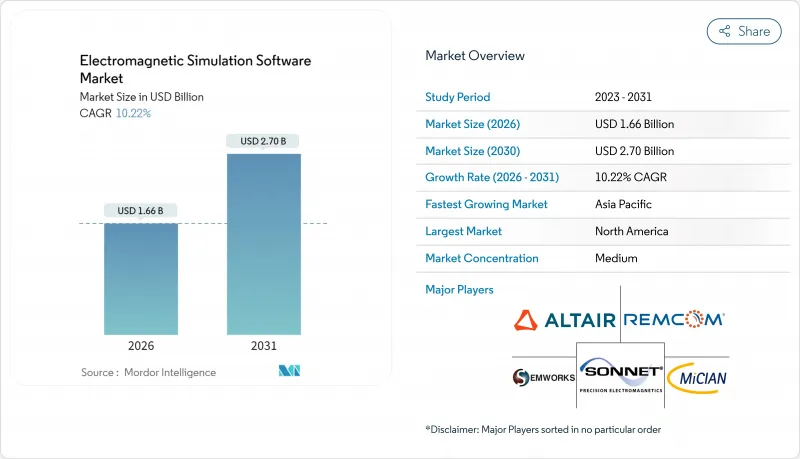
本報告按求解器類型(積分和微分方程求解器、漸近方法及其他)、部署模式(本地部署、雲端部署及其他)、應用領域(天線設計與分析及其他)、最終用戶產業(電訊、航太與國防及其他)、頻段(靜態/直流、射頻、微波及其他)和地區進行細分。市場預測以美元計價。
全球電磁場模擬軟體市場趨勢及洞察
5G/6G 基礎設施的擴展正在推動對先進天線和射頻設計工具的需求不斷成長。
到2025年,電信業者將運作超過150萬個5G基地台。此外,從6GHz以下大型基地台到毫米波小型基地台的轉變,也帶來了傳統射線追蹤軟體無法以所需精度處理的電磁現象。為了模擬大規模相位陣列陣的互連、掃描電阻漂移和柵瓣抑制,全波求解器正在推動電信設備供應商投資於結合有限元素法和積分方程法的混合方法。日本的「超越5G推進聯盟」累計500億日圓(約3.4億美元)用於2024年兆赫收發器的研究。這要求模擬供應商將求解器的頻率範圍擴展到300GHz以上,並引入基於石墨烯的超表面的量子修正材料模型。 Keysight 的「PathWave Design 2025」透過基於機器學習的天線綜合技術,將設計迭代次數減少了 40%,從而加劇了工期緊迫的基地台專案競爭。即將推出的 ITU IMT-2030 指南要求供應商能夠模擬可重構智慧表面和全像成形技術,這些應用對精度的要求遠高於傳統漸近方法。
向基於雲端的模擬平台遷移,以實現協作工程工作流程
隨著工程團隊將高效能叢集的資本投資轉向「基於核心時間」的收費模式,到2025年,42%的新增電磁場模擬授權將雲端部署,高於2023年的28%。 Cadence OnCloud在Amazon Web Services和Microsoft Azure上提供Clarity 3D Solver實例,可將突發性工作負載的整體擁有成本降低約30%。 Ansys Cloud Direct在Electronics Desktop介面中整合了彈性擴充功能,讓工程師無需編寫批次腳本即可卸載時域有限差分掃描。雲端原生平台 OnScale 在 2025 年上半年電磁場模擬作業量年增 150%,這主要得益於醫療設備製造商加快了符合 IEC 62209 標準的無線植入比吸收率 (SAR) 測試。安全需求使得國防和半導體產業的使用者仍然選擇在本地部署,但混合架構正在興起,在這種架構中,敏感幾何資料保存在本地儲存庫中,而場求解則在私有雲端中運行。
HPC 授權和硬體需求帶來的整體擁有成本 (TCO) 較高。
一級電磁求解器的價格為每個許可證 5 萬至 15 萬美元,年度維護成本最高可達初始成本的 22%。生產工作負載通常需要配備 128 至 512 個叢集核心的叢集、用於加速時域有限差分法 (FDTD) 的圖形處理器 (GPU) 以及低延遲互連,這些都可能使硬體預算超過 50 萬美元。由於缺乏供應商資金籌措和區域雲端中心,南美、中東和非洲的中小型企業在性能低下的工作站上面臨求解器執行時間過長的問題。雖然 Altair憑證式的HyperWorks 許可提供了更大的柔軟性,但其應用仍然集中在北美和歐洲,這些地區的企業合約佔據主導地位。受生成式人工智慧訓練需求的推動,預計 2025 年初將出現 GPU供不應求,這將使工作站交付時間延長至多六個月,給設計進度帶來壓力。
細分市場分析
以求解器類型分析電磁場模擬軟體市場規模,預計到2025年,有限元素方法解決方案將佔銷售額的28%,主要得益於馬達、變壓器和MRI線圈的設計需求。隨著半導體晶圓廠採用時域有限差分法(FDTD)對3nm以下節點的片上天線進行協同仿真,此方法預計將以13.5%的複合年成長率成長。在該方法中,電磁耦合與電晶體模型在單一時間推進循環中相互作用,推動了電磁場模擬軟體市場的整體收入成長。雖然矩量法在處理電大雷達面積問題時仍佔據主導地位,但要處理超過10個波長的尺度,則需要使用多層高速多極子方法來加速。 Altair公司的Feko 2024.1利用圖形處理器(GPU)在NVIDIA A100叢集上實現了6倍加速,使其對相位陣列開發人員的吸引力日益增強。
混合求解器結合了有限元素方法和積分方程式方法,兼顧了材料的通用性和開放邊界的效率,從而推動了其在電磁場模擬軟體市場佔有率的成長。達梭系統公司整合到 3DEXPERIENCE 平台中的 CST Studio 套件報告稱,到 2025 年,隨著 5G 大規模 MIMO 設計人員將天線陣列分類為有限元素域和自由空間邊界,混合求解器的許可數量將成長 25%。雖然漸近方法、物理光學、幾何光學和均勻衍射理論在波長遠小於平台尺寸的雷達特徵預測中仍然有用,但隨著對更高精度需求的增加,它們的收入僅佔 12%。有限積分技術和傳輸線矩陣求解器正被用於一些特殊的瞬態現象(例如雷擊)和電磁相容性 (EMC) 研究,其中結構化網格可以彌補表面限制。
由於國防、汽車和半導體產業的使用者需要保護其專有資料免受公共網路的侵害,到2025年,本地部署方案的收入佔比將達到58%。儘管如此,雲端收入仍以16.5%的複合年成長率成長,預計將逐步削弱本地部署解決方案在電磁場模擬軟體市場的主導地位。到2025年,混合雲端電磁場模擬軟體的市佔率將達到18%,因為供應商採用了聯合代幣授權來追蹤本地和雲端節點的使用情況,並簡化預算預測。
過去,延遲問題曾阻礙了互動式工作流程,但如今,毗鄰設計辦公室的邊緣運算區域能夠實現低於 50 毫秒的往返處理時間。西門子 Simcenter 雲端高效能運算 (HPC) 服務由服務等級協定 (SLA) 提供支持,在歐洲和北美的資料中心提供專用實例,並正在迅速被一級汽車零件供應商所採用。這在知識產權管理和運算彈性之間取得了平衡。 OnScale 的無伺服器架構無需本地安裝,並將部署時間縮短至幾分鐘,這對於那些難以投資硬體叢集的醫療設備新創公司來說極具吸引力。
區域分析
到2025年,北美將佔全球銷售額的36%。這其中包括為雷達訊號特徵建模的大型國防公司、為液冷機架進行電磁相容性(EMC)研究的超大規模資料中心業者,以及為電動車檢驗雷達模組的一級汽車供應商。美國國防部已在2025財政年度累計12億美元用於電子戰系統,其中一部分將用於電磁場模擬軟體的授權。加拿大於2024年中期拍賣了3.8GHz頻段,以刺激天線陣列的研發投資。根據《美墨加協定》(USMCA)的規定,墨西哥2024年的汽車產量將超過350萬輛,因此,汽車製造商(OEM)在出口前必須在國內進行電磁相容性(EMC)模擬。
預計亞太地區2026年至2031年的複合年成長率將達到12.8%。中國移動計畫在2025年部署超過70萬個5G基地台,這將推動對大規模MIMO陣列模擬技術的需求。日本的「超越5G促進聯盟」正在資助兆赫研究,而韓國計畫在2028年進行6G現場試驗。印度Reliance Jio公司於2025年1月累計5億美元用於國產電信設備的研發,這將支持國內電磁場模擬相關支出。在日本,預計到2025年,30%的新車將配備4D雷達,這將擴大對符合CISPR 25標準的求解器許可證的需求。
到2025年,歐洲將佔總銷售額的22%,這主要得益於空中巴士和泰雷茲等公司採購用於基於DO-160和STANAG 4370標準的航空電子設備電磁相容性(EMC)評估的求解器。德國2024年410萬輛的汽車產量也催生了對電控系統(ECU)認證所需解算器處理能力的需求。此外,英國2.5億英鎊(約3.15億美元)的5G多元化基金為需要先進天線設計的開放式無線接取網路(ORA)供應商提供了支援。南美洲和中東及非洲地區合計佔2025年總銷售額的6%,但受到高昂的總擁有成本和有限的計算基礎設施的限制。不過,位於聖保羅、杜拜和約翰尼斯堡的區域資料中心正在拓展雲端存取的可能性。
其他好處
- Excel格式的市場預測(ME)表
- 3個月的分析師支持
目錄
第1章:引言
- 研究假設和市場定義
- 調查範圍
第2章:調查方法
第3章執行摘要
第4章 市場狀況
- 市場概覽
- 市場促進因素
- 5G/6G 基礎設施的擴展正在推動對先進天線和射頻設計工具的需求不斷成長。
- 向基於雲端的模擬平台遷移,以實現協作工程工作流程
- 擴大人工智慧驅動的替代模型的使用,以加快設計週期。
- 汽車雷達和ADAS感測器在電動車和自動駕駛汽車中的應用日益廣泛。
- 所有行業都應制定更嚴格的全球電磁干擾/電磁相容性法規
- 即時系統健康監測和數位孿生技術在預測性維護的應用。
- 市場限制因素
- HPC 授權和硬體需求帶來的整體擁有成本 (TCO) 較高。
- 熟練的計算電磁工程師短缺
- 將傳統CAD與EDA工作流程整合的複雜性
- 兆赫頻段大規模模型精度的局限性
- 產業價值鏈分析
- 宏觀經濟因素對市場的影響
- 監理情勢
- 技術展望
- 波特五力分析
第5章 市場規模與成長預測
- 求解器類型
- 積分和微分方程求解器
- 有限元素法(FEM)
- 有限差分時域法(FDTD)
- 矩量法(MoM)
- 多層快速多極子方法(MLFMM)
- 有限積分技術(FIT)
- 傳輸線矩陣(TLM)
- 漸近法
- 物理光學(PO)
- 幾何光學(GO)
- 均勻衍射理論(UTD)
- 混合及其他數值分析方法
- 混合有限元素-IE求解器
- 有限積分法(FIM)
- 積分和微分方程求解器
- 按部署模式
- 現場
- 基於雲端的
- 混合
- 透過使用
- 天線設計與分析
- 行動裝置的電磁特性
- 汽車雷達和ADAS感測器
- 電磁相容性(EMC/EMI)
- 無線傳播和通道建模
- 其他應用(生物醫學和醫療保健領域的電路協同模擬和訊號完整性、超材料和光電等)
- 按最終用途行業分類
- 電訊
- 汽車和運輸業
- 航太/國防
- 家用電子產品
- 醫療保健和醫療設備
- 工業自動化和物聯網
- 其他終端用戶產業
- 按頻段
- 靜電/直流
- 低頻(低於30MHz)
- 射頻(30MHz 至 3GHz)
- 微波(3-30 GHz)
- 毫米波(30-300 GHz)
- 兆赫(超過 300GHz)
- 按地區
- 北美洲
- 美國
- 加拿大
- 墨西哥
- 南美洲
- 巴西
- 阿根廷
- 其他南美國家
- 歐洲
- 德國
- 法國
- 英國
- 其他歐洲國家
- 亞太地區
- 中國
- 日本
- 印度
- 韓國
- 其他亞太國家
- 中東
- 土耳其
- 沙烏地阿拉伯
- 阿拉伯聯合大公國
- 其他中東國家
- 非洲
- 南非
- 其他非洲國家
- 北美洲
第6章 競爭情勢
- 市場集中度
- 策略趨勢
- 市佔率分析
- 公司簡介
- ANSYS Inc.
- Dassault Systemes SE
- Keysight Technologies Inc.
- Cadence Design Systems Inc.
- Altair Engineering Inc.
- COMSOL AB
- Siemens Digital Industries Software
- Hexagon AB(MSC Software)
- Synopsys Inc.
- National Instruments Corporation
- ESI Group SA
- Remcom Inc.
- EMPIRE(IMST GmbH)
- WIPL-D doo
- Mician GmbH
- Sonnet Software Inc.
- ElectroMagneticWorks Inc.
- EMWorks Inc.
- ZMT Zurich MedTech AG(Sim4Life)
- EMCoS Ltd.
第7章 市場機會與未來展望
According to Mordor Intelligence, the electromagnetic simulation software market size reached USD 1.66 billion in 2026 and is projected to advance to USD 2.70 billion by 2031, reflecting a robust 10.22% CAGR during 2026-2031.
This report is Segmented by Solver Type (Integral and Differential Equation Solvers, Asymptotic, and More), Deployment (On-Premise, Cloud, and More), Application (Antenna Design and Analysis, and More), End-Use (Telecommunications, Aerospace and Defense, and More), Frequency (Static/DC, Radio Frequency, Microwave, and More), and Geography. The Market Forecasts are in Terms of Value (USD).
Global Electromagnetic Simulation Software Market Trends and Insights
Expansion of 5G/6G Infrastructure Demanding Advanced Antenna and RF Design Tools
Operators activated more than 1.5 million 5G base stations during 2025, and the migration from sub-6 GHz macro cells to millimeter-wave small cells exposes electromagnetic phenomena that older ray-tracing software cannot handle at the required accuracy. Full-wave solvers model mutual coupling, scan impedance drift, and grating-lobe suppression across large phased arrays, prompting telecom equipment vendors to invest in hybrid finite element-integral equation methods. Japan's Beyond 5G Promotion Consortium budgeted JPY 50 billion (USD 340 million) in 2024 for terahertz transceiver research, which obliges simulation vendors to extend solver ranges beyond 300 GHz and to incorporate quantum-corrected material models for graphene-based metasurfaces. Keysight's PathWave Design 2025 uses machine-learning-assisted antenna synthesis to cut design iterations by 40%, enhancing competitiveness in time-sensitive base-station programs. Compliance with forthcoming ITU IMT-2030 guidelines will push vendors to simulate reconfigurable intelligent surfaces and holographic beamforming, use-cases that exceed the fidelity of classical asymptotic techniques.
Shift Toward Cloud-Based Simulation Platforms for Collaborative Engineering Workflows
Cloud deployments represented 42% of new electromagnetic simulation licenses in 2025, rising from 28% in 2023, as engineering teams replace capital expenditure on high-performance clusters with per-core-hour billing. Cadence OnCloud provisions Clarity 3D Solver instances on Amazon Web Services and Microsoft Azure, paring total ownership cost by roughly 30% for bursty workloads. Ansys Cloud Direct embeds elastic scaling inside the Electronics Desktop interface, allowing engineers to offload finite difference time domain sweeps without writing batch scripts. OnScale, a cloud-native platform, logged a 150% year-on-year rise in electromagnetic jobs during H1 2025 as medical-device makers accelerated specific absorption rate studies for wireless implants under IEC 62209. Security mandates keep defense and semiconductor users on-premise, but hybrid architectures that keep sensitive geometry in local vaults while executing field solves in private clouds are gaining momentum.
High Total Cost of Ownership for HPC Licenses and Hardware Requirements
Tier-1 electromagnetic solvers carry list prices between USD 50,000 and USD 150,000 per seat, with annual maintenance adding up to 22% of the initial fee. Production workloads often demand clusters with 128-512 CPU cores, graphics processing units for finite difference time domain acceleration, and low-latency interconnects that can lift hardware budgets beyond USD 500,000. Small and medium enterprises in South America, Middle East and Africa lack vendor financing and regional cloud centers, resulting in extended solver runtimes on underpowered workstations. Altair's token-based HyperWorks license improves flexibility, yet uptake remains concentrated in North America and Europe where enterprise agreements dominate. GPU shortages through early 2025, caused by demand from generative-AI training, stretched workstation delivery times by up to six months, squeezing design schedules.
Other drivers and restraints analyzed in the detailed report include:
- Increasing Use of AI-Powered Surrogate Models to Accelerate Design Cycles
- Growing Adoption of Automotive Radar and ADAS Sensors in Electric and Autonomous Vehicles
- Shortage of Skilled Computational Electromagnetics Engineers
For complete list of drivers and restraints, kindly check the Table Of Contents.
Segment Analysis
The electromagnetic simulation software market size for solver type shows finite element method solutions holding 28% revenue in 2025, anchored by electric-motor, transformer, and MRI-coil design needs. Finite difference time domain is forecast to grow at a 13.5% CAGR as semiconductor fabs adopt it for on-chip antenna co-simulation at sub-3-nm nodes, where electromagnetic coupling interacts with transistor models in a single time-marching loop, driving incremental revenue across the electromagnetic simulation software market. Method of moments remains a staple for electrically large radar cross-section problems but requires multilevel fast multipole method acceleration to scale beyond 10 wavelengths. Altair's Feko 2024.1 leverages graphics processing units to deliver a six-fold speed-up on NVIDIA A100 clusters, widening its appeal among phased-array developers.
Hybrid finite element-integral equation solvers bridge material versatility with open-boundary efficiency, explaining their growing share of the electromagnetic simulation software market. CST Studio Suite, now integrated within Dassault Systemes' 3DEXPERIENCE platform, reported a 25% uplift in hybrid-solver licenses in 2025 as 5G massive MIMO designers partition antenna arrays into finite element regions and free-space boundaries. Asymptotic techniques physical optics, geometric optics, and uniform theory of diffraction retain utility for radar signature prediction where the wavelength is much smaller than platform dimensions; however, they represent only 12% revenue as accuracy demands climb. Finite integration technique and transmission-line matrix solvers serve niche transient lightning-strike and electromagnetic compatibility studies where structured grids offset curved-surface limitations.
On-premise deployments captured 58% of 2025 revenue as defense, automotive, and semiconductor users shield proprietary geometry from public networks. Despite this base, cloud revenue is rising at a 16.5% CAGR and is poised to erode on-premise dominance in the electromagnetic simulation software market. The electromagnetic simulation software market share of hybrid cloud reached 18% in 2025 as vendors rolled out federated token licensing that tracks consumption across local and cloud nodes, smoothing budget forecasting.
Latency concerns once hindered interactive workflows, yet edge-compute zones adjacent to design offices now offer sub-50 ms round-trip times. Siemens' Simcenter Cloud HPC delivers dedicated instances in European and North American data centers backed by service-level agreements, and uptake has been brisk among tier-1 automotive suppliers, balancing intellectual property control with compute elasticity. OnScale's serverless architecture eliminates local installation and reduces ramp-up time to minutes, appealing to start-ups in medical devices that cannot fund hardware clusters.
Complete Report Scope:
- By Solver Type
- Integral and Differential Equation Solvers
- Finite Element Method (FEM)
- Finite Difference Time Domain (FDTD)
- Method of Moments (MoM)
- Multilevel Fast Multipole Method (MLFMM)
- Finite Integration Technique (FIT)
- Transmission Line Matrix (TLM)
- Asymptotic Techniques
- Physical Optics (PO)
- Geometric Optics (GO)
- Uniform Theory of Diffraction (UTD)
- Hybrid and Other Numerical Methods
- Hybrid FEM-IE Solvers
- Finite Integral Method (FIM)
- Integral and Differential Equation Solvers
- By Deployment Model
- On-Premise
- Cloud-Based
- Hybrid
- By Application
- Antenna Design and Analysis
- Mobile Device Electromagnetics
- Automotive Radar and ADAS Sensors
- Electromagnetic Compatibility (EMC/EMI)
- Wireless Propagation and Channel Modelling
- Other Applications (Biomedical and Healthcare Circuit Co-Simulation and Signal Integrity, Metamaterials and Photonics, and others)
- By End-Use Industry
- Telecommunications
- Automotive and Transportation
- Aerospace and Defense
- Consumer Electronics
- Healthcare and Medical Devices
- Industrial Automation and IoT
- Other End-Use Industries
- By Frequency Range
- Static / DC
- Low Frequency (< 30 MHz)
- Radio Frequency (30 MHz - 3 GHz)
- Microwave (3 - 30 GHz)
- Millimeter Wave (30 - 300 GHz)
- Terahertz (> 300 GHz)
- By Geography
- North America
- United States
- Canada
- Mexico
- South America
- Brazil
- Argentina
- Rest of South America
- Europe
- Germany
- France
- United Kingdom
- Rest of Europe
- Asia-Pacific
- China
- Japan
- India
- South Korea
- Rest of Asia-Pacific
- Middle East
- Turkey
- Saudi Arabia
- United Arab Emirates
- Rest of Middle East
- Africa
- South Africa
- Rest of Africa
- North America
Geography Analysis
North America accounted for 36% of 2025 revenue thanks to defense primes modeling radar signatures, hyperscalers performing electromagnetic compatibility studies on liquid-cooled racks, and automotive tier-1s validating radar modules for electric vehicles. The United States Department of Defense budgeted USD 1.2 billion in FY 2025 for electronic-warfare systems, a portion allocated to electromagnetic simulation software licenses. Canada auctioned 3.8 GHz spectrum in mid-2024, spurring antenna-array R&D investments. Mexico's production of more than 3.5 million vehicles in 2024 pressed OEMs to perform in-country electromagnetic compatibility simulations before export under the United States-Mexico-Canada Agreement rules.
Asia-Pacific is projected to grow at a 12.8% CAGR from 2026-2031. China Mobile rolled out over 700,000 5G base stations in 2025, catalyzing demand for massive-MIMO array simulation. Japan's Beyond 5G Promotion Consortium funds terahertz research, while South Korea schedules 6G field trials for 2028. India's Reliance Jio earmarked USD 500 million in January 2025 for indigenous telecom equipment, underpinning domestic electromagnetic simulation spending. Japan integrated 4D radar into 30% of new vehicles during 2025, boosting CISPR 25-driven solver licenses.
Europe generated 22% of 2025 revenue, led by Airbus and Thales purchasing solvers for avionics electromagnetic compatibility under DO-160 and STANAG 4370 standards. Germany's production of 4.1 million vehicles in 2024 necessitated solver capacity to certify electronic control units, and the United Kingdom's GBP 250 million (USD 315 million) 5G diversification fund backed open-radio-access-network vendors requiring advanced antenna design. South America and Middle East and Africa together formed 6% of 2025 revenue, constrained by high total cost of ownership and limited compute infrastructure, but regional data centers in Sao Paulo, Dubai, and Johannesburg are widening cloud accessibility.
- ANSYS Inc.
- Dassault Systemes SE
- Keysight Technologies Inc.
- Cadence Design Systems Inc.
- Altair Engineering Inc.
- COMSOL AB
- Siemens Digital Industries Software
- Hexagon AB (MSC Software)
- Synopsys Inc.
- National Instruments Corporation
- ESI Group SA
- Remcom Inc.
- EMPIRE (IMST GmbH)
- WIPL-D d.o.o.
- Mician GmbH
- Sonnet Software Inc.
- ElectroMagneticWorks Inc.
- EMWorks Inc.
- ZMT Zurich MedTech AG (Sim4Life)
- EMCoS Ltd.
Additional Benefits:
- The market estimate (ME) sheet in Excel format
- 3 months of analyst support
TABLE OF CONTENTS
1 INTRODUCTION
- 1.1 Study Assumptions and Market Definition
- 1.2 Scope of the Study
2 RESEARCH METHODOLOGY
3 EXECUTIVE SUMMARY
4 MARKET LANDSCAPE
- 4.1 Market Overview
- 4.2 Market Drivers
- 4.2.1 Expansion of 5G/6G Infrastructure Demanding Advanced Antenna and RF Design Tools
- 4.2.2 Shift Toward Cloud-Based Simulation Platforms for Collaborative Engineering Workflows
- 4.2.3 Increasing Use of AI-Powered Surrogate Models to Accelerate Design Cycles
- 4.2.4 Growing Adoption of Automotive Radar and ADAS Sensors in Electric and Autonomous Vehicles
- 4.2.5 Rising Stringency of Global EMI/EMC Regulations Across Industries
- 4.2.6 Deployment of Digital Twins for Real-Time System Health and Predictive Maintenance
- 4.3 Market Restraints
- 4.3.1 High Total Cost of Ownership for HPC Licenses and Hardware Requirements
- 4.3.2 Shortage of Skilled Computational Electromagnetics Engineers
- 4.3.3 Integration Complexity with Legacy CAD and EDA Workflows
- 4.3.4 Accuracy Limitations at Terahertz Frequencies for Large-Scale Models
- 4.4 Industry Value Chain Analysis
- 4.5 Impact of Macroeconomic Factors on the Market
- 4.6 Regulatory Landscape
- 4.7 Technological Outlook
- 4.8 Porter's Five Forces Analysis
- 4.8.1 Bargaining Power of Suppliers
- 4.8.1.1 Bargaining Power of Buyers
- 4.8.1.2 Threat of New Entrants
- 4.8.1.3 Threat of Substitute Products
- 4.8.1.4 Intensity of Competitive Rivalry
- 4.8.1 Bargaining Power of Suppliers
5 MARKET SIZE AND GROWTH FORECASTS (VALUE)
- 5.1 By Solver Type
- 5.1.1 Integral and Differential Equation Solvers
- 5.1.1.1 Finite Element Method (FEM)
- 5.1.1.2 Finite Difference Time Domain (FDTD)
- 5.1.1.3 Method of Moments (MoM)
- 5.1.1.4 Multilevel Fast Multipole Method (MLFMM)
- 5.1.1.5 Finite Integration Technique (FIT)
- 5.1.1.6 Transmission Line Matrix (TLM)
- 5.1.2 Asymptotic Techniques
- 5.1.2.1 Physical Optics (PO)
- 5.1.2.2 Geometric Optics (GO)
- 5.1.2.3 Uniform Theory of Diffraction (UTD)
- 5.1.3 Hybrid and Other Numerical Methods
- 5.1.3.1 Hybrid FEM-IE Solvers
- 5.1.3.2 Finite Integral Method (FIM)
- 5.1.1 Integral and Differential Equation Solvers
- 5.2 By Deployment Model
- 5.2.1 On-Premise
- 5.2.2 Cloud-Based
- 5.2.3 Hybrid
- 5.3 By Application
- 5.3.1 Antenna Design and Analysis
- 5.3.2 Mobile Device Electromagnetics
- 5.3.3 Automotive Radar and ADAS Sensors
- 5.3.4 Electromagnetic Compatibility (EMC/EMI)
- 5.3.5 Wireless Propagation and Channel Modelling
- 5.3.6 Other Applications (Biomedical and Healthcare Circuit Co-Simulation and Signal Integrity, Metamaterials and Photonics, and others)
- 5.4 By End-Use Industry
- 5.4.1 Telecommunications
- 5.4.2 Automotive and Transportation
- 5.4.3 Aerospace and Defense
- 5.4.4 Consumer Electronics
- 5.4.5 Healthcare and Medical Devices
- 5.4.6 Industrial Automation and IoT
- 5.4.7 Other End-Use Industries
- 5.5 By Frequency Range
- 5.5.1 Static / DC
- 5.5.2 Low Frequency (< 30 MHz)
- 5.5.3 Radio Frequency (30 MHz - 3 GHz)
- 5.5.4 Microwave (3 - 30 GHz)
- 5.5.5 Millimeter Wave (30 - 300 GHz)
- 5.5.6 Terahertz (> 300 GHz)
- 5.6 By Geography
- 5.6.1 North America
- 5.6.1.1 United States
- 5.6.1.2 Canada
- 5.6.1.3 Mexico
- 5.6.2 South America
- 5.6.2.1 Brazil
- 5.6.2.2 Argentina
- 5.6.2.3 Rest of South America
- 5.6.3 Europe
- 5.6.3.1 Germany
- 5.6.3.2 France
- 5.6.3.3 United Kingdom
- 5.6.3.4 Rest of Europe
- 5.6.4 Asia-Pacific
- 5.6.4.1 China
- 5.6.4.2 Japan
- 5.6.4.3 India
- 5.6.4.4 South Korea
- 5.6.4.5 Rest of Asia-Pacific
- 5.6.5 Middle East
- 5.6.5.1 Turkey
- 5.6.5.2 Saudi Arabia
- 5.6.5.3 United Arab Emirates
- 5.6.5.4 Rest of Middle East
- 5.6.6 Africa
- 5.6.6.1 South Africa
- 5.6.6.2 Rest of Africa
- 5.6.1 North America
6 COMPETITIVE LANDSCAPE
- 6.1 Market Concentration
- 6.2 Strategic Moves
- 6.3 Market Share Analysis
- 6.4 Company Profiles (includes Global Level Overview, Market Level Overview, Core Segments, Financials as available, Strategic Information, Market Rank/Share for Key Companies, Products and Services, and Recent Developments)
- 6.4.1 ANSYS Inc.
- 6.4.2 Dassault Systemes SE
- 6.4.3 Keysight Technologies Inc.
- 6.4.4 Cadence Design Systems Inc.
- 6.4.5 Altair Engineering Inc.
- 6.4.6 COMSOL AB
- 6.4.7 Siemens Digital Industries Software
- 6.4.8 Hexagon AB (MSC Software)
- 6.4.9 Synopsys Inc.
- 6.4.10 National Instruments Corporation
- 6.4.11 ESI Group SA
- 6.4.12 Remcom Inc.
- 6.4.13 EMPIRE (IMST GmbH)
- 6.4.14 WIPL-D d.o.o.
- 6.4.15 Mician GmbH
- 6.4.16 Sonnet Software Inc.
- 6.4.17 ElectroMagneticWorks Inc.
- 6.4.18 EMWorks Inc.
- 6.4.19 ZMT Zurich MedTech AG (Sim4Life)
- 6.4.20 EMCoS Ltd.
7 MARKET OPPORTUNITIES AND FUTURE OUTLOOK
- 7.1 White-Space and Unmet-Need Assessment

 全球模擬軟體市場規模、佔有率、趨勢和成長分析報告(2026-2034)
 航太模擬軟體市場分析及預測(至2035年):依類型、產品、服務、技術、組件、應用、部署、最終用戶、功能及解決方案分類
 模擬軟體:市場佔有率分析、產業趨勢與統計、成長預測(2026-2031)
 模擬軟體市場-2026-2032年全球市場預測
 2026-2030年全球模擬軟體市場
 全球電磁場模擬軟體市場:機會與策略展望(至2035年)2026年全球工作模擬市場報告2026年全球離散事件模擬軟體市場報告
 智慧工廠模擬軟體市場預測至2034年-按軟體類型、組件、企業規模、應用、最終用戶和地區分類的全球分析
 引擎聲音模擬晶片市場報告:趨勢、預測和競爭分析(至2035年)