


 |
市場調查報告書
商品編碼
2124164
射頻前端模組:市場佔有率分析、產業趨勢與統計、成長預測(2026-2031)RF Front End Module - Market Share Analysis, Industry Trends & Statistics, Growth Forecasts (2026 - 2031) |
||||||

※ 本網頁內容可能與最新版本有所差異。詳細情況請與我們聯繫。
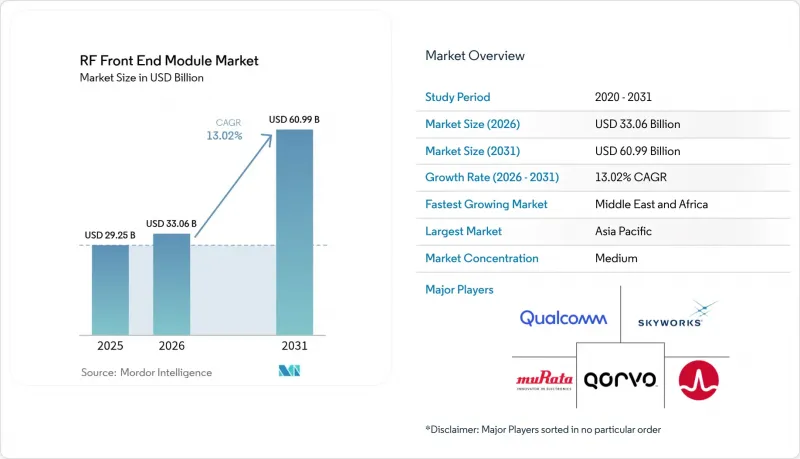
根據 Mordor Intelligence 預測,射頻前端模組市場規模將從 2025 年的 292.5 億美元成長到 2026 年的 330.6 億美元,然後在 2031 年達到 609.9 億美元,2026 年至 2031 年的複合年成長率為 13.02%。
本報告按組件(功率放大器、雙工器和分複用器、濾波器、開關、低雜訊放大器、天線調諧器)、應用(家用電子電器、汽車、無線通訊、工業、航太與國防及其他應用)、頻段(6 GHz 以下及其他)和地區進行細分。市場預測以美元計價。
全球射頻前端模組市場趨勢及洞察
6GHz 以下頻段智慧型手機中 5G 設計的應用程式呈現爆炸性成長
由於電信業者在部署服務時優先考慮廣覆蓋,因此6GHz以下頻段成為射頻前端模組市場的主要驅動力。三星採用SKY5平台,在延長電池續航力的同時,將基板面積減少了30%。目前,設備製造商在定義高階產品時,射頻性能和攝影機影像品質都是重要的評估標準。由於安裝面積有限、需要進行多頻段載波聚合以及SAR限制更為嚴格,整合式前端模組(FEM)比分立式配置更受歡迎。採用演算法驅動封包追蹤技術的供應商正在提高電源效率,這與永續發展目標相契合。因此,每項設計的應用都會促進生產規模的擴大,從而形成良性循環,最終降低單位成本。
毫米波技術在固定無線接入(FWA)CPE中的快速普及。
2024年,Verizon的服務覆蓋範圍擴展至4,000萬戶家庭,凸顯了毫米波固定無線存取(FWA)的經濟合理性。用戶端設備(CPE)採用更大的天線,每個安裝位元可容納4至8條毫米波射頻鏈路-是智慧型手機的四倍。儘管產量適中,但由於每個節點的物料清單(BOM)成本較高,射頻前端模組市場仍在擴張。政策制定者優先考慮固定通訊服務的頻段分配,以降低干擾風險並促進固定安裝波束控制天線的應用。由於毫米波功率放大器(PA)的平均售價(ASP)仍然很高,因此,為戶外安裝設備開發出散熱解決方案的供應商可以獲得可觀的利潤。
BAW濾波器專利相關的智慧財產權即將出現短缺。
儘管基礎BAW專利即將到期,但後續的技術創新卻停滯不前。由於只有少數供應商掌握在頻寬維持Q值領先所需的技術,授權費用不斷上漲。尋求拓展新頻段的OEM廠商被迫在支付高昂的許可費和轉向TC-SAW之間做出選擇,而TC-SAW在高溫環境下的性能可能更差。專利即將到期引發了防禦性訴訟,並導致研發資金流失。新參與企業面臨極高的進入門檻,增強了現有企業的議價能力,並減緩了射頻前端模組市場濾波器領域的降價速度。
細分市場分析
到2025年,濾波器將佔據射頻前端模組市場33.78%的佔有率,隨著頻段的擴展,濾波器仍將至關重要。同時,天線調諧器正以13.98%的複合年成長率(CAGR)保持領先地位,因為在整個分散的頻寬內實現電阻已成為設計要求。隨著開關、低雜訊放大器(LNA)和雙工器的整合,混合型射頻前端模組(FEM)的市場規模預計將穩定成長,因為插入損耗降低,熱設計也得到簡化。對於功率放大器,原始設備製造商(OEM)面臨著透過與控制器捆綁銷售來降低平均售價(ASP)的壓力,但氮化鎵(GaN)製程在高功率細分市場中保持了利潤率。載波聚合的穩定需求支撐著開關市場,隨著3載波聚合(3-CC)下行鏈路在中頻段終端的普及,這種需求還在不斷成長。
低雜訊放大器 (LNA) 正在推動農村地區網路覆蓋範圍的擴展,在這些地區,接收靈敏度比峰值資料速率更為重要。分立式雙工器在傳統 LTE頻寬仍然至關重要,但由於下一代時分雙工 (TDD) 方案的引入,搭載率正在減少。 Qorvo 的 2024 年 FEM 產品線與傳統的分立式配置相比,PCB 尺寸縮小了 40%,這凸顯了外形規格優勢如何超越單純的組件性能。因此,組件供應商正在調整藍圖,優先考慮高度整合的 SIP,以符合 OEM籌資策略。
區域分析
亞太地區在中國行動電話生產和韓國密集的5G基礎設施建設的支撐下,預計到2025年將維持56.88%的射頻前端模組市場佔有率。其涵蓋鎵提煉、晶圓製造和模組組裝的完整供應鏈,使其在成本和前置作業時間方面擁有無可比擬的優勢。日本10兆美元的半導體計畫正在增強區域生態系統的韌性,並為化合物半導體試點生產線提供資金支持。
北美憑藉其國防預算和對5G技術的早期應用,繼續保持高性能設計領域的領先地位。 MACOM公司斥資3.45億美元拓展氮化鎵(GaN)業務,這是旨在縮小與亞洲製造差距的多項先進封裝舉措之一。然而,消費性電子設備生產仍主要依賴零件進口,這使得原始設備製造商(OEM)面臨跨境物流風險。
在中東和非洲地區,由於電信業者跳過4G直接邁向獨立組網的5G,複合年成長率(CAGR)高達13.95%。政府的數位經濟戰略正在推動基地台和頻段的建設資金投入,但設備的可負擔性促使人們將注意力集中在6GHz以下的頻段。在歐洲,汽車產業和工業4.0的需求強勁,出於GDPR和供應鏈主權的考慮,品牌商被迫在在地採購。在南美洲和東協等新興市場,隨著供應商尋求開發尚未開發的潛在用戶群體,技術轉移正在穩步推進。
其他好處:
- Excel格式的市場預測(ME)表
- 3個月的分析師支持
目錄
第1章:引言
- 研究假設和市場定義
- 調查範圍
第2章:調查方法
第3章執行摘要
第4章 市場狀況
- 市場概覽
- 市場促進因素
- 採用 6GHz 以下頻段的 5G 設計的智慧型手機正在迅速普及。
- 毫米波在固定無線存取(FWA)CPE中的快速普及
- 原始設備製造商正在推動採用整合平台,將從數據機到天線的所有組件都整合在一起。
- 擴大台灣和中國的GaAs晶圓產能
- 國防領域對基於氮化鎵的AESA雷達模組的需求
- 關於「維修權」的法律正在延長行動電話的使用壽命(儘管它們沒有受到太多關注)。
- 市場限制因素
- BAW濾波器專利相關的智慧財產權即將出現短缺。
- 毫米波封裝工程師短缺(這一點並未得到足夠的重視)。
- 由於出口限制,鎵的供應鏈正面臨緊張。
- 透過設備內人工智慧降低射頻傳輸佔空比(被低估了)
- 價值鏈分析
- 監理情勢
- 技術展望
- 波特五力模型
第5章 市場規模與成長預測
- 按組件
- 功率放大器(PA)
- Duplexa 和 Diplexa
- 濾波器(SAW、BAW、TC-SAW)
- 轉變
- 低雜訊放大器(LNA)
- 天線調諧器
- 整合/混合有限元素法
- 透過使用
- 家用電子電器(智慧型手機、穿戴式裝置)
- 汽車(ADAS、V2X 通訊)
- 無線通訊(5G、Wi-Fi 6/6E)
- 產業
- 航太/國防
- 其他用途
- 按頻段
- 低於 6 GHz (FR1)
- 毫米波(24–47 GHz,FR2)
- 超過 47 GHz(6G 研究和開發的頻段)
- 按地區
- 北美洲
- 美國
- 加拿大
- 墨西哥
- 南美洲
- 巴西
- 阿根廷
- 智利
- 其他南美國家
- 歐洲
- 英國
- 德國
- 法國
- 義大利
- 西班牙
- 其他歐洲國家
- 亞太地區
- 中國
- 日本
- 印度
- 韓國
- 澳洲
- 新加坡
- 馬來西亞
- 其他亞太國家
- 中東和非洲
- 中東
- 沙烏地阿拉伯
- 阿拉伯聯合大公國
- 土耳其
- 其他中東國家
- 非洲
- 南非
- 奈及利亞
- 其他非洲國家
- 中東
- 北美洲
第6章 競爭情勢
- 市場集中度
- 策略趨勢
- 市佔率分析
- 公司簡介
- Skyworks Solutions, Inc.
- Qorvo, Inc.
- Murata Manufacturing Co., Ltd.
- Qualcomm Technologies, Inc.
- Broadcom Inc.
- NXP Semiconductors NV
- Infineon Technologies AG
- Taiyo Yuden Co., Ltd.
- TDK Corporation
- Skyworks Aerolab Pte. Ltd.
- Wisol Co., Ltd.
- Akoustis Technologies, Inc.
- Resonant Inc.
- pSemi Corporation
- Maxscend Microelectronics Co., Ltd.
- Unisoc(Shanghai)Technologies Co., Ltd.
- Jiangsu Hengxin Technology Co., Ltd.
- Kyocera Corporation
- RFHIC Corporation
- MACOM Technology Solutions Holdings, Inc.
- WIN Semiconductors Corp.
- Silterra Malaysia Sdn. Bhd.
- Optimum Semiconductor Technologies Inc.
- Finwave Semiconductor, Inc.
- UMC RF Solution Business Unit
- Tower Semiconductor Ltd.
第7章 市場機會與未來展望
According to Mordor Intelligence, the RF front-end module market size is expected to grow from USD 29.25 billion in 2025 to USD 33.06 billion in 2026 and is forecast to reach USD 60.99 billion by 2031 at 13.02% CAGR over 2026-2031.
This report is Segmented by Component (Power Amplifiers, Duplexers and Diplexers, Filters, Switches, Low-Noise Amplifiers, and Antenna Tuners), Application (Consumer Electronics, Automotive, Wireless Communication, Industrial, Aerospace and Defense, and Other Applications), Frequency Range (Sub-6 GHz, and More), and Geography. The Market Forecasts are Provided in Terms of Value (USD).
Global RF Front End Module Market Trends and Insights
Explosive 5G Design-Wins in Sub-6 GHz Smartphones
Carrier rollouts prioritize blanket coverage, making sub-6 GHz the volume engine for the RF front end module market. Samsung's adoption of the SKY5 platform trimmed board area by 30% while boosting battery endurance. Device makers now rate RF performance alongside camera quality when defining premium tiers. Tight footprints, multi-band carrier aggregation, and stricter SAR limits favor consolidated FEMs over discrete chains. Suppliers with algorithm-assisted envelope tracking add power efficiency, a point that resonates with sustainability targets. The result is a virtuous cycle in which every design win feeds production scale that, in turn, lowers per-unit cost.
Rapid mmWave Adoption in Fixed-Wireless Access (FWA) CPE
Verizon's service footprint grew to 40 million homes in 2024, confirming the economic logic of mmWave FWA. CPE devices accept bigger antennas, so each install embeds four to eight mmWave RF chains-up to 4X the smartphone content. Higher bill-of-materials value per node lifts the RF front end module market even with moderate unit volumes. Policy makers allocate spectrum preferentially to fixed services, reducing interference risk and facilitating beam-steering antennas that remain stationary. Suppliers that master thermal dissipation in outdoor units secure sizable margins, because mmWave PAs still command premium ASPs.
Looming IP Shortages for BAW Filter Patents
Foundational BAW patents near expiry, yet follow-on innovations have plateaued. Few suppliers hold the residual know-how for GHz-range Q-factor leadership, so licensing fees climb. OEMs trying to add new bands must either pay premiums or switch to TC-SAW, which can underperform in high-temperature use. Patent cliffs motivate defensive litigation that diverts R&D funds. Smaller entrants face high barriers, concentrating bargaining power with incumbents and slowing price erosion in the filter slice of the RF front end module market.
Other drivers and restraints analyzed in the detailed report include:
- OEM Push for Integrated Modem-to-Antenna Platforms
- GaAs Wafer Capacity Expansion in Taiwan and China
- Tight Gallium Supply Chain Amid Export Restrictions
For complete list of drivers and restraints, kindly check the Table Of Contents.
Segment Analysis
Filters controlled a 33.78% share of the RF front-end module market in 2025 and remain indispensable for band proliferation. Antenna tuners, however, post a category-leading 13.98% CAGR as impedance-matching across a fragmented spectrum turns into a design must-have. The RF front-end module market size for hybrid FEMs is projected to climb steadily because integrating switches, LNAs, and duplexers lowers insertion loss and simplifies thermal layout. Power amplifiers face ASP compression as OEMs bundle them with controllers, though GaN processes preserve margin in high-power niches. Switches enjoy steady pull from carrier aggregation, especially as 3-CC downlink becomes mainstream in mid-band devices.
Low-noise amplifiers ride coverage-extension campaigns in rural zones, where receiver sensitivity outweighs peak data rate. Discrete duplexers stay relevant for legacy LTE bands, but next-gen time-division duplex lowers their attach rate in select 5G frequencies. Qorvo's 2024 FEM line shaved 40% PCB footprint versus prior discrete builds, highlighting how form-factor wins can substitute for raw component performance. As a result, component vendors recalibrate roadmaps to favor highly integrated SIPs, aligning with OEM procurement strategies that reward module-level cost per function.
Complete Report Scope:
- By Component
- Power Amplifiers (PA)
- Duplexers and Diplexers
- Filters (SAW, BAW, TC-SAW)
- Switches
- Low-Noise Amplifiers (LNA)
- Antenna Tuners
- Integrated/Hybrid FEMs
- By Application
- Consumer Electronics (Smartphones, Wearables)
- Automotive (ADAS, V2X Communication)
- Wireless Communication (5G, Wi-Fi 6/6E)
- Industrial
- Aerospace and Defense
- Others Applications
- By Frequency Range
- Sub-6 GHz (FR1)
- mmWave (24-47 GHz, FR2)
- More than 47 GHz (6G R&D bands)
- By Geography
- North America
- United States
- Canada
- Mexico
- South America
- Brazil
- Argentina
- Chile
- Rest of South America
- Europe
- United Kingdom
- Germany
- France
- Italy
- Spain
- Rest of Europe
- Asia-Pacific
- China
- Japan
- India
- South Korea
- Australia
- Singapore
- Malaysia
- Rest of Asia-Pacific
- Middle East and Africa
- Middle East
- Saudi Arabia
- United Arab Emirates
- Turkey
- Rest of Middle East
- Africa
- South Africa
- Nigeria
- Rest of Africa
- Middle East
- North America
Geography Analysis
Asia-Pacific maintained 56.88% share of the RF front end module market in 2025, powered by China's handset output and South Korea's dense 5G builds. Integrated supply chains encompass raw gallium refining, wafer fabrication, and module assembly, yielding cost and cycle-time advantages few regions can match. Japan's USD 10 trillion semiconductor program strengthens local ecosystem resilience and funds compound semiconductor pilot lines.
North America leverages defense budgets and early 5G adoption to sustain high-performance design leadership. MACOM's USD 345 million GaN expansion joins multiple advanced-packaging initiatives aimed at closing the manufacturing gap with Asia. However, component imports still dominate the volume of consumer devices, exposing OEMs to cross-border logistics risk.
Middle East and Africa posts a 13.95% CAGR as operators bypass 4G and leapfrog to standalone 5G. Government digital-economy strategies fund towers and spectrum, but device affordability dictates a sub-6 GHz focus. Europe enjoys demand from the automotive and Industry 4.0, where GDPR and supply-chain sovereignty push brands to source locally. South America and emerging ASEAN markets absorb technology transfer as suppliers chase untapped subscriber growth.
- Skyworks Solutions, Inc.
- Qorvo, Inc.
- Murata Manufacturing Co., Ltd.
- Qualcomm Technologies, Inc.
- Broadcom Inc.
- NXP Semiconductors N.V.
- Infineon Technologies AG
- Taiyo Yuden Co., Ltd.
- TDK Corporation
- Skyworks Aerolab Pte. Ltd.
- Wisol Co., Ltd.
- Akoustis Technologies, Inc.
- Resonant Inc.
- pSemi Corporation
- Maxscend Microelectronics Co., Ltd.
- Unisoc (Shanghai) Technologies Co., Ltd.
- Jiangsu Hengxin Technology Co., Ltd.
- Kyocera Corporation
- RFHIC Corporation
- MACOM Technology Solutions Holdings, Inc.
- WIN Semiconductors Corp.
- Silterra Malaysia Sdn. Bhd.
- Optimum Semiconductor Technologies Inc.
- Finwave Semiconductor, Inc.
- UMC RF Solution Business Unit
- Tower Semiconductor Ltd.
Additional Benefits:
- The market estimate (ME) sheet in Excel format
- 3 months of analyst support
TABLE OF CONTENTS
1 INTRODUCTION
- 1.1 Study Assumptions and Market Definition
- 1.2 Scope of the Study
2 RESEARCH METHODOLOGY
3 EXECUTIVE SUMMARY
4 MARKET LANDSCAPE
- 4.1 Market Overview
- 4.2 Market Drivers
- 4.2.1 Explosive 5G design-wins in sub-6 GHz smartphones
- 4.2.2 Rapid mmWave adoption in fixed wireless access (FWA) CPE
- 4.2.3 OEM push for integrated modem-to-antenna platforms
- 4.2.4 GaAs wafer capacity expansion in Taiwan and China
- 4.2.5 Defense demand for GaN-based AESA radar modules
- 4.2.6 "Right-to-Repair" laws extending handset lifecycles (under-radar)
- 4.3 Market Restraints
- 4.3.1 Looming IP shortages for BAW filter patents
- 4.3.2 Talent gap in mmWave packaging engineers (under-radar)
- 4.3.3 Tight gallium supply chain amid export restrictions
- 4.3.4 On-device AI reducing RF Tx duty-cycle (under-radar)
- 4.4 Value Chain Analysis
- 4.5 Regulatory Landscape
- 4.6 Technological Outlook
- 4.7 Porter's Five Forces
- 4.7.1 Threat of New Entrants
- 4.7.2 Bargaining Power of Suppliers
- 4.7.3 Bargaining Power of Buyers
- 4.7.4 Threat of Substitutes
- 4.7.5 Industry Rivalry
5 MARKET SIZE AND GROWTH FORECASTS (VALUE)
- 5.1 By Component
- 5.1.1 Power Amplifiers (PA)
- 5.1.2 Duplexers and Diplexers
- 5.1.3 Filters (SAW, BAW, TC-SAW)
- 5.1.4 Switches
- 5.1.5 Low-Noise Amplifiers (LNA)
- 5.1.6 Antenna Tuners
- 5.1.7 Integrated/Hybrid FEMs
- 5.2 By Application
- 5.2.1 Consumer Electronics (Smartphones, Wearables)
- 5.2.2 Automotive (ADAS, V2X Communication)
- 5.2.3 Wireless Communication (5G, Wi-Fi 6/6E)
- 5.2.4 Industrial
- 5.2.5 Aerospace and Defense
- 5.2.6 Others Applications
- 5.3 By Frequency Range
- 5.3.1 Sub-6 GHz (FR1)
- 5.3.2 mmWave (24-47 GHz, FR2)
- 5.3.3 More than 47 GHz (6G R&D bands)
- 5.4 By Geography
- 5.4.1 North America
- 5.4.1.1 United States
- 5.4.1.2 Canada
- 5.4.1.3 Mexico
- 5.4.2 South America
- 5.4.2.1 Brazil
- 5.4.2.2 Argentina
- 5.4.2.3 Chile
- 5.4.2.4 Rest of South America
- 5.4.3 Europe
- 5.4.3.1 United Kingdom
- 5.4.3.2 Germany
- 5.4.3.3 France
- 5.4.3.4 Italy
- 5.4.3.5 Spain
- 5.4.3.6 Rest of Europe
- 5.4.4 Asia-Pacific
- 5.4.4.1 China
- 5.4.4.2 Japan
- 5.4.4.3 India
- 5.4.4.4 South Korea
- 5.4.4.5 Australia
- 5.4.4.6 Singapore
- 5.4.4.7 Malaysia
- 5.4.4.8 Rest of Asia-Pacific
- 5.4.5 Middle East and Africa
- 5.4.5.1 Middle East
- 5.4.5.1.1 Saudi Arabia
- 5.4.5.1.2 United Arab Emirates
- 5.4.5.1.3 Turkey
- 5.4.5.1.4 Rest of Middle East
- 5.4.5.2 Africa
- 5.4.5.2.1 South Africa
- 5.4.5.2.2 Nigeria
- 5.4.5.2.3 Rest of Africa
- 5.4.5.1 Middle East
- 5.4.1 North America
6 COMPETITIVE LANDSCAPE
- 6.1 Market Concentration
- 6.2 Strategic Moves
- 6.3 Market Share Analysis
- 6.4 Company Profiles (includes Global level Overview, Market level overview, Core Segments, Financials as available, Strategic Information, Market Rank/Share for key companies, Products and Services, and Recent Developments)
- 6.4.1 Skyworks Solutions, Inc.
- 6.4.2 Qorvo, Inc.
- 6.4.3 Murata Manufacturing Co., Ltd.
- 6.4.4 Qualcomm Technologies, Inc.
- 6.4.5 Broadcom Inc.
- 6.4.6 NXP Semiconductors N.V.
- 6.4.7 Infineon Technologies AG
- 6.4.8 Taiyo Yuden Co., Ltd.
- 6.4.9 TDK Corporation
- 6.4.10 Skyworks Aerolab Pte. Ltd.
- 6.4.11 Wisol Co., Ltd.
- 6.4.12 Akoustis Technologies, Inc.
- 6.4.13 Resonant Inc.
- 6.4.14 pSemi Corporation
- 6.4.15 Maxscend Microelectronics Co., Ltd.
- 6.4.16 Unisoc (Shanghai) Technologies Co., Ltd.
- 6.4.17 Jiangsu Hengxin Technology Co., Ltd.
- 6.4.18 Kyocera Corporation
- 6.4.19 RFHIC Corporation
- 6.4.20 MACOM Technology Solutions Holdings, Inc.
- 6.4.21 WIN Semiconductors Corp.
- 6.4.22 Silterra Malaysia Sdn. Bhd.
- 6.4.23 Optimum Semiconductor Technologies Inc.
- 6.4.24 Finwave Semiconductor, Inc.
- 6.4.25 UMC RF Solution Business Unit
- 6.4.26 Tower Semiconductor Ltd.
7 MARKET OPPORTUNITIES AND FUTURE OUTLOOK
- 7.1 White-space and Unmet-need Assessment

 半導體前端設備:市場佔有率分析、產業趨勢與統計、成長預測(2026-2031)
 射頻前端模組市場報告:趨勢、預測與競爭分析(至2035年)
 全球射頻前端模組市場預測至2034年:依組件、頻段、連接技術、材料、應用、最終用戶及地區分類
 射頻前端模組市場規模、佔有率和成長分析:按組件配置、應用、最終用戶產業、分銷管道和地區分類-2026-2033年產業預測
 射頻前端市場規模、佔有率和成長分析:按組件、技術、應用和地區分類-2026-2033年產業預測
 射頻前端模組和組件專利監測
 射頻前端模組市場規模、佔有率、趨勢和預測:按組件、應用和地區分類,2026-2034年
 射頻前端模組市場:依模組類型、頻寬、材質、應用及通路分類-2026-2032年全球預測
 2026年全球射頻前端市場報告
 射頻前端模組市場規模、佔有率和趨勢分析報告:按類型、技術、應用、地區和細分市場預測(2026-2033 年)