


 |
市場調查報告書
商品編碼
2124161
廣播設備:市場佔有率分析、產業趨勢與統計、成長預測(2026-2031)Broadcast Equipment - Market Share Analysis, Industry Trends & Statistics, Growth Forecasts (2026 - 2031) |
||||||

※ 本網頁內容可能與最新版本有所差異。詳細情況請與我們聯繫。
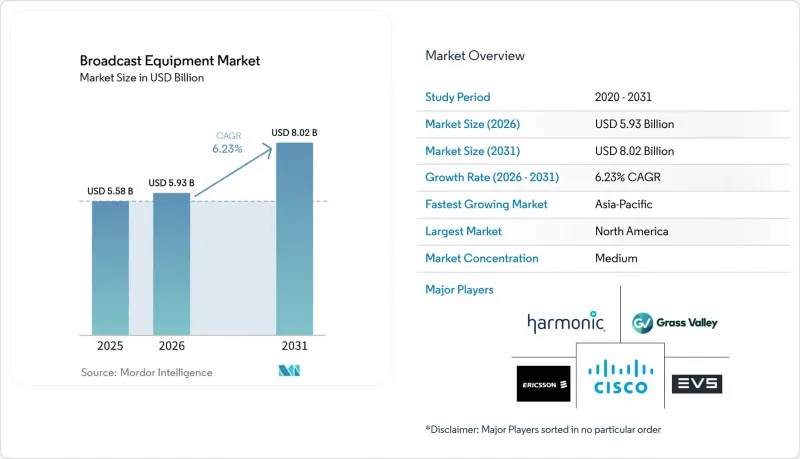
根據 Mordor Intelligence 預測,廣播設備市場規模將從 2025 年的 55.8 億美元成長到 2026 年的 59.3 億美元,然後在 2031 年達到 80.2 億美元,2026 年至 2031 年的複合年成長率為 6.23%。
本報告按技術(類比廣播、數位廣播)、產品(拋物面天線、開關等)、應用(無線電廣播、電視廣播、網路直播、衛星廣播)、最終用戶(廣播公司、有線電視網路營運商、串流媒體服務供應商、製作工作室)和地區進行細分。市場預測以美元計價。
全球廣播設備市場趨勢與洞察
面向消費者的OTT服務的擴張正在加速設備升級。
主流串流媒體服務用戶數量的爆炸性成長迫使廣播公司對其基礎設施進行現代化改造,以便同時提供高品質的線性碼率和自適應碼率串流。 2024年,Netflix的全球用戶達到2.6億,Disney+的用戶數也超過1.5億。這促使版權所有擁有者要求有線電視前端使用HEVC編碼,頻寬高效率的串流媒體使用AV1編碼,以及新興的8K VVC標準進行分發。這推動了多轉碼器編碼器取代單一功能設備的普及,並在新聞編輯室、體育網路和地方電視台之間催生了新的採購模式。同時,原創內容預算的激增也推動了IP回程傳輸設備的普及,以支援分散式遠端製作和雲端後製,使工作室能夠在無需依賴大規模現場人員的情況下加速全球發行。
快速過渡到基於IP的廣播基礎設施
隨著 SMPTE ST 2110 標準達到關鍵的普及階段,78% 的廣播公司已將 IP 基礎設施專案納入 2024 年的累計,加速了從 SDI 路由器和配線架到通用乙太網路架構的過渡。隨著工作流程從專用基頻鏈路轉向運行在商用現成 (COTS) 伺服器上的軟體實例,向通用乙太網路架構的過渡將顯著降低佈線複雜性和總體擁有成本 (TCO)。 IP 網路也透過無縫路徑保護簡化了冗餘,而原生多播支援營運擴展,包括臨時頻道和遠端說明室。最重要的是,IP 主幹網路將作為連接公共雲端服務的直接橋樑,在重要活動期間實現臨時運算能力提升,而無需承擔永久性硬體成本,從而進一步推動廣播設備市場的發展。
超高清和8K傳輸設備需要高額資本投資。
從高畫質到超高畫質再到8K的過渡,讓網路資料速率和處理開銷加倍,設備價格也飆升至高畫質相容機型的3到7倍。新興市場的小規模廣播公司和營運商難以調整這些巨額支出的投資回收期,導致部署模式呈現「兩極化」:主流頻道率先升級,而地方電視台則落後。有限的資金籌措管道和較短的折舊免稅額週期進一步加劇了預算壓力,延緩了設備的廣泛普及,並阻礙了廣播設備市場充分發揮其獲利潛力。
細分市場分析
預計到2025年,數位平台將佔總收入的66.02%,複合年成長率達7.92%,這表明儘管世界各國政府嚴格執行類比廣播淘汰期限,數位平台仍保持著強勁的發展勢頭。同時,許多網路營運商正在現有數位傳輸網路之上疊加IP架構,從而實現自建傳輸鏈路和互動服務,進而推動廣告收入成長。雖然混合(類比-數位)廣播設備市場在某些地區仍然佔據重要地位,但由於類比廣播淘汰計畫的實施,升級寬限期縮短,導致市場對可透過軟體更新重新配置的組合式發送器的需求不斷成長。
數位編碼的高頻效率也是推動這一普及趨勢的重要因素,它允許在單一射頻頻寬內重複使用多個輔助頻道和資訊服務。這種柔軟性促進了亞太地區在地化節目的發展以及歐洲臨時體育頻道的出現,並為廣告商拓展了廣告空間。提供高效能調變器和原生IP監控面板的供應商正不斷獲得重複訂單,進一步鞏固了數位技術在廣播設備市場的主導地位。
預計到2025年,編碼器將佔銷售額的24.42%,並維持6.61%的成長勢頭,因為所有分發管道——地面電波、衛星、有線電視和OTT——都依賴壓縮效率。人工智慧演算法能夠學習場景的複雜性並自適應地分配比特,從而在不影響影像品質的前提下節省30-40%的資源。這些創新正在推動良性劣化的升級,透過降低串流媒體提供商的CDN成本並為衛星營運商釋放轉發器頻寬,從而鞏固其在廣播設備市場的主導地位。
影像伺服器、交換器和發送器雖然仍然必不可少,但它們的設計越來越傾向於採用模組化的 x86 硬體,並封裝在容器化的軟體中。因此,客戶更專注於編配API 和授權的柔軟性,而非硬體本身的規格。拋物面天線仍被用作遠端傳輸和災害復原的鏈路,但隨著 5G 和光纖的普及,其成長速度落後於 IP地面電波鏈路。在日益融合的廣播設備產業中,將編碼器與雲端轉碼和即時打包相結合的供應商保持著競爭優勢。
區域分析
預計到2025年,北美將以33.21%的市佔率引領廣播設備市場,這主要得益於IP技術的早期應用、對下一代電視的激勵措施以及對串流媒體的大量投資。美國聯邦通訊委員會(FCC)的頻率重組和ATSC 3.0標準的引入推動了設施的重組,而版權所有擁有者則對REMI Studios進行了大量投資,該公司為全國性的體育賽事轉播提供支持。在加拿大,強制性的公共服務法規促進了多語言字幕和本地發送器的採購。與此同時,墨西哥在模擬廣播完全淘汰後,迎來了最後一波發送器訂單。
歐洲位居第二,這得益於歐洲廣播聯盟 (EBU) 推動的跨境舉措旨在促進標準化和基礎設施共用。德國和英國在超高清工作流程和 IP 中心輻射式製作方面處於主導,而法國則透過與文化保護基金相關的公共廣播升級來推動需求。在南部和東部市場,設備升級週期保持穩定,持續進行 DVB-T 到 DVB-T2 的替換,並增加 HEVC 編碼器以擴展高清層。
亞太地區以7.05%的複合年成長率領先,這主要得益於印度覆蓋全國的數位化進程(已連接超過2億戶家庭)以及中國基於5G的廣播試點項目(正在進行8K和VR測試廣播)。日本和韓國憑藉身臨其境型音訊和4K/8K衛星服務保持技術領先地位,而東南亞國家則利用多邊融資進行基礎建設。在澳大利亞,龐大的人口基數推動了對衛星上行鏈路和IP傳輸的需求,以覆蓋廣闊的區域,這與廣播設備市場的區域成長要素相輔相成。
其他好處:
- Excel格式的市場預測(ME)表
- 3個月的分析師支持
目錄
第1章:引言
- 研究假設和市場定義
- 調查範圍
第2章:調查方法
第3章執行摘要
第4章 市場狀況
- 市場概覽
- 市場促進因素
- 對支援多種轉碼器的編碼器的需求日益成長。
- 面向消費者的OTT服務的擴張正在加速設備的升級換代。
- 快速過渡到基於IP的廣播基礎設施
- 疫情後遠端製作(REMI)工作流程激增
- 基於雲端原生SaaS的播放和圖形部署
- 新興國家在數位轉型方面的政府義務
- 市場限制因素
- 全球媒體格式標準化過程仍然落後。
- 對超高清和8K傳輸設備進行了大量資本投資。
- 都市區頻率分配的限制
- IP和雲端廣播系統操作方面的技能差距
- 產業價值鏈分析
- 監理情勢
- 技術展望
- 波特五力分析
- 宏觀經濟因素的影響
第5章 市場規模與成長預測
- 透過技術
- 類比廣播
- 數位廣播
- 依產品
- 拋物面天線
- 轉變
- 影像伺服器
- 編碼器
- 發送器和中繼器
- 其他產品
- 透過使用
- 廣播
- 電視廣播
- 網路直播
- 衛星廣播
- 最終用戶
- 廣播員
- 有線電視網路營運商
- 串流服務供應商
- 製作工作室
- 按地區
- 北美洲
- 美國
- 加拿大
- 墨西哥
- 歐洲
- 德國
- 英國
- 法國
- 俄羅斯
- 其他歐洲國家
- 亞太地區
- 中國
- 日本
- 印度
- 韓國
- 澳洲
- 其他亞太國家
- 中東和非洲
- 中東
- 沙烏地阿拉伯
- 阿拉伯聯合大公國
- 其他中東國家
- 非洲
- 南非
- 埃及
- 其他非洲國家
- 中東
- 南美洲
- 巴西
- 阿根廷
- 其他南美國家
- 北美洲
第6章 競爭情勢
- 市場集中度
- 策略趨勢
- 市佔率分析
- 公司簡介
- Cisco Systems Inc.
- Telefonaktiebolaget LM Ericsson
- EVS Broadcast Equipment SA
- Grass Valley USA LLC
- Harmonic Inc.
- Clyde Broadcast Technology Ltd
- Sencore Inc.
- Eletec Broadcast Telecom Sarl
- AVL Technologies Inc.
- ETL Systems Ltd
- Rohde and Schwarz GmbH and Co KG
- NEC Corporation
- Sony Group Corporation
- Panasonic Corporation
- Imagine Communications Corp.
- Avid Technology Inc.
- Belden Inc.
- Blackmagic Design Pty Ltd
- Ross Video Ltd.
- TVU Networks Corporation
- NewTek Inc.
第7章 市場機會與未來展望
According to Mordor Intelligence, the broadcast equipment market size is expected to grow from USD 5.58 billion in 2025 to USD 5.93 billion in 2026 and is forecast to reach USD 8.02 billion by 2031 at 6.23% CAGR over 2026-2031.
This report is Segmented by Technology (Analog Broadcasting, Digital Broadcasting), Product (Dish Antennas, Switches, and More), Application (Radio Broadcasting, Television Broadcasting, Internet Live Streaming, Satellite Broadcasting), End User (Broadcasters, Cable Network Operators, Streaming Service Providers, Production Studios), and Geography. The Market Forecasts are Provided in Terms of Value (USD).
Global Broadcast Equipment Market Trends and Insights
Direct-To-Consumer OTT Expansion Accelerating Equipment Upgrades
Explosive subscriber growth at leading streaming services compels broadcasters to overhaul legacy plants so they can output pristine linear feeds and adaptive bitrate streams simultaneously. Netflix recorded 260 million global subscriptions in 2024, while Disney+ passed 150 million, prompting rights holders to demand delivery in HEVC for cable head-ends, AV1 for bandwidth-efficient streaming, and emerging VVC for 8K readiness. Multi-codec encoders, therefore, replace single-purpose appliances, triggering a new purchase cycle across newsrooms, sports networks, and regional stations. In parallel, the surge in original content budgets fuels the uptake of IP-backhaul kits that support distributed remote production and cloud post-production, ensuring that studios can fast-track global releases without relying on heavy on-site crews.
Rapid Transition to IP-Based Broadcasting Infrastructure
With SMPTE ST 2110 reaching critical mass, 78% of broadcasters budgeted IP infrastructure projects for 2024, accelerating the sunset of SDI routers and patch panels. Switching to commodity Ethernet fabrics slashes cabling complexity and reduces total cost of ownership as workflows migrate from dedicated baseband chains to software instances running on COTS servers. IP networks also simplify redundancy through seamless path protection, while native multicast enables operational scaling for pop-up channels or remote commentary positions. Crucially, IP backbones provide a direct bridge to public cloud services, enabling temporary compute bursts during marquee events without incurring permanent hardware costs, thereby further propelling the broadcast equipment market.
High Capital Expenditure for UHD and 8K Transmission Gear
Transitioning from HD to UHD and then to 8K multiplies network data rates and processing overhead, pushing equipment prices up to 3-7 times those of HD counterparts. Smaller stations and emerging-market operators struggle to align their payback horizons with such steep outlays, creating a two-speed adoption pattern where marquee channels upgrade first and regional players lag. Limited financing options and fast depreciation cycles exacerbate budget pressures, delaying wider rollouts and restraining the broadcast equipment market's full revenue potential.
Other drivers and restraints analyzed in the detailed report include:
- Growing Demand for Encoders Supporting Multiple Codecs
- Surge in Remote Production Workflows Post-Pandemic
- Persistent Lack of Global Standardization of Media Formats
For complete list of drivers and restraints, kindly check the Table Of Contents.
Segment Analysis
Digital platforms claimed 66.02% of 2025 revenue, and their 7.92% CAGR indicates relentless momentum as governments enforce analog switch-off deadlines. In parallel, many networks overlay IP fabrics on existing digital transmission, enabling self-provisioned contribution links and interactive services that drive advertising yield. The broadcast equipment market size for hybrid analog-digital solutions remains meaningful in rural pockets, yet sunset timetables narrow replacement windows, prompting brisk demand for combo transmitters that can be reconfigured through software updates.
Adoption also reflects the spectral efficiency of digital encoding, which allows multiplexing of secondary channels and data services within a single RF allocation. This agility fuels local language programming in the Asia-Pacific region and pop-up sports channels in Europe, expanding the addressable inventory for advertisers. Vendors that bundle spectrum-efficient modulators with IP-native monitoring dashboards secure repeat orders, reinforcing the primacy of digital technology within the broadcast equipment market.
Encoders generated 24.42% of 2025 turnover and maintain a 6.61% growth trajectory as every distribution path-terrestrial, satellite, cable, or OTT-depends on compression efficiency. AI-assisted algorithms now learn scene complexity and allocate bits adaptively, achieving 30-40% savings without picture degradation. These innovations lower CDN bills for streaming providers and free up transponder bandwidth for satellite operators, fueling a virtuous upgrade cycle that supports the broadcast equipment market's leadership share.
Video servers, switches, and transmitters remain indispensable, yet their design increasingly adopts modular, x86-based hardware wrapped in containerized software. As a result, customers focus on orchestration APIs and license flexibility rather than raw hardware specs. Dish antennas continue to serve remote contribution and disaster-recovery links, but growth lags IP terrestrial paths as 5G and fiber footprints widen. Vendors that package encoders with cloud transcoding and just-in-time packaging retain a competitive advantage across a converged broadcast equipment industry.
Complete Report Scope:
- By Technology
- Analog Broadcasting
- Digital Broadcasting
- By Product
- Dish Antennas
- Switches
- Video Servers
- Encoders
- Transmitters and Repeaters
- Other Products
- By Application
- Radio Broadcasting
- Television Broadcasting
- Internet Live Streaming
- Satellite Broadcasting
- By End User
- Broadcasters
- Cable Network Operators
- Streaming Service Providers
- Production Studios
- By Geography
- North America
- United States
- Canada
- Mexico
- Europe
- Germany
- United Kingdom
- France
- Russia
- Rest of Europe
- Asia-Pacific
- China
- Japan
- India
- South Korea
- Australia
- Rest of Asia-Pacific
- Middle East and Africa
- Middle East
- Saudi Arabia
- United Arab Emirates
- Rest of Middle East
- Africa
- South Africa
- Egypt
- Rest of Africa
- Middle East
- South America
- Brazil
- Argentina
- Rest of South America
- North America
Geography Analysis
North America led the broadcast equipment market with a 33.21% share in 2025 thanks to early IP adoption, NextGen TV incentives and heavy streaming investment. The Federal Communications Commission's spectrum repack and ATSC 3.0 rollouts triggered facility rebuilds, while rights-holders poured capital into REMI studios supporting coast-to-coast sports coverage. Canada's public-service mandates spurred procurements of multilingual captioning and rural transmitters, whereas Mexico's completed analog switch-off supplied a final wave of transmitter orders.
Europe ranks second, buoyed by cross-border initiatives from the European Broadcasting Union that promote standardization and shared infrastructure. Germany and the United Kingdom spearhead UHD workflows and IP hub-and-spoke production, and France underpins demand with public broadcasting upgrades tied to cultural preservation funds. Southern and Eastern markets continue replacing DVB-T with DVB-T2 and adding HEVC encoders for HD tier expansion, sustaining steady equipment refresh cycles.
Asia-Pacific posts the fastest 7.05% CAGR as India's nationwide digitization connects more than 200 million households and China's 5G-based broadcast pilots showcase 8K and VR trials. Japan and South Korea retain technology leadership through immersive audio and 4K/8K satellite services, while Southeast Asian nations tap multilateral loans for infrastructure. Australia's dispersed population drives demand for satellite uplinks and IP contribution to span vast geographies, rounding out regional growth drivers for the broadcast equipment market.
- Cisco Systems Inc.
- Telefonaktiebolaget LM Ericsson
- EVS Broadcast Equipment SA
- Grass Valley USA LLC
- Harmonic Inc.
- Clyde Broadcast Technology Ltd
- Sencore Inc.
- Eletec Broadcast Telecom Sarl
- AVL Technologies Inc.
- ETL Systems Ltd
- Rohde and Schwarz GmbH and Co KG
- NEC Corporation
- Sony Group Corporation
- Panasonic Corporation
- Imagine Communications Corp.
- Avid Technology Inc.
- Belden Inc.
- Blackmagic Design Pty Ltd
- Ross Video Ltd.
- TVU Networks Corporation
- NewTek Inc.
Additional Benefits:
- The market estimate (ME) sheet in Excel format
- 3 months of analyst support
TABLE OF CONTENTS
1 INTRODUCTION
- 1.1 Study Assumptions and Market Definition
- 1.2 Scope of the Study
2 RESEARCH METHODOLOGY
3 EXECUTIVE SUMMARY
4 MARKET LANDSCAPE
- 4.1 Market Overview
- 4.2 Market Drivers
- 4.2.1 Growing Demand for Encoders Supporting Multiple Codecs
- 4.2.2 Direct-To-Consumer OTT Expansion Accelerating Equipment Upgrades
- 4.2.3 Rapid Transition to IP-Based Broadcasting Infrastructure
- 4.2.4 Surge in Remote Production (REMI) Workflows Post-Pandemic
- 4.2.5 Adoption of Cloud-Native SaaS Playout and Graphics
- 4.2.6 Government Mandates for Digital Switch-Over in Emerging Economies
- 4.3 Market Restraints
- 4.3.1 Persistent Lack of Global Standardization of Media Formats
- 4.3.2 High Capital Expenditure for UHD and 8K Transmission Gear
- 4.3.3 Spectrum Allocation Constraints in Urban Regions
- 4.3.4 Skills Gap in Operating IP and Cloud Broadcast Systems
- 4.4 Industry Value Chain Analysis
- 4.5 Regulatory Landscape
- 4.6 Technological Outlook
- 4.7 Porter's Five Forces Analysis
- 4.7.1 Bargaining Power of Suppliers
- 4.7.2 Bargaining Power of Buyers
- 4.7.3 Threat of New Entrants
- 4.7.4 Threat of Substitutes
- 4.7.5 Intensity of Competitive Rivalry
- 4.8 Impact of Macroeconomic Factors
5 MARKET SIZE AND GROWTH FORECASTS (VALUE)
- 5.1 By Technology
- 5.1.1 Analog Broadcasting
- 5.1.2 Digital Broadcasting
- 5.2 By Product
- 5.2.1 Dish Antennas
- 5.2.2 Switches
- 5.2.3 Video Servers
- 5.2.4 Encoders
- 5.2.5 Transmitters and Repeaters
- 5.2.6 Other Products
- 5.3 By Application
- 5.3.1 Radio Broadcasting
- 5.3.2 Television Broadcasting
- 5.3.3 Internet Live Streaming
- 5.3.4 Satellite Broadcasting
- 5.4 By End User
- 5.4.1 Broadcasters
- 5.4.2 Cable Network Operators
- 5.4.3 Streaming Service Providers
- 5.4.4 Production Studios
- 5.5 By Geography
- 5.5.1 North America
- 5.5.1.1 United States
- 5.5.1.2 Canada
- 5.5.1.3 Mexico
- 5.5.2 Europe
- 5.5.2.1 Germany
- 5.5.2.2 United Kingdom
- 5.5.2.3 France
- 5.5.2.4 Russia
- 5.5.2.5 Rest of Europe
- 5.5.3 Asia-Pacific
- 5.5.3.1 China
- 5.5.3.2 Japan
- 5.5.3.3 India
- 5.5.3.4 South Korea
- 5.5.3.5 Australia
- 5.5.3.6 Rest of Asia-Pacific
- 5.5.4 Middle East and Africa
- 5.5.4.1 Middle East
- 5.5.4.1.1 Saudi Arabia
- 5.5.4.1.2 United Arab Emirates
- 5.5.4.1.3 Rest of Middle East
- 5.5.4.2 Africa
- 5.5.4.2.1 South Africa
- 5.5.4.2.2 Egypt
- 5.5.4.2.3 Rest of Africa
- 5.5.4.1 Middle East
- 5.5.5 South America
- 5.5.5.1 Brazil
- 5.5.5.2 Argentina
- 5.5.5.3 Rest of South America
- 5.5.1 North America
6 COMPETITIVE LANDSCAPE
- 6.1 Market Concentration
- 6.2 Strategic Moves
- 6.3 Market Share Analysis
- 6.4 Company Profiles (includes Global Level Overview, Market Level Overview, Core Segments, Financials as Available, Strategic Information, Market Rank/Share for Key Companies, Products and Services, and Recent Developments)
- 6.4.1 Cisco Systems Inc.
- 6.4.2 Telefonaktiebolaget LM Ericsson
- 6.4.3 EVS Broadcast Equipment SA
- 6.4.4 Grass Valley USA LLC
- 6.4.5 Harmonic Inc.
- 6.4.6 Clyde Broadcast Technology Ltd
- 6.4.7 Sencore Inc.
- 6.4.8 Eletec Broadcast Telecom Sarl
- 6.4.9 AVL Technologies Inc.
- 6.4.10 ETL Systems Ltd
- 6.4.11 Rohde and Schwarz GmbH and Co KG
- 6.4.12 NEC Corporation
- 6.4.13 Sony Group Corporation
- 6.4.14 Panasonic Corporation
- 6.4.15 Imagine Communications Corp.
- 6.4.16 Avid Technology Inc.
- 6.4.17 Belden Inc.
- 6.4.18 Blackmagic Design Pty Ltd
- 6.4.19 Ross Video Ltd.
- 6.4.20 TVU Networks Corporation
- 6.4.21 NewTek Inc.
7 MARKET OPPORTUNITIES AND FUTURE OUTLOOK
- 7.1 White-space and Unmet-Need Assessment

 廣播設備市場-2026-2032年全球市場預測
 2026年全球廣播設備市場報告
 廣播設備市場報告:按產品、技術、應用和地區分類(2026-2034 年)
 廣播設備市場分析及預測(至2035年):類型、產品、服務、技術、組件、應用、部署、最終用戶、功能2026年全球即時網際網路通訊協定(IP)廣播設備市場報告
 全球廣播設備市場規模、佔有率、趨勢和成長分析報告(2026-2034)2026年全球廣播級動圈USB麥克風市場報告
 全球即時IP直播設備市場-按產品、應用、地區和競爭格局分類的產業規模、佔有率、趨勢、機會和預測(2021-2031年)專業直播設備市場:依產品類型、最終用途、解析度、工作流程、分發方式、連接方式和價格範圍分類,全球預測(2026-2032年)廣播監控市場按監控類型、部署類型、行業垂直領域和最終用戶分類 - 全球預測 2026-2032 年