


 |
市場調查報告書
商品編碼
2124151
企業績效管理:市場佔有率分析、產業趨勢與統計、成長預測(2026-2031)Enterprise Performance Management - Market Share Analysis, Industry Trends & Statistics, Growth Forecasts (2026 - 2031) |
||||||

※ 本網頁內容可能與最新版本有所差異。詳細情況請與我們聯繫。
根據 Mordor Intelligence 預測,企業績效管理 (EPM) 市場規模將從 2025 年的 69.9 億美元和 2026 年的 76.9 億美元成長到 2031 年的 118.9 億美元,2026 年至 2031 年的年複合成長率(CAGR)為 9.1%。
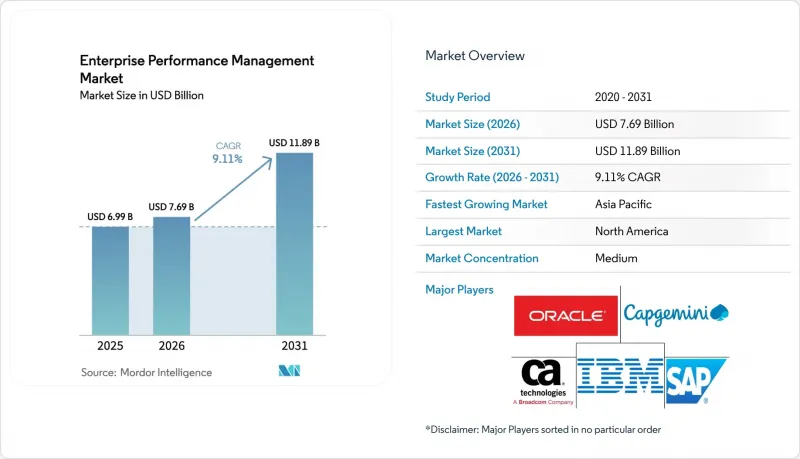
本報告按組件(解決方案和服務)、部署模式(雲端和本地部署)、企業規模(中小企業和大型企業)、最終用戶行業(銀行、金融服務和保險 (BFSI)、IT 和電信、醫療保健、製造業、零售和電子商務、能源和公共產業等)以及地區進行細分。市場預測以價值(美元)表示。
全球企業績效管理市場趨勢與洞察
北美中型企業市場向雲端原生 EPM 套件遷移,以實現即時 FP&A(財務規劃與分析)。
中型企業正在逐步淘汰本地部署的整合工具,轉而採用雲端套件,以實現即時差異分析和滾動預測。訂閱式定價模式無需前期投資,而行動存取則支援遠端辦公。 OracleOracle稱,其 Fusion Cloud EPM 的訂單年增 25%,目標客戶為年營收在 5 億美元至 20 億美元之間的公司。 Workday 指出,到 2025 年初,其 Adaptive Planning 的客戶群將超過 6,500 家,比 2024 年成長 30%。這一成長歸功於其內建的異常檢測模型。自然語言查詢介面也使其用戶群擴展到非財務專業人士。
將人工智慧和機器學習整合到歐洲跨國公司的情境建模中
歐洲製造業和製藥公司正在採用機率預測來應對外匯波動和供應鏈中斷。 Anaplan透露,其40%的歐洲客戶在其Predictive Insights引擎發布後的12個月內就採用了該引擎。 IBM在2024年下半年為其Planning Analytics增加了自動產生假設情境的功能,能夠在幾分鐘內產生數千種情境組合。監管因素也在推動這項需求。歐洲銀行管理局(EBA)最新的壓力測試要求模擬數十年的氣候風險。
歐洲財務規劃與分析 (FP&A) 專業人員短缺,阻礙了先進企業績效管理 (EPM) 的採用。
財務長們正苦於招募能夠建立基於促進因素的模型並解讀機器學習輸出的分析師。普華永道發布的《2025年人才調查》顯示,58%的歐洲財務主管將財務規劃與分析(FP&A)人才短缺列為他們面臨的三大挑戰之一。德勤指出,冗長的使用者培訓導致平均專案週期延長至九個月,而北美地區僅為六個月。儘管專業機構已推出雲端企業績效管理(EPM)認證,但人才供應仍不足。
細分市場分析
到2025年,解決方案收入佔比達到71.42%,再次印證了軟體訂閱是企業績效管理(EPM)市場的主要支出促進因素。同時,服務板塊的成長速度更快,複合年成長率(CAGR)達到9.89%。這是因為跨財務、銷售和供應鏈職能的多模組部署需要變革管理、資料整合和培訓方面的專業知識,但很少企業具備這些內部專業知識。據諮詢公司稱,為了滿足這項需求,EPM人員數量增加了35%。
該服務的成長勢頭得益於其基於訂閱的託管服務,該服務提供每月結算支援和模型調整。平均實施專案週期為 6-9 個月,企業會將 40-50% 的預算用於協調營運和財務指標的研討會。隨著生成式人工智慧驅動的輔助駕駛系統日益普及,用戶培訓包中新增了快速工程課程,進一步提升了該服務的收入。
預計到2025年,雲端部署將佔總部署規模的66.58%,複合年成長率達9.57%,標誌著企業績效管理市場正向訂閱模式決定性轉變。 API優先架構使財務領導者能夠在不中斷營運的情況下,將一流的模組整合到現有的ERP核心系統中。同時,在國防和某些對資料本地化有嚴格要求的金融領域,本地部署仍然普遍存在。
多租戶雲端的季度功能更新正在縮小創新差距,並提供人工智慧預測和自然語言查詢工具,而無需冗長的升級。混合部署將本地事務處理與雲端規劃結合,在中國等居住法規仍然嚴格的地區正日益普及。主權雲的出現有望進一步推動這一趨勢,因為它既能滿足本地合規要求,又不犧牲彈性。
區域分析
到2025年,北美將佔總收入的41.37%,這反映出該地區對雲端運算和薩班斯-奧克斯利法案下的審計管理的早期採用。美國中型企業正在遷移到人工智慧驅動的套件,以縮短財務報告週期;而加拿大企業則正在整合ESG數據,以符合聯邦氣候變遷資訊揭露法規的要求。墨西哥共享服務的擴張正在推動對多幣種財務報告整合的需求。平台整合趨勢支援能夠降低整體擁有成本(TCO)的整合套件。
亞太地區正經歷最快的成長,複合年成長率達10.46%,這主要得益於印度和中國的轉型計畫。在這些國家,企業集團正在對其眾多子公司的規劃營運進行標準化。日本的監管改革強制要求企業揭露季度獲利預測,加速了雲端規劃系統的普及。然而,在分散式ERP環境中,資料品質孤島在某些情況下可能會使實施時間延長高達50%。
歐洲的發展趨勢正受到ESG報告標準化進程的影響,大型企業紛紛將碳排放指標納入法定工作流程。在中東,儘管國內已開放新的雲端區域,但由於安全方面的擔憂,雲端技術的普及仍面臨阻力。同時,拉丁美洲的中小型企業在外匯波動的影響下,正面臨整體擁有成本(TCO)的挑戰。在非洲新興市場,南非和奈及利亞的銀行正引領企業績效管理(EPM)的實施,以支持區域擴張。
其他好處:
- Excel格式的市場預測(ME)表
- 3個月的分析師支持
目錄
第1章:引言
- 研究假設和市場定義
- 調查範圍
第2章:調查方法
第3章執行摘要
第4章 市場狀況
- 市場概覽
- 市場促進因素
- 北美中型企業市場向雲端原生EPM套件遷移,以實現即時財務規劃與分析
- 將人工智慧/機器學習整合到歐洲跨國公司的情境建模中
- 歐盟將企業績效管理 (EPM)、環境、社會和治理 (ESG) 以及強制性綜合報告結合。
- 由美國《薩班斯-奧克斯利法案現代化法案》支持的數位金融轉型計劃
- 在全球零售供應鏈中實施 xP&A
- 以 API 為先導的可組合金融架構的興起,實現了即插即用的 EPM 模組。
- 市場限制因素
- 亞洲大型企業集團分散式ERP環境中的資料品質孤島
- 歐洲財務規劃與分析 (FP&A) 專業人員短缺,阻礙了先進企業績效管理 (EPM) 的採用。
- 中東金融機構雲端遷移面臨的公認安全風險
- 拉丁美洲中小企業多模組企業績效管理套件的總擁有成本較高
- 產業價值鏈分析
- 技術展望
- 監理情勢
- 宏觀經濟因素對市場的影響
- 波特五力分析
第5章 市場規模與成長預測
- 按組件
- 解決方案
- 服務
- 部署模式
- 雲
- 現場
- 按公司規模
- 中小企業
- 大公司
- 按最終用戶行業分類
- BFSI
- IT/通訊
- 衛生保健
- 製造業
- 零售與電子商務
- 能源公用事業
- 政府/公共部門
- 其他終端用戶產業
- 按地區
- 北美洲
- 美國
- 加拿大
- 墨西哥
- 歐洲
- 德國
- 英國
- 法國
- 義大利
- 西班牙
- 其他歐洲國家
- 亞太地區
- 中國
- 日本
- 印度
- 韓國
- 東南亞
- 其他亞太國家
- 南美洲
- 巴西
- 阿根廷
- 其他南美國家
- 中東
- UAE
- 沙烏地阿拉伯
- 土耳其
- 其他中東國家
- 非洲
- 南非
- 奈及利亞
- 其他非洲國家
- 北美洲
第6章 競爭情勢
- 市場集中度
- 策略趨勢
- 市佔率分析
- 公司簡介
- Oracle Corporation
- SAP SE
- IBM Corporation
- Broadcom Inc.(CA Technologies)
- Capgemini SE
- Workday Inc.
- Anaplan Inc.
- Infor Inc.
- Wolters Kluwer NV(CCH Tagetik)
- Board International SA
- OneStream Software LLC
- Planful Inc.
- Vena Solutions Inc.
- Prophix Software Inc.
- Jedox AG
- Solver Inc.
- Kepion Inc.
- Longview Solutions Inc.
- BlackLine Inc.
- Kaufman Hall and Associates LLC(Axiom)
- Unit4 NV
- Centage Corporation
- Host Analytics Inc.(legacy)
- Insightsoftware Inc.
- Syntellis Performance Solutions
第7章 市場機會與未來展望
According to Mordor Intelligence, the enterprise performance management market size is projected to expand from USD 6.99 billion in 2025 and USD 7.69 billion in 2026 to USD 11.89 billion by 2031, registering a CAGR of 9.11% between 2026 to 2031.
This report is Segmented by Component (Solutions, and Services), Deployment Mode (Cloud, and On-Premise), Enterprise Size (Small and Medium Enterprises, and Large Enterprises), End-User Industry (BFSI, IT and Telecom, Healthcare, Manufacturing, Retail and E-Commerce, Energy and Utilities, and More), and Geography. The Market Forecasts are Provided in Terms of Value (USD).
Global Enterprise Performance Management Market Trends and Insights
Shift to Cloud-Native EPM Suites for Real-Time FP-and-A in Mid-Market North America
Mid-market companies are discarding on-premises consolidation tools in favour of cloud suites that deliver real-time variance analysis and rolling forecasts. Subscription pricing removes upfront capital expenditure, while mobile access supports remote work patterns. Oracle reported 25% year-over-year growth in Fusion Cloud EPM bookings for organizations with USD 500 million-USD 2 billion in annual revenue. Workday noted that its Adaptive Planning customer count exceeded 6,500 in early 2025, up 30% from 2024, attributing the expansion to embedded anomaly-detection models. Natural-language query interfaces are widening user adoption beyond finance specialists.
Integration of AI and ML for Scenario Modelling in European Multinationals
European manufacturers and pharmaceutical firms have embraced probabilistic forecasting to account for currency swings and supply-chain shocks. Anaplan disclosed that 40% of its European customers adopted the Predictive Insights engine within 12 months of launch. IBM added automated what-if generation to Planning Analytics in late 2024, enabling thousands of scenario permutations in minutes. Regulatory drivers amplify demand: updated European Banking Authority stress tests require climate-risk simulations over decade-long horizons.
Shortage of FP-and-A Talent Restricting Advanced EPM Rollouts in Europe
CFOs struggle to recruit analysts who can configure driver-based models and interpret machine-learning outputs. PwC's 2025 workforce survey indicated that 58% of European finance leaders cite FP-and-A talent shortages as a top three obstacle. Deloitte observed that average project timelines have stretched to nine months, versus six in North America, due to extended user training. Professional bodies have launched cloud-EPM certifications, yet supply remains insufficient.
Other drivers and restraints analyzed in the detailed report include:
- Convergence of EPM with ESG and Integrated Reporting Mandates in the EU
- Adoption of xP-and-A Across Global Retail Supply Chains
- Perceived Security Risks Hindering Cloud Migration in Middle East Financial Institutions
For complete list of drivers and restraints, kindly check the Table Of Contents.
Segment Analysis
Solutions accounted for 71.42% of 2025 revenue, reaffirming software subscriptions as the primary spending driver in the Enterprise Performance Management market. Services, however, are growing faster at a 9.89% CAGR because multi-module deployments across finance, sales, and supply-chain functions require change-management, data-integration, and training expertise that most organizations lack internally. Advisory firms reported 35% headcount growth in EPM practices to meet this demand.
Service momentum is sustained by subscription-based managed offerings that provide monthly close assistance and model tuning. Implementation projects average six to nine months, and enterprises allocate 40-50% of their budgets to workshops that align operational and financial metrics. As generative-AI copilots proliferate, user-training packages are expanding to include prompt-engineering curricula, further lifting services revenue.
Cloud installations represented 66.58% of the 2025 base and are advancing at a 9.57% CAGR, underscoring a decisive shift in the Enterprise Performance Management market toward subscription delivery. API-first architectures allow finance leaders to layer best-of-breed modules onto existing ERP cores without disruptive replacements. On-premises footprints persist in defense and certain financial sectors with strict data-localization mandates.
Quarterly feature updates on multi-tenant clouds shrink the innovation gap, delivering AI forecasting and natural-language query tools without protracted upgrades. Hybrid deployments, mixing on-premises transaction processing with cloud planning, are emerging in jurisdictions such as China where residency rules remain stringent. Sovereign-cloud offerings promise further momentum by satisfying local compliance without sacrificing elasticity.
Complete Report Scope:
- By Component
- Solutions
- Services
- By Deployment Mode
- Cloud
- On-Premise
- By Enterprise Size
- Small and Medium Enterprises (SMEs)
- Large Enterprises
- By End-user Industry
- BFSI
- IT and Telecom
- Healthcare
- Manufacturing
- Retail and E-Commerce
- Energy and Utilities
- Government and Public Sector
- Other End-user Industries
- By Geography
- North America
- United States
- Canada
- Mexico
- Europe
- Germany
- United Kingdom
- France
- Italy
- Spain
- Rest of Europe
- Asia Pacific
- China
- Japan
- India
- South Korea
- Southeast Asia
- Rest of Asia Pacific
- South America
- Brazil
- Argentina
- Rest of South America
- Middle East
- UAE
- Saudi Arabia
- Turkey
- Rest of Middle East
- Africa
- South Africa
- Nigeria
- Rest of Africa
- North America
Geography Analysis
North America retained 41.37% of 2025 revenue, reflecting early cloud adoption and Sarbanes-Oxley driven audit controls. U.S. mid-market firms migrate to AI-enabled suites to trim close cycles, whereas Canadian corporates integrate ESG data to comply with federal climate-disclosure rules. Mexico's shared-service expansion fuels multi-currency consolidation demand. Platform consolidation trends favour unified suites that lower total cost of ownership.
Asia Pacific is the fastest-growing region at a 10.46% CAGR, led by transformation programs in India and China where conglomerates standardize planning across numerous subsidiaries. Japanese reforms mandating quarterly guidance accelerate cloud-planning uptake. Data-quality silos, however, lengthen implementations by up to 50% in decentralized ERP environments.
Europe's trajectory is shaped by ESG reporting convergence, with large corporates integrating carbon metrics into statutory workflows. The Middle East faces adoption headwinds due to security concerns, despite new in-country cloud regions, while Latin American SMEs wrestle with total cost of ownership amidst currency volatility. Africa's nascent market centers on South African and Nigerian banks implementing EPM to support regional expansion.
- Oracle Corporation
- SAP SE
- IBM Corporation
- Broadcom Inc. (CA Technologies)
- Capgemini SE
- Workday Inc.
- Anaplan Inc.
- Infor Inc.
- Wolters Kluwer N.V. (CCH Tagetik)
- Board International S.A.
- OneStream Software LLC
- Planful Inc.
- Vena Solutions Inc.
- Prophix Software Inc.
- Jedox AG
- Solver Inc.
- Kepion Inc.
- Longview Solutions Inc.
- BlackLine Inc.
- Kaufman Hall and Associates LLC (Axiom)
- Unit4 N.V.
- Centage Corporation
- Host Analytics Inc. (legacy)
- Insightsoftware Inc.
- Syntellis Performance Solutions
Additional Benefits:
- The market estimate (ME) sheet in Excel format
- 3 months of analyst support
TABLE OF CONTENTS
1 INTRODUCTION
- 1.1 Study Assumptions and Market Definition
- 1.2 Scope of the Study
2 RESEARCH METHODOLOGY
3 EXECUTIVE SUMMARY
4 MARKET LANDSCAPE
- 4.1 Market Overview
- 4.2 Market Drivers
- 4.2.1 Shift to Cloud-Native EPM Suites for Real-Time FP&A in Mid-Market North America
- 4.2.2 Integration of AI/ML for Scenario Modeling in European Multinationals
- 4.2.3 Convergence of EPM with ESG and Integrated Reporting Mandates in EU
- 4.2.4 Digital Finance Transformation Programs Spurred by US SOX Modernization Act
- 4.2.5 Adoption of xP&A Across Global Retail Supply Chains
- 4.2.6 Rise of API-First Composable Finance Architectures Enabling Plug-and-Play EPM Modules
- 4.3 Market Restraints
- 4.3.1 Data-Quality Silos in Decentralized ERP Landscapes of Large Asian Conglomerates
- 4.3.2 Shortage of FP&A Talent Restricting Advanced EPM Rollouts in Europe
- 4.3.3 Perceived Security Risks Hindering Cloud Migration in Middle East Financial Institutions
- 4.3.4 High TCO for Multi-Module EPM Suites among Latin American SMEs
- 4.4 Industry Value-Chain Analysis
- 4.5 Technological Outlook
- 4.6 Regulatory Landscape
- 4.7 Impact of Macroeconomic Factors on the Market
- 4.8 Porter's Five Forces Analysis
- 4.8.1 Threat of New Entrants
- 4.8.2 Bargaining Power of Buyers
- 4.8.3 Bargaining Power of Suppliers
- 4.8.4 Threat of Substitutes
- 4.8.5 Intensity of Competitive Rivalry
5 MARKET SIZE AND GROWTH FORECASTS (VALUES)
- 5.1 By Component
- 5.1.1 Solutions
- 5.1.2 Services
- 5.2 By Deployment Mode
- 5.2.1 Cloud
- 5.2.2 On-Premise
- 5.3 By Enterprise Size
- 5.3.1 Small and Medium Enterprises (SMEs)
- 5.3.2 Large Enterprises
- 5.4 By End-user Industry
- 5.4.1 BFSI
- 5.4.2 IT and Telecom
- 5.4.3 Healthcare
- 5.4.4 Manufacturing
- 5.4.5 Retail and E-Commerce
- 5.4.6 Energy and Utilities
- 5.4.7 Government and Public Sector
- 5.4.8 Other End-user Industries
- 5.5 By Geography
- 5.5.1 North America
- 5.5.1.1 United States
- 5.5.1.2 Canada
- 5.5.1.3 Mexico
- 5.5.2 Europe
- 5.5.2.1 Germany
- 5.5.2.2 United Kingdom
- 5.5.2.3 France
- 5.5.2.4 Italy
- 5.5.2.5 Spain
- 5.5.2.6 Rest of Europe
- 5.5.3 Asia Pacific
- 5.5.3.1 China
- 5.5.3.2 Japan
- 5.5.3.3 India
- 5.5.3.4 South Korea
- 5.5.3.5 Southeast Asia
- 5.5.3.6 Rest of Asia Pacific
- 5.5.4 South America
- 5.5.4.1 Brazil
- 5.5.4.2 Argentina
- 5.5.4.3 Rest of South America
- 5.5.5 Middle East
- 5.5.5.1 UAE
- 5.5.5.2 Saudi Arabia
- 5.5.5.3 Turkey
- 5.5.5.4 Rest of Middle East
- 5.5.6 Africa
- 5.5.6.1 South Africa
- 5.5.6.2 Nigeria
- 5.5.6.3 Rest of Africa
- 5.5.1 North America
6 COMPETITIVE LANDSCAPE
- 6.1 Market Concentration
- 6.2 Strategic Moves
- 6.3 Market Share Analysis
- 6.4 Company Profiles {(includes Global level Overview, Market level overview, Core Segments, Financials as available, Strategic Information, Market Rank/Share for key companies, Products and Services, and Recent Developments)}
- 6.4.1 Oracle Corporation
- 6.4.2 SAP SE
- 6.4.3 IBM Corporation
- 6.4.4 Broadcom Inc. (CA Technologies)
- 6.4.5 Capgemini SE
- 6.4.6 Workday Inc.
- 6.4.7 Anaplan Inc.
- 6.4.8 Infor Inc.
- 6.4.9 Wolters Kluwer N.V. (CCH Tagetik)
- 6.4.10 Board International S.A.
- 6.4.11 OneStream Software LLC
- 6.4.12 Planful Inc.
- 6.4.13 Vena Solutions Inc.
- 6.4.14 Prophix Software Inc.
- 6.4.15 Jedox AG
- 6.4.16 Solver Inc.
- 6.4.17 Kepion Inc.
- 6.4.18 Longview Solutions Inc.
- 6.4.19 BlackLine Inc.
- 6.4.20 Kaufman Hall and Associates LLC (Axiom)
- 6.4.21 Unit4 N.V.
- 6.4.22 Centage Corporation
- 6.4.23 Host Analytics Inc. (legacy)
- 6.4.24 Insightsoftware Inc.
- 6.4.25 Syntellis Performance Solutions
7 MARKET OPPORTUNITIES AND FUTURE OUTLOOK
- 7.1 White-space and Unmet-Need Assessment

 PPP專案績效管理軟體市場:全球市場預測,2026-2032年財務績效管理軟體市場:全球市場預測,2026-2032年
 企業績效管理:市場佔有率分析、產業趨勢與統計、成長預測(2026-2031)
 2026-2030年全球企業績效管理(CPM)軟體市場
 2026-2030年全球企業績效管理(EPM)應用市場企業績效管理市場-2026-2032年全球市場預測
 企業績效管理 (EPM) 市場預測 2034 年-按解決方案類型、部署模式、組件、應用、企業規模和地區分類的全球分析
 企業績效管理 (EPM) 市場規模、佔有率和成長分析:按組件、部署類型、企業規模、最終用戶和地區分類-2026-2033 年產業預測
 全球企業績效管理市場:機會與策略展望(至2035年)
 企業績效管理 (EPM) 市場分析及至 2035 年預測:按類型、產品類型、服務、技術、組件、應用、部署模式、最終用戶、模組和功能分類