


 |
市場調查報告書
商品編碼
2124145
人工智慧管治:市場佔有率分析、產業趨勢與統計、成長預測(2026-2031)AI Governance - Market Share Analysis, Industry Trends & Statistics, Growth Forecasts (2026 - 2031) |
||||||

※ 本網頁內容可能與最新版本有所差異。詳細情況請與我們聯繫。
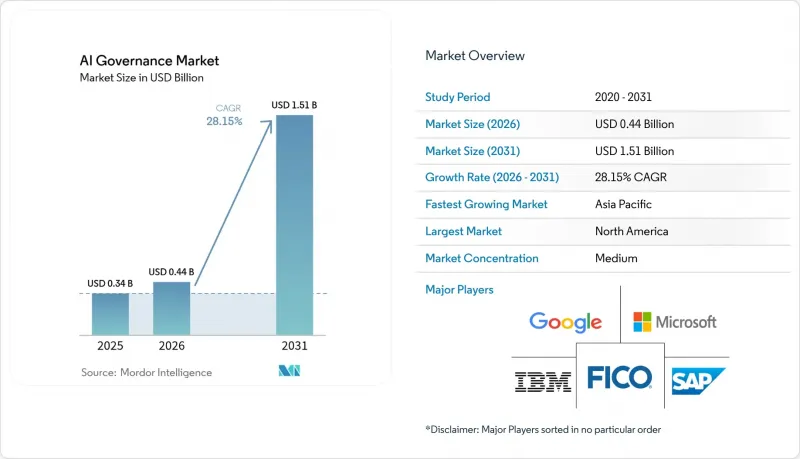
據 Mordor Intelligence 稱,2025 年人工智慧管治市場價值 3.4 億美元,預計到 2031 年將從 2026 年的 4.4 億美元成長到 15.1 億美元,預測期(2026-2031 年)的複合年成長率為 28.15%。
本報告按組件(平台/軟體套件、點解決方案、服務)、部署模式(雲端[SaaS]和本地/私有雲端)、最終用戶行業(銀行、金融服務和保險、醫療保健和生命科學、其他)、應用領域(偏見和公平管理、可解釋性和透明度、其他)、組織規模(大型企業和中小企業[SME])以及地區地區進行細分。
全球人工智慧管治市場趨勢與洞察
對模型透明度和可解釋性的需求日益成長
根據歐盟人工智慧法規,高風險人工智慧系統現在必須具備清晰的技術文件、可追溯的審計日誌以及易於理解的自動化決策理由。使用人工智慧進行信用評分的金融機構必須提供令監管機構和受影響消費者都滿意的解釋。企業越來越將可解釋性視為一種競爭優勢,它可以加快內部核准流程並增強客戶信任。供應商正在積極回應,提供能夠自動記錄模型沿襲並即時產生自然語言解釋的平台。因此,採購團隊正在優先考慮通過透明度認證的解決方案,並將預算從不透明的「黑箱」演算法轉向可解釋的架構。
針對人工智慧的監管法規迅速擴展
2024年至2025年間,全球實施了70多項新的人工智慧監管立法或行政指令。歐盟的人工智慧法樹立了全球標桿,而中國的生成式人工智慧通知系統則引入了一種事實上的授權模式,要求服務供應商註冊訓練資料和安全措施。區域差異迫使跨國公司維護合規儀表板,將模型清單與區域風險類別進行映射。歐盟對高風險系統的六個月期限與亞洲通常的一年寬限期形成鮮明對比,這使得那些在設計階段就採用靈活管治框架的公司比在生命週期後期追溯性地添加控制措施的公司更具優勢。
人工智慧倫理和合規人員普遍短缺。
對具備資料科學、法律和風險監控等多學科專業知識的專家的需求遠遠超過供應。根據2024年的一項勞動力調查,65%的組織認為需要製定更多法規來確保生成式人工智慧的安全使用,但很少有組織擁有足夠的內部專業知識來滿足合規要求。歐洲公司正在緊急招募人工智慧倫理專家,以滿足歐盟人工智慧法律的要求。高薪和諮詢費推高了合規預算,導致企業增加對自動化的投資,以便將政策檢查整合到開發平臺中。
細分市場分析
到2025年,平台和軟體套件將佔總收入的42.40%,這凸顯了買家對能夠以統一方式管理策略、監控和文件的整合環境的偏好。 IBM等供應商正在提供整合式儀錶板,將模型清單與司法管轄區的義務相匹配,從而最大限度地減輕審計負擔。用於偏差檢測和可解釋性的單點工具正以28.6%的複合年成長率快速成長,因為它們可以無縫整合到現有流程中,而無需大規模的系統替換。由於技能嚴重短缺,各組織擴大將框架設計和監管聯絡工作外包,服務子領域也因此穩定成長。
企業架構師傾向於使用單一記錄系統來避免缺陷。然而,在現有系統(棕地)環境中,分階段部署十分普遍。團隊通常會先使用偏差掃描 API 來標記不同的影響,然後再疊加自動化文件產生工具。這種「模組化」方法正在促進平行成長:平台在新興的數位化原生企業中不斷擴大市場佔有率,而點解決方案則正在滲透到成熟的大型企業中。對專業服務的需求仍然強勁,這反映出諸如資料流映射、風險等級分類以及使內部政策與各種監管機構的術語保持一致等任務需要投入大量精力。
預計到 2025 年,雲端部署將佔據人工智慧管治市場 77.20% 的佔有率,複合年成長率高達 29.4%。服務提供者正將管治功能直接整合到其平台服務中,並提供自動升級以適應不斷變化的法規。使用者可以透過單一主機查看跨多個資料中心的提示、訓練運行和推理日誌,從而減輕合規負擔。由於前期投入極低,中小企業更傾向於這種付費使用制的方案。
儘管雲端運算蓬勃發展,但為了滿足資料主權和延遲限制,部分工作負載仍然保留在本地。歐洲一些銀行在試行產生式信用評分時,通常會在內部伺服器上執行可解釋性演算法,以確保敏感的客戶資料留在國內。混合部署方案十分普遍,訓練在本地沙箱環境中進行,而監控儀錶板則位於獨立的雲端環境中。如果供應商能夠在不同的部署模式下提供相同的功能,則可以在客戶在不同階段的環境之間遷移模型時抓住交叉銷售的機會。
區域分析
預計到2025年,北美將佔據32.85%的市場佔有率,這反映了早期創業融資、高雲端普及率以及各州監管法規的多樣性,這些因素共同推動了對集中監管的需求。儘管白宮關於人工智慧的行政命令提供了廣泛的指南,但具體細節仍由各個機構自行決定,這鼓勵在相關定義日趨完善的過程中,積極主動地進行合規投資。加拿大鼓勵制定自願性標準,但暗示即將訂定一部反映歐洲風險等級的「人工智慧和數據法案」。墨西哥已在《美墨加協定》(USMCA)中納入了關於跨國資料流動的條款,鼓勵國內企業加強與北美合作夥伴相適應的管治。
預計到2031年,亞太地區的複合年成長率將達到34.7%,成長率位居全球之首。中國正在建構一個多層級的監管查核點,透過將國家安全要求與各部會的實施指南結合,並沿著組織層級部署相關政策,從而使供應商受益。日本寬鬆的監管方式鼓勵業界自我規範,並輔以行業特定指南,為可無縫整合到各種工具鏈中的模組化管治體系提供了發展路徑。韓國將於2026年1月生效的《人工智慧基礎法》在歐洲式透明度要求的基礎上進行了擴展,而印度的邦級舉措則正在資助負責任人工智慧的沙盒計畫。總而言之,這些措施共同構成了一個多元化的格局,需要支援多語言介面和靈活的政策引擎。
在歐洲,人工智慧正穩步發展,歐盟人工智慧立法為其提供了支持。執法機構可處以相當於全球收入7%的罰款,迫使違規者迅速採取行動。德國和法國透過建立成熟的產業人工智慧中心以及政府共同投資可信賴的人工智慧中心,主導人工智慧的普及應用。英國則奉行以現有監管機構為核心的創新友善模式,而跨境業者仍需遵守歐盟標準以維持市場進入。北歐國家優先考慮公共部門的透明度,實施開放原始碼監控腳本並發布演算法註冊表,而東歐成員國則利用歐盟結構基金採用承包管治平台。
其他好處:
- Excel格式的市場預測(ME)表
- 3個月的分析師支持
目錄
第1章:引言
- 研究假設和市場定義
- 調查範圍
第2章:調查方法
第3章執行摘要
第4章 市場狀況
- 市場概覽
- 市場促進因素
- 對模型透明度和可解釋性的需求日益成長
- 針對人工智慧的法規(例如歐盟人工智慧法案和美國演算法課責法案)正在迅速擴展。
- 人工智慧結果不公平或有偏見,導致公司聲譽風險增加。
- 受環境、社會及公司治理(ESG)因素的影響,投資人要求揭露演算法影響的壓力越來越大。
- 「人工智慧對人工智慧」的自主合規代理的出現降低了審計成本。
- 保險承銷商提供保費折扣,條件是他們遵守經認證的人工智慧管治架構。
- 市場限制因素
- 人工智慧倫理和合規領域普遍存在人才短缺。
- 與傳統MLOps堆疊整合的複雜性
- 由於全球監管定義各不相同,因此行政負擔會跨越多個司法管轄區。
- 「影子人工智慧」(未經授權使用基因人工智慧)正在破壞適當的管治控制。
- 價值供應鏈分析
- 監理情勢
- 技術展望
- 波特五力分析
第5章 市場規模與成長預測
- 按組件
- 平台/軟體套件
- 重點解決方案(偏見/可解釋性/監控)
- 服務
- 不同的發展
- 雲(SaaS)
- 本地部署/私有雲端
- 按最終用戶行業分類
- BFSI
- 醫療保健和生命科學
- 政府/國防
- 零售與電子商務
- 汽車與出行
- 通訊與媒體
- 其他行業
- 按應用程式字段
- 控制偏見和公平
- 可解釋性和透明度
- 模型風險和效能監控
- 監管合規性和審計追蹤
- 資料隱私和安全措施
- 按組織規模
- 大公司
- 中小企業
- 按地區
- 北美洲
- 美國
- 加拿大
- 墨西哥
- 南美洲
- 阿根廷
- 巴西
- 其他南美國家
- 歐洲
- 英國
- 德國
- 法國
- 其他歐洲國家
- 亞太地區
- 中國
- 日本
- 印度
- 韓國
- 其他亞太國家
- 中東和非洲
- 阿拉伯聯合大公國
- 沙烏地阿拉伯
- 土耳其
- 南非
- 其他中東和非洲國家
- 北美洲
第6章 競爭情勢
- 市場集中度
- Strategic Initiatives
- 市佔率分析
- 公司簡介
- IBM Corporation
- Microsoft Corporation
- Google LLC(Alphabet)
- SAP SE
- SAS Institute Inc.
- Salesforce Inc.
- FICO Inc.
- ServiceNow Inc.(Model Risk Governance)
- DataRobot Inc.
- H2O.ai Inc.
- Arthur AI Inc.
- Credo AI Inc.
- Aporia Technologies Ltd.
- Validere Technologies Inc.
- Truera Inc.
- Fairly AI Inc.
- Pymetrics Inc.(HireVue)
- Integrate.ai Inc.
- Meta Platforms Inc.
- IBM-Red Hat(OpenShift AI Governance)
第7章 市場機會與未來展望
According to Mordor Intelligence, the AI governance market size was valued at USD 0.34 billion in 2025 and estimated to grow from USD 0.44 billion in 2026 to reach USD 1.51 billion by 2031, at a CAGR of 28.15% during the forecast period (2026-2031).
This report is Segmented by Component (Platforms/Software Suites, Point Solutions, and Services), Deployment (Cloud [SaaS] and On-Premise/Private Cloud), End-User Industry (BFSI, Healthcare and Life Sciences, and More), Application Area (Bias and Fairness Management, Explainability and Transparency, and More), Organization Size (Large Enterprises and Small and Mid-Size Enterprises [SMEs]) and Geography.
Global AI Governance Market Trends and Insights
Growing Demand for Model Transparency and Explainability
Provisions in the EU AI Act now require high-risk AI systems to generate clear technical documentation, traceable audit logs, and human-readable justification for automated decisions. Financial institutions using AI for credit scoring must supply explanations that satisfy both regulators and affected consumers. Enterprises increasingly view interpretability as a competitive asset that speeds internal approval cycles and bolsters customer trust. Vendors respond with platforms that auto-document model lineage and produce real-time natural-language explanations. As a result, procurement teams prioritize solutions certified for transparency, shifting budget away from opaque "black-box" algorithms toward interpretable architectures.
Rapid Proliferation of AI-Specific Regulations
Between 2024 and 2025, more than 70 new legislative or executive directives governing AI entered force worldwide. The EU AI Act sets a global reference point, while China's generative-AI filing regime introduces a de facto license model that obliges service providers to register training data and safety controls. Jurisdictional divergences force multinational firms to maintain compliance dashboards that map model inventories to each region's risk categories. Deadlines as short as six months for high-risk systems in the EU contrast with one-year grace periods common in Asia, rewarding companies that embed flexible governance frameworks at design time rather than retrofitting controls late in the lifecycle.
Widespread Shortage of AI Ethics and Compliance Talent
Demand for multidisciplinary professionals who understand data science, law, and risk oversight far exceeds supply. A 2024 workforce survey found that 65% of organizations believe additional regulation is needed to ensure safe use of generative AI, yet few possess enough internal expertise to comply. European companies urgently recruit AI ethics specialists to satisfy the EU AI Act mandates. High salaries and consulting fees inflate compliance budgets, motivating investment in automation that embeds policy checks into development pipelines.
Other drivers and restraints analyzed in the detailed report include:
- Rising Enterprise Reputational Risk from Unfair or Biased AI Outcomes
- Escalating ESG-Driven Investor Pressure to Disclose Algorithmic Impacts
- High Integration Complexity with Legacy MLOps Stacks
For complete list of drivers and restraints, kindly check the Table Of Contents.
Segment Analysis
Platforms and software suites commanded 42.40% revenue in 2025, underlining buyer preference for unified environments that manage policies, monitoring, and documentation together. Vendors such as IBM deliver integrated dashboards that map model inventories to jurisdiction-specific obligations, minimizing audit fatigue. Point tools for bias detection and explainability expand fastest at a 28.6% CAGR because they plug neatly into existing pipelines without a large-scale rip-and-replace. The services sub-segment grows steadily as organizations outsource framework design and regulator liaison amid acute skill shortages.
Enterprise architects favor a single system of record to avoid gaps. Yet in brownfield settings, incremental roll-outs dominate. Teams often start with a bias-scanning API that flags disparate impact, then layer on automated documentation generators. This "modular" journey fuels parallel growth paths where platforms gain share in green-field digital-native firms while point solutions penetrate established corporates. Professional services demand remains resilient, reflecting the heavy lift of mapping data flows, classifying risk tiers, and aligning internal policies to each regulator's language.
Cloud implementations represented 77.20% of the AI Governance market in 2025 and are slated to compound at 29.4% annually. Providers embed governance hooks directly into platform services, offering automatic upgrades that track evolving rules. A single console can inspect prompts, training runs, and inference logs across multi-region data centers, slicing compliance overhead. SMEs gravitate to these pay-as-you-go options because upfront capital requirements are negligible.
Despite cloud momentum, certain workloads remain on-premises to satisfy data sovereignty or latency constraints. European banks piloting generative-credit scoring often run explainability algorithms on in-house servers to keep sensitive customer data inside national borders. Hybrid designs, therefore, proliferate training may occur in an on-premises sandbox, whereas monitoring dashboards reside in a sovereign cloud enclave. Vendors that deliver parity across deployment modes capture cross-sell opportunities as clients move models through staged environments.
Complete Report Scope:
- By Component
- Platforms/Software Suites
- Point Solutions (Bias/Explainability/Monitoring)
- Services
- By Deployment
- Cloud (SaaS)
- On-Premise/Private Cloud
- By End-User Industry
- BFSI
- Healthcare and Life Sciences
- Government and Defense
- Retail and E-commerce
- Automotive and Mobility
- Telecom and Media
- Other Industries
- By Application Area
- Bias and Fairness Management
- Explainability and Transparency
- Model Risk and Performance Monitoring
- Regulatory Compliance and Audit Trail
- Data Privacy and Security Controls
- By Organisation Size
- Large Enterprises
- Small and Mid-size Enterprises (SMEs)
- By Geography
- North America
- United States
- Canada
- Mexico
- South America
- Argentina
- Brazil
- Rest of South America
- Europe
- United Kingdom
- Germany
- France
- Rest of Europe
- Asia-Pacific
- China
- Japan
- India
- South Korea
- Rest of Asia-Pacific
- Middle East and Africa
- United Arab Emirates
- Saudi Arabia
- Turkey
- South Africa
- Rest of Middle East and Africa
- North America
Geography Analysis
North America's 32.85% 2025 share reflects early venture funding, high cloud adoption, and a mosaic of state rules that drive demand for centralised oversight. The White House Executive Order on AI sets broad guardrails but defers specifics to agencies, prompting proactive compliance spending while definitions mature. Canada favors voluntary standards but signals an impending AI & Data Act that mirrors European risk tiers. Mexico adopts cross-border data-flow clauses within USMCA, nudging domestic firms toward governance upgrades compatible with North American partners.
Asia Pacific is projected to post a 34.7% CAGR to 2031, the fastest worldwide. China blends national security imperatives with provincial implementation guidelines, creating multi-layer checkpoints that reward vendors able to cascade policies down organisational hierarchies. Japan's light-touch approach encourages voluntary codes complemented by sector guidance, offering growth lanes for modular governance suites that snap into diverse toolchains. South Korea's AI Basic Act, effective January 2026, extends Europe-style transparency requirements, whereas India's state initiatives inject funding for responsible-AI sandboxes. Collectively, these schemes create a patchwork that necessitates multilingual interface support and flexible policy engines.
Europe shows steady uptake anchored by the EU AI Act. Enforcement authorities can levy penalties equal to 7% of global turnover, compelling swift action. Germany and France lead deployments through established industrial AI hubs and government co-investment in trustworthy AI centres. The United Kingdom pursues an innovation-friendly route centred on existing regulators, yet cross-border businesses still align with EU standards to preserve market access. Nordic countries emphasise public-sector transparency, deploying open-source monitoring scripts to publish algorithm registers, while Eastern European members leverage EU structural funds to adopt turnkey governance platforms.
- IBM Corporation
- Microsoft Corporation
- Google LLC (Alphabet)
- SAP SE
- SAS Institute Inc.
- Salesforce Inc.
- FICO Inc.
- ServiceNow Inc. (Model Risk Governance)
- DataRobot Inc.
- H2O.ai Inc.
- Arthur AI Inc.
- Credo AI Inc.
- Aporia Technologies Ltd.
- Validere Technologies Inc.
- Truera Inc.
- Fairly AI Inc.
- Pymetrics Inc. (HireVue)
- Integrate.ai Inc.
- Meta Platforms Inc.
- IBM-Red Hat (OpenShift AI Governance)
Additional Benefits:
- The market estimate (ME) sheet in Excel format
- 3 months of analyst support
TABLE OF CONTENTS
1 INTRODUCTION
- 1.1 Study Assumptions and Market Definition
- 1.2 Scope of the Study
2 RESEARCH METHODOLOGY
3 EXECUTIVE SUMMARY
4 MARKET LANDSCAPE
- 4.1 Market Overview
- 4.2 Market Drivers
- 4.2.1 Growing demand for model transparency and explainability
- 4.2.2 Rapid proliferation of AI-specific regulations (EU AI Act, U.S. Algorithmic Accountability Act, etc.)
- 4.2.3 Rising enterprise reputational risk from unfair or biased AI outcomes
- 4.2.4 Escalating ESG-driven investor pressure to disclose algorithmic impacts
- 4.2.5 Emergence of "AI-for-AI" autonomous compliance agents reducing audit costs
- 4.2.6 Insurance underwriters tying premium discounts to certified AI governance frameworks
- 4.3 Market Restraints
- 4.3.1 Widespread shortage of AI ethics and compliance talent
- 4.3.2 High integration complexity with legacy MLOps stacks
- 4.3.3 Fragmented global regulatory definitions causing multi-jurisdictional overhead
- 4.3.4 Shadow-AI (unapproved GenAI usage) undermining formal governance controls
- 4.4 Value/Supply-Chain Analysis
- 4.5 Regulatory Landscape
- 4.6 Technological Outlook
- 4.7 Porter's Five Forces Analysis
- 4.7.1 Bargaining Power of Suppliers
- 4.7.2 Bargaining Power of Buyers
- 4.7.3 Threat of New Entrants
- 4.7.4 Threat of Substitutes
- 4.7.5 Intensity of Competitive Rivalry
5 MARKET SIZE AND GROWTH FORECASTS (VALUE)
- 5.1 By Component
- 5.1.1 Platforms/Software Suites
- 5.1.2 Point Solutions (Bias/Explainability/Monitoring)
- 5.1.3 Services
- 5.2 By Deployment
- 5.2.1 Cloud (SaaS)
- 5.2.2 On-Premise/Private Cloud
- 5.3 By End-User Industry
- 5.3.1 BFSI
- 5.3.2 Healthcare and Life Sciences
- 5.3.3 Government and Defense
- 5.3.4 Retail and E-commerce
- 5.3.5 Automotive and Mobility
- 5.3.6 Telecom and Media
- 5.3.7 Other Industries
- 5.4 By Application Area
- 5.4.1 Bias and Fairness Management
- 5.4.2 Explainability and Transparency
- 5.4.3 Model Risk and Performance Monitoring
- 5.4.4 Regulatory Compliance and Audit Trail
- 5.4.5 Data Privacy and Security Controls
- 5.5 By Organisation Size
- 5.5.1 Large Enterprises
- 5.5.2 Small and Mid-size Enterprises (SMEs)
- 5.6 By Geography
- 5.6.1 North America
- 5.6.1.1 United States
- 5.6.1.2 Canada
- 5.6.1.3 Mexico
- 5.6.2 South America
- 5.6.2.1 Argentina
- 5.6.2.2 Brazil
- 5.6.2.3 Rest of South America
- 5.6.3 Europe
- 5.6.3.1 United Kingdom
- 5.6.3.2 Germany
- 5.6.3.3 France
- 5.6.3.4 Rest of Europe
- 5.6.4 Asia-Pacific
- 5.6.4.1 China
- 5.6.4.2 Japan
- 5.6.4.3 India
- 5.6.4.4 South Korea
- 5.6.4.5 Rest of Asia-Pacific
- 5.6.5 Middle East and Africa
- 5.6.5.1 United Arab Emirates
- 5.6.5.2 Saudi Arabia
- 5.6.5.3 Turkey
- 5.6.5.4 South Africa
- 5.6.5.5 Rest of Middle East and Africa
- 5.6.1 North America
6 COMPETITIVE LANDSCAPE
- 6.1 Market Concentration
- 6.2 Strategic Initiatives
- 6.3 Market Share Analysis
- 6.4 Company Profiles (includes Global level Overview, Market level overview, Core Segments, Financials as available, Strategic Information, Market Rank/Share for key companies, Products and Services, and Recent Developments)
- 6.4.1 IBM Corporation
- 6.4.2 Microsoft Corporation
- 6.4.3 Google LLC (Alphabet)
- 6.4.4 SAP SE
- 6.4.5 SAS Institute Inc.
- 6.4.6 Salesforce Inc.
- 6.4.7 FICO Inc.
- 6.4.8 ServiceNow Inc. (Model Risk Governance)
- 6.4.9 DataRobot Inc.
- 6.4.10 H2O.ai Inc.
- 6.4.11 Arthur AI Inc.
- 6.4.12 Credo AI Inc.
- 6.4.13 Aporia Technologies Ltd.
- 6.4.14 Validere Technologies Inc.
- 6.4.15 Truera Inc.
- 6.4.16 Fairly AI Inc.
- 6.4.17 Pymetrics Inc. (HireVue)
- 6.4.18 Integrate.ai Inc.
- 6.4.19 Meta Platforms Inc.
- 6.4.20 IBM-Red Hat (OpenShift AI Governance)
7 MARKET OPPORTUNITIES AND FUTURE OUTLOOK
- 7.1 White-space and Unmet-need Assessment

 AI驅動的Nudge市場規模、佔有率和成長分析:按解決方案類型、部署模式、應用、企業規模、最終用戶產業、最終用戶和地區分類-2026-2033年產業預測
 人工智慧管治全球市場規模、佔有率、趨勢和成長分析報告(2026-2034)
 功能商店市場預測至 2034 年—按功能類型、部署模式、組件、企業功能、應用程式、最終用戶和地區分類的全球分析
 人工智慧管治市場-2026-2032年全球市場預測
 人工智慧管治市場機會、成長要素、產業趨勢分析及2026-2035年預測
 全球人工智慧管治平台市場:按產品/服務、部署方式、功能、組織規模、應用領域和最終用戶產業分類-市場規模、產業動態、機會分析和預測(2026-2035 年)人工智慧驅動的運算管治市場預測至2034年:按管治功能、部署模式、技術、應用、最終用戶和地區分類的全球分析
 2026年全球藝術捐贈諮詢市場報告
 2026-2030年全球人工智慧倫理與管治解決方案市場
 2026-2030年全球人工智慧政策與標準市場