


 |
市場調查報告書
商品編碼
2124120
葉蠟石:市場佔有率分析、產業趨勢與統計、成長預測(2026-2031)Pyrophyllite - Market Share Analysis, Industry Trends & Statistics, Growth Forecasts (2026 - 2031) |
||||||

※ 本網頁內容可能與最新版本有所差異。詳細情況請與我們聯繫。
據 Mordor Intelligence 稱,預計葉蠟石市場將從 2025 年的 786.22 千噸成長到 2026 年的 802.81 千噸,到 2031 年達到 891.16 千噸,預計 2026 年至 2031 年達到 891.16 千噸,預計 2026 年至 2031 年的複合年成長率為 2.11%。
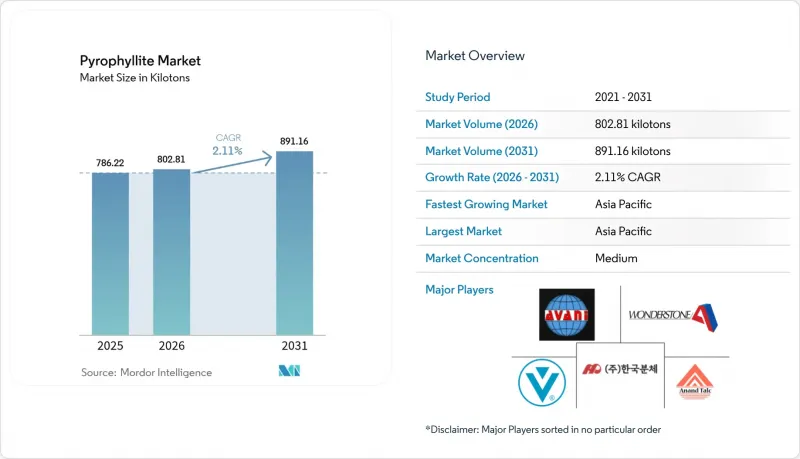
本報告按類型(天然葉蠟石及其他類型)、應用(陶瓷、耐火材料、填充材、玻璃纖維、橡膠和屋頂材料、肥料、裝飾石材及其他應用)和地區(亞太地區、北美地區、歐洲地區、南美地區以及中東和非洲地區)進行細分。市場預測以噸為單位。
全球葉蠟石市場趨勢及洞察
電弧煉鋼對耐火材料的需求日益成長。
電弧爐正在取代高爐-氧氣轉爐工藝,因為電弧爐能減少直接二氧化碳排放,並允許100%使用廢料。由於耐火材料在每次熔煉過程中都要承受1600 度C的熱衝擊,因此,具有極低熱膨脹係數、優異的抗渣性和穩定的氧化鋁-二氧化矽網路結構的葉蠟石粘合劑擴大被用於製造出鐵口磚、鋼包磚和卸料磚。預計全球對電弧爐(EAF)的投資將從2024年的6.7億美元成長到2032年的12.7億美元,年複合成長率達11%,這將直接影響耐火材料對耐火材料的需求成長。 RHI Magnesita斥資10億美元進行收購,以確保礦石供應,滿足不斷成長的需求;而中國對菱鎂礦的出口限制將進一步拓寬氧化鋁-二氧化矽替代品的選擇範圍。
用於高膜厚工業塗料的輕質礦物填料
離岸風力發電機塔架、液化天然氣儲存槽和海洋結構需要厚膜塗層,以在不增加品質的情況下提供耐腐蝕性。葉蠟石呈片狀晶體形態,屈光為1.58,使其在較低濃度下即可達到與滑石粉相當的遮蓋力,單層塗層即可形成400-600微米的乾膜厚度。此外,隨著二氧化鈦(TiO2)價格在2024年上漲40%,北美和歐洲的塗料工程師也開始採用這種礦物作為替代品。玻璃纖維製造商透過在E玻璃原料中添加葉蠟石,將熔點降低了30-50 度C。這減少了天然氣的消耗,符合脫碳目標。預計這些因素將推動複合年成長率(CAGR)成長0.3個百分點,主要成長區間為2026年至2028年。同時,塗料製造商也擴大採用新型母粒。
豐富的替代礦物:滑石、高嶺土、長石
滑石、高嶺土和長石與葉蠟石的最終用途有近80%的共用,並享受著數百萬噸的經濟效益。受喬治亞、Cornwall和江蘇省低成本採礦的支撐,高嶺土的銷售額預計將從2024年的48.5億美元成長到2030年的66.7億美元。滑石繼續作為聚合物和造紙的標準填料使用,而長石仍然是陶瓷中最便宜的助熔劑。隨著這些替代品的出現,葉蠟石的複合年成長率正在下降0.4個百分點,因為買家在性能要求允許的情況下會採用這些替代品。
細分市場分析
預計到2025年,天然礦石將佔總供應量的86.65%,而到2031年,精礦和合成礦石的供應量預計將增加2.71%。來自金斯山和奧托斯代爾的天然礦石,用於陶瓷、耐火材料和填料等應用,價格為每噸200至350美元。但電池和化妝品行業的買家則需要氧化鐵含量低於0.05%的精礦,價格為每噸800至1200美元。 QuantumScape公司規定氧化鋁含量的容差為±0.02%,這只有透過結合浮選和酸浸製程才能實現,無論是天然礦石或合成礦石。
混合加工流程正在重新定義產品分類。北卡羅來納州的生產商在煅燒前增加了磁選工序,而日本公司則使用矽烷化合物對粉末進行表面處理,用於化妝品領域。儘管天然礦石在銷售上仍佔據市場主導地位,但這種轉變正在改變收入結構。據報道,合成葉蠟石的價格是天然葉蠟石的三到五倍,這促使加工企業投資於浸出和煅燒設備。
區域分析
亞太地區預計到2025年將佔全球消費量的75.62%,並預計到2031年將以每年2.78%的速度成長。中國遼寧省的綜合採礦和耐火材料產業生態系統支撐了大部分需求,而印度的陶瓷和填料行業也推動了部分需求。日本和韓國以每噸600-900美元的價格從北卡羅來納州進口低鐵含量精礦,用於先進陶瓷和分離器的研發。
到2025年,北美將佔據顯著的市場佔有率,其中北卡羅來納州的兩家工廠為美國鋼鐵和塗料製造商供貨。根據《通膨抑制法案》,預計到2030年,美國國內電弧爐(EAF)煉鋼產量將增加15%至20%,這將推動該地區對葉蠟石的需求。在歐洲,市場穩定成長,德國和瑞典的氫氣爐先導計畫刺激了對低鹼耐火材料的新需求。在南歐,陶瓷產業的客戶仍然集中在義大利和西班牙,而北歐離岸風力發電的投資正在推動對塗料填料的需求。
除了南美洲,中東和非洲的市場也在擴張。雖然南非的大部分產品都用於出口,但鐵路和能源的限制限制了供應。如果中國實施類似於2010年稀土元素實施的出口配額,買家可能會轉向北卡羅來納州和南非。考慮到授權程序的延誤,到2031年,亞太地區的市佔率不太可能低於70%。
其他好處:
- Excel格式的市場預測(ME)表
- 3個月的分析師支持
目錄
第1章:引言
- 研究假設和市場定義
- 調查範圍
第2章:調查方法
第3章執行摘要
第4章 市場狀況
- 市場概覽
- 市場促進因素
- 電弧煉鋼對耐火材料的需求增加
- 用於高膜厚工業塗料的輕質礦物填料
- 在石棉訴訟案頻傳的背景下,化妝品產業正從滑石粉轉向葉蠟石。
- 用於全固態電池的陶瓷隔膜,需要高純度鋁矽原料。
- 低鹼等級,可用於製造氫氣爐用耐火材料。
- 市場限制因素
- 豐富的替代礦物:滑石、高嶺土、長石
- 低鐵、高氧化鋁礦體短缺
- 由於細磨和浮選迴路的改進,導致能源消耗量高。
- 價值鏈分析
- 波特五力模型
第5章 市場規模與成長預測
- 按類型
- 天然葉蠟石
- 其他類型
- 透過使用
- 陶瓷
- 耐火材料
- 填充材(紙張、油漆、殺蟲劑)
- 玻璃纖維
- 橡膠和屋頂材料
- 肥料(土壤改良劑)
- 裝飾石材
- 其他用途
- 按地區
- 亞太地區
- 中國
- 印度
- 日本
- 韓國
- 馬來西亞
- 泰國
- 印尼
- 越南
- 其他亞太國家
- 北美洲
- 美國
- 加拿大
- 墨西哥
- 歐洲
- 德國
- 英國
- 法國
- 義大利
- 西班牙
- 北歐國家
- 土耳其
- 俄羅斯
- 其他歐洲國家
- 南美洲
- 巴西
- 阿根廷
- 哥倫比亞
- 其他南美國家
- 中東和非洲
- 沙烏地阿拉伯
- 阿拉伯聯合大公國
- 卡達
- 埃及
- 奈及利亞
- 南非
- 其他中東和非洲國家
- 亞太地區
第6章 競爭情勢
- 市場集中度
- 策略趨勢
- 市佔率和排名分析
- 公司簡介
- Anand Talc
- Avani Group
- Hankook Mineral Powder Co. Ltd.
- Hebei Yayang Spodumene Co., Ltd.
- Idwala Industrial Holdings
- Jinhae Pyrophyllite
- Liaoyuan Pharmaceutical Co., Ltd.
- NINGBO INNO PHARMCHEM CO., LTD.
- PT Gunung Bale
- RT Vanderbilt Holding Company, Inc.
- RHI Magnesita
- SAMIROCK Company
- SEPRA
- SKKU Minerals
- Wonderstone
第7章 市場機會與未來展望
According to Mordor Intelligence, the pyrophyllite market size is expected to increase from 786.22 kilotons in 2025 to 802.81 kilotons in 2026 and reach 891.16 kilotons by 2031, growing at a CAGR of 2.11% over 2026-2031.
This report is Segmented by Type (Natural Pyrophyllite and Other Types), Application (Ceramics, Refractory, Filler Materials, Fiberglass, Rubber and Roofing, Fertilizers, Ornamental Stones, and Other Applications), and Geography (Asia-Pacific, North America, Europe, South America, and Middle East and Africa). Market Forecasts are Provided in Terms of Volume (Tons).
Global Pyrophyllite Market Trends and Insights
Rising Refractory Demand in Electric-Arc Steelmaking
Electric-arc furnaces displace blast-oxygen routes because they cut direct CO2 emissions and accept 100% scrap feedstocks. Every heat subjects refractories to 1,600 °C thermal shock, so tap-hole, ladle, and launder bricks increasingly rely on pyrophyllite binders that exhibit very low thermal expansion, excellent slag resistance, and stable alumina-silica networks. Global EAF capital spending rose from USD 670 million in 2024 and is slated to hit USD 1.27 billion by 2032 at an 11% CAGR, which feeds directly into refractory-grade pyrophyllite absorption. RHI Magnesita's USD 1 billion acquisition spree locks in ore supply for this wave, while any Chinese export restriction on magnesite would widen the application window for alumina-silicate alternatives.
Lightweight Mineral Fillers for High-Build Industrial Coatings
Offshore wind-turbine towers, LNG tanks, and marine structures need thick coatings that resist corrosion without adding mass. Pyrophyllite's platy habit and 1.58 refractive index deliver hiding power equivalent to talc at lower loading, enabling 400-600 μm dry-film thickness in one pass. North American and European formulators also substitute the mineral for titanium dioxide after 2024's 40% TiO2 price spike. Fiberglass manufacturers mix pyrophyllite into E-glass batches to lower the melting temperature by 30-50 °C, which trims natural-gas use and aligns with decarbonization goals. These factors add 0.3 percentage points to the forecast CAGR, mainly in 2026-2028, while paint lines qualify new masterbatches.
Abundant Substitute Minerals: Talc, Kaolin, Feldspar
Talc, kaolin, and feldspar serve roughly 80% of the same end uses and benefit from multi-million-ton economies of scale. Kaolin sales should climb from USD 4.85 billion in 2024 to USD 6.67 billion by 2030, bolstered by low-cost mining in Georgia, Cornwall, and Jiangsu. Talc continues as the default filler for polymers and paper, while feldspar remains the cheapest ceramic flux. These options shave 0.4 percentage points off pyrophyllite's CAGR as buyers substitute whenever performance requirements allow.
Other drivers and restraints analyzed in the detailed report include:
- Shift from Talc to Pyrophyllite in Cosmetics Amid Asbestos Litigation
- Solid-State Battery Ceramic Separators Needing High-Purity Al-Si Feedstocks
- Scarcity of Low-Iron, High-Al2O3 Ore Bodies
For complete list of drivers and restraints, kindly check the Table Of Contents.
Segment Analysis
Natural grades supplied 86.65% of 2025 tonnage, yet beneficiated and synthetic options are logging a 2.71% expansion through 2031. Natural feedstocks from Kings Mountain and Ottosdal sell at USD 200-350 per ton for ceramics, refractories, and filler uses, while battery and cosmetics buyers demand concentrates leached to <0.05% Fe2O3 that fetch USD 800-1,200. QuantumScape specifies +-0.02% tolerance on alumina, achievable only by flotation plus acid-leach routes that straddle natural and synthetic classes.
Hybrid processing is redefining product taxonomy. North Carolina producers are adding magnetic separation before calcination, while Japanese traders surface-treat powders with silanes for cosmetics. This migration shifts revenue even if natural ore retains volume leadership. The pyrophyllite market reports that synthetics can command three to five times natural pricing, supporting processors' capital spending on leach and calcine assets.
Complete Report Scope:
- By Type
- Natural Pyrophyllite
- Other Types
- By Application
- Ceramics
- Refractory
- Filler Materials (Paper, Paints, Insecticides)
- Fiberglass
- Rubber and Roofing
- Fertilizers (Soil Conditioners)
- Ornamental Stones
- Other Applications
- By Geography
- Asia-Pacific
- China
- India
- Japan
- South Korea
- Malaysia
- Thailand
- Indonesia
- Vietnam
- Rest of Asia-Pacific
- North America
- United States
- Canada
- Mexico
- Europe
- Germany
- United Kingdom
- France
- Italy
- Spain
- Nordic Countries
- Turkey
- Russia
- Rest of Europe
- South America
- Brazil
- Argentina
- Colombia
- Rest of South America
- Middle-East and Africa
- Saudi Arabia
- United Arab Emirates
- Qatar
- Egypt
- Nigeria
- South Africa
- Rest of Middle-East and Africa
- Asia-Pacific
Geography Analysis
Asia-Pacific possessed 75.62% of 2025 consumption and will advance at 2.78% to 2031. China's coupled mining-refractory ecosystem in Liaoning underpins most of that demand, and India's ceramics and filler sectors add further pull. Japan and South Korea import low-iron North Carolina concentrates at USD 600-900 per ton for advanced ceramics and separator research and development.
North America accounted for a significant market share in 2025 as two North Carolina operations feed U.S. steelmakers and coatings formulators. Inflation Reduction Act incentives should lift domestic EAF steel output 15-20% by 2030, nudging regional pyrophyllite uptake. Europe is witnessing moderate market growth, with Germany's and Sweden's hydrogen-furnace pilots sparking new low-alkali refractory demand. Southern Europe retains ceramics customers in Italy and Spain, while Nordic offshore-wind investments push coating fillers.
South America, plus the Middle East and Africa, are witnessing an expansion of the market. South African production goes mostly to export markets, but rail and energy constraints cap quantum. Any Chinese export quota, similar to the 2010 rare-earth move, would reroute buyers toward North Carolina and South Africa. Given permitting lags, Asia-Pacific is unlikely to drop below 70% share by 2031.
- Anand Talc
- Avani Group
- Hankook Mineral Powder Co. Ltd.
- Hebei Yayang Spodumene Co., Ltd.
- Idwala Industrial Holdings
- Jinhae Pyrophyllite
- Liaoyuan Pharmaceutical Co., Ltd.
- NINGBO INNO PHARMCHEM CO., LTD.
- PT Gunung Bale
- R.T. Vanderbilt Holding Company, Inc.
- RHI Magnesita
- SAMIROCK Company
- SEPRA
- SKKU Minerals
- Wonderstone
Additional Benefits:
- The market estimate (ME) sheet in Excel format
- 3 months of analyst support
TABLE OF CONTENTS
1 Introduction
- 1.1 Study Assumptions and Market Definition
- 1.2 Scope of the Study
2 Research Methodology
3 Executive Summary
4 Market Landscape
- 4.1 Market Overview
- 4.2 Market Drivers
- 4.2.1 Rising refractory demand in electric-arc steelmaking
- 4.2.2 Light-weight mineral fillers for high-build industrial coatings
- 4.2.3 Shift from talc to pyrophyllite in cosmetics amid asbestos litigation
- 4.2.4 Solid-state-battery ceramic separators needing high-purity Al-Si feedstocks
- 4.2.5 Low-alkali grades enabling hydrogen furnace refractories
- 4.3 Market Restraints
- 4.3.1 Abundant substitute minerals: talc, kaolin, feldspar
- 4.3.2 Scarcity of low-iron, high-Al2O3 ore bodies
- 4.3.3 High-energy intensity of fine-grinding and flotation circuit upgrades
- 4.4 Value Chain Analysis
- 4.5 Porter's Five Forces
- 4.5.1 Threat of New Entrants
- 4.5.2 Bargaining Power of Buyers
- 4.5.3 Bargaining Power of Suppliers
- 4.5.4 Threat of Substitute Products
- 4.5.5 Degree of Competition
5 Market Size and Growth Forecasts (Volume)
- 5.1 By Type
- 5.1.1 Natural Pyrophyllite
- 5.1.2 Other Types
- 5.2 By Application
- 5.2.1 Ceramics
- 5.2.2 Refractory
- 5.2.3 Filler Materials (Paper, Paints, Insecticides)
- 5.2.4 Fiberglass
- 5.2.5 Rubber and Roofing
- 5.2.6 Fertilizers (Soil Conditioners)
- 5.2.7 Ornamental Stones
- 5.2.8 Other Applications
- 5.3 By Geography
- 5.3.1 Asia-Pacific
- 5.3.1.1 China
- 5.3.1.2 India
- 5.3.1.3 Japan
- 5.3.1.4 South Korea
- 5.3.1.5 Malaysia
- 5.3.1.6 Thailand
- 5.3.1.7 Indonesia
- 5.3.1.8 Vietnam
- 5.3.1.9 Rest of Asia-Pacific
- 5.3.2 North America
- 5.3.2.1 United States
- 5.3.2.2 Canada
- 5.3.2.3 Mexico
- 5.3.3 Europe
- 5.3.3.1 Germany
- 5.3.3.2 United Kingdom
- 5.3.3.3 France
- 5.3.3.4 Italy
- 5.3.3.5 Spain
- 5.3.3.6 Nordic Countries
- 5.3.3.7 Turkey
- 5.3.3.8 Russia
- 5.3.3.9 Rest of Europe
- 5.3.4 South America
- 5.3.4.1 Brazil
- 5.3.4.2 Argentina
- 5.3.4.3 Colombia
- 5.3.4.4 Rest of South America
- 5.3.5 Middle-East and Africa
- 5.3.5.1 Saudi Arabia
- 5.3.5.2 United Arab Emirates
- 5.3.5.3 Qatar
- 5.3.5.4 Egypt
- 5.3.5.5 Nigeria
- 5.3.5.6 South Africa
- 5.3.5.7 Rest of Middle-East and Africa
- 5.3.1 Asia-Pacific
6 Competitive Landscape
- 6.1 Market Concentration
- 6.2 Strategic Moves
- 6.3 Market Share(%)/Ranking Analysis
- 6.4 Company Profiles (includes Global Overview, Market Overview, Core Segments, Financials, Strategic Information, Products and Services, Recent Developments)
- 6.4.1 Anand Talc
- 6.4.2 Avani Group
- 6.4.3 Hankook Mineral Powder Co. Ltd.
- 6.4.4 Hebei Yayang Spodumene Co., Ltd.
- 6.4.5 Idwala Industrial Holdings
- 6.4.6 Jinhae Pyrophyllite
- 6.4.7 Liaoyuan Pharmaceutical Co., Ltd.
- 6.4.8 NINGBO INNO PHARMCHEM CO., LTD.
- 6.4.9 PT Gunung Bale
- 6.4.10 R.T. Vanderbilt Holding Company, Inc.
- 6.4.11 RHI Magnesita
- 6.4.12 SAMIROCK Company
- 6.4.13 SEPRA
- 6.4.14 SKKU Minerals
- 6.4.15 Wonderstone
7 Market Opportunities and Future Outlook
- 7.1 White-space and Unmet-need Assessment

 滑石粉市場報告:趨勢、預測及競爭分析(至2035年)超細滑石粉市場報告:趨勢、預測及競爭分析(至2035年)
 滑石粉市場-2026-2032年全球市場預測
 滑石粉:市場佔有率分析、產業趨勢與統計、成長預測(2026-2031)
 全球滑石粉市場
 葉蠟石市場-全球產業規模、佔有率、趨勢、機會、預測:按應用、地區和競爭格局分類,2021-2031年
 滑石市場預測至2034年—按類型、礦床類型、應用和地區分類的全球分析
 滑石市場報告:礦床類型、形態、終端用途產業及地區分類,2026-2034年
 2026-2034年全球葉蠟石市場規模、佔有率、趨勢和成長分析報告日本滑石市場規模、佔有率、趨勢和預測:按礦床類型、形態、最終用途行業和地區分類,2026-2034年