


 |
市場調查報告書
商品編碼
2120419
滑石粉:市場佔有率分析、產業趨勢與統計、成長預測(2026-2031)Talc - Market Share Analysis, Industry Trends & Statistics, Growth Forecasts (2026 - 2031) |
||||||

※ 本網頁內容可能與最新版本有所差異。詳細情況請與我們聯繫。
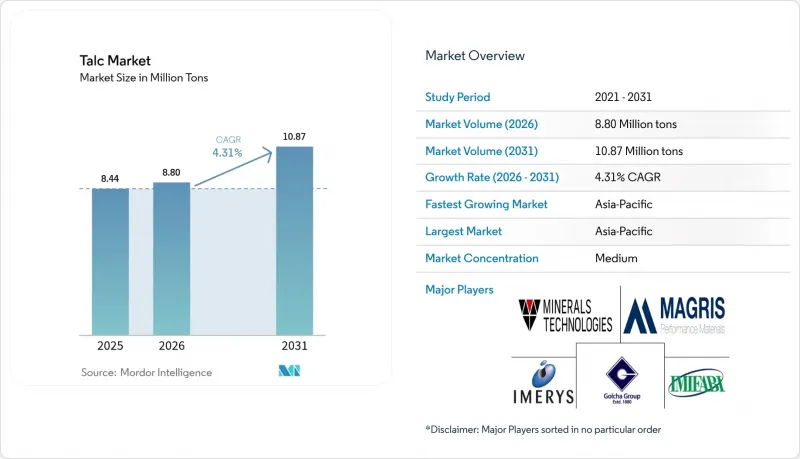
根據 Mordor Intelligence 預測,滑石市場規模將從 2025 年的 844 萬噸成長到 2026 年的 880 萬噸,然後在 2031 年達到 1087 萬噸,2026 年至 2031 年的複合年成長率為 4.31%。
本報告按礦床類型(碳酸滑石、氯酸鹽滑石)、終端用戶行業(塑膠和橡膠、油漆和塗料、陶瓷、紙漿和造紙、個人護理和化妝品、食品和飲料以及其他行業)和地區(亞太地區、北美、歐洲、南美、中東和非洲)進行細分。市場預測以噸為單位。
全球滑石市場趨勢與洞察
汽車輕量化領域對PP和TPO材料的穩定應用
汽車製造商在聚丙烯 (PP) 和熱塑性聚烯烴 (TPO) 複合材料中添加 15% 至 25% 的滑石粉,以達到符合燃油效率和電動汽車續航里程監管要求的剛度重量比,而無需改造射出成型線設備。伊梅里斯 (Imerys) 於 2025 年在蕪湖開設了一家價值 4,300 萬歐元的工廠,每年供應 3 萬噸超細級滑石粉,用於電池外殼和內裝板。根據經合組織 (OECD) 的預測,東南亞和東亞的塑膠使用量預計將從 2019 年的 6,000 萬噸增至 2060 年的 1.5 億噸,其中汽車和電子產業預計將成為成長最快的產業。馬來西亞的循環經濟舉措將在 2024 年從報廢車輛中回收 12,000 噸 PP 和 ABS,預計到 2030 年這一數字將增加三倍。滑石粉的成核作用可將成型週期縮短 8% 至 12%,從而提高一級供應商的產量,運轉率達到 85% 至 90%。
亞洲正逐步向水性建築塗料過渡。
中國GB30981.1-2025標準將內牆塗料的揮發性有機化合物(VOC)含量限制在80克/公升以內,迫使塗料生產商採用水性黏合劑,而水性黏合劑需要更高的滑石粉含量。印度標準局(BIS)正在製定類似的限值,預計在2026年底發布。水性塗料通常含有12%至18%的滑石粉,高於溶劑型塗料的8%至12%。這是因為滑石粉的層狀片狀晶體可以彌補其遮蓋力的降低。根據泰國工業和經濟事務局的數據,2024年泰國國內滑石粉產量增加了17.27%,由於越南、印尼和菲律賓的需求,出口量也增加了14.73%。與二氧化鈦相比,滑石粉的價格在每噸 150 美元至 250 美元之間,這使得油漆製造商能夠在其他添加劑價格上漲的情況下穩定零售價格。
石棉相關訴訟帶來的持續成本
2024年5月,強生公司提出以100億美元和解6.2萬件與化妝品級滑石粉相關的卵巢癌訴訟。由於LTL Management公司多次申請破產保護(第11章)都被駁回,提案仍處於懸而未決的狀態,這加劇了上游礦商的不確定性。 2025年第一季,Minerals Technologies公司撥出2.15億美元設立信託基金,用於處理在以3,200萬美元累計Barretts Minerals公司後遺留的684起未決訴訟。 2025年1月,Imerys公司獲得90%債權人批准,對其北美業務進行重組,該重組方案允許隔離過去的負債,但也限制了其資產負債表的柔軟性。預計到2025年,主要滑石粉生產商的保費將上漲40%至60%,而總承保限額將降至5,000萬至1億美元,這將迫使中型企業轉向自保或退出化妝品級滑石粉市場。
細分市場分析
到2025年,碳酸滑石將佔滑石總產量的61.90%。這主要得益於中國、印度和巴西豐富的變質岩帶,這些岩帶所產出的礦石生產實惠,適用於塑膠、塗料和陶瓷等產業。綠泥石滑石將佔據剩餘佔有率,預計其年複合成長率將達到4.76%,因為汽車和電子產業的客戶要求其鐵含量低於50ppm,而許多碳酸滑石礦石無法達到此標準。綠泥石滑石的鐵含量低於0.05%,而碳酸滑石的鐵含量為0.15%至0.30%,因此綠泥石滑石可以消除白色汽車內裝件的色差問題,並降低化妝品配方中的漂白成本。綠泥石滑石的價格將比碳酸滑石高出50至100美元,但可減少窯爐8%至12%的二氧化碳排放,有助於企業遵守歐盟的碳定價機制。 2024年芬蘭的一場勞資糾紛導致滑石粉年產量減少4萬至5萬噸,迫使買家透過固定價格合約提前預訂60%至70%的年度需求。這標誌著滑石粉市場格局發生結構性轉變,將重塑高附加價值產業滑石粉的市場佔有率。
日韓電子產品製造商的囤貨行為清楚地表明了供應緊張的局面。進口商已將安全庫存從罷工前的22天增加到2025年的45天,以保護供應鏈,但也佔用了流動資金。印度加工商正將目光投向西澳大利亞的綠泥石礦藏,以實現來源多元化並對沖外匯風險。碳酸鹽礦石在建築填充材和橡膠行業仍然至關重要,因為在這些行業中,價格比純度更為重要。
區域分析
亞太地區2025年市佔率預計將達到53.22%,複合年成長率(CAGR)為5.18%,這項預測受到多種因素的支持。印度陶瓷產業累計創造5.1萬至5.3萬立方公尺(61億至64億美元)的銷售額。這得益於國內瓷磚需求6%至7%的成長以及已公佈的2540萬平方米產能。在越南,由於針對中國產品的反傾銷措施,2024年越南瓷磚出口量激增22%。這刺激了對輥窯維修的投資,而輥窯改造需要更細的滑石粉來防止變形。中國的GB30981.1-2025揮發性有機化合物(VOC)排放標準迫使複合材料生產商將水性塗料中的滑石粉含量提高30%至40%。 2024年,泰國的滑石粉產量增加了17.27%,這反映了其作為東協加工中心的重要地位。根據經合組織的長期預測模型,到2060年,區域塑膠需求預計將成長兩倍,達到1.5億噸,滑石粉將深度融入輕量化趨勢。日本和韓國主要進口亞氯酸鹽級滑石粉用於電子和製藥行業,但由於重金屬含量限制在ppm以下,這些行業的准入門檻很高。
在北美,訴訟和生產商退出限制了成長。 Minerals Technologies公司於2024年4月以3,200萬美元的價格出售Barretts Minerals公司,凸顯了責任風險和營運收入之間的兩難。強生公司尚未解決的100億美元提案推高了保險成本,導致保費上漲40%至60%。蒙大拿州和佛蒙特州的美國礦場仍在繼續為汽車和塗料客戶供貨,但在公眾的密切關注下,獲得新的許可證進展緩慢。在加拿大和墨西哥,優先考慮在地採購的《美墨加協定》(USMCA)規則適用,主要體現在汽車塑膠產業。美國食品藥物管理局(FDA)於2024年強制實施的顯微鏡檢測增加了批次間檢測成本,迫使小眾食品藥物管理局品牌轉向澱粉基替代品。
在歐洲,高品質紙張產業轉向生物基材料以及伊梅里斯義大利滑石公司(Imerys Talc Italia)於2025年3月破產,導致滑石粉供應受限。北歐的亞氯酸鹽企業為製藥和食品接觸材料市場供應滑石粉,但罷工導致現貨市場供應緊張,迫使買家通過照付不議合約來確保其年度需求的60-70%。德國、法國、英國和義大利的滑石粉消費也涉及汽車、建築塗料和陶瓷領域。歐盟新的生態設計法規要求從2028年起提交“材料護照”,優先考慮來源明確、生命週期碳排放量低的填料,這將給高能耗滑石粉生產商帶來成本壓力。南美、中東和非洲的總合相對較小,主要受巴西汽車塑膠和沙烏地阿拉伯新興陶瓷產業叢集的推動,但外匯波動和物流瓶頸限制了需求成長。
其他好處:
- Excel格式的市場預測(ME)表
- 3個月的分析師支持
目錄
第1章:引言
- 研究假設和市場定義
- 調查範圍
第2章:調查方法
第3章執行摘要
第4章 市場狀況
- 市場概覽
- 市場促進因素
- 汽車輕量化領域對PP和TPO材料的穩定應用
- 亞洲正加速向水性建築塗料的轉變。
- 包裝產業對滑石粉填充聚合物母粒的需求強勁
- 南亞和東南亞陶瓷生產的擴張
- 人工智慧驅動的礦石分選技術正在提高礦石回收率和單位經濟效益。
- 市場限制因素
- 石棉相關訴訟帶來的持續成本
- 生物基填料可取代高品質紙張中的滑石粉
- 芬蘭勞資糾紛後,歐洲出現高純度礦石短缺。
- 價值鏈分析
- 波特五力模型
第5章 市場規模與成長預測
- 按礦床類型
- 滑石碳酸鹽型
- 滑石/亞氯酸鹽型
- 按最終用戶行業分類
- 塑膠和橡膠
- 油漆和塗料
- 陶瓷
- 紙漿和造紙
- 個人護理化妝品
- 食品/飲料
- 其他終端用戶產業
- 按地區
- 亞太地區
- 中國
- 印度
- 日本
- 韓國
- 東南亞國協
- 其他亞太國家
- 北美洲
- 美國
- 加拿大
- 墨西哥
- 歐洲
- 德國
- 英國
- 法國
- 義大利
- 北歐國家
- 其他歐洲國家
- 南美洲
- 巴西
- 阿根廷
- 其他南美國家
- 中東和非洲
- 沙烏地阿拉伯
- 南非
- 其他中東和非洲國家
- 亞太地區
第6章 競爭情勢
- 市場集中度
- 策略趨勢
- 市佔率和排名分析
- 公司簡介
- AKJ MinChem
- ANAND TALC
- Chanda Minerals
- CIMBAR PERFORMANCE MINERALS
- euroMinerals GmbH
- Golcha Group
- Hayashi-Kasei
- Imerys
- IMI Fabi SpA
- LITHOS Industrial Minerals GmbH
- Magris Performance Materials
- Minerals Technologies Inc.
- Nippon Talc Co., Ltd.
- Sibelco
第7章 市場機會與未來展望
According to Mordor Intelligence, the talc market size is expected to grow from 8.44 Million tons in 2025 to 8.80 Million tons in 2026 and is forecast to reach 10.87 Million tons by 2031 at 4.31% CAGR over 2026-2031.
This report is Segmented by Deposit Type (Talc Carbonate and Talc Chlorite), End-User Industry (Plastics and Rubber, Paints and Coatings, Ceramics, Pulp and Paper, Personal Care and Cosmetics, Food and Beverage, and Other Industries), and Geography (Asia-Pacific, North America, Europe, South America, and Middle-East and Africa). The Market Forecasts are Provided in Terms of Volume (Tons).
Global Talc Market Trends and Insights
Robust PP and TPO Adoption in Automotive Lightweighting
Automakers embed 15%-25% talc in PP and TPO compounds to achieve stiffness-to-weight ratios that meet fuel-economy and EV-range mandates without retooling injection lines. Imerys opened a EUR 43 million facility in Wuhu in 2025 to supply 30,000 tons of ultra-fine grades targeted at battery housings and interior panels. The OECD projects plastics use in Southeast and East Asia to rise from 60 million tons in 2019 to 150 million tons by 2060, with automotive and electronics driving the steepest slopes. Malaysia's circular-economy initiative recovered 12,000 tons of PP and ABS from end-of-life vehicles in 2024, a figure expected to triple by 2030. Talc's nucleating effect shortens molding cycles by 8%-12%, raising throughput for tier-one suppliers operating at 85%-90% capacity utilization.
Growing Shift to Water-Based Architectural Paints in Asia
China's GB30981.1-2025 caps VOCs at 80 g/L for interior coatings, forcing formulators to adopt aqueous binders that require higher talc loadings. India's Bureau of Indian Standards is drafting similar limits for notification in late 2026. Water-based systems typically contain 12%-18% talc, up from 8%-12% in solvent-borne paints, because the mineral's lamellar platelets compensate for lower hiding power. Thailand's Office of Industrial Economics recorded a 17.27% rise in domestic talc output in 2024, with exports up 14.73% on demand from Vietnam, Indonesia, and the Philippines. Compared with titanium dioxide, talc is priced at USD 150-250 per ton, enabling paint makers to hold shelf prices steady despite inflation in other additives.
Persistent Asbestos-Related Litigation Costs
Johnson & Johnson offered USD 10 billion in May 2024 to settle 62,000 ovarian-cancer claims tied to cosmetic talc. The proposal remains in limbo after successive Chapter 11 filings by LTL Management were dismissed, prolonging uncertainty for upstream miners. Minerals Technologies booked a USD 215 million provision in Q1 2025 to fund a trust for 684 open cases, after divesting Barretts Minerals for USD 32 million. Imerys obtained 90% creditor approval in January 2025 for its North American restructuring, ring-fencing legacy liabilities but constraining balance-sheet flexibility. Insurance premiums on talc producers' primary layers rose 40%-60% in 2025, while aggregate limits tightened to USD 50-100 million, compelling mid-tier players to self-insure or exit cosmetic grades.
Other drivers and restraints analyzed in the detailed report include:
- Strong Demand for Talc-Filled Polymer Masterbatch in Packaging
- Expansion of Ceramics Production in South and Southeast Asia
- Bio-Based Fillers Replacing Talc in Premium Papers
For complete list of drivers and restraints, kindly check the Table Of Contents.
Segment Analysis
Talc carbonate accounted for 61.90% of 2025 tonnage, thanks to abundant metamorphic belts in China, India, and Brazil that yield cost-effective ore for plastics, paints, and ceramics. Talc Chlorite, holding the balance, will expand at a 4.76% CAGR as automotive and electronics customers impose sub-50 ppm iron limits impossible for many carbonate ores. Chlorite talc delivers less than 0.05% iron versus 0.15%-0.30% for carbonate, eliminating color shift in white automotive trim and cutting bleaching costs in cosmetic formulations. Chlorite grades fetch a USD 50-100 premium but reduce kiln CO2 evolution by 8%-12%, aiding EU carbon-pricing compliance. Finnish labor strikes in 2024 sidelined 40,000-50,000 t/y, forcing buyers to pre-book 60%-70% of annual needs under fixed-price contracts, a structural move that reshapes the talc market share at the value-added end of the spectrum.
Stockpiling by Japanese and South Korean electronics firms illustrates tightness: importers doubled safety inventories to 45 days in 2025, up from 22 days pre-strike, insulating supply chains yet locking in working capital. Indian processors eye Western Australia's chlorite veins to diversify sourcing and hedge currency exposure. Carbonate ore remains indispensable for construction fillers and rubber, where price outweighs purity.
Complete Report Scope:
- By Deposit Type
- Talc Carbonate
- Talc Chlorite
- By End-user Industry
- Plastics and Rubber
- Paints and Coatings
- Ceramics
- Pulp and Paper
- Personal Care and Cosmetics
- Food and Beverage
- Other End-user Industries
- By Geography
- Asia-Pacific
- China
- India
- Japan
- South Korea
- ASEAN Countries
- Rest of Asia-Pacific
- North America
- United States
- Canada
- Mexico
- Europe
- Germany
- United Kingdom
- France
- Italy
- NORDIC Countries
- Rest of Europe
- South America
- Brazil
- Argentina
- Rest of South America
- Middle-East and Africa
- Saudi Arabia
- South Africa
- Rest of Middle-East and Africa
- Asia-Pacific
Geography Analysis
Asia-Pacific's 53.22% slice in 2025 and a 5.18% forecast CAGR rely on synchronized forces. India's ceramic sector generated INR 51,000-53,000 crore (USD 6.1-6.4 billion) in FY 2025, underpinned by 6%-7% domestic tile demand and 25.4 million m2 of announced capacity. Vietnam's tile exports jumped 22% in 2024 after anti-dumping rulings against Chinese products, spurring investment in roller-kiln retrofits that demand finer talc to avert warping. China's GB30981.1-2025 VOC cap forces formulators to raise talc in water-based paints by 30%-40%. Thailand's 17.27% rise in 2024 output reflects its role as an ASEAN processing hub. OECD long-range models see regional plastics demand tripling to 150 million tons by 2060, locking talc into the lightweighting narrative. Japan and South Korea specialize in chlorite-grade imports for electronics and pharma, where sub-ppm heavy-metal limits create high barriers to entry.
North America's growth is restricted owing to litigation and producer exits. Minerals Technologies' April 2024 sale of Barretts Minerals for USD 32 million underscores the squeeze between liability risk and operating returns. Johnson & Johnson's unresolved USD 10 billion proposal magnifies insurance costs, adding 40%-60% to premiums. U.S. mines in Montana and Vermont still supply automotive and paints customers, but new permits evolve slowly amid public scrutiny. In Canada and Mexico, primarily in auto plastics, covered by USMCA rules favouring local content. The FDA's 2024 microscopy mandate raises batch-testing costs, nudging niche cosmetics brands toward starch alternatives.
Europe is curbed by bio-based substitution in premium paper and the March 2025 bankruptcy of Imerys Talc Italy. Nordic chlorite operations feed pharmaceutical and food-contact markets, strike, tighten spot supply, and drive buyers to commit 60%-70% of annual needs under take-or-pay terms. Germany, France, the UK, and Italy's consumption spans automotive, architectural paints, and ceramics. The EU's forthcoming Ecodesign Regulation, which will require material passports from 2028, favors fillers with transparent provenance and lower life-cycle carbon, putting cost pressure on energy-intensive talc producers. South America and the Middle-East and Africa together take a smaller share, led by Brazil's auto plastics and Saudi Arabia's nascent ceramics clusters, though currency swings and logistics bottlenecks limit velocity.
- AKJ MinChem
- ANAND TALC
- Chanda Minerals
- CIMBAR PERFORMANCE MINERALS
- euroMinerals GmbH
- Golcha Group
- Hayashi-Kasei
- Imerys
- IMI Fabi SpA
- LITHOS Industrial Minerals GmbH
- Magris Performance Materials
- Minerals Technologies Inc.
- Nippon Talc Co., Ltd.
- Sibelco
Additional Benefits:
- The market estimate (ME) sheet in Excel format
- 3 months of analyst support
TABLE OF CONTENTS
1 Introduction
- 1.1 Study Assumptions and Market Definition
- 1.2 Scope of the Study
2 Research Methodology
3 Executive Summary
4 Market Landscape
- 4.1 Market Overview
- 4.2 Market Drivers
- 4.2.1 Robust PP and TPO Adoption in Automotive Lightweighting
- 4.2.2 Growing Shift to Water-Based Architectural Paints in Asia
- 4.2.3 Strong Demand for Talc-Filled Polymer Masterbatch in Packaging
- 4.2.4 Expansion of Ceramics Production in South and Southeast Asia
- 4.2.5 AI-Enabled Ore-Sorting Boosting Ore Recovery and Unit Economics
- 4.3 Market Restraints
- 4.3.1 Persistent Asbestos-Related Litigation Costs
- 4.3.2 Bio-Based Fillers Replacing Talc in Premium Papers
- 4.3.3 High-Purity Ore Shortages in Europe After Finnish Labor Strike
- 4.4 Value Chain Analysis
- 4.5 Porter's Five Forces
- 4.5.1 Bargaining Power of Suppliers
- 4.5.2 Bargaining Power of Consumers
- 4.5.3 Threat of New Entrants
- 4.5.4 Threat of Substitutes
- 4.5.5 Degree of Competition
5 Market Size and Growth Forecasts (Volume)
- 5.1 By Deposit Type
- 5.1.1 Talc Carbonate
- 5.1.2 Talc Chlorite
- 5.2 By End-user Industry
- 5.2.1 Plastics and Rubber
- 5.2.2 Paints and Coatings
- 5.2.3 Ceramics
- 5.2.4 Pulp and Paper
- 5.2.5 Personal Care and Cosmetics
- 5.2.6 Food and Beverage
- 5.2.7 Other End-user Industries
- 5.3 By Geography
- 5.3.1 Asia-Pacific
- 5.3.1.1 China
- 5.3.1.2 India
- 5.3.1.3 Japan
- 5.3.1.4 South Korea
- 5.3.1.5 ASEAN Countries
- 5.3.1.6 Rest of Asia-Pacific
- 5.3.2 North America
- 5.3.2.1 United States
- 5.3.2.2 Canada
- 5.3.2.3 Mexico
- 5.3.3 Europe
- 5.3.3.1 Germany
- 5.3.3.2 United Kingdom
- 5.3.3.3 France
- 5.3.3.4 Italy
- 5.3.3.5 NORDIC Countries
- 5.3.3.6 Rest of Europe
- 5.3.4 South America
- 5.3.4.1 Brazil
- 5.3.4.2 Argentina
- 5.3.4.3 Rest of South America
- 5.3.5 Middle-East and Africa
- 5.3.5.1 Saudi Arabia
- 5.3.5.2 South Africa
- 5.3.5.3 Rest of Middle-East and Africa
- 5.3.1 Asia-Pacific
6 Competitive Landscape
- 6.1 Market Concentration
- 6.2 Strategic Moves
- 6.3 Market Share (%)/Ranking Analysis
- 6.4 Company Profiles (includes Global level Overview, Market level overview, Core Segments, Financials as available, Strategic Information, Products and Services, Recent Developments)
- 6.4.1 AKJ MinChem
- 6.4.2 ANAND TALC
- 6.4.3 Chanda Minerals
- 6.4.4 CIMBAR PERFORMANCE MINERALS
- 6.4.5 euroMinerals GmbH
- 6.4.6 Golcha Group
- 6.4.7 Hayashi-Kasei
- 6.4.8 Imerys
- 6.4.9 IMI Fabi SpA
- 6.4.10 LITHOS Industrial Minerals GmbH
- 6.4.11 Magris Performance Materials
- 6.4.12 Minerals Technologies Inc.
- 6.4.13 Nippon Talc Co., Ltd.
- 6.4.14 Sibelco
7 Market Opportunities and Future Outlook
- 7.1 White-space and Unmet-Need Assessment

 葉蠟石:市場佔有率分析、產業趨勢與統計、成長預測(2026-2031)
 滑石粉市場報告:趨勢、預測及競爭分析(至2035年)超細滑石粉市場報告:趨勢、預測及競爭分析(至2035年)
 滑石粉市場-2026-2032年全球市場預測
 全球滑石粉市場
 葉蠟石市場-全球產業規模、佔有率、趨勢、機會、預測:按應用、地區和競爭格局分類,2021-2031年
 滑石市場預測至2034年—按類型、礦床類型、應用和地區分類的全球分析
 滑石市場報告:礦床類型、形態、終端用途產業及地區分類,2026-2034年
 2026-2034年全球葉蠟石市場規模、佔有率、趨勢和成長分析報告日本滑石市場規模、佔有率、趨勢和預測:按礦床類型、形態、最終用途行業和地區分類,2026-2034年