


 |
市場調查報告書
商品編碼
2124106
電流感測器:市場佔有率分析、行業趨勢和統計數據、成長預測(2026-2031)Current Sensor - Market Share Analysis, Industry Trends & Statistics, Growth Forecasts (2026 - 2031) |
||||||

※ 本網頁內容可能與最新版本有所差異。詳細情況請與我們聯繫。
根據 Mordor Intelligence 預測,電流感測器市場規模將從 2025 年的 38.9 億美元成長到 2026 年的 42.5 億美元,然後在 2031 年達到 65.7 億美元,2026 年至 2031 年的複合年成長率為 9.13%。
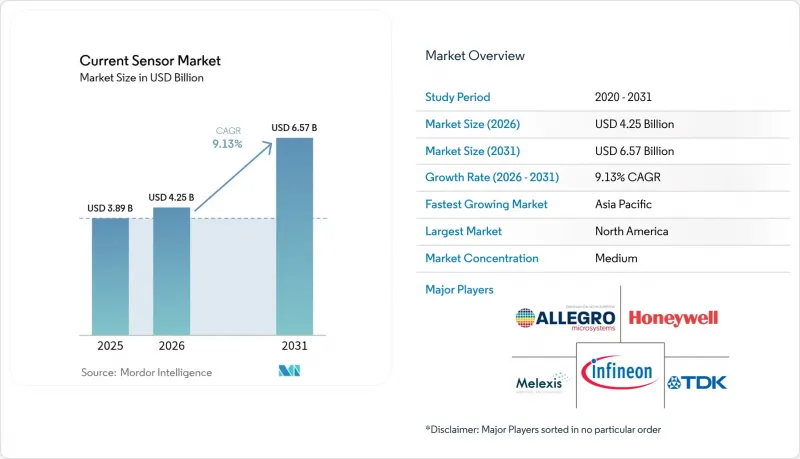
本報告按感測器類型(霍爾效應感測器、光纖電流電流感測器、電感/CT感測器等)、隔離技術(開放回路隔離等)、電流範圍(600A)、終端用戶產業(汽車和運輸、工業自動化和機器人、能源和電力等)和地區進行分類。
全球電流感測器市場趨勢與洞察
電池供電系統和可再生能源系統的普及
在公用事業規模的太陽能發電和儲能專案中,通常會安裝多個監測點,包括直流匯流箱、逆變器輸入端和併網鏈路,這會對每兆瓦的感測器需求產生協同效應。雙向V2G(車輛到電網)介面要求充放電電流的測量精度達到1%以下,這增加了傳統霍爾效應元件的壓力,同時也促進了抗電磁干擾光纖感測器的應用。在亞太地區,可再生能源部署義務和電動車購買激勵措施的結合,協同增加了汽車、工業和電網市場對感測器的需求。此外,在分散式能源系統的部署中,非侵入式羅氏線圈因其精度驗證的有效性而備受青睞。系統整合商擴大採用數位介面,以便將現場數據直接整合到預測性維護平台中。
加速電動車電氣化和高級駕駛輔助系統(ADAS)的整合。
高階電動車過渡到 800V 架構,要求感測器在保持 5kV 以上介電強度的同時,實現微秒的反應速度。即使是單輛電池式電動車,也需要多達 50 個電流測量點,涵蓋牽引逆變器、電池管理系統 (BMS) 和熱迴路。整合到線控轉向和線控刹車模組中的高級駕駛輔助系統 (ADAS) 執行器增加了冗餘感測通道,以符合 ISO 26262 標準。 TMR 解決方案憑藉其卓越的溫度穩定性和低靜態電流,獲得了市場佔有率,使 Allegro MicroSystems 等供應商成為動力傳動系統和底盤應用中傳統霍爾效應元件的替代品。開關頻率超過 100kHz 的碳化矽 (SiC) 逆變器突破了傳統電流互感器的頻寬限制,促使人們投資於功率模組中的整合感測技術。
霍爾效應感測器的平均售價正在下降。
來自中國晶圓廠的大量通用型車用級晶片湧入市場,擠壓了毛利率,並引發了現有供應商之間的整合。一級整合商集中採購以獲得批量折扣,加劇了入門級霍爾效應感測器領域的「低價競爭」。供應商試圖透過系統級封裝(SiP)功能(例如診斷功能和數位介面)來差異化,但價格差異持續擴大。許多利基製造商轉向三極管(TMR)和光纖產品線,但龐大的研發投入和漫長的車規認證流程阻礙了中小企業進入該領域。整合模組策略透過將感測器和基於微控制器(MCU)的監控功能整合到功率級中,在一定程度上緩解了價格壓力,並符合原始設備製造商(OEM)以價值為導向的採購模式。
細分市場分析
霍爾效應裝置憑藉著成熟的生產線和在牽引逆變器和工業驅動器中久經考驗的可靠性,在2025年佔據了47.55%的銷售額。然而,其頻寬限制和熱漂移促使設計人員轉向TMR和光纖方案。由於可再生能源安裝商要求在高壓開關站進行無需電氣隔離的測量,光纖感測器在2026年至2031年間的複合年成長率將達到12.21%。 TMR的靈敏度是傳統霍爾效應感測器的10倍,可作為BMS分流器的替代方案,降低電阻損耗,並減少電池組的待機功耗。
先進的電動車逆變器採用共封裝的TMR晶片,以實現瞬時相電流回饋,滿足1 MHz頻寬目標。隨著高壓直流輸電(HVDC)的擴展,光纖電流電流感測器市場預計到2031年將達到10.12億美元。雖然電感式電流互感器(CT)在1000 A以上的電流範圍內仍佔據相當大的市場佔有率,但羅氏線圈已解決了現有裝置的維修審核問題,無需切斷導線。隨著功率密度藍圖圖對適用於更小模組面積的非飽和、低剖面解決方案的需求不斷成長,這種轉變正在加速。
開放回路架構佔了56.58%的市場佔有率,在400V電動車電池組和600V太陽能逆變器中實現了成本和安全性的平衡。封閉回路型裝置利用磁回饋實現了±0.5%的精度,隨著設計人員不斷提高效率指標,其複合年成長率達到了11.12%。這些感測器能夠補償車載充電器和伺服驅動器中的環境溫度漂移,確保符合歐洲生態設計標準。預計到2031年,封閉回路型電流感測器的市佔率將成長至41.05%。
在對電氣隔離要求不高的48V輕混平台中,非隔離式分流感測器逐漸流行起來。然而,隨著封裝級電壓接近60V,其適用性受到威脅,促使供應商將分流器和數位隔離器整合到混合封裝中。將模擬前端、Σ- Delta轉換器和隔離通道整合到單一IC中,可以降低物料清單成本、減少PCB面積並提升閉合迴路的提案。
區域分析
預計到2025年,亞太地區將佔據全球市場榜首,佔全球銷售額的46.27%。這主要得益於中國擴大電動車生產規模,並維持其在半導體封裝領域的絕對優勢。政府對可再生能源的扶持政策推動了國內光纖感測器新創企業的湧現。日本憑藉其精密製造的傳統優勢,將先進的TMR產品商業化;而韓國則將電流感測功能整合到其SiC功率模組出口生產線中。
北美位居第二。對超大規模資料中心的投資以及《通貨膨脹削減法案》(IRA) 下清潔能源專案的獎勵促進了感測器採購。美國的製造業回流計畫促進了電力系統基礎設施和國防領域安全關鍵部件的本地化生產。加拿大為實現電池原料自給自足所做的努力,支撐了與採礦電氣化相關的區域感測器需求。
在歐洲,嚴格的二氧化碳排放目標和功能安全要求得以推行,使得汽車閉合迴路裝置的平均售價(ASP)維持在高位。德國和法國建立了重要的研發中心,將感測器設計和氮化鎵逆變器相關的新創公司連結起來。在中東和非洲,太陽能園區的投資催生了新的需求,而拉丁美洲的成長則主要得益於墨西哥和巴西的汽車組裝叢集。在各個地區,目前的感測器市場規模都隨著電池製造地的擴張和可再生能源領域的資本投資而成長。
其他好處:
- Excel格式的市場預測(ME)表
- 3個月的分析師支持
目錄
第1章:引言
- 研究假設和市場定義
- 調查範圍
第2章:調查方法
第3章執行摘要
第4章 市場狀況
- 市場概覽
- 市場促進因素
- 電池供電和可再生能源系統的普及
- 加速電動車電氣化和高級駕駛輔助系統(ADAS)的整合。
- 功能安全相關法規(ISO 26262、IEC 61508)
- 雙向車對車充電(V2G)技術的應用正在迅速成長。
- 高頻GaN/SiC功率電子元件的小型化
- 面向人工智慧工作負載的資料中心電源監控
- 市場限制因素
- 霍爾效應感測器的平均售價下降
- 精密漂移和分流/CT的替代方案
- 高滲透性岩芯所用合金的供應鏈緊張。
- 智慧電網計量系統中網路安全合規的成本
- 重要法規結構的評估
- 價值鏈分析
- 技術展望
- 波特五力模型
- 對關鍵相關人員的影響評估
- 主要用例和案例研究
- 宏觀經濟因素對市場的影響
- 投資分析
第5章 市場區隔
- 依感測器類型
- 霍爾效應感測器
- 光纖電流感測器
- 感應式/CT感應器
- 磁通門感測器
- 羅戈夫斯基線圈感測器
- 透過分離技術
- 開放回路(隔離式)
- 封閉回路型(隔離式)
- 非絕緣型(分流法)
- 按目前範圍
- <50 A
- 50~200 A
- 200~600 A
- >600 A
- 按最終用戶行業分類
- 汽車和運輸業
- 工業自動化與機器人技術
- 能源與電力(太陽能、風能、儲能系統)
- 家用電子產品
- 通訊和資料中心
- 醫療器材
- 按地區
- 北美洲
- 美國
- 加拿大
- 墨西哥
- 南美洲
- 巴西
- 阿根廷
- 其他南美國家
- 歐洲
- 德國
- 英國
- 法國
- 義大利
- 俄羅斯
- 其他歐洲國家
- 亞太地區
- 中國
- 日本
- 韓國
- 印度
- ASEAN
- 其他亞太國家
- 中東和非洲
- 中東
- 沙烏地阿拉伯
- 阿拉伯聯合大公國
- 土耳其
- 其他中東國家
- 非洲
- 南非
- 奈及利亞
- 其他非洲國家
- 中東
- 北美洲
第6章 競爭情勢
- 市場集中度
- 策略趨勢
- 市佔率分析
- 公司簡介
- Allegro MicroSystems Inc.
- TDK Corporation(TDK-Micronas GmbH)
- Asahi Kasei Microdevices Corp.
- Infineon Technologies AG
- Tamura Corporation
- Melexis NV
- Honeywell International Inc.
- Texas Instruments Inc.
- Sensitec GmbH
- LEM International SA
- Pulse Electronics Corp.
- ACEINNA Inc.
- Vacuumschmelze GmbH & Co KG
- MagnTek Microelectronics Co. Ltd.
- NewJapanRadio Co. Ltd.
- Murata Manufacturing Co. Ltd.
- Onsemi Corp.
- ROHM Semiconductor Co. Ltd.
- Sensata Technologies Inc.
- NK Technologies
- ABB Ltd.
- CR Magnetics Inc.
- Eaton Corp. plc
- LEMKEN AG
- Topworx Inc.
- Schneider Electric SE
第7章 市場機會與未來展望
According to Mordor Intelligence, the current sensor market size is expected to grow from USD 3.89 billion in 2025 to USD 4.25 billion in 2026 and is forecast to reach USD 6.57 billion by 2031 at 9.13% CAGR over 2026-2031.
This report is Segmented by Sensor Type (Hall-Effect Sensors, Fiber-Optic Current Sensors, Inductive/CT Sensors, and More), Isolation Technology (Open-Loop Isolated, and More), Current Range (600A), End-User Industry (Automotive and Transportation, Industrial Automation and Robotics, Energy and Power, and More), and Geography
Global Current Sensor Market Trends and Insights
Proliferation of Battery-Powered and Renewable-Energy Systems
Utility-scale solar and storage projects installed multiple monitoring points-DC combiner boxes, inverter inputs, and grid-tie links-creating a multiplier effect on sensor demand per megawatt. Bidirectional vehicle-to-grid (V2G) interfaces required sub-1% accuracy when measuring charge and discharge currents, pressuring traditional Hall-effect devices and boosting fiber-optic adoption for their electromagnetic immunity. Asia-Pacific installations paired renewable-energy mandates with EV incentives, compounding sensor demand across automotive, industrial, and grid markets. Distributed-energy deployments also favored non-intrusive Rogowski coils for retrofit accuracy checks. Integrators increasingly specified digital interfaces, so field data fed directly into predictive-maintenance platforms.
Acceleration of EV Electrification and ADAS Integration
Premium EVs migrated to 800 V architectures, compelling sensors to sustain >=5 kV isolation while delivering microsecond response times. A single battery-electric vehicle already required up to 50 current measurement points spanning traction inverters, battery-management systems (BMS), and thermal loops. ADAS actuators in steer-by-wire and brake-by-wire modules added redundant sensing channels for ISO 26262 compliance. TMR solutions gained share through superior temperature stability and lower quiescent current, positioning suppliers like Allegro MicroSystems to replace legacy Hall-effect parts in powertrain and chassis domains. SiC inverters, switching above 100 kHz, stretched bandwidth expectations beyond conventional current transformers, spurring investment in integrated sensing within power modules.
Average-Selling-Price Erosion in Hall-Effect Sensors
Chinese fabs flooded commodity automotive grades, squeezing gross margins and triggering consolidation among incumbent suppliers. Tier-1 integrators centralized procurement to extract volume discounts, accelerating a race-to-bottom dynamic in the entry-level Hall-effect tier. Vendors attempted to differentiate through system-in-package features-diagnostics or digital interfaces-but price gaps still widened. Many niche manufacturers pivoted toward TMR or fiber-optic portfolios; however, the steep R&D commitment and lengthy automotive qualification deterred smaller firms. Integrated module strategies partly countered price pressure by bundling sensor plus MCU supervision within power stages, aligning with OEM value-based sourcing models.
Other drivers and restraints analyzed in the detailed report include:
- Functional-Safety Mandates (ISO 26262, IEC 61508)
- High-Frequency GaN/SiC Power-Electronics Miniaturization
- Supply-Chain Tightness for High-Permeability Core Alloys
For complete list of drivers and restraints, kindly check the Table Of Contents.
Segment Analysis
Hall-effect devices captured 47.55% revenue in 2025 due to mature production lines and proven reliability across traction inverters and industrial drives. Yet their bandwidth ceiling and thermal drift propelled designers toward TMR and fiber-optic options. Fiber-optic sensors recorded a 12.21% CAGR for 2026-2031 as renewable-energy installers specified galvanic-free measurement in high-voltage switchyards. TMR delivered 10X sensitivity over legacy Hall-effect, enabling low-ohmic drop in BMS shunt replacements and cutting standby power in battery packs.
Advanced EV inverters integrated a co-packaged TMR die for instantaneous phase-current feedback that met 1 MHz bandwidth targets. The current sensor market size for fibre-optic devices is forecast to reach USD 1,012 million by 2031 amid HVDC expansion. Inductive CTs retained a foothold above 1,000 A, while Rogowski coils addressed retrofit audits without interrupting conductors. The transition accelerated as power-density roadmaps demanded non-saturating, low-profile options suitable for tight module footprints.
Open-loop architectures dominated with 56.58% share, balancing cost and safety for 400 V EV packs and 600 V solar inverters. Closed-loop devices-leveraging magnetic feedback for +-0.5% accuracy-posted an 11.12% CAGR as designers sharpened efficiency metrics. These sensors offset ambient temperature drift in onboard chargers and servo drives, ensuring regulators met eco-design standards in Europe. Current sensor market share for closed-loop options is expected to climb toward 41.05% by 2031.
Non-isolated shunt sensors thrived in emerging 48 V mild-hybrid platforms where galvanic isolation was non-mandatory. However, pack-level voltages creeping toward 60 V threatened their addressable window, inciting suppliers to pair shunts with digital isolators in hybrid packages. The convergence of analog front-end, sigma-delta converter, and isolation channel in a single IC redefined BOM costs and shrank PCB real estate, strengthening the closed-loop value proposition.
Complete Report Scope:
- By Sensor Type
- Hall-Effect Sensors
- Fiber-Optic Current Sensors
- Inductive / CT Sensors
- Fluxgate Sensors
- Rogowski-Coil Sensors
- By Isolation Technology
- Open-Loop (Isolated)
- Closed-Loop (Isolated)
- Non-Isolated (Shunt-based)
- By Current Range
- <50 A
- 50 - 200 A
- 200 - 600 A
- >600 A
- By End-User Industry
- Automotive and Transportation
- Industrial Automation and Robotics
- Energy and Power (Solar, Wind, ESS)
- Consumer Electronics
- Telecom and Data-Centers
- Medical Devices
- By Geography
- North America
- United States
- Canada
- Mexico
- South America
- Brazil
- Argentina
- Rest of South America
- Europe
- Germany
- United Kingdom
- France
- Italy
- Russia
- Rest of Europe
- Asia-Pacific
- China
- Japan
- South Korea
- India
- ASEAN
- Rest of Asia-Pacific
- Middle East and Africa
- Middle East
- Saudi Arabia
- United Arab Emirates
- Turkey
- Rest of Middle East
- Africa
- South Africa
- Nigeria
- Rest of Africa
- Middle East
- North America
Geography Analysis
Asia-Pacific led with 46.27% revenue in 2025 because China scaled EV output and maintained dominant semiconductor packaging capacity. Governments funded renewables, prompting domestic fiber-optic sensor startups to emerge. Japan leveraged precision-manufacturing heritage to commercialize advanced TMR products, while South Korea integrated current sensing in SiC power-module export lines.
North America ranked second. Hyperscale data-center spending and Inflation Reduction Act incentives for clean-energy projects spurred sensor procurement. United States reshoring programs favored local fabrication of safety-critical components destined for grid infrastructure and defense. Canada's push for battery-raw-material autonomy underpinned regional sensor demand tied to mining electrification.
Europe pursued stringent CO2 targets and functional-safety mandates, sustaining high ASPs for automotive-grade closed-loop devices. Germany and France hosted key R&D hubs linking sensor design with GaN inverter start-ups. The Middle East and Africa recorded emerging demand via solar-park investments, whereas Latin America's growth followed automotive assembly clusters in Mexico and Brazil. Across regions, the current sensor market size co-moved with battery manufacturing footprints and renewable-energy capex.
- Allegro MicroSystems Inc.
- TDK Corporation (TDK-Micronas GmbH)
- Asahi Kasei Microdevices Corp.
- Infineon Technologies AG
- Tamura Corporation
- Melexis NV
- Honeywell International Inc.
- Texas Instruments Inc.
- Sensitec GmbH
- LEM International SA
- Pulse Electronics Corp.
- ACEINNA Inc.
- Vacuumschmelze GmbH & Co KG
- MagnTek Microelectronics Co. Ltd.
- NewJapanRadio Co. Ltd.
- Murata Manufacturing Co. Ltd.
- Onsemi Corp.
- ROHM Semiconductor Co. Ltd.
- Sensata Technologies Inc.
- NK Technologies
- ABB Ltd.
- CR Magnetics Inc.
- Eaton Corp. plc
- LEMKEN AG
- Topworx Inc.
- Schneider Electric SE
Additional Benefits:
- The market estimate (ME) sheet in Excel format
- 3 months of analyst support
TABLE OF CONTENTS
1 INTRODUCTION
- 1.1 Study Assumptions and Market Definition
- 1.2 Scope of the Study
2 RESEARCH METHODOLOGY
3 EXECUTIVE SUMMARY
4 MARKET LANDSCAPE
- 4.1 Market Overview
- 4.2 Market Drivers
- 4.2.1 Proliferation of battery-powered and renewable energy systems
- 4.2.2 Acceleration of EV electrification and ADAS integration
- 4.2.3 Functional-safety mandates (ISO 26262, IEC 61508)
- 4.2.4 Surge in bidirectional on-board charger (V2G) deployments
- 4.2.5 High-frequency GaN/SiC power-electronics miniaturization
- 4.2.6 Data-center power monitoring for AI workloads
- 4.3 Market Restraints
- 4.3.1 Average-selling-price erosion in Hall-effect sensors
- 4.3.2 Accuracy drift vs. shunt / CT alternatives
- 4.3.3 Supply-chain tightness for high-permeability core alloys
- 4.3.4 Cyber-security compliance costs in smart-grid metering
- 4.4 Evaluation of Critical Regulatory Framework
- 4.5 Value Chain Analysis
- 4.6 Technological Outlook
- 4.7 Porter's Five Forces
- 4.7.1 Bargaining Power of Suppliers
- 4.7.2 Bargaining Power of Buyers
- 4.7.3 Threat of New Entrants
- 4.7.4 Threat of Substitutes
- 4.7.5 Competitive Rivalry
- 4.8 Impact Assessment of Key Stakeholders
- 4.9 Key Use Cases and Case Studies
- 4.10 Impact on Macroeconomic Factors of the Market
- 4.11 Investment Analysis
5 MARKET SEGMENTATION
- 5.1 By Sensor Type
- 5.1.1 Hall-Effect Sensors
- 5.1.2 Fiber-Optic Current Sensors
- 5.1.3 Inductive / CT Sensors
- 5.1.4 Fluxgate Sensors
- 5.1.5 Rogowski-Coil Sensors
- 5.2 By Isolation Technology
- 5.2.1 Open-Loop (Isolated)
- 5.2.2 Closed-Loop (Isolated)
- 5.2.3 Non-Isolated (Shunt-based)
- 5.3 By Current Range
- 5.3.1 <50 A
- 5.3.2 50 - 200 A
- 5.3.3 200 - 600 A
- 5.3.4 >600 A
- 5.4 By End-User Industry
- 5.4.1 Automotive and Transportation
- 5.4.2 Industrial Automation and Robotics
- 5.4.3 Energy and Power (Solar, Wind, ESS)
- 5.4.4 Consumer Electronics
- 5.4.5 Telecom and Data-Centers
- 5.4.6 Medical Devices
- 5.5 By Geography
- 5.5.1 North America
- 5.5.1.1 United States
- 5.5.1.2 Canada
- 5.5.1.3 Mexico
- 5.5.2 South America
- 5.5.2.1 Brazil
- 5.5.2.2 Argentina
- 5.5.2.3 Rest of South America
- 5.5.3 Europe
- 5.5.3.1 Germany
- 5.5.3.2 United Kingdom
- 5.5.3.3 France
- 5.5.3.4 Italy
- 5.5.3.5 Russia
- 5.5.3.6 Rest of Europe
- 5.5.4 Asia-Pacific
- 5.5.4.1 China
- 5.5.4.2 Japan
- 5.5.4.3 South Korea
- 5.5.4.4 India
- 5.5.4.5 ASEAN
- 5.5.4.6 Rest of Asia-Pacific
- 5.5.5 Middle East and Africa
- 5.5.5.1 Middle East
- 5.5.5.1.1 Saudi Arabia
- 5.5.5.1.2 United Arab Emirates
- 5.5.5.1.3 Turkey
- 5.5.5.1.4 Rest of Middle East
- 5.5.5.2 Africa
- 5.5.5.2.1 South Africa
- 5.5.5.2.2 Nigeria
- 5.5.5.2.3 Rest of Africa
- 5.5.5.1 Middle East
- 5.5.1 North America
6 COMPETITIVE LANDSCAPE
- 6.1 Market Concentration
- 6.2 Strategic Moves
- 6.3 Market Share Analysis
- 6.4 Company Profiles {(includes Global level Overview, Market level overview, Core Segments, Financials as available, Strategic Information, Market Rank/Share for key companies, Products and Services, and Recent Developments)}
- 6.4.1 Allegro MicroSystems Inc.
- 6.4.2 TDK Corporation (TDK-Micronas GmbH)
- 6.4.3 Asahi Kasei Microdevices Corp.
- 6.4.4 Infineon Technologies AG
- 6.4.5 Tamura Corporation
- 6.4.6 Melexis NV
- 6.4.7 Honeywell International Inc.
- 6.4.8 Texas Instruments Inc.
- 6.4.9 Sensitec GmbH
- 6.4.10 LEM International SA
- 6.4.11 Pulse Electronics Corp.
- 6.4.12 ACEINNA Inc.
- 6.4.13 Vacuumschmelze GmbH & Co KG
- 6.4.14 MagnTek Microelectronics Co. Ltd.
- 6.4.15 NewJapanRadio Co. Ltd.
- 6.4.16 Murata Manufacturing Co. Ltd.
- 6.4.17 Onsemi Corp.
- 6.4.18 ROHM Semiconductor Co. Ltd.
- 6.4.19 Sensata Technologies Inc.
- 6.4.20 NK Technologies
- 6.4.21 ABB Ltd.
- 6.4.22 CR Magnetics Inc.
- 6.4.23 Eaton Corp. plc
- 6.4.24 LEMKEN AG
- 6.4.25 Topworx Inc.
- 6.4.26 Schneider Electric SE
7 MARKET OPPORTUNITIES AND FUTURE OUTLOOK
- 7.1 White-space and Unmet-Need Assessment

 無芯磁電流感測器市場:全球市場預測,2026-2032年
 接地指示器市場規模、佔有率和成長分析:按產品類型、電壓範圍、應用、最終用戶、安裝方式和地區分類-2026-2033年產業預測電流感測器市場-2026-2032年全球市場預測
 電流感測器市場機會、成長要素、產業趨勢分析及2026-2035年預測
 全球高壓電流感測器市場規模、佔有率、趨勢和成長分析報告(2026-2034年)
 電流感測器市場-全球產業規模、佔有率、趨勢、機會、預測:按類型、技術、應用、最終用戶、地區和競爭格局分類,2021-2031年
 全球高壓電流感測器市場:按產品類型、技術、最終用途和地區分類-預測至2032年
 2026年全球電網感測器市場報告
 電流感測器市場規模、佔有率和成長分析:按感測器類型、迴路類型、電流偵測方法、輸出、應用和地區分類-2026-2033年產業預測
 電流感測器市場規模、佔有率、趨勢和預測:按類型、電流檢測技術、檢測方法、應用、最終用途和地區分類,2026-2034年