

 |
市場調查報告書
商品編碼
2124095
英國建築市場:市場佔有率分析、產業趨勢與統計、成長預測(2026-2031年)UK Construction - Market Share Analysis, Industry Trends & Statistics, Growth Forecasts (2026 - 2031) |
||||||

※ 本網頁內容可能與最新版本有所差異。詳細情況請與我們聯繫。
根據 Mordor Intelligence 預測,英國建築市場規模預計在 2026 年達到 3,253.3 億美元,到 2031 年達到 3,914.5 億美元,複合年成長率為 3.77%。
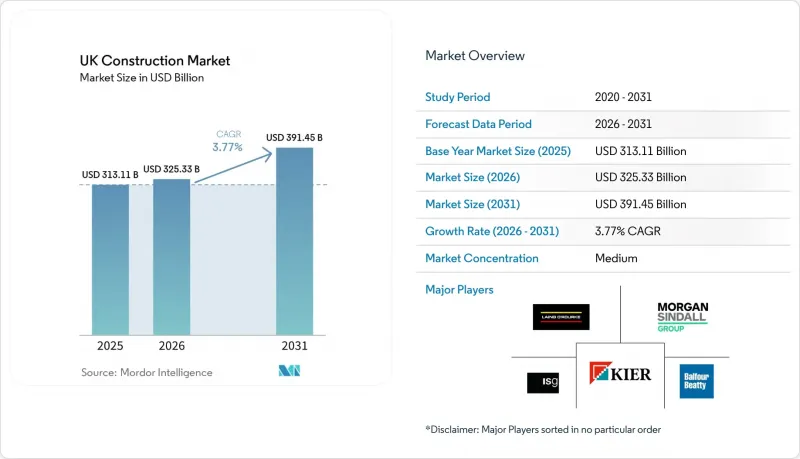
本報告按行業(住宅、商業、基礎設施)、建築類型(新建、維修)、施工方法(傳統現場施工、現代施工方法)、資金來源(公共、私人)和地區(英格蘭、蘇格蘭、威爾斯、北愛爾蘭)進行細分。市場預測以美元計價。
英國建築市場趨勢與洞察
長期住宅短缺推高了住宅開工量。
與供給能力相比,住宅需求依然居高不下,混合用途租賃住房和棕地地開發項目因家庭組建和城市更新等優先事項而備受關注。專案進展,而消防安全措施和品質標準則影響設計選擇和專案時間表。 「英格蘭住房計畫」及其與地方政府的夥伴關係,為前期準備工作、場地開發和住宅經濟適用租賃住宅提供了途徑,從而提升了已批准項目的核准能力。租賃型住房和老年住宅繼續吸引重視穩定收益和營運平台的機構投資者的資金。供應壓力持續推動英國建設產業向平台化供應模式轉型,以實現可擴展的解決方案和高度可複製的住宅類型。
政府大型企劃(HS2、RIS2)導致土木工程訂單積壓。
2026年,大規模交通基礎設施和維護項目將繼續支撐土木工程訂單訂單,其中南部的HS2高鐵項目、戰略性道路改造以及相關車站和重建項目構成了承包商的訂單。專案管治和資訊需求正在推動數位成熟度的提升,重點關注安全性、可追溯性和材料來源的透明度。政府客戶遵循標準化的採購和施工流程,優先考慮具備整合設計、建造和製造能力的團隊。由此產生的訂單前景支持多年的人力、車輛投資和供應商發展,以應對重複性工作包。這項因素進一步強化了英國建築市場對可預測產能和以結果為導向的績效的重視。
技術純熟勞工短缺和勞動力老化
持續存在的技能缺口限制了建築業的產能,尤其是在合格技工、現場主管、數位工程和建築管理等領域。儘管培訓項目不斷擴展,但平衡不同經驗水平的人才配置仍需時日,而對專業的競爭加劇了成本和施工風險。生產力工具和標準化設計在一定程度上緩解了這種壓力,但某些項目仍然需要稀缺技能和資格認證,這使得快速擴張變得困難。公共機構和行業協會呼籲建立強調現代方法和數位化能力的學徒制和職業發展路徑。這些限制因素持續影響英國建築市場的競標策略和人才規劃。
細分市場分析
到2025年,住宅產業將引領整個產業,佔產業總量的38.10%,這主要得益於對城市生活的需求、混合所有權形式的供應以及現有住宅存量品質的提升。機構投資者繼續優先考慮營運穩定的租賃型住房和老年住宅。設計和產品化使得基於平台的建造模式成為可能,從而提高了可預測性、安全性和成本效益。地方政府和英格蘭住房署(Homes England)的項目正在加強土地收購和經濟適用住宅供應的管道建設,重點關注品質和施工安全。英國建築市場透過標準化組件、全面的數位化文件以及對建築法規的可靠遵守來支持這些要求。
到2031年,基礎設施建設將是成長最快的產業,這主要體現在戰略性道路維修、車站和城市空間維修以及能源和公共產業網路的發展工作。承包商正在組建由土木、結構和機電專家組成的綜合團隊,以管理運作中設施周圍的複雜流程。資訊管理和資產資料傳輸對於公共客戶設定的全生命週期績效目標至關重要。技能和重型設備策略是根據隧道、土方工程和大型結構等施工風險最高的項目量身定做的。因此,英國建築市場正將資源集中在需要成熟的、多學科土木工程專案能力的領域。
到2025年,新建建築將佔比最高,達到55.10%,這反映了持續進行的住宅開發、商業改造和戰略基礎設施項目。新建建築符合最新的能源性能、消防安全和數位化文件規範要求,涵蓋所有類型的資產。在不影響安全性的前提下,盡可能採用平台組件和異地系統,以減少返工並加快試運行。承包商根據現場條件和客戶目標,將傳統方法與工廠預製解決方案結合。這種平衡模式維持了英國建築市場的生產力。
隨著業主和公共機構致力於實現現有資產的脫碳、修復和延長使用壽命,預計到2031年,翻新產業將實現最快成長。學校、醫院和地方政府設施的改造項目正在擴展,涵蓋能源效率和安全性的提升。對數位化測量、點雲模型和資產資訊的需求正在指導已投入使用建築的改造工作,並降低風險。承包商正在將建築結構維修與設施現代化、控制系統升級以及加熱脫碳方案相結合。這波翻維修正在延長資產的使用壽命,並促使英國建築市場的資源轉移到維修能力。
其他好處:
- Excel格式的市場預測(ME)表
- 3個月的分析師支持
目錄
第1章:引言
- 研究假設和市場定義
- 調查範圍
第2章:調查方法
第3章執行摘要
第4章 市場狀況
- 市場概覽
- 市場促進因素
- 大型政府計畫(HS2、RIS2)導致土木工程訂單訂單。
- 長期住宅短缺推高了住宅開工量。
- 「2050年淨零排放」目標正在刺激對綠色維修的需求。
- 《建築安全法》實施後,異地模組化建築的現況
- 全球私募股權和退休基金在基礎建設次市場的併購
- 數位孿生技術的引入提高了專案執行效率。
- 市場限制因素
- 技術工人短缺和勞動力老化
- 原物料價格波動與供應鏈中斷
- 冗長的規劃和授權程序
- 以BIM為中心的專案中的網路安全風險
- 價值供應鏈分析
- 概述
- 房地產開發商和建築公司—關鍵的定量和定性見解
- 建築和工程公司—關鍵的定量和定性見解
- 建築材料和設備製造商—關鍵的定量和定性見解
- 政府措施和願景
- 監理情勢
- 技術展望
- 產業吸引力—五力分析
- 新進入者的威脅
- 供應商的議價能力
- 消費者議價能力
- 替代品的威脅
- 競爭公司之間的競爭
- 定價(建築材料)及施工成本(材料、人事費用、設備)分析
- 英國與其他國家關鍵產業指標的比較
- 即將開展的重大項目/正在進行的項目(重點關注大型企劃)
第5章 市場規模與成長預測
- 按行業
- 住宅
- 公寓/住宅
- 別墅/獨立式住宅
- 商業的
- 辦公室
- 零售
- 工業與物流
- 其他
- 基礎設施
- 交通基礎建設(公路、鐵路、航空等)
- 能源公用事業
- 其他
- 住宅
- 依建築類型
- 新建工程
- 維修
- 透過施工方法
- 傳統現場方法
- 現代建築方法(預製、模組化等)
- 投資資訊來源
- 民眾
- 私人的
- 按地區
- 英格蘭
- 蘇格蘭
- 威爾斯
- 北愛爾蘭
第6章 競爭情勢
- 市場集中度
- 策略趨勢
- 市佔率分析
- 公司簡介
- Balfour Beatty
- Kier Group
- Morgan Sindall Group
- Laing O'Rourke
- ISG
- Skanska UK
- BAM Construct UK
- Bouygues UK
- Willmott Dixon
- Wates Group
- Galliford Try
- Sir Robert McAlpine
- Mace Group
- Multiplex
- Costain Group
- VINCI Construction UK(incl. Taylor Woodrow)
- Ferrovial Construction UK
- Lendlease Europe(UK)
- John Sisk & Son(UK)
- Barratt Developments
- Persimmon
- Taylor Wimpey
- Vistry Group
- Berkeley Group
第7章 市場機會與未來展望
According to Mordor Intelligence, the UK construction market size is USD 325.33 billion in 2026 and is forecast to reach USD 391.45 billion by 2031 at a 3.77% CAGR.
This report is Segmented by Sector (Residential, Commercial, Infrastructure), by Construction Type (New Construction, Renovation), by Construction Method (Conventional On-Site, Modern Methods of Construction), by Investment Source (Public, Private), and by Geography (England, Scotland, Wales, Northern Ireland). The Market Forecasts are Provided in Terms of Value (USD).
UK Construction Market Trends and Insights
Chronic Housing Shortfall Pushing Residential Starts
Housing demand remains elevated relative to supply capacity, with household formation and urban regeneration priorities putting attention on mixed-tenure delivery and brownfield land. Planning performance and infrastructure servicing shape the pace of starts, while fire safety remediation and quality standards influence design choices and project sequencing. Homes England programs and local authority partnerships provide routes for enabling works, site assembly, and affordable tenures, which support throughput where consents are granted. Build-to-rent and later living continue to draw institutional capital that values stable yields and operational platforms. The pressure on supply continues to direct the UK construction sector toward scalable solutions and platform-based delivery for repeatable housing types.
Government Mega-Projects (HS2, RIS2) Boosting Civil-Engineering Backlog
Large transport and enabling works continue to anchor civil engineering workloads in 2026, with HS2 works in the south, strategic road upgrades, and associated station and regeneration sites shaping contractor backlogs. Program governance and information requirements promote higher digital maturity and emphasize safety, tracing, and material provenance. Government clients maintain standardized procurement and delivery protocols that favor teams with integrated design, construction, and manufacturing capability. The resulting pipeline supports multi-year resourcing, fleet investment, and supplier development to meet repeatable work packages. This driver reinforces the UK construction market's focus on predictable throughput and outcome-based performance.
Skilled-Labour Shortage and Aging Workforce
Persistent skills gaps restrict delivery capacity, especially in qualified trades, site supervision, digital engineering, and building control. Training programs expand, yet experience profiles take time to rebalance, and competition for specialist roles raises cost and delivery risk. Productivity tools and standardized design reduce pressure, but certain projects still require rare skills and accreditation, which are difficult to scale quickly. Public bodies and industry groups call for apprenticeships and mid-career transition pathways, with a focus on modern methods and digital competencies. The constraint continues to shape tendering strategies and workforce planning across the UK construction market.
Other drivers and restraints analyzed in the detailed report include:
- Net-Zero 2050 Targets Stimulating Green Retrofit Demand
- Off-Site and Modular Building Uptake Post-Building Safety Act
- Lengthy Planning and Permitting Timelines
For complete list of drivers and restraints, kindly check the Table Of Contents.
Segment Analysis
Residential leads the sector composition with a 38.10% contribution in 2025, supported by demand for urban living, mixed-tenure delivery, and quality upgrades of the existing stock. Institutional capital continues to prioritize build-to-rent and later living formats with operational stability. Design and productization enable platform-build approaches that improve predictability, safety, and cost. Local authorities and Homes England programs enhance site assembly and affordable delivery pipelines, with a focus on quality and build safety. The UK construction market supports these requirements with standardized components, strong digital records, and assured building control compliance.
Infrastructure is the fastest-growing sector through 2031, reflecting strategic road renewals, station and urban realm upgrades, and enabling works for energy and utility networks. Contractors deploy integrated teams that combine civils, structures, and M&E to deliver complex staging around live operations. Information management and asset data handover are critical to lifecycle performance targets set by public clients. Skills and plant strategy align to tunneling, earthworks, and large structures where delivery risk is highest. The UK construction market, therefore, concentrates resources where civil engineering programs require proven multidisciplinary capabilities.
New construction holds the largest share in 2025 at 55.10%, reflecting live residential schemes, commercial repurposing, and strategic infrastructure packages. New build supports modern specifications for energy performance, fire safety, and digital documentation across asset types. Platform kits and off-site systems are applied where they reduce rework and accelerate commissioning without compromising safety. Contractors mix traditional trades with factory-enabled solutions based on site conditions and client objectives. This balanced model sustains throughput across the UK construction market.
Renovation records the fastest projected growth to 2031 as owners and public bodies target decarbonization, remediation, and longevity of existing assets. Programs in schools, hospitals, and local authority estates scale energy upgrades and safety improvements. Digital surveys, point-cloud models, and asset information requirements guide interventions and reduce risk during work on occupied buildings. Contractors combine building fabric upgrades with services modernization, controls, and heat decarbonization options. This renovation wave extends the service life of assets and shifts resources within the UK construction market to retrofit capabilities.
Complete Report Scope:
- By Sector
- Residential
- Apartments/Condominiums
- Villas/Landed Houses
- Commercial
- Office
- Retail
- Industrial and Logistics
- Others
- Infrastructure
- Transportation Infrastructure (Roadways, Railways, Airways, others)
- Energy & Utilities
- Others
- Residential
- By Construction Type
- New Construction
- Renovation
- By Construction Method
- Conventional On-Site
- Modern Methods of Construction (Prefabricated, Modular, etc)
- By Investment Source
- Public
- Private
- By Geography
- England
- Scotland
- Wales
- Northern Ireland
List of Companies Covered in this Report:
- Balfour Beatty
- Kier Group
- Morgan Sindall Group
- Laing O'Rourke
- ISG
- Skanska UK
- BAM Construct UK
- Bouygues UK
- Willmott Dixon
- Wates Group
- Galliford Try
- Sir Robert McAlpine
- Mace Group
- Multiplex
- Costain Group
- VINCI Construction UK (incl. Taylor Woodrow)
- Ferrovial Construction UK
- Lendlease Europe (UK)
- John Sisk & Son (UK)
- Barratt Developments
- Persimmon
- Taylor Wimpey
- Vistry Group
- Berkeley Group
Additional Benefits:
- The market estimate (ME) sheet in Excel format
- 3 months of analyst support
TABLE OF CONTENTS
1 Introduction
- 1.1 Study Assumptions & Market Definition
- 1.2 Scope of the Study
2 Research Methodology
3 Executive Summary
4 Market Landscape
- 4.1 Market Overview
- 4.2 Market Drivers
- 4.2.1 Government mega-projects (HS2, RIS2) boosting civil-engineering backlog
- 4.2.2 Chronic housing shortfall pushing residential starts
- 4.2.3 Net-Zero 2050 targets stimulating green retrofit demand
- 4.2.4 Off-site & modular building uptake post-Building Safety Act
- 4.2.5 Infrastructure secondary-market M&A by global PE & pension funds
- 4.2.6 Digital-twin adoption improving project delivery efficiency
- 4.3 Market Restraints
- 4.3.1 Skilled-labour shortage & ageing workforce
- 4.3.2 Material-price volatility & supply-chain disruption
- 4.3.3 Lengthy planning & permitting timelines
- 4.3.4 Cyber-security risks in BIM-centric projects
- 4.4 Value / Supply-Chain Analysis
- 4.4.1 Overview
- 4.4.2 Real Estate Developers and Contractors - Key Quantitative and Qualitative Insights
- 4.4.3 Architectural and Engineering Companies - Key Quantitative and Qualitative Insights
- 4.4.4 Building Material and Equipment Companies - Key Quantitative and Qualitative Insights
- 4.5 Government Initiatives & Vision
- 4.6 Regulatory Landscape
- 4.7 Technological Outlook
- 4.8 Industry Attractiveness - Porter's Five Force Analysis
- 4.8.1 Threat of New Entrants
- 4.8.2 Bargaining Power of Suppliers
- 4.8.3 Bargaining Power of Consumers
- 4.8.4 Threat of Substitutes
- 4.8.5 Intensity of Competitive Rivalry
- 4.9 Pricing (Construction Materials) and Construction Cost (Materials, Labour, Equipment) Analysis
- 4.10 Comparison of Key Industry Metrics of the United Kingdom with Other Countries
- 4.11 Key Upcoming/Ongoing Projects (with a focus on Mega Projects)
5 Market Size & Growth Forecasts (Value, In USD Billion)
- 5.1 By Sector
- 5.1.1 Residential
- 5.1.1.1 Apartments/Condominiums
- 5.1.1.2 Villas/Landed Houses
- 5.1.2 Commercial
- 5.1.2.1 Office
- 5.1.2.2 Retail
- 5.1.2.3 Industrial and Logistics
- 5.1.2.4 Others
- 5.1.3 Infrastructure
- 5.1.3.1 Transportation Infrastructure (Roadways, Railways, Airways, others)
- 5.1.3.2 Energy & Utilities
- 5.1.3.3 Others
- 5.1.1 Residential
- 5.2 By Construction Type
- 5.2.1 New Construction
- 5.2.2 Renovation
- 5.3 By Construction Method
- 5.3.1 Conventional On-Site
- 5.3.2 Modern Methods of Construction (Prefabricated, Modular, etc)
- 5.4 By Investment Source
- 5.4.1 Public
- 5.4.2 Private
- 5.5 By Geography
- 5.5.1 England
- 5.5.2 Scotland
- 5.5.3 Wales
- 5.5.4 Northern Ireland
6 Competitive Landscape
- 6.1 Market Concentration
- 6.2 Strategic Moves
- 6.3 Market Share Analysis
- 6.4 Company Profiles {(includes Global level Overview, Market level overview, Core Segments, Financials as available, Strategic Information, Market Rank/Share for key companies, Products & Services, and Recent Developments)}
- 6.4.1 Balfour Beatty
- 6.4.2 Kier Group
- 6.4.3 Morgan Sindall Group
- 6.4.4 Laing O'Rourke
- 6.4.5 ISG
- 6.4.6 Skanska UK
- 6.4.7 BAM Construct UK
- 6.4.8 Bouygues UK
- 6.4.9 Willmott Dixon
- 6.4.10 Wates Group
- 6.4.11 Galliford Try
- 6.4.12 Sir Robert McAlpine
- 6.4.13 Mace Group
- 6.4.14 Multiplex
- 6.4.15 Costain Group
- 6.4.16 VINCI Construction UK (incl. Taylor Woodrow)
- 6.4.17 Ferrovial Construction UK
- 6.4.18 Lendlease Europe (UK)
- 6.4.19 John Sisk & Son (UK)
- 6.4.20 Barratt Developments
- 6.4.21 Persimmon
- 6.4.22 Taylor Wimpey
- 6.4.23 Vistry Group
- 6.4.24 Berkeley Group
7 Market Opportunities & Future Outlook
- 7.1 White-space & unmet-need assessment

 中國建築業:市場佔有率分析、產業趨勢與統計、成長預測(2026-2031年)
 2035 年之前建築與重型設備遠端資訊處理市場分析與預測:類型、產品類型、服務、技術、組件、應用、部署模式、最終用戶、功能、安裝模式
 按承包商類型、營業單位、建築類型、最終用途行業、類別和地區分類的建築市場規模、佔有率和成長分析 - 2026-2033 年行業預測
 全球太陽能樁市場:市場規模、佔有率、成長率、產業分析、依類型、應用和地區劃分的分析以及未來預測(2026-2034)
 全球施工機械追蹤市場全球建築穿戴科技市場全球礫石穩定器格柵市場
 海洋建築市場規模、佔有率、趨勢分析報告:按材料、地區、細分市場、預測,2025-2030 年全球鋼樁市場規模(按產品、應用、地區、範圍和預測)