

 |
市場調查報告書
商品編碼
2124093
中國建築業:市場佔有率分析、產業趨勢與統計、成長預測(2026-2031年)China Construction - Market Share Analysis, Industry Trends & Statistics, Growth Forecasts (2026 - 2031) |
||||||

※ 本網頁內容可能與最新版本有所差異。詳細情況請與我們聯繫。
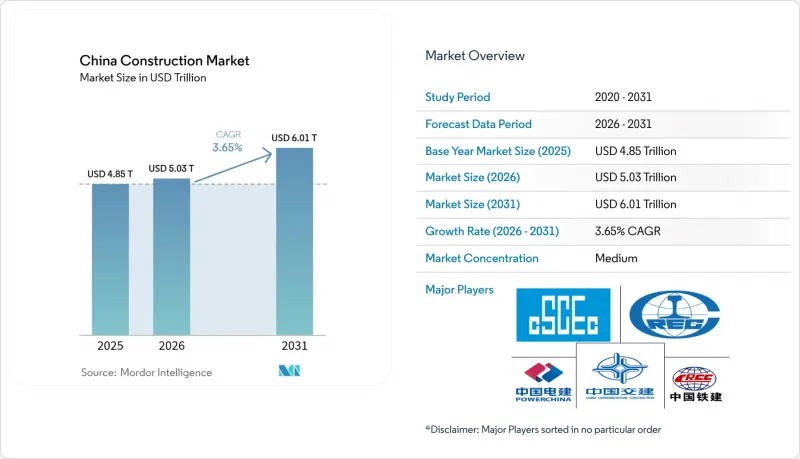
根據 Mordor Intelligence 預測,中國建築市場規模將從 2025 年的 4.85 兆美元成長到 2026 年的 5.03 兆美元,然後在 2031 年達到 6.01 兆美元,2026 年至 2031 年的複合年成長率為 3.65%。
本報告按行業(住宅、商業、基礎設施)、建築類型(新建、維修)、施工方法(傳統現場施工、現代施工方法)、資金來源(公共、私人)和地區(江蘇、廣東、浙江、北京、上海及中國其他地區)進行細分。市場預測以美元計價。
中國建築市場趨勢與洞察
政府基礎設施獎勵策略
中國正投資5,714億美元用於“隱性基礎設施”,例如地下管道、燃氣管網和供熱網路。該計畫重點在於加強防災措施和智慧城市技術建設,使擁有先進工程、BIM和物聯網能力的建築公司獲得競爭優勢。固定資產數據顯示,2025年初,基礎建設支出將年增5.6%,水利投資將激增39.1%,凸顯了短期成長動能強勁。地方政府被要求達到綠建築標準,經濟刺激資金與能源指標掛鉤,推動了對高性能建築材料的需求。
都市化驅動的住宅需求
中國的五年規劃目標是實現70%的都市化,並透過戶籍制度改革,為約3億移工提供城鎮服務。這項變化帶來了對保障性住宅以及醫院、學校、交通等配套設施的持續需求。目前,中西部省份的都市化進程快於沿海地區,並擴大了這項需求的地理範圍。政策指南優先考慮包容性和保障性住宅,為掌握標準化、低成本設計的建築商創造了可預測的工作機會。
地方政府土地銷售收入下降
土地出售收入佔城市預算的30%之多,但小城市住宅需求疲軟導致拍賣收入下降,限制了可用於新計畫的資金。地方政府正透過推遲或縮減公共工程項目來應對,這減少了依賴市政訂單的建築公司的短期訂單機會。儘管正在進行的財政改革可能會使收入來源多元化,但其實施時間仍存在不確定性,這給競標流程帶來了風險。
細分市場分析
預計基礎設施產業將以5.41%的複合年成長率成長,成長速度超過其他所有產業,主要得益於中國優先推進交通網路、水利和公共產業的現代化建設。在中國的建築市場中,受惠於有利於移工的住宅補貼政策,住宅產業預計到2025年將維持35.10%的市場佔有率。由於電子商務和供應鏈本地化,工業和物流設施建設蓬勃發展,而隨著遠端辦公的興起,傳統辦公大樓的建設成長放緩。
政府斥資158公里建設全自動駕駛高速公路,並啟動一項價值5714億美元的「隱形基礎設施」計劃,凸顯了其建造韌性電網的決心。未來幾年,可再生能源併網計畫和平路運河的建設將推動電力需求成長。儘管多用戶住宅仍是主流,但隨著通勤者對更大生活空間的需求,二線城市郊區的低密度別墅也日益受到青睞。嚴格的綠色建築法規正推動公共和住宅建築領域向高規格隔熱材料轉型,從而提升了對節能材料的需求。
2025年,新建建築佔中國建築市場支出的77.05%,但隨著都市更新宣傳活動的活性化,預計到2031年,維修工程將以每年5.22%的速度成長。多用戶住宅的維修可以提高能源性能和抗震能力,也符合綠色債券和專案債券的合格要求。
城市優質土地有限,拆除會帶來社會成本,因此業主往往更傾向於維修。將老舊商場改造成多功能社區中心,或將辦公大樓改建為公寓,都是盈利的維修案例。從財務角度來看,維修工程的土地購買成本較低,核准流程也更快捷,這使得熟悉居住環境施工的專業承包商能夠獲得更高的利潤率。因此,在中國建築市場中,大型翻新維修的市場規模成長速度甚至超過了成熟大都會圈的新建案。
其他好處:
- Excel格式的市場預測(ME)表
- 3個月的分析師支持
目錄
第1章:引言
- 研究假設和市場定義
- 調查範圍
第2章:調查方法
第3章執行摘要
第4章 市場狀況
- 市場概覽
- 市場促進因素
- 政府獎勵策略
- 都市化導致的住宅需求
- 數位化專案核准平台(利用BIM)
- 在日本境內將對「一帶一路」計劃產生連鎖反應的項目
- 一線城市強制分配預製住宅
- 市場限制因素
- 區域城市長期住宅過剩
- 技術純熟勞工的人事費用不斷上漲
- 透過與環境、社會及公司治理(ESG)掛鉤的融資方式,限制高碳排放的建築工程。
- 地方政府土地銷售收入下降
- 價值供應鏈分析
- 概述
- 房地產開發商和建築公司—關鍵定量和定性分析結果
- 建築和工程公司—關鍵的定量和定性見解
- 建築材料和設備製造商—關鍵的定量和定性見解
- 政府措施和願景
- 監理情勢
- 技術展望
- 產業吸引力—五力分析
- 供應商的議價能力
- 消費者議價能力
- 新進入者的威脅
- 替代品的威脅
- 競爭公司之間的競爭
- 定價(建築材料)及施工成本(材料、人事費用、設備)分析
- 中國與其他國家關鍵產業指標的比較
- 即將開展的重大項目/正在進行的項目(重點關注大型企劃)
第5章 市場規模與成長預測
- 按行業
- 住宅
- 公寓/住宅
- 別墅/獨立式住宅
- 商業的
- 辦公室
- 零售
- 工業與物流
- 其他
- 基礎設施
- 交通基礎建設(公路、鐵路、航空等)
- 能源公用事業
- 其他
- 住宅
- 依建築類型
- 新建工程
- 維修
- 透過施工方法
- 傳統現場方法
- 現代建築方法(預製、模組化等)
- 投資資訊來源
- 民眾
- 私人的
- 按地區
- 江蘇
- 廣東省
- 浙江省
- 北京
- 上海
- 中國等地區
第6章 競爭情勢
- 市場集中度
- 策略趨勢
- 市佔率分析
- 公司簡介
- China State Construction Engineering(CSCEC)
- China Railway Group(CREC)
- China Railway Construction(CRCC)
- China Communications Construction(CCCC)
- Power Construction Corporation(PowerChina)
- China Metallurgical Group(MCC)
- China Energy Engineering Corporation(CEEC)
- Shanghai Construction Group
- China National Chemical Engineering(CNCEC)
- China Petroleum Engineering(CPEC)
- Beijing Construction Engineering Group
- Sinohydro
- CRRC Urban Construction
- Beijing Urban Construction Group
- Jiangsu Nantong No.2 Construction
- Huashi Group
- Zhejiang Construction Investment Group
- China Harbour Engineering
- Longfor Construction
- Country Garden Construction
第7章 市場機會與未來展望
According to Mordor Intelligence, the China construction market size is expected to grow from USD 4.85 trillion in 2025 to USD 5.03 trillion in 2026 and is forecast to reach USD 6.01 trillion by 2031 at 3.65% CAGR over 2026-2031.
This report is Segmented by Sector (Residential, Commercial, Infrastructure), by Construction Type (New Construction, Renovation), by Construction Method (Conventional On-Site, Modern Methods of Construction), by Investment Source (Public, Private), and by Geography (Jiangsu, Guangdong, Zhejiang, Beijing, Shanghai, Rest of China). The Market Forecasts are Provided in Terms of Value (USD).
China Construction Market Trends and Insights
Government Infrastructure Stimulus Packages
China is channeling USD 571.4 billion into "hidden infrastructure" such as underground pipelines, gas grids, and heating networks. The program emphasizes disaster-prevention upgrades and smart-city technologies, which in turn favor contractors with advanced engineering, BIM, and IoT capabilities. Fixed-asset data show 5.6% year-on-year growth in infrastructure outlays during early 2025, with water-conservancy investments leaping 39.1%, underscoring strong near-term momentum. Local authorities must meet green-building codes, linking stimulus funding to energy-efficiency metrics and amplifying demand for high-performance materials.
Urbanization-Driven Housing Demand
China's five-year plan aims for a 70% urbanization rate, granting roughly 300 million migrant workers access to city services through hukou reform. The shift fuels a steady need for affordable apartments plus supporting hospitals, schools, and transit. Central and western provinces are now logging quicker urban growth than the coast, widening geographic demand. Policy directives prioritize inclusive, affordable homes, creating predictable workflows for builders skilled in standardized, low-cost designs.
Shrinking Local-Government Land-Sale Revenues
Land sales finance up to 30% of municipal budgets, but weaker housing demand in smaller cities is shrinking auction receipts and curbing funds available for new projects. Local authorities respond by delaying or downsizing public works pipelines, dampening near-term opportunities for contractors dependent on municipal orders. Fiscal reforms under discussion may diversify revenue streams, yet timelines remain uncertain, adding risk to bid pipelines.
Other drivers and restraints analyzed in the detailed report include:
- Digital Project-Approval Platforms (BIM-Powered)
- Domestic BRI Corridor Spill-Over Projects
- Persistent Residential Oversupply in Lower-Tier Cities
For complete list of drivers and restraints, kindly check the Table Of Contents.
Segment Analysis
Infrastructure captured 5.41% CAGR prospects, outpacing all other sectors as the state prioritizes transport links, water conservancy, and utility upgrades. Within the China construction market, residential retained a 35.10% share in 2025, backed by migrant-friendly housing subsidies. Industrial and logistics facilities are surging on e-commerce and supply-chain localization, while traditional office towers slow amid remote-work adoption.
Government outlays for the 158-km fully automated highway and the USD 571.4 billion hidden-infrastructure program underscore commitment to resilient networks. Renewables-ready grid projects and the Pinglu Canal add multi-year volume. Apartment blocks remain core, yet low-density villas around Tier-2 suburbs are gaining ground as commuters seek larger living spaces. Tight green-building rules steer both public and residential segments toward higher-spec insulation, boosting demand for energy-efficient materials.
New construction commanded 77.05% of 2025 spend in the China construction market, yet renovations are forecast to climb 5.22% annually to 2031 as urban-renewal campaigns intensify. Multi-family retrofits improve energy performance and seismic safety, aligning with green bond eligibility and special-purpose bond issuance.
Owners favor renovation because prime city plots are limited and demolition carries social costs. Conversion of aging malls into mixed-use community hubs and office-to-apartment reconfigurations are examples of lucrative upgrades. Fiscally, renovations' lower land-acquisition costs and quicker approvals translate into higher margins for specialist contractors versed in live-environment work. The China construction market size for large-scale retrofits is therefore expanding even faster than ground-up projects in mature metros.
Complete Report Scope:
- By Sector
- Residential
- Apartments/Condominiums
- Villas/Landed Houses
- Commercial
- Office
- Retail
- Industrial and Logistics
- Others
- Infrastructure
- Transportation Infrastructure (Roadways, Railways, Airways, others)
- Energy & Utilities
- Others
- Residential
- By Construction Type
- New Construction
- Renovation
- By Construction Method
- Conventional On-Site
- Modern Methods of Construction (Prefabricated, Modular, etc)
- By Investment Source
- Public
- Private
- By Geography
- Jiangsu
- Guangdong
- Zhejiang
- Beijing
- Shanghai
- Rest Of China
List of Companies Covered in this Report:
- China State Construction Engineering (CSCEC)
- China Railway Group (CREC)
- China Railway Construction (CRCC)
- China Communications Construction (CCCC)
- Power Construction Corporation (PowerChina)
- China Metallurgical Group (MCC)
- China Energy Engineering Corporation (CEEC)
- Shanghai Construction Group
- China National Chemical Engineering (CNCEC)
- China Petroleum Engineering (CPEC)
- Beijing Construction Engineering Group
- Sinohydro
- CRRC Urban Construction
- Beijing Urban Construction Group
- Jiangsu Nantong No.2 Construction
- Huashi Group
- Zhejiang Construction Investment Group
- China Harbour Engineering
- Longfor Construction
- Country Garden Construction
Additional Benefits:
- The market estimate (ME) sheet in Excel format
- 3 months of analyst support
TABLE OF CONTENTS
1 Introduction
- 1.1 Study Assumptions & Market Definition
- 1.2 Scope of the Study
2 Research Methodology
3 Executive Summary
4 Market Landscape
- 4.1 Market Overview
- 4.2 Market Drivers
- 4.2.1 Government infrastructure stimulus packages
- 4.2.2 Urbanisation-driven housing demand
- 4.2.3 Digital project-approval platforms (BIM-powered)
- 4.2.4 Domestic BRI corridor spill-over projects
- 4.2.5 Mandatory prefabrication quotas in Tier-1 cities
- 4.3 Market Restraints
- 4.3.1 Persistent residential oversupply in lower-tier cities
- 4.3.2 Escalating skilled-labour costs
- 4.3.3 ESG-linked lending caps on carbon-intensive builds
- 4.3.4 Shrinking local-government land-sale revenues
- 4.4 Value / Supply-Chain Analysis
- 4.4.1 Overview
- 4.4.2 Real Estate Developers and Contractors - Key Quantitative and Qualitative Insights
- 4.4.3 Architectural and Engineering Companies - Key Quantitative and Qualitative Insights
- 4.4.4 Building Material and Equipment Companies - Key Quantitative and Qualitative Insights
- 4.5 Government Initiatives & Vision
- 4.6 Regulatory Landscape
- 4.7 Technological Outlook
- 4.8 Industry Attractiveness - Porter's Five Force Analysis
- 4.8.1 Bargaining Power of Suppliers
- 4.8.2 Bargaining Power of Consumers
- 4.8.3 Threat of New Entrants
- 4.8.4 Threat of Substitutes
- 4.8.5 Intensity of Competitive Rivalry
- 4.9 Pricing (Construction Materials) and Construction Cost (Materials, Labour, Equipment) Analysis
- 4.10 Comparison of Key Industry Metrics of the China with Other Countries
- 4.11 Key Upcoming/Ongoing Projects (with a focus on Mega Projects)
5 Market Size & Growth Forecasts (Value, In USD Billion)
- 5.1 By Sector
- 5.1.1 Residential
- 5.1.1.1 Apartments/Condominiums
- 5.1.1.2 Villas/Landed Houses
- 5.1.2 Commercial
- 5.1.2.1 Office
- 5.1.2.2 Retail
- 5.1.2.3 Industrial and Logistics
- 5.1.2.4 Others
- 5.1.3 Infrastructure
- 5.1.3.1 Transportation Infrastructure (Roadways, Railways, Airways, others)
- 5.1.3.2 Energy & Utilities
- 5.1.3.3 Others
- 5.1.1 Residential
- 5.2 By Construction Type
- 5.2.1 New Construction
- 5.2.2 Renovation
- 5.3 By Construction Method
- 5.3.1 Conventional On-Site
- 5.3.2 Modern Methods of Construction (Prefabricated, Modular, etc)
- 5.4 By Investment Source
- 5.4.1 Public
- 5.4.2 Private
- 5.5 By Geography
- 5.5.1 Jiangsu
- 5.5.2 Guangdong
- 5.5.3 Zhejiang
- 5.5.4 Beijing
- 5.5.5 Shanghai
- 5.5.6 Rest Of China
6 Competitive Landscape
- 6.1 Market Concentration
- 6.2 Strategic Moves
- 6.3 Market Share Analysis
- 6.4 Company Profiles (includes Global level Overview, Market level overview, Core Segments, Financials as available, Strategic Information, Products & Services, and Recent Developments)
- 6.4.1 China State Construction Engineering (CSCEC)
- 6.4.2 China Railway Group (CREC)
- 6.4.3 China Railway Construction (CRCC)
- 6.4.4 China Communications Construction (CCCC)
- 6.4.5 Power Construction Corporation (PowerChina)
- 6.4.6 China Metallurgical Group (MCC)
- 6.4.7 China Energy Engineering Corporation (CEEC)
- 6.4.8 Shanghai Construction Group
- 6.4.9 China National Chemical Engineering (CNCEC)
- 6.4.10 China Petroleum Engineering (CPEC)
- 6.4.11 Beijing Construction Engineering Group
- 6.4.12 Sinohydro
- 6.4.13 CRRC Urban Construction
- 6.4.14 Beijing Urban Construction Group
- 6.4.15 Jiangsu Nantong No.2 Construction
- 6.4.16 Huashi Group
- 6.4.17 Zhejiang Construction Investment Group
- 6.4.18 China Harbour Engineering
- 6.4.19 Longfor Construction
- 6.4.20 Country Garden Construction
7 Market Opportunities & Future Outlook

 英國建築市場:市場佔有率分析、產業趨勢與統計、成長預測(2026-2031年)
 2035 年之前建築與重型設備遠端資訊處理市場分析與預測:類型、產品類型、服務、技術、組件、應用、部署模式、最終用戶、功能、安裝模式
 按承包商類型、營業單位、建築類型、最終用途行業、類別和地區分類的建築市場規模、佔有率和成長分析 - 2026-2033 年行業預測
 全球太陽能樁市場:市場規模、佔有率、成長率、產業分析、依類型、應用和地區劃分的分析以及未來預測(2026-2034)
 全球施工機械追蹤市場全球建築穿戴科技市場全球礫石穩定器格柵市場
 海洋建築市場規模、佔有率、趨勢分析報告:按材料、地區、細分市場、預測,2025-2030 年全球鋼樁市場規模(按產品、應用、地區、範圍和預測)