


 |
市場調查報告書
商品編碼
2124052
防滑添加劑:市場佔有率分析、產業趨勢與統計、成長預測(2026-2031 年)Anti-slip Additives - Market Share Analysis, Industry Trends & Statistics, Growth Forecasts (2026 - 2031) |
||||||

※ 本網頁內容可能與最新版本有所差異。詳細情況請與我們聯繫。
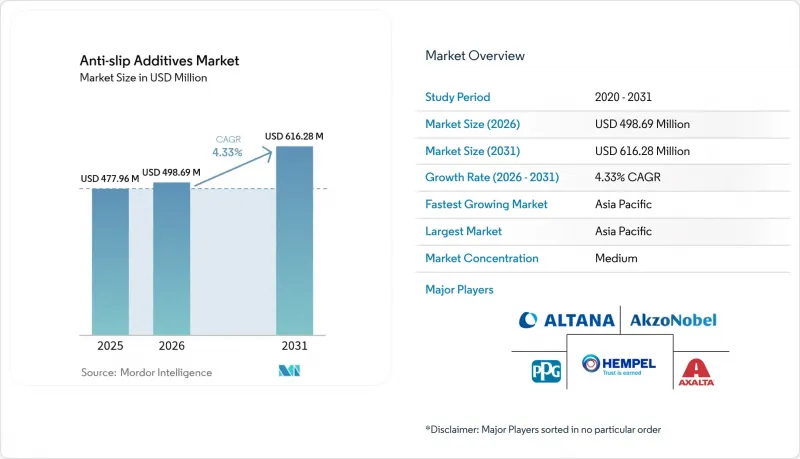
據 Mordor Intelligence 稱,2025 年防滑添加劑市值為 4.7796 億美元,預計到 2031 年將達到 6.1628 億美元,而 2026 年為 4.9869 億美元,預測期(2026-2031 年)的複合成長率為 4.33%。
本報告按添加劑類型(氧化鋁、二氧化矽及其他)、添加劑形態(粉末、骨材、混合物)、應用領域(建築施工、工業地板材料、船舶及其他)和地區(亞太、北美、歐洲、南美、中東和非洲)進行細分。市場預測以美元計價。
全球防滑添加劑市場趨勢及洞察
工業地板材料安全性的需求日益成長
在一般行業中,滑倒、絆倒和跌倒是導致職場死亡的第二大原因,這促使監管機構收緊對地面摩擦力的規定。加之勞工保險的不斷上漲,製造商正進一步推動採用高性能塗層,以在整個維護週期中保持摩擦。為此,供應商正在開發均勻嵌入環氧樹脂和聚氨酯找平層中的合成顆粒,從而在摩擦係數和美觀性之間取得平衡。終端用戶擴大從設計階段就開始採用這些解決方案,而不是在事故發生後才被動應對,這反映出企業營運方式正朝著風險管理導向型轉變。因此,工業地板材料仍然是防滑添加劑市場最大的驅動力。
亞太地區建築業的擴張
中國、印度和東南亞國協積極的基礎設施投資推動了防滑添加劑的穩定需求。公共採購指南現已明確規定交通樞紐的地面鋪設和飾面材料必須防滑,這刺激了石英和二氧化矽混合物的持續訂單。快速的都市化增加了行人密度,導致地面磨損加劇,維修週期加快。由於工期縮短,承包商優先選擇能夠快速分散到水泥基面層和自流平砂漿中的添加劑。擁有物流中心和區域製造工廠的跨國公司也在推行全球安全標準,將潛在需求擴展到傳統公共工程之外。因此,亞太地區擁有最大的市場規模和最快的成長速度。
關於揮發性有機化合物和有害物質的法規
美國AIM法規規定地板塗料的VOC含量上限為400克/公升,但有些州的標準較為嚴格,迫使製造商轉向水性塗料或100%固態系統。歐洲的REACH法規和各地區的PFAS淘汰指令也使情況更加複雜,例如Micro Powders公司決定在2025年底前停止生產PTFE基產品。法規遵循導致研發成本增加和認證週期延長,尤其對於中小型製造商更是如此。雖然法規最終會引導使用者使用更乾淨的化學品,但短期內的不確定性可能會導致資本項目延期,並暫時減緩防滑添加劑市場的訂單趨勢。
細分市場分析
到2025年,氧化鋁的銷售額將佔總銷售額的47.25%,鞏固其在工廠工程師中的領先地位。這些工程師優先考慮堆高機通道和裝卸區域的硬度和耐磨性。該領域的成熟源於可靠的現場數據和廣泛的分銷網路,採購負責人信賴其在多年維護週期內可預測的潤滑性能。
同時,二氧化矽正以5.05%的複合年成長率(CAGR)在市場中領先。這是因為以沉澱法和煙燻法生產的二氧化矽憑藉其優異的吸油性和低比重,能夠在較低的添加劑濃度下達到所需的表面形貌。據PPG公司稱,其沉澱法製備的二氧化矽的吸油量是傳統填料的40倍以上,從而能夠實現更薄、更高效的塗層。這一轉變也符合環保理念,因為與某些金屬氧化物相比,每種等級的二氧化矽通常被認為具有更低的監管風險。
區域分析
預計到2025年,亞太地區將佔全球銷售額的56.62%,並以4.62%的複合年成長率成長,鞏固其作為規模最大和成長最快地區的雙重地位。公共基礎設施和大型工業園區的投資激增,支撐了對採用批量配製防滑粉末的地板塗料的穩定需求。
北美和歐洲市場在嚴格的法規支援下,維持著強勁的基準需求。美國國家AIM規則與UL的地面防滑測試結合,強制要求對低VOC標準和摩擦係數進行認證。歐洲指令要求醫院和火車站等場所提供防滑性能證明,促使設計人員採用經過認證的粗糙表面處理系統。儘管銷售量成長較為溫和,但由於客戶重視卓越的耐用性和環保認證,利潤結構依然具有吸引力。
中東、非洲和南美洲預計將出現新的成長潛力。海灣國家的機場和海上設施擴建工程均指定使用防滑人行道,以緩解高溫導致的地面濕滑。在南美洲,資源主導經濟體正投資建造更安全的礦物加工和港口設施,儘管經濟普遍波動,但添加劑的訂單仍然強勁。這些地區共同為防滑添加劑市場帶來了多元化,並保護供應商免受成熟市場需求停滯的影響。
其他好處:
- Excel格式的市場預測(ME)表
- 3個月的分析師支持
目錄
第1章:引言
- 研究假設和市場定義
- 調查範圍
第2章:調查方法
第3章執行摘要
第4章 市場狀況
- 市場概覽
- 市場促進因素
- 工業地板材料安全性的需求日益成長
- 亞太地區建築業的擴張
- 符合船舶甲板安全標準
- 利用奈米顆粒提高耐久性
- PFAS的逐步淘汰正在推動生物基替代品的採用。
- 市場限制因素
- 關於揮發性有機化合物和有害物質的法規
- 原物料價格波動
- 過渡到紋理聚合物地板材料
- 價值鏈分析
- 波特五力模型
第5章 市場規模與成長預測
- 按添加劑類型
- 氧化鋁
- 二氧化矽
- 其他
- 按添加劑類型
- 粉末
- 骨材的
- 混合物
- 透過使用
- 建築/施工
- 工業地板材料
- 海上
- 其他
- 按地區
- 亞太地區
- 中國
- 印度
- 日本
- 韓國
- ASEAN
- 其他亞太國家
- 北美洲
- 美國
- 加拿大
- 墨西哥
- 歐洲
- 德國
- 英國
- 法國
- 義大利
- 西班牙
- 俄羅斯
- 其他歐洲國家
- 南美洲
- 巴西
- 阿根廷
- 其他南美國家
- 中東和非洲
- 沙烏地阿拉伯
- 南非
- 其他中東和非洲國家
- 亞太地區
第6章 競爭情勢
- 市場集中度
- 策略趨勢
- 市佔率(%)/排名分析
- 公司簡介
- Akzo Nobel NV
- ALTANA
- Ampacet Corporation
- Arkema
- Associated Chemical
- Axalta Coating Systems, LLC
- BASF
- Evonik Industries AG
- Hempel A/S
- Jotun
- PPG Industries Inc.
- Pro Chem Inc.
- Rust-Oleum Corporation
- SAICOS COLOUR GmbH
- Sika AG
- The Sherwin-Williams Company
第7章 市場機會與未來展望
According to Mordor Intelligence, the anti-slip additives market size was valued at USD 477.96 million in 2025 and estimated to grow from USD 498.69 million in 2026 to reach USD 616.28 million by 2031, at a CAGR of 4.33% during the forecast period (2026-2031).
This report is Segmented by Additive Type (Aluminum Oxide, Silica, and Others), Additive Nature (Powder, Aggregate, and Mix), Application (Buildings and Construction, Industrial Flooring, Marine, and Others), and Geography (Asia-Pacific, North America, Europe, South America, and Middle-East and Africa). The Market Forecasts are Provided in Terms of Value (USD).
Global Anti-slip Additives Market Trends and Insights
Growing Demand for Industrial Flooring Safety
Slips, trips, and falls rank as the second-leading cause of workplace fatalities in general industry, prompting regulators to tighten surface-traction mandates. Rising workers' compensation premiums further encourage manufacturers to install high-performance coatings that sustain friction over the full maintenance cycle. In response, suppliers are engineering synthetic grains that embed evenly within epoxies or polyurethane screeds to achieve a balance of coefficient of friction and esthetic finish. End users increasingly integrate such solutions at the design stage rather than reacting to incidents, reflecting a wider shift toward risk-managed operations. As a result, industrial flooring remains the largest pull-through channel for the Anti-Slip Additives market.
Expansion of APAC Construction Sector
Aggressive infrastructure spending across China, India, and the ASEAN bloc is injecting steady volume into the Anti-Slip Additives market. Public procurement guidelines now specify slip-resistant pavement and transit concourse finishes, stimulating recurring orders for broadcast quartz and silica blends. Rapid urbanization raises pedestrian density, intensifying wear on floor surfaces and accelerating refurbishment cycles. Contractors value additives that disperse quickly in cementitious toppings and self-leveling mortars because jobsite timelines are compressed. Multinational owners of logistics hubs and regional manufacturing plants also impose global safety codes, multiplying addressable demand beyond classical public works. Consequently, Asia-Pacific simultaneously hosts the largest base and the fastest growth trajectory.
VOC and Hazardous-Substance Regulations
The US National AIM Rule fixes a 400 g/l VOC ceiling for floor coatings, while certain state codes enforce even tighter thresholds, compelling reformulation toward water-borne or 100% solid systems. European REACH and local PFAS phase-out directives add complexity, evidenced by Micro Powders' decision to terminate PTFE-based grades by end-2025. Compliance accelerates research and development expenditure and lengthens qualification cycles, especially for small and mid-size producers. Although regulation ultimately steers users toward cleaner chemistries, near-term uncertainty can defer capital projects, temporarily muting order flow in the Anti-Slip Additives market.
Other drivers and restraints analyzed in the detailed report include:
- Marine-Deck Safety Compliance
- Nanoparticle-Enabled Durability Upgrades
- Raw-Material Price Volatility
For complete list of drivers and restraints, kindly check the Table Of Contents.
Segment Analysis
Aluminum oxide held 47.25% revenue share in 2025, underscoring its entrenched status among plant engineers who prize hardness and abrasion resistance for fork-truck aisles and loading bays. The segment's maturity stems from proven field data and widespread distributor availability, giving purchasing managers confidence in predictable slip performance over multi-year maintenance cycles.
Yet silica is advancing at a market-leading 5.05% CAGR as precipitated and fumed variants leverage superior oil-absorption and low specific gravity to deliver the required surface profile at lower addition rates. PPG indicates that its precipitated silica can carry more than 40 times the weight of traditional bulking agents, translating into thinner yet efficient coatings. The shift also aligns with environmental preferences because silica grades typically exhibit benign regulatory profiles compared with certain metal oxides.
Complete Report Scope:
- By Additive Type
- Aluminum Oxide
- Silica
- Others
- By Additive Nature
- Powder
- Aggregate
- Mix
- By Application
- Buildings and Construction
- Industrial Flooring
- Marine
- Others
- By Geography
- Asia-Pacific
- China
- India
- Japan
- South Korea
- ASEAN
- Rest of Asia-Pacific
- North America
- United States
- Canada
- Mexico
- Europe
- Germany
- United Kingdom
- France
- Italy
- Spain
- Russia
- Rest of Europe
- South America
- Brazil
- Argentina
- Rest of South America
- Middle-East and Africa
- Saudi Arabia
- South Africa
- Rest of Middle-East and Africa
- Asia-Pacific
Geography Analysis
Asia-Pacific retained 56.62% revenue in 2025 and is forecast to expand at 4.62% CAGR, cementing its dual status as largest and fastest region. Surging investments in public infrastructure and mega-factory complexes anchor steady demand for floor coatings that integrate anti-slip powders at the batch stage.
North America and Europe each retain robust baseline demand anchored in regulatory discipline. The US National AIM Rule meshes with UL floor-slip testing to enforce low-VOC thresholds and friction certification. European directives require documented slip resistance in hospitals and rail terminals, steering specifiers toward certified coarse-texture systems. Although volume growth is slower, margin structures remain attractive because clients emphasize premium durability and environmental labels.
The Middle-East and Africa and South America deliver emerging upside. Gulf states' airport and offshore complex expansions specify non-skid walkways to mitigate heat-related surface smoothness. In South America, resource-driven economies invest in safer mineral-processing and port facilities, sustaining additive orders despite broader economic swings. Collectively, these regions inject diversification into the Anti-Slip Additives market, buffering suppliers against demand plateaus in mature territories.
- Akzo Nobel N.V.
- ALTANA
- Ampacet Corporation
- Arkema
- Associated Chemical
- Axalta Coating Systems, LLC
- BASF
- Evonik Industries AG
- Hempel A/S
- Jotun
- PPG Industries Inc.
- Pro Chem Inc.
- Rust-Oleum Corporation
- SAICOS COLOUR GmbH
- Sika AG
- The Sherwin-Williams Company
Additional Benefits:
- The market estimate (ME) sheet in Excel format
- 3 months of analyst support
TABLE OF CONTENTS
1 Introduction
- 1.1 Study Assumptions and Market Definition
- 1.2 Scope of the Study
2 Research Methodology
3 Executive Summary
4 Market Landscape
- 4.1 Market Overview
- 4.2 Market Drivers
- 4.2.1 Growing Demand for Industrial Flooring Safety
- 4.2.2 Expansion of APAC Construction Sector
- 4.2.3 Marine-Deck Safety Compliance
- 4.2.4 Nanoparticle-Enabled Durability Upgrades
- 4.2.5 Phase-Out of PFAS Drives Bio-Based Alternatives
- 4.3 Market Restraints
- 4.3.1 VOC and Hazardous-Substance Regulations
- 4.3.2 Raw-Material Price Volatility
- 4.3.3 Shift to Textured Polymer Flooring
- 4.4 Value Chain Analysis
- 4.5 Porter's Five Forces
- 4.5.1 Bargaining Power of Suppliers
- 4.5.2 Bargaining Power of Buyers
- 4.5.3 Threat of New Entrants
- 4.5.4 Threat of Substitutes
- 4.5.5 Degree of Competition
5 Market Size and Growth Forecasts (Value)
- 5.1 By Additive Type
- 5.1.1 Aluminum Oxide
- 5.1.2 Silica
- 5.1.3 Others
- 5.2 By Additive Nature
- 5.2.1 Powder
- 5.2.2 Aggregate
- 5.2.3 Mix
- 5.3 By Application
- 5.3.1 Buildings and Construction
- 5.3.2 Industrial Flooring
- 5.3.3 Marine
- 5.3.4 Others
- 5.4 By Geography
- 5.4.1 Asia-Pacific
- 5.4.1.1 China
- 5.4.1.2 India
- 5.4.1.3 Japan
- 5.4.1.4 South Korea
- 5.4.1.5 ASEAN
- 5.4.1.6 Rest of Asia-Pacific
- 5.4.2 North America
- 5.4.2.1 United States
- 5.4.2.2 Canada
- 5.4.2.3 Mexico
- 5.4.3 Europe
- 5.4.3.1 Germany
- 5.4.3.2 United Kingdom
- 5.4.3.3 France
- 5.4.3.4 Italy
- 5.4.3.5 Spain
- 5.4.3.6 Russia
- 5.4.3.7 Rest of Europe
- 5.4.4 South America
- 5.4.4.1 Brazil
- 5.4.4.2 Argentina
- 5.4.4.3 Rest of South America
- 5.4.5 Middle-East and Africa
- 5.4.5.1 Saudi Arabia
- 5.4.5.2 South Africa
- 5.4.5.3 Rest of Middle-East and Africa
- 5.4.1 Asia-Pacific
6 Competitive Landscape
- 6.1 Market Concentration
- 6.2 Strategic Moves
- 6.3 Market Share (%)/ Ranking Analysis
- 6.4 Company Profiles (includes Global level Overview, Market level overview, Core Segments, Financials as available, Strategic Information, Market Rank/Share for key companies, Products and Services, and Recent Developments)
- 6.4.1 Akzo Nobel N.V.
- 6.4.2 ALTANA
- 6.4.3 Ampacet Corporation
- 6.4.4 Arkema
- 6.4.5 Associated Chemical
- 6.4.6 Axalta Coating Systems, LLC
- 6.4.7 BASF
- 6.4.8 Evonik Industries AG
- 6.4.9 Hempel A/S
- 6.4.10 Jotun
- 6.4.11 PPG Industries Inc.
- 6.4.12 Pro Chem Inc.
- 6.4.13 Rust-Oleum Corporation
- 6.4.14 SAICOS COLOUR GmbH
- 6.4.15 Sika AG
- 6.4.16 The Sherwin-Williams Company
7 Market Opportunities and Future Outlook
- 7.1 White-space and Unmet-need Assessment

 2026-2030年全球防滑塗料市場
 防滑塗層:市場佔有率分析、行業趨勢和統計數據、成長預測(2026-2031 年)
 防滑塗料市場:2026-2032年全球市場預測(依塗料類型、表面處理、技術、基材類型、形態、應用及銷售管道)
 全球防滑塗料市場規模、佔有率、趨勢和成長分析報告(2026-2034年)
 防滑塗料市場規模、佔有率及成長分析(依塗料類型、應用領域、終端用戶產業、配方類型及地區分類)-2026-2033年產業預測
 防滑添加劑市場-全球產業規模、佔有率、趨勢、機會及按類型、應用、地區和競爭格局分類的預測(2021-2031年)
 2032 年防滑紙市場預測:按產品類型、材料類型、應用、最終用戶和地區進行的全球分析