

 |
市場調查報告書
商品編碼
2114716
防滑塗層:市場佔有率分析、行業趨勢和統計數據、成長預測(2026-2031 年)Anti-Slip Coatings - Market Share Analysis, Industry Trends & Statistics, Growth Forecasts (2026 - 2031) |
||||||

※ 本網頁內容可能與最新版本有所差異。詳細情況請與我們聯繫。
據 Mordor Intelligence 稱,2025 年防滑塗料市場價值為 1.7281 億美元,預計到 2031 年將達到 2.1898 億美元,而 2026 年為 1.7978 億美元,預測期(2026-2031 年)的複合成長率為 4.03%。
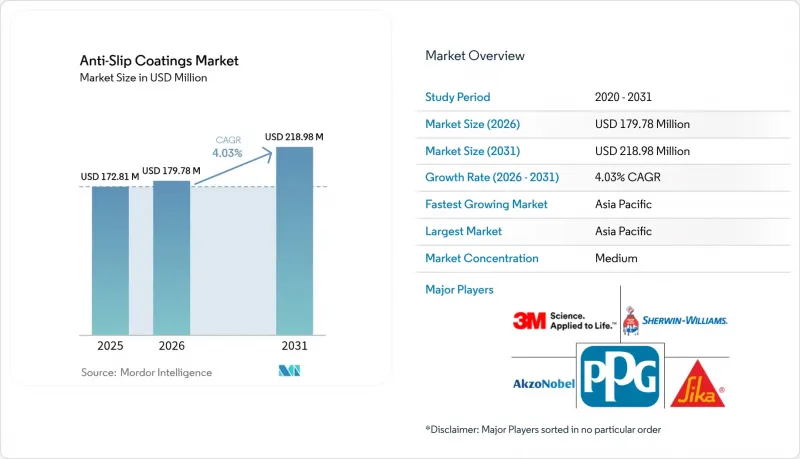
本報告按樹脂類型(環氧樹脂、聚氨酯、丙烯酸樹脂及其他樹脂)、技術(水性、溶劑型)、應用領域(住宅、商業、工業及其他應用)和地區(亞太地區、北美、歐洲、南美以及中東和非洲)對產業進行細分。市場預測以美元計價。
全球防滑塗層市場趨勢及洞察
在智慧自動化製造工廠中得到更廣泛的應用
如今的自動化工廠需要能夠承受機器人持續通行、滾動負荷和嚴格衛生標準的地板材料,同時也要維持穩定的摩擦係數。工廠工程師發現,許多傳統的環氧樹脂塗層會干擾電磁感測器的運行,或在重複使用過氧化氫清潔後劣化,導致計劃外停機。兼具防滑性能和靜電放電 (ESD) 防護功能的混合聚天冬胺酸酯系統因其快速固化的特性而日益普及,使生產能夠在數小時內全面恢復。在亞太地區的電子產業中心,停機成本飆升,與生產線中斷的風險相比,優質塗層的額外成本顯得微不足道。因此,採購團隊擴大參考預先配置的「智慧地面」性能模板,這些模板將防滑、靜電放電和耐化學腐蝕等指標整合到單一的規範中。
更嚴格的職業安全健康標準和強制性保險
美國職業安全與健康管理局 (OSHA) 目前對每起與嚴重跌倒和滑倒相關的違規行為處以最高 15,000 美元的罰款,而保險公司則為採用經認證的防滑塗層的設施提供兩位數的保費折扣。由於每次事故的賠償金額通常在 50,000 美元到 100,000 美元之間,設施業主估計,每平方英尺 5 美元到 8 美元的塗層成本,僅透過預防一次事故就能收回成本。安全審核員還要求提供摩擦係數測試結果的證明文件,這推動了對附帶認證包的產品的需求。這些合規趨勢正迅速將可選升級轉變為必不可少的資本投資項目,尤其是在客流量大的零售連鎖店和物流中心。
嚴格的環境法規
美國環保署 (EPA) 計畫限制使用N-甲基吡咯烷酮和幾種 PFAS 基界面活性劑,這將迫使配方生產商重新設計現有產品線,並使成本增加 15% 至 25%。水性產品可以應對揮發性有機化合物 (VOC) 的挑戰,但可能需要額外的塗層,導致施工時間延長和人事費用增加。擁有強大開發平臺的公司可以適應這些轉變,但小規模的區域供應商可能會被迫退出市場或成為收購目標。
細分市場分析
以樹脂體系類型來看,環氧樹脂塗料佔防滑塗料市場的43.62%。由於其與混凝土的強黏合性、耐化學腐蝕性以及能夠與各種骨材混合物配合使用(即使在潮濕狀態下也能增強摩擦力),環氧樹脂塗料的需求依然強勁。然而,市場成長正轉向其他樹脂類別,這些樹脂具有基礎環氧樹脂所不具備的特性,例如快速重複使用、低溫固化和抗紫外線。聚天冬胺酸酯混合物可在兩小時內固化,使得汽車工廠的堆高機通道能夠在下一班開始前重新開放。同時,胺甲酸乙酯-丙烯酸酯混合系統具有足夠的柔韌性,可填補吊掛式板中的微裂縫。
從2026年到2031年,其他類型的樹脂預計將以4.74%的複合年成長率成長,這是樹脂家族中最高的成長率。這些樹脂因其氣味極低而備受醫院和資料中心青睞,使工作人員能夠更快地重返工作崗位。供應商現在將防滑二氧化矽包裝在預先計量好的筒裝中,簡化了現場混合比例,並減少了施工人員的失誤。隨著規範制定者越來越重視性能而非商品成本,小眾樹脂創新者正在重塑防滑塗料市場的競爭格局,並成功躋身於曾經由環氧樹脂巨頭主導的指定產品清單中。
區域分析
預計到2025年,亞太地區將佔據44.35%的市場佔有率,並在2031年之前以4.82%的複合年成長率持續成長,成為全球銷量最高的地區。在中國和印度,與自動自動導引運輸車(AGV)配合使用的高品質防滑表面已被列入城市軌道運輸、半導體製造廠和大型醫院項目的規範要求中。在東南亞國家聯盟(東協),安全標準正根據ISO摩擦標準進行標準化,最低要求不斷提高,並且在市政競標中,品牌產品越來越受到優先考慮。
雖然北美在絕對規模上落後於其他地區,但其物流倉庫、超級市場和醫療機構園區的大規模維修週期使其受益匪淺。由於美國職業安全與健康管理局 (OSHA) 的嚴格執法以及中西部地區獨特的冬季風險,即使在建築需求放緩時期,市場需求仍然強勁。終端用戶通常需要防滑和抗菌性能,並且更傾向於選擇能夠同時滿足這兩種要求的混合化學成分產品。
在歐洲,由於保險公司的監管,聚氨酯塗料的應用已趨於成熟。但歷史建築的維修正在推動其成長,承包商需要透氣性強、水性塗料來保護歷史建築的基材。中東和非洲市場雖然規模仍然較小,但隨著體育場館、地鐵和旅遊設施的建設,其成長率極高。抗紫外線和抗熱衝擊性是該地區的重要性能指標,而聚氨酯混合塗料產品在這些方面展現出優勢。
其他好處:
- Excel格式的市場預測(ME)表
- 3個月的分析師支持
目錄
第1章:引言
- 研究假設和市場定義
- 調查範圍
第2章:調查方法
第3章執行摘要
第4章 市場狀況
- 市場概覽
- 市場促進因素
- 在智慧製造和自動化製造場所的應用日益廣泛。
- 更嚴格的職業安全健康標準和強制性保險覆蓋範圍
- 由於商業基礎設施老化,維修需求日益成長。
- 亞太和中東地區的建築業蓬勃發展
- 防滑混合塗層在醫療領域引起關注
- 市場限制因素
- 嚴格的環境法規
- 原料(環氧樹脂、聚氨酯)價格波動
- 來自嵌入式紋理地板和膠帶的競爭
- 價值鏈分析
- 波特五力模型
第5章 市場規模與成長預測
- 依樹脂類型
- 環氧樹脂
- 聚氨酯
- 丙烯酸纖維
- 其他樹脂類型(例如聚天冬胺酸基樹脂)
- 透過技術
- 水溶液
- 溶劑型
- 透過使用
- 住宅
- 商業
- 產業
- 其他用途(交通基礎設施、運動、休閒)
- 按地區
- 亞太地區
- 中國
- 印度
- 日本
- 韓國
- 澳洲和紐西蘭
- 其他亞太國家
- 北美洲
- 美國
- 加拿大
- 墨西哥
- 歐洲
- 德國
- 英國
- 法國
- 義大利
- 俄羅斯
- 其他歐洲國家
- 南美洲
- 巴西
- 阿根廷
- 其他南美國家
- 中東和非洲
- 沙烏地阿拉伯
- UAE
- 南非
- 其他中東和非洲國家
- 亞太地區
第6章 競爭情勢
- 市場集中度
- 策略趨勢
- 市佔率和排名分析
- 公司簡介
- 3M
- Akzo Nobel NV
- Anti-Slip Anywhere
- Axalta Coating Systems, LLC
- FloorSlip Limited
- Flowcrete Group Ltd.
- Hempel A/S
- Henkel AG & Co. KGaA
- ICP Group
- Jotun
- Mapei SpA
- Nippon Paint Marine Coatings Co., Ltd.
- PPG Industries Inc.
- Rust-Oleum Corporation
- Sika AG
- The Sherwin-Williams Company
第7章 市場機會與未來展望
According to Mordor Intelligence, the anti-slip coatings market size was valued at USD 172.81 million in 2025 and estimated to grow from USD 179.78 million in 2026 to reach USD 218.98 million by 2031, at a CAGR of 4.03% during the forecast period (2026-2031).
This report Segments the Industry by Resin Type (Epoxy, Polyurethane, Acrylic, and Other Resin Types), Technology (Water-Based, and Solvent-Based), Application (Residential, Commercial, Industrial, and Other Applications), and Geography (Asia-Pacific, North America, Europe, South America, and Middle East and Africa). The Market Forecasts are Provided in Terms of Value (USD).
Global Anti-Slip Coatings Market Trends and Insights
Expanding Use Across Smart & Automated Manufacturing Floors
Automated factories now specify flooring that can tolerate continual robotic traffic, rolling loads, and aggressive sanitation while preserving stable friction values. Plant engineers have found that many legacy epoxy finishes interfere with electromagnetic sensors or degrade after repeated peroxide clean-downs, leading to unscheduled shutdowns. Hybrid polyaspartic systems that pair slip resistance with electrostatic discharge protection are gaining favor because they cure rapidly and support full production restart within hours. In Asia-Pacific's electronics clusters, downtime costs have climbed sharply, making the incremental price of premium coatings less significant than the risk of line interruption. As a result, procurement teams increasingly reference preset "smart floor" performance templates that bundle anti-slip, ESD, and chemical-resistance metrics into a single specification.
Stricter Workplace-Safety Codes & Insurance Mandates
The Occupational Safety and Health Administration now issues penalties topping USD 15,000 per serious slip-and-fall breach, while insurers offer double-digit premium discounts to sites that install certified non-skid finishes. Settlement payouts of USD 50,000-100,000 per claim are common, so facility owners calculate that a USD 5-8 per ft2 coating expense pays for itself after averting even one incident. Safety auditors also require documented coefficient-of-friction testing, pushing demand for products that ship with certification packages. These compliance dynamics quickly convert optional upgrades into mandatory capital items, especially in retail chains and logistics centers that face heavy foot traffic.
Stringent Environment Regulations
The Environmental Protection Agency plans to restrict N-Methyl-2-pyrrolidone and several PFAS surfactants, compelling formulators to re-engineer legacy lines at a cost uptick of 15-25%. Water-based options solve VOC hurdles but sometimes need extra build coats, which lengthen installation schedules and raise labor invoices. Firms with deep R&D pipelines can absorb these transitions, whereas small regional suppliers may exit the market or become acquisition targets.
Other drivers and restraints analyzed in the detailed report include:
- Rising Retro-fit Demand from Aging Commercial Infrastructure
- Construction Boom in Asia-Pacific and Middle-East
- Raw-Material (Epoxy, PU) Price Volatility
For complete list of drivers and restraints, kindly check the Table Of Contents.
Segment Analysis
Epoxy finishes generated 43.62% of the anti-slip coatings market size for resin systems. They retain appeal because they bond tenaciously to concrete, endure chemicals, and accept varied aggregate blends that raise friction under wet oils. Yet, growth momentum is shifting toward other resin categories that deliver rapid return-to-service, lower temperature cure, or UV reliability that basic epoxies cannot match. Polyaspartic blends cure within two hours, letting automotive plants resume fork-truck routes before the next shift, while hybrid urethane-acrylic systems stretch enough to bridge micro-cracks in suspended slabs.
From 2026 to 2031, other resin types are projected to advance at a 4.74% CAGR, the highest among resin families. Hospitals and data centers prefer them because they emit ultra-low odor and release workers faster. Suppliers now bundle nonslip silica into pre-weighted cartridges, simplifying field ratios and reducing installer error. As specification writers value performance over commodity cost, niche resin innovators secure reference listings that were once the exclusive domain of epoxy giants, reshaping the competitive narrative inside the anti-slip coatings market.
Complete Report Scope:
- By Resin Type
- Epoxy
- Polyurethane
- Acrylic
- Other Resin Types (Polyaspartic, etc.)
- By Technology
- Water-based
- Solvent-based
- By Application
- Residential
- Commercial
- Industrial (Includes Marine)
- Other Applications (Transportation Infrastructure, Sports, Leisure)
- By Geography
- Asia-Pacific
- China
- India
- Japan
- South Korea
- Australia and New Zealand
- Rest of APAC
- North America
- United States
- Canada
- Mexico
- Europe
- Germany
- United Kingdom
- France
- Italy
- Russia
- Rest of Europe
- South America
- Brazil
- Argentina
- Rest of South America
- Middle East and Africa
- Saudi Arabia
- UAE
- South Africa
- Rest of Middle East and Africa
- Asia-Pacific
Geography Analysis
Asia-Pacific generated the largest regional revenue, leveraging a 44.35% share in 2025 and advancing at a 4.82% CAGR through 2031. Mass rail, semiconductor fab, and megahospital projects in China and India specify premium non-skid surfaces that integrate with automated guided vehicles. The Association of Southeast Asian Nations is standardizing safety codes in line with ISO friction norms, lifting baseline requirements, and pushing municipal tenders toward branded products.
North America trails in absolute size but benefits from extensive retrofit cycles across logistics warehouses, supermarkets, and healthcare campuses. Stringent OSHA enforcement and mid-western winter hazards keep demand resilient even during construction slowdowns. End users often bundle slip resistance with antimicrobial ratings, favoring hybrid chemistries that answer both criteria.
Europe maintains mature adoption levels driven by insurer stipulations, yet growth stems from heritage building upgrades where contractors seek breathable water-borne solutions that protect historic substrates. Middle Eastern and African markets remain smaller but display outsized growth rates as stadiums, metros, and tourism assets emerge. Specifications here emphasize UV durability and thermal shock resistance, giving polyurethane hybrids an edge.
- 3M
- Akzo Nobel N.V.
- Anti-Slip Anywhere
- Axalta Coating Systems, LLC
- FloorSlip Limited
- Flowcrete Group Ltd.
- Hempel A/S
- Henkel AG & Co. KGaA
- ICP Group
- Jotun
- Mapei S.p.A.
- Nippon Paint Marine Coatings Co., Ltd.
- PPG Industries Inc.
- Rust-Oleum Corporation
- Sika AG
- The Sherwin-Williams Company
Additional Benefits:
- The market estimate (ME) sheet in Excel format
- 3 months of analyst support
TABLE OF CONTENTS
1 Introduction
- 1.1 Study Assumptions and Market Definition
- 1.2 Scope of the Study
2 Research Methodology
3 Executive Summary
4 Market Landscape
- 4.1 Market Overview
- 4.2 Market Drivers
- 4.2.1 Expanding Use Across Smart and Automated Manufacturing Floors
- 4.2.2 Stricter Workplace-Safety Codes and Insurance Mandates
- 4.2.3 Rising Retro-Fit Demand from Aging Commercial Infrastructure
- 4.2.4 Construction Boom in Asia-Pacific and Middle-East
- 4.2.5 Anti-Slip Hybrid Coatings Gaining Healthcare Traction
- 4.3 Market Restraints
- 4.3.1 Stringent Environment Regulations
- 4.3.2 Raw-Material (Epoxy, PU) Price Volatility
- 4.3.3 Competition from Embedded Textured Flooring and Tapes
- 4.4 Value Chain Analysis
- 4.5 Porter's Five Forces
- 4.5.1 Threat of New Entrants
- 4.5.2 Bargaining Power of Buyers
- 4.5.3 Bargaining Power of Suppliers
- 4.5.4 Threat of Substitutes
- 4.5.5 Degree of Competition
5 Market Size and Growth Forecast
- 5.1 By Resin Type
- 5.1.1 Epoxy
- 5.1.2 Polyurethane
- 5.1.3 Acrylic
- 5.1.4 Other Resin Types (Polyaspartic, etc.)
- 5.2 By Technology
- 5.2.1 Water-based
- 5.2.2 Solvent-based
- 5.3 By Application
- 5.3.1 Residential
- 5.3.2 Commercial
- 5.3.3 Industrial (Includes Marine)
- 5.3.4 Other Applications (Transportation Infrastructure, Sports, Leisure)
- 5.4 By Geography
- 5.4.1 Asia-Pacific
- 5.4.1.1 China
- 5.4.1.2 India
- 5.4.1.3 Japan
- 5.4.1.4 South Korea
- 5.4.1.5 Australia and New Zealand
- 5.4.1.6 Rest of APAC
- 5.4.2 North America
- 5.4.2.1 United States
- 5.4.2.2 Canada
- 5.4.2.3 Mexico
- 5.4.3 Europe
- 5.4.3.1 Germany
- 5.4.3.2 United Kingdom
- 5.4.3.3 France
- 5.4.3.4 Italy
- 5.4.3.5 Russia
- 5.4.3.6 Rest of Europe
- 5.4.4 South America
- 5.4.4.1 Brazil
- 5.4.4.2 Argentina
- 5.4.4.3 Rest of South America
- 5.4.5 Middle East and Africa
- 5.4.5.1 Saudi Arabia
- 5.4.5.2 UAE
- 5.4.5.3 South Africa
- 5.4.5.4 Rest of Middle East and Africa
- 5.4.1 Asia-Pacific
6 Competitive Landscape
- 6.1 Market Concentration
- 6.2 Strategic Moves
- 6.3 Market Share(%)/Ranking Analysis
- 6.4 Company Profiles (includes Global level Overview, Market level overview, Core Segments, Financials as available, Strategic Information, Market Rank/Share, Products and Services, Recent Developments)
- 6.4.1 3M
- 6.4.2 Akzo Nobel N.V.
- 6.4.3 Anti-Slip Anywhere
- 6.4.4 Axalta Coating Systems, LLC
- 6.4.5 FloorSlip Limited
- 6.4.6 Flowcrete Group Ltd.
- 6.4.7 Hempel A/S
- 6.4.8 Henkel AG & Co. KGaA
- 6.4.9 ICP Group
- 6.4.10 Jotun
- 6.4.11 Mapei S.p.A.
- 6.4.12 Nippon Paint Marine Coatings Co., Ltd.
- 6.4.13 PPG Industries Inc.
- 6.4.14 Rust-Oleum Corporation
- 6.4.15 Sika AG
- 6.4.16 The Sherwin-Williams Company
7 Market Opportunities and Future Outlook
- 7.1 White-space and Unmet-Need Assessment
- 7.2 Development of High Efficient Anti-Slip Coatings

 2026-2030年全球防滑塗料市場
 防滑塗料市場:2026-2032年全球市場預測(依塗料類型、表面處理、技術、基材類型、形態、應用及銷售管道)
 全球防滑塗料市場規模、佔有率、趨勢和成長分析報告(2026-2034年)
 防滑塗料市場規模、佔有率及成長分析(依塗料類型、應用領域、終端用戶產業、配方類型及地區分類)-2026-2033年產業預測
 防滑添加劑市場-全球產業規模、佔有率、趨勢、機會及按類型、應用、地區和競爭格局分類的預測(2021-2031年)
 2032 年防滑紙市場預測:按產品類型、材料類型、應用、最終用戶和地區進行的全球分析
 防滑添加劑市場:市場佔有率分析、產業趨勢與統計、成長預測(2025-2030 年)全球防滑塗料市場規模(按類型、應用、地區、範圍和預測)