


 |
市場調查報告書
商品編碼
2124043
身份驗證(ID):市場佔有率分析、行業趨勢和統計數據、成長預測(2026-2031 年)Identity (ID) Verification - Market Share Analysis, Industry Trends & Statistics, Growth Forecasts (2026 - 2031) |
||||||

※ 本網頁內容可能與最新版本有所差異。詳細情況請與我們聯繫。
根據 Mordor Intelligence 預測,身分驗證市場規模將從 2025 年的 141.9 億美元成長到 2026 年的 157.8 億美元,然後在 2031 年達到 268 億美元,2026 年至 2031 年的複合年成長率為 11.18%。
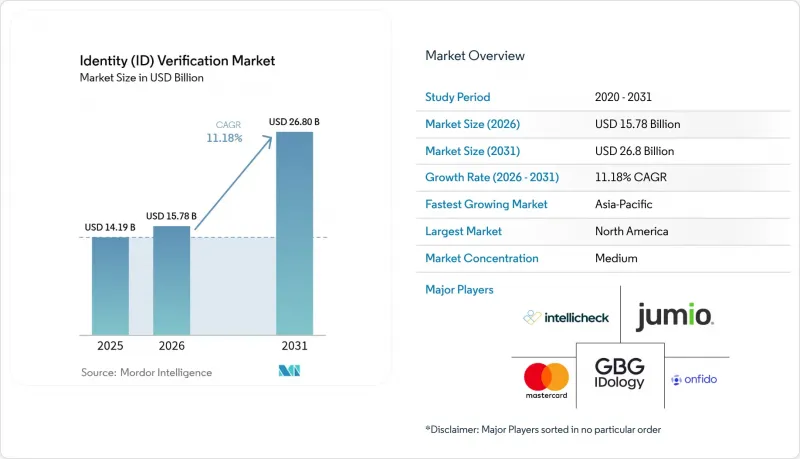
本報告按部署方式(本地部署、雲端部署)、解決方案類型(文件/身份驗證、生物識別等)、最終用戶行業(金融服務業 (BFSI)、零售/電子商務等)、組織規模(大型企業、中小企業 (SME))和地區進行細分。市場預測以美元 (USD) 為單位。
全球身份驗證(ID)市場趨勢與洞察
網路詐騙的增加以及監管機構因此而處以的罰款
預計2024年,詐欺性開戶將佔金融交易總額的2.1%,較兩年前的1.27%大幅增加。據估計,目前已發現的詐欺案件中有42.5%利用了生成式人工智慧技術,迫使銀行實施多層防禦,以即時偵測合成身分和深度造假語音。監管機構的監管力道同樣嚴格。 2023年,全球金融機構因KYC(了解你的客戶)相關罰款支付了66億美元。風險增加和罰款上漲的雙重壓力正迫使買家遷移到企業級編配平台,這些平台將文件取證、生物識別識別和持續行為監控整合到單一API中。
遠端入職和強制性電子身份驗證的激增
亞太地區78%的消費者認為,在使用新的金融應用程式之前,進行數位身分驗證至關重要。監管機構正在將這一趨勢納入法律法規。歐盟強制要求所有成員國在24個月內發行“數位身分錢包”,從而有效地將電子KYC(了解你的客戶)制度化。在美國排名前十的銀行之一實施語音認證後,其他已實現身分驗證自動化的機構發現,其服務台回應時間縮短了45秒。此外,不同供應商之間檢驗憑證的互通性產生了網路效應,將重新處理註冊流程的摩擦減少了一半,並增強了平台的規模經濟效益。
全球監管標準碎片化
KYC(了解你的客戶)法規不僅因國家而異,即使在同一地區,不同銀行監管機構的規定也可能有所不同,這迫使平台運行並行的身份驗證流程和資料居住架構。美國強調資料可攜性,而歐盟的GDPR則提倡在地化,這使得統一的雲端部署變得更加複雜。在亞洲,日本要求獲得金融服務廳(FSA)的許可,而韓國則要求加密貨幣交易所與銀行建立合作關係。合規團隊在應對這種錯綜複雜的局面時,擴張週期會延長,營運成本也會上升。
細分市場分析
到2025年,雲端採用將佔身分驗證市場65.12%的佔有率,年複合成長率達12.72%,因為企業更傾向於使用更靈活的雲端服務而非資本密集伺服器。預計到2031年,與雲端採用相關的身份驗證市場規模將達到187億美元,這反映了數位銀行和零工經濟平台中API的快速普及。持續的模型更新、集中式威脅情報管理和零停機修補程式正在使雲端成為標準架構。只有在法規要求本地資料處理的司法管轄區才需要本地部署環境,但即使在這些司法管轄區,如果服務提供者建立經認證的區域中心,也允許使用雲端服務。
韌性也是推動因素之一。萬事達卡每年分析 1,430 億筆交易,並更新其異常檢測評分程序,為所有租戶帶來即時的收益。雲端集線器還簡化了與檢驗憑證和行動駕駛執照的整合,將專案週期從數月縮短至數週。隨著邊緣資料中心的日益普及,延遲問題也隨之減少,即使是需要亞秒往返時間的生物識別視訊串流,也能實現雲端部署。
預計到2025年,生物識別引擎將佔據身分驗證市場35.84%的佔有率,到2031年將維持12.86%的複合年成長率,超越僅依賴文件的認證方式。到2031年,與生物識別方法相關的身份驗證市場規模預計將超過101億美元,這主要得益於被動式生物識別檢測技術的發展,該技術可在背景影片幀中隱蔽運行。供應商正在將臉部、語音和行為訊號結合,以實現持續身份驗證,從而減少帳戶被盜用的風險。
雖然基於文件的驗證仍將繼續,但預計它將逐漸成為輔助步驟。像 Aware 這樣的供應商正在發布即時合成媒體偵測技術,該技術可以偵測出肉眼無法看到的 GPU 渲染痕跡。已實施多模態生物識別的金融機構報告稱,準確率提高了 250%,這降低了人工審核成本並提高了客戶轉換率。目前,基於知識的問題和靜態資料庫查詢僅限於一些特定應用場景,例如低風險的年齡驗證。
區域分析
由於積極主動的詐欺防範措施和生物識別的早期應用,北美在2025年仍維持著32.43%的身份驗證市場佔有率。在美國,該計畫從2025年5月起在運輸安全管理局(TSA)查核點全面接受移動駕駛執照,這反映了運輸安全局對數位認證的信心。加拿大的開放銀行藍圖正在進一步加速跨平台身分驗證資訊的可攜性。
亞太地區正經歷顯著成長,複合年成長率高達11.52%,這主要得益於新加坡的金融科技沙盒、印度與Aadhaar合作構建的支付基礎設施以及日本金融廳對加密貨幣的監管。自新加坡辦事處成立以來,Trulioo的企業身分驗證率已達到90%,顯示該地區對KYC API的需求十分旺盛。隨著智慧型手機普及率的不斷提高和即時支付方案的擴展,預計亞太地區將在預測期內成為Trulioo最大的增量收入來源。
其他好處:
- Excel格式的市場預測(ME)表
- 3個月的分析師支持
目錄
第1章:引言
- 研究假設和市場定義
- 調查範圍
第2章:調查方法
第3章執行摘要
第4章 市場狀況
- 市場概覽
- 市場促進因素
- 網路詐騙案件的增加以及監管機構因此而增加的罰款。
- 強制性遠端入職和電子身份驗證的激增
- 利用人工智慧提高文件認證的準確性
- 跨境數位身分互通性示範實驗
- 新興市場的金融科技普惠計劃
- 檢驗憑證和 Web3 身分錢包的興起
- 市場限制因素
- 全球監管標準不一致
- 深度造假和生成式人工智慧冒充威脅
- 整合原有核心系統的成本相對較高。
- 限制雲端採用的資料主權障礙
- 供應鏈分析
- 監理情勢
- 技術展望
- 波特五力模型
- 對影響市場的宏觀經濟因素進行評估
第5章 市場規模與成長預測
- 不同的發展
- 現場
- 雲
- 按解決方案類型
- 文件/身份驗證
- 生物識別
- 身份驗證和活體檢測
- 其他
- 按最終用戶行業分類
- 金融服務(BFSI)
- 零售與電子商務
- 政府/公共部門
- 衛生保健
- 通訊/IT
- 其他
- 按組織規模
- 大公司
- 中小企業
- 按地區
- 北美洲
- 美國
- 加拿大
- 墨西哥
- 南美洲
- 巴西
- 阿根廷
- 其他南美國家
- 歐洲
- 德國
- 英國
- 法國
- 義大利
- 西班牙
- 其他歐洲國家
- 亞太地區
- 中國
- 日本
- 印度
- 韓國
- 東南亞
- 其他亞太國家
- 中東和非洲
- 中東
- 沙烏地阿拉伯
- 阿拉伯聯合大公國
- 土耳其
- 其他中東國家
- 非洲
- 南非
- 奈及利亞
- 埃及
- 其他非洲國家
- 中東
- 北美洲
第6章 競爭情勢
- 市場集中度
- 策略趨勢
- 市佔率分析
- 公司簡介
- Mastercard
- Onfido
- GBG(Idology)
- Intellicheck
- Jumio
- Trulioo
- Mitek Systems
- Veriff
- IBM
- AuthenticID
- Experian
- TransUnion
- LexisNexis Risk Solutions
- Pindrop
- ComplyCube
- Nuance Communications
- Thales Group
- IDEMIA
- Okta
- Ping Identity
- Equifax
- NEC Corporation
- Acuant
- Persona
第7章 市場機會與未來展望
According to Mordor Intelligence, the identity verification market size is expected to grow from USD 14.19 billion in 2025 to USD 15.78 billion in 2026 and is forecast to reach USD 26.8 billion by 2031 at 11.18% CAGR over 2026-2031.
This report is Segmented by Deployment (On-Premises, Cloud), Solution Type (Document / ID Verification, Biometric Verification, and More), End User Industry (Financial Services (BFSI), Retail and E-Commerce, and More), Organization Size (Large Enterprises, Small and Medium Enterprises (SMEs)), and by Geography. The Market Forecasts are Provided in Terms of Value (USD).
Global Identity (ID) Verification Market Trends and Insights
Increasing Cyber-Fraud and Regulatory Fines
Fraudulent account openings spiked to 2.1% of financial transactions in 2024, a sharp rise from 1.27% two years earlier.An estimated 42.5% of detected fraud events now leverage generative AI, which forces banks to deploy multi-layer defences that spot synthetic IDs and deepfake voices in real time. Regulators are equally assertive: global institutions paid USD 6.6 billion in KYC-related penalties during 2023. The combined pressure of higher risk and higher fines is pushing buyers toward enterprise-grade orchestration platforms that integrate document forensics, biometric liveness, and continuous behavioural monitoring in a single API.
Surge in Remote Onboarding and e-KYC Mandates
Seventy-eight percent of APAC consumers deem digital identity checks essential before using new financial apps. Regulators are codifying that preference: the EU requires every member state to issue a Digital Identity Wallet within 24 months, effectively institutionalising electronic KYC. Organisations that automate verification cut service-desk handle times by up to 45 seconds, as a top-10 US bank confirmed after rolling out voice authentication. Network effects then arise when verified credentials become transferable across providers, halving repeat onboarding friction and reinforcing platform scale advantages.
Fragmented Global Regulatory Standards
KYC rules vary not only by country but sometimes by banking supervisor inside the same region, forcing platforms to run parallel verification flows and data-residency architectures. The United States stresses portability, whereas EU GDPR pushes localisation, complicating unified cloud deployments. In Asia, Japan insists on FSA licences while South Korea demands bank partnerships for cryptocurrency exchanges. As compliance teams juggle this patchwork, expansion timetables lengthen and operating costs rise.
Other drivers and restraints analyzed in the detailed report include:
- AI-Driven Accuracy Improvements in Document Forensics
- Cross-Border Digital ID Interoperability Pilots
- Deepfake and Generative-AI Spoofing Threats
For complete list of drivers and restraints, kindly check the Table Of Contents.
Segment Analysis
Cloud deployment captured 65.12% identity verification market share in 2025 and is expanding at a 12.72% CAGR as firms prefer elastic consumption to capital-heavy servers. The identity verification market size associated with cloud deployments is projected to reach USD 18.7 billion by 2031, reflecting rapid API adoption among digital banks and gig-economy platforms. Continuous model updates, centralised threat-intel sharing, and zero-downtime patching position cloud as the reference architecture. On-premise remains mandatory only where statutes mandate local data processing, yet even those jurisdictions accept cloud when providers open certified regional centres.
Resilience is another driver. Mastercard analyses 143 billion annual transactions to update anomaly-scoring routines that instantly benefit every tenant. Cloud hubs also simplify integration with verifiable credentials and mobile driver's licenses, cutting project timelines from months to weeks. As edge data centres proliferate, latency concerns fade, allowing cloud adoption even for biometric video streams that demand sub-second round-trip times.
Biometric engines held 35.84% of identity verification market share in 2025 and post a 12.86% CAGR through 2031, outpacing document-only approaches. The identity verification market size tied to biometric modalities is forecast to surpass USD 10.1 billion by 2031, driven by passive liveness that operates invisibly in background video frames. Vendors blend facial, voice, and behavioural signals to deliver continuous authentication, narrowing the attack surface for account takeover.
Document checks will persist yet increasingly act as a secondary step. Providers like Aware release real-time synthetic-media detection that flags GPU-rendered artefacts invisible to the naked eye Aware. Financial institutions deploying multi-modal biometrics report 250% accuracy gains, which lowers manual review cost and boosts customer conversion. Knowledge-based questions and static database lookups now serve niche use cases such as low-risk age gating.
Complete Report Scope:
- By Deployment
- On-premise
- Cloud
- By Solution Type
- Document / ID Verification
- Biometric Verification
- Authentication and Liveness
- Others
- By End-user Industry
- Financial Services (BFSI)
- Retail and E-commerce
- Government and Public Sector
- Healthcare
- Telecom and IT
- Others
- By Organization Size
- Large Enterprises
- Small and Medium Enterprises (SMEs)
- By Geography
- North America
- United States
- Canada
- Mexico
- South America
- Brazil
- Argentina
- Rest of South America
- Europe
- Germany
- United Kingdom
- France
- Italy
- Spain
- Rest of Europe
- Asia-Pacific
- China
- Japan
- India
- South Korea
- Southeast Asia
- Rest of Asia-Pacific
- Middle East and Africa
- Middle East
- Saudi Arabia
- United Arab Emirates
- Turkey
- Rest of Middle East
- Africa
- South Africa
- Nigeria
- Egypt
- Rest of Africa
- Middle East
- North America
Geography Analysis
North America retained 32.43% identity verification market share in 2025, buoyed by aggressive fraud enforcement and early biometric rollouts. The United States plans nationwide mobile driver's license acceptance at TSA checkpoints from May 2025, signalling federal confidence in digital credentials. Canada's open-banking roadmap further accelerates cross-platform identity portability.
Asia-Pacific stands out with 11.52% CAGR, propelled by Singapore's fintech sandbox, India's Aadhaar-linked payment rails, and Japan's FSA crypto rules. Trulioo reached a 90% business-verification rate after opening its Singapore hub, illustrating demand for regional KYC APIs. Rising smartphone penetration and real-time payment schemes make APAC the largest incremental revenue pool over the forecast horizon.
- Mastercard
- Onfido
- GBG (Idology)
- Intellicheck
- Jumio
- Trulioo
- Mitek Systems
- Veriff
- IBM
- AuthenticID
- Experian
- TransUnion
- LexisNexis Risk Solutions
- Pindrop
- ComplyCube
- Nuance Communications
- Thales Group
- IDEMIA
- Okta
- Ping Identity
- Equifax
- NEC Corporation
- Acuant
- Persona
Additional Benefits:
- The market estimate (ME) sheet in Excel format
- 3 months of analyst support
TABLE OF CONTENTS
1 INTRODUCTION
- 1.1 Study Assumptions and Market Definition
- 1.2 Scope of the Study
2 RESEARCH METHODOLOGY
3 EXECUTIVE SUMMARY
4 MARKET LANDSCAPE
- 4.1 Market Overview
- 4.2 Market Drivers
- 4.2.1 Increasing cyber-fraud and regulatory fines
- 4.2.2 Surge in remote onboarding and e-KYC mandates
- 4.2.3 AI-driven accuracy improvements in document forensics
- 4.2.4 Cross-border digital ID interoperability pilots
- 4.2.5 Fintech inclusion programmes in emerging markets
- 4.2.6 Rise of verifiable credentials and Web3 identity wallets
- 4.3 Market Restraints
- 4.3.1 Fragmented global regulatory standards
- 4.3.2 Deepfake and generative-AI spoofing threats
- 4.3.3 High integration cost for legacy core systems
- 4.3.4 Data-sovereignty barriers limiting cloud roll-outs
- 4.4 Supply-Chain Analysis
- 4.5 Regulatory Landscape
- 4.6 Technological Outlook
- 4.7 Porter's Five Forces
- 4.7.1 Bargaining Power of Suppliers
- 4.7.2 Bargaining Power of Buyers
- 4.7.3 Threat of New Entrants
- 4.7.4 Threat of Substitutes
- 4.7.5 Degree of Competition
- 4.8 Assesment of Macroeconomic Factors on the market
5 MARKET SIZE AND GROWTH FORECASTS (VALUE)
- 5.1 By Deployment
- 5.1.1 On-premise
- 5.1.2 Cloud
- 5.2 By Solution Type
- 5.2.1 Document / ID Verification
- 5.2.2 Biometric Verification
- 5.2.3 Authentication and Liveness
- 5.2.4 Others
- 5.3 By End-user Industry
- 5.3.1 Financial Services (BFSI)
- 5.3.2 Retail and E-commerce
- 5.3.3 Government and Public Sector
- 5.3.4 Healthcare
- 5.3.5 Telecom and IT
- 5.3.6 Others
- 5.4 By Organization Size
- 5.4.1 Large Enterprises
- 5.4.2 Small and Medium Enterprises (SMEs)
- 5.5 By Geography
- 5.5.1 North America
- 5.5.1.1 United States
- 5.5.1.2 Canada
- 5.5.1.3 Mexico
- 5.5.2 South America
- 5.5.2.1 Brazil
- 5.5.2.2 Argentina
- 5.5.2.3 Rest of South America
- 5.5.3 Europe
- 5.5.3.1 Germany
- 5.5.3.2 United Kingdom
- 5.5.3.3 France
- 5.5.3.4 Italy
- 5.5.3.5 Spain
- 5.5.3.6 Rest of Europe
- 5.5.4 Asia-Pacific
- 5.5.4.1 China
- 5.5.4.2 Japan
- 5.5.4.3 India
- 5.5.4.4 South Korea
- 5.5.4.5 Southeast Asia
- 5.5.4.6 Rest of Asia-Pacific
- 5.5.5 Middle East and Africa
- 5.5.5.1 Middle East
- 5.5.5.1.1 Saudi Arabia
- 5.5.5.1.2 United Arab Emirates
- 5.5.5.1.3 Turkey
- 5.5.5.1.4 Rest of Middle East
- 5.5.5.2 Africa
- 5.5.5.2.1 South Africa
- 5.5.5.2.2 Nigeria
- 5.5.5.2.3 Egypt
- 5.5.5.2.4 Rest of Africa
- 5.5.5.1 Middle East
- 5.5.1 North America
6 COMPETITIVE LANDSCAPE
- 6.1 Market Concentration
- 6.2 Strategic Moves
- 6.3 Market Share Analysis
- 6.4 Company Profiles (includes Global level Overview, Market level overview, Core Segments, Financials as available, Strategic Information, Market Rank/Share for key companies, Products and Services, and Recent Developments)
- 6.4.1 Mastercard
- 6.4.2 Onfido
- 6.4.3 GBG (Idology)
- 6.4.4 Intellicheck
- 6.4.5 Jumio
- 6.4.6 Trulioo
- 6.4.7 Mitek Systems
- 6.4.8 Veriff
- 6.4.9 IBM
- 6.4.10 AuthenticID
- 6.4.11 Experian
- 6.4.12 TransUnion
- 6.4.13 LexisNexis Risk Solutions
- 6.4.14 Pindrop
- 6.4.15 ComplyCube
- 6.4.16 Nuance Communications
- 6.4.17 Thales Group
- 6.4.18 IDEMIA
- 6.4.19 Okta
- 6.4.20 Ping Identity
- 6.4.21 Equifax
- 6.4.22 NEC Corporation
- 6.4.23 Acuant
- 6.4.24 Persona
7 MARKET OPPORTUNITIES AND FUTURE OUTLOOK
- 7.1 White-space and Unmet-Need Assessment

 2026年全球身分證(ID卡)掛鉤市場報告
 身分驗證市場:2026-2032年全球市場預測(按服務類型、驗證管道、資料類型、用例、產業、部署模式和組織規模分類)
 身分驗證軟體市場規模、佔有率和趨勢分析報告:按組件、部署模式、類型、企業規模、最終用途、地區和細分市場預測(2026-2033 年)
 背景調查:市場佔有率分析、行業趨勢和統計數據、成長預測(2026-2031 年)背景調查軟體:市佔率分析、產業趨勢與統計、成長預測(2026-2031)
 身分驗證解決方案市場預測—全球身分驗證類型、認證方法、階段、用例、最終用戶和地區分析—2034年
 身分驗證市場規模、佔有率、趨勢和預測:按類型、組件、部署模式、組織規模、行業和地區分類,2026-2034 年
 線上背景調查市場:按應用程式和地區分類身份驗證市場:按技術和地區分類通訊身分與認證服務:市場佔有率分析、產業趨勢與統計資料、成長預測(2026-2031 年)