


 |
市場調查報告書
商品編碼
2124009
幾丁聚醣:市場佔有率分析、產業趨勢與統計、成長預測(2026-2031)Chitosan - Market Share Analysis, Industry Trends & Statistics, Growth Forecasts (2026 - 2031) |
||||||

※ 本網頁內容可能與最新版本有所差異。詳細情況請與我們聯繫。
根據 Mordor Intelligence 估計,2026 年幾丁聚醣市值為 63 億美元,預計到 2031 年將達到 113 億美元,在預測期(2026-2031 年)內複合年成長率為 12.38%。
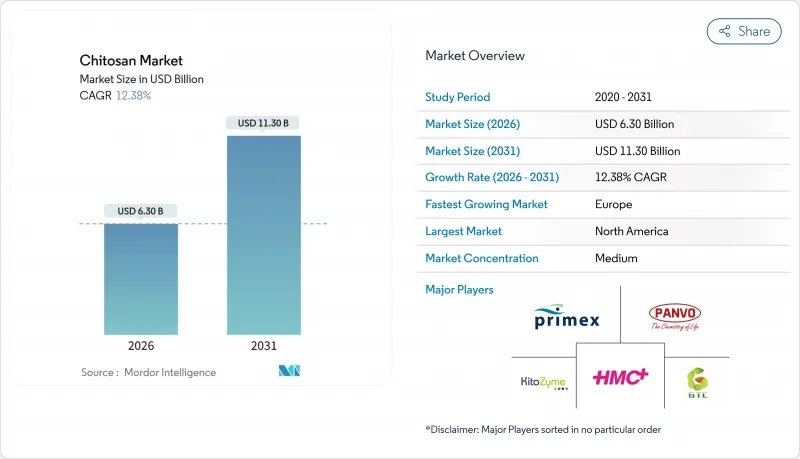
本報告按原料(蝦、蟹等)、等級(工業級、食品級等)、形態(粉末、片狀等)、應用(水處理、化妝品和個人護理等)以及地區(北美、歐洲、亞太、中東和非洲、南美)進行細分。本市場研究報告列出了上述各細分市場的規模(以美元計)。
全球幾丁聚醣市場趨勢與洞察
加強水處理法規
歐盟公共事業部門現在被要求實施針對微量污染物的第四級處理措施,而幾丁聚醣透過同時絮凝膠體和吸附微量有機物,將明礬的使用量減少高達30%。在美國,工業設施面臨40 CFR第125部分關於重金屬排放的更嚴格規定,而幾丁聚醣衍生物可去除93-99%的鐵、銅和鋅,且不會產生有害污泥。在中國,隨著電鍍廢水總鉻排放限值降至0.5 mg/L,浙江和廣東兩省正積極推廣使用幾丁聚醣基凝聚劑。這些監管趨勢正在擴大兼具高性能和生物分解性的高脫幾丁聚醣度殼聚醣的潛在市場。
對可生物分解和環保材料的需求正在迅速成長。
追求無塑膠包裝和可堆肥農業材料的品牌所有者正在指定使用幾丁聚醣薄膜,這種薄膜在工業堆肥條件下60天內可分解80-90%,速度遠快於聚乙烯。歐盟一次性塑膠指令限制了Oxo分解聚合物的使用,促使配方研發人員專注於無殘留幾丁聚醣種子披衣和緩釋肥料。護髮品牌正在利用季幾丁聚醣革新凝膠產品,這種產品無需使用微塑膠即可提供定型效果,並利用其海洋來源的特性在商店中獲得高價。這些趨勢正在改變全球幾丁聚醣市場,使其從單純的合規性轉變為一種行銷優勢,而生物分解性成為關鍵賣點。
過敏原問題限制了這些產品在食品和化妝品領域的推廣。
源自幾丁聚醣的低質量殼聚醣中殘留的蛋白質可能引發對甲殼類過敏人群的IgE反應。因此,歐洲食品安全局(EFSA)推遲發布關於直接接觸食品的聲明,迫使化妝品品牌在其產品上標註「甲殼類動物來源」。雖然源自真菌或昆蟲的幾丁聚醣可能可以避免標註過敏原,但其臨床安全性數據的不完整阻礙了其全面商業化。在風險評估完成之前,大眾市場食品和化妝品配方開發商可能會限制幾丁聚醣的使用,或投資於更高純度的產品,從而減緩短期銷售量。
細分市場分析
預計到2025年,蝦殼將佔全球幾丁聚醣市場產量的45.55%。泰國、越南和印度的成熟物流體系為此提供了支撐,這些國家每年向專用脫乙醯生產線供應150萬噸蝦殼廢棄物。預計螃蟹將以13.25%的複合年成長率推動市場成長,阿拉斯加和北歐的加工商正在加強其蝦殼收集系統,以提高脫乙醯率並降低單位成本。昆蟲外骨骼和真菌生質能正逐漸成為素食、清真和猶太潔食產品的新型原料,但由於基礎設施不完善,提取成本仍高出20-30%。季節性波動持續影響全球幾丁聚醣市場,在厄爾尼諾年份,氣候異常會導致蝦類漁獲量減少,迫使加工業者透過使用甲殼類動物和真菌的混合原料來規避供應風險。雖然魷魚衍生的幾丁聚醣仍然是一種小眾產品,但其透明度和低黏度使其在高級化妝品市場獲得了溢價,這表明海洋衍生成分具有多樣化的潛力。
挪威和加拿大螃蟹基產品產能的擴張得益於政府補貼,這些補貼津貼有效利用冷水漁業廢棄物,從而提高了歐洲買家的供應穩定性,滿足了歐盟綠色交易下對產品可追溯性的要求。亞洲各國政府鼓勵利用食物廢棄物進行昆蟲養殖,也促進了以黑蠅為原料的幾丁聚醣試驗生產工廠的建設,為循環經濟開闢了新的發展道路。目前,昆蟲來源的幾丁聚醣在全球幾丁聚醣市場中所佔佔有率不到2%,但如果生命週期評估(LCA)結果良好,隨著精煉成本的降低,其市場佔有率有望擴大。整體而言,原料多樣化可以降低原料風險,並有助於在易受水產養殖疾病影響的市場中保持價格穩定。
至2025年,工業級幾丁聚醣將佔全球市場佔有率的45.53%,其75-85%的去乙醯化將滿足水處理和紡織等細分市場的需求。同時,隨著臨床證據的不斷累積和軍方對止血敷料的需求增加,預計到2031年,醫藥級和生物醫學級殼聚醣的年複合成長率將超過通用級殼聚醣,達到12.85%。殼聚醣的價格取決於去乙醯化、內毒素含量和分子量範圍,符合GMP標準的批次零售價是工業級的3到10倍。
與幾丁聚醣-膠原蛋白複合物和奈米凝膠基質相關的藥物載體專利支撐了價格穩定,而Primex、Heppe Medical 幾丁聚醣以及少數中國DMF擁有者的寡頭壟斷供應則維持了市場紀律。食品級幾丁聚醣介於工業級和醫用級之間,在美國獲得了「公認安全(GRAS)」認證,但在歐洲仍在等待全面批准。因此,殼聚醣的等級分類較為寬泛,買家並非僅根據數量需求進行分類,而是根據監管風險和利潤率偏好進行分類。
區域分析
預計到2031年,歐洲將呈現最高的成長率,年複合成長率(CAGR)將達到14.51%,主要得益於第四紀污水法規以及幾丁聚醣被歸類為生物促效劑,從而簡化了其在農業中的應用。德國正在資助市政試點項目,以幾丁聚醣取代聚丙烯醯胺;西班牙則在葡萄栽培中引入幾丁聚醣噴霧劑,以減少合成殺菌劑的使用。在英國,幾丁聚醣敷料已在創傷中心實現標準化,這增加了醫院的需求,並進一步鞏固了該地區在醫療應用領域的主導地位。
預計到2025年,北美將佔據全球幾丁聚醣市場佔有率的25.13%,主要得益於美國環保署(EPA)的預處理標準以及幾丁聚醣基止血劑在戰場上的早期應用。儘管隨著水處理設施的建設,市場成長速度將會放緩,但由於吸入級幾丁聚醣已被納入美國藥典(USP)的首個標準,其在製藥領域的應用前景依然十分可觀。加拿大的冷水蟹漁業能夠提供低污染的蟹殼,從而支撐高品質的藥品供應鏈,並增強區域競爭力。
亞太地區是殼聚醣的主要原料供應地,其中泰國、越南和中國每年處理約200萬噸貝殼廢棄物。這些國家對幾丁聚醣的應用程度各不相同。在中國,更嚴格的鉻排放標準促進了殼聚醣在區域內的推廣應用,但執法力度不足阻礙了其在全國的普及。日本利用其獨特的水解技術,專注於生產化妝品級寡糖;而印度的水產養殖基地正在擴大工業級殼聚醣的生產,以出口到世界各地。在中東等新興市場,幾丁聚醣正被測試用作海水淡化的預處理劑;在南美洲,儘管面臨關稅和基礎設施方面的阻力,殼聚醣的應用仍在穩步推進,例如巴西已在有機大豆種植中採用幾丁聚醣基生物農藥。
其他好處:
- Excel格式的市場預測(ME)表
- 3個月的分析師支持
目錄
第1章:引言
- 研究假設和市場定義
- 調查範圍
第2章:調查方法
第3章執行摘要
第4章 市場狀況
- 市場概覽
- 市場促進因素
- 加強水處理法規
- 對可生物分解和環保材料的需求日益成長
- 拓展幾丁聚醣寡糖在生物醫學、化妝品和食品領域的應用。
- 工業污水處理中向生物基凝聚劑的過渡
- 真菌和植物來源的幾丁聚醣在素食和清真/猶太潔食市場的應用。
- 透過循環經濟模式,從水產品和昆蟲產生的廢棄物中創造價值。
- 市場限制因素
- 人們對過敏原的擔憂阻礙了食品和化妝品的廣泛普及。
- 超高純度醫用級幾丁聚醣高成本
- 真菌發酵能力擴充性的局限性
- 氣候相關的甲殼類動物生物量供應波動
- 價值供應鏈分析
- 監理情勢
- 技術展望
- 波特五力模型
第5章 市場規模與成長預測
- 按原料
- 蝦
- 螃蟹
- 烏賊
- 真菌/菌絲體
- 昆蟲外骨骼
- 其他
- 按年級
- 工業級
- 食品級
- 醫藥級和生物醫學級
- 按形式
- 粉末
- 薄片
- 液體
- 奈米/微米顆粒
- 透過使用
- 水處理
- 化妝品和個人護理
- 製藥和生物醫學
- 食品/飲料
- 農業和園藝
- 紡織和印刷
- 其他
- 按地區
- 北美洲
- 美國
- 加拿大
- 墨西哥
- 歐洲
- 德國
- 英國
- 法國
- 義大利
- 西班牙
- 其他歐洲國家
- 亞太地區
- 中國
- 日本
- 印度
- 澳洲
- 韓國
- 其他亞太國家
- 中東和非洲
- GCC
- 南非
- 其他中東和非洲國家
- 南美洲
- 巴西
- 阿根廷
- 其他南美國家
- 北美洲
第6章 競爭情勢
- 市場集中度
- 市佔率分析
- 公司簡介
- Advanced Biopolymers AS
- Bio21 AS
- ChitoTech Co. Ltd
- D'Labs Chemicals Pvt Ltd
- Dainichiseika Color & Chemicals Mfg Co. Ltd
- Golden-Shell Pharmaceutical Co. Ltd
- GTC Bio Corporation
- Heppe Medical Chitosan GmbH
- Japan BioKey Inc.
- KIMICA Corporation
- KitoZyme SA
- Koyo World
- Marsing & Co A/S
- Meron Biopolymers
- Panvo Organics Pvt Ltd
- Primex ehf
- Qingdao Yunzhou Biochemistry Co. Ltd
- Tidal Vision Products Inc.
- Zhejiang Aoxing Biotechnology Co. Ltd
- Zhejiang Golden-Shell Biotechnology Co. Ltd
第7章 市場機會與未來展望
According to Mordor Intelligence, the chitosan market size is estimated at USD 6.30 billion in 2026, and is expected to reach USD 11.30 billion by 2031, at a CAGR of 12.38% during the forecast period (2026-2031).
This report is Segmented by Source (Shrimps, Crabs, and More), Grade (Industrial Grade, Food Grade, and More), Form (Powder, Flake, and More), Application (Water Treatment, Cosmetics and Personal Care, and More), and Geography (North America, Europe, Asia-Pacific, Middle East and Africa, and South America). The Market Research Report Offers the Value (in USD) for the Above Segments.
Global Chitosan Market Trends and Insights
Rising Water-Treatment Regulations
Utilities in the European Union must now install quaternary treatment that targets micropollutants, and chitosan simultaneously coagulates colloids and adsorbs trace organics, reducing alum use by up to 30%. Industrial sites in the United States face stricter 40 CFR Part 125 limits for heavy metals, and chitosan derivatives remove 93-99% of iron, copper and zinc without hazardous sludge. China has cut total chromium limits for electroplating effluent to 0.5 mg L-1, prompting early adoption of chitosan flocculants in Zhejiang and Guangdong. These converging regulations enlarge the addressable market for high-deacetylation chitosan grades that assure both performance and biodegradability.
Surging Demand for Biodegradable and Eco-Friendly Materials
Brand owners pursuing plastic-free packaging and compostable agriculture inputs are specifying chitosan films that degrade 80-90% within 60 days under industrial composting, far faster than polyethylene. The Single-Use Plastics Directive in Europe curbs oxo-degradable polymers, directing formulators toward chitosan seed coatings and controlled-release fertilizers that leave no persistent residue. Hair-care brands are reformulating gels with quaternized chitosan that delivers hold without microplastics, leveraging marine-origin storytelling to command premium shelf pricing. These preferences move the global chitosan market beyond compliance, turning biodegradability into a marketing advantage.
Allergenic Concerns Limiting Food and Cosmetic Uptake
Residual proteins in lower-grade crustacean chitosan can trigger IgE reactions in shellfish-sensitized individuals, leading the European Food Safety Authority to delay opinions on direct food contact and forcing cosmetic brands to label shellfish origin. Fungal and insect chitosan could bypass allergen labeling, but clinical safety dossiers remain incomplete, holding back full-scale commercialization. Until risk assessments conclude, formulators in mass-market foods and cosmetics will limit chitosan inclusion or invest in higher-purity grades, tempering near-term volume growth.
Other drivers and restraints analyzed in the detailed report include:
- Expanding Biomedical, Cosmetics and Food Uses of Chitosan Oligosaccharides
- Shift Toward Bio-Based Flocculants in Industrial Effluents
- High Cost of Ultra-High-Purity Medical-Grade Chitosan
For complete list of drivers and restraints, kindly check the Table Of Contents.
Segment Analysis
Shrimp shells yielded 45.55% of global chitosan market output in 2025, supported by established logistics in Thailand, Vietnam and India that channel 1.5 million t of shell waste into dedicated deacetylation lines. Crabs are forecast to lead growth at a 13.25% CAGR as processors in Alaska and Northern Europe consolidate shell recovery, boosting deacetylation yields and lowering unit costs. Insect exoskeletons and fungal biomass are emerging feedstocks with vegan, Halal and Kosher positioning, yet extraction costs remain 20-30% higher owing to immature infrastructure. Seasonal variability still influences the global chitosan market, as climate anomalies shrink shrimp harvests in El Nino years, prompting processors to hedge supply with mixed crustacean and fungal inputs. Although squid-derived chitosan remains a niche, its clarity and low viscosity command premium pricing in high-end cosmetics, revealing the diversification potential within marine feedstocks.
Crab-based capacity expansions in Norway and Canada are backed by grants that subsidize cold-water fishery waste valorization, reinforcing supply security for European buyers seeking traceability under the EU Green Deal. Asian government incentives for insect farming on food waste are likewise nurturing pilot-scale black soldier fly chitosan plants, opening a circular-economy storyline. While insect chitosan currently represents less than 2% of global chitosan market volume, favorable life-cycle assessments could accelerate its share once purification costs fall. Overall, feedstock diversification limits raw-material risk and supports stable pricing in a market vulnerable to aquaculture disease outbreaks.
Industrial-grade material commanded 45.53% of the global chitosan market size in 2025, filling water-treatment and textile niches where 75-85% deacetylation suffices. Pharmaceutical and biomedical grades, however, will outpace commodity specifications at 12.85% CAGR through 2031 as clinical evidence spreads and military procurement of hemostatic dressings rises. The degree of deacetylation, endotoxin burden and molecular-weight range define price tiers, with Good Manufacturing Practice batches retailing at 3-10 times industrial equivalents.
Drug-carrier patents covering chitosan-collagen composites and nano-gel matrices strengthen price resilience, while oligopolistic supply from Primex, Heppe Medical Chitosan and a few Chinese DMF holders preserves market discipline. Food-grade chitosan, positioned between industrial and medical benchmarks, benefits from Generally Recognized as Safe status in the United States yet awaits full clearance in Europe. As a result, the grade hierarchy widens, segmenting buyers by regulatory exposure and margin appetite rather than sheer volume requirements.
Complete Report Scope:
- By Source
- Shrimps
- Crabs
- Squid
- Fungi / Mycelium
- Insect Exoskeletons
- Others
- By Grade
- Industrial Grade
- Food Grade
- Pharmaceutical & Biomedical Grade
- By Form
- Powder
- Flake
- Liquid
- Nano / Micro Particles
- By Application
- Water Treatment
- Cosmetics & Personal Care
- Pharmaceutical & Biomedical
- Food & Beverage
- Agriculture & Horticulture
- Textile & Printing
- Others
- By Geography
- North America
- United States
- Canada
- Mexico
- Europe
- Germany
- United Kingdom
- France
- Italy
- Spain
- Rest of Europe
- Asia-Pacific
- China
- Japan
- India
- Australia
- South Korea
- Rest of Asia-Pacific
- Middle East & Africa
- GCC
- South Africa
- Rest of Middle East & Africa
- South America
- Brazil
- Argentina
- Rest of South America
- North America
Geography Analysis
Europe will post the strongest 14.51% CAGR through 2031, propelled by quaternary wastewater mandates and the biostimulant classification that simplifies chitosan deployment in farming. Germany funds municipal trials that replace polyacrylamide with chitosan, and Spain deploys chitosan sprays in viticulture to reduce synthetic fungicide load. United Kingdom trauma centers have standardized chitosan dressings, boosting hospital demand and reinforcing the region's leadership in medical applications.
North America captured 25.13% of global chitosan market share in 2025, anchored by EPA pretreatment standards and early battlefield use of chitosan hemostats. Growth moderates as water-treatment installations mature, yet pharmaceutical prospects remain attractive as inhaled-drug-grade chitosan wins its first USP monograph. Canada's cold-water crab fisheries provide low-contaminant shells, supporting premium pharmaceutical supply chains and reinforcing regional competitiveness.
Asia-Pacific supplies most feedstock, processing about 2 million t of shell waste annually in Thailand, Vietnam and China. Domestic chitosan uptake is uneven; China tightened chromium discharge limits, catalyzing localized adoption, but enforcement gaps restrain nationwide penetration. Japan specializes in cosmetic-grade oligosaccharides with proprietary hydrolysis technology, while India's aquaculture hubs expand industrial-grade output for global export. Emerging markets in the Middle East test chitosan as a pretreatment in desalination, and South America inches forward with Brazil deploying chitosan bio-pesticides in organic soy farming amid tariff and infrastructure headwinds.
- Advanced Biopolymers AS
- Bio21 AS
- ChitoTech Co. Ltd
- D'Labs Chemicals Pvt Ltd
- Dainichiseika Color & Chemicals Mfg
- Golden-Shell Pharmaceutical Co. Ltd
- GTC Bio
- Heppe Medical Chitosan
- Japan BioKey Inc.
- KIMICA
- KitoZyme
- Koyo World
- Marsing & Co A/S
- Meron Biopolymers
- Panvo Organics
- Primex ehf
- Qingdao Yunzhou Biochemistry Co. Ltd
- Tidal Vision Products Inc.
- Zhejiang Aoxing Biotechnology Co. Ltd
- Zhejiang Golden-Shell Biotechnology Co. Ltd
Additional Benefits:
- The market estimate (ME) sheet in Excel format
- 3 months of analyst support
TABLE OF CONTENTS
1 Introduction
- 1.1 Study Assumptions & Market Definition
- 1.2 Scope of the Study
2 Research Methodology
3 Executive Summary
4 Market Landscape
- 4.1 Market Overview
- 4.2 Market Drivers
- 4.2.1 Rising water-treatment regulations
- 4.2.2 Surging demand for biodegradable & eco-friendly materials
- 4.2.3 Expanding biomedical, cosmetics & food uses of chitosan oligosaccharides
- 4.2.4 Shift toward bio-based flocculants in industrial effluents
- 4.2.5 Adoption of fungal/plant-based chitosan for vegan & Halal/Kosher markets
- 4.2.6 Circular-economy valorization of seafood & insect waste streams
- 4.3 Market Restraints
- 4.3.1 Allergenic concerns limiting food & cosmetic uptake
- 4.3.2 High cost of ultra-high-purity medical-grade chitosan
- 4.3.3 Limited scalability of fungal fermentation capacity
- 4.3.4 Climate-driven volatility of crustacean biomass supply
- 4.4 Value / Supply-Chain Analysis
- 4.5 Regulatory Landscape
- 4.6 Technological Outlook
- 4.7 Porter's Five Forces
- 4.7.1 Threat of New Entrants
- 4.7.2 Bargaining Power of Buyers/Consumers
- 4.7.3 Bargaining Power of Suppliers
- 4.7.4 Threat of Substitute Products
- 4.7.5 Intensity of Competitive Rivalry
5 Market Size & Growth Forecasts (Value, USD)
- 5.1 By Source
- 5.1.1 Shrimps
- 5.1.2 Crabs
- 5.1.3 Squid
- 5.1.4 Fungi / Mycelium
- 5.1.5 Insect Exoskeletons
- 5.1.6 Others
- 5.2 By Grade
- 5.2.1 Industrial Grade
- 5.2.2 Food Grade
- 5.2.3 Pharmaceutical & Biomedical Grade
- 5.3 By Form
- 5.3.1 Powder
- 5.3.2 Flake
- 5.3.3 Liquid
- 5.3.4 Nano / Micro Particles
- 5.4 By Application
- 5.4.1 Water Treatment
- 5.4.2 Cosmetics & Personal Care
- 5.4.3 Pharmaceutical & Biomedical
- 5.4.4 Food & Beverage
- 5.4.5 Agriculture & Horticulture
- 5.4.6 Textile & Printing
- 5.4.7 Others
- 5.5 By Geography
- 5.5.1 North America
- 5.5.1.1 United States
- 5.5.1.2 Canada
- 5.5.1.3 Mexico
- 5.5.2 Europe
- 5.5.2.1 Germany
- 5.5.2.2 United Kingdom
- 5.5.2.3 France
- 5.5.2.4 Italy
- 5.5.2.5 Spain
- 5.5.2.6 Rest of Europe
- 5.5.3 Asia-Pacific
- 5.5.3.1 China
- 5.5.3.2 Japan
- 5.5.3.3 India
- 5.5.3.4 Australia
- 5.5.3.5 South Korea
- 5.5.3.6 Rest of Asia-Pacific
- 5.5.4 Middle East & Africa
- 5.5.4.1 GCC
- 5.5.4.2 South Africa
- 5.5.4.3 Rest of Middle East & Africa
- 5.5.5 South America
- 5.5.5.1 Brazil
- 5.5.5.2 Argentina
- 5.5.5.3 Rest of South America
- 5.5.1 North America
6 Competitive Landscape
- 6.1 Market Concentration
- 6.2 Market Share Analysis
- 6.3 Company Profiles (includes Global level Overview, Market level overview, Core Segments, Financials as available, Strategic Information, Market Rank/Share for key companies, Products & Services, and Recent Developments)
- 6.3.1 Advanced Biopolymers AS
- 6.3.2 Bio21 AS
- 6.3.3 ChitoTech Co. Ltd
- 6.3.4 D'Labs Chemicals Pvt Ltd
- 6.3.5 Dainichiseika Color & Chemicals Mfg Co. Ltd
- 6.3.6 Golden-Shell Pharmaceutical Co. Ltd
- 6.3.7 GTC Bio Corporation
- 6.3.8 Heppe Medical Chitosan GmbH
- 6.3.9 Japan BioKey Inc.
- 6.3.10 KIMICA Corporation
- 6.3.11 KitoZyme SA
- 6.3.12 Koyo World
- 6.3.13 Marsing & Co A/S
- 6.3.14 Meron Biopolymers
- 6.3.15 Panvo Organics Pvt Ltd
- 6.3.16 Primex ehf
- 6.3.17 Qingdao Yunzhou Biochemistry Co. Ltd
- 6.3.18 Tidal Vision Products Inc.
- 6.3.19 Zhejiang Aoxing Biotechnology Co. Ltd
- 6.3.20 Zhejiang Golden-Shell Biotechnology Co. Ltd
7 Market Opportunities & Future Outlook
- 7.1 White-space & Unmet-Need Assessment

 全球幾丁聚醣市場研究報告(2026版)
 幾丁聚醣市場:2026-2032年全球市場預測(依原料、形態、等級、應用及銷售管道分類)
 幾丁聚醣市場:按應用和地區分類
 全球幾丁聚醣市場規模、佔有率、趨勢和成長分析報告(2026-2034年)
 幾丁聚醣市場規模、佔有率、趨勢及預測(依等級、來源、應用及地區分類),2026-2034年
 2026年全球幾丁聚醣市場報告
 幾丁聚醣市場-全球產業規模、佔有率、趨勢、機會、預測:依原料、應用、區域和競爭格局分類,2021-2031年幾丁質樹脂市場按應用、終端用途產業、等級和形態分類 - 全球預測 2026-2032幾丁質粉市場按應用、終端用戶產業、原料、等級、分子量及粒徑分類-2026-2032年全球預測日本殼聚醣市場報告(按等級、來源、應用和地區分類,2026-2034年)