

 |
市場調查報告書
商品編碼
2124006
學校家具:市場佔有率分析、產業趨勢與統計、成長預測(2026-2031)School Furniture - Market Share Analysis, Industry Trends & Statistics, Growth Forecasts (2026 - 2031) |
||||||

※ 本網頁內容可能與最新版本有所差異。詳細情況請與我們聯繫。
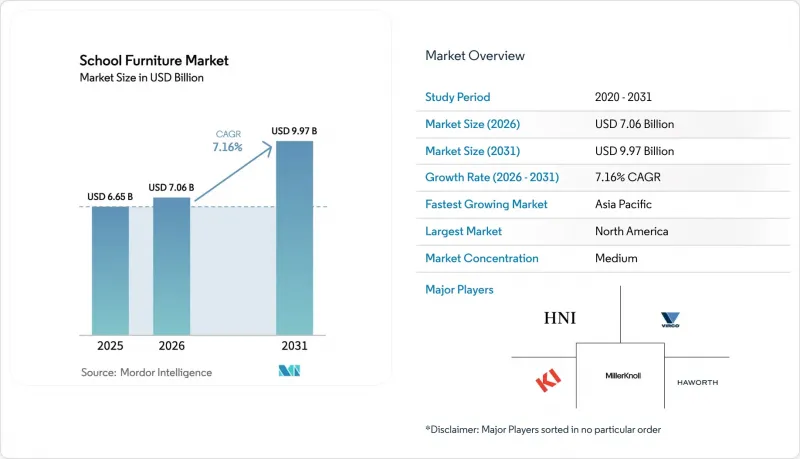
根據 Mordor Intelligence 預測,學校家具市場規模將從 2025 年的 66.5 億美元成長到 2026 年的 70.6 億美元,到 2031 年將達到 99.7 億美元,2026 年至 2031 年的複合年成長率為 7.16%。
本報告按產品(座椅家具、儲物家具、實驗室家具等)、材料(木材、金屬等)、應用(教室、圖書館、實驗室等)、銷售管道(線下、線上)和地區(北美、南美、歐洲、亞太、中東和非洲)進行細分。市場預測以美元計價。
全球學校家具市場趨勢及洞察
靈活的學習方式正在推動對模組化家具的需求。
靈活的、企劃為基礎的教育模式正在改變中小學和高等教育競標中的採購行為,其核心規範包括模組化、無需工具即可重新配置以及高效的儲存設計。教育機構持續與以學習為中心的合作夥伴攜手,在同一面積內設計能夠支持講座、小組討論和混合式教學活動的學習環境,從而增強了學校家具市場的韌性,以滿足管理者對教室柔軟性的需求。標準化機構和採購機構正在透過參考BIFMA X6.1標準來提升教育座椅及相關類別的耐用性和安全性,從而提高公開競標中對性能和使用壽命的預期。 2025年推出的新產品將強調符合人體工學的設計,以適應主動學習的需求,並轉向快速重新配置,包括坐立兩用、嵌套式和移動式配置,旨在實現教學模式之間的快速轉換。高等教育機構中模組化教室的試點實施也促進了這種設計語言向 K-12(幼兒園到高中)的傳播,並支持了學校家具市場向靈活佈局發展的趨勢,這種佈局可以從小學教育擴展到高等教育課程。
透過政府和多邊融資促進基礎設施投資
專項資本項目和多邊融資正在擴大教室容量並實現實驗室現代化。這不僅保證了短期引進週期,也拓寬了多年發展前景。 2025年12月,亞洲開發銀行(亞洲開發銀行)批准了巴基斯坦旁遮普邦三個總額達3.81億美元的項目,旨在實現農業現代化、加強STEM教育和改善醫療保健。這筆資金包括用於氣候適應型低碳農業機械化的優惠貸款和贈款,這將惠及22萬個農村家庭;擴大中等教育的普及範圍;以及透過新建培訓設施、模擬實驗室和數位系統來改革護理人員隊伍,從而提升人力資本和改善民生。世界銀行的「RIGHT+」框架指導教育投資,致力於建立具有韌性、包容性、環境友善、健康且適宜教育的實體學習環境(PLE),強調高品質的學校基礎設施(從教室到設施網路)如何改善學習成果、增強氣候適應能力並有助於縮小全球教育差距。該框架旨在促進策略規劃、安全、永續性、可近性和有效實施,以加強教育系統,尤其是在脆弱地區。
原料價格波動給利潤率和專案可行性帶來了壓力。
原物料價格(例如鋼鐵、木材和樹脂)的波動持續擾亂採購計劃和價格穩定,迫使製造商縮短報價有效期並更頻繁地調整標價。影響軟木材的持續貿易措施增加了跨境供應的不確定性,並使學校家具競標和合約履行中的成本假設變得更加複雜。由於學區通常以多年周期核准資本預算,週期中期的材料附加費可能導致項目範圍的修改和延誤,將交貨推遲到更晚的會計期間,並降低訂單積壓情況的透明度。為此,供應商擴大提供「預生產」和「預定價」計劃,以便在產品配置標準化的同時提前鎖定成本。這有助於在早期資金籌措可行的情況下保護學區的預算。同時,納入公共採購指南的甲醛和排放標準提高了複合木製品的合規標準,增加了材料和測試成本,同時也加強了教育環境中的健康和安全要求。
細分市場分析
到2025年,座椅家具將佔學校家具市場佔有率的48.44%。這主要歸因於所有學習環境(無論年級或用途)對椅子和凳子的高需求。實驗室家具是成長最快的產品系列,預計到2031年將以8.17%的複合年成長率成長。這反映了STEM設施和創客空間專案的穩定擴張,這些設施需要專用工作台、儲物空間以及易於清潔且耐化學腐蝕的表面。製造商正在升級其實驗室解決方案,使其包含內建電源和耐用的桌面,並設計成可重新配置以適應理論與實踐相結合的教學模式,這一趨勢在北美各地的教育展上顯而易見。座椅設計的重點繼續轉向移動式和可堆疊式設計,以支援快速重新配置,同時保持教育特定標準要求的耐用性。隨著越來越多的教育機構將靈活佈局標準化,學校家具市場對無需工具即可組裝且易於存放的座椅的需求不斷成長,這些座椅可以減少重新佈置教室時的空間負擔。
實驗室家具是成長最快的類別,而公共部門對科學教育的投資也推動了這一成長。多邊計畫明確資助需要訂製家具和設備的實驗室維修。在巴基斯坦旁遮普邦,亞洲開發銀行(亞銀)向100所學校提供的貸款確保了教室和實驗室的維修預算,從而增強了該地區對面向科學教育的家具的多年需求。在座椅家具方面,不斷上漲的原料成本和大型專案的折扣持續擠壓利潤空間,促使企業在公開競標條件下改善生產流程並加強產品線管控。各地區的指導方針越來越強調使用可移動儲物櫃和移動白板,而不是固定式櫥櫃,這不僅有利於空間再利用,還能最佳化資金管理,以滿足不斷變化的專案需求。從幼兒園到高中,各教育機構對低排放家具的建議規範日益普及,對認證座椅和表面材料的需求不斷成長,這些因素都推動了學校家具市場供應商之間的差異化。
木材仍然是最大的材料類別,預計到2025年將佔市場佔有率的41.64%。同時,塑膠和聚合物衍生物的年成長率預計到2031年將達到8.38%,這反映了人們對循環材料的最新規範和期望。影響金屬(特別是用於框架和實驗室結構的鋼材衍生物)的政策措施正在推動混合結構的普及,這些結構可以減少金屬的使用,並有助於符合監管要求。家具製造商及其供應商正在投資於循環材料流,強調再生材料的含量和可重複的工藝流程,一些品牌透過閉合迴路項目量化了年度廢棄物再利用量。循環意識設計也影響聚合物座椅的產品線決策,而旗艦產品正轉向使用消費後樹脂,直覺地展現了公共採購中對可回收性的重視。歐洲的永續發展要求,包括數位產品護照和再生材料含量基準值,也鼓勵對教育產品線的材料來源和處置方法進行記錄,以符合機構採購標準。
在木材、金屬和聚合物材料領域,學校家具行業不斷最佳化耐用性、可維護性和易於重新配置的特性,以使教室能夠適應全天不斷變化的課程形式。隨著公共部門對低排放複合木材、板材和桌面產品線的指導方針執行得更加一致和嚴格,這些產品線的設計採用了符合敏感環境中甲醛和揮發性有機化合物 (VOC) 標準的黏合劑和基材。木材和金屬相結合的混合設計以及單一材料聚合物外殼,在確保教室安全始終是採購評估的首要考慮因素方面發揮著至關重要的作用,同時滿足了對生命週期和可回收性的期望。這種端到端透明化的趨勢也體現在可回收性和再利用計畫中,這些計畫重新檢驗了翻新產品的安全性和保固範圍,從而擴大了資本和永續發展規劃中可接受的選擇範圍。在此背景下,學校家具市場受益於那些在設計時充分考慮了易於拆卸、標準化零件和可維護性的產品線,這些產品線旨在保持學習環境的高效性和合規性。
區域分析
到2025年,北美將佔據全球學校家具市場49.37%的佔有率,這主要得益於大規模部署和持續的資本規劃,這些規劃以多年週期性的方式投資於學習環境的升級改造。大規模學區根據長期資本規劃架構採購家具,包括現代化改造和擴容,從而確保在每個規劃期間教育產品的穩定採購。在加拿大各省的預算中,學校基礎設施投資仍然是優先事項,其中不列顛哥倫比亞省制定了針對K-12項目的多年期巨額資金計劃。這些預算撥款重點用於抗震維修、擴容和現代化舉措,預計將透過持續的公開競標和維修項目推動對學校家具的持續需求。針對加拿大鋼鐵衍生性商品的貿易措施持續影響金屬框架產品的採購選擇,凸顯了採購多元化和本地組裝對教育機構客戶的重要性。在美國,採購政策強調健康和永續性標準,鼓勵供應商在競標時提交合規證明。這增強了全部區域K-12採購標準的統一性。
預計到2031年,亞太地區將以9.73%的年均成長率達到最高成長,這主要得益於政府對新建校舍、現代化改造計畫以及教室和實驗室擴建的大量公共投資。在巴基斯坦旁遮普邦,由亞洲開發銀行(亞銀)支持的100所學校的維修項目正在改善教室和實驗室條件,該項目採用大規模標準化採購和系統化的交付計劃。東南亞也是重點關注地區,世界銀行向柬埔寨提供的貸款用於新建900多間教室。這些教室需要配備符合包容性標準和水、環境衛生和個人衛生(WASH)改善要求的家具、教師工作區和學生課桌。亞銀的其他配套項目正在維修職業學校,引入抗災功能和現代化設施,並在安裝階段提供家具和設備。這些項目專注於韌性、健康和包容性設計標準,體現了國際最佳實踐,從而促進了全部區域學校家具市場向通用規範的融合。
在歐洲及其他地區,受政策、永續性法規和教育資產資本化等因素的影響,各種不同的模式正在湧現,這些因素也影響企業制定的多年籌資策略。歐洲買家期望獲得更完善的文件和更高的產品透明度,包括數位化產品護照和報廢處理流程,這提高了市場參與企業標準和供應鏈資訊揭露要求。強調人體工學和學生健康的斯堪地那維亞模式被廣泛引用,並持續影響歐洲各地的規格和供應商產品線。在中東和其他高投資地區,新建校園通常需要符合國際標準的家具和全面的專案管理,因此能夠提供整合交付系統的供應商訂單集中。這些政策和資金籌措環境為專注於教育設施的供應商創造了明確的商機,從而推動了政策主導和成長型地區學校家具市場的發展。
其他好處:
- Excel格式的市場預測(ME)表
- 3個月的分析師支持
目錄
第1章:引言
- 研究假設和市場定義
- 調查範圍
第2章:調查方法
第3章執行摘要
第4章 市場狀況
- 市場概覽
- 市場促進因素
- 靈活的學習方式正在推動對模組化家具的需求。
- 透過政府和多邊融資擴大基礎建設資金的獲取管道
- 人體工學設計和學生福祉正成為採購要求。
- 適用於需要整合電源的家具的數位設備程序
- 與永續性和循環經濟相關的舉措
- 人工智慧與自適應學習技術的融合
- 市場限制因素
- 原料價格波動給利潤率和專案可行性帶來了壓力。
- 貿易壁壘和運輸中斷推高了到貨成本。
- 將預算重新分配給教育科技(Ed-Tech)訂閱和網路連結。
- 教育科技實施所需熟練人員短缺
- 產業價值鏈分析
- 波特五力分析
- 洞察最新市場趨勢與創新
- 洞察近期市場趨勢(新產品發布、策略性舉措、投資、合作、合資、業務擴張、併購等)
第5章 市場規模與成長預測
- 依產品
- 座椅家具
- 儲物家具
- 實驗室家具
- 其他產品(講台、白板、公告板)
- 材料
- 樹
- 金屬
- 塑膠聚合物
- 其他材料
- 透過使用
- 課堂
- 圖書館
- 研究所
- 其他區域(行政/員工休息室、室外/公共區域等)
- 透過分銷管道
- 離線
- 機構投資人直接競標
- 零售商店和專賣店
- 合約家具經銷商
- 線上
- 廠商直銷電子商務
- 第三方市場
- 離線
- 按地區
- 北美洲
- 加拿大
- 美國
- 墨西哥
- 南美洲
- 巴西
- 秘魯
- 智利
- 阿根廷
- 其他南美國家
- 歐洲
- 英國
- 德國
- 法國
- 西班牙
- 義大利
- 比荷盧經濟聯盟(比利時、荷蘭、盧森堡)
- 北歐國家(丹麥、芬蘭、冰島、挪威、瑞典)
- 其他歐洲國家
- 亞太地區
- 印度
- 中國
- 日本
- 澳洲
- 韓國
- 東南亞(新加坡、馬來西亞、泰國、印尼、越南、菲律賓)
- 其他亞太國家
- 中東和非洲
- 阿拉伯聯合大公國
- 沙烏地阿拉伯
- 南非
- 奈及利亞
- 其他中東和非洲國家
- 北美洲
第6章 競爭情勢
- 市場集中度
- 策略趨勢
- 市佔率分析
- 公司簡介
- MillerKnoll Inc.
- HNI Corp.
- Virco Mfg. Corp.
- KI Furniture
- Smith System Mfg. Co.
- Haworth Inc.
- VS America Inc.
- Fleetwood Group
- Paragon Furniture Inc.
- Scholar Craft
- Artcobell Corp.
- Hertz Furniture
- Marco Group Inc.
- Haskell Education
- Godrej Interio
- KOKUYO Co. Ltd.
- Vitra International AG
- Academia Furniture Industries
- Agati Furniture
- British Thornton
- Infiniti Modules
第7章 市場機會與未來展望
According to Mordor Intelligence, the school furniture market size is expected to grow from USD 6.65 billion in 2025 to USD 7.06 billion in 2026 and is forecast to reach USD 9.97 billion by 2031 at 7.16% CAGR over 2026-2031.
This report is Segmented by Product (Seating Furniture, Storage Furniture, Lab Furniture, and More), by Material (Wood, Metal, and More), by Application (Classroom, Library, Laboratories, and More), by Distribution Channel (Offline, and Online), and by Geography (North America, South America, Europe, Asia-Pacific, Middle-East and Africa). The Market Forecasts are Provided in Terms of Value (USD).
Global School Furniture Market Trends and Insights
Flexible Learning Pedagogies Driving Modular Furniture Demand
Flexible, project-based teaching models are reshaping purchasing behavior by elevating modularity, tool-free reconfiguration, and storage-efficient designs as core specifications in K-12 and higher education bids. Institutions continue to engage learning-focused partners to design settings that support lecture, breakout, and hybrid activities in the same footprint, reinforcing the resilience of the school furniture market as administrators seek classroom agility. Standards bodies and procurement agencies reinforce durability and safety by referencing BIFMA X6.1 for educational seating and related categories, raising the threshold for performance and lifecycle expectations in public tenders. Product launches for 2025 underscore the shift toward active-learning ergonomics and rapid reconfiguration, including sit-stand, nesting, and motion-friendly formats designed for quick transitions between teaching modes. Higher education pilots in modular classrooms also reinforce a design language flowing back to K-12, sustaining the school furniture market's orientation toward flexible layouts that scale from primary to advanced programs.
Government and Multilateral Funding Unlocking Infrastructure Capital
Dedicated capital programs and multilateral finance are expanding classroom capacity and modernizing laboratories, which sustain near-term installation cycles and broaden multi-year visibility. The Asian Development Bank (ADB) approved three projects totaling USD 381 million in December 2025 to modernize agriculture, strengthen STEM education, and improve healthcare in Pakistan's Punjab province. The funding includes concessional loans and grants for climate-resilient, low-carbon farm mechanization benefiting 220,000 rural households, expanded secondary education access, and nursing workforce reforms with new training facilities, simulation labs, and digital systems to enhance human capital and livelihoods. The World Bank's RIGHT+ framework guides education investment in resilient, inclusive, green, healthy, and teaching & learning conducive physical learning environments (PLEs), emphasizing how quality school infrastructure from classrooms to networks of facilities boosts learning outcomes, supports climate resilience, and addresses global education gaps. It promotes strategic planning, safety, sustainability, accessibility, and effective implementation to enhance education systems, especially in vulnerable regions.
Raw Material Price Volatility Compressing Margins and Project Feasibility
Fluctuations in the prices of steel, lumber, and resin inputs continue to disrupt procurement planning and pricing stability, prompting manufacturers to shorten quote-validity periods and revise list prices more frequently. Ongoing trade measures affecting softwood lumber add uncertainty to cross-border supply, complicating cost assumptions for school furniture tenders and contract execution. Because school districts typically approve capital budgets on multi-year cycles, mid-cycle material surcharges can trigger scope revisions or project delays, shifting deliveries into later fiscal periods and altering backlog visibility. In response, suppliers increasingly offer pre-build or pre-pricing programs that lock in costs earlier when product configurations are standardized, helping protect district budgets when early funding commitments are feasible. At the same time, formaldehyde and emissions standards embedded in public procurement guidelines raise the compliance baseline for composite wood products, increasing material and testing costs while reinforcing health and safety requirements in educational environments.
Other drivers and restraints analyzed in the detailed report include:
- Ergonomic Design and Student Well-Being Becoming Procurement Mandates
- Digital Device Programs Necessitating Power-Integrated Furniture
- Trade Barriers and Shipping Disruptions Inflating Landed Costs
For complete list of drivers and restraints, kindly check the Table Of Contents.
Segment Analysis
Seating furniture captured 48.44% of the school furniture market share in 2025, as every learning environment requires chairs and stools in large volumes across grades and use cases. Lab furniture is the fastest-growing product group with an 8.17% CAGR through 2031, reflecting a steady expansion of STEM facilities and maker-space programs that require specialized benching, storage, and easy-to-clean, chemical-resistant surfaces. Manufacturers are updating lab solutions to include integrated power and durable tops while enabling reconfiguration to align with blended theory-and-practice formats, a move visible in education-focused showcases across North America. Design emphasis within seating continues to shift toward motion-friendly and nestable formats that support quick transitions, while preserving durability standards set by education-specific protocols. As more institutions standardize on flexible layouts, the school furniture market sees growing demand for tool-free assembly and storage-efficient seating that reduces the space burden when rooms are reconfigured.
The fastest-growing lab category is also lifted by public investment in science education, where multilateral programs explicitly fund laboratory upgrades that require aligned furnishings and fixtures. In Pakistan's Punjab province, ADB financing for 100 schools aligns budgets to both classroom and laboratory upgrades, reinforcing multi-year demand for science-ready furniture at the district scale. Seating remains under margin pressure due to input costs and discounting on large projects, which encourages process improvements and disciplined product line management under public tender conditions. District guidelines increasingly consider movable storage and mobile whiteboards instead of built-in casework, facilitating space repurposing while aligning capital stewardship to evolving program needs. Specification language favoring low-emission furniture has become more common, raising demand for certified seating and surfaces across K-12, which reinforces vendor differentiation in the school furniture market.
Wood remained the largest material category, accounting for 41.64% of the market size in 2025, while plastics and polymer derivatives are on an 8.38% annual growth path through 2031, reflecting updated specifications and circular content expectations. Policy actions affecting metals, especially steel derivatives used in frames and lab structures, are contributing to hybrid constructions that reduce metal tonnage and support compliance. Furniture producers and their suppliers are investing in circular material flows that emphasize recycled content and repeatable processes, with some brands quantifying annual diversion of waste through closed-loop programs. Design for circularity also influences portfolio decisions on polymer-based seating, where product icons have transitioned to post-consumer resins, offering a visible signal of recyclability priorities in public tenders. European sustainability requirements, including digital product passports and recycled content thresholds, are also prompting education-focused portfolios to document material provenance and end-of-life handling, aligning with institutional buying criteria.
Across wood, metal, and polymer families, the school furniture industry continues to optimize for durability, maintenance, and ease of reconfiguration so classrooms can support changing lesson formats throughout the day. As compliance for low-emission composite wood is more consistently enforced in public-sector guidelines, product line engineering for panels and tops incorporates adhesives and substrates that meet formaldehyde and VOC expectations for sensitive environments. Hybrid wood-metal designs and mono-material polymer shells both play roles in addressing lifecycle and recyclability expectations while ensuring classroom safety remains paramount in procurement scoring. The move toward end-to-end transparency is also visible in remanufacture and reuse programs that revalidate product safety and warranty coverage after refurbishment, which broadens acceptable options in capital and sustainability plans. In this context, the school furniture market benefits from product families designed for disassembly, consistent parts, and serviceability that keep learning environments productive and compliant.
Complete Report Scope:
- By Product
- Seating Furniture
- Storage Furniture
- Lab Furniture
- Other Products (Podiums, Whiteboards, Notice Boards)
- By Material
- Wood
- Metal
- Plastic & Polymer
- Other Material
- By Application
- Classroom
- Library
- Laboratories
- Others (Administrative & Faculty Offices, Outdoor & Common Areas, etc.)
- By Distribution Channel
- Offline
- Direct Institutional Tenders
- Retail & Specialist Dealers
- Contract Furniture Dealers
- Online
- Company Direct E-Commerce
- Third-Party Marketplaces
- Offline
- By Geography
- North America
- Canada
- United States
- Mexico
- South America
- Brazil
- Peru
- Chile
- Argentina
- Rest of South America
- Europe
- United Kingdom
- Germany
- France
- Spain
- Italy
- BENELUX (Belgium, Netherlands, and Luxembourg)
- NORDICS (Denmark, Finland, Iceland, Norway, and Sweden)
- Rest of Europe
- Asia-Pacific
- India
- China
- Japan
- Australia
- South Korea
- South East Asia (Singapore, Malaysia, Thailand, Indonesia, Vietnam, and Philippines)
- Rest of Asia-Pacific
- Middle East And Africa
- United Arab of Emirates
- Saudi Arabia
- South Africa
- Nigeria
- Rest of Middle East And Africa
- North America
Geography Analysis
North America accounted for 49.37% of the school furniture market size in 2025, underscoring a large installed base and consistent capital programming that funds learning environment upgrades on multi-year cycles. Large districts align furniture acquisitions to long-range capital frameworks that include modernization and capacity expansions, stabilizing procurement for education-focused products during each plan horizon. Canadian provincial budgets continue to prioritize school infrastructure investment, with British Columbia planning substantial multi-year funding for K-12 projects. These allocations focus on seismic upgrades, capacity expansions, and modernization initiatives, which are expected to translate into sustained demand for school furniture through ongoing public tenders and refurbishment programs. Trade measures in Canada that target steel derivative products continue to reshape sourcing choices for metal-frame items, supporting the case for diversified supply and local assembly for education customers. Procurement policies within the United States emphasize health and sustainability standards and encourage vendors to document compliance at the point of bid, reinforcing consistent criteria for K-12 purchases across the region.
Asia-Pacific is the fastest-growing region at a 9.73% rate through 2031, supported by new school construction, modernization programs, and broad public investment that expands classroom and laboratory capacity. In Pakistan's Punjab province, ADB-backed upgrades to 100 schools include both classroom and laboratory improvements, which support standardized purchases at scale and structured delivery timelines. Southeast Asia is also in focus, where World Bank financing for Cambodia is funding more than 900 new classrooms that will require furnishings, teacher work areas, and student desks aligned to inclusive access and WASH improvements. Complementary ADB programs are upgrading technical schools, including disaster-resilient features and modern facilities that will be furnished and equipped during installation phases. These projects focus on resilience, health, and inclusive design standards that mirror international best practices, which helps the school furniture market converge to common specifications across the region.
Europe and other regions reflect heterogeneous patterns shaped by policy, sustainability rules, and capital availability for education assets, and these factors frame multi-year procurement strategies. European buyers anticipate expanded documentation and product transparency, including digital product passports and end-of-life pathways, raising the bar for market participation and supply chain disclosures. Scandinavian practice is widely cited for ergonomics and student wellness orientation, which continues to influence specifications and supplier portfolios across the continent. In the Middle East and other high-investment geographies, new school campuses often call for international-standard furniture and full-scope project management, which concentrates awards with suppliers able to offer integrated delivery. These policies and capital conditions sustain a focused opportunity set for vendors that specialize in education spaces, thereby supporting the school furniture market across policy-driven and growth-oriented regions.
- MillerKnoll Inc.
- HNI Corp.
- Virco Mfg. Corp.
- KI Furniture
- Smith System Mfg. Co.
- Haworth Inc.
- VS America Inc.
- Fleetwood Group
- Paragon Furniture Inc.
- Scholar Craft
- Artcobell Corp.
- Hertz Furniture
- Marco Group Inc.
- Haskell Education
- Godrej Interio
- KOKUYO Co. Ltd.
- Vitra International AG
- Academia Furniture Industries
- Agati Furniture
- British Thornton
- Infiniti Modules
Additional Benefits:
- The market estimate (ME) sheet in Excel format
- 3 months of analyst support
TABLE OF CONTENTS
1 Introduction
- 1.1 Study Assumptions & Market Definition
- 1.2 Scope of the Study
2 Research Methodology
3 Executive Summary
4 Market Landscape
- 4.1 Market Overview
- 4.2 Market Drivers
- 4.2.1 Flexible Learning Pedagogies Driving Modular Furniture Demand
- 4.2.2 Government and Multilateral Funding Unlocking Infrastructure Capital
- 4.2.3 Ergonomic Design and Student Well-Being Becoming Procurement Mandates
- 4.2.4 Digital Device Programs Necessitating Power-Integrated Furniture
- 4.2.5 Sustainability and Circular-Economy Mandates
- 4.2.6 Integration of AI and Adaptive learning Technologies
- 4.3 Market Restraints
- 4.3.1 Raw Material Price Volatility Compressing Margins and Project Feasibility
- 4.3.2 Trade Barriers and Shipping Disruptions Inflating Landed Costs
- 4.3.3 Budget Reallocation Toward Ed-Tech Subscriptions and Connectivity
- 4.3.4 Limited Skilled Workforce for EdTech Implementation
- 4.4 Industry Value Chain Analysis
- 4.5 Porter's Five Forces Analysis
- 4.5.1 Threat of New Entrants
- 4.5.2 Bargaining Power of Suppliers
- 4.5.3 Bargaining Power of Buyers
- 4.5.4 Threat of Substitutes
- 4.5.5 Competitive Rivalry
- 4.6 Insights into the Latest Trends and Innovations in the Market
- 4.7 Insights on Recent Developments (New Product Launches, Strategic Initiatives, Investments, Partnerships, JVs, Expansion, M&As, etc.) in the Market
5 Market Size & Growth Forecasts (Value)
- 5.1 By Product
- 5.1.1 Seating Furniture
- 5.1.2 Storage Furniture
- 5.1.3 Lab Furniture
- 5.1.4 Other Products (Podiums, Whiteboards, Notice Boards)
- 5.2 By Material
- 5.2.1 Wood
- 5.2.2 Metal
- 5.2.3 Plastic & Polymer
- 5.2.4 Other Material
- 5.3 By Application
- 5.3.1 Classroom
- 5.3.2 Library
- 5.3.3 Laboratories
- 5.3.4 Others (Administrative & Faculty Offices, Outdoor & Common Areas, etc.)
- 5.4 By Distribution Channel
- 5.4.1 Offline
- 5.4.1.1 Direct Institutional Tenders
- 5.4.1.2 Retail & Specialist Dealers
- 5.4.1.3 Contract Furniture Dealers
- 5.4.2 Online
- 5.4.2.1 Company Direct E-Commerce
- 5.4.2.2 Third-Party Marketplaces
- 5.4.1 Offline
- 5.5 By Geography
- 5.5.1 North America
- 5.5.1.1 Canada
- 5.5.1.2 United States
- 5.5.1.3 Mexico
- 5.5.2 South America
- 5.5.2.1 Brazil
- 5.5.2.2 Peru
- 5.5.2.3 Chile
- 5.5.2.4 Argentina
- 5.5.2.5 Rest of South America
- 5.5.3 Europe
- 5.5.3.1 United Kingdom
- 5.5.3.2 Germany
- 5.5.3.3 France
- 5.5.3.4 Spain
- 5.5.3.5 Italy
- 5.5.3.6 BENELUX (Belgium, Netherlands, and Luxembourg)
- 5.5.3.7 NORDICS (Denmark, Finland, Iceland, Norway, and Sweden)
- 5.5.3.8 Rest of Europe
- 5.5.4 Asia-Pacific
- 5.5.4.1 India
- 5.5.4.2 China
- 5.5.4.3 Japan
- 5.5.4.4 Australia
- 5.5.4.5 South Korea
- 5.5.4.6 South East Asia (Singapore, Malaysia, Thailand, Indonesia, Vietnam, and Philippines)
- 5.5.4.7 Rest of Asia-Pacific
- 5.5.5 Middle East And Africa
- 5.5.5.1 United Arab of Emirates
- 5.5.5.2 Saudi Arabia
- 5.5.5.3 South Africa
- 5.5.5.4 Nigeria
- 5.5.5.5 Rest of Middle East And Africa
- 5.5.1 North America
6 Competitive Landscape
- 6.1 Market Concentration
- 6.2 Strategic Moves
- 6.3 Market Share Analysis
- 6.4 Company Profiles (includes Global Level Overview, Market Level Overview, Core Segments, Financials as available, Strategic Information, Market Rank/Share for key companies, Products & Services, and Recent Developments)
- 6.4.1 MillerKnoll Inc.
- 6.4.2 HNI Corp.
- 6.4.3 Virco Mfg. Corp.
- 6.4.4 KI Furniture
- 6.4.5 Smith System Mfg. Co.
- 6.4.6 Haworth Inc.
- 6.4.7 VS America Inc.
- 6.4.8 Fleetwood Group
- 6.4.9 Paragon Furniture Inc.
- 6.4.10 Scholar Craft
- 6.4.11 Artcobell Corp.
- 6.4.12 Hertz Furniture
- 6.4.13 Marco Group Inc.
- 6.4.14 Haskell Education
- 6.4.15 Godrej Interio
- 6.4.16 KOKUYO Co. Ltd.
- 6.4.17 Vitra International AG
- 6.4.18 Academia Furniture Industries
- 6.4.19 Agati Furniture
- 6.4.20 British Thornton
- 6.4.21 Infiniti Modules
7 Market Opportunities & Future Outlook
- 7.1 Platform-Compatible Retrofit & Upgrade Kits
- 7.2 Dealer-Network Gap-Filling & Regional Custom Solutions

 學前玩具市場機會、成長促進因素、產業趨勢分析及2026-2035年預測
 嬰兒汽車安全座椅市場:按產品類型、材質和最終用戶分類,全球預測(2026-2032)
 學校家具市場規模、佔有率、成長及全球產業分析:按類型、應用和地區分類,並預測至2026-2034年
 學校家具市場報告:按產品、材料和地區分類 2026-2034 年
 按所有權、年齡層和地區分類的學前教育市場規模、佔有率和成長分析 - 產業預測(2026-2033 年)
 學校家具市場-全球產業規模、佔有率、趨勢、機會和預測(按產品類型、按應用、按配銷通路、按地區和競爭情況,2020-2030 年預測)