

 |
市場調查報告書
商品編碼
2071201
學前玩具市場機會、成長促進因素、產業趨勢分析及2026-2035年預測Preschool Toys Market Opportunity, Growth Drivers, Industry Trend Analysis, and Forecast 2026 - 2035 |
||||||

全球學前玩具市場預計到 2025 年將達到 253 億美元,年複合成長率為 6.2%,到 2035 年將達到 461 億美元。
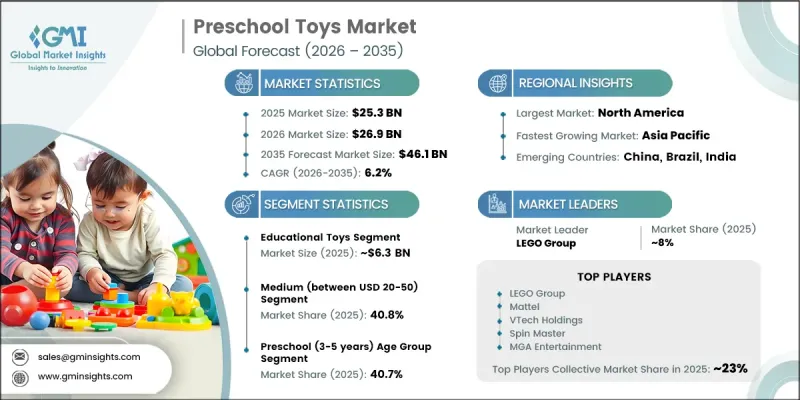
隨著消費者對促進兒童學習和發展的產品的需求不斷成長,市場正在穩步擴張。家長和照顧者越來越傾向於選擇兼具趣味性和教育價值的玩具,這推動了對旨在促進認知、社交和身體發展的創新產品的需求。人們日益認知到早期兒童學習的重要性,從而帶動了對有助於技能發展和適齡學習體驗的產品的消費。永續性也是學前玩具產業的關鍵關注點,製造商正採用環保的生產方法和材料,以滿足不斷變化的消費者期望和監管要求。此外,技術進步正在透過提供更具互動性和沈浸感的遊戲體驗來改變市場。將數位功能融入玩具設計,有助於創造個人化的學習環境,從而增強參與度並促進發展成果。人們對以學習為中心的遊戲理念的興趣日益濃厚,進一步推動了市場成長,因為家庭越來越重視那些能夠培養兒童早期發展中的創造力、批判性思維和基本學習技能的產品。
| 市場範圍 | |
|---|---|
| 開始年份 | 2025 |
| 預測期 | 2026-2035 |
| 起始金額 | 253億美元 |
| 預測金額 | 461億美元 |
| 複合年成長率 | 6.2% |
隨著製造商不斷推出創新產品以滿足不斷變化的消費者期望,學前玩具市場正經歷重大變革。消費者日益重視玩具的教育價值,推動了旨在透過互動遊戲促進學習、同時支持認知、社交和運動技能發展的玩具的研發。環境因素也影響產品開發策略,企業致力於使用永續材料和負責任的生產方式,以吸引具有環保意識的消費者。同時,數位科技的進步提升了產品的功能性,使玩具製造商能夠創造更具吸引力和適應性的體驗,從而支持個人化學習。對旨在培養基礎知識和解決問題能力的玩具的需求不斷成長,持續為全球市場拓展創造機會。
預計到2025年,教育玩具市場規模將達到63億美元,並在2026年至2035年間以6.5%的複合年成長率成長。隨著家長、教育工作者和照顧者越來越重視有助於早期學習和技能發展的產品,教育玩具市場持續成長。教育玩具被廣泛認為是促進智力發展、創造力、溝通能力和全面發展的有效工具,因此在學前玩具領域極具吸引力。人們對早期學習益處的認知不斷提高、教育舉措的不斷拓展以及對遊戲發展體驗重要性的日益重視,進一步鞏固了教育玩具的市場地位。因此,教育玩具仍然是推動整體市場成長的主要動力。
預計到2025年,3至5歲幼兒細分市場將佔據40.7%的市場佔有率,並在2035年之前以6.3%的複合年成長率成長。該細分市場之所以能維持主導的市場佔有率,主要得益於幼兒在這成長發育階段的顯著發展。這個年齡層的兒童熱衷於系統性的遊戲和學習體驗,因此對各類玩具的需求都非常旺盛。早期兒童教育計畫的普及、家庭購買力的提升以及對兒童發展準備的日益重視,都持續支撐著這個市場需求。此外,該年齡層兒童的購買決策往往受到學習目標和發展成果的影響,這進一步鞏固了該細分市場在市場上的主導地位。
美國學前玩具市場預計到2025年將達到50億美元,並在2026年至2035年間以5.6%的複合年成長率成長。這一市場成長的驅動力包括消費者購買力增強、兒童發展意識不斷提高以及玩具製造和零售環境日趨成熟。家長們越來越重視有助於學習、技能發展和教育提升的產品,從而在多個產品類型中創造了穩定的需求。完善的分銷網路、廣泛的零售通路以及不斷擴展的電商通路進一步推動了市場擴張。持續的產品創新和引人注目的玩具理念的推出將支持市場的持續成長,並鞏固美國在北美學前玩具市場的主導地位。
目錄
第1章:調查方法和範圍
第2章執行摘要
第3章 行業洞察
- 產業生態系分析
- 零件供應商
- 原物料供應商
- 玩具製造商
- 銷售代理商和批發商
- 零售通路
- 最終用戶
- 影響產業的因素
- 成長促進因素
- 人們對幼兒教育和認知發展的興趣日益濃厚
- 家長越來越意識到寓教於樂對孩子發展的益處。
- 雙薪家庭增加以及對子女的自由裁量權支出增加。
- 產業潛在風險與挑戰
- 嚴格的安全法規和合規成本
- 合規和測試成本增加
- 機會
- 環保永續的玩具創新
- 個性化和客製化趨勢
- 直接面對消費者(D2C)經營模式
- 成長促進因素
- 技術與創新展望
- 智慧互聯玩具
- STEM與教育科技的融合
- 永續材料創新
- AR/VR在學齡前兒童遊戲的應用
- 價格趨勢
- 按地區
- 依產品類型
- 對過去價格趨勢的分析
- 定價策略:按業務類型分類
- 未來市場趨勢
- 成長潛力分析
- 監理框架
- 美國玩具安全標準
- 歐盟玩具安全法規
- 數位產品護照的要求
- 化學物質法規與合規
- 年齡層別和展示要求
- 貿易統計
- 進出口量及進口額趨勢
- 主要貿易路線及關稅的影響
- 區域貿易平衡分析
- 供應鏈分析
- 全球採購趨勢
- 製造地
- 原物料採購面臨的挑戰
- 物流及配送網路
- 致力於永續發展和符合道德規範的採購
- 人工智慧和生成式人工智慧對市場的影響
- 利用人工智慧改造現有經營模式
- 按細分市場分類的生成式人工智慧用例和部署藍圖
- 風險、限制和監管考量
- 波特的分析
- PESTLE分析
- 消費者購買行為分析
- 人口趨勢
- 影響購買決策的因素
- 消費者產品採納
- 首選分銷管道
- 理想價格範圍
第4章 競爭情勢
- 介紹
- 企業市佔率分析
- 按地區
- 企業矩陣分析
- 主要市場公司的競爭分析
- 競爭定位矩陣
- 主要進展
- 併購
- 夥伴關係和聯盟
- 新產品發布
- 業務拓展計劃
第5章 市場估算與預測:依產品類型分類,2022-2035年
- 教育玩具
- STEM/STEAM玩具
- 謎
- 字母和數字玩具
- 學習平板電腦和電子學習輔助工具
- 組裝和建築玩具
- 建構模組
- 互鎖塊
- 可堆疊玩具
- 磁性組裝套件
- 玩偶和人偶
- 時尚娃娃
- 人物玩偶
- 嬰兒玩偶
- 微縮模型
- 車輛和交通工具玩具
- 乘用車和卡車
- 火車和鐵路套裝
- 搭乘用玩具
- 遙控車
- 藝術與創新玩具
- 繪畫材料
- 手工套裝
- 橡皮泥
- 繪畫和著色套裝
- 戶外和活躍遊戲玩具
- 體育用品
- 遊樂場設備
- 玩水和玩沙
- 平衡車和滑板車
- 其他(布製玩具、填充動物、音樂玩具、樂器等)
第6章 市場估計與預測:依價格區間分類,2022-2035年
- 價格低廉(20 美元以下)
- 中價位(20-50美元)
- 高價位(50美元以上)
第7章 市場估計與預測:依年齡層別分類,2022-2035年
- 幼兒(1-3歲)
- 學齡前兒童(3-5歲)
- 幼兒期(5-7歲)
第8章 市場估算與預測:依材料分類,2022-2035年
- 塑膠
- 傳統塑膠
- 生物基和再生塑膠
- 木製的
- 實木
- 複合板
- FSC認證的永續木材
- 金屬
- 織物
- 其他材質(橡膠、發泡體等)
第9章 市場估計與預測:依最終用途分類,2022-2035年
- 個人
- 教育機構
- 幼稚園及日託中心
- 幼稚園
- 幼兒教育中心
- 特殊教育設施
第10章 市場估價與預測:依通路分類,2022-2035年
- 線上
- 電子商務網站
- 公司網站
- 離線
- 大賣場和超級市場
- 百貨公司
- 專賣店
- 加盟店
- 其他零售店
第11章 市場估價與預測:按地區分類,2022-2035年
- 北美洲
- 美國
- 加拿大
- 歐洲
- 德國
- 英國
- 法國
- 義大利
- 西班牙
- 亞太地區
- 中國
- 印度
- 日本
- 韓國
- 澳洲
- 拉丁美洲
- 巴西
- 墨西哥
- 阿根廷
- 中東和非洲
- 沙烏地阿拉伯
- UAE
- 南非
第12章:公司簡介
- 世界公司
- LEGO Group
- Mattel(Fisher-Price)
- Hasbro
- VTech Holdings
- Spin Master
- MGA Entertainment
- Tomy Company
- 當地公司
- Ravensburger AG
- Simba Dickie Group
- Chicco
- Little Tikes
- Step2 Company
- Schleich
- Jakks Pacific
- 新興企業
- Jazwares, LLC
- PlanToys
- Hape International
- Green Toys
- Plus-Plus
- Learning Resources
- Edushape
- Wonderworld
The Global Preschool Toys Market was valued at USD 25.3 billion in 2025 and is estimated to grow at a CAGR of 6.2% to reach USD 46.1 billion by 2035.
The market is witnessing steady expansion as consumer preferences continue to evolve toward products that support childhood learning and developmental outcomes. Parents and caregivers are increasingly seeking toys that combine engagement with educational value, creating strong demand for innovative products designed to enhance cognitive, social, and physical development. Growing awareness regarding the importance of early childhood learning is encouraging spending on products that contribute to skill development and age-appropriate learning experiences. Sustainability has also become a significant focus area across the preschool toys industry, prompting manufacturers to adopt environmentally responsible production practices and materials that align with evolving consumer expectations and regulatory requirements. In addition, technological advancements are transforming the market by enabling more interactive and immersive play experiences. The integration of digital capabilities into toy design is helping create personalized learning environments that improve engagement and developmental outcomes. Rising interest in learning-focused play concepts is further contributing to market growth as families increasingly prioritize products that support creativity, critical thinking, and foundational learning skills during early childhood development.
| Market Scope | |
|---|---|
| Start Year | 2025 |
| Forecast Year | 2026-2035 |
| Start Value | $25.3 Billion |
| Forecast Value | $46.1 Billion |
| CAGR | 6.2% |
The preschool toys market is undergoing a significant transformation as manufacturers continue to introduce innovative products that align with changing consumer expectations. Increasing emphasis on educational benefits has encouraged the development of toys that promote learning through interactive play while supporting cognitive, social, and motor skill development. Environmental considerations are also influencing product development strategies, with companies focusing on sustainable materials and responsible manufacturing practices to appeal to environmentally conscious consumers. At the same time, advancements in digital technologies are enhancing product functionality, allowing toy manufacturers to create more engaging and adaptive experiences that support personalized learning. Growing demand for toys designed to develop foundational knowledge and problem-solving abilities continues to create opportunities for market expansion across global markets.
The educational toys segment generated USD 6.3 billion in 2025 and is expected to grow at a CAGR of 6.5% between 2026 and 2035. This segment continues to lead the preschool toys market as parents, educators, and caregivers increasingly prioritize products that contribute to early-stage learning and skill development. Educational toys are widely regarded as valuable tools for fostering intellectual growth, creativity, communication abilities, and developmental progress, making them highly attractive within the preschool category. Their strong market position is further supported by increasing awareness of early learning benefits, growing educational initiatives, and broader recognition of the importance of developmental play experiences. As a result, educational toys remain a primary contributor to overall market growth.
The preschool age group segment, covering children between 3 and 5 years of age, accounted for 40.7% share in 2025 and is projected to grow at a CAGR of 6.3% through 2035. This segment maintains a leading market share due to the significant developmental progress that occurs during these formative years. Children within this age range demonstrate greater engagement with structured play activities and learning-oriented experiences, resulting in strong demand across a wide variety of toy categories. Increasing participation in early childhood education programs, rising household spending capacity, and growing emphasis on developmental preparedness continue to support demand. Purchasing decisions for this age group are often influenced by learning objectives and developmental outcomes, reinforcing the segment's dominant position within the market.
United States Preschool Toys Market generated USD 5 billion in 2025 and is anticipated to grow at a CAGR of 5.6% from 2026 to 2035. Market growth in the country is supported by strong consumer purchasing power, heightened awareness regarding childhood development, and a mature toy manufacturing and retail environment. Parents increasingly prioritize products that contribute to learning, skill development, and educational enrichment, creating consistent demand across multiple product categories. A well-established distribution network, extensive retail presence, and growing digital commerce channels further strengthen market expansion. Ongoing product innovation and the introduction of engaging toy concepts continue to support sustained growth and reinforce the country's leadership position within the North American preschool toys market.
Key companies operating in the Global Preschool Toys Market include Hasbro, VTech Holdings, LEGO Group, MGA Entertainment, Mattel (Fisher-Price), Spin Master, Tomy Company, Ravensburger AG, Chicco (Artsana Group), Simba Dickie Group, Step2 Company, Little Tikes, Jakks Pacific, Schleich, Green Toys, Hape International, Learning Resources, PlanToys, Edushape, Plus-Plus, Wonderworld, and Jazwares, LLC. Companies operating in the preschool toys market are focusing on product innovation, educational value enhancement, and sustainability initiatives to strengthen their competitive position. Manufacturers are investing in research and development to create toys that support early learning, cognitive development, and interactive engagement while aligning with evolving consumer preferences. Many companies are incorporating advanced technologies to improve user experiences and differentiate their product offerings. Sustainability has also become a key strategic priority, with businesses adopting environmentally responsible materials and manufacturing processes to meet growing consumer demand for eco-friendly products. In addition, companies are expanding their digital and retail distribution networks to improve accessibility and market reach.
Table of Contents
Chapter 1 Methodology & Scope
- 1.1 Market scope & definitions
- 1.2 Research design
- 1.2.1 Research approach
- 1.2.2 Data collection methods
- 1.3 Base estimates and calculations
- 1.3.1 Base year calculation
- 1.3.2 Market estimates & forecasts parameters
- 1.4 Forecast Model
- 1.4.1 Key trends for market estimates
- 1.4.2 Quantified market impact analysis
- 1.4.2.1 Mathematical impact of growth parameters on forecast
- 1.4.3 Scenario analysis framework
- 1.5 Primary research and validation
- 1.5.1 Some of the primary sources (but not limited to)
- 1.6 Data mining sources
- 1.6.1 Paid Sources
- 1.7 Primary research and validation
- 1.7.1 Primary sources
- 1.8 Research Trail & confidence scoring
- 1.8.1 Research trail components
- 1.8.2 Scoring components
- 1.9 Research transparency addendum
- 1.9.1 Source attribution framework
- 1.9.2 Quality assurance metrics
- 1.9.3 Our commitment to trust
- 1.10 Market Definitions
Chapter 2 Executive Summary
- 2.1 Industry 360° synopsis
- 2.2 Key market trends
- 2.2.1 Region
- 2.2.2 Product type
- 2.2.3 Age group
- 2.2.4 Price
- 2.2.5 Material
- 2.2.6 End use
- 2.2.7 Distribution channel
Chapter 3 Industry Insights
- 3.1 Industry ecosystem analysis
- 3.1.1 Component suppliers
- 3.1.2 Raw material suppliers
- 3.1.3 Toy Manufacturers
- 3.1.4 Distributors & Wholesalers
- 3.1.5 Retail Channels
- 3.1.6 End Users
- 3.2 Industry Impact forces
- 3.2.1 Growth drivers
- 3.2.1.1 Growing emphasis on early childhood education & cognitive development
- 3.2.1.2 Rising parental awareness of developmental benefits from play-based learning
- 3.2.1.3 Increasing dual-income households & discretionary spending on children
- 3.2.2 Industry pitfalls & Challenges
- 3.2.2.1 Stringent safety regulations & compliance costs
- 3.2.2.2 Rising compliance & testing costs
- 3.2.3 Opportunities
- 3.2.3.1 Eco-friendly & sustainable toy innovation
- 3.2.3.2 Personalization & customization trends
- 3.2.3.3 Direct-to-consumer (D2C) business models
- 3.2.1 Growth drivers
- 3.3 Technology and Innovation landscape
- 3.3.1 Smart & connected toys
- 3.3.2 STEM & educational technology integration
- 3.3.3 Sustainable material innovations
- 3.3.4 AR/VR in preschool play
- 3.4 Price trends (driven by primary research)
- 3.4.1 By region
- 3.4.2 By product type
- 3.4.3 Historical price trend analysis
- 3.4.4 Pricing strategy by player type
- 3.5 Future market trends
- 3.6 Growth potential analysis
- 3.7 Regulatory framework
- 3.7.1 U.S. toy safety standards
- 3.7.2 EU toy safety regulation
- 3.7.3 Digital product passport requirements
- 3.7.4 Chemical restrictions & compliance
- 3.7.5 Age grading & labeling requirements
- 3.8 Trade statistics (driven by paid database) (HS Code- 9503)
- 3.8.1 Import/export volume & value trends
- 3.8.2 Key trade corridors & tariff impact
- 3.8.3 Regional trade balance analysis
- 3.9 Supply chain analysis
- 3.9.1 Global sourcing dynamics
- 3.9.2 Manufacturing hubs
- 3.9.3 Material sourcing challenges
- 3.9.4 Logistics & distribution networks
- 3.9.5 Sustainability & ethical sourcing initiatives
- 3.10 Impact of AI & Generative AI on the Market
- 3.10.1 AI-Driven disruption of existing business models
- 3.10.2 GenAI use cases & adoption roadmap by segment
- 3.10.3 Risks, limitations & regulatory considerations
- 3.11 Porter's analysis
- 3.12 PESTEL analysis
- 3.13 Consumer buying behavior analysis
- 3.13.1 Demographic trends
- 3.13.2 Factors affecting buying decisions
- 3.13.3 Consumer product adoption
- 3.13.4 Preferred distribution channel
- 3.13.5 Preferred price range
Chapter 4 Competitive Landscape, 2025
- 4.1 Introduction
- 4.2 Company market share analysis
- 4.2.1 By Region
- 4.2.1.1 North America
- 4.2.1.2 Europe
- 4.2.1.3 Asia Pacific
- 4.2.1.4 Latin America
- 4.2.1.5 Middle East & Africa
- 4.2.1 By Region
- 4.3 Company matrix analysis
- 4.4 Competitive analysis of major market players
- 4.5 Competitive positioning matrix
- 4.6 Key developments
- 4.6.1 Mergers & acquisitions
- 4.6.2 Partnerships & collaborations
- 4.6.3 New product launches
- 4.6.4 Expansion plans
Chapter 5 Market Estimates & Forecast, By Product Type, 2022 - 2035, (USD Billion) (Million Units)
- 5.1 Key trends
- 5.2 Educational toys
- 5.2.1 STEM/STEAM toys
- 5.2.2 Puzzles
- 5.2.3 Alphabet & number toys
- 5.2.4 Learning tablets & electronic learning aids
- 5.3 Building & construction toys
- 5.3.1 Building blocks
- 5.3.2 Interlocking bricks
- 5.3.3 Stacking toys
- 5.3.4 Magnetic building sets
- 5.4 Doll & action figures
- 5.4.1 Fashion dolls
- 5.4.2 Character dolls
- 5.4.3 Baby dolls
- 5.4.4 Miniature figures
- 5.5 Vehicles & transportation toys
- 5.5.1 Cars & trucks
- 5.5.2 Trains & railway sets
- 5.5.3 Ride-on toys
- 5.5.4 Remote-controlled vehicles
- 5.6 Art & creative play toys
- 5.6.1 Art supplies
- 5.6.2 Craft kits
- 5.6.3 Modeling clay & dough
- 5.6.4 Drawing & coloring sets
- 5.7 Outdoor & active play toys
- 5.7.1 Sports equipment
- 5.7.2 Playground equipment
- 5.7.3 Water & sand play
- 5.7.4 Balance bikes & scooters
- 5.8 Others (soft toys & plush, musical toys & instruments, etc.)
Chapter 6 Market Estimates & Forecast, By Price Range, 2022 - 2035, (USD Billion) (Million Units)
- 6.1 Key trends
- 6.2 Low (Below USD 20)
- 6.3 Medium (Between USD 20-50)
- 6.4 High (More than USD 50)
Chapter 7 Market Estimates & Forecast, By Age Group, 2022 - 2035, (USD Billion) (Million Units)
- 7.1 Key trends
- 7.2 Toddler (1-3 years)
- 7.3 Preschool (3-5 years)
- 7.4 Early childhood (5-7 years)
Chapter 8 Market Estimates & Forecast, By Material, 2022 - 2035, (USD Billion) (Million Units)
- 8.1 Key trends
- 8.2 Plastic
- 8.2.1 Traditional plastic
- 8.2.2 Bio-based & recycled plastic
- 8.3 Wooden
- 8.3.1 Solid wood
- 8.3.2 Engineered wood
- 8.3.3 FSC-certified & sustainable wood
- 8.4 Metal
- 8.5 Fabric
- 8.6 Others (rubber, foam, etc.)
Chapter 9 Market Estimates & Forecast, By End Use, 2022 - 2035, (USD Billion) (Million Units)
- 9.1 Key trends
- 9.2 Individual
- 9.3 Educational institutions
- 9.3.1 Preschools & daycare centers
- 9.3.2 Kindergartens
- 9.3.3 Early learning centers
- 9.3.4 Special education facilities
Chapter 10 Market Estimates & Forecast, By Distribution Channel, 2022 - 2035, (USD Billion) (Million Units)
- 10.1 Online
- 10.1.1 E-Commerce website
- 10.1.2 Company owned website
- 10.2 Offline
- 10.2.1 Hypermarket/supermarket
- 10.2.2 Departmental stores
- 10.2.3 Specialized stores
- 10.2.4 Franchised outlets
- 10.2.5 Other retail stores
Chapter 11 Market Estimates & Forecast, By Region, 2022 - 2035, (USD Billion) (Million Units)
- 11.1 Key trends
- 11.2 North America
- 11.2.1 U.S.
- 11.2.2 Canada
- 11.3 Europe
- 11.3.1 Germany
- 11.3.2 UK
- 11.3.3 France
- 11.3.4 Italy
- 11.3.5 Spain
- 11.4 Asia Pacific
- 11.4.1 China
- 11.4.2 India
- 11.4.3 Japan
- 11.4.4 South Korea
- 11.4.5 Australia
- 11.5 Latin America
- 11.5.1 Brazil
- 11.5.2 Mexico
- 11.5.3 Argentina
- 11.6 MEA
- 11.6.1 Saudi Arabia
- 11.6.2 UAE
- 11.6.3 South Africa
Chapter 12 Company Profiles
- 12.1 Global Players
- 12.1.1 LEGO Group
- 12.1.2 Mattel (Fisher-Price)
- 12.1.3 Hasbro
- 12.1.4 VTech Holdings
- 12.1.5 Spin Master
- 12.1.6 MGA Entertainment
- 12.1.7 Tomy Company
- 12.2 Regional Players
- 12.2.1 Ravensburger AG
- 12.2.2 Simba Dickie Group
- 12.2.3 Chicco
- 12.2.4 Little Tikes
- 12.2.5 Step2 Company
- 12.2.6 Schleich
- 12.2.7 Jakks Pacific
- 12.3 Emerging Brands
- 12.3.1 Jazwares, LLC
- 12.3.2 PlanToys
- 12.3.3 Hape International
- 12.3.4 Green Toys
- 12.3.5 Plus-Plus
- 12.3.6 Learning Resources
- 12.3.7 Edushape
- 12.3.8 Wonderworld

 學校家具:市場佔有率分析、產業趨勢與統計、成長預測(2026-2031)
 嬰兒汽車安全座椅市場:按產品類型、材質和最終用戶分類,全球預測(2026-2032)
 學校家具市場規模、佔有率、成長及全球產業分析:按類型、應用和地區分類,並預測至2026-2034年
 學校家具市場報告:按產品、材料和地區分類 2026-2034 年
 按所有權、年齡層和地區分類的學前教育市場規模、佔有率和成長分析 - 產業預測(2026-2033 年)
 學校家具市場-全球產業規模、佔有率、趨勢、機會和預測(按產品類型、按應用、按配銷通路、按地區和競爭情況,2020-2030 年預測)