


 |
市場調查報告書
商品編碼
2124002
鈉離子電池:市場佔有率分析、行業趨勢和統計數據、成長預測(2026-2031 年)Sodium-ion Battery - Market Share Analysis, Industry Trends & Statistics, Growth Forecasts (2026 - 2031) |
||||||

※ 本網頁內容可能與最新版本有所差異。詳細情況請與我們聯繫。
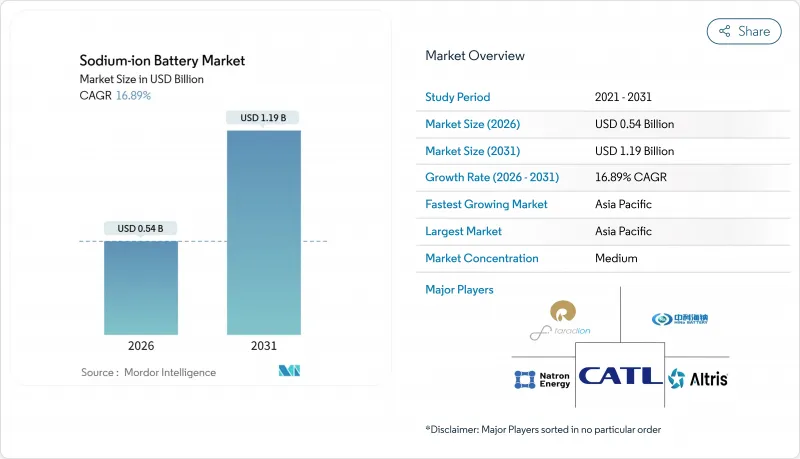
據 Mordor Intelligence 稱,2026 年鈉離子電池市場規模估計為 5.4 億美元,預計到 2031 年將達到 11.9 億美元,在預測期(2026-2031 年)內複合年成長率為 16.89%。
本報告按形狀(圓柱形、矩形、袋式)、應用(固定式儲能、交通運輸、消費電子產品、工業備用電源、船舶等)、最終用戶行業(公共產業、住宅、商業/工業、汽車)和地區(北美、歐洲、亞太地區、南美、中東和非洲)進行分類。
全球鈉離子電池市場趨勢及洞察
中國政府主導的100兆瓦以上併網容量的競標正在加速國內電力需求。
繼北京將鈉離子電池列為儲能「戰略性」技術後,廣西和江蘇兩省的輸電運營商已簽署契約,計劃在2025年前安裝超過100兆瓦時的鈉離子電池。南寧海納電池有限公司安裝的一套100兆瓦時系統,在5000次循環後實現了92%的往返效率,平準化儲能成本(LCOE)低於0.10美元/千瓦時。為了避免電力業者受到碳酸鋰價格波動的影響(2022年碳酸鋰價格飆升至每噸8萬美元),競標流程得到了加速。國內堿灰蘊藏量(每噸300美元)支撐了價格穩定,而國家開發銀行的優惠融資降低了專案資金籌措成本。政策制定者透過確保數吉瓦時的需求,將商業化進程縮短了近兩年。
為了符合歐盟電池法規,歐洲電動車製造商正在其低續航里程車型中改用鈉離子電池。
根據歐盟電池法規,自2027年起,電池製造商必須揭露碳足跡並達到回收材料含量標準,這將迫使他們過渡到不含鈷和鎳的鈉離子電池。 Stellantis和福斯汽車正在對A級和B級車型的鈉離子電池組進行試點測試,並表示與NMC811電芯相比,這些電池可減少35%至40%的碳排放。 Northvolt與Altris合作開發了一款160 Wh/kg的原型電池,並正在其位於斯凱勒夫特的工廠推進用於沃爾沃下一代城市汽車系列的棱柱形電池的量產。除了簡化供應鏈以降低數位化通行證合規成本外,電池製造商還將鈉電池視為應對智利和澳洲鋰出口緊張的風險對沖工具。
- 在長續航力電動車中,能量密度比磷酸鐵鋰電池低 30%。
鈉電池的能量密度為140-160 Wh/kg,比磷酸鐵鋰電池的180-200 Wh/kg低約30%,導致電池組重量增加,使其應用範圍僅限於城市汽車、貨車和固定式應用。特斯拉的目標是到2027年達到4,680個單體電池300 Wh/kg的能量密度,凸顯了鈉電池仍需彌補的差距。在電池系統中,重量增加會導致對佈線和消防設備的需求增加約15%。歐洲汽車製造商將鈉電池組限制在A級車型上,但預計到2025年,A級車型僅佔電動車銷量的12%。銻摻雜陽極在實驗室中展現出良好的前景,但成本仍然過高,難以實用化,而且預計能量密度上限在2031年之前將保持不變。
細分市場分析
預計到2025年,圓柱形電池將佔鈉離子電池市場48.5%的佔有率,主要得益於鋰離子電池繞組線的再利用。軟包電池預計將以22.0%的複合年成長率成長,這主要受汽車製造商對車輛底盤下方空間利用率的追求所驅動。棱柱形模組約佔30%,在兆瓦級專案中佔據主導地位,因為標準化的280Ah模組簡化了機架配置。寧德時代(CATL)的「Naxtra」系列產品同時提供用於家用儲能的18,650圓柱形電池和電動滑板車的軟包電池,展現了其在化學成分方面的柔軟性。
層壓軟包電池使設計人員能夠有效利用A級車不規則的底盤空間,即使是一立方厘米的空間也至關重要。棱柱形電池在中國電網市場的主導地位在於其熱插拔模組,這顯著減少了因現場維護而造成的停機時間。隨著自動化層壓生產線的成熟,圓柱形電池的成本優勢正在減弱。到2031年,隨著汽車產量超過固定式電池,市場偏好可能會趨向於軟包電池和棱柱形電池。
區域分析
預計到2025年,亞太地區將佔據鈉離子電池市場45.6%的佔有率,並將以19.5%的複合年成長率持續成長至2031年。中國吉瓦級工廠和印度摩托車市場的蓬勃發展是推動市場需求成長的主要因素。海納在南寧的100兆瓦時計畫已展現出併網規模的實用性。寧德時代也與江蘇和山東兩省電網簽署了多年購電協議,這兩個省份的新增再生能源佔中國新增可再生能源總量的18%。印度24億美元的獎勵計畫正在加速國內整車製造商與法拉迪安位於賈姆訥格爾的工廠之間的合作,該工廠計劃於2026年投產。日本和韓國正在探索將鈉電池用於船舶輔助電源,而泰國和印尼正在崛起為區域摩托車市場的組裝中心。
預計到2025年,歐洲將佔據約28%的市場佔有率,這主要得益於北歐國家在寒冷氣候下的普及以及政府對住宅儲能系統的補貼。瑞典向Altris公司提供的8000萬瑞典克朗津貼以及挪威每千瓦時5000挪威克朗的補貼,凸顯了政策的力量。德國和法國正在試行使用鈉電池來穩定太陽能發電,以因應2027年碳排放法規的實施。 Northvolt公司正在透過為沃爾沃城市汽車開發棱柱型電池來擴大其國內產能。西班牙和義大利等南歐國家由於依賴進口,初期普及程度有限。
預計到2025年,北美將佔據約18%的市場佔有率,需求主要集中在電力公司的儲能和資料中心的備用電源。 Peak Energy位於科羅拉多的2吉瓦時電廠計劃於2027年運作,但前提是必須向南方公司和杜克能源公司供貨。 Natron位於北卡羅來納州的超級工廠項目在原定於2025年關閉後陷入停滯,造成了供應缺口。美國能源部尚未就《通膨控制法案》下的稅額扣抵資格要求提供指南。加拿大正在亞伯達省的油砂地區試行興建微電網,墨西哥正在評估農村電氣化計畫。南美洲、中東和非洲合計總合佔有率不足9%,其中巴西和南非正在鋰物流成本飆升的地區試行興建微電網。
其他好處:
- Excel格式的市場預測(ME)表
- 3個月的分析師支持
目錄
第1章:引言
- 研究假設和市場定義
- 調查範圍
第2章:調查方法
第3章執行摘要
第4章 市場狀況
- 市場概覽
- 市場促進因素
- 中國政策支持的超過100兆瓦時的併網競標正在加速國內需求。
- 為了符合歐盟電池法規,歐洲電動車製造商正在將其短續航里程車型的電池改為鈉離子電池。
- 由於磷酸鐵鋰電池正極材料成本上漲,每包電池的成本差異已縮小至每千瓦時 70 美元以下。
- Prussian Blue 的技術創新使得印度的摩托車充電時間縮短至 15 分鐘。
- 其在寒冷氣候下的耐寒性能促使北歐國家推出補貼措施,用於扶持住宅儲能系統。
- 寧德時代與電力公司合資的工廠確保了垂直整合的供應鏈。
- 市場限制因素
- - 與長續航力電動車相比,長續航力電動車的能量密度降低了 30%。
- 缺乏標準化的電池管理系統協議正在推高整合成本。
- 一個新興的回收生態系統與歐盟的「電池護照」法規存在衝突。
- 超過 3.7 V 的設計中存在金屬鈉沉積的風險
- 供應鏈分析
- 監理政策前景
- 技術展望
- 波特五力模型
第5章 市場規模與成長預測
- 按形狀
- 圓柱形
- 棱鏡
- 小袋
- 透過使用
- 固定式儲能
- 運輸
- 家用電子產品
- 工業緊急電源
- 船舶和其他
- 按最終用戶行業分類
- 公用事業
- 住宅
- 商業和工業用途
- 車
- 按地區
- 北美洲
- 美國
- 加拿大
- 墨西哥
- 歐洲
- 英國
- 德國
- 法國
- 西班牙
- 北歐國家
- 俄羅斯
- 其他歐洲國家
- 亞太地區
- 中國
- 印度
- 日本
- 韓國
- 東南亞國協
- 其他亞太國家
- 南美洲
- 巴西
- 阿根廷
- 哥倫比亞
- 其他南美國家
- 中東和非洲
- 阿拉伯聯合大公國
- 沙烏地阿拉伯
- 南非
- 其他中東和非洲國家
- 北美洲
第6章 競爭情勢
- 策略趨勢(併購、聯盟、購電協議)
- 市場佔有率分析(主要公司的市場排名和市場佔有率)
- 公司簡介
- Contemporary Amperex Technology Co. Limited(CATL)
- Faradion Ltd
- Natron Energy Inc.
- HiNa Battery Technology Co. Ltd
- Altris AB
- TIAMAT SAS
- AMTE Power PLC
- NGK Insulators Ltd
- BYD Co. Ltd
- Northvolt AB
- Clarios International
- Peak Energy
- Panasonic Energy Co.
- BLUETTI Power Inc.
- North American Battery Systems(NABS)
- Sodium Ion Technologies LLC
第7章 市場機會與未來展望
According to Mordor Intelligence, the sodium-ion battery market size is estimated at USD 0.54 billion in 2026, and is expected to reach USD 1.19 billion by 2031, at a CAGR of 16.89% during the forecast period (2026-2031).
This report is Segmented by Form Factor (Cylindrical, Prismatic, and Pouch), Application (Stationary Energy Storage, Transportation, Consumer Electronics, Industrial Backup Power, and Marine and Others), End-User Industry (Utility, Residential, Commercial and Industrial, and Automotive), and Geography (North America, Europe, Asia-Pacific, South America, and Middle East and Africa).
Global Sodium-ion Battery Market Trends and Insights
China's Policy-Backed 100 + MWh Grid Tenders Accelerate Domestic Demand
Provincial grid operators in Guangxi and Jiangsu awarded more than 100 MWh of sodium-ion contracts during 2025 after Beijing labeled the chemistry "strategic" for energy storage. A 100 MWh system installed by HiNa Battery in Nanning delivered 92% round-trip efficiency across 5,000 cycles and met a levelized cost of storage below USD 0.10 per kWh. Tenders were fast-tracked to cushion utilities from lithium carbonate volatility that spiked to USD 80,000 per tonne in 2022. Domestic soda-ash reserves at USD 300 per tonne underpin price stability, while China Development Bank offers preferential loans that shave project financing costs. By anchoring multi-gigawatt-hour demand, policymakers have shortened commercial ramp-up timelines by close to two years.
European EV OEMs Switching Low-Range Models to Sodium-Ion to Meet EU Battery Regulation
The European Union's Battery Regulation requires carbon-footprint declarations and recycled-content thresholds from 2027, nudging OEMs toward cobalt- and nickel-free sodium recipes. Stellantis and Volkswagen are piloting sodium packs for A- and B-segment cars, citing a 35% to 40% drop in embedded carbon compared with NMC811 cells. Northvolt built a 160 Wh/kg prototype with Altris and is adapting prismatic formats at Skelleftea for Volvo's next city car line. Simpler supply chains reduce digital-passport compliance costs, and OEMs view sodium chemistry as a hedge should lithium exports tighten in Chile or Australia.
-30% Energy-Density Penalty vs. LFP in Long-Range EVs
Sodium cells reach 140-160 Wh/kg, roughly 30% short of LFP's 180-200 Wh/kg, forcing heavier packs and limiting the chemistry to city cars, vans, and stationary roles. Tesla targets 300 Wh/kg by 2027 for its 4680 cell, highlighting the gulf that sodium must close. Heavier racks inflate cabling and fire-suppression needs by about 15% in grid storage. European automakers confine sodium packs to A-segment models that formed just 12% of 2025 EV sales. Antimony-doped anodes show promise in labs but remain cost-prohibitive, keeping density ceilings static through 2031.
Other drivers and restraints analyzed in the detailed report include:
- LFP Cathode Cost Inflation Narrows Pack-Level Cost Gap Below USD 70/kWh
- Prussian-Blue Breakthrough Enables 15-Minute Charge for India Two-Wheelers
- Absence of Standardized BMS Protocols Raises Integration Costs
For complete list of drivers and restraints, kindly check the Table Of Contents.
Segment Analysis
Cylindrical formats held 48.5% of the sodium-ion battery market size in 2025, benefiting from repurposed lithium winding lines. Pouch cells are set for a 22.0% CAGR, propelled by automakers chasing volumetric efficiency under vehicle floors. Prismatic modules, roughly 30%, dominate megawatt-scale projects where standardized 280 Ah blocks simplify racking. CATL's Naxtra range offers both 18650 cylinders for home storage and pouches for scooters, proving chemistry flexibility.
Stacked pouch cells let designers exploit irregular chassis spaces in A-segment cars, a decisive edge where every cubic centimeter counts. Prismatic dominance in China's grid market owes to hot-swappable modules that slash field servicing downtime. Cylindrical cost leadership is fading as automated stacking lines mature; by 2031, market preference may converge on pouch and prismatic as automotive volume overtakes stationary installations.
Complete Report Scope:
- By Form Factor
- Cylindrical
- Prismatic
- Pouch
- By Application
- Stationary Energy Storage
- Transportation
- Consumer Electronics
- Industrial Backup Power
- Marine and Others
- By End-User Industry
- Utility
- Residential
- Commercial and Industrial
- Automotive
- By Geography
- North America
- United States
- Canada
- Mexico
- Europe
- United Kingdom
- Germany
- France
- Spain
- Nordic Countries
- Russia
- Rest of Europe
- Asia-Pacific
- China
- India
- Japan
- South Korea
- ASEAN Countries
- Rest of Asia-Pacific
- South America
- Brazil
- Argentina
- Colombia
- Rest of South America
- Middle East and Africa
- United Arab Emirates
- Saudi Arabia
- South Africa
- Rest of Middle East and Africa
- North America
Geography Analysis
Asia-Pacific controlled 45.6% of the sodium-ion battery market share in 2025 and is forecast to rise at a 19.5% CAGR to 2031. China's gigawatt-hour factories and India's two-wheeler boom underpin demand. HiNa's 100 MWh project in Nanning showcased grid-scale viability, and CATL sealed multi-year offtake deals with Jiangsu and Shandong grids that together host 18% of China's renewables. India's USD 2.4 billion incentive scheme accelerates partnerships between domestic OEMs and Faradion's Jamnagar plant, scheduled for 2026 start-up. Japan and South Korea explore sodium for marine auxiliaries, while Thailand and Indonesia emerge as assembly hubs for regional scooter markets.
Europe captured around 28% share in 2025, led by Nordic cold-climate adoption and residential-storage subsidies. Sweden's SEK 80 million grant to Altris and Norway's NOK 5,000 per kWh rebate highlight policy pull. Germany and France are piloting sodium for solar firming ahead of 2027 carbon footprint rules. Northvolt works on prismatic cells for Volvo's city cars, adding domestic capacity. Southern markets like Spain and Italy depend on imports, limiting early penetration.
North America held a roughly 18% share in 2025, concentrated in utility storage and data-center backup. Peak Energy's 2 GWh Colorado plant aims for 2027 output with Southern Company and Duke Energy offtake. Natron's North Carolina gigafactory plan stalled after its 2025 shutdown, leaving supply gaps. Eligibility for Inflation Reduction Act credits remains pending Department of Energy guidance. Canada pilots mini-grids in Alberta's oil sands, and Mexico assesses rural electrification schemes. South America and the Middle East & Africa combined for under 9%, with Brazil and South Africa testing mini-grids where lithium logistics prove costly.
- Contemporary Amperex Technology Co. Limited (CATL)
- Faradion Ltd
- Natron Energy Inc.
- HiNa Battery Technology Co. Ltd
- Altris AB
- TIAMAT SAS
- AMTE Power PLC
- NGK Insulators Ltd
- BYD Co. Ltd
- Northvolt AB
- Clarios International
- Peak Energy
- Panasonic Energy Co.
- BLUETTI Power Inc.
- North American Battery Systems (NABS)
- Sodium Ion Technologies LLC
Additional Benefits:
- The market estimate (ME) sheet in Excel format
- 3 months of analyst support
TABLE OF CONTENTS
1 Introduction
- 1.1 Study Assumptions & Market Definition
- 1.2 Scope of the Study
2 Research Methodology
3 Executive Summary
4 Market Landscape
- 4.1 Market Overview
- 4.2 Market Drivers
- 4.2.1 China's Policy-Backed 100+ MWh Grid Tenders Accelerate Domestic Demand
- 4.2.2 European EV OEMs Switching Low-Range Models to Sodium-Ion to Meet EU Battery Regulation
- 4.2.3 LFP Cathode Cost Inflation Narrows Pack-Level Cost Gap Below $70/kWh
- 4.2.4 Prussian-Blue Breakthrough Enables 15-min Charge for India Two-Wheelers
- 4.2.5 Cold-Climate Resilience Spurs Nordic Residential Storage Subsidies
- 4.2.6 CATL-Utility Joint-Venture Plants Secure Vertical Supply Chains
- 4.3 Market Restraints
- 4.3.1 -30 % Energy-Density Penalty vs. LFP in Long-Range EVs
- 4.3.2 Absence of Standardised BMS Protocols Raises Integration Costs
- 4.3.3 Nascent Recycling Ecosystem Clashes with EU Battery-Passport Rules
- 4.3.4 Metallic-Sodium Deposition Risks in >3.7 V Designs
- 4.4 Supply-Chain Analysis
- 4.5 Regulatory Policy Outlook
- 4.6 Technological Outlook
- 4.7 Porter's Five Forces
- 4.7.1 Bargaining Power of Suppliers
- 4.7.2 Bargaining Power of Buyers
- 4.7.3 Threat of New Entrants
- 4.7.4 Threat of Substitutes
- 4.7.5 Intensity of Competitive Rivalry
5 Market Size & Growth Forecasts
- 5.1 By Form Factor
- 5.1.1 Cylindrical
- 5.1.2 Prismatic
- 5.1.3 Pouch
- 5.2 By Application
- 5.2.1 Stationary Energy Storage
- 5.2.2 Transportation
- 5.2.3 Consumer Electronics
- 5.2.4 Industrial Backup Power
- 5.2.5 Marine and Others
- 5.3 By End-User Industry
- 5.3.1 Utility
- 5.3.2 Residential
- 5.3.3 Commercial and Industrial
- 5.3.4 Automotive
- 5.4 By Geography
- 5.4.1 North America
- 5.4.1.1 United States
- 5.4.1.2 Canada
- 5.4.1.3 Mexico
- 5.4.2 Europe
- 5.4.2.1 United Kingdom
- 5.4.2.2 Germany
- 5.4.2.3 France
- 5.4.2.4 Spain
- 5.4.2.5 Nordic Countries
- 5.4.2.6 Russia
- 5.4.2.7 Rest of Europe
- 5.4.3 Asia-Pacific
- 5.4.3.1 China
- 5.4.3.2 India
- 5.4.3.3 Japan
- 5.4.3.4 South Korea
- 5.4.3.5 ASEAN Countries
- 5.4.3.6 Rest of Asia-Pacific
- 5.4.4 South America
- 5.4.4.1 Brazil
- 5.4.4.2 Argentina
- 5.4.4.3 Colombia
- 5.4.4.4 Rest of South America
- 5.4.5 Middle East and Africa
- 5.4.5.1 United Arab Emirates
- 5.4.5.2 Saudi Arabia
- 5.4.5.3 South Africa
- 5.4.5.4 Rest of Middle East and Africa
- 5.4.1 North America
6 Competitive Landscape
- 6.1 Strategic Moves (M&A, Partnerships, PPAs)
- 6.2 Market Share Analysis (Market Rank/Share for key companies)
- 6.3 Company Profiles (includes Global level Overview, Market level overview, Core Segments, Financials as available, Strategic Information, Products & Services, and Recent Developments)
- 6.3.1 Contemporary Amperex Technology Co. Limited (CATL)
- 6.3.2 Faradion Ltd
- 6.3.3 Natron Energy Inc.
- 6.3.4 HiNa Battery Technology Co. Ltd
- 6.3.5 Altris AB
- 6.3.6 TIAMAT SAS
- 6.3.7 AMTE Power PLC
- 6.3.8 NGK Insulators Ltd
- 6.3.9 BYD Co. Ltd
- 6.3.10 Northvolt AB
- 6.3.11 Clarios International
- 6.3.12 Peak Energy
- 6.3.13 Panasonic Energy Co.
- 6.3.14 BLUETTI Power Inc.
- 6.3.15 North American Battery Systems (NABS)
- 6.3.16 Sodium Ion Technologies LLC
7 Market Opportunities & Future Outlook
- 7.1 White-space & Unmet-Need Assessment

 模組化鈉離子電池組市場分析及預測(至2035年):類型、產品、技術、組件、應用、材料類型、最終用戶、功能、安裝配置
 鈉離子電池市場:預測(至 2034 年)—按電池類型、陰極材料、電解類型、電池形狀、最終用戶和地區進行全球分析。
 鈉離子電池材料市場規模、佔有率、成長、全球產業分析、區域趨勢及2026年至2034年預測。
 公用事業規模鈉離子能源儲存系統系統市場機會、成長促進因素、產業趨勢分析及2026-2035年預測
 全球鈉離子電池市場:機會與策略展望(至2035年)鈉離子電池市場預測至 2034 年—按電池類型、組件、電池容量、技術、應用、最終用戶和地區進行全球分析。
 全球鈉離子電池市場(至2040年):按電池類型、技術、應用、終端用戶產業、地區和主要企業分類
 鈉離子電池市場:2026-2032 年全球市場預測,按類型、技術、電池容量、組件、電池設計、負極材料、正極材料、電解液類型、應用和銷售管道。
 鈉離子電池市場:按類型、應用、最終用戶和地區分類突破性創新推動鈉離子電池的商業化